Archives For November 30, 1999

Trump-religious-liberty-EO

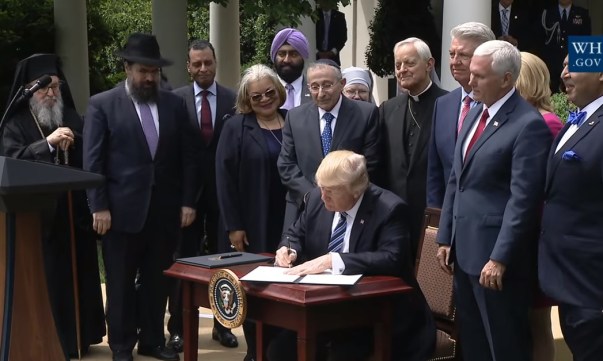
President Donald Trump signed an executive order to protect faith beliefs and practice in a ceremony May 4. Screen capture from WhiteHouse.gov. Courtesy Baptist Press

On May 4 – The National Day of Prayer – President Donald Trump, signed an executive order promising to provide churches, non-profit organizations, and Christian-owned business greater religious liberty. Reaction among Christians, especially evangelicals has been mixed. Here’s a round-up of some of those reactions:

Baptists cautious on Trump executive order
Russell Moore, president of the Southern Baptist Ethics & Religious Liberty Commission, said, “After years of open hostility toward religious institutions and conscience from the previous administration, this executive order is a welcome change in direction toward people of faith from the White House. Not only that, but many federal agencies are working already to ensure that the executive and administrative violations of religious freedom from the Obama administration are being rolled back.” Read more from Moore and other Southern Baptists.

Concern Trump’s order doesn’t address key issues
Some evangelical voices, like Ryan Anderson of the Heritage Foundation; David French, a lawyer and writer at National Review; and Gregory Baylor with Alliance Defending Freedom had critical words for the president’s religious liberty executive order. They called the order woefully inadequate, weak, and a promise unfulfilled.

What Trump understands about religious liberty in America
There is a war on religious liberty in America – and this war is targeting people of the Christian faith. An Army of militant atheists and LGBT activists are hell-bent on eradicating Christianity from the public marketplace and punishing Christians who follow the teachings of Christ. That’s why President Trump signed an executive order on religious liberty Thursday in the Rose Garden – to protect Americans who have been targeted by a politically correct lynch mob.

Reaction mixed on order targeting birth control, churches, politics
Trump’s executive order targeted the Johnson Amendment, a provision of tax law which prohibits churches from getting directly involved in political campaigns. But it stopped short of his vow to “totally destroy” the amendment, instead instructing the Internal Revenue Service to enforce the law consistent with how it’s done so in the past — allowing speech on political and moral issues as long as it doesn’t advocate the election or defeat of a particular candidate.

Analysis: Trump order unlikely to alter sermonizing
Many Americans want religious leaders to be clear about their values and how those values impact every aspect of life, including politics. And they want churches to be free to practice their faith, which includes discussing politics without any government intervention. But few want their preacher’s advice on which candidate to vote for.

Sources: Baptist Press, World Magazine, Fox News, USA Today, Baptist Press

Michael Allen

In a complete revamp from any year in memory, the 2017 Southern Baptist Pastors’ Conference features pastors of average-sized SBC churches who will preach through one book of the Bible—Paul’s letter to the Philippians.

Michael Allen, pastor of Uptown Baptist Church in Chicago and a former president of IBSA’s Pastors’ Conference, is one of 12 pastors who will take the stage in Phoenix June 11-12. The group also includes David Choi, pastor of Chicago’s Church of the Beloved.

Allen spoke with the Illinois Baptist about his upcoming message and what pastors like him contribute to the SBC family:

Q: What passage will you preach in Phoenix?

A: I’ll be preaching Philippians 3:17-21. This passage gives us a reminder of our citizenship in heaven, and helps the church distinguish itself from the world in how we think, act, and live. And then it also reminds us that it is the resurrection power of Christ that changes us both inside and out.

Q: What do you think is unique about what smaller or average-sized churches (and their pastors) add to SBC life?

A: The conference choice of pastors who lead small and medium-sized churches helps the conference attendees better identify and relate to guys just like them. We know that most churches in America, regardless of denomination, are small (less than 100). It also highlights the fact that pastors of smaller churches can effectively handle the Word of God, even in big venues. The Scriptures remind us not to “despise small beginnings” (Zech. 4:10).

Q: The conference this year also is focused on diversity. In your opinion, what is the value of hearing from pastors of different ethnicities and backgrounds?

A: We all have a unique cultural background which colors how we see and experience life. Culture also is a lens through which we see and interpret God’s Word and God himself. So hearing from ethnically diverse preachers in our convention enriches us all, because God made us different and his intentions are that we learn from and complement each other.

Q: You represent both the Midwest and one of the country’s largest cities. What about your ministry experience in Chicago do you want the larger SBC family to hear and understand?

A: The SBC family needs to understand that the world continues to move into ever-growing metropolitan cities, making them more and more diverse—ethnically, socio-economically, religiously, and every other measurement of diversity. Therefore, we have a great opportunity to win the world to Christ without ever boarding a plane.

At the same time [increasing diversity] makes ministry more complex, and more resources are needed to do ministry here. Whatever strategy the International Mission Board is using to reach the world for Christ can and should be prayerfully considered to be employed in America’s rich and diverse urban centers. IMB and the North American Mission Board ought to continue to seek ways they can collaborate with each other for the glory of God in the salvation of souls.

The primary group of preachers at the Pastors’ Conference will be joined by four pastors who will give testimonies of how their lives and ministries have benefited from smaller membership churches:

  • SBC President Steve Gaines, pastor of Bellevue Baptist Church, Memphis
  • J.D. Greear, pastor of The Summit Church, Raleigh-Durham, N.C.
  • Johnny Hunt, pastor of First Baptist Church, Woodstock, Ga., and former SBC president
  • Fred Luter, pastor of Franklin Avenue Baptist Church, New Orleans, and former SBC president

For more information on the Pastors’ Conference, including a full schedule, go to sbcannualmeeting.net.

The Briefing

Christian nation no more?
Most Americans do not believe America is a Christian nation today, even if many say it was in the past. About one-third (35%) of the American public believes the U.S. was a Christian nation in the past and is still a Christian nation today; close to half (45%) say the U.S. was once a Christian nation but no longer remains so; and 14% say the U.S. has never been a Christian nation.

SWBTS apologizes for photo
Paige Patterson, the president of Southwestern Baptist Theological Seminary, apologized for a photo of white professors posing as rappers that appeared on Twitter and was instantly deemed racist. The photo featured senior School of Preaching faculty members gesturing and wearing bandannas and chains and was labeled “Notorious S.O.P.” One of them appears to hold a handgun.

Cedarville’s Philippians 4:8 rule
This spring, Cedarville University enacted new curriculum guidelines inspired by Philippians 4:8 and aimed at purifying coursework of erotic and graphic content. The university has spelled out new guidelines officially barring any materials that “may be considered ‘adult’ in nature, that represent immorality, or that may be a stumbling block to students.”

Religious freedom dying in Russia
Russia’s nationwide outlaw of Jehovah’s Witnesses will likely ricochet and strike other religions outside of Russian Orthodoxy there, said Donald Ossewaarde, an independent Baptist missionary forced to shut down his church in that country. He has exhausted his appeals on an August 2016 conviction of operating a church without a permit under the 2016 anti-religion Yarovaya Law. Ossewaarde, who is making plans to return May 8 to his home in Elgin, Ill., said every religion outside Russian Orthodoxy is considered a cult.

Students: Biblical views on sex ‘unChrist-like’
A student club at Seattle Pacific University recently protested against the Christian university because it adheres to biblical views on human sexuality and gender identity.  The club, called SPU Haven, which advocates for gay students, claims that the university’s “Statement on Human Sexuality” is “unethical, unscientific and unChrist-like,” according to College Fix.

Sources: Facts and Trends, Religion News, Christianity Today, Baptist Press, The Christian Post

Nate Adams IBSA exterior

Nate Adams

In just a few weeks, thousands of church messengers will gather in Phoenix for the annual Southern Baptist Convention and its many related events and opportunities. Last year’s St. Louis convention drew 533 messengers from Illinois, our state’s largest representation since 2002. Only host state Missouri and nearby Tennessee sent more messengers, and I believe Illinois Baptists’ strong showing gave us a stronger than usual voice in the national convention.

It would be great to have as many Illinois messengers as possible in Phoenix, but if history is any indicator, distance and travel expense will reduce our numbers significantly. Even if you can’t travel that far west this year, let me share a couple of ways you can stay engaged with the larger SBC from right here in Illinois.

First, the convention itself and some related events will be live streamed via the Internet, providing a front row seat from your computer screen. Our IBSA communications staff will also be there, uploading the latest happenings to IBSA.org and giving you an Illinois perspective on news coming out of the convention.

You and your church can also participate in the evangelistic efforts that surround this year’s Southern Baptist Convention, and in a way that reaches out not only to Phoenix, but to your community as well. This year the SBC is partnering with evangelist Greg Laurie to bring the Harvest America Crusade to the University of Phoenix Stadium on Sunday evening, June 11.

In Phoenix or from Illinois, you can help share the gospel with half a million people.

While an estimated 65,000 people will gather in the stadium that night, the Harvest Crusade hopes to invite as many as 500,000 viewers through multiple simulcast locations, such as our churches and homes right here in Illinois. In a similar Harvest America Crusade in Texas last year, more than 24,000 people made professions of faith in Christ, many of them at the remote simulcast sites.

Might this Harvest America Crusade be something that your church would consider hosting on June 11, as a way of inviting your community to hear the gospel message, and participate in potentially one of the largest evangelistic events in American history? Or perhaps you would consider hosting a small group in your home, and using it as a conversation starter with friends for whom you have been praying.

Pat Pajak, IBSA’s associate executive director of evangelism, is already in communication with dozens of pastors and evangelism leaders across Illinois, asking them to consider hosting a simulcast location. If you would like information on being a host site on June 11, you can contact Pat directly at PatPajak@IBSA.org or (217) 391-3129.

It’s amazing to me that technology and a little planning and cooperation among Christians and churches can make it possible for a half million people to hear the gospel message at the same time. It also reminds me that we could do so much more to spread the good news about Jesus if we would leverage these same things more consistently in our churches.

For example, does your church have young people that could help you use social media more effectively in reaching your community, and beyond? Are there tech-savvy folks sitting in the back rows of your auditorium that could be invited to the front rows of service?

We can stay here in Illinois and yet engage the larger Baptist family as it gathers in Phoenix. We can stay in our churches or homes and yet be part of sharing the gospel with a half million people at once. And we can stay at our computer screens and help our church reach people in new ways through technology. Aren’t these amazing days, when God has given us the ability to go, even when we stay?

Nate Adams is executive director of the Illinois Baptist State Association. Respond at IllinoisBaptist@IBSA.org.

Exterior of a building with Education engraved in stone

I hadn’t intended college to be a particularly eye-opening experience. I was excited about my newfound freedom and interesting classes and those deep friendships everyone always talked about, but I was going someplace where I thought all those things would happen in the context of familiarity. My Southern Baptist college had felt like home during my first on-campus visit—that was what drew me there in the first place.

But at the start of my second semester, I sat with my Bible on the roof of the gymnasium (where the serious scholars went to study all night), wondering whether the loneliness and uncertainty I felt meant I had made the wrong decision in coming to a place six hours from home. Those good college things—the classes and the friends and the football games and the freedom—had all happened. But instead of feeling fulfilled, I was left with a bigger question, one that I now know most people that age, particularly younger Christians, probably face at one time or another: Who am I going to be?

I met people my own age who pushed me to a deeper investigation of what it means to be a Christian, no matter what job I would eventually choose.

A few years later when I graduated, I was glad I had been at that small college six hours from home as I tried to answer that big question. Because it was there that I found people with the knowledge, experience, and empathy to help young people navigate that tricky territory between the familiar and the future. Here are three things I still value about my Christian college experience:

1. A deeper faith identity. Raised in a minister’s home, I thought I had Christianity figured out (and, at 18, probably most everything else too). That’s why it was surprising, then convicting, to find other people my age who knew much more and felt much more about the call of Jesus on their lives than I did. And these weren’t just the kids that had committed to career ministry or missions—these were everyday students studying to be dentists, attorneys, and counselors. But they seemed to understand that the responsibility of a Christian to be, well, a Christian, extended far beyond one’s future vocation. They lived their faith in a way I wanted to, and their example pushed me to a deeper investigation of what it meant to be actually be a believer in Christ, no matter what job I would eventually choose.

2. Challenging, trustworthy professors. My first class on my first day of college was Old Testament Survey, taught by a young professor who would present four or five different theories about a difficult text and then say something like: “That’s what some people think. Here’s what I think.” Usually, his opinion was similar to one that he had presented. But by giving us the breadth of knowledge on a particular topic, he showed us young Bible scholars that it’s OK to wrestle with Scripture. At the same time, his daily, trustworthy counsel through the Bible gave us an anchor to come back to amid the multiple interpretations offered by the outside world.

3. Unrequired opportunities. Like many high school youth group kids, I started going to church because my parents drove me there, and I kept going because I had always gone. But in college, I didn’t have to be anywhere. Tuesday night Bible study wasn’t a necessity; neither was a Saturday mission project in our neighboring city. Learning to commit to things that weren’t required drove me to deeper discipline about how I spent my energy and time. The ministry activities that are most valuable, I learned in college, are the ones that root themselves in your mind and heart so that you are compelled to take part, even if no one would miss you if you weren’t there.

After I graduated, I moved to the Midwest to attend graduate school at a large state university. It was certainly different than where I had been. And that’s one more reason I’m grateful for my college experience: The foundation that God, through wise professors and leaders, had begun to lay for me carried me through the challenges of a truly unfamiliar place. And has continued to do so, all these years later.

– Meredith Flynn

The Briefing

W.V. Bible class faces legal challenge
For decades Mercer County’s public schools have offered a weekly Bible class during the school day — 30 minutes at the elementary level and 45 minutes in middle school. The program is not mandatory, but almost every child in the district attends. And there is widespread support for the classes: Parents and community members help raise nearly $500,000 a year to pay for the Bible in the Schools program. Now, two county residents with school-age children argue in a lawsuit that the program violates the establishment clause of the First Amendment and the West Virginia constitution.

Baptist Baylor picks first female president
Linda Livingstone succeeds Baylor University’s first non-Baptist president, Kenneth Starr, who was fired last year over the Texas institution’s bungled response to ongoing reports of rape on campus. Livingstone, a former faculty member of Baylor and Pepperdine University, leaves her position as business school dean at George Washington University to become the Waco school’s first female president in its 172-year history.

Porn deemed public health crisis in 5 states
At least five states have officially declared pornography a public health crisis or harmful to the public, and at least one other is considering a similar measure, according to bill updates filed on state legislature websites.

Saudi Arabia elected to UN women’s rights commission
Saudi Arabia was elected to the United Nations Commission on the Status of Women. The addition of the Gulf nation was first flagged by UN Watch, a nongovernmental body that monitors the United Nations. The Commission on the Status of Women’s executive director slammed the election. “Electing Saudi Arabia to protect women’s rights is like making an arsonist into the town fire chief,” Hillel Neuer said.

‘John 3:16’ NFL suicide mystery
It wasn’t a suicide note that former NFL star Aaron Hernandez left in his prison cell when he reportedly hanged himself. Instead, the Massachusetts corrections officers who discovered his body Wednesday morning saw “John 3:16” written across Hernandez’s forehead in red ink. A Bible in the cell lay open to the same verse.

Sources: Washington Post, Christianity Today, Baptist Press, The Hill, STL Today

Exterior of Modern Church with Large Cross

A bill in the Illinois Senate that would have required pastors to take state-regulated classes in child protection raises important questions: Shouldn’t pastors do all they can to protect children, one colleague asked. Yes, obviously, but at what risk to religious communities’ First Amendment rights?

And, as important is this question: Why aren’t clergy engaging in stronger self-policing using a mechanism most already have in place, the ministerial code of ethics?

Sen. Melinda Bush of Lake County withdrew the bill last week, after objections from pastors on First Amendment grounds: If the state requires pastors to receive certification in this well-intended and altruistic concern, then what’s next? There aren’t many steps from this bill to government licensure of clergy and churches. “Won’t somebody please think of the children!” isn’t a sufficient argument to allow government regulation of pastoral work.

And, there’s a better way.

As a seminary student, I was required to write for myself a ministerial code of ethics. I studied a dozen examples and came up with a list of biblical and ethical ways for dealing with people, issues, and sticky situations.

A year or two later, I was the grader for that class, and I read scores of codes of ethics submitted by students. Most of these aspiring pastors took the assignment seriously, considering how they should handle counseling and confidentiality, reporting of abuse or neglect, the pastor’s relationship to the law and enforcement agencies. Some addressed euthanasia, and a few spoke to sexual identity and relationship issues just entering public discourse at the time.

Some of these students laid a good foundation for engaging and regulating their future work, so when hard questions arose, they already had biblical ways of processing the issues not based on emotion and reaction.

A good ministerial code of ethics guides pastors in their ministry to children and families in jeopardy. It requires that pastors stay up-to-date on the issues and the law. Through such personally adopted codes, pastors police themselves. They may join in voluntary association with other clergy in their enforcement.

Our Baptist polity—respecting the autonomy of the local church—doesn’t allow the denomination to enforce rules on pastors. Neither does the U. S. Constitution. That’s why we must take responsibility to govern ourselves.

For the sake of the children.

– Eric Reed

Pray Praying Hope Help Spirituality Religion Concept

How to help students ask—and answer—big questions about the future

Jeff Reep works to help students make the right decisions for their futures, even if the process takes a while.

“It’s always better to get it right than to get it fast,” the director of career services tells students at Cedarville University, a Christian school in Ohio. Indeed, many collegians report not getting it right on their first attempt. Reep points to a statistic from leadership expert Tim Elmore that found 40% of college graduates wish they had chosen a different major.

It’s easy to see how it happens to so many people, Reep said. Well-meaning people at church or in the community start asking a student in high school where they’re planning to go to college and what they’ve chosen as a major. The response—business, education, etc.—often isn’t based on how God is leading, or how the student is wired. Instead, it becomes something that’s easy to repeat. All of a sudden, Reep said, the student is a junior in college who’s never really struggled with what they’ll do with their degree once they’ve earned it.

Am I really surrendered to God? Is my treasure, satisfaction, and identity in him?

That trajectory puts students on the fast track to joining the majority of Americans who aren’t happy in their work, Reep said. The number of satisfied workers inproved slightly over the last decade, according to the Conference Board’s annual job satisfaction survey. Still, just over half of the population say they don’t like their job.

“So many times, people look at a lifestyle and don’t consider a life work,” Reep said. A young person might aspire to live in a certain neighborhood or achieve a certain level of prestige, for example, but they don’t consider what kind of work is actually required of a particular vocation.

At Cedarville, Reep’s team helps students in three basic areas: exploration, which includes counseling about careers, internships, and majors; navigational skills, or developing resumés, cover letters, and other tools needed in a job search; and networking opportunities with faculty and employers who can help them as they investigate their options. Everything Reep’s team does is designed to help students answer big questions: Who am I? And where does God want me to be?

When he talks with students, Reep tells them he knows what God wants them to do, which is a pretty major assertion that he doesn’t take lightly. But there are three things he says he feels sure the Lord is calling them to do as they think about the future. The three steps can be helpful to pastors and church leaders as they help students in their congregations navigate the same issues:

1. Pray about it. And pray specifically, Reep advises. Ask God to put people on your mind who you should talk to about a potential career direction. Who can help you as you’re thinking through these things, or who can refer you to someone else who can help?

2. Ask for advice. Proverbs 11:14 says there is safety in a multitude of counselors. Reep urges students to heed Scripture’s encouragement to seek out wise advisors. And not just for job or internship opportunities. People are honored when you ask for career advice based on their experience, he said. And they may be able to point students to opportunities they haven’t yet considered.

3. Delight yourself in the Lord. The counsel of Psalm 37:4 is especially comforting for students seeking God’s will for their future. If a student can say they’re delighting in the Lord, that he’s their treasure, their satisfaction, and their identity, Reep said, then the next question is: What do you desire to do?

“If there is something that you desire to do, put it out there,” he advises. “And then start moving toward it.” And stay open to how God might continue to shape that desire.

The differences between “vocation” and “career” and “calling” can be confusing for students trying to make sense of their options. But Reep says every Christian is in full-time ministry. “Whether it is [as] a pharmacist or at a state university or on the mission field. And God is the one that provides for each of those people.” Calling goes back to “am I really, totally surrendered to him, am I a living sacrifice for him, is my treasure, satisfaction, and identity in him,” Reep said. “Then, out of that, what I do is my service, my calling.”

-Meredith Flynn

The Briefing

Has Trump found religion in the Oval Office?
President Donald Trump has increasingly infused references to God into his prepared remarks — calling on God to bless all the world after launching strikes in Syria, asking God to bless the newest Supreme Court justice, invoking the Lord to argue in favor of a war on opioids. Language like that has the Christian conservatives who helped lift Trump to the White House nodding their heads in approval. But others who have long followed Trump are skeptical that the president has found religion in the Oval Office.

Study: Evangelicals left churches over Trump
A number of Christians left their churches following last November’s election won by President Trump, including 10% of evangelicals who reported leaving their houses of worship before last December, a new study has found. The study found those most likely to leave their churches were Trump supporters who felt their clergy didn’t support him and those who opposed Trump and believed their church leaders strongly supported the billionaire real estate mogul.

Sounding the alarm on transgender regret
Robert Wenman was four years into being a “full-time” transgender woman in Ontario, Canada, when a police officer asked him: “You got all your legal rights by now. Why don’t you just enjoy life as a woman?” The question left the then-LGBT activist stuttering: Here he was, training a group of law enforcers on transgender rights, yet he couldn’t answer a basic question: Why? Why was he still campaigning, still fighting?

‘Bible Answer Man’ converts to Orthodoxy
On Palm Sunday, Hank Hanegraaff and his wife entered into Orthodox Christianity at St. Niktarios Greek Orthodox Church in Charlotte, NC. The former Protestant is well known among evangelicals as the Bible Answer Man. Since 1989, Hanegraaff has been answering questions on Christianity, denominations, and the Bible on a nationally syndicated radio broadcast.

Anticipation growing for SBC Phoenix 2017
Apparent interest in the Southern Baptist Convention’s upcoming annual meeting has necessitated an increase in hotel room availability for attendees the second consecutive year. The SBC Executive Committee has reserved an additional 500 rooms for the 2017 meeting June 13-14 in Phoenix. The previously reserved block of rooms was fully booked as early as March.

Sources: Politico, The Christian Post, World Magazine, Christianity Today, Baptist Press

The surrendered life

ib2newseditor —  April 17, 2017

Surrendered life

Martyn Lloyd-Jones was one of the greatest preachers of the twentieth century. He pastored the Westminster Chapel in the heart of London for nearly three decades, and by the end of his ministry he was one of the most influential ministers on earth. But before Lloyd-Jones was a great preacher, he was an accomplished physician. After earning his medical degree, he came under the tutelage of Lord Horder, caregiver to His Majesty, King George V, and enjoyed one of the most promising medical careers in all of England.

In considering God’s call to ministry, Lloyd-Jones wrestled with his “physician’s dilemma”—giving up medicine to pursue preaching. Ultimately, it was a war of desire, and his desire for ministry won out:

“We spend most of our time rendering people fit to go back to their sin! I want to heal souls. If a man has a diseased body and his soul is all right, he is all right to the end; but a man with a healthy body and distressed soul is all right for sixty years or so and then he has to face eternity in Hell.”

From his book, “Discerning Your Call to Ministry,” Midwestern Baptist Theological Seminary President Jason K. Allen offers insight on ministry, calling, and Christian education.

Are you willing to surrender?
A generation ago, “surrendering to ministry” was a common phrase in evangelical churches. It was certainly common in my childhood church. Most every sermon ended with an invitation to surrender to ministry. This immediately followed our pastor’s appeal to follow Christ, be baptized, or join the church.

Like Moses at the burning bush, you can persist in your excuses, or surrender to the call of God on your life.

As a boy, the phrase “surrender to ministry” both mystified and unnerved me. It sounded as though one was embracing an unwanted life, a call to a distant land for an undesired work. It seemed like a call one intuitively resisted—as long as possible—until finally buckling under the Spirit’s pressure and embarking on a life of ministry that, albeit noble, would be marked by sacrifice and hardship.

In hindsight, I do not think that is what my pastor meant, nor do I think that is what the New Testament implies. As I found in my own life, surrendering to ministry is not caving to an unwanted vocation; it is embracing what becomes increasingly irresistible: gospel ministry.

In other words, if by surrendering to ministry we mean engaging in an undesirable work, then jettison that phrase now. But if we mean surrendering to minister as unto the Lord and self-consciously choosing to forgo other life opportunities, conveniences, and ambitions, then surrendering to ministry is a good, healthy phrase. In fact, I am convinced “surrendering to ministry” is a phrase the church needs to recover and ministry-posture the church needs to cultivate. Every faithful ministry begins with a surrendered life, and that submissiveness shapes every aspect of one’s ministry, including why, where, and what one preaches.

What surrender entails
Surrendering to ministry rightly establishes the pastor’s motivation. After all, the pastor’s incentive should not be material gain, the applause of men, or any other earthly enticement. Rather, the preacher should, like the apostle Paul, know in his heart, “If I preach the gospel, I have nothing to boast of, for I am under compulsion; for woe is me if I do not preach the gospel” (1 Cor. 9:16).

To surrender to preach the ministry is to be so gripped by God’s call, and so moved for His glory, that one shares Jeremiah’s burden: “If I say, ‘I will not remember Him or speak anymore in His name,’ then in my heart it becomes like a burning fire shut up in my bones; and I am weary of holding it in, and I cannot endure it” (Jer. 20:9).

The urgency with which one preaches may ebb and flow based on a multitude of factors, including the receptivity of the congregation, the preacher’s spirituality vitality, and the tenor of the text itself. But, for the man rightly surrendered to ministry, the “why” of the ministry is settled—it is for Christ and His glory.

Additionally, surrendering to ministry includes a determination to follow God’s call wherever it may lead. This may include a willingness to leave family and friends, go to a distant place, and undertake a new work. After all, Jesus reflected, “Foxes have holes, and the birds of the air have nests, but the Son of Man has nowhere to lay his head” (Matt. 8:20).

Too many ministers are perfectly willing to follow God’s call as long as it does not lead out of their hometown. Such kingdom restrictiveness is alien to the New Testament and stymies one’s availability to be used by God. Practically speaking, you can know if you are limiting God’s call if you’ve already placed—perhaps even unconsciously—limits on where you are willing to serve Christ.

A willingness to go wherever includes a willingness to minister to whomever. There are churches across the land poised for anything but numerical success. Challenging demographics, an unreceptive audience, or a dilapidated neighborhood might make God’s call unattractive, but if it is God’s call, it is a glorious one—regardless of the zip code. After all, struggling churches and dying communities need ministers, too. God typically calls more to a people than a place. If God calls you to minister to a church in a challenging area, are you willing to go?

Don’t settle for the path of least resistance or the best payout. Seek God’s will and surrender to it.

Surrendering to ministry also means operating under the authority of God’s Word. Most especially, this relates to the act of preaching itself. The role of the preacher is not to cobble together anecdotes with human insights and then sprinkle in a couple of Bible verses to produce a “homily.” The faithful preacher tunes his ear to the Spirit of God, not the critic’s grumble. His finger is on the text, not in the air, gauging the wind. His voice is given to preaching the Word, not peddling shallow sermons for shallow people.

Too many pastors are textual acrobats, contorting their preaching to avoid Scripture’s sharper edges. Such preachers have become adept at explaining away difficult texts and dodging confrontational verses. From the earliest days of ministry you’ll have to guard your heart from pleasing anyone other than the Lord. Fearing combative personalities, overreacting to legitimate criticism, or stubbornly desiring man’s approval can all compromise your message and disorient you from paramount loyalty: loyalty to the One who called you—God Himself.

Two stories of surrender
The Bible offers no better case study of surrendering to ministry than the Old Testament prophet Jonah. God called Jonah to go to Nineveh, and preach repentance so the people there might be saved. It’s crystal clear that God was concerned about the why, where, and what of Jonah’s message.

Tragically, Jonah resisted God’s call in spectacular fashion. When God called Jonah, he was in Israel. God instructed him to go to Nineveh, which was about 550 miles east of Jerusalem in what is now modern-day Iraq, but Jonah did the exact opposite. He struck out for Tarshish, located in modern-day Spain, some 2,000 miles in the opposite direction!

Why did Jonah resist God’s call to preach repentance to the Ninevites? The Ninevites were the sworn enemies of the Israelites. The last thing Jonah wanted was to see the Ninevites repent and escape God’s impending judgement. In fact, Jonah actually confessed that he fled to Tarshish because he knew God was “gracious and compassionate, slow to anger and abundant in loving kindness, and one who relents concerning calamity” (Jonah 4:2).

God’s ministers are not spiritual free agents. We are not ecclesiastical entrepreneurs who strike out on our own and minister in accordance with our own desires. As Jonah’s sin was running from God’s appointed place of ministry, a more common twenty-first-century sin might be running to a preferred place of ministry.

On the contrary, aspire to be like John Piper, who went to Bethlehem Baptist Church in 1980 despite a small, aging congregation in dilapidated facilities located in a transitional neighborhood. He sensed God’s call, followed it, and has been used by God like few others in our generation.

A number of years ago I faced a similarly challenging decision. A church reached out to me about helping them through a season of challenge and transition. I felt God’s leading to serve the church, but several friends sought to dissuade me. I vividly recall one friend telling me, “Stay away. That church will ruin your resume. It’s a troubled congregation in a troubled part of town. Billy Graham couldn’t grow that church. You’ll have plenty of great opportunities in the years ahead. Don’t settle for anything less than God’s best for you.”

Though well intended, that counsel was altogether unhelpful and disorienting. For a while it confused me, until I remembered that God’s will for my life is God’s best for my life. By enlarging my circle of wise counselors, reflecting on the church’s needs, and my wife and I seeking the Lord and gaining His peace, it became clear that God was indeed calling us to that church.

The bottom line is, if you had a million lives to live you could not improve upon the life God has called you to live and the ministry to which He has called you. Don’t settle for second best by choosing the path of least resistance or the ministry that promises the best payout. Seek God’s will and surrender to it.

These days the phrase “surrendering to ministry” seems a vestige of the previous generation of church life. This is more than unfortunate; it is unhealthy, and the church is the big loser.

Surrendering to ministry means you’re willing to go to anyone, anywhere, anytime. But don’t be confused; as you surrender you will enter more fully into God’s joy and blessing. A surrendered life is integral to a healthy ministry.

– Reprinted by permission