Archives For March 31, 2016

Stirring the Waters

After three years of declining baptisms, SBC leaders are calling it what it is—an evangelism crisis.

What happened to evangelism in the Southern Baptist Convention?”

The question, posed by SBC President Ronnie Floyd, came after the Annual Church Profile reports completed by Southern Baptist churches showed a third consecutive year of declining baptisms.

In fact, the total for 2014 (the most recent year for which national statistics are currently available) is the lowest number of baptisms since 1947. Southern Baptist churches baptized 305,301 people, a 1.63% decrease from the previous year. An in Illinois, the annual number of baptisms, which has hovered around 5,000, dropped to 4,400 in 2015.

“Deplorable” is how Floyd described the reality that even though there are more SBC churches than ever, and an ever larger population to reach with the gospel, it’s simply not happening—at least, not according to the baptism numbers.

Recently, Floyd and other SBC leaders have been increasingly vocal about how the numbers reflect an even bigger problem: an evangelism crisis.

“Lostness in North America is having a bigger impact on Southern Baptists than Southern Baptists are having on lostness,” New Orleans Theological Seminary President Chuck Kelley said at a recent chapel service.

The picture is bleak, but all is not lost, SBC leaders seem to agree. A turnaround is dependent on renewed appreciation for and dedication to evangelism in the Southern Baptist Convention and in individual churches. Church members need models, leaders who are soul winners themselves and can train people in the pews to share their faith.

“Let’s not be paralyzed,” Floyd wrote on his blog, urging Baptists to action. “Do something. Do more than you are doing now. Take a risk.

“Return to the importance of reaching and baptizing people.”

Mission drift

One reason some leaders cite for the SBC’s decline in baptisms, and overall in evangelism, is a culture that sidelines those things. In an address to the SBC Executive Committee in February, Floyd spoke about a critical shift that has brought the denomination to this point:

“Years ago, something happened where pastors and churches that reached and baptized people effectively came under the microscope of other Baptists who oftentimes did not have a heart for evangelism themselves. A culture of skepticism about evangelism began to creep into our convention. Evangelism began to die.”

Even the way we talk about evangelism is different, said IBSA’s Pat Pajak. The weekly opportunity to go out “soul winning” has been replaced with more politically correct titles such as outreach, or more often the practice has been lost altogether. “In the process, born-again believers have lost the passion and emphasis on reaching into the pagan pool and bringing the lost to Christ,” said Pajak, who leads the Church Consulting Team.

Recent research supports this: A 2012 study by LifeWay Research found that while 80% of Protestant church-goers believe they have a personal responsibility to share their faith, 61% hadn’t told anyone how to become a Christian in the previous six months. Nearly half (48%) hadn’t invited an unchurched person to attend a church event or service in six months.

LifeWay Research President Ed Stetzer broke down the research this way: “…The typical churchgoer tells less than one person how to become a Christian in a given year. The number for more than half of respondents was zero. The second most frequent answer was one.”
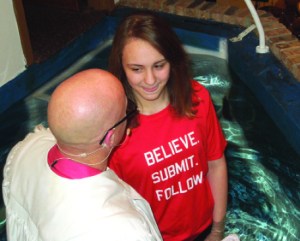
The shirt says it all -- Emily Zimmer is baptized by Pastor Tracy Smith at First Baptist Church in Mt. Zion.

The shirt says it all — Emily Zimmer is baptized by Pastor Tracy Smith at First Baptist Church in Mt. Zion, one of many congregations in Illinois that experienced large increases in baptisms in 2015.

To right the ship, SBC leaders have pointed first to the need for spiritual awakening—first in churches, then in the culture at large. But there are also solutions to be found at the denominational level and in local churches, starting with leaders.

Floyd recalled a time when only preachers who led strong evangelistic churches were invited to speak at the SBC Pastors’ Conference and annual meeting. Those leaders were also the ones nominated for denominational offices. In his November blog post about the state of evangelism in the SBC, Floyd seemed to call for a return to those principles.

“Quite honestly, I am not impressed by how many books a pastor sells, how many Twitter followers he may have, at how many conferences he speaks, how great of a preacher he is, or how much his church does around the world if he pastors or is associated with a church that has a lame commitment to evangelizing and baptizing lost people and reaching his own community with the gospel of Christ.”

At the local level, too, leaders can help reverse the decline by creating an environment that is conducive to evangelism, said IBSA’s Mark Emerson.

“The pastors who are effectively reaching people for Christ are creating an environment of evangelism in their churches,” said Emerson, whose Church Resources team equips churches in evangelism.

“They are making sure every ministry has an evangelistic purpose, they are designing their worship services to communicate the gospel and offer an opportunity for people to make a decision. These churches are training their members to effectively enter into gospel conversations.”

Modeling evangelism

Scott Foshie is one pastor currently training his congregation to have those gospel conversations. Steeleville Baptist Church will start evangelism training in April, based on the “Can We Talk?” program created by Texas pastor (and FBC Pastors’ Conference President) John Meador.

“When it’s time to bridge a conversation from small talk to gospel talk, that’s an awkward transition for people to make,” said Foshie, who has pastored the church since early 2015. The six-week curriculum combines training with practical experience; teams of three people go out into the community, visiting neighbors and practicing gospel conversations.

Foshie’s personal stake in the training goes beyond the fact that it’s happening at his church. As a student of the F.A.I.T.H. evangelism training tool, he led his future wife, Audra, to faith in Christ.

“Personal evangelism training is very important to me because it changed my life. So, I want people to experience that. Personal evangelism training unleashes the army of the Lord, (it’s) what God has called us to do.”

But first, people have to face down a common obstacle: fear. The pastor likened sharing the gospel to someone handing you the keys to their sports car and telling you to take it around town.

“What we need to teach them is, hey, you step out in faith, you begin to learn to share, you simply share, and the Holy Spirit’s going to help you,” Foshie said.

“Once people learn to share the gospel, it changes their life completely.”

Disliking their options, some evangelicals consider withdrawing from presidential politics this time around.

USA symbols mapWith eight months to go until the presidential election, a World magazine survey finds 8 in 10 evangelical leaders say they would vote for an outside third-party candidate as president over Democrat Hillary Clinton or Republican Donald Trump.

Meanwhile, Trump has been victorious in several southern states where voters identified heavily as evangelical, sparking a debate over the meaning of the word “evangelical.”

This tension has not been unnoticed by the media. A recent Yahoo Politics article declared, “Donald Trump’s candidacy has sparked a civil war inside American Christianity.” In an essay for the New York Times, Russell Moore, head of the Southern Baptist Ethics and Religious Liberty Commission, asked, “Have evangelicals who support Trump lost their values?” In the article he decries Trump’s past behaviors and urges Christians to vote according to biblical moral values.

World’s March survey of 103 evangelical leaders and influencers showed more than 50% said they would, on principle, “vote for a third-party candidate who had no chance to win.” The survey also found 76% would vote for Sen. Ted Cruz as president if he secured the Republican nomination. In the eight prior surveys, their choice had been Sen. Marco Rubio who has since ended his campaign.

The debate continues over the disconnect between evangelical leaders and some people in the pews. D. C. Innes, King’s College professor and World magazine contributor, told the Deseret News evangelicals support Trump because they believe they’ve lost the culture wars. “Evangelicals, for example, became politically engaged to preserve their way of life and they don’t feel they’ve gotten their support’s worth from politicians. Abortion, gay marriage—they’ve lost on every front,” said Innes. “The support for Trump is an act of desperation: Protect us. We’re not free to be Christians anymore, so you’ve got my vote.”

Turning to Trump, who is decidely not evangelical, is one option. At the other end of the spectrum is The Benedict Option. In 500 AD, after the fall of the Roman empire, Benedict moved to the city of Rome to continue his education. Disgusted by the decadence there, he left the city and withdrew from society. Benedict became a monk and started several monasteries, leading to the Catholic order that bears his name.

Rod Dreher, writing for the American Conservative, calls this “a communal withdrawal from the mainstream, for the sake of sheltering one’s faith and family from corrosive modernity and cultivating a more traditional way of life.”

A less severe option calls on Christians not to withdraw, but to focus on their churches as “counter-cultural communities of disciples who covenant to walk together for the sake of worship, catechesis, witness, and service.”

Nathan Finn of Union University says this movement (called the Paleo-Baptist Option because it draws from Baptist history) is necessary because “all Christians need to learn from each other, sharpen one another, and spur each other on to love and good deeds. We need each other as our respective traditions seek to follow Christ and bear witness to his kingship in a culture that is increasingly hostile to all forms of orthodox, full-throated, publicly engaged Christianity.”

Of course, considering either outright withdrawal from politics or shoring up “the Christian resistance against what the empire represents,” possibly by way of supporting a third-party run, is all conjecture at this point. With Super Tuesday behind us, and until both parties choose their nominees for the general election, believing evangelicals can only watch and pray for better options.

Metro St. Louis leaders ready for Crossover partners

Crossover-Banner-smallSt. Louis | As Southern Baptists across the country turn their eyes to St. Louis, Ronny Carroll is more than ready to receive a few thousand extra laborers in order to achieve a great harvest.

“With the manpower coming, our churches can really pull off something God-sized,” said Carroll, executive director of missions for the Metro East Baptist Association, which serves the Illinois side of the St. Louis area. “The preparation alone has already given our churches a boost of energy and excitement in anticipation of what God’s going to do.”

Crossover St. Louis will take place on June 11, just before the 2016 Southern Baptist Convention (SBC) annual meeting, which will be held June 14-15 at the city’s America’s Center. Crossover will include more than 70 service and outreach projects throughout five counties in the St. Louis metropolitan area.

Prior to the 2015 SBC annual meeting in Columbus, Ohio, thousands of seeds were planted resulting in at least 345 people who made professions of faith. Carroll is hoping to double that this year.

“We are praying for 1,000 souls to come to Jesus and for 27 new churches to be established,” he said. “I believe God is going to do his job, we just need to be ready for his movement.”

Carroll said that during the last few months and even years, God has been paving the way for an epic revival of hope and healing to break out in St. Louis. And he said God has used Southern Baptists every step of the way.

“Look at all that has happened, in particular the flooding that occurred around Christmas, where Southern Baptists have been the hands and feet of Jesus,” Carroll said, referring to SBC Disaster Relief efforts in St. Louis just a few months ago. “At one level, Crossover will tie into the work that has already been done and add one more dimension to the truth that Southern Baptists, as individuals and as churches, really care about the people and the communities and quality of life they have. They are primed and ready to receive the eternal hope and salvation that Christ offers.”

And to do that, Carroll said the plan for Crossover St. Louis is to “keep it small, but make it huge.”

Crossover will impact churches in six different associations in both Missouri and Illinois. But, because of the unique needs within each association and community, the projects are indigenous to what will make the biggest impact in a given neighborhood.

“Each church has its own local vision and the 21 projects on our side of the river reflect the unique flavor of our communities,” Carroll said. “We are working with city officials and mayors for some of our cleanup projects and planning block parties, or fiestas, in some of our growing Hispanic neighborhoods.”

Tom Firasek, ministry and partnership coordinator for the St. Louis Metro Baptist Association, said organization-wise they are already miles ahead of where past Crossover events were at this stage of the preparation process.

“We met with Rich Halcombe (director of missions in Columbus) and other Columbus Southern Baptist leadership and spent the day learning what works, what doesn’t and what logistical needs might come up,” Firasek said.

“When you are about to support and rally behind 75 or so highly visible events at the same time, you want to be sure to orchestrate everything with excellence, while at the same time pointing to Jesus and proclaiming the gospel every step of the way.”

In addition, Firasek said between 100-150 seminary students will be joining the effort in St. Louis during the week leading up to Crossover.

“We would love to see God open up the needs and challenges of St. Louis so that some of these folks would consider planting their lives here or making ongoing partnerships here,” Firasek said. “In the metro area we have one church for every 7,500 people. We need more church starts.”

With Crossover St. Louis just a couple months away, Carroll said their biggest need is for more volunteers to commit to join them.

“If God’s leading you to be a part of Crossover, please commit to join us soon so we can get you partnered with a project,” he said. “Also, we would love for you to join us in prayer. We are praying God will flood us with his mercy and grace and that He will prepare the lost people to receive Jesus as their Lord and Savior.”

Carroll said they are also praying for churches to be ready to plug new Christians into their ministries and for church plants to grow quickly from the influx of new believers across St. Louis.

“God has already opened so many doors for the gospel to be presented in a mighty way here,” he said. “Pray that we will be faithful with the doors he’s opened.”

For more information on projects taking place during Crossover St. Louis visit the Metro East Baptist Association website at meba.org or visit namb.net/crossover.

Kayla Rinker is a freelance journalist in Missouri.

The BriefingIllinois judge orders Christian B&B to host same-sex wedding

An Illinois administrative judge has given the owners of a bed and breakfast one year to provide their facility to a gay couple “for an event celebrating their civil union.” The order, part of a decision handed down March 22 in a discrimination case filed by the two men, also includes an $80,000 fine.

Religious liberty focus of new study
A growing number of Americans believe religious liberty is on the decline and that the nation’s Christians face growing intolerance, according to a survey by LifeWay Research. Two-thirds (63%) say Christians face increasing intolerance, up from half (50%) in 2013. Those surveyed also noted American Christians complain too much.

Feds threaten NC aid over transgender law
The Obama administration is considering whether North Carolina’s new law on gay and transgender rights makes the state ineligible for billions of dollars in federal aid for schools, highways and housing. Cutting off federal money would put major new pressure on North Carolina to repeal the law, which prohibits transgender people from using public bathrooms that do not match the sexes on their birth certificates.

Abortion pill guidelines eased
The Food and Drug Administration has updated its guidelines concerning the abortion drug mifepristone, allowing women to take it later in pregnancy and with reduced medical supervision. The New York Times called the update “an unequivocal victory for abortion rights advocates.”

Evangelicals love baseball
Religion, it turns out, is a better predictor of who is a baseball fan than age or where one lives. A poll last year by CBS found that while there is a gender gap (but evangelical women are among baseball’s biggest fans), there are also religious differences. The “nones” are less likely to be fans; Catholics and evangelicals are more likely to root, root, root for the home team.

Sources: WORLD Magazine, Facts & Trends, New York Times, Baptist Press, Religion News Service

International Mission Board President David Platt says he wasn’t aware he would appear on a campaign video for Southern Baptist Convention President nominee J.D. Greear, according to a report by the Louisiana Baptist Message.

Platt_blog

International Mission Board President David Platt (BP photo)

The video, posted on YouTube shortly after Greear’s nomination was announced in March, was created by Ashley Unzicker, whose 2014 rap pardoy schooled Baptists on their own history (set to the theme song from “The Fresh Prince of Bel-Air.”) Unzicker’s new rap about Greear’s candidacy features cameos by SBC leaders, including Platt, Ethics and Religious Liberty Commission President Russell Moore, and Southeastern Seminary President Danny Akin, saying the line “It’s tricky.” (The rap is set to Run-D.M.C.’s 1986 song of the same name.)

In response to the video, some outlets (including this blog) have questioned whether SBC leaders should be seen as endorsing one candidate over another.

Baptist Message editor Will Hall informed fellow editors in an email April 4 that Platt “denies he knowingly endorsed J.D. Greear for president of the Southern Baptist Convention, stating he was not aware Greear’s request for a video clip was for the purpose of creating a campaign ad.”

In an email response to an IMB trustee March 23, Platt said he was overseas when Greear asked him to shoot the 2-second video clip, but he wasn’t aware how it would be used.

“Please be assured (and please assure anyone who asks you about it) that I am not personally (and we are certainly not organizationally) endorsing anyone for SBC president,” Platt wrote. He said he would “be thrilled” to serve alongside Greear or Steve Gaines, the pastor of Bellevue Baptist Church in Memphis, Tenn., who was announced as a candidate March 9, or “any other faithful Southern Baptist pastor who might be nominated to serve in this important role.”

Platt added that he had called Gaines “to assure him that I was not in any way ‘endorsing’ J.D., and I expressed my delight in the prospect of Steve potentially being in that role. We had a great conversation about his vision for the SBC, and I am completely confident in the Lord’s leadership in whoever serves in this role for the next couple of years.”

David Crosby, pastor of First Baptist Church, New Orleans, was announced on March 24 as a third nominee for the denomination’s top elected post. Messengers to the Southern Baptist Convention in St. Louis will vote for the office of president on Tuesday, June 14.


Top 10

“I feel like in some ways, after 10 years, I’m just figuring things out,” Nate Adams told the Illinois Baptist State Association Board of Directors last month during a celebration of his service as executive director.

Adams offered some reflection on IBSA’s victories over the last ten years, and a few challenges ahead, all in the form of a “top ten list.”

10. Goals and measurements. IBSA now has a consistent, annual pattern of evaluating churches’ needs (surveys), measuring churches’ progress (ACP), setting focused, organizational goals, and measuring effectiveness through multiple, strategic metrics. Our goals are based on facts and feedback, not programs or preferences. Everything from annual budgets to the Annual Meeting theme are driven by purpose and strategy.

9. Strong church participation. Over the past 10 years, IBSA churches baptized 49,584 people and planted 242 new churches. Mission trip participation is up 23% to more than 24,000. Nearly $90 million was given to missions, including more than $64 million through the Cooperative Program (CP). This growth in church participation is in spite of fewer total churches and members.

8. Financial frugality, stability, and health. Over the past 10 years, annual income over expense has averaged $395,000 or around 5% (in 2006 it was $36,608). IBSA’s Cooperative Agreement with the Baptist Foundation of Illinois (BFI) has helped it to grow and for the CP subsidy of BFI to be reduced from a peak of $153,000 to $35,000 in the 2016 IBSA budget.

While 2015 CP giving was $411,000 less than 2009 and NAMB revenue was $252,000 less, IBSA has avoided involuntary lay-offs, and modest compensation increases have been possible each year.

7. Updated and renewed facilities. In 2012, IBSA completed a $1.9-million renovation of its Springfield building and grounds, debt-free and on schedule. The building now hosts groups of up to 250. In 2014, Lake Sallateeska expanded and renovated its dining hall and two other buildings.

6. Staff efficiency and strength. IBSA has trimmed, restructured, and right-sized its staff to adjust to available resources, increased personnel costs, and the evolving needs of churches. Part-time zone consultants are the most notable example. Today, the IBSA staff is not only more diverse, but far more field-based and closer to churches than it was 10 years ago.

5. Effective change management. IBSA has weathered significant economic and social change, from the secular culture, to the national SBC, to local associations and churches themselves. Many organizations and state conventions in particular have had traumatic adjustments to these changes. By acting early, budgeting conservatively, and an “elastic” restructuring, IBSA has for the most part been able to manage a gradual altitude adjustment with minimal negative consequences to IBSA churches. Changes at both the national SBC and local association level present IBSA with new opportunities and challenges for the future.

Those are the victories of the past 10 years. Now the challenges ahead:

4. IBSA churches’ relatively low net impact on lostness in Illinois. While 242 churches have been planted, the net IBSA congregation count has dropped from 1,032 to 957. IBSA churches baptized 4,400 in 2015, yet dropped 3,352 in Sunday School attendance.

3. Reversing health and growth trends among churches. Annual baptisms are down 18% from the 2009 level. Overall worship attendance is now basically the same in 2016 as 2006, though it rose as much as 9.3% (in 2008). Overall Sunday school attendance in 2016 was 17.4% lower than in 2006.

2. Rekindling the passion and renewing the power of cooperation. Some younger leaders and those without Baptist backgrounds do not always understand or buy in to the cooperative missions model. After dropping to 6.8% in 2013 and 2014, the CP giving percentage rebounded to 7.1% in 2015. Nationally, the average is 5.5%. “Engagement” is key for IBSA’s future.

1. Raising the bar of leadership. Most of the challenges and problems with which IBSA churches struggle are rooted in leadership issues. As the 2015 Midwest Leadership Summit and 2016 Illinois Leadership Summit demonstrated, there is a hunger for leadership development among IBSA churches and leaders.