Archives For February 29, 2016

Politics and religion

Bloomington, Champaign, Decatur, Peoria, Springfield – these Illinois cities were all visited in the last few days by candidates vying for the U.S. presidency. As the March 15 Illinois primaries loomed so did the candidates.

I had the opportunity to attend one of these rallies, where I was packed into an auditorium with other would be voters. It wasn’t my first political rally, but I was struck as always by the sense of camaraderie displayed by the participants. You may not know anyone there, but you know you belong. You can speak freely with total strangers who won’t shout you down for your beliefs.

As we waited for the candidate to take the stage, organizers led us in enthusiastically chanting the candidate’s name. A local pastor came to the platform and lead a prayer for the nation. Then it was time to recite the Pledge of Allegiance. I almost said “amen” at its conclusion.

The candidate finally appeared on stage to much cheering and applause. As the speech continued the candidate’s voice fell into a rhythm as any good pastor’s would. Elderly women could be heard shouting, “Amen,” when something was said that they agreed with strongly. Soon they were joined by others. A few men even held their hands in the air as some do during worship services on Sunday mornings.

I realized then that for many, this was something akin to a religious experience and wondered if the churched and unchurched in the room knew it too. It frightened me in a way, and saddened me too. When was the last time I had been in a church service filled with such excitement? When had I last experienced such a sense of camaraderie and acceptance among fellow Christians?

There has been much debate lately about how Christians should behave as citizens of this nation and as citizens of heaven. Such debate is good and should take place. But what I’ll continue to ponder is how to be more loving and Christ-like to others inside and outside the walls of the church.

Lisa Sergent is a contributing editor to the Illinois Baptist.

The BriefingStates debate religious liberty protections
Within the last 24 months, state legislators have introduced almost 100 (and counting) “targeted laws”—legislation designed to give legal cover to business owners, religious schools, and ministries that affirm the sanctity of marriage between one man and one woman.

US to decide if Christians face genocide from ISIS
For two years, ISIS has been terrorizing Christians and other religious minorities in Syria and Iraq. March 17 Secretary of State John Kerry will have to tell Congress whether the United States will officially label ISIS’ actions a “genocide.”

ERLC, IMB urge prayer for refugees March 15
The March 15 focus of the campaign — #PrayForRefugees — comes on the fifth anniversary of the outbreak of hostilities in the Middle Eastern country. The ERLC and its partners are calling for churches, small groups, Christian organizations, families and individuals to pray for the more than 13.5 million Syrians who need humanitarian assistance as a result of the conflict.

Voters don’t care about candidates’ generosity
Americans contributed $358 billion to charity in 2014, according to Giving USA. How much did each current presidential candidate contribute to that record-setting sum? The candidates, for the most part, are not telling, and pollsters, the media, and voters are not asking.

Workplaces get chaplains
A number of companies have hired spiritual leaders to serve on their staffs. Though slightly less trendy than nap rooms and yoga classes, workplace chaplaincies are another attempt to make workers more productive by catering to their “whole” selves.

Sources: WORLD Magazine, Christianity Today, Baptist Press, The Atlantic, World Magazine

Monochrome reality

Artist Andy Rains shows Christ’s humble beauty in simple black and white.

In our self-centered era, many people think the humble are losers and only the proud win. The Suffering Servant disagrees.

These aren’t humble times. So far, 2016 has produced as much bluster and blow as any year in memory. Not the meteorological kind, rather the political kind.

It is increasingly evident that ours is a land that no longer appreciates the humble man. In most every news report in this election cycle, humility as a value is trounced by pride, promises, and vainglory. Not the videogame Vainglory produced by Super Evil Megacorp (really, that’s the actual name of a game manufacturer); but the inordinate pride in one’s self and one’s accomplishments condemned in the Elizabethan English of the King James Version of the Bible as “vainglory” (Galatians 5:26, Philippians 2:3).

Prior to the 2008 election, a book was published that proposed “Jesus for President.” In it, the authors took a familiar concept from Charles Sheldon’s famous 1896 book “In His Steps” that first asked the question “What would Jesus do” and applied it to American politics: What would Jesus do—if he ran for president?

Probably lose. At least that would appear to be the answer in 2016.

Let’s face it: the humility platform would not prove popular today. The humility platform is not high and lifted up, it doesn’t have room for boasting. Its candidate doesn’t make empty promises. He doesn’t exalt himself, even though in the case of Jesus he rightfully could. He does nothing at the expense of others. And he’s interested in only One endorsement.

How could he possibly win here in Braggadocio?

Still, there is much the Humble One can tell the candidates—and the electorate.

A better example

Four passages in the book of Isaiah have been identified as the Servant Songs. The Ethiopian eunuch reading Scripture while sitting in a royal vehicle asked Philip, “Who is the prophet talking about?” He was reading from Isaiah:

“He was led like a lamb to the slaughter, and as a sheep before its shearers is silent, so he did not open his mouth. By oppression and judgment he was taken away. Yet who of his generation protested? For he was cut off from the land of the living…”  (Isa 53:7-8).

“Who is the prophet talking about, himself or someone else?” the servant to a queen asked Philip (Acts 8:34).

Definitely someone else.

He was talking about the Lord’s servant, the Suffering Servant. Jewish interpreters say the passage refers to the nation Israel, since in most of the book God speaks to Israel. But the verses describing an utterly humble servant and his sacrificial and redemptive work cannot be about a proud and unrepentant nation. They are clearly about the Messiah.

The Suffering Servant is Jesus.

In the Gospels, we see his humility in living tableau. He touches the unclean—lepers, lame, and blind people—and heals them as Isaiah predicted he would. He shows willing descent as he assumes the place of the lowest slave in the house and kneels to wash the feet of his followers. Then he stands with the condemned on the killing hill.

In Philippians, Paul sings a little song of the early church that puts Jesus’ humility into theological perspective.

“Who, being in very nature God, did not consider equality with God something to be used to his own advantage; rather, he made himself nothing by taking the very nature of a servant, being made in human likeness.

“And being found in appearance as a man, he humbled himself by becoming obedient to death—even death on a cross!” (Philippians 2:6-8).

Jesus’ humility was not only a matter of location but also of position. He let go of all the things God deserves in terms of dominion and stooped down to his own creation. He subjected himself to his own created beings, even though he knew beforehand they would murder him.

He never sought to justify his actions. He never came to his own defense. Neither did anyone else.

Was there ever a clearer picture of humility.

The mirror cracked

Today our concept of humility is corrupted. “Lord, it’s hard to be humble, when you’re perfect in every way,” songwriter Mac Davis wrote. Even our contemporary examples become more idols than icons as our culture converts them into celebrities.

Mother Teresa is rushed to sainthood so her musky humility sharpened in Calcutta ghettos can be perfumed for the ages. Pope Francis, hailed for his (relatively) simple lifestyle chides a woman in a parade line. “Don’t be selfish!” he snapped when she pulled him away from a handicapped man he was praying over. Our selfish generation demands something more grand from those who willingly would be lowly. Humility is not fashionable; it’s barely tolerated.

Could it be that Billy Graham sitting in a rocker on the porch of his Blue Ridge mountain cabin out of the glare of the Crusade spotlight is the last example of humility in our egotistical age?

The times are louder. The boasts are prouder. And the rhetoric of its claimants is so overblown that their platforms cannot support it. If only our national leaders could learn a few lessons from the Humble One. If only our countrymen would accept from their icons true servant leadership.

A humble servant is silent

“There is a time to speak,” the Preacher says in Ecclesiastes, “and a time to be silent.” The Suffering Servant is more often silent, so much so that silence has become one of his chief characteristics. When he speaks, it is to the glory of God and to the benefit of others; it is rarely if ever on his own behalf.

The word picture drawn by Isaiah is of a lamb about to be slaughtered. The lamb knows something is coming, from its perspective something bad. And yet he offers not a bleat in protest. If silence is consent, then the lamb is offering his tacit acceptance. Likewise, Christ before his accusers offers no defense of himself. His defense could rightly be that he is God and has done all to the glory of his Father. But he keeps his rebuttal to himself and leans in to his mission with the same humble spirit that has characterized his whole life on earth. The day of his exaltation will come, but there before Pilate, Herod, and the Jewish supreme court, it’s still about three days away.

Andrew Murray says, “Humility is perfect quietness of heart.” In this way, a humble servant stands in stark contrast to the leading figures of our time who exhibit little quietude.

In his little book Humility, Murray describes the inner working of this outward silence: “It is to expect nothing, to wonder at nothing that is done to me, to feel nothing done against me. It is to be at rest when nobody praises me, and when I am blamed or despised. It is to have a blessed home in the Lord, where I can go in and shut the door, and kneel to my Father in secret, and am at peace as in a deep sea of calmness, when all around and above is trouble.”

Oh, how we need that room, that door, that peace.

He is not vain

Isaiah’s prophetic description of the Messiah says there was nothing particularly attractive about him. Even before he was “marred,” “pierced” and “crushed” at Golgotha, the Servant was a plain man with “no beauty” and a king with “no majesty.” He is not a pretty flaxen-haired Jesus as painted in Sallman’s Head of Christ over grandma’s mantelpiece.

Our generation has bought the Kardashian concept of beauty that requires everyone in the public eye to be “carved out of cream cheese.” By this standard, Abraham Lincoln couldn’t get elected to office today. He was tall enough, but homely people don’t win elections. Nor would Cleveland, Taft, or Teddy Roosevelt. Too fat, bald, or bespectacled.

Appearance is not only about outward beauty. There is the vanity of money, stature, power, and position. The desire for reputation is a form of the vanity of fame. The proud person is concerned about the opinion others have of him. “Pride must die in you,” Murray warned, “or nothing of heaven can live in you.”

This is the dying to self Jesus called for, the laying down of his life.

“Men sometimes speak as if humility and meekness would rob us of what is noble and bold and manlike,” Murray said. The humble are rarely exalted in our times, nor do they win elections. But a wise generation doesn’t judge on outward appearances. To the extent it is possible they follow God’s standard when he sent Samuel to anoint lowly shepherd boy David to replace the high but corrupted Saul: He looked on the heart.

And what does he see there?

As a “man of sorrows,” the Suffering Servant is serious about serious things. Oh, sure, he can be great fun, but he is also sober minded. Jesus enjoys a good time in good company (remember the wedding at Cana), but he handles serious subject matter with the gravity deserved. He is “acquainted with grief.” One charged with so great a task as carrying our sorrows to the cross surely feels them deeply.

The same must be true of those who claim him as Lord: “Then Jesus told his disciples, “If anyone would come after me, let him deny himself and take up his cross and follow me” (Matt. 16:24).

“Humility, the place of entire dependence on God, is the first duty and the highest virtue of the creature, and the root of every virtue. And so pride, or the loss of this humility, is the root of every sin and evil,” Murray said.

For those who follow in the way of Christ, there is an inverse relationship between vanity and a quiet spirit. “Pride must die in you,” Murray warned, “or nothing of heaven can live in you.”

He serves needs over wants

The word “populist” has returned to the American vocabulary, driven largely by the large crowds showing up at campaign rallies. By definition, a populist candidate is concerned with the interests of common people. He seeks the involvement of ordinary folks in the political process and welcomes into the discourse issues drawn from ordinary lives. But by recent example, populism involves stirring up the desires of the people, then promising to fulfill them whether they are right (and righteous) or not.

A humble servant may be populist by its original definition. He is concerned about the people, but he doesn’t play to the crowd as is the current practice. At times the crowds were with Jesus; at times they were against him; but Jesus never played to the crowds. He never healed to curry favor. He did not feed the 5,000 to increase his poll numbers.

A humble servant doesn’t dispense treats to get public approval. Or health benefits or government subsidies or campaign promises. He accepts the hard job and does the hard work to its completion, even if that causes everyone to turn away.

The challenge for Americans today is to show some maturity by supporting a leader who will do what the nation needs, not necessarily what the people want. That may sound paternalistic, but isn’t God’s kingdom paternalistic? The Father is always doing what is best for his children, even when they don’t understand it or like it.

He lives with the end in mind 

A humble servant may live and work from a lower position, but that somehow gives him a higher perspective. Isaiah’s picture of the Suffering Servant is paradoxical: he is lowly but he will be exalted; he is oppressed, yet he is the strong arm of the Lord; he is wounded for the sake of our healing. And there’s this paradox concerning “the will of the Lord”—

Yet it was the will of the Lord to crush him; he has put him to grief; when his soul makes an offering for guilt, he shall see his offspring; he shall prolong his days; the will of the Lord shall prosper in his hand (Isaiah 53:10).

It was the will of God that the Suffering Servant be crushed, yet the will of God only prospers when this is done. Crushing and prospering would seem to be opposites. One destroys while the other creates. One shrinks and the other grows. One is an ending, but the other is unending.

And in all of this the humble Servant knows there is a higher purpose than his momentary affliction. The purpose in his dying is to make possible our living—forever. His offering is our ransom. His ending is our beginning. In it all he does not object, because the Servant knows that his grief will become our source of joy and our salvation.

There, between the Lord’s will that the Servant be crushed and the prospering of the Lord’s will in the Servant’s hand is the great promise: this lowly Servant will have offspring. That’s us, his children, his followers, his redeemed.

Isaiah, 700 years before hand, describes the centerpoint of history, the cross, where the crushing intent of the Lord’s will is met by the prosperous outcome of the Lord’s will in the salvation and multiplication of his progeny. This is only possible because the lowly Servant is willing to submit to the Lord’s will that he die and that he rise again, that we believing may be born again to new life.

Rising from that moment in history is the way for all who will follow the Suffering Servant. “Here is the path to the higher life: down, lower down!” Murray said. “Just as water always seeks and fills the lowest place, so the moment God finds men abased and empty, His glory and power flow in to exalt and to bless.”

Eric Reed is editor of the Illinois Baptist


On its surface, the contest for Southern Baptist Convention president appears to be about passing the baton. Steve Gaines is 58. He is the pastor of Bellevue Baptist Church in metro Memphis, an old-school megachurch whose pulpit Adrian Rogers commanded for more than three decades. From that post, Rogers helped engineer the conservative resurgence in the SBC. Gaines, likewise, is committed to conservative theology in the Rogers mould, a traditionalist on evangelism, the need for personal commitment to Christ in salvation, and the commonly held Baptist soteriology of the past century. Gaines is a product of Southwestern Seminary whose president, Paige Patterson, was a chief engineer in the conservative resurgence, and who at 73 is a leading example of altar-call style, personal commitment evangelism.

J. D. Greear, at 42, represents the new wave. His, too, is a megachurch, built in his 14 years as pastor. The Summit Church is contemporary. Its attenders are younger than the average Southern Baptist congregation, and their theology learned from Greear is more reformed. Greear speaks to the crowd identified in Collin Hansen’s book of the same title as “young, restless, and reformed.” He is often a headliner at events for younger Southern Baptists. Greear holds two degrees, both from Southeastern Seminary.

Yes, this election may appear to be about the passing of boomers and the ascendance of Gen-X and Millennials to top leadership in the convention. But more important, it’s about theology and the breadth of the SBC tent. The denomination took a decided step to the right when Patterson, Rogers, and the leaders of the 1970’s and 80’s planted a firm stake for biblical inerrancy and social conservatism. But the convention has continued inching right as a generation of pastors inspired by Southern Seminary president Al Mohler and other reform theologians assumes leadership. The outcome of this election will say whether people in the pews are moving with them.

Messengers will elect a new Southern Baptist Convention president at the SBC Annual Meeting June14-15 in St. Louis, MO.

Eric Reed is editor of the Illinois Baptist.

Greear and Gaines

Steve Gaines and JD Greear are candidates for Southern Baptist Convention President in 2016.

As the candidates jostle among themselves in the race for United States president, the race for Southern Baptist Convention president has become a two-man race. Last week, Florida pastor Jimmy Scroggins announced he will nominate J.D. Greear, pastor of The Summit Church in Raleigh-Durham, N.C., to be the next SBC president. Today, Georgia pastor and past SBC president Johnny Hunt announced he is nominating Steve Gaines, pastor of Bellevue Baptist Church in Cordova, Tenn., to serve in that position.

Greear, 42, is seen by some as part of a new wave of younger SBC leaders. While Gaines, 58, is seen by others as an establishment candidate. With the convention three months away, there is plenty of time for additional candidates to throw their hats in the ring for the office and for other SBC posts as well.

Cooperative Program giving has become an important benchmark for recent SBC presidential candidates and it looks like that will continue. Scroggins said in his press release that Greear’s church, The Summit, “voted last year to give $390,000 to the Cooperative Program in 2016, making it one of the top CP giving churches in the state of North Carolina and the SBC.” A 230% increase in The Summit’s CP giving according to Scroggins.

Baptist Press reported, “Three years ago, the congregation [The Summit] voted to increase its giving through the Cooperative Program over a five-year period to 2.4% of undesignated receipts…The Summit reached its goal two years early.”

Baptist Press also talked with Gaines’ Bellevue and was told the “finance committee is recommending that the congregation give $1 million during its 2016-17 church year through the Cooperative Program, Southern Baptists’ unified channel for funding state- and SBC-level missions and ministries. That will total approximately 4.6% of undesignated receipts.” Baptist Press calculated “between 2011 and 2016, the church has increased its CP giving by 278%.”

The SBC is also focusing on increasing baptism numbers in its churches after multiple years of decreases. Annual Church Profiles (ACP) show The Summit’s baptisms have increased from 19 in 2002, when Greear arrived, to 928 in 2014. Gaines has served as Bellevue’s pastor for 11 years. The church, which was previously led by the late Adrian Rogers, has averaged 481 baptisms per year during his tenure according to ACP reports.

Both candidates are married and each have four children (Gaines also has nine grandchildren). And, both hold master of divinity and doctor of philosophy degrees, Greear from Southeastern Seminary and Gaines from Southwestern Seminary.

The 2016 Southern Baptist Convention will take place June 14-15 in St. Louis, MO. Current SBC President Ronnie Floyd is finishing his second term in the post. Floyd is pastor of Cross Church, Northwest Arkansas.

Scroggins, pastor of Family Church in West Palm Beach, Fla., nominated Greear March 2, and Hunt, and pastor of First Baptist Church in Woodstock, Ga., nominated Gaines March 9.

The BriefingNY Times asks: What does it mean to be evangelical?
Donald Trump’s popularity with evangelicals has led some church leaders to break with the term. The New York Times Opinion Page asked four evangelical writers to share what it mean to be an evangelical today.

Gary Smalley passes away
Best-selling author and world-renowned marriage and relationship expert Gary Smalley has died at age 75. Smalley passed away March 6 after a lengthy illness, his family announced on Facebook March 7.

Christianity Today apologizes for ‘son-in-law’ job posting
The flagship evangelical magazine Christianity Today has tweeted an apology after publishing a job listing for a son-in-law that raised some eyebrows on social media. The ad, which ran in the March edition, was bought by an unnamed Chicagoland church elder who is based in Wheaton, Ill., the magazine’s longtime home.

Millennials increasingly view the church negatively
Since 2010, millennials’ view of churches and other religious organizations as having a positive effect on the country has fallen 18 percentage points, according to Pew Research. In 2015, 55% of young adults believed churches have a positive impact on the country compared with 73% five years ago.

Florist who refused gay wedding gets appeal
The highest court in Washington state has agreed to hear the appeal of florist Barronelle Stutzman found guilty of violating state laws and the constitutional rights of a gay couple when she refused to arrange flowers for their wedding, citing religious beliefs.

Bible translators split over Trinity description
Wycliffe Associates (WA) is leaving Wycliffe Global Alliance (WGA), a partnership of more than 100 Bible translation agencies around the globe. WA cited several reasons for its decision, starting with controversy over the language used to describe Jesus. In some Bible translations, the language of Jesus’ relationship to God the Father (e.g. “Son of God”) is softened to stem confusion and anger from Muslims.

Sources: BPnews.net, Christianity Today, Facts and Trends, Focus on the Family, Religion News Service, New York Times

Eleven Portraits

Lisa Misner —  March 7, 2016

Eleven_portraits

In some ways I’m just getting started and just beginning to figure some things out.

Visitors to the IBSA office building in Springfield sometimes take note of eleven portraits displayed there, acknowledging the men who have served IBSA as executive director since its formation in 1907. Those portraits used to hang in the entrance lobby, and since our building renovation a few years ago they have been on display in our first floor Resource Room.

While it’s hard for me to believe, by God’s grace I have just celebrated 10 years in that executive director role. That milestone recently led me to a few reflective moments in front of those portraits. Four of those men are simply historical figures to me, but I’ve had the privilege of meeting the other six personally. They each served in different times and faced different challenges, but together they form the legacy of leadership on which I now gratefully stand.

I’ve been told by others around the Southern Baptist Convention that 10 years seems to be about the typical length of service in the state executive director role. Since years of service are noted on a little plaque beneath each of the IBSA portraits, I did the math and learned that indeed the average term of service here in Illinois has been just over nine years.

There are, however, two distinct groups of IBSA executive directors among my 10 predecessors. Six men served less than seven years, and four served 12 or more. The smaller, longer-serving group were four of the first five executive directors, all of whom completed their service by the 1970s. The larger, shorter-serving group represent the more current trend. And at 10 years’ service, I now stand in the middle.

There are many reasons why leaders stay in roles for a short time, including some which are beyond their control. So I wouldn’t second guess the Lord’s leadership or providence in any of the shorter terms of service. But after investing 10 years here at IBSA, I have a new appreciation for the men in the longer term group.

It takes time to establish relationships, and to build trust. It takes time to learn the many systems and traditions and landmines inherent in a thousand diverse churches working together. It takes time to learn the regional and ethnic and generational uniqueness of churches and their leaders. It takes time to take necessary risks and make unavoidable mistakes, and then to recover and learn from them. And I’m now discovering that it takes time to do it all again and again, as new pastors and leaders come on the scene.

After 10 years, I feel in some ways I’m just getting started and just beginning to figure some things out. Yet by the law of averages I’ve already had as many years as most executive directors ever get. It makes me admire the men who stayed 12, or 17, or 19 years.

And it makes me want to sprint right past this 10-year mark and see what might be possible in the company of these long-tenured men that preceded me.

It’s certainly possible to overstay your welcome, or to outstay your effectiveness. And it’s always best when a leader can recognize that time long before anyone else does. But for the most part, it can be very good for an organization and its mission when a leader finds favor and stays.

So if you are wondering whether to stay and persevere where you are, let me encourage you to do so if at all possible. One day you will take your place among the portraits of former leaders in your place of service. It may be less and less common for leaders to stay long in one place. But if God gives you grace and favor to do so, I believe you will find a unique influence that only comes with time.

Nate Adams is executive director of the Illinois Baptist State Association. Respond at IllinoisBaptist@IBSA.org.

Six missionary families who have accepted God’s call are featured during the Annie Armstrong Easter Offering Week of Prayer for North American Missions, set for March 6-13. The goal for the 2016 Annie Armstrong Easter Offering is $70 million.

The Rager family

The Rager family

Three years ago Barry Rager was the pastor of a small Kentucky church. Most of his days were centered on important church business. He prepared sermons, visited sick members and mediated church disputes. All good work. All important work. All kingdom work.

“I was kind of like the coach saying, ‘Hey, reach the people you are with,’ but I wasn’t actually the one doing it,” Rager says.

Three years later, and his life couldn’t be more different. Living in the Mapleton-Fall Creek neighborhood of Indianapolis’ core, his mission field is everywhere.

A trip to Indianapolis for the 2008 Southern Baptist Convention first opened Rager’s eyes to the needs of the city. It wasn’t until 2012 that James Edwards came to him with an offer: “We want to plant a church in a major U.S. city, and we want you to be the planter.” Rager didn’t have to think hard about which city.

Edwards, pastor of Pleasant Valley Community Church, and the congregation felt the call to plant a church in an urban city, which eventually led to a strong calling for a church plant in Indianapolis. Edwards had met the Ragers on a playground where a strong friendship was formed. For years, the Ragers and Edwards encouraged and supported each other and their ministries. When Pleasant Valley felt God tell them to plant a church, they prayerfully considered who would lead the church plant.

“Barry Rager’s name continued to surface,” said Edwards. Pleasant Valley asked the Ragers to pray about planting a church in Indianapolis. “It was clear to Barry and Amy that God was calling them to plant a church in the heart of Indianapolis,” said Edwards. “Our strong inclination to partner with Barry and Amy came primarily through the leadership of the Holy Spirit.”

A once thriving city in the 1920s, by the 1960s many residents had moved to the suburbs.

Today, 41.5% of residents do not have a high school diploma. A 2013 NeighborhoodScout.com article called the northern half of the area the 17th most dangerous neighborhood in the U.S.

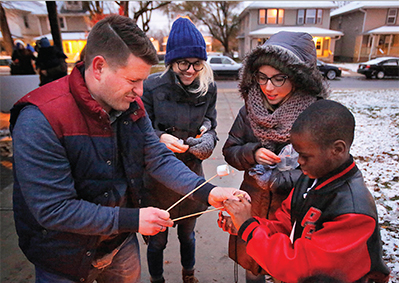
Indianapolis church planter Barry Rager (left) and New Circle Church use events like S’mores and Snow in the Park to reach a neighborhood many describe as dangerous.

Indianapolis church planter Barry Rager (left) and New Circle Church use events like S’mores and Snow in the Park to reach a neighborhood many describe as dangerous. The Ragers are North American Mission Board 2016 Week of Prayer Missionaries. NAMB photo by John Swain

Once the Ragers relocated to Indianapolis, they were told it would likely take them years to connect with their neighbors and build disciple-making relationships.

“When we moved in, we decided that we were going to be as open and positive as we possibly could be,” Amy Rager says. “Most of the people around here keep their blinds shut 24-7. They’re very closed. So we thought, you know what? Our blinds are going to be open. We’re going to act like we trust these people. We’re going to do anything we can to initiate that relationship.”

Before their boxes were even unpacked, the family showed up on their neighbors’ doorsteps with freshly-baked homemade cookies. They also invited their neighbors into their home for dinner.

As they continued to build community, the Ragers eventually started worship services with 40 people attending in September 2014. That was the launch of New Circle Church, Indianapolis. A year later their worship attendance more than doubled and they had seen 22 people baptized.

Barry focuses the church on a simple-yet-comprehensive mission—introducing people to Jesus, developing gospel-centered community and commissioning them to reach people for Christ.

“What I get to do is brag on Jesus and what He has done,” Rager says. “It is such an honor to brag on Jesus.”

“I think if it is never our intention to live on mission, then we won’t live on mission,” Rager says. “We have to be intentional in the way we use our time, and in the meetings we have with people.

– By Tobin Perry on www.AnnieArmstrong.com

Crossover makes a difference in host city and back at home

Uptown_Crossover

COLUMBUS – Mission volunteers from Uptown traveled to Columbus, Ohio in 2015, where they worked for two days training and encouraging local believers in prayer walking and evangelism.

The words of an old praise chorus aptly describe the effect missions can have in a local church:

“It only takes a spark to get a fire going…”

Once church members who have engaged in missions start “passing on” their experiences to their friends, it can ignite a missions fire of sorts, causing a church to look in their own neighborhood and beyond for ways they can reach more people with the gospel.

That’s how IBSA zone consultant Steven Glover describes the impact of Crossover, an annual outreach event held prior to the Southern Baptist Convention. This year’s Crossover initiative in St. Louis is planned largely for Saturday, June 11, although some projects start earlier (see planning checklist below).

Last year, Glover and his family participated in Crossover with a team from Uptown Baptist Church in Chicago. The volunteers worked with a church in urban Columbus, Ohio, to prayer walk their community and share the gospel with people they met. Glover and the team also helped train the Ohioans in prayer walking and evangelism, equipping them for the ministry they did together.

Once they got back to Chicago, they shared with the rest of the congregation what had happened in Columbus. As with any mission trip, the resulting benefits could have stopped there, Glover said.

“But if you have people who have participated in and are excited about it, they’ll continue to talk about it,” he said. That’s why the key is getting as many people involved as possible.

This year, Uptown will take a team to St. Louis to work with a church in a similar ministry setting as their own inner-city church. In Columbus, said Uptown’s missions coordinator Doug Nguyen, the church worked with “an urban congregation that ministered to Muslims and immigrants, as well as families around the neighborhood in downtown Columbus.
“And we’re looking to do the same in St. Louis.”

Uptown_Crossover_2014

BALTIMORE – Members of Uptown Baptist’s Crossover team share the gospel prior to the 2014 Southern Baptist Convention.

 
After Uptown partnered with a Baltimore church for Crossover in 2014, they were able to pray for the congregation specifically when rioting broke out in the city the next spring. “We’re all praying for them right now, for churches to really step up and be the salt and light in that community,” Nguyen told the Illinois Baptist at the time.

When mission volunteers help other Christians reach their community, they’re bearing each other’s burdens, Glover said. They’re energized by helping fulfill the Great Commission, by doing what God has called his people to do.

They’re also more likely to come back home and find ways to do the same in their own city.

“It’s a good investment,” Glover said, “because it’s an ongoing thing.” Iron sharpens iron, he said, referencing Proverbs 27:17. “Getting next to someone who has gone out and done that has such an impact.”

Crossover checklist

Making plans to join Uptown and hundreds of other churches at Crossover prior to this year’s Southern Baptist Convention? Start now by working through this checklist of questions:

Who’s going?
As you recruit volunteers for your Crossover team, think about who they are. What are their ages, ministry skills, and spiritual gifts?

View the list of Illinois Crossover projects at meba.org/crossover-st-louis- 2016, and look for those that fit your team. For example, if you have Spanish speakers in your group, consider joining Iglesia Bautista Maranatha in Granite City for prayer walking and door-to-door evangelism in their community.

Interested in sports outreach? Help Sterling Baptist Church host a 3-on-3 basketball tournament.

What time can they give?
Most Crossover projects happen the Saturday before the Convention begins—this year, that’s June 11. But some initiatives cover a longer span of time:

  • A church plant in Fairmont City needs help with a home makeover
    project June 6-11.
  • Two congregations in Hartford and East Alton are working together on a week-long canvassing project, capped off with a community block party.
  • A new church in Collinsville will utilize volunteers for community surveying and sharing the gospel on  Saturday, and then will host a preview worship service Sunday.
  • Check the full project list at meba.org for more multi-day opportunities.

What’s next?
Start thinking now about how to share your ministry experiences with the congregation back at home.

Which stories best illustrate how God worked through your team to increase your partner church’s influence and favor in their community? Did anyone accept Christ? What spiritual needs can your church pray for over the next year?

Also, how might you extend the relationship with your Crossover partner church? Uptown kept in touch with Baltimore pastor Ryan Palmer, who they worked with in 2014. He visited Uptown when he was in Chicago the next year. As you plan your Crossover project, consider how it might spark a ministry partnership that goes beyond one day.

The Briefing‘LSD in the water,’ says Moore
Here & Now’s Jeremy Hobson interviewed Russell Moore, president of the Ethics and Religious Liberty Commission, Feb. 29 covering the issues evangelical voters are most concerned about and how the tone of the campaign is resonating with them. “I think this campaign gives me reason to think someone has released LSD into the water system in this country, and every single day one looks at the news and cannot even fathom that it’s happening,” Moore cracked.

Baptist group: Keep church, political parties separate
Jon Akin wants members of his congregation in Lebanon, Tenn., to be politically engaged, but the Southern Baptist pastor thinks sermons should focus on the issues, not a particular candidate or political party. He belongs to Baptist21, a group of young Southern Baptist ministers who want a clear division between their denomination and the Republican Party.

Survey spotlights refugees, churches & fear
When it comes to helping refugees, Protestant churches and their pastors are often separated by faith and fear, according to a new survey from LifeWay Research. Most pastors say Christians should lend a hand to refugees and foreigners, and believe caring for refugees is a privilege. But pastors say their churches are twice as likely to fear refugees than they are to help them.

Kasich tells Christian bakers, ‘Make them a cupcake’
Republican presidential candidate John Kasich said that social conservatives need to “move on” from the issue of gay marriage and Christian wedding vendors shouldn’t deny service to same-sex weddings. Although Kasich, an Anglican, believes marriage is a union between one man and one woman, he said conservatives need to move on to more important issues.

Bible removed from POW/MIA display inside VA clinic
A Bible and Bible verse were removed from a POW/MIA display inside an Ohio Veteran’s Administration clinic after the Military Religious Freedom Foundation complained. They were part of a “Missing Man Table” recently erected by volunteers at an outpatient clinic in Akron.

Sources: Baptist Press, Christian Post, Fox News, Here and Now, USA Today