Archives For November 30, 1999

totaleclipsecolumbiasc.com

totaleclipsecolumbiasc.com

When the sun goes dark Aug. 21, southern Illinois will be one of the best places to catch the first total solar eclipse visible from the U.S. since 1979. Churches in the region, along with others across the country, are planning to use the event as an opportunity to share the gospel.

Everyone in the contiguous U.S. will be able to see at least a partial eclipse, but the 70-mile-wide “path of totality,” in which a total eclipse will be visible, will pass through 14 states, including Illinois. Makanda, Ill., located just south of Carbondale, has been cited as the “greatest point of duration,” or the place where the eclipse will be visible the longest—2 minutes and 38 seconds, according to a city website devoted to sharing eclipse information.

Lakeland Baptist Church in Carbondale hosted an area-wide prayer and worship rally Aug. 14 to spiritually prepare for the influx of people. And Nine Mile Baptist Association, through a partnership with IBSA, plans to distribute 50,000 gospel tracts during the weekend prior to the eclipse. Additionally, people will be stationed at each of Carbondale’s four entry points to pray over every car that enters the city. “We want to cover our city in prayer,” said Lakeland Pastor Phil Nelson.

Elsewhere in the eclipse’s path, churches are utilizing the unique ministry opportunity to meet spiritual needs in their community—whether it’s inviting eclipse viewers to use their parking lots, or using the event to launch future ministries.

In Casper, Wyo., Mountain View Baptist Church and College Heights Baptist Church have partnered with Child Evangelism Fellowship of Central Wyoming to purchase copies of a DVD titled “God of Wonders,” which explains how creation reveals God and how salvation is available through Jesus Christ. Church members will distribute the DVDs during the eclipse along with 3,000 evangelistic bookmarks.

“Additionally,” Mountain View pastor Buddy Hanson said, “if our parking lot is utilized for eclipse watchers, we will take that opportunity to try and share the gospel.”
In Lincoln, Neb., the launch of Hope City, a North American Mission Board church plant, is set to correspond with the eclipse. The congregation’s first service is slated for Aug. 20. That day and during the eclipse, the church will distribute 2,000 “college survival kits” at the University of Nebraska-Lincoln.

First Baptist Church in Hendersonville, Tenn., will host a gospel concert on Sunday, Aug. 20, and is inviting people to watch the eclipse from their parking lots the next day. “We have already handed out over 4,000 eclipse viewing glasses and have several hundred more for those needing them,” said Executive Pastor Bruce Raley.

Beginning just after 10 a.m. local time in Lincoln Beach, Ore., the total eclipse will take approximately an hour and a half to pass over Oregon, Idaho, Wyoming, Montana, Nebraska, Iowa, Kansas, Missouri, Illinois, Kentucky, Tennessee, Georgia, North Carolina, and South Carolina. Viewers are strongly encouraged to wear eclipse glasses or other protective eyewear.

– From Baptist Press, with additional reporting by the Illinois Baptist

SBC 17

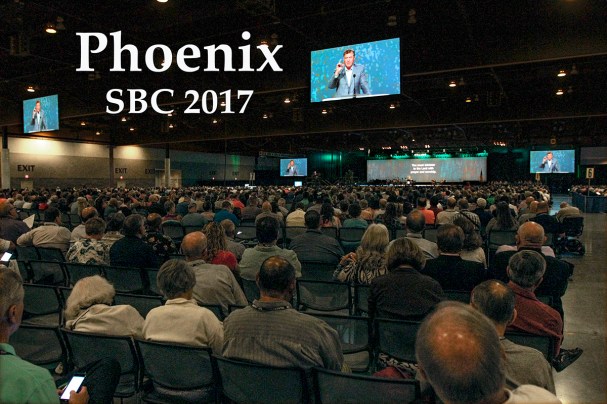
Appointment of a task force to study how Southern Baptists can be more effective in evangelism and a resolution decrying “alt-right white supremacy” were among highlights of the Southern Baptist Convention annual meeting June 13-14 in Phoenix.

In addition, messengers honored 15-term registration secretary Jim Wells with a resolution of appreciation after hearing a report he is in the advanced stages of cancer. Attendees of the SBC Pastors’ Conference preceding the annual meeting elected Florida pastor H.B. Charles as the conference’s first black president.

The unofficial total of 5,018 registered messengers, down from 7,321 last year, expanded representation on the Executive Committee to include four states or defined territories which had not previously qualified for representation under Bylaw 30. Southern Baptists also gave the EC authority to sell the SBC Building in Nashville and received a multimillion-dollar gift through the Cooperative Program from the Florida Baptist Convention stemming from the sale of its building in Jacksonville.

When registered guests, exhibitors and others were included, the count of those at the annual meeting was tallied, as of June 15, at 9,318.

Alt-right resolution

A resolution on “the anti-gospel of alt-right white supremacy” decried “every form of racism, including alt-right white supremacy, as antithetical to the Gospel of Jesus Christ” and pledged to pray “both for those who advocate racist ideologies and those who are thereby deceived.”

A vote to approve the resolution June 14 was followed by a standing ovation from messengers.

In its initial report, the Resolutions Committee declined to recommend convention action on a resolution submitted by Texas pastor Dwight McKissic condemning the white supremacist movements sometimes known as “white nationalism” or the “alt-right.” Two June 13 motions to consider the resolution on the convention floor each failed to achieve the requisite two-thirds majority. Amid ongoing discussion, however, the Resolutions Committee requested and was granted by the convention an opportunity to reverse its decision and present a resolution on alt-right racist ideology.

Resolutions Committee chairman Barrett Duke, in presenting the resolution, told messengers, “We regret and apologize for the pain and the confusion that we created for you and a watching world when we decided not to report out a resolution on alt-right racism.” The committee abhors racism, Duke said, adding the initial decision not to recommend a resolution condemning alt-right racist ideology did not reflect sympathy with that ideology.

Evangelism task force

SBC President Steve Gaines, who was reelected to a second term, recommended creation of the evangelism task force to study how Southern Baptists can be more effective in personal soul winning and evangelistic preaching. North American Mission Board President Kevin Ezell made a motion, later approved by messengers, that the convention authorize Gaines to appoint the group.

In the annual meeting’s final session, Gaines announced the members of the 19-person task force, including chairman Paige Patterson, president of Southwestern Baptist Theological Seminary. The group will report to the 2018 SBC annual meeting in Dallas.

Creation of the task force was in keeping with an evangelism emphasis in Gaines’ presidential address. “I want to encourage you to be a soul winner,” said Gaines, pastor of Memphis-area Bellevue Baptist Church in Cordova, Tenn.

A Tuesday-evening message by California pastor and evangelist Greg Laurie urged preachers to extend public invitations for people to follow Christ whenever they proclaim the Gospel. In his message, Laurie announced that Harvest Christian Fellowship in Riverside, Calif., where he is pastor, has begun cooperating with the SBC.

Wells honored

The resolution of appreciation for Wells, recommended by the Executive Committee, expressed “deepest and most sincere gratitude to God” that Wells “has fulfilled the role as an officer of the Convention with godliness, integrity, kindness, and thoroughness, assuring that each duly elected messenger from churches that cooperate with the Southern Baptist Convention was properly certified and that each messenger’s ballot was accurately counted and reported in every balloted vote.”

Wells, who was first elected registration secretary in 2002, was not present at the annual meeting. The EC appointed his chief assistant Don Currence, minister of administration and children’s pastor of First Baptist Church in Ozark, Mo., as acting registration secretary. Messengers elected Currence as 2018 registration secretary on the second ballot from a field of five nominees.

Executive Committee report

Among 11 Executive Committee recommendations approved by messengers was one authorizing the EC “to continue studying the advisability of a sale of the SBC Building, and to sell the property upon such terms and conditions, and at such a time, if any, as the Executive Committee may hereafter approve.”

Another recommendation approved by messengers granted EC representation to four regions even though they have too few church members to apply for EC representation under the provisions of SBC Bylaw 30. The recommendation amended Bylaw 18 to list the Dakotas, Iowa, Minnesota-Wisconsin and Montana as each being entitled to a single EC representative.

During the EC’s report, Florida Baptist Convention executive director Tommy Green presented a check for $3,156,500 to help fund SBC Cooperative Program ministries. The gift represented 51 percent of proceeds from the sale of the Florida convention’s building. EC President Frank S. Page said the gift brought 2016-17 CP Allocation Budget overage above last year’s surplus total.

Page’s report to the SBC included the launch of a convention-wide stewardship emphasis featuring a partnership with Ramsey Solutions, the organization led by radio host Dave Ramsey. The stewardship emphasis continued June 14 with a president’s panel discussion on stewardship moderated by Gaines.

Officers

In addition to Gaines and Currence, newly elected SBC officers included first vice president Walter Strickland, a leader of Southeastern Baptist Theological Seminary’s Kingdom Diversity Initiative, and Jose Abella, pastor of Providence Road Church, a bilingual congregation in Miami. Recording secretary John Yeats was reelected to a 21st term.

Patterson was elected as the 2018 convention preacher.

Motions

Messengers made 11 motions. The only one to receive approval at the annual meeting was the proposal to create an evangelism task force. Two motions were ruled out of order, and eight were referred to SBC entities or committees.

Among motions to be referred were a proposal to study merging NAMB and the International Mission Board and a request that NAMB, the IMB and LifeWay Christian Resources consider expanding their trustee boards to grant broader representation.

A motion to let messengers consider defunding the Ethics & Religious Liberty Commission was ruled out of order because it was made after the convention approved the 2017-18 CP Allocation Budget, which establishes the percentage of CP receipts distributed to each CP-funded entity.

In other news:

— IMB President David Platt said the board’s finances are on “stable ground” and urged messengers to focus on the “present work we are doing” rather than “past financial struggles.” The IMB presentation included a commissioning service at which messengers gathered around newly appointed missionaries to pray.

— In the NAMB report, Ezell said 732 new churches were planted by Southern Baptists in 2016 and 232 existing churches began cooperating with the SBC.

— The annual Crossover evangelism emphasis and the tandem Harvest America crusade yielded 3,549 professions of faith.

— A group of about 50 protesters gathered outside the Phoenix Convention Center June 13, asking the SBC to remove homosexuality and transgenderism from its “sin list.” The group distributed flyers that included the 2017 SBC logo and theme.

— Messengers approved changing the IMB’s fiscal year to Oct. 1-Sept. 30.

— The Global Hunger Relief Run June 14 allowed messengers and other annual meeting attendees to participate in either a 5K run or one-mile family-oriented fun run to raise money for hunger relief projects in North America and internationally.

— A full 80 percent of members elected to the 2017-18 Committee on Nominations have never served on an SBC board or committee, said Randy Davis, chairman of the Committee on Committees, the body which nominates the Committee on Nominations.

— All speakers at the June 11-12 SBC Pastors’ Conference were pastors of churches with approximately 500 or fewer in average attendance.

— All annual meeting attendees are asked to fill out a survey available at www.surveymonkey.com/r/sbcam17.

–Baptist Press

Welcome to our mission field

Elizabeth Young

Elizabeth Young

For the third time in 14 years, Arizona Southern Baptists will welcome the larger Southern Baptist family to Phoenix in June.

When Phoenix was chosen to host the Southern Baptist Convention’s annual meeting the first time in 2003, we were more than a little surprised, given our reputation for high summertime temperatures. But with Baptists’ repeated visits, we figured the word must have gotten out that, given our low humidity, our average 102-106 degree June temperature isn’t as bad as “back home” for a lot of folks.

We’re delighted when the family comes to town. We hope, for many, it’s a reminder that Southern Baptist work does exist outside of the Deep South and west of the Continental Divide. Illinois Baptists may feel the same way about recognition of Southern Baptists north of the Mason-Dixon Line.

While we want to offer a warm welcome to the family, we sincerely pray that our guests will remember they are on a mission field. We pray for a quiet, peaceful annual meeting so that we don’t have to explain to our lost neighbors why feuding Baptists, or Baptists engaged in culture wars, made the local news. When you’re up to your eyeballs in lost people, it puts a different perspective on priorities of concern.

Illinois Baptists probably understand this, too. Although we have some differences, we seem to have a lot in common.

You have more people—almost 13 million to our 6.9 million—but we have more land—nearly 114,000 square miles to your almost 58,000. You have more churches—nearly 1,000 to our about 450—but we have similar church-to-population ratios—one church for every 13,000 people in Illinois and one for every 15,000 in Arizona.

Both of our states have one large metropolitan area that encompasses two-thirds or more of the state’s population. And whether it’s Chicagoland or greater Phoenix, also known as the Valley of the Sun, the city is a massive sea of people who don’t know Jesus as savior.

Whether on not you make the trek to the Grand Canyon State this summer, our message to you is the same. We’re drawing from Paul’s Macedonian Call in Acts 16:9 and inviting you to “Come over…and help us.”

Consider what God is calling you to do:
• Pray for God’s work in our vast state.
• Partner with an Arizona church.
• Plant a church in Arizona.

May God give all of us a “Macedonian” vision for Arizona—and beyond!

Elizabeth Young is director of communications for the Arizona Southern Baptist Convention and the editor of Portraits magazine.

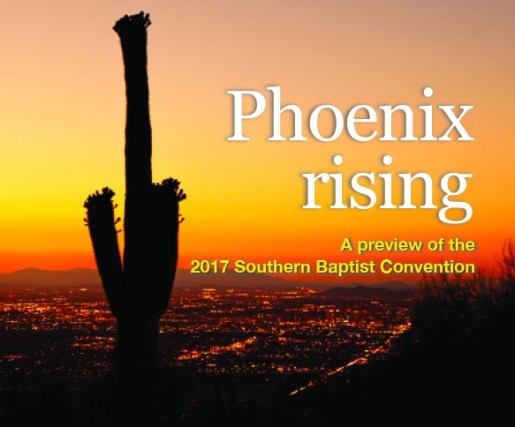
Phoenix rising

When Baptists gather in Phoenix next month, they’ll address the challenges of taking the gospel to a world that seems less inclined to hear the message, and doing so with fewer resources to get the job done.

Messengers to the Southern Baptist Convention June 13-14 will also meet against a very different political backdrop than a year ago, and could contend with the fallout of recent debate fueled by a raucous and divisive U.S. presidential election.

Or not.

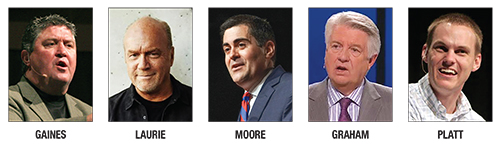
Recent calls for Convention-wide unity—and similar statements by SBC leaders—could rule the day in Phoenix, where Baptists will focus on prayer, evangelism, and financial stewardship, said SBC President Steve Gaines.

“I believe Southern Baptists can be used of God to spark a mighty movement of prayer, evangelism, and discipleship across our nation and around the world,” said Gaines, pastor of Bellevue Baptist Church in metro Memphis, Tenn., in announcing the meeting’s theme. “Pray! For such a time as this” is based on Luke 18:1 and Esther 4:14.

“If we will pray and abandon ourselves to the Lord, he will use us exponentially to take the gospel to people,” Gaines said.

SBC personalities

Similar to the previous few annual meetings, Gaines said the 2017 gathering will include seasons of prayer, as well as a personal evangelism emphasis on Tuesday evening led by Greg Laurie.

The California evangelist also will lead a Harvest Crusade Sunday, June 11, as part of the annual Crossover evangelistic effort that precedes the Southern Baptist Convention (see Nate Adams’s column on page 2 for more information). Organizers say the event at University of Phoenix Stadium, which holds 65,000 people, promises to be the largest single gospel presentation in Arizona history.

Focus on stewardship
Following the example of previous annual meetings, the gathering in Phoenix will include a panel discussion with SBC leaders. This year’s topic: financial stewardship.

Gaines told Baptist Press Southern Baptist churches cannot give more to SBC missions and ministries than church members give through their local congregations.

“The solution for increased funding for world missions begins in the heart of every individual believer in Christ,” he said. “Southern Baptists need to get our financial houses in order.

The Cooperative Program—Southern Baptists’ unified giving channel for supporting missions and ministry around the world—is likely to be a topic of conversation in Phoenix as well. In February, Prestonwood Baptist Church in Plano, Texas, pastored by former SBC President Jack Graham, announced they would temporarily escrow their CP giving because of positions taken by the Ethics and Religious Liberty Commission.

ERLC President Russell Moore, a vocal critic of now-President Donald Trump during the campaign, has apologized for comments that seemed directed at all evangelicals who supported Trump, and the ERLC’s executive board released a statement in April pledging their support for Moore. The statement also called for unity in the SBC despite differences, a sentiment echoed by Gaines.

“I believe all of us who are recipients of grace and forgiveness should grant him the same forgiveness that we desire from the Lord,” Gaines said after Moore and the ERLC executive board released the statement. “It is high time that we put all of this behind us….It is time to move ahead and work together to double our efforts to take the gospel to our nation and the nations.”

If the recent controversy surrounding the ERLC does make an appearance at the SBC, it could be in the form of a motion from the floor, or during the Q&A time following Moore’s report, which is the final item on the meeting schedule. International Mission Board President David Platt could also face questions about the IMB’s support of a Muslim group’s fight to build a mosque in New Jersey. (Like the ERLC, the IMB also signed on to a friend of the court brief in support of the group.)

In February, Platt apologized for how “distracting and divisive” the brief was, and pledged that in the future, the IMB “will have a process in place to keep us focused on our primary mission.” Still, the mosque debate could spark a religious liberty conversation in Phoenix, as could President Trump’s controversial travel ban for people from some majority Muslim countries into the U.S.

Online pre-registration for the Phoenix meeting is now open at sbcannualmeeting/sbc17. Messengers and guests are required to be registered and properly badged in order to enter the general sessions June 13-14.

For more information about the Southern Baptist Convention’s June meeting in Phoenix, go to sbcannualmeeting.net.

– With info from Baptist Press

Trump-religious-liberty-EO

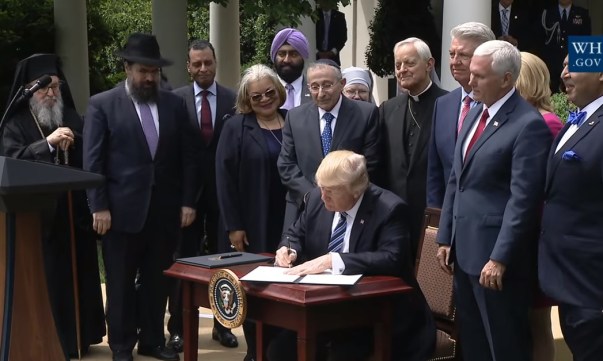
President Donald Trump signed an executive order to protect faith beliefs and practice in a ceremony May 4. Screen capture from WhiteHouse.gov. Courtesy Baptist Press

On May 4 – The National Day of Prayer – President Donald Trump, signed an executive order promising to provide churches, non-profit organizations, and Christian-owned business greater religious liberty. Reaction among Christians, especially evangelicals has been mixed. Here’s a round-up of some of those reactions:

Baptists cautious on Trump executive order
Russell Moore, president of the Southern Baptist Ethics & Religious Liberty Commission, said, “After years of open hostility toward religious institutions and conscience from the previous administration, this executive order is a welcome change in direction toward people of faith from the White House. Not only that, but many federal agencies are working already to ensure that the executive and administrative violations of religious freedom from the Obama administration are being rolled back.” Read more from Moore and other Southern Baptists.

Concern Trump’s order doesn’t address key issues
Some evangelical voices, like Ryan Anderson of the Heritage Foundation; David French, a lawyer and writer at National Review; and Gregory Baylor with Alliance Defending Freedom had critical words for the president’s religious liberty executive order. They called the order woefully inadequate, weak, and a promise unfulfilled.

What Trump understands about religious liberty in America
There is a war on religious liberty in America – and this war is targeting people of the Christian faith. An Army of militant atheists and LGBT activists are hell-bent on eradicating Christianity from the public marketplace and punishing Christians who follow the teachings of Christ. That’s why President Trump signed an executive order on religious liberty Thursday in the Rose Garden – to protect Americans who have been targeted by a politically correct lynch mob.

Reaction mixed on order targeting birth control, churches, politics
Trump’s executive order targeted the Johnson Amendment, a provision of tax law which prohibits churches from getting directly involved in political campaigns. But it stopped short of his vow to “totally destroy” the amendment, instead instructing the Internal Revenue Service to enforce the law consistent with how it’s done so in the past — allowing speech on political and moral issues as long as it doesn’t advocate the election or defeat of a particular candidate.

Analysis: Trump order unlikely to alter sermonizing
Many Americans want religious leaders to be clear about their values and how those values impact every aspect of life, including politics. And they want churches to be free to practice their faith, which includes discussing politics without any government intervention. But few want their preacher’s advice on which candidate to vote for.

Sources: Baptist Press, World Magazine, Fox News, USA Today, Baptist Press

Exterior of Modern Church with Large Cross

A bill in the Illinois Senate that would have required pastors to take state-regulated classes in child protection raises important questions: Shouldn’t pastors do all they can to protect children, one colleague asked. Yes, obviously, but at what risk to religious communities’ First Amendment rights?

And, as important is this question: Why aren’t clergy engaging in stronger self-policing using a mechanism most already have in place, the ministerial code of ethics?

Sen. Melinda Bush of Lake County withdrew the bill last week, after objections from pastors on First Amendment grounds: If the state requires pastors to receive certification in this well-intended and altruistic concern, then what’s next? There aren’t many steps from this bill to government licensure of clergy and churches. “Won’t somebody please think of the children!” isn’t a sufficient argument to allow government regulation of pastoral work.

And, there’s a better way.

As a seminary student, I was required to write for myself a ministerial code of ethics. I studied a dozen examples and came up with a list of biblical and ethical ways for dealing with people, issues, and sticky situations.

A year or two later, I was the grader for that class, and I read scores of codes of ethics submitted by students. Most of these aspiring pastors took the assignment seriously, considering how they should handle counseling and confidentiality, reporting of abuse or neglect, the pastor’s relationship to the law and enforcement agencies. Some addressed euthanasia, and a few spoke to sexual identity and relationship issues just entering public discourse at the time.

Some of these students laid a good foundation for engaging and regulating their future work, so when hard questions arose, they already had biblical ways of processing the issues not based on emotion and reaction.

A good ministerial code of ethics guides pastors in their ministry to children and families in jeopardy. It requires that pastors stay up-to-date on the issues and the law. Through such personally adopted codes, pastors police themselves. They may join in voluntary association with other clergy in their enforcement.

Our Baptist polity—respecting the autonomy of the local church—doesn’t allow the denomination to enforce rules on pastors. Neither does the U. S. Constitution. That’s why we must take responsibility to govern ourselves.

For the sake of the children.

– Eric Reed

wp-adMore than 100 evangelical pastors and ministry leaders signed an open letter expressing their opposition to President Donald Trump’s executive order that restricts immigration from seven Muslim countries, suspends entrance of all refugees for 120 days, and prevents all Syrian refugees from entering the United States indefinitely. The open letter appeared as a full-page ad in the Feb. 7 issue of the Washington Post.

Two of the signatories — former Southern Baptist Convention President Bryant Wright and Southeastern Baptist Theological Seminary President Daniel Akin — told Baptist Press their signatures reflect a specific policy disagreement and not a blanket repudiation of the president’s approach to immigration.

The letter addressed to President Trump and Vice President Mike Pence, stated, “As Christian pastors and leaders, we are deeply concerned by the recently announced moratorium on refugee resettlement. Our care for the oppressed and suffering is rooted in the call of Jesus to ‘love our neighbor as we love ourselves.’ In the story of the Good Samaritan (Luke 10:25-37), Jesus makes it clear that our ‘neighbor’ includes the stranger and anyone fleeing persecution and violence, regardless of their faith or country.”

The order, suspended by a lower court, was stayed Feb. 9 by a three-judge panel of the 9th Circuit Court of Appeals. The president has vowed to continue to the fight which is expected to be taken to the Supreme Court.

The Christian relief organization, World Vision, coordinated the letter. According to a press release from the organization, an additional “500 evangelical pastors and ministry leaders representing every state in the nation” signed the letter but their names did not appear in the ad. The release also states, “World Relief is one of nine agencies nationally authorized by the U.S. State Department to resettle refugees.”

Seven other Southern Baptists, including Ed Stetzer, executive director of the Billy Graham Center for Evangelism at Wheaton College in Wheaton, Ill., were signatories. Stetzer first voiced his opposition to the order last month in an op-ed published by the Post Jan. 26.  The Ethics and Religious Liberty Commission’s Russell Moore was not a signatory to the letter, but wrote his own letter to the president expressing his concern, which appeared in Jan. 30 issue of the Post.

Other well-known signatories include Max Lucado, author and minister of preaching at Oak Hills Church in San Antonio, TX; Tim Keller, pastor at Redeemer Presbyterian Church in New York City; Eugene Cho, pastor at Quest Church in Seattle; Derwin Gray, lead pastor at Transformation Church, SC; and Bill Hybels, senior pastor at Willow Creek Community Church in South Barrington, IL.

Read the full text of the letter.

– Lisa Sergent with additional reporting by Baptist Press

Editor’s note: This post has been updated to include a blog post/podcast from Albert Mohler.

Four  prominent Southern Baptists are taking public—and differing—positions on President Trump’s executive order that restricts immigration from seven Muslim countries, suspends entrance of all refugees for 120 days, and prevents all Syrian refugees from entering the United States indefinitely.  Commentary from both Russell Moore and Ed Stetzer was published in the Washington Post, while Ronnie Floyd and Albert Mohler are speaking out on their blogs.

61222russell_moore

Russell Moore

Russell Moore, the president of the SBC’s Ethics and Religious Liberty Commission, has begun commenting on actions by the new administration, after a relatively quiet December. He wrote a letter to President Trump, Vice President Pence, Speaker Ryan, and Majority Leader McConnell responding to the president’s order on refugees that the Post has exclusively on its opinion page.  In the Jan. 30 letter, Moore references the Resolution on Refugee Ministry passed by messengers to the 2016 Southern Baptist Convention in St. Louis. “’Scripture calls for and expects God’s people to minister to the sojourner.’ Southern Baptist churches throughout the United States lead the way in carrying out this calling,” Moore wrote.

Moore also expressed concern for the safety of Southern Baptists who, “are among the many Americans living in majority-Muslim countries to carry out the biblical call to love their neighbors.” He also called on the president to reaffirm his administration’s “commitment to religious freedom” and “adjust the Executive Order as necessary.”

Ed_Stetzer_PC

Ed Stetzer

Ed Stetzer, the former Executive Director of LifeWay Research who now serves as the Billy Graham Distinguished Chair at Wheaton College in Wheaton, IL, had his own op-ed published by the Post Jan. 26, “Evangelicals, we cannot let alternative facts drive U.S. refugee policy.” Stetzer agreed with the president on a need for a greater focus on national security however, he said, “I’m concerned that the president is operating on generated fear rather than facts. We need a better way.”

Stetzer’s better way is to “reject false facts,” “recapture a vision of what it means that all are made in God’s image,” and to “fight for those without a voice.”

Ronnie_Floyd_press

Ronnie Floyd

Ronnie Floyd, pastor of Cross Church and immediate past president of the Southern Baptist Convention, published, “Navigating through the refugee issue from a biblical perspective,” to his blog, RonnieFloyd.com. In his post Floyd declared, “If we do not look at it biblically, we enter into dialogue without authority and clarity.” He advised: Love the refugee, fix the immigration system, and pray diligently.

He too referenced the 2016 Resolution on Refugee Ministry, “…one line in this resolution that realized the biblical responsibility of government: ‘RESOLVED, That we call on the governing authorities to implement the strictest security measures possible in the refugee screening and selection process, guarding against anyone intent on doing harm…’”

Floyd, who served on Trump’s religious advisory board during the election, wrote, “This line was included in the resolution because as followers of Christ, we must understand the tension that occurs because our government has a responsibility it is mandated to fulfill.”

He concluded by asking Christians to stress balance in their reactions to what is taking place. “Believing and operating with biblical balance, we know the Church must realize biblically that the government’s duty is to protect its citizens. Simultaneously, we must affirm the responsibility of the Church to minister to refugees who are brought inside the borders of America.”

albert-mohler2

Albert Moher

Albert Mohler, president of Southern Seminary, devoted the January 30 edition of The Briefing to the controversy. He sought to clarify misconceptions many have concerning the executive order by pointing out the seven countries on the identified in the order are known terrorist threats. He noted several other countries have much larger Muslim populations and do not appear on the list.

“The entire system of laws in this country concerning our borders and entry into the country is a part of the government’s responsibility to keep the nation secure,” Mohler said.

Mohler compared previous immigrants who came not just to live in America but to be American, to the teachings of classical Islam. “It is not just what is often called radical Islam, it is classical Islam, it is the Islam believed by the vast majority of Muslims around the world that requires that every Muslim seek to bring every nation under the law of the Quran, under Sharia law.”

He cautioned, “The significant issue to observe here is that even though some who are coming in terms of these waves of Muslim immigration intend to join these communities and these cultures, the reality is that the majority of these immigrants and Muslims have not been assimilated into the cultures. To put it in terms of the American experiment, we have to be very careful that we do not reshape America by creating a population that does not intend, even though they are resident in this country, to be a part of the American project.” He pointed to the situation in Europe as an example of this reshaping.

The BriefingBaptists mobilize after weekend storms in Southeast

Southern Baptists throughout the Southeast have started responding to a deadly storm system that reportedly claimed the lives of at least 19 people from Georgia to Mississippi over a two-day period this past weekend. According to the Associated Press, 39 possible tornadoes were reported in the Southeast.

Ban reinstated on U.S. funds promoting abortion overseas
President Trump signed an executive order blocking foreign aid or federal funding for international nongovernmental organizations that provide or “promote” abortions. The order came Jan. 23, one day after the 44th anniversary of the Roe V. Wade Supreme Court ruling that made abortion legal, and days before the annual “March for Life” in Washington on Jan. 27.

U.S. abortion rate hits all-time low
The abortion rate in the United States declined to an all-time low, while the number of lethal procedures dropped below a million for the first time since 1975, according to a new report. The Guttmacher Institute reported the rate fell to 14.6 abortions per 1,000 women 15 to 44 years old in 2014, which is a decline of 14 percent since its most recent survey in 2011.

Divinity schools: Stop using ‘he’ or ‘him’ to refer to God
Guidelines at two top U.S. divinity schools have recommended professors use “inclusive” gender-neutral language—including for God, according to documents from both Duke and Vanderbilt. Vanderbilt’s 2016-2017 catalog says the divinity school “commits continuously and explicitly to include gender as an analyzed category and to mitigate sexism” in its teachings.

Vatican to issue stamp featuring Martin Luther
The Vatican office charged with issuing stamps confirmed that Martin Luther, who broke away from the Catholic Church in a schism 500 years ago, will be celebrated with a postage stamp in 2017. Honoring Luther and the anniversary of the Protestant Reformation is an unlikely choice for the Church. Luther, an Augustinian monk, was excommunicated in 1521.

Sources: Baptist Press, The Hill, Life Site News, Heat Street, Christianity Today

Inauguration news round-up

ib2newseditor —  January 20, 2017

small American flags in the background

Time: Trump held a very Godly inauguration
Christianity has been a part of the presidential inauguration since George Washington laid his hand on a Bible for the very first swearing-in. So, it was not unusual that Donald Trump sought to involve faith in his inauguration. But the ways in which the 45th President invoked God in unusually blunt ways in his inaugural address were. He quoted a Psalm of David from the Bible to buttress his policy. “The Bible tells us, ‘how good and pleasant it is when God’s people live together in unity.’”

S. Baptist involvement in the inauguration
The participation of at least five Southern Baptist pastors in inaugural activities for President Donald Trump continues a tradition of prayer, Scripture, and references to God surrounding presidential inaugurations dating back to George Washington. In addition to Friday’s activities, a Saturday, Jan. 21 National Prayer Service at the National Cathedral in Washington will feature Arkansas pastor Ronnie Floyd, Texas pastors Jack Graham and Ramiro Peña and California pastor David Jeremiah.

Muslims angry imam to participate in prayer service
A popular Washington-area imam’s decision to issue the Muslim call to prayer at Trump’s inaugural prayer service has sparked a heated debate among American Muslim community leaders and activists over the appropriate ways to engage with a president, who they say has repeatedly disparaged Islam. Mohamed Magid, a Sudanese-American imam, is the only Muslim leader listed on a lineup packed with Evangelicals and other faith leaders who are scheduled to participate in the National Prayer Service at the National Cathedral.

SBC Pres. Gaines pens Christian response to inauguration
Today Donald J. Trump became the 45th President of the United States. As you know, Mr. Trump won a highly volatile election last November. Some see him as a candidate of much-needed change, readily resonating with his Reaganish slogan, “Make America Great Again!” Others see Mr. Trump as a less than desirable candidate for the highest office in the land. What are Southern Baptists to do?

Three S. Baptists nominated for cabinet positions
Three Southern Baptists — Tom Price, Scott Pruitt, and Sonny Perdue – have been nominated to serve in cabinet positions for the Trump administration. Price, a regular attendee at Johnson Ferry Baptist Church in Marietta, Ga., has been nominated as secretary of the Department of Health and Human Services. Pruitt, a member of Tulsa-area First Baptist Church in Broken Arrow, Okla., has been nominated as administrator of the Environmental Protection Agency. Former Georgia Gov. Sonny Perdue, was announced Jan. 18 as Trump’s choice for agriculture secretary.

Presidents who mentioned God in inaugural address
Every U.S. President has mentioned God in their inaugural address, even if speaking of the Lord in their own way, fitting with the times. With thanks to Bill Federer in America’s God and Country, consider this sampling of mentions.

Sources: Time, Baptist Press Washington Post, Baptist Press (2), Christian Post