Archives For November 30, 1999

Opening Day of the SBC

ib2newseditor —  June 13, 2017

Opening Day SBC

The first official day of the Southern Baptist Convention is underway, following three days of pre-meeting activities. Outside the Phoenix Convention Center, LGBT protestors are standing in a circle on the corner nearest the main entrance, receiving instructions on how to talk with messengers about gay and transgender issues,

In the press room, the question is “How soon before someone on the platform says, ‘The Southern Baptist Convention only exists two days a year?’” It’s an inside joke for people who cover the convention 365 days a year, but who recognize that our un-denomination only takes official actions when messengers gather annually to vote.

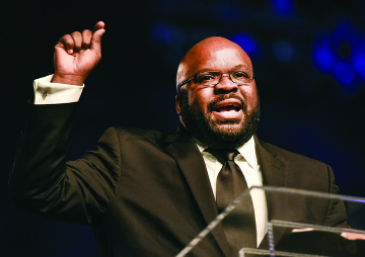
On the platform, SBC Executive Committee President Frank Page is presenting the gavel to SBC President Steve Gaines, who, tapping the ancient mallet gently on the podium, declares the meeting officially open.

And, after 21 days of fasting and prayer, Gaines begins explaining the rules for conducting business, and starting a meeting themed “Pray: For such a time as this.”

Pastor of the Memphis-area megachurch Bellevue, Gaines is expected to be re-elected to a second one-year term as president. Illinois’ own Doug Munton, pastor of First Baptist Church of O’Fallon, will complete his term as first vice-president.

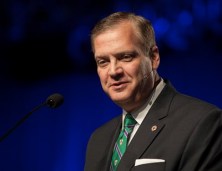
The main issue, as best we can tell, is whether messengers will bring any motions concerning the future of the SBC’s Ethics and Religious Liberty Commission, and its president, Russell Moore. Speculation among convention regulars is that the ERLC will not be chastised for actions in the 2016 election that perturbed some pastors and church members—but messengers can bring most any kind of motion.

The last opportunity for introducing new business will be at 3:45 p.m. (PT) today. Moore’s report is scheduled for Wednesday afternoon. It will be the last item of business.

Watch the livestream at http://live.sbc.net/.

-Eric Reed in Phoenix

The Briefing

Crossover & Harvest America share timeless Gospel message
More than 700 voices worshiped at North Phoenix Baptist Church in Phoenix, Ariz. on Friday, June 9, kicking off the weekend’s Crossover Arizona and Harvest America events. NAMB’s Crossover Arizona and Greg Laurie’s Harvest America joined forces to host a three-day evangelistic outreach involving training, street evangelism and service projects before culminating in Harvest America’s Sunday night crusade. By the end of that evening, Harvest reported 2,904 salvation decisions at the event with another 494 indicating decisions online.

100s of new churches not enough to satisfy Southern Baptists
Southern Baptists gained almost 500 churches last year, while taking in more than $11 billion. Such statistics would have most US denominations praising the Lord. But because of declines in other metrics that matter more—including their namesake, baptisms—leaders say members should offer lament instead.

Delaware legalizes abortion through all 9 months
Delaware gave pro-abortion advocates a rare but big win last week when Gov. John Carney signed a bill making it legal to kill unborn babies through all nine months of pregnancy. Proponents of the bill drafted it out of fear the Supreme Court might someday overturn the 1973 Roe v. Wade ruling that legalized abortion nationwide.

Trump: ‘It’s time to put a stop to attacks on religion’
President Trump told his political base of evangelical Christians that he would continue to restore the religious liberty many of them feel they’ve lost. “It is time to put a stop to the attacks on religion,” Trump said in a speech to the Faith and Freedom Coalition.

McDonald’s introduces gay pride fries in rainbow boxes
McDonald’s is serving its signature fries in cheerful rainbow-colored boxes at participating locations throughout the greater California Bay Area, as well as at some D.C. locations. The rainbow fries will be available throughout the month of June.

Sources: Baptist Press, Christianity Today, World Magazine, Religion News, Houston Chronicle

Phoenix map 1

It’s going to be hot enough in Phoenix without a squabble. Maybe we won’t see motions from the floor at the 2017 Southern Baptist Convention to defund the Ethics & Religious Liberty Commission or dismiss its president, Russell Moore.

There are several reasons for this new hope. First, both sides in the election-year dust up have offered conciliatory statements. Jack Graham, pastor of Dallas-area megachurch Prestonwood, announced his congregation would restore their Cooperative Program giving in April. The church had “escrowed” its SBC missions contributions while they examined complaints that Moore had criticized presidential candidate Donald Trump and those who planned to vote for him.

The complaints from the Texas church and others exposed some theological and political distance between ERLC leadership responsible for articulating Southern Baptist views in Washington and those Southern Baptists back home who fund them.

Similarly, the Louisiana Baptist Convention’s Executive Board studied “issues of concern” related to the ERLC. But recently, the board said “it has evaluated the complaints lodged against the ERLC, that its leadership has met with Dr. Moore and has sent a letter to the trustees of the ERLC and encourages the churches to continue their generous financial support for all our convention work.”

And there’s the action by Moore himself.

His tone toward Graham and Prestonwood Church may have helped. Moore explained that his comments about the election were never aimed at the Southern Baptist rank-and-file; and in explaining his actions, Moore never sought to defend himself.

More important, there’s word to this editorial team and others that the ERLC staff is making new efforts to connect with the grassroots. For example, Vice President for Communications Dan Darling appeared at the Illinois Baptist Women’s Priority Conference. (He addressed family issues in a declining culture.) The ERLC, fond of sending videos to state and regional events, is more likely to appear in person in the future. Now three years into their tenure, the ERLC leadership is learning that it should not get too far ahead of the people who sent them.

And, with the placement of the ERLC’s report last on the convention agenda, rather than on the first day as in years past, there may only be time to accept their mea culpa and move forward.

Eric Reed is editor of the Illinois Baptist.

HB Charles

Phoenix | Florida pastor H.B. Charles will be nominated to lead the 2018 SBC Pastors’ Conference in Dallas. Charles, pastor of Shiloh Metropolitan Baptist Church in Jacksonville, Fla., preached at the 2016 Illinois Baptist Pastors’ Conference.

Oklahoma pastor Brad Graves had previously been announced as a candidate for Pastors’ Conference president, but he withdrew his candidacy to clear the way for Charles. Graves told Baptist Press “it’s never a loss when you can join God in his work.”

The decision to nominate Charles stemmed from an informal gathering of past Pastors’ Conference presidents May 2 at which the group expressed a desire to nominate someone representing the numerous qualified pastors from ethnic minority groups, said former Pastors’ Conference President Ken Whitten. Charles would be the first African American to serve as Pastors’ Conference president.

Graves, whose candidacy was announced April 17, told BP the decision to withdraw from the election was “a big God moment,” adding no one pressured him to withdraw—except the Holy Spirit after a season of prayer. “I don’t want to be anything divisive” in the SBC, said Graves, pastor of First Baptist Church in Ada, Okla. “I think it’s time to show the culture that there is something that unites [Southern Baptists] more than just a Cooperative Program or a mission statement, but that we really do care for one another.”

Graves added, “Our convention is very diverse,” and Charles’ nomination “will help show how diverse we really are.”

Charles has served as pastor of Shiloh since 2008. The church, formerly a vastly African American congregation, became more racially diverse when it merged in 2015 with the predominantly white Ridgewood Baptist Church in Orange Park, Fla. While the Jacksonville campus remains predominantly African American, as much as 40% of Shiloh’s campus in Orange Park is Anglo, with a smattering of other ethnicities.

– From Baptist Press

SBC candidates

The slate of nominees for Southern Baptist Convention offices to be elected in Phoenix represent a push toward greater diversity in SBC leadership.

Walter Strickland, special advisor to the president for diversity at Southeastern Baptist Theological Seminary, will be nominated for the role of first vice president (currently filled by Illinois pastor Doug Munton). Strickland also teaches theology and operates a consulting agency to assist churches and organizations with diversity-related issues.

“As our nation and our convention become more diverse, it is imperative that our leadership reflect the diversity that marks the Kingdom of God and Heaven itself,” said Georgia pastor James Merritt, who will nominate Strickland. “Beyond that we need people in leadership that reflect the best of Southern Baptists theologically, spiritually, and personally.

“Walter Strickland meets both of these needs perfectly and I am excited about nominating him for the position of first vice president at our upcoming annual meeting in Phoenix.”

Also to be nominated in Phoenix is Jose Abella, pastor of Providence Road Baptist Church in Miami, Florida. Abella, one of the preachers at this year’s SBC Pastors’ Conference, planted the bilingual congregation in 2010.

“Jose is a loving picture of what Southern Baptists are working to become,” said Georgia pastor Michael Lewis in a news release about the nomination, “effective in an urban context, multiplying churches, reaching different generations, ethnicities and socioeconomic groups, all while being faithful to Scripture.”

A third SBC leader, John Yeats, will be nominated for office in Phoenix. Yeats is executive director of the Missouri Baptist Convention and will be nominated for his 21st term as SBC recording secretary.

First elected to the post in 1997, Yeats designed the process currently used to get information from the convention floor to the platform at the Committee on Order of Business, Baptist Press reported.

Yeats said he and his wife, Sharon, who serves beside him on the convention platform “are deeply honored by Southern Baptists to serve our Lord in this role.”

Steve GainesSteve Gaines, pastor of the Memphis-area Bellevue Baptist Church, will be nominated for a second one-year term as SBC president by his son Grant Gaines, pastor of Calvary Baptist Church in Jackson, Tenn. Gaines was elected last year after North Carolina pastor J.D. Greear pulled out of the race before a second run-off election.

For more information about the Southern Baptist Convention in Phoenix, go to sbcannualmeeting.net.

– From Baptist Press reports

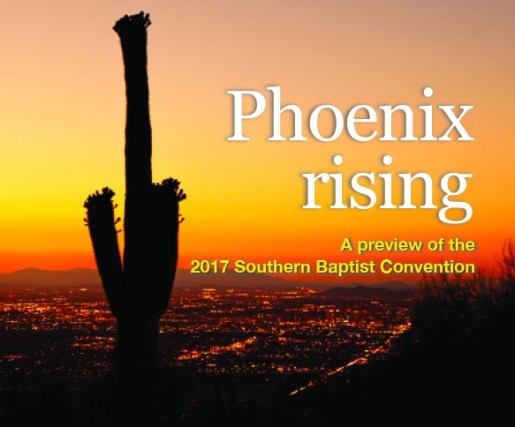
Phoenix rising

When Baptists gather in Phoenix next month, they’ll address the challenges of taking the gospel to a world that seems less inclined to hear the message, and doing so with fewer resources to get the job done.

Messengers to the Southern Baptist Convention June 13-14 will also meet against a very different political backdrop than a year ago, and could contend with the fallout of recent debate fueled by a raucous and divisive U.S. presidential election.

Or not.

Recent calls for Convention-wide unity—and similar statements by SBC leaders—could rule the day in Phoenix, where Baptists will focus on prayer, evangelism, and financial stewardship, said SBC President Steve Gaines.

“I believe Southern Baptists can be used of God to spark a mighty movement of prayer, evangelism, and discipleship across our nation and around the world,” said Gaines, pastor of Bellevue Baptist Church in metro Memphis, Tenn., in announcing the meeting’s theme. “Pray! For such a time as this” is based on Luke 18:1 and Esther 4:14.

“If we will pray and abandon ourselves to the Lord, he will use us exponentially to take the gospel to people,” Gaines said.
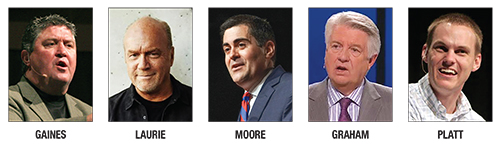
SBC personalities

Similar to the previous few annual meetings, Gaines said the 2017 gathering will include seasons of prayer, as well as a personal evangelism emphasis on Tuesday evening led by Greg Laurie.

The California evangelist also will lead a Harvest Crusade Sunday, June 11, as part of the annual Crossover evangelistic effort that precedes the Southern Baptist Convention (see Nate Adams’s column on page 2 for more information). Organizers say the event at University of Phoenix Stadium, which holds 65,000 people, promises to be the largest single gospel presentation in Arizona history.

Focus on stewardship
Following the example of previous annual meetings, the gathering in Phoenix will include a panel discussion with SBC leaders. This year’s topic: financial stewardship.

Gaines told Baptist Press Southern Baptist churches cannot give more to SBC missions and ministries than church members give through their local congregations.

“The solution for increased funding for world missions begins in the heart of every individual believer in Christ,” he said. “Southern Baptists need to get our financial houses in order.

The Cooperative Program—Southern Baptists’ unified giving channel for supporting missions and ministry around the world—is likely to be a topic of conversation in Phoenix as well. In February, Prestonwood Baptist Church in Plano, Texas, pastored by former SBC President Jack Graham, announced they would temporarily escrow their CP giving because of positions taken by the Ethics and Religious Liberty Commission.

ERLC President Russell Moore, a vocal critic of now-President Donald Trump during the campaign, has apologized for comments that seemed directed at all evangelicals who supported Trump, and the ERLC’s executive board released a statement in April pledging their support for Moore. The statement also called for unity in the SBC despite differences, a sentiment echoed by Gaines.

“I believe all of us who are recipients of grace and forgiveness should grant him the same forgiveness that we desire from the Lord,” Gaines said after Moore and the ERLC executive board released the statement. “It is high time that we put all of this behind us….It is time to move ahead and work together to double our efforts to take the gospel to our nation and the nations.”

If the recent controversy surrounding the ERLC does make an appearance at the SBC, it could be in the form of a motion from the floor, or during the Q&A time following Moore’s report, which is the final item on the meeting schedule. International Mission Board President David Platt could also face questions about the IMB’s support of a Muslim group’s fight to build a mosque in New Jersey. (Like the ERLC, the IMB also signed on to a friend of the court brief in support of the group.)

In February, Platt apologized for how “distracting and divisive” the brief was, and pledged that in the future, the IMB “will have a process in place to keep us focused on our primary mission.” Still, the mosque debate could spark a religious liberty conversation in Phoenix, as could President Trump’s controversial travel ban for people from some majority Muslim countries into the U.S.

Online pre-registration for the Phoenix meeting is now open at sbcannualmeeting/sbc17. Messengers and guests are required to be registered and properly badged in order to enter the general sessions June 13-14.

For more information about the Southern Baptist Convention’s June meeting in Phoenix, go to sbcannualmeeting.net.

– With info from Baptist Press

Nate Adams IBSA exterior

Nate Adams

In just a few weeks, thousands of church messengers will gather in Phoenix for the annual Southern Baptist Convention and its many related events and opportunities. Last year’s St. Louis convention drew 533 messengers from Illinois, our state’s largest representation since 2002. Only host state Missouri and nearby Tennessee sent more messengers, and I believe Illinois Baptists’ strong showing gave us a stronger than usual voice in the national convention.

It would be great to have as many Illinois messengers as possible in Phoenix, but if history is any indicator, distance and travel expense will reduce our numbers significantly. Even if you can’t travel that far west this year, let me share a couple of ways you can stay engaged with the larger SBC from right here in Illinois.

First, the convention itself and some related events will be live streamed via the Internet, providing a front row seat from your computer screen. Our IBSA communications staff will also be there, uploading the latest happenings to IBSA.org and giving you an Illinois perspective on news coming out of the convention.

You and your church can also participate in the evangelistic efforts that surround this year’s Southern Baptist Convention, and in a way that reaches out not only to Phoenix, but to your community as well. This year the SBC is partnering with evangelist Greg Laurie to bring the Harvest America Crusade to the University of Phoenix Stadium on Sunday evening, June 11.

In Phoenix or from Illinois, you can help share the gospel with half a million people.

While an estimated 65,000 people will gather in the stadium that night, the Harvest Crusade hopes to invite as many as 500,000 viewers through multiple simulcast locations, such as our churches and homes right here in Illinois. In a similar Harvest America Crusade in Texas last year, more than 24,000 people made professions of faith in Christ, many of them at the remote simulcast sites.

Might this Harvest America Crusade be something that your church would consider hosting on June 11, as a way of inviting your community to hear the gospel message, and participate in potentially one of the largest evangelistic events in American history? Or perhaps you would consider hosting a small group in your home, and using it as a conversation starter with friends for whom you have been praying.

Pat Pajak, IBSA’s associate executive director of evangelism, is already in communication with dozens of pastors and evangelism leaders across Illinois, asking them to consider hosting a simulcast location. If you would like information on being a host site on June 11, you can contact Pat directly at PatPajak@IBSA.org or (217) 391-3129.

It’s amazing to me that technology and a little planning and cooperation among Christians and churches can make it possible for a half million people to hear the gospel message at the same time. It also reminds me that we could do so much more to spread the good news about Jesus if we would leverage these same things more consistently in our churches.

For example, does your church have young people that could help you use social media more effectively in reaching your community, and beyond? Are there tech-savvy folks sitting in the back rows of your auditorium that could be invited to the front rows of service?

We can stay here in Illinois and yet engage the larger Baptist family as it gathers in Phoenix. We can stay in our churches or homes and yet be part of sharing the gospel with a half million people at once. And we can stay at our computer screens and help our church reach people in new ways through technology. Aren’t these amazing days, when God has given us the ability to go, even when we stay?

Nate Adams is executive director of the Illinois Baptist State Association. Respond at IllinoisBaptist@IBSA.org.

Steve GainesIt seems a fair question, especially following the loquacious and public presidency of Ronnie Floyd. Steve Gaines, by comparison, is almost invisible. This is not a criticism of Gaines, that he would have a different style as Southern Baptist Convention president. That is to be expected. Each president makes his own way and leads from his own strengths. But Gaines’s style, working in a less public way that his immediate predecessors, leaves us wondering: What is Steve Gaines doing?
And we find ourselves hoping that he’s focusing on issues that we just haven’t heard about yet.

Floyd wrote. Floyd spoke. A lot. Almost every week Floyd published on his blog and in Baptist Press his thoughts on righting the denomination and meeting the culture conflict head on. He quickly assumed a statesman position for his two years in office, urging support for missions and the Cooperative Program. We in the local Baptist news media came to rely on his thoughtful, well-reasoned analysis of current events.

Gaines, on the other hand, has spoken for publication rarely. He offered a few comments in the election season and after the January inauguration, mostly encouraging Southern Baptists to pray for the Trump Administration. And in February he addressed Baptist newspaper editors and state convention executive directors in Los Angeles. Gaines spoke on Trump’s election, appointments, and early actions as president. And he urged prayer for revival in America. Gaines has themed the 2017 SBC Annual Meeting “Pray: For Such a Time as This,” following Floyd and his predecessor, Fred Luter, in bringing Southern Baptists to our knees for spiritual awakening.

But it’s his comment on the complaints about the Ethics and Religious Liberty Commission and its president Russell Moore that, we hope, gives a glimpse at Gaines’s work behind the curtain.

“I hope the kind of talk we have been hearing is not the direction in which we are going. I hope Russell will remain in his position and that we have reconciliation with a lot of people,” Gaines said in Los Angeles. His comment came almost simultaneously with the announcement by Dallas-area pastor Jack Graham that his megachurch, Prestonwood Baptist, would be holding in escrow its $1-million offering through the Cooperative Program. Graham expressed concerns about the direction of the SBC and the ERLC, in particular, after an election cycle marked by anti-Trump tweets, Moore’s ongoing concern for refugees, and the “friend of the court” support of a freedom of religion case, in which both the ERLC and the International Mission Board (IMB) opposed onerous government regulations placed on a New Jersey mosque.

Southern Baptists do not need another era of suspicion, doubt, and sometime demagoguery. Our mission cause is too important to withhold funding over ancillary anxieties. The reconciliation that Gaines spoke about requires behind-the-scenes diplomacy and skillful mediation. That’s what we might hope Gaines is doing, even if we never hear about it publicly.

-Eric Reed is editor of the Illinois Baptist

face-the-nation-moore

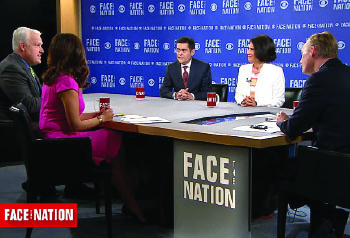
WELCOME TO MARS HILL – ERLC President Russell Moore joined a panel discussion on Face the Nation.

Russell Moore has the hardest job in the Southern Baptist Convention. He is required to speak on behalf of a people who take great pride in speaking for themselves, even (or especially) with the Almighty. It’s in our theology (priesthood of all believers). It’s in our polity (autonomy of the local congregation). It’s in our DNA (we’re preachers).

So when someone dares to speak for all of us, and says something we might disagree with, we bristle.

Some are bristling over Moore’s anti-Trump stance during the election. And, as the Wall Street Journal and NPR reported a month ago, some churches are considering withdrawing support for the Southern Baptist agency Moore heads, the Ethics and Religious Liberty Commission. Moore apologized for any ill will he caused, but has that settled the conflict?

Moore is two years into his presidency, succeeding Richard Land who served 25 years in the role. Land was brusque, but his views matched the vast majority of Southern Baptists’ on issues of religious liberty and sanctity of life, and we mostly agreed with him when he spoke for us.

But times have changed. As evidenced by Moore, a new generation is rising to SBC leadership, and they focus on different issues than their predecessors did. Moore has spoken to the church’s handling of refugees and the theology of adoption and gender issues—and politics.

Several questions arise from the murmurings about the ERLC:

Is the ERLC really out of touch with mainstream Southern Baptist opinion? Or are we finding, especially in this election cycle, that the world is more complex and even once-monolithic Southern Baptists have varying opinions on some issues—especially political issues?

Is this a squall that will subside as Moore finds a more modulated approach to his “spokesman-ship”? Or is there really a storm brewing?

Will older leaders assume the statesman role, and let younger leaders lead? Or, is there truly a divide among Southern Baptists among generational, geographical, educational, economic, or political divides that will not be bridged.

Time will tell, we suppose. But in the meantime—

We need the ERLC, and it shouldn’t be muzzled. The ERLC should still represent Southern Baptists in the public discourse on religious liberty, the church, and sanctity of life. True, some ERLC staff posted political opinions on their personal blogs and Twitter feeds during the election cycle. Their views might have been too easily mistaken for Southern Baptists’ as a whole. Only Moore should address the SBC’s core issues in the blogosphere or Twitterverse.

Stop the habitual tweeting. The tweet may be the lingua franca, but the 140-character debate hasn’t served the ERLC well lately. At times in 2016, we wondered if the ERLC really needed to express opinions on so many topics. Those who speak for Southern Baptists should not be reactionary, but instead offer considered opinions and measured words.

Finally, we should acknowledge generational differences and allow the hand-off to proceed. This is no longer the Land era. Younger Baptists may have a different perspective on some things, but, so long as their views are biblical, we must let them speak to their times—and ours.

-Eric Reed

Read more about this story, “Baptists debate politics, religious liberty, missions funding”

Editor’s note: This post has been updated to include a blog post/podcast from Albert Mohler.

Four  prominent Southern Baptists are taking public—and differing—positions on President Trump’s executive order that restricts immigration from seven Muslim countries, suspends entrance of all refugees for 120 days, and prevents all Syrian refugees from entering the United States indefinitely.  Commentary from both Russell Moore and Ed Stetzer was published in the Washington Post, while Ronnie Floyd and Albert Mohler are speaking out on their blogs.

61222russell_moore

Russell Moore

Russell Moore, the president of the SBC’s Ethics and Religious Liberty Commission, has begun commenting on actions by the new administration, after a relatively quiet December. He wrote a letter to President Trump, Vice President Pence, Speaker Ryan, and Majority Leader McConnell responding to the president’s order on refugees that the Post has exclusively on its opinion page.  In the Jan. 30 letter, Moore references the Resolution on Refugee Ministry passed by messengers to the 2016 Southern Baptist Convention in St. Louis. “’Scripture calls for and expects God’s people to minister to the sojourner.’ Southern Baptist churches throughout the United States lead the way in carrying out this calling,” Moore wrote.

Moore also expressed concern for the safety of Southern Baptists who, “are among the many Americans living in majority-Muslim countries to carry out the biblical call to love their neighbors.” He also called on the president to reaffirm his administration’s “commitment to religious freedom” and “adjust the Executive Order as necessary.”

Ed_Stetzer_PC

Ed Stetzer

Ed Stetzer, the former Executive Director of LifeWay Research who now serves as the Billy Graham Distinguished Chair at Wheaton College in Wheaton, IL, had his own op-ed published by the Post Jan. 26, “Evangelicals, we cannot let alternative facts drive U.S. refugee policy.” Stetzer agreed with the president on a need for a greater focus on national security however, he said, “I’m concerned that the president is operating on generated fear rather than facts. We need a better way.”

Stetzer’s better way is to “reject false facts,” “recapture a vision of what it means that all are made in God’s image,” and to “fight for those without a voice.”

Ronnie_Floyd_press

Ronnie Floyd

Ronnie Floyd, pastor of Cross Church and immediate past president of the Southern Baptist Convention, published, “Navigating through the refugee issue from a biblical perspective,” to his blog, RonnieFloyd.com. In his post Floyd declared, “If we do not look at it biblically, we enter into dialogue without authority and clarity.” He advised: Love the refugee, fix the immigration system, and pray diligently.

He too referenced the 2016 Resolution on Refugee Ministry, “…one line in this resolution that realized the biblical responsibility of government: ‘RESOLVED, That we call on the governing authorities to implement the strictest security measures possible in the refugee screening and selection process, guarding against anyone intent on doing harm…’”

Floyd, who served on Trump’s religious advisory board during the election, wrote, “This line was included in the resolution because as followers of Christ, we must understand the tension that occurs because our government has a responsibility it is mandated to fulfill.”

He concluded by asking Christians to stress balance in their reactions to what is taking place. “Believing and operating with biblical balance, we know the Church must realize biblically that the government’s duty is to protect its citizens. Simultaneously, we must affirm the responsibility of the Church to minister to refugees who are brought inside the borders of America.”

albert-mohler2

Albert Moher

Albert Mohler, president of Southern Seminary, devoted the January 30 edition of The Briefing to the controversy. He sought to clarify misconceptions many have concerning the executive order by pointing out the seven countries on the identified in the order are known terrorist threats. He noted several other countries have much larger Muslim populations and do not appear on the list.

“The entire system of laws in this country concerning our borders and entry into the country is a part of the government’s responsibility to keep the nation secure,” Mohler said.

Mohler compared previous immigrants who came not just to live in America but to be American, to the teachings of classical Islam. “It is not just what is often called radical Islam, it is classical Islam, it is the Islam believed by the vast majority of Muslims around the world that requires that every Muslim seek to bring every nation under the law of the Quran, under Sharia law.”

He cautioned, “The significant issue to observe here is that even though some who are coming in terms of these waves of Muslim immigration intend to join these communities and these cultures, the reality is that the majority of these immigrants and Muslims have not been assimilated into the cultures. To put it in terms of the American experiment, we have to be very careful that we do not reshape America by creating a population that does not intend, even though they are resident in this country, to be a part of the American project.” He pointed to the situation in Europe as an example of this reshaping.