Archives For November 30, 1999

HOUSTON | All three took center stage at different moments today in the Southern Baptist Convention Exhibit Hall.

The Southern Baptist Convention Exhibit Hall opened today, giving messengers a place to catch up with old friends, learn more about SBC agencies and partners, and meet a robot. (Keep scrolling down.)

The Southern Baptist Convention Exhibit Hall opened today, giving messengers a place to catch up with old friends, learn more about SBC agencies and partners, and meet a robot. (Keep scrolling down.)

IBSA Executive Director Nate Adams (center) visited the exhibits at Houston's George R. Brown Convention Center with his sons, Ethan (left) and Noah.

IBSA Executive Director Nate Adams (center) visited the exhibits at Houston’s George R. Brown Convention Center with his sons, Ethan (left) and Noah.

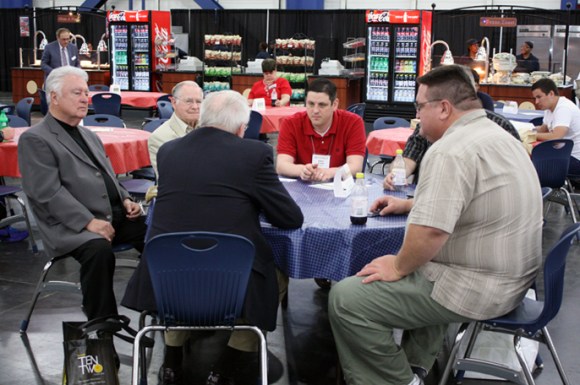
Illinois Baptist pastor Adam Cruse (center, in red) talked with friends in the exhibit hall, including Illinois' own Sons of the Father gospel group.

Illinois Baptist pastor Adam Cruse (center, in red) talked with friends in the exhibit hall, including Illinois’ own Sons of the Father gospel group.

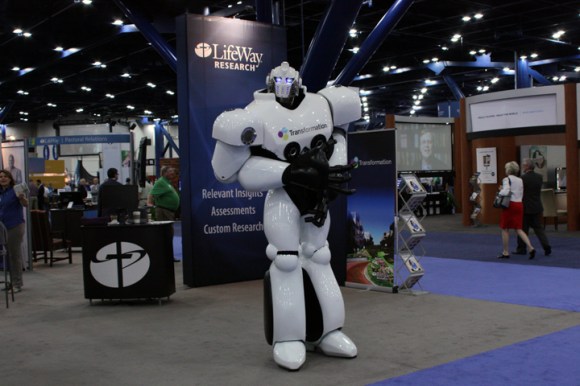
A walking, talking robot (or Transformer) greeted guests at the LifeWay Christian Resources booth, charming most and befuddling a few born before the 1980s cartoon. LifeWay's "Transformational Church" materials are designed to help strengthen congregations by measuring the signs of a healthy church.

A walking, talking robot (or Transformer) greeted guests at the LifeWay Christian Resources booth, charming most and befuddling a few born before the 1980s cartoon. LifeWay’s “Transformational Church” materials are designed to help strengthen congregations by measuring the signs of a healthy church.

People gathered in the hall to hear from the Calvinism advisory team appointed to study how Southern Baptists can cooperate across theological divides. The team's findings likely will be featured during the SBC Executive Committee's report tomorrow.

People gathered in the hall to hear from the Calvinism advisory team appointed to study how Southern Baptists can cooperate across theological divides. The team’s findings likely will be featured during the SBC Executive Committee’s report tomorrow.

Leo Endel, executive director of the Minnesota-Wisconsin Baptist Convention and a member of the advisory team, said, "When we talk about the unity, particularly in John 17 that Jesus prayed for, that is not the same thing as uniformity. And in fact, we become richer by the conversation that takes place across the spectrum."

Leo Endel, executive director of the Minnesota-Wisconsin Baptist Convention and a member of the advisory team, said, “When we talk about the unity, particularly in John 17 that Jesus prayed for, that is not the same thing as uniformity. And in fact, we become richer by the conversation that takes place across the spectrum.”

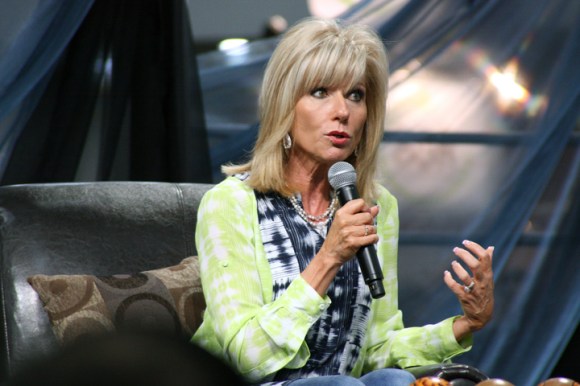
LifeWay's Ed Stetzer interviewed Bible study author and teacher Beth Moore about how she went from a substitute Sunday School teacher to a world-renowned speaker.

LifeWay’s Ed Stetzer interviewed Bible study author and teacher Beth Moore about how she went from a substitute Sunday School teacher to a world-renowned speaker.

In-depth Bible study "has been life out of the ditch for me," Moore told Stetzer.

In-depth Bible study “has been life out of the ditch for me,” Moore told Stetzer.


Fred Luter encourages listeners at the SBC Pastors' Conference in Houston.

Fred Luter encourages listeners at the SBC Pastors’ Conference in Houston.

HOUSTON | “Can I just share my testimony for just a minute?”

Southern Baptist Convention President and New Orleans native Fred Luter drew on his experiences  after Hurricane Katrina to encourage listeners at the SBC Pastors’ Conference June 9.

“One day you can be pastoring thousands and thousands of people, and the next day, you can be without a congregation,” Luter said, alluding to the storm that devastated his city and his church, Franklin Avenue Baptist.

“One day, you’re in a city where everybody knows your name…and the next day, you’re in the city where you’re only known by your FEMA number.”

Luter’s message, from Psalm 34, focused on taking heart when you get to “the other side of ministry,” when afflictions and trials of all kinds threaten to discourage and overwhelm the righteous.

“Every child of God sooner or later in life will face the other side of ministry,” he said.

He spoke like a pastor to the crowd assembled at Houston’s George R. Brown Convention Center, exhorting them to pay special attention to the word “but” in Psalm 34:19. “Many are the afflictions of the righteous, but the Lord delivers him out of them all.”

‘That word ‘but’ is a sanctified conjunction,” Luter said to laughter from the audience. “It negates everything that was said before.” He told the crowd that just when it feels like everything is about to go under, “God can put a ‘but’ in your situation.”

He ended his message with an illustration from his favorite movie franchise, James Bond. Animatedly, he described how the super spy manages to get himself out of every scrape he ever gets into. While watching a documentary one day about the making of James Bond movies, Luter said he realized how that was possible: The writers write it that way in the script!

Holding up his Bible and smiling joyously at the crowd, Luter said, “You know how I know you’re going to make it?

“It’s in the script!”

Hello, Bayou City!

Meredith Flynn —  June 9, 2013

NEWS | Meredith Flynn

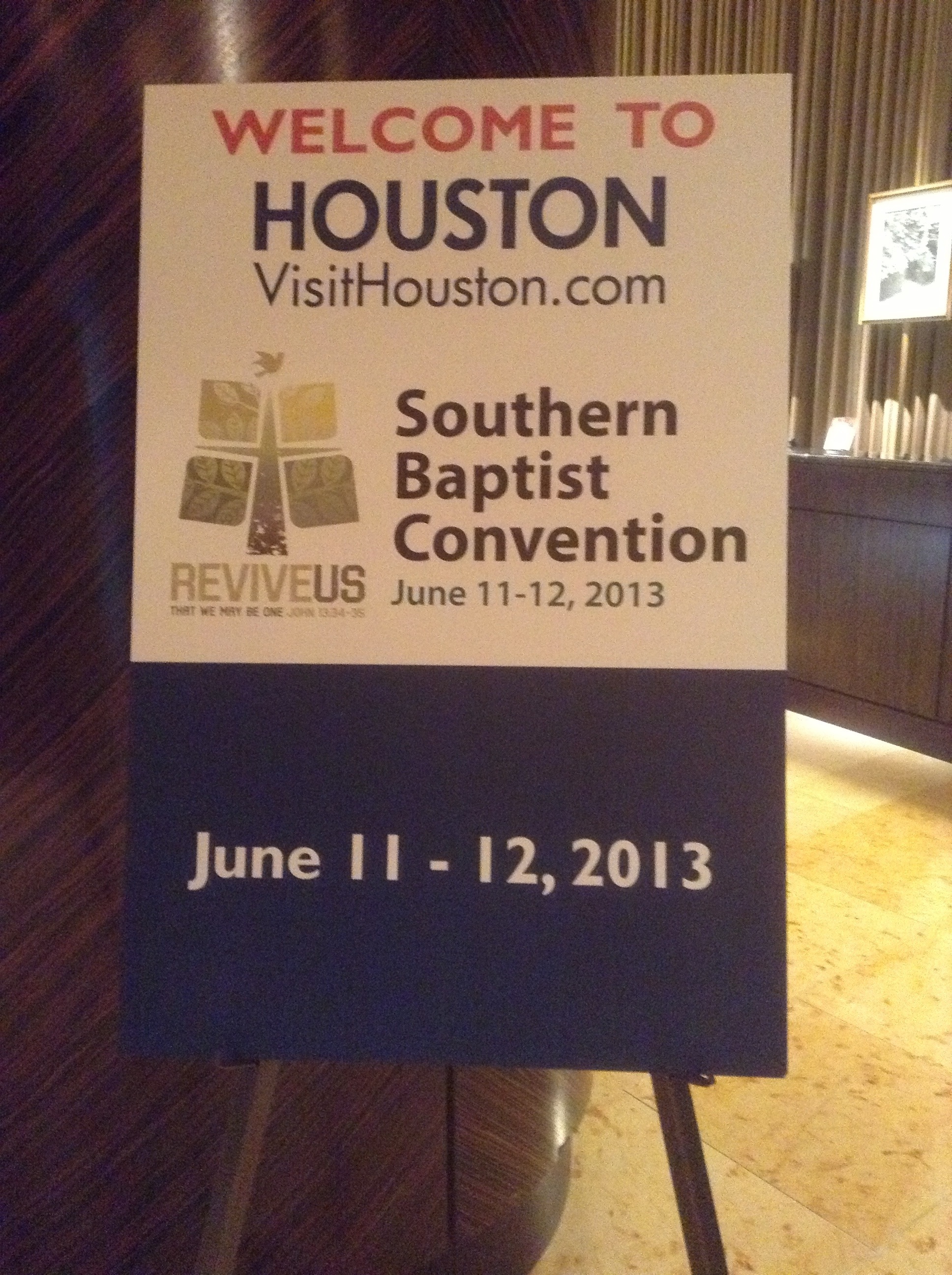
The Southern Baptist Convention will kick off in just a few hours, and the Illinois Baptist will be in Houston all week with live coverage here on ib2news.org, and at Facebook.com/IllinoisBaptist and Twitter.com/IllinoisBaptist.

We’re anticipating the re-election of Fred Luter, currently running unopposed, to a second term as SBC President. And in the wake of a report by the Calvinism advisory team that formed last year, Reformed theology could get a lot of attention from speakers on the platform and in the audience. SBC Executive Committee President Frank Page, who appointed the advisory team to study how Southern Baptists can cooperate despite theological differences, is likely to share the group’s finding during his report Tuesday.

Boy Scouts, marriage, and a continuing discussion of gender-inclusive language in the NIV Bible are other topics that could come up on the convention floor.

You can watch all the action, beginning tonight with the Pastors’ Conference, at sbcannualmeeting.net.

20130609-132448.jpg

Tuesday_BriefingUrges cooperation, unity around Baptist Faith & Message ahead of meeting in Houston

THE BRIEFING | Meredith Flynn

The advisory committee formed by Southern Baptist Executive Committee President Frank Page to study the divide over Reformed theology in the convention released its final report a week before the SBC was scheduled to hold its annual meeting in Houston.

Page assembled the group last August, after an annual meeting in New Orleans where Reformed theology was a hot-button issue. Much of the conversation then centered on the need to work together despite theological differences; Page wanted the team to help him develop “a strategy whereby people of various theological persuasions can purposely work together in missions and evangelism.”

The group’s 3,200-word statement outlines nine areas of theology that all Southern Baptists can agree on, and then tackles areas of disagreement within those issues. For example:

“We agree that God is absolutely sovereign in initiating salvation, uniting the believer to Himself, and preserving the believer to the end, but we differ as to how God expresses His sovereignty with respect to human freedom,” the report reads.

Pointing to one of the tenets of Reformed theology, the statement continues, “We agree that the Holy Spirit working through the Gospel enables sinners to be saved, but we differ as to whether this grace is resistible or irresistible.”

But those tensions shouldn’t hinder cooperation, according to the advisory committee, which was made up of people from both sides of the theological divide. Rather, “we urge Southern Baptists to grant one another liberty in those areas within The Baptist Faith and Message (BFM) where differences in interpretation cause us to disagree.”

Later in the report, the group points to the BFM, as adopted in 2000, as the confession that “is to serve as the doctrinal basis for our cooperation in Great Commission ministry.”

A report on the group’s work is expected during next week’s annual meeting, which begins June 11. In its closing words, the statement offers a challenge that could be especially important in Houston:

“If we stand together in truth, we can trust one another in truth, even as we experience tension. We can talk like brothers and sisters in Christ, and we can work urgently and eagerly together.”

Read the full report at BPNews.net.

-With reporting by Baptist Press

Other news:

Baptists expected to discuss Boy Scouts at annual meeting
Southern Baptist ethicist Richard Land told CNN there is a “100% chance” there will be a resolution to disaffiliate with Boy Scouts during the upcoming Southern Baptist Convention in Houston. “…And a 100% chance that 99% of people will vote for it,” Land continued. “Southern Baptists are going to be leaving the Boy Scouts en masse.” Boy Scouts of America recently voted to allow gay-identifying youth to be members. As autonomous churches, Southern Baptist congregations can choose their own course of action when it comes to Boy Scouts, but many will likely find it difficult to comply with the new policy, SBC spokesman Sing Oldham told CNN. “With this policy change, the Boy Scouts’ values are contradictory to the basic values of our local churches.” Read more on CNN’s Belief blog.

What does Illinois’ non-action on same-sex marriage mean for the rest of the country?The St. Louis Post-Dispatch asked that question in the wake of Rep. Greg Harris’ refusal to call the same-sex marriage bill for a vote before the Illinois House adjourned its spring session May 31. David Smith, executive director of the Illinois Family Institute, told the paper, “The momentum has been stopped.

“It shows that it’s not as popular with people as the national media is telling us.”

Smith added that the non-action in Illinois could be a “bellwether” for other states, especially those that don’t lean as far to the left. As the Post-Dispatch pointed out, “If gay marriage fails here, how would a state like Missouri ever even flirt with it?” Read the full story here.

One-third of Americans trust God more during suffering
A new study by LifeWay Research found 33% of Americans trust God more during times of suffering that seems unfair. The research, conducted after the devastating May 20 tornado in Moore, Okla., also found 25% of people reported being “confused by God” during such times, and 16% say they “don’t think about God in those situations.” Read more at LifeWayResearch.com.

THE BRIEFING | Meredith Flynn

The number of non-Anglo congregations in the Southern Baptist Convention has increased by more than 66 percent since 1998, according to data from the convention’s agencies. Of the SBC’s 50,768 congregations, just over 10,000 identified themselves by an ethnicity other than Anglo in 2011, up from 6,044 in 1998.

SBC President Fred Luter, elected last year as the convention’s first African American president, rejoiced over the shift.

“I remember at one time I was the only [African American pastor] in my city who was Southern Baptist,” Luter said. “I caught a lot of flack as a result of that. Thank God I’m able to see some of the fruit of my labor – not only at my particular church but in the associations and conventions across the country.”

In Illinois, one-fourth of Southern Baptist churches, missions and church plants identify either as an ethnicity other than Anglo, or as a multi-ethnic church.

“Having been Southern Baptist since 1969, and to see the changes and see the increase, it’s simply exciting to me,” said Don Sharp, pastor of Faith Tabernacle Baptist Church in Chicago. “I really get a good handle on it when I go to Black Church Week at Ridgecrest, N.C., and see the gathering of close to 2,000 who come there who are Southern Baptist.

“I remember some years ago when we went there, and there weren’t enough of us to fill up one little room.”

The largest jump in non-Anglo congregations within the SBC has predominantly come from an 82.7 percent increase in the number of African American congregations, but Hispanic congregations also have seen a significant increase over the same span – nearly 63 percent. And the number of Asian congregations affiliated with the SBC has grown by 55 percent. Read more at BPNews.net.

-From Baptist Press, with additional reporting by Meredith Flynn

Other news

Richard Blackaby says prayer is hard workWhile in Springfield to speak to directors of missions and associational leaders, author Richard Blackaby sat down with the Illinois Baptist for a Q&A on prayer and character development. Blackaby, who comes from a famously prayerful family (his father Henry co-authored “Experiencing God), said prayer is hard work.

“It must be, because so many Christians struggle with it. I mean, it’s not really hard to do, but it is a discipline because you’re talking to someone that’s invisible. You don’t hear His voice, and you’re busy, and you start thinking of all the other stuff you should be doing.”

The solution? Carving out unhurried time with God, to start with, Blackaby said. He also suggested writing out your prayers. “Not my prayer requests…but actually writing out in sentence form what I was asking God to do.

“I’d get my hands on it better when it was written out.”

For more of the IB‘s interview with Richard Blackaby, see the next issue of the Illinois Baptist, online Feb. 8 here.

Stanford opens religious liberty clinic
One of the country’s most prestigious law schools has opened the first legal clinic exclusively for religious freedom cases, Baptist Press reports. “It’s not needed because the U.S. is uniquely persecuting – it’s not,” said Stanford Law professor Michael McConnell. “I believe we are the freest and most welcoming country in the world … But we still be to fight and to think and to litigate and protect.” The clinic works like a small law firm, where students handle real cases under the supervision of a professor. Read full story at BPNews.net.

Help from above?
A survey by the Public Religion Research Institute found 27% of Americans believe God “plays a role in determining which team wins” in sporting events. And 53% believe God “rewards athletes who have faith with good health and success.” Institute CEO Robert P. Jones told CNN that many Christians believe in “a God that is very active in their daily lives and very concerned about the things that matter to them. So far as sports are one of the things that matter, it stands to reason that God is playing an important role.” Read more on CNN’s Belief blog.

COMMENTARY | Posted by Meredith Flynn

LifeWay Christian Resources recently released the Annual Church Profile, a statistical picture of the health of Southern Baptist churches and denomination as a whole. There was some good news: slight increases in baptisms, total number of churches, and giving. But also some bad news: a nearly 1% decline in total membership (from 16,136,044 million last year to 15,978,112 this year). It’s the fifth straight year total membership of SBC churches has dropped.

More concerning, said LifeWay Vice President Ed Stetzer, is the rate of decline. In a Baptist Press column June 13, Stetzer wrote total membership has declined 2% since 2007, including nearly one whole percentage point this year. “This trend points to a future of more and faster decline — and it is a 60-year trend.”

Rather than manage the decline like other denominations, Stetzer said, there are some steps Southern Baptist pastors and leaders can take to “fight for our future.” Four steps he suggests:

1. Rally around the things we agree on under the Baptist Faith & Message, and refuse to engage in battles over secondary issues that will only end in further division.

2. Raise up new leaders who represent a variety of ethnicities and generations.

3. Reach more people. “Southern Baptists love evangelism, as long as someone else is doing it,” Stetzer wrote. “But ‘someone else’ is not doing it either. Every year, it takes more Southern Baptists to reach one lost person, as the member to baptism ratio shows.”

4. Plant more churches by equipping and then supporting church planters.

Now it’s your turn: How can leaders, pastors and members of Southern Baptist churches help reverse the denomination’s trend of decline?

THE BRIEFING | Meredith Flynn

In his own words: David Platt on the ‘sinner’s prayer’
David Platt has released two blog posts to explain his views on recent debate surrounding the “sinner’s prayer.”

Platt, pastor of The Church at Brook Hills in Birmingham, Ala., sparked controversy in a YouTube video earlier this year in which he called the prayer “superstitious,” and also delivered an intense message on the topic at the Southern Baptist Pastors’ Conference.

In the posts, Platt combats media accounts that he is “against” the sinner’s prayer, or that the issue stems from Reformed theological views that some people don’t have a chance for redemption in Christ.

“…Words really can’t describe how much a comment like this pierces my heart, for nothing (I hope and pray) could be further from the truth,” Platt wrote in the first post. “Any cautions I have expressed with a ‘sinner’s prayer’ have absolutely nothing directly to do with the doctrine of election, and I definitively don’t believe that certain people ‘actually have no chance for life in Christ.’”

So, does the sinner’s prayer ever fit into an evangelism strategy? Platt’s second blog post outlines the plan he teaches in his church’s evangelism and missions class, including how to lead someone to call out to God in repentance and belief. Read both posts at radical.net/blog.

Religious groups pledge to stand firm despite healthcare decision
After last week’s healthcare ruling, opponents responded to the Supreme Court’s decision to uphold the 2010 law, which requires insurance plans to cover contraceptives and sterilizations without cost to employees. O.S. Hawkins, president of GuideStone Financial Resources, said GuideStone “will never allow this Administration, or any other, to tell us that we have to provide abortive drugs like morning-after pills. … We will maintain our advocacy on behalf of ministers we are privileged to serve.” To read more about the Supreme Court’s decision and the fallout, go to bpnews.net.

What does the average American think about the Bible?
A new Barna study says younger adults are less likely to perceive the Bible as relevant and useful when compared with older adults. The 2012 State of the Bible survey, conducted by Barna for the American Bible Society, also found nearly half of Americans believe the Bible contains the same truths as the Koran and the Book of Mormon. Read more findings here.

Disaster Relief volunteers mobilize for action in Colorado, Florida
As monster wildfires rage in Colorado and other Western states while Hurricane Debby leaves massive flooding behind in north Florida, Southern Baptist Disaster Relief leaders are busy mapping responses in both parts of the country. Read more at bpnews.net.

Teen carries carries cross from Texas to Washington – on foot
Junior Garcia, a 19-year-old from Saginaw, Texas, has received permission to set up a 12-foot cross in Lafayette Park, across the street from the White House. And’s he’s taking it there by foot. Garcia and a team from Oasis International Church set out on “The Journey” June 7, and will hold a prayer service in the park to celebrate the end of their trip. Read the full story at christianpost.com.

By Nate Adams, IBSA Executive Director

I can usually measure the value of a meeting by the follow-up actions I note for myself as a result of it. If I don’t write anything down, the meeting was probably pretty pointless. If the meeting moves me to action or change, it may have been worthwhile.

So let me share with you a few of my follow-up notes from the recent Southern Baptist Convention in New Orleans, at least as they relate to the major issues discussed at this year’s annual meeting. You can read about these issues in the July 2 of the Illinois Baptist or at IBSA.org.

My notes about the informal name “Great Commission Baptists” as an alternative to “Southern Baptists” could be summarized simply by the phrase “wait and see.” Clearly a large number of churches feel that having an alternate name, even an optional one, is not a positive thing. But the majority that voted to endorse the alternate name gave those who wish to try it out a new tool to potentially reach people for whom the term “Southern” may be a barrier.

For now, I plan to “wait and see” how many churches embrace the new name, especially here in the Midwest. I suspect we will continue using the “Illinois Baptist” identity in our communications more than either of the others.

My notes about the various issues that have the Calvinist vs. Arminian theology debate at their root simply say, “stay above the fray.” Both outgoing President Bryant Wright and SBC Executive Committee President Frank Page served us well, I thought, when they essentially stated that the Baptist Faith and Message is big enough for both strains of theological thought, and that there is more danger in our heart attitudes about either position than in the doctrinal differences themselves.

Some time ago I came to the personal conclusion that Calvinist theology describes salvation more from God’s perspective outside time, and that Arminian theology describes salvation more from man’s perspective within time. I’m sure that those for whom that explanation is not sufficient will continue this centuries-old debate. I plan to try and stay above the fray of that argument, and pray it does not distract us from our far more important Great Commission task.

Finally, you may not think I need follow-up notes from the election of Fred Luter as the SBC’s first African American president. But I found I did. Tuesday night, just after Pastor Luter’s election, I attended a dinner with the African American Fellowship of Southern Baptists that included SBC entity executives and state executive directors like myself from all over the country.

Even during that dinner, I formed several follow up notes for myself: Don’t just sit with people you know – get to know some new African American brothers and sisters. Learn to understand and appreciate the history and the pain, the culture and the passions of African American churches and their leaders, especially those that have chosen to be part of the Southern Baptist family. Relax and enjoy different worship and preaching styles – God wants to speak to you through those too! Recognize how important it is to make sure African American leaders are participating in Southern Baptist life, both in key discussions and in key leadership positions. Develop more personal, not just professional, relationships with African American pastors and leaders.

As I said, I can measure the value of a meeting by the follow-up actions I note for myself. If the meeting truly moves me to action or change, it may have been worthwhile. My follow through on these notes has the potential to make this year’s SBC meeting truly worthwhile. I hope these notes for needed future action help you too.

(Editor’s note: New Orleans in Rear View. Now that we’re back home, our Illinois Baptist news team reflects on the question: What is the lasting value of the 2012 SBC?)

 Posted by Meredith Flynn

David Platt, pastor of The Church at Brook Hills in Birmingham, Ala., delivers a Pastors' Conference message in New Orleans on true repentance and salvation.

David Platt, pastor of The Church at Brook Hills in Birmingham, Ala., delivers a Pastors’ Conference message in New Orleans on true repentance and salvation.

Before the convention, many (especially us press types) were buzzing about how a growing debate over Reformed theology might come up from the floor. The answer: It didn’t really pan out like we thought it might, at least in terms of a heated debate.

Instead, Pastors’ Conference speakers and panelists at some of the surrounding meetings encouraged Southern Baptists to work together, even if it means crossing theological lines. And some, most notably Alabama pastor David Platt, spoke passionately about the bigger fish we have to fry.

During his message Monday afternoon, Platt referenced a YouTube video from a message he preached at an inter-denominational conference earlier this summer. On the widely-watched video, Platt said the sinner’s prayer is a “superstitious” prayer that never appears in Scripture, and called into question some traditional evangelism methods.

In his message at the Pastors’ Conference, Platt admitted that as a young pastor, he would be wise to watch his words. But then he stayed true to what he said briefly in the video, pleading with Southern Baptists to preach the true Gospel, full of the messages of repentance, belief, discipleship, and global mission.

Two days later, after some debate on the convention floor, messengers approved a resolution upholding the “sinner’s prayer” as a biblical means to salvation.

How we lead people toward a saving knowledge of Christ, and where we find the conviction of our own salvation, is the most important conversation we can have, in my view. I’m grateful for the discussion, and look forward to watching and listening as God moves us closer to His heart for people.

(Editor’s note: New Orleans in Rear View. Now that we’re back home, our Illinois Baptist news team reflects on the question: What is the lasting value of the 2012 SBC?)

Posted by Eric Reed

Parents watch the convention proceedings from the "stroller section," a cordoned-off area for families with young children.

Parents watch the convention proceedings from the “stroller section,” a cordoned-off area for families with young children.

Descending the escalator on the final day of the convention, I watched on the floor below me as a four-year-old had a meltdown. He wasn’t alone. His sister, a couple of years younger, perched in a carrier seat atop a stroller, teared up, and eventually wailed.

I felt the same way. We were all tired. The only difference between us was, I couldn’t get away with a meltdown.

Landing at the foot of the two-story escalator, I was suddenly in a sea of small children. “Don’t run!” the father of one said futilely. “There are grown-ups here.”

Really?

Not as many grown-ups as children, it seemed at times. This was a convention of young people. Once the domain of people with hair in various shades of gray and blue, this gathering was marked by a large percentage of young adults, many of whom bought their families. (There were strollers everywhere, even a “stroller section” roped off near the platform.) And their presence was felt in all the proceedings of the convention.

Perhaps the Pastors Conference foreshadowed a shift we should notice. Opening on Fathers Day, the line-up included sons introducing their better-known fathers as conference speakers. “Dad’s gonna bring the heat!” one son said before his father preached. But in one notable reversal, it was the father, a former convention president, who introduced his up-and-coming son. There was a changing of the guard, it seemed.

The most challenging and emotionally gripping moments among the pre-meeting sermons came from the youngest preacher, in his early 30s.

The debate over use of “the sinner’s prayer” started with young people, as an older generation’s tried and accepted method is challenged. 

And it is young people who raised debate over Reformed theology and Calvinism. A young pastor (age 40, son of a past SBC president) drafted a response and coined the phrase “Traditionalists” to describe his (and many elders’) Southern Baptist theology.

Many messengers speaking from the floor mics during the business sessions were younger pastors. 

This emergence of young people in SBC life was clearest at the Baptist 21 panel discussion (and turkey po-boy lunch). “21” in the name refers to 21st century, but it might have characterized their age. Fully half the people in the SRO crowd of nearly 1,000 were in their 20s and 30s.

For watching the panel discussion, the Conservative Resurgence of the 1980s was ancient history. Like WW2. Many of them were not born at the time today’s senior convention leaders stopped what they described as a left-leaning drift and returned the denomination to biblical inerrancy. For these young people, Judge Paul Pressler and Dr. Paige Patterson are historical figures to be honored (which they were at the luncheon).

For a few minutes in New Orleans, the convention’s past met its future. And it was clear in that moment that this is not your grandfather’s SBC.

Or even your father’s.

It belongs to the kids.