Archives For November 30, 1999

Southern Baptist Convention

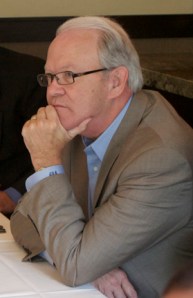
Church planter Scott Venable (second from right) shares about the process of starting Mosaic Church in Wicker Park, during a listening session hosted by SBC Executive Committee President Frank Page.

Church planter Scott Venable (second from right) shares about the process of starting
Mosaic Church in Wicker Park, during a listening session hosted by SBC Executive Committee
President Frank Page (photo below).


NEWS | Frank Page
is president of the Southern Baptist Convention’s Executive Committee, but he also carries the title CEO, which he has often said means “chief encouraging officer.” Operating in that role, Page joined pastors and church planters in northern Illinois for two “listening sessions” in August.

Throughout the year, Page has met with leaders in several states. In Chicagoland, he and members of his staff hosted church planters at a luncheon in Edgewater to discuss specific ministry challenges related to planting in the city. They also were at Broadview Missionary Baptist Church for a session with more than 50 leaders.

“I think the key is building relationships and building trust,” Page told SBC Life about the listening sessions. “It’s time to build some momentum on correct relationships.”

Broadview Pastor Marvin Parker said he was impressed Page “is taking the time to go around the country, to hear what SBC pastors are talking about.” In the Chicago sessions, Page and leaders addressed several issues:
Page_blogChurch size and diversity. Page previously has called small churches the “backbone” of the convention. In the session at Broadview, he told leaders that a large majority of Southern Baptist churches run 100 people or less, said Pastor Don Sharp. “And to me, that’s a story that needs to be told over and over and over again,” said Sharp, pastor of Faith Tabernacle Baptist Church in Chicago.

“…We hear these stories of people coming in places and [the] membership’s quadrupled and the baptisms are off the board, so to speak, but it doesn’t speak to many of us” pastors of small churches, Sharp said. Faced with the comparisons, leaders can fall into fear that they’re the reason their church doesn’t measure up.

“If nothing else, I came out of that meeting with a sense of, ‘Keep doing what you’re doing, and leave room for God to do the rest.’”

The group also discussed diversity in the SBC, and the need for more ethnic groups to be represented in convention leadership, Sharp said. He paraphrased Page’s words: “The election of Fred Luter (as the SBC’s first African American president) should not be an anomaly…it shouldn’t take another 30 or 40 years for something like that to happen again.”

Cooperative Program education. The CP is Southern Baptists’ main method of supporting missions around the world, but it doesn’t have a Lottie Moon or Annie Armstrong to help promote it. “One of the keys for the future is to somehow put a face on the Cooperative Program,” said IBSA’s Dennis Conner during the Edgewater meeting of church planters. “We are deep into a cultural shift where people want to know the people they support.”

That challenge is something his team deals with every day, Page said, asking for ideas. The planters suggested using social media or daily news briefs to connect Southern Baptists with missionaries they support through the Cooperative Program.

The Executive Committee’s Ashley Clayton suggested a more foundational plan to help communicate the importance of CP giving in the next generation. “Perfunctory” support for CP has been tailing off for several decades even among older Baptists, Clayton said. There’s a need to elevate again Baptists’ core values, like international missions, reaching unreached people groups, planting churches, and theological education.

“These are core values, that when you say it in a room full of pastors, they nod their heads, they’re in agreement, they go, ‘Yeah, I’ll support that.’”

The Chicago challenge. Also in Edgewater, Page heard from Chicagoland church planters about how long it often takes to grow a church. Michael Allen, city coordinator for Send North America: Chicago, said he tells planters, “When you come to Chicago to plant a church, buy a cemetery plot.”

“In other words, don’t come to Chicago thinking I’m going to try this church planting thing and see if it works out….Many [church planters] who start do not last, and I think primarily they didn’t realize just how hard the ground is, and how much gumption you have to have.”

Page told the leaders around the lunch table that he understands the role of a sponsoring church pastor, but hasn’t had personal experience as a church planter. “I don’t even pretend to understand what you might be going through,” he said.

“I will tell you that what I hear, what I’ve seen in the past four to five years, is that things are changing across our nation….Even in the deep south, we’re seeing an encroaching lostness in some areas that is profoundly more than what you might think.”

The planters and Page discussed the temptation church planters have to move to a new place with the hope of winning the city, but without really understanding its culture and context.

Page said he was praying for “an indigenous move of God, that native Chicagoans will be able to reach the city for Christ, in addition to those that God does bring in from the outside that has called, and equipped, and [that] have the staying power to get it done.”

COMMENTARY | Meredith Flynn

The Southern Baptist Convention’s summer annual meeting traditionally is a time for Baptists to make big statements together. And, in the past, many of those decisions have made a splash with national media.

The attention in those years made the annual meeting feel like a major event that held import for a large part of the culture, and not just for messengers meeting in the Convention city.

But this year’s Convention in Baltimore didn’t get that kind of reaction. Even the buzziest issues – a resolution on transgender
identity and possible action concerning a California church – received relatively few mentions from national media.

The quiet raises a question for Baptists: Was 2014 the year the SBC dropped off the national radar?

Throughout the years, SBC stories have dominated national headlines: The return to conservative theology in the 1980s, the decision to boycott Disney in 1997, and the election of Fred Luter as the SBC’s first African American president two years ago. We’ve made it a practice to include several bits from other media in the Convention issue of the Illinois Baptist, to widen our paper’s perspective and answer the question, “What do they think about what we think?” Reading the national news coverage
can be enlightening and a little dangerous, kind of like Googling your own name.

When we went to gather information for the section this year, we came up empty. There were a few stories about the resolution to affirm that gender is determined by biological sex, rather than self-perception. And some writers commented before the Convention about the likelihood of action against a California church that recently voted to change its stance on same-sex relationships. But it was nothing like in years past, when national coverage of the Convention was extensive.

The lack of attention seems to confirm fear that the SBC’s influence is waning. Or maybe it’s shifting.

One columnist did write a thorough piece on the SBC, just prior to the meeting in Baltimore. In a piece for Religion News Service, Jacob Lupfer said, “A generation after the ‘Conservative Resurgence,’ the SBC has capitalized on its remarkable unity….This is not to say there are no matters of controversy, but the nature and scope of disagreements make doctrinal and ideological cohesion – not infighting – hallmarks of today’s Southern Baptist Convention.”

Remarkable unity, doctrinal and ideological cohesion. A mouthful of a headline, but good news for Southern Baptists.

Meredith Flynn is managing editor of the Illinois Baptist newspaper.

Fred_Luter_revivalCOMMENTARY | Eric Reed

I’ve never been prouder – of Fred Luter or of the Southern Baptist Convention – than when, on the second day of the annual meeting in Baltimore, they suspended the agenda and spent most of an hour in prayer.

Will this be Bro. Fred’s lasting contribution to the SBC, I thought to myself, that he was willing to lay aside the fixed orders of business, to call us all to our knees, and to take our deep needs to the Lord?

Two years earlier, I sat on a bench in the cavernous lobby of the New Orleans Convention Center talking with a pastor-friend of mine. He’s African American. I seemed more excited by Luter’s election that day than he did. I posed a question about the new president’s lasting impact.

“We’ll have to wait and see,” was his response. “Will this be a one-time thing, or has the Convention really changed? Is there room for me in leadership?”

That has been the response of several people I’ve asked since then, even Luter himself. Many people, especially African American pastors, said they wanted to see what happened after Luter’s term. Would he really be able to increase the ethnic diversity on SBC boards and in leadership? Would there be a lasting place at the table for black, Hispanic, and Asian leaders?

Under Luter’s direction, the committees responsible for manning those boards have attempted to broaden representation. In fact, messengers at the Phoenix convention in 2011 had ordered the start of such a concentrated effort even before Luter’s election as the SBC’s first African American president.

It was good to see several African American pastors on the platform in 2014: Southern Seminary Professor Kevin Smith spoke for the Resolutions Committee. Chicago’s very own Marvin Parker of Broadview Missionary Baptist Church served with the Committee on Order of Business and Michael Allen of Uptown Baptist Church was elected “back-up preacher” for the 2015 annual meeting.

But it took a messenger from the floor to confirm what those watching the live video stream had noticed. There was not a lot cultural diversity on the worship platform. The messenger moved that the music teams next year be more diverse, because, he noted, while the choirs and bands were almost all white, the Convention isn’t anymore – and heaven won’t be either.

I saw a similar message in the official photograph of the incoming SBC officers: five middle-aged white guys in dark suits. Except for one goatee, that photograph could have been snapped in 1974.

Or 1954.

We missed an opportunity to extend Bro. Fred’s impact. Korean-American pastor Daniel Kim ran for president, and his showing as a late-entry against winner Ronnie Floyd was respectable. But both first and second vice-presidents ran unopposed. Why? Because no one else stepped up.

Fred Luter’s lasting impact may not be that he radically altered the composition of committees or platform personnel. Instead, he demonstrated the door is open and there’s room at the table. And he was willing to take the risk.

As a pastor in New Orleans, Luter suffered jeers for his embrace of the historically white denomination. And before he agreed to run for SBC president in 2012, one advisor warned, “Look at the racial make-up of the Convention, Fred. You might lose.”

But he won. In a big way. Unopposed. Twice. To cheers and tears and shouts of joy from a whole lot of people glad that a new day had arrived for Southern Baptists.

Successor Floyd called him “the most beloved president” in recent SBC history. Luter traveled widely and preached in churches of all sizes and ethnicities. He embodied the new spirit of the SBC, and he did it with characteristic joy and grace. For all that, he is deservedly and deeply appreciated.

But, for me, Fred Luter’s lasting impact is that he was willing to step up.

Eric Reed is editor of the Illinois Baptist.

Nate_Adams_blog_callout_JuneHEARTLAND | Nate Adams

One big event that pulls many of us together each June is the annual Southern Baptist Convention. This year’s gathering in Baltimore was filled with inspirational music, messages and reports. But at its core, the annual SBC is a business meeting where messengers from autonomous churches gather to affirm or determine how they will cooperate.

Those messengers elect board and committee members. They agree on how to invest shared resources in missions and ministry. And they declare to one another and to many onlookers the biblical truths on which they will continue to stand.

It’s a big event with big consequences. But the reality is that there are relatively few messengers at the annual meeting compared to the number of churches and church members that cooperate as the Southern Baptist Convention. Most of us trust a few of us to determine which leaders, strategies, and priorities should direct the resources that we all have shared.

That’s why I would argue that the real big event for Southern Baptists does not take place in a convention center, or in a single city, or even on the same day. The real big event that determines at least the financial strength of our Great Commission cooperation happens in multiple locations at multiple times. It’s called the local church business meeting. That is where each church determines the percentage of its budget that will go through the Cooperative Program to support Southern Baptist missions and ministries. And that is the “big event” that really determines the degree to which we will cooperate in fulfilling our shared, Great Commission purpose.

For more than 20 years now, the percentage given by all SBC churches through the Cooperative Program as a percentage of undesignated giving has ever so slowly declined. It’s only been a fraction of a percent each year. But over time, national CP giving as a percentage of churches’ undesignated giving has declined to 5.4%, when it used to be almost 11%.

Here in Illinois, our churches are doing a little better than the national average. IBSA churches’ CP giving is about 7% of their undesignated gifts. But that is still well below the level being given 20 years ago.

There are some indications, however, that the trend in CP giving may be on the verge of a reversal. Annual Church Profile data for 2013 was recently released, revealing a second consecutive year of uptick rather than decline in national CP giving. The “One Percent Challenge” that Dr. Frank Page has been championing for 2-3 years now appears to be gaining traction, and numerous churches are accepting that challenge to intentionally increase the percentage of their CP giving.

Other churches are starting to give a percentage of their offerings, rather than a flat amount. It’s only two years, but it’s enough to encourage optimism that churches may be recapturing their vision for the power and effectiveness of cooperative missions giving.

So whether you were able to attend the big event of the Southern Baptist Convention this year or not, I hope you will consider attending the big event of your church’s business meetings, especially the one where the annual budget is discussed. Challenge your church to be one that’s helping reverse the trend by increasing your commitment to SBC missions and ministries through the Cooperative Program.

The Big Event of all history, of course, will be that day when Jesus returns and our Great Commission task as His church draws to a close. All our churches’ big events should anticipate and point to that one. And our churches’ business meetings are a good place to start, because that’s where we can choose priorities that demonstrate we believe He’s coming back soon.

Nate Adams is executive director of the Illinois Baptist State Association.

The_BriefingTHE BRIEFING | Meredith Flynn

Ronnie Floyd, elected president of the Southern Baptist Convention last week in Baltimore, is calling on Baptists to rally in Columbus, Ohio, next summer to pray together for spiritual awakening.

“As I work with our Order of Business Committee as well as other leaders, I will respectfully request that we dedicate as much time as possible in next year’s convention to pray extraordinarily for the next Great Awakening,” Floyd wrote in a June 16 column for Baptist Press. “I want to call you to Columbus to what could be one of the most significant prayer gatherings in our history.

Floyd, pastor of Cross Church in northwest Arkansas, said in Baltimore that America’s greatest need is a great awakening. Prior to the convention, he organized two national gatherings for Baptist pastors to pray together.

“Our convention has bemoaned our decline in baptisms, membership, attendance and giving far too long,” Floyd wrote. “Now is the time for us to take aggressive action by calling out to God together in prayer.

“At the same time, we must take the needed strategic actions to change our trajectory as a convention of churches. While we face these critical times, we know God is doing some amazing things right now through Southern Baptists. As we celebrate those to the glory of God in Columbus, we will also call out to God in urgent desperation.”

Read Floyd’s column at BPNews.net, and click here to read more of the Illinois Baptist’s coverage from Baltimore.

Stanley explains tweets during SBC meeting
Georgia pastor Andy Stanley sparked a long online conversation when he tweeted during the Southern Baptist Convention’s annual meeting, according to a Christian Post report. The Baltimore meeting focused heavily on revival and spiritual awakening. Stanley, pastor of North Point Community Church in Alpharetta, was not at the meeting but tweeted on the topic several times, including, “Instead of praying for revival leaders of the SBC should go spend three weeks with @perrynoble Why pray for one when you can go watch one.”

Stanley was referring to Pastor Perry Noble of New Spring Church in South Carolina. He told The Christian Post that in the tweet and others during the meeting, he was referring to revival in the local church, rather than in a great awakening sense. “I can understand the confusion and I definitely contributed to it,” said Stanley, who still exhorted the local church to take actions that can lead to spiritual awakening.

“I love the local church. And I’ll admit I get a bit stirred up when I hear church leaders talk about the need to reach more people while refusing to make the changes necessary to actually get the job done.” Read more at ChristianPost.com.

Millenials tell Barna: Top 5 things to do before 30
Barna’s recent study of Millenials – “20 and Something” – delves into what the generation believes about life and work. Including the five things they most want to accomplish before they turn 30: gain financial independence (59%), finish their education (52%), start a career (51%), find out who they really are (40%), and follow their dreams (31%). Read more at Barna.org.

Be fruitful, says Pope
After celebrating Mass with 15 married couples at the Vatican, Pope Francis warned against childlessness. “It might be better – more comfortable – to have a dog, two cats, and the love goes to the two cats and the dog,” he said, according to a report by Religion News Service. “Then, in the end this marriage comes to old age in solitude, with the bitterness of loneliness.”

The pope’s remarks came on the heels of a report that Italy’s birth rate fell to a record low in 2013. The U.S. birth rate hit a record low in 2012, but about 4,700 more babies were born in 2013, according to the Centers for Disease Control and Prevention.

List locates world’s most persecuted countries
Christians face the worst persecution in North Korea and Somalia, according to the 2014 World Watch List. For 12 years, North Korea has topped the list released by non-profit organization Open Doors. Syria, Iraq, Afghanistan, Saudi Arabia, Pakistan, Iran and Yemen also are in this year’s top 10, along with the Maldives, a chain of islands off the coast of India.

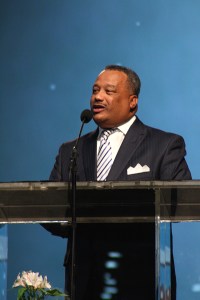
Luter preached on revival that begins with prayer. "If there is any hope for spiritual renewal in America, that renewal must start in our churches, and it must start with the people in our churches, Christians, believers, and the body of Christ."

“If there is any hope for spiritual renewal in America, that renewal must start in our churches, and it must start with the people in our churches, Christians, believers, and the body of Christ,” said outgoing SBC President Fred Luter.

NEWS | Meredith Flynn

At a time when many churches are struggling to reach people with the Gospel and Christianity is increasingly strange to the culture, Baptists meeting in Baltimore were called to repent earnestly, pray fervently, and long deeply for the power and presence of God.

They discussed denominational decline, religious liberty and sexual brokenness, but the 2014 Annual Meeting likely will be remembered for the rumblings of revival that seemed to ripple under every message and conversation.

It was theme of this year’s meeting – revival that starts with prayer. And it’s our greatest need, said new SBC President Ronnie Floyd.

Start with us
“Brothers and sisters, we are losing a generation,” Fred Luter warned Baptists during the Tuesday evening revival service. He referenced recently released numbers from the Annual Church Profile report, showing several areas of decline.

“For another year, our baptism numbers are down. For another year, our attendance is down. For another year, our youth numbers are down.” We can’t ignore the reports any longer, he said, calling Southern Baptists to repentance and remorse that the Bible promises will lead to revival (see story below for more on Luter’s message).

Some say the reason churches baptize fewer people is because we don’t have effective evangelism strategies, said Gary Frost, North American Mission Board VP for the Midwest. But, “The problem of declining baptisms is not a failure of strategy, it’s a failure of quality,” he said. “There’s a lack of quality in the lives of the people of God.”

Frost was one of three speakers to present 10-minute theme interpretations on prayer, restoration and revival.

If we’re going to see a transformational movement of God’s Spirit, he said, God’s people must hunger and thirst for God’s holiness. Frost used a sports analogy: If you want to win a basketball championship, for example, you need great players.

“I believe there’s a failure of spiritual athleticism in the body of Christ. There are those who have failed to be disciplined through whom God can move and do the work that he has called the church to do.”

Or, most of us are caught up in ritual and expectations, rather than expecting and praying for God’s powerful presence. Francis Chan emotionally addressed the SBC Pastors’ Conference just prior to the Convention. The author of “Crazy Love” told Baptists he sees a lot of ritual and faithfulness over the years, “but I’m concerned that there’s not this desperate cry for God.”

While Chan urged the convention toward a passion for God’s presence, SBC Executive Committee Frank Page asked them to pray their hearts would be broken for lost people.

I’m not asking you to manufacture tears, he said during a 45-minute prayer meeting in the middle of the business session. But pray that some time in the next year “our hearts will be so sensitized as a people to lostness, that we will feel it so deeply, there will be tears.” There were, even as Southern Baptists prayed in small groups around the convention hall.

O God, help us as a convention to be spiritually renewed,” Page prayed, “and in that spiritual renewal, to have a renewed passion for the lost.”

Broken people, broken culture
Convention debate or controversy generally arises from resolutions and motions presented during the business session. But messengers in Baltimore adopted all nine resolutions brought by the committee with very little conversation, and the motions process was similarly quiet. Baptists did, however, talk about the issues at other meetings between sessions.

At the 9Marks gathering Tuesday night, moderator Mark Dever, pastor of Capitol Hill Baptist Church and 9Marks founder, asked Southern Seminary president Al Mohler to explain why the SBC didn’t take action on a motion to discipline a California congregation that recently voted to become a “third way” church that neither affirms nor condemns same-sex lifestyles.

“…You can’t dis-fellowship someone who’s not in fellowship with you,” Mohler told the meeting of mostly younger Baptists. Although New Heart Community Church in La Mirada refers to itself as a Southern Baptist church, Mohler said, they haven’t sent messengers to the Convention and, to his knowledge, there’s no financial connection between the church and the SBC. (In a Religion News Service report, California Southern Baptist Convention Executive Director Fermin Whittaker said the church has given $80 per month to the Cooperative Program.)

It’s also unclear whether New Heart is a congregation or a mission church. They are listed as a member of the Los Angeles Southern Baptist Association, which Mohler said does have responsibility to take action, even if the SBC does not.

Baptists discussed another issue related to sexuality in the form of an adopted resolution on transgender identity. The measure resolves that the SBC affirms “gender identity is determined by biological sex and not by one’s self-perception.” It prescribes extending “love and compassion to those whose sexual self-understanding is shaped by a distressing conflict between their biological sex and their gender identity,” while opposing “cultural efforts to validate claims to transgender identity.”

The resolution was well-timed and needed, Russell Moore told media at a press conference in Baltimore. “The cultural mindset is that gender is something that is constructed by the individual,” said the president of the Ethics and Religious Liberty Commission. “So it’s disconnected from how the person is created.

“And that’s one of the reasons why I think this resolution…was so wise, because it spoke to what the Bible teaches about what gender means in the first place, about how God’s design is good, and then talked about the fact that we’re living in a world that is fallen, in which there is a great deal of confusion in what it means to address that.”

Moore’s report to the Convention focused on religious liberty and included two groups of special guests. Members of the Green family, who own Hobby Lobby, accepted the John Leland Award for Religious Liberty. The Supreme Court currently is considering whether Hobby Lobby has to provide abortion-inducing drugs in its employee health care plans.

Naghmeh Abedini, wife of imprisoned pastor Saeed Abedini, accepted the Richard Land Award for Distinguished Service on her husband’s behalf. Messengers knelt at their seats to pray for a release for Abedini, held captive in Iran since 2012. Adedini was arrested for sharing his Christian faith, and has refused to stop witnessing, even inside the Iranian prison.

“The Gospel came to use in letters being written out by apostles from jail cells,” Moore said during his report. “The Gospel came to us through the centuries from people who were constantly under threat to their liberty to preach.”

And it is powerful to transcend and transform the culture, and revive a denomination.

“We serve at the pleasure of a Messiah who has appointed us, everyone in this room, to be born and then to be born again in a time and in a place when sometimes even the most basic principles of Christianity are going to sound increasingly strange and freakish and sometimes even subversive to the culture around us,” Moore said.

“That should not drive us to fists clenched in anger. That should not drive us to hands wringing in fear. That should drive us to hands lifted in prayer.”

Baltimore | “Lord, send a revival.” The Southern Baptist Convention’s annual meeting was focused on spiritual awakening and renewal, starting with focused prayer by individual believers and churches, extending to the denomination and the nation. As SBC President Fred Luter said, “Let it begin with me!”

Luter, pastor of Franklin Avenue Baptist Church in New Orleans, brought the crowd to its feet during a Tuesday evening revival service.

Luter, pastor of Franklin Avenue Baptist Church in New Orleans, brought the crowd to its feet during a Tuesday evening revival service.

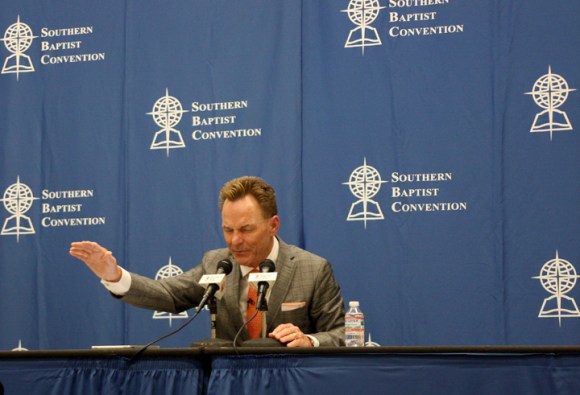
Newly elected SBC President Ronnie Floyd prays for the Convention during a post-election press conference.

Newly elected SBC President Ronnie Floyd prays for the Convention during a post-election press conference.

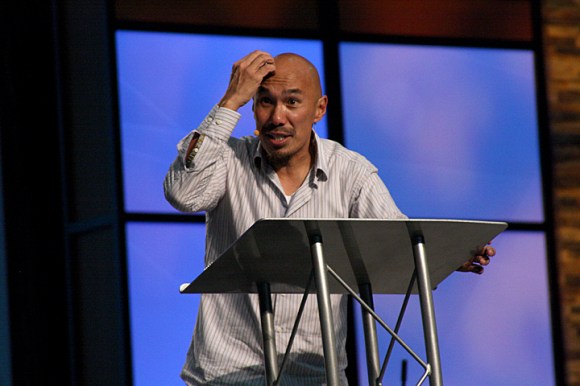
Francis Chan urged his listeners at the SBC Pastors' Conference to yearn desperately for God's presence and power.

Francis Chan urged his listeners at the SBC Pastors’ Conference to yearn desperately for God’s presence and power.

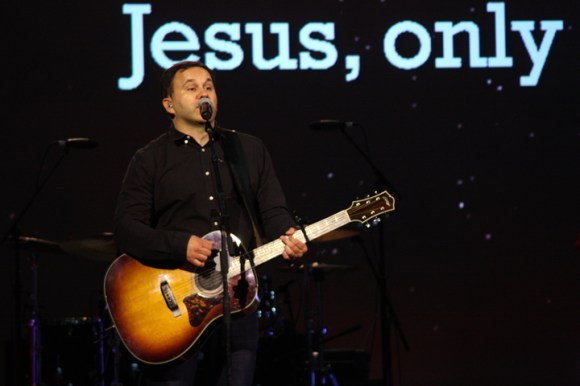
Matt Redman, author of numerous praise anthems sung around the world, led in worship at the SBC Pastors' Conference prior to the start of the annual meeting.

Matt Redman, author of numerous praise anthems sung around the world, led in worship at the SBC Pastors’ Conference prior to the start of the annual meeting.

Redman was joined by a choir from Biltmore Baptist Church in Asheville, North Carolina.

Redman was joined by a choir from Biltmore Baptist Church in Asheville, North Carolina.

David Platt gave his listeners at the Pastors' Conference 25 attributes of God from Pslam 68. "Once you get a taste of the glory of God, you find yourself possessed by an insatiable passion for more and more and more," said the pastor of The Church at Brook Hills in Birmingham, Ala. "You want God more than anything else."

David Platt gave his listeners at the Pastors’ Conference 25 attributes of God from Pslam 68. “Once you get a taste of the glory of God, you find yourself possessed by an insatiable passion for more and more and more,” said the pastor of The Church at Brook Hills in Birmingham, Ala. “You want God more than anything else.”

Ronnie Floyd, pastor of Cross Church in northwest Arkansas, opened the Pastors' Conference with a message about Moses going up to be with God. "We are never gonna be cool enogh to win our town, our rual setting, to win our cities, to win our nations…the only thing that’s going to do that is a might movement of the spirit of God that comes only when we are going up to be with God," Floyd said.

Ronnie Floyd, pastor of Cross Church in northwest Arkansas, opened the Pastors’ Conference with a message about Moses going up to be with God. “We are never gonna be cool enough to win our town, our rural setting, to win our cities, to win our nations…the only thing that’s going to do that is a mighty movement of the spirit of God that comes only when we are going up to be with God,” Floyd said.

Charles Billingsley, worship pastor at Thomas Road Baptist Church in Lynchburg, Va., led music during the Tuesday night revival service.

Charles Billingsley, worship pastor at Thomas Road Baptist Church in Lynchburg, Va., led music during the Tuesday night revival service.

Luter preached on revival that begins with prayer. "If there is any hope for spiritual renewal in America, that renewal must start in our churches, and it must start with the people in our churches, Christians, believers, and the body of Christ."

Luter preached on revival that begins with prayer. “If there is any hope for spiritual renewal in America, that renewal must start in our churches, and it must start with the people in our churches, Christians, believers, and the body of Christ.”

Luter led the crowd: "Lord, send a revival, and let it begin with me."

Luter led the crowd: “Lord, send a revival, and let it begin with me.”

Marvin Parker, pastor of Broadview Missionary Baptist Church and a member of the SBC Committee on Order of Business, closed the revival service in prayer.

Marvin Parker, pastor of Broadview Missionary Baptist Church and a member of the SBC Committee on Order of Business, closed the revival service in prayer.

Tom Elliff, president of the International Mission Board, is given a standing ovation during his report. Elliff asked trustees in February to begin looking for his successor.

Tom Elliff, president of the International Mission Board, is given a standing ovation during his report. Elliff asked trustees in February to begin looking for his successor.

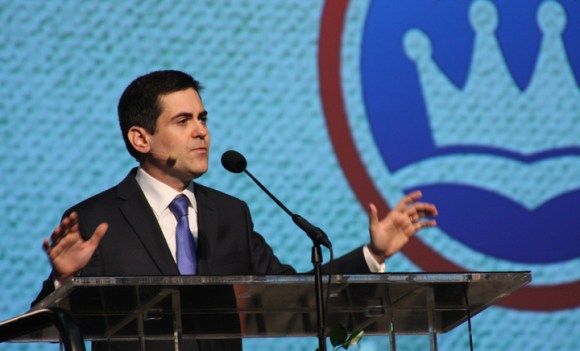
Russell Moore, president of the Ethics and Religious Liberty Commission, used his report to present an award to the Green family, the owners of Hobby Lobby. The Supreme Court currently is considering whether Hobby Lobby has to provide abortion-inducing drugs in its employee health care plans.

Russell Moore, president of the Ethics and Religious Liberty Commission, used his report to present an award to the Green family, the owners of Hobby Lobby. The Supreme Court currently is considering whether Hobby Lobby has to provide abortion-inducing drugs in its employee health care plans.

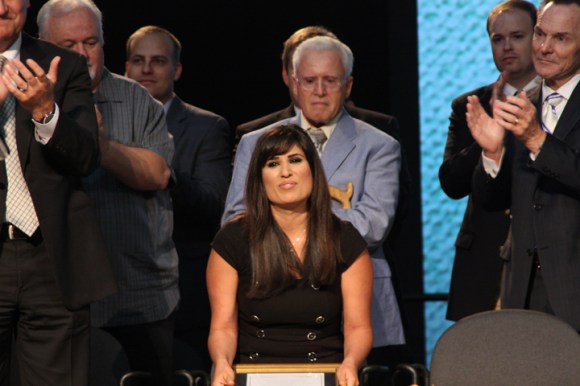
Moore also presented an award to imprisoned pastor Saeed Abedini. His wife, Naghmeh, accepted on behalf of her husband, a former leader in Iran's house church movement who was arrested in 2012.

Moore also presented an award to imprisoned pastor Saeed Abedini. His wife, Naghmeh, accepted on behalf of her husband, a former leader in Iran’s house church movement who was arrested in 2012.

Phillip Bethancourt of the ERLC moderated a panel discussion with Samuel Rodriguez, Rick Warren, David Platt and Russell Moore on the Hobby Lobby Supreme Court case.

Phillip Bethancourt of the ERLC moderated a panel discussion with Samuel Rodriguez, Rick Warren, David Platt and Russell Moore on the Hobby Lobby Supreme Court case.

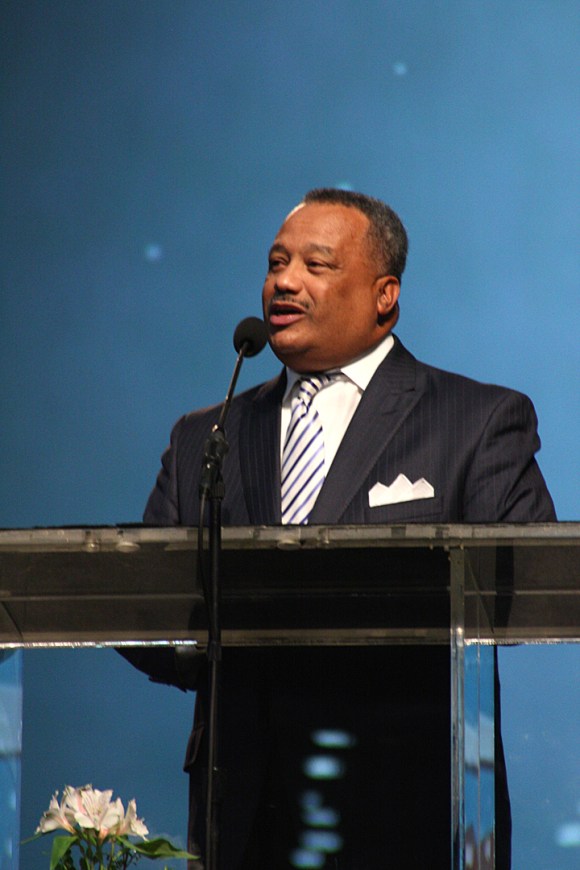
Frank Page, president of the Southern Baptist Executive Committee, led part of a 45-minute prayer meeting during Wednesday's business session.

Frank Page, president of the Southern Baptist Executive Committee, led part of a 45-minute prayer meeting during Wednesday’s business session.

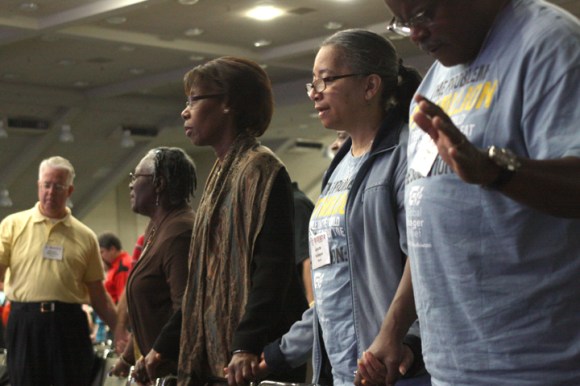
Members of Broadview Missionary Baptist Church joined fellow messengers in praying for personal and church revival, as well as denominational and national spiritual awakening.

Members of Broadview Missionary Baptist Church joined fellow messengers in praying for personal and church revival, as well as denominational and national spiritual awakening.

Jack and Wilma Booth of Calvary Baptist Church in Elgin pray in their seats for Pastor Saeed Abedini, imprisoned in Iran.

Jack and Wilma Booth of Calvary Baptist Church in Elgin pray in their seats for Pastor Saeed Abedini, imprisoned in Iran.

John Meador, pastor of First Baptist Church, Euless, Texas, preached the annual sermon to close Wednesday morning's session.

John Meador, pastor of First Baptist Church, Euless, Texas, preached the annual sermon to close Wednesday morning’s session.

Page presented a plaque of appreciation to Luter, on stage with his wife, Elizabeth, son and daughter-in-law.

Page presented a plaque of appreciation to Luter, on stage with his wife, Elizabeth, son and daughter-in-law.

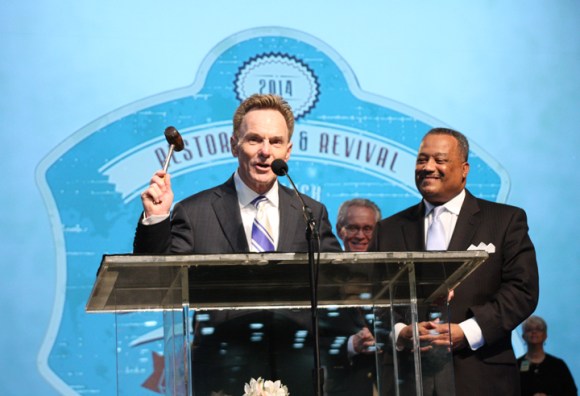
Luter passed the gavel to Floyd, who officially closed the Baltimore meeting. The 2015 Southern Baptist Convention Annual Meeting will be in Columbus, Ohio, June 16-17.

Luter passed the gavel to Floyd, who officially closed the Baltimore meeting. The 2015 Southern Baptist Convention Annual Meeting will be in Columbus, Ohio, June 16-17.

Fun in Baltimore

Meredith Flynn —  June 13, 2014

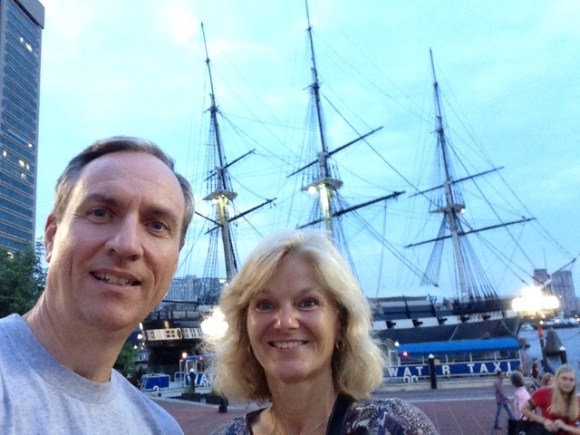
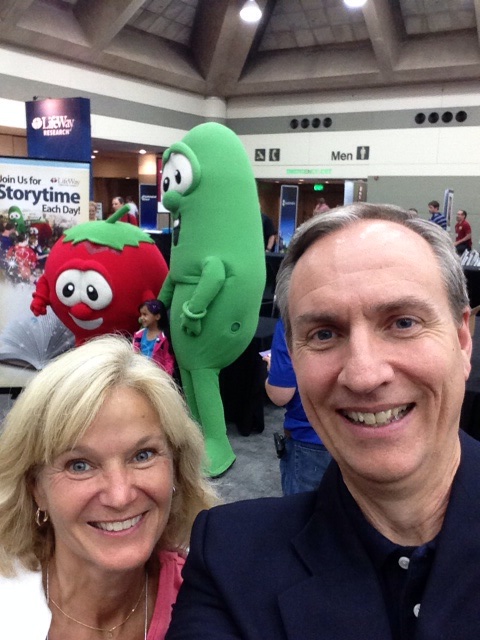
We asked our boss to send a selfie or two from Baltimore. He and his wife, Beth, are good sports. Just ask Bob and Larry.

imageimageimageimageimage

Prayer_webRunning 45 minutes ahead of schedule on the second day, those keeping the Southern Baptist Convention’s annual meeting on track didn’t do the usual thing – advancing the schedule to allow more time for business (or lunch).

Instead, they got down to the serious business of prayer.

Clustered in small groups across the convention hall, Baptists prayed for personal and national revival, and for spiritual awakening in churches and in a denomination “that often seems to have lost its first love,” said Frank Page, president of the SBC Executive Committee.

It wasn’t the only time messengers were called to prayer and repentance during the Baltimore gathering. A powerful message by Francis Chan had resulted in a similar prayer moment a few days before.

“We need the next great spiritual awakening,” said new Southern Baptist Convention President Ronnie Floyd, who succeeds New Orleans pastor Fred Luter. Floyd, pastor of Cross Church in northwest Arkansas, received 51.62% of the vote in a three-candidate race with Maryland pastor Dennis Kim, who leads a large, mostly Korean congregation and Jared Moore of Kentucky, who ran on a “small church” platform.

Little debate: The Baltimore meeting was relatively quiet, with less than usual debate over reports by the SBC Resolutions Committee and Committee on Order of Business, which handles motions submitted by messengers. Of the 17 motions brought to the committee, six were referred to convention entities for further study and 10 were ruled out of order. Only one – a motion to pray for the persecuted church – was acted upon on the convention floor. It was adopted by unanimous consent, and Committee Chairman David Smith led the convention in a prayer for the Nigerian girls kidnapped by a terrorist group in their own country.

Sexual issues: The Resolutions Committee proposed nine measures to messengers. Each was adopted without much discussion, including a resolution on transgender identity that affirms “gender identity is determined by biological sex and not by one’s self-perception.”

The Convention took no action on a California church whose pastor announced he is attempting to find “a third way” to deal with members who are avowed homosexuals, neither affirming nor condemning their lifestyle. A motion to discipline New Heart Community Church of La Mirada was ruled out of order, because it would direct officers of the SBC to act outside the scope of their duties as defined in the constitution and bylaws.

Young, but sparse attendance: Like at the last few annual meetings, younger Baptists were more visible again in Baltimore. But they seemed to congregate at meetings hosted by equipping ministries like Baptist21 and 9Marks, rather than in the main convention hall.

The Baltimore meeting had 5,294 registered messengers. Next year’s meeting in Columbus, Ohio, – a second consecutive convention in a non-Southern city – could mean similarly low attendance, but Floyd said he will issue a “Call to Columbus” to bring Baptists to Ohio for the purpose of praying together.

Baltimore | The Southern Baptist Convention’s 2014 annual meeting ended this afternoon as Fred Luter handed off the gavel to new President Ronnie Floyd. The pastor of Cross Church in northwest Arkansas, said, “Boom!” as the gavel met the podium to officially close the meeting. And Luter threw his arms in the air with a big grin.

Check back later for more images from the Convention and Pastors’ Conference, and our list of takeaways from this week in Baltimore. Thank you always for following the news with us!

Gavel_1Gavel_2Gavel_3