Archives For November 30, 1999

Columbus, Ohio | Meredith Flynn

The most personal testimony shared publicly during the 2015 Southern Baptist Convention in Columbus, Ohio, came from a source most Baptists probably had never heard of prior to the meeting.

Rosaria Butterfield (second from left) was part of a panel discussion on same-sex marriage at the 2015 Southern Baptist Convention.

Rosaria Butterfield participated in a panel discussion Wednesday afternoon with some very familiar faces—men that have been instrumental in calling Baptists to a deeper reliance on the gospel when it comes to understanding how it intersects with cultural issues.

When it was her turn to speak, she delivered the truth, plain and simple:

“I often tell people I was not converted out of homosexuality,” said Butterfield, a former lesbian. “I was converted out of unbelief. And then the Lord started working on some other stuff.”

One reporter in the press room later commented they were glad Butterfield had been in Columbus, so that more people could hear her story. Her past and, in a different way, her present—her husband pastors a Reformed Presbyterian Church—set her apart from her audience in Columbus. But as she nodded encouragingly as the other panelists talked, and when she delivered the short version of her testimony with an almost-constant smile, the value of hearing from a new voice at the Southern Baptist Convention was clear.

As a professor at Syracuse University, Butterfield said she had finished the book she needed to write to achieve tenure and turned her attention to what she really wanted to write: “a critique of the religious right from a lesbian feminist point of view.”

In the process, she met a Christian pastor and his wife who invited her into their home (and visited hers) and truly befriended her. At first, “I thought I simply got free research assistants,” Butterfield told the audience in Columbus.

But after two years and reading through the Bible seven times, she said, “The Bible simply got to be bigger inside me than I. And one of the things that I realized was that I wanted Jesus.”

Butterfield’s fascinating testimony, detailed in her book “The Secret Thoughts of an Unlikely Convert: An English Professor’s Journey Into Christian Faith,” stands alone as encouragement to churches trying to reach out to their neighbors with genuine love and the truth of the gospel.

But it was what she said later in the discussion that could prove to be most helpful. In just a few minutes, Butterfield laid out a prescription for how the church can minister compassionately to the LGBT community:

Make your Christian community an accessible community. That means giving up ownership of our time, Butterfield said, and also gaining a more “collective” understanding of sin.

She quoted 1 Corinthians 10:13, about God providing a way of escape from temptation. “What if your home is the way of escape?” she asked.

Share “the means of grace” in a public way. How can Christians make repentance more known (and understood) among their neighbors?

Get to know the Bible—better than we do now. Time with the Lord is “a public community service,” Butterfield said. It’s how Christians get ready to speak a word of truth.

“Don’t deny the power of the gospel to change lives and to travel at the grassroots level,” Butterfield said near the end of the conversation. “Your friendships matter.”

For those listening to her story in Columbus, the power of the gospel was undeniable.

Watch the panel discussion, held during the Wednesday afternoon session of the Southern Baptist Convention, at http://live.sbc.net.s3-website-us-east-1.amazonaws.com/ondemand.html.

HEARTLAND | Eric Reed

When I said to my co-workers, “Well, let’s go meet a thousand of our closest friends,” I didn’t know how true that statement would be. We left our offices and drove the four blocks to Springfield’s Crowne Plaza Hotel, site of the 2015 Midwest Leadership Summit. And like so many of our Baptist gatherings, this one felt like Homecoming Week at Sandy Creek Church. We saw dear friends from across Illinois, and some we knew from the other dozen states in attendance.

Eric_Reed_Feb9But I never expected to see Woodie.

After all, it’s been 35 years. And the last time I saw Woodie, he was a Mormon. In Alabama. Go figure. Woodie and his siblings were fourth-generation Reformed Latter Day Saints (RLDS) living in a fishing town on the Gulf Coast. We all went to high school together. Although our school was a ministry of a conservative fundamentalist church, no one made an issue of Woodie’s religion. All his family
were clean-cut, well-mannered, and better behaved than many in our class who claimed to be Christians. I remember Woodie as a great guy, a good football player, and very well liked. But lost.

Woodie came to that truth while in college. Through a campus ministry he came to a life-saving faith in Jesus Christ and left his family’s religion. Later, he attended Mid-America Seminary and was called to ministry. Eventually Woodie moved to Lamoni, Iowa, the place where Latter Day Saints founder Joseph Smith once lived and present-day home to the RLDS college. Woodie had attended that college for a couple of years until he began question the RLDS religion.

Returning in 1991, Woodie started a Baptist student ministry, reaching out to RLDS students and others.

Eventually he pastored First Baptist Church of Lamoni, the sponsor of his college ministry, for nine years, and just recently was called to lead Calvary Baptist Church in Clinton, Iowa. Woodie said God is opening doors to Brazilian soccer players (in Iowa!) because his son plays soccer and his wife is originally from Brazil. Go figure.

That’s why he was at the Midwest Leadership Summit and standing in the hallway outside the ballroom at the Springfield Crowne Plaza. Woodie is a Southern Baptist pastor in the Midwest, looking for fresh ideas, inspiration, and encouragement.

I stand amazed by all God has done in Woodie’s Christian life and Baptist ministry. And I’m so glad God brought our paths to cross again.

I should be more amazed that 35 years after high school—even though Woodie hasn’t changed much—I recognized him standing there. But that’s the Lord’s doing too.

Go figure.

Eric Reed is IBSA’s associate executive director for the Church Communications team, and editor of the Illinois Baptist newspaper.

THE BRIEFING | Meredith Flynn

As World Cup fever raged across the globe – and even here! – new research from Barna showed most Americans recognize their country’s fascination with sports, and almost two-in-three think the culture cares too much about athletics.

The nationwide survey conducted in February found 89% of adults strongly or somewhat agree that sports are an important part of American culture, with men slightly more likely to strongly agree than women. Interestingly, practicing Christians (55%) were the most likely group to strongly agree.

soccer ballBarna also found 27% of Americans believe the culture cares too much about sports, and 39% agree somewhat. A majority of Americans also agree strongly or somewhat that professional athletes make too much money (86%), and that American professional sports are very corrupt and distract from important global issues (both 62%).
As for America’s favorite sport: Football reigns supreme with regular viewers (53%), followed by basketball and baseball (both 33%). Soccer’s numbers were higher than you might think, especially considering the survey was completed before the World Cup. 11% of Americans regularly watch the beautiful game (that’s what they call soccer), 20% have played it, and 16% say their kids play.

Zamperini remembered as Olympian, war hero, Christian
Former Olympic runner and prisoner of war Louis Zamperini died July 2 at the age of 97. Zamperini, the subject of Laura Hillenbrand’s 2010 book “Unbroken,” also was a Christian. His conversion happened at a Billy Graham Crusade after he returned from a Japanese POW camp, at the height of his bitterness and rage over two years of captivity. Read Denny Burk’s tribute to Zamperini.

Some Nigerian girls escape, more than 200 remain captive
While many Americans were celebrating independence, dozens of women and girls in Nigeria were finding freedom from a much more immediate threat. The Christian Post reports more than 60 women and girls kidnapped by Boko Haram on June 22 escaped around July 4. More than 200 girls reportedly are still held by the terrorist group founded to fight the influence of Western education. In a video message released earlier this year, Boko Haram leader Abubakar Shekau threatened to sell the kidnapped girls.

Book release: Piper’s ‘Pastor’s Kid’
Barnabas Piper’s new book “The Pastor’s Kid: Finding Your Own Faith and Identity,” was written for PKs, pastors and churches, the son of famed pastor John Piper wrote in the introduction. Coinciding with the book’s July 1 release, the author answered questions from culture writer Jonathan Merritt in this Q&A for Religion News Service, including the biggest negative effect of his upbringing (“not connecting with God in a personal way”). Piper also shared a few surprising facts about his dad, like his love for the comedy “What About Bob.”

Four Southern Baptists named to ’33 under 33’ list
Christianity Today’s list of influential young leaders includes four Baptists, Baptist Press reported July 1. They are:

  • Trevin Wax, a blogger and managing editor of LifeWay’s The Gospel Project
  • Hip-hop artist turned pastoral intern Trip Lee
  • Former rapper D.A. Horton, who is now the North American Mission Board’s national coordinator for urban student missions
  • Saira Blair, a 17-year-old candidate for West Virginia’s state legislature

See the rest of the list at ChristianityToday.com.


Mark_Warnock_blog_calloutCOMMENTARY | Mark Warnock

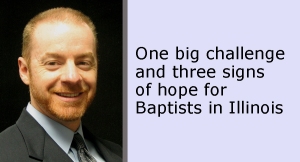
I resigned in December from my church, First Baptist Columbia, to return to my home state of Florida. God has burdened me with the vast lostness of South Florida, and impressed upon me a duty to be closer to my aging parents. I’m moving down to join a church planting movement in South Florida, and to shine my little Gospel light in that darkness.

This move brings to a close 17 years of ministry in Illinois – six-and-a-half years in Chicagoland, and eleven years in the Metro East. I leave behind a host of people at my church and throughout the state that I love and respect. As I leave Illinois, I see both a lingering challenge and a great hope.

The primary challenge I see is the same one the church faces everywhere: selfishness. On a personal level, a church level, and a denominational level, we must fight constantly the Satanic gravity of our own selfishness that wants to make our lives all about us, our churches all about us, and our denomination all about us.  Jesus our Savior came not to be served, but to serve, and He calls us to deny ourselves, to take up our cross and to follow Him.

God formed a church to be a light to the world, for His glory. He has graciously allowed us to cooperate as a denomination to pool our efforts to fulfill the Great Commission, for His glory. So to the leaders in Illinois: Do not stop calling us outward, to the lost. Remember Luke 15, and the priority of God our Father: “…there is joy in the presence of God’s angels over one sinner who repents.”

This fight to keep our eyes outward is not in vain, because there are signs of hope everywhere. Here are three I see:

Planting churches. I learned during my time at Columbia that one key to a healthy church is a steady stream of new converts. Like families, which continue to exist only if new babies are regularly born into them, churches begin to die without new spiritual life, and denominations begin to die without new churches.

I’m encouraged that God is calling men and women to devote their lives to starting new churches, and that IBSA is giving great priority to new church starts all across the state. Even more, I’m encouraged that increasingly, established IBSA churches are beginning to discover the joy and adventure of partnering with, supporting and working alongside church plants for the advancement of the Gospel.

Thinking students. I began teaching high school students at IBSA’s Super Summer in the late 90s. Many of the students I had in the early years are now pastoring or leading in churches across our state. I have been consistently impressed with the quality of the students in Illinois. They are passionate about the Gospel, hungry to be taught, and eager to love God with their minds. If our churches fail to equip our students with a clear understanding of the Gospel and the intellectual tools to be apologists in a hostile culture, we are in deep, deep trouble. The good news is that when presented with the challenge, our students – our future leaders – consistently rise to it.

A saving God. The real reason I have hope for the Gospel in Illinois and in South Florida? God keeps saving people. In my Monday night men’s group in Columbia, God kept saving some of the most unlikely men. In my first Sunday at my new church in West Palm Beach, I met a woman who came to church without an invitation, just stirred by the Spirit, and not knowing why she was there. She came to faith that week.

Consider Jesus’ answer to the scribes in Mark 2:17 who asked why He was eating with unlikely dinner guests – sinners and tax collectors. “Those who are well don’t need a doctor, but the sick do need one. I didn’t come to call the righteous, but sinners.”

No one is as passionate as our God to save sinners like us.

So to my colleagues in the Gospel across Illinois: Thank you for 17 years of friendship and love. Don’t lose heart. Let your light shine in the darkness. Keep speaking of Jesus. Keep fighting the good fight. Keep holding out the Gospel, because our God is willing and mighty to save.

Mark Warnock formerly served as associate pastor of First Baptist, Columbia.

pull quote_BUCHANANCOMMENTARY | Joe Buchanan

Robbie was a young man who grew up in the first church I pastored. His name has been changed but his story is true. Robbie came forward to “give his life to Jesus” and be baptized for the first time during a fall revival service when he was 10 years old. At first, he began to show spiritual fruit and experience the joy of his salvation. But within six months, Robbie started to wonder whether he was really saved.

The next spring, Robbie again came forward to “ask Jesus into His heart.” Once again he showed some initial change, but eventually began to doubt his salvation. When he came to me ask me what to do, I did what I had been taught to do since I was a kid: I shared the Gospel with him and asked if he wanted to pray the sinner’s prayer to be saved. Robbie said yes, and the next week we baptized him.

This cycle continued for the 10 years that I was his pastor. Does this sound familiar?

The sad reality is that Robbie was not the only person going through this cycle in our church. In fact, it’s being repeated in churches all across the Southern Baptist Convention, and has become so familiar that we almost think it’s normal and just part of being a believer. But in his new book, “Stop Asking Jesus into Your Heart,” J.D. Greear writes the problem may actually be the unbiblical language we use in describing how people should respond to the Gospel.

Specifically, Greear notes some ways we couch our response to the Gospel (using phrases like “ask Jesus into your heart,” or “accept Jesus as Lord and Savior,” or “give your heart to Jesus”) are not biblical. He writes, “These phrases may not be wrong in themselves, but the Bible never tells us, specifically, to seek salvation in those ways.  The biblical summation of a saving response towards Christ is ‘repentance’ and ‘belief’ in the Gospel.”

Greear continues, “Repentance and faith are heart postures you take toward the finished work of Christ. You might express the beginning of that posture in a prayer. But don’t make the mistake of equating that prayer with the posture. The sinner’s prayer is not a magic incantation or a recipe you follow to get a salvation cake. The real stuff – that stuff that matters – is the posture of repentance and faith behind the words you speak. The prayer is good only insofar as it verbalizes the posture.”

Make no mistake, Greear is not telling us to stop doing evangelism. In fact, he is inviting us to return to a biblical approach of sharing the Gospel. He reminds us that how we invite people to respond to the Good News of Jesus must be firmly grounded in the Scripture, not in tradition or pragmatism. In doing so, Greear upholds the noblest aspirations of those who hold to the authority and inerrancy of the Bible.

After reading and thinking about this book, it has occurred to me that my presentation of the Gospel is largely at fault for Robbie’s struggles. My intentions were good, but I had inherited an unbiblical and unhelpful method of explaining the response to the Gospel. This is a difficult pill to swallow, but it can go along way toward returning our churches to a healthy method and mindset of evangelism.

If I were to counsel with Robbie today, I would want to make sure that his assurance of salvation is securely grounded in the Scripture. The best way I know to do this would be to take him to some of the Scriptures that demonstrate specific changes that occur as a result of salvation. Does he love the other members of Christ’s family (1 John 2:9 and 3:14-16)? Has he experienced the desire to stop sinful behavior and obey God (1 John 2:29 and 3:6)?

And I would urge him to ask other members of the church if they have witnessed these changes in his life. This combination – Scripture and the people of God – is the best way of helping Robbie and others like him to come to the full assurance of his salvation, or to see the need to repent and believe.

Dr. Joe Buchanan is pastor of First Baptist Church, Metropolis, and author of the upcoming book “Cultivating a Gospel-Shaped Attitude”.

HEARTLAND | 1 Peter 1: 3-19 (ESV)

Blessed be the God and Father of our Lord Jesus Christ! According to his great mercy, he has caused us to be born again to a living hope through the resurrection of Jesus Christ from the dead, to an inheritance that is imperishable, undefiled, and unfading, kept in heaven for you, who by God’s power are being guarded through faith for a salvation ready to be revealed in the last time.

In this you rejoice, though now for a little while, if necessary, you have been grieved by various trials, so that the tested genuineness of your faith – more precious than gold that perished though it is tested by fire – may be found to result in praise and glory and honor at the revelation of Jesus Christ.

Though you have not seen him, you love him. Though you do not now see him, you believe in him and rejoice with joy that is inexpressible and filled with glory, obtaining the outcome of your faith, the salvation of your souls.

Concerning this salvation, the prophets who prophesied about the grace that was to be yours searched and inquired carefully, inquiring what person or time the Spirit of Christ in them was indicating when he predicted the sufferings of Christ and the subsequent glories.

It was revealed to them that they were serving not themselves but you, in the things that have now been announced to you through those who preached the good news to you by the Holy Spirit sent from heaven, things into which angels now long to look.

Therefore, preparing your minds for action, and being sober-minded, set your hope fully on the grace that will be brought to you at the revelation of Jesus Christ.

As obedient children, do not be conformed to the passions of your former ignorance, but as he who called you is holy, you also be holy in all your conduct, since it is written, “You shall be holy, for I am holy.”

And if you call on him as Father who judges impartially according to each one’s deeds, conduct yourselves with fear throughout the time of your exile, knowing that you were ransomed from the futile ways inherited from your forefathers, not with perishable things such as silver or gold, but with the precious blood of Christ, like that of a lamb without blemish or spot.