Archives For November 30, 1999

Rick_Warren“I’m kind of glad that cultural Christianity is dying. If you know anything about history…the church is never strongest when it’s in the majority. Has never been, never, ever been. It is always when it is in the salt and light mode.”

Warren, pastor of Saddleback Church in Lake Forest, Ca., joined Samuel Rodriguez, David Platt and Russell Moore in a panel discussion about “Hobby Lobby and the Future of Religious Liberty.”

SBC_annual_meeting_logoBaltimore | The Southern Baptist Convention’s annual meeting officially starts here June 10, but Baptists are already on their way to Charm City for pre-Convention festivities. Here’s our list of what to watch for over the next few days:

1. Southern Baptists will elect a new president, and their choice could point to the lasting legacy of Fred Luter, elected two years ago as the SBC’s first African American president. A victory for Maryland pastor Dennis Kim could mean Baptists have embraced Luter’s charge to bring more diverse voices to the leadership table. Electing Ronnie Floyd might mean they’ve taken to heart Luter’s pleas for revival, and believe that Floyd, who organized recent prayer gatherings for church leaders, is a president who can lead Baptists toward the repentance required for spiritual awakening. And a vote for Kentucky pastor Jared Moore, the youngest candidate at 33, could signify older Baptists recognize the importance of engaging the next generation of leaders.

All three have expressed their desire to help Baptists unify around the Great Commission and cooperative missions. Click here to read short profiles of each candidate, and link to their Baptist Press Q&A’s.

2. How much will numbers matter? Attendance at the Convention will likely be a hot topic before and after the final tallies come in – last year’s registration in Houston was uncharacteristically low for a southern city, and some think Baltimore’s messenger total could rival the decades-low point set in Phoenix in 2011. Low attendance might reignite conversation about an online meeting/voting process, which some bloggers have advocated for in recent years.

In another mathematical matter, the SBC Executive Committee will discuss whether to bring a recommendation to the floor to amend Article III of the Constitution, which governs how many messengers individual churches may send to the annual meeting. Some have questioned whether the amendment would inhibit participation from smaller churches, since it would increase the financial contribution required to send additional messengers (more than two). But Executive Committee President Frank Page has vowed not to do anything that will hurt small churches.

3. Same old culture war? The issues might be similar to those in recent years – marriage chief among them – but Southern Baptists tactics in the culture war seem to be shifting. Ethics & Religious Liberty Commission President Russell Moore has encouraged Christians to embrace the strangeness of their beliefs and to avoid “more culture war posturing” for the sake of a “Christ-shaped counter-revolution.” At least two issues could put his encouragements to the test: A California congregation that recently split over whether to affirm same-sex lifestyles, and a proposed resolution on gender identity issues.

All that plus crab cakes, regular cake (courtesy of famed Baltimore baker Duff Goldman), and a special tour of the city highlighting favorite daughter Annie Armstrong. Check back here for frequent updates, or go to Facebook.com/IllinoisBaptist and Twitter.com/IllinoisBaptist. Thanks for traveling with us!

ERLC_Summit_logoNEWS | Meredith Flynn

Nashville, Tenn. | The first Leadership Summit hosted by the Southern Baptist Ethics and Religious Liberty Commission kicked off this afternoon at the SBC building in Nashville. The meeting of 180 church leaders is focused on how the Gospel applies to human sexuality, especially in a culture that’s changing fast.

“So many of the questions that pastors grapple with today deal with situations that would not even have been possible a generation ago,” ERLC President Russell Moore said when the summit was announced a few months ago. “As technology advances and the culture changes, the questions that we have to grapple with are often increasingly complex.”

The meeting’s first speaker, Heath Lambert, tackled one of those digital age issues with a keynote address on pornography. Lambert, executive director of the Association of Certified Biblical Counselors and a professor at Southern Seminary, said porn is a “silent killer” in churches.

“I think that pornography represents the greatest moral crisis in the history of the church,” Lambert said. It is “something that evangelicals can do in a dark room behind a shut door after they’ve railed against homosexual marriage and talked about conservative theology.”

Redefining marriage is a threat to the church, he added, but “a greater threat to the church today is the Christian pastor, the Christian schoolteacher, the Christian Bible college and seminary student, who exalts sound theology, who points to the Bible, and then retreats to the basement computer to indulge in an hour or three of internet pornography.”

Using Proverbs 7 as a backdrop, Lambert likened pornography to the Scripture passage’s “forbidden woman.” The Bible gives strategies for dealing with sexual temptation, and the church should too, he said. But the first call is to cling to the Gospel.

“I’m pleading with the church to have practical strategies…but those behaviors won’t be enough if we are not teaching people to draw near to Jesus Christ,” Lambert said.

He closed his message with three charges to church leaders concerning pornography: First, pursue accountability. 75% of pastors are accountable to no one for their internet activity, Lambert said.

Second, address your people. “If your job is to preach the whole counsel of God, here it is,” Lambert said. “You’ve got to talk about it. If we do not share this, if we overlook it, it’s folly. It’s foolishness.”

And third, awaken the world to the problem. “Evangelicals have tenderly and tenaciously taken up many causes…I want to ask that together we would begin to take up this cause, that we would begin to say, ‘Enough is enough.'”

Marriage, purity, human trafficking, and pastoral care for sexual sin are among the topics the Leadership Summit will explore through large-group sessions, breakouts and panel discussions. Check back here for updates, and watch it at live.erlc.com.

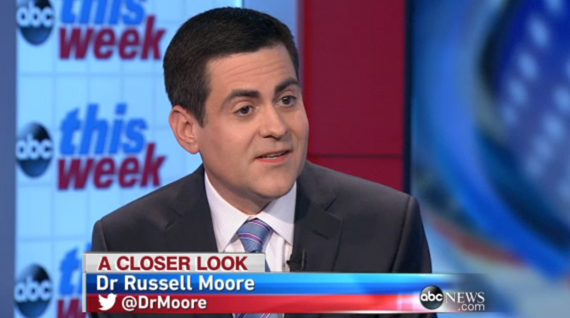
Russell Moore was joined on ABC's "The Week" by fellow panelists Franklin Graham, Ralph Reed and Cokie Roberts.

Russell Moore was joined on ABC’s “The Week” by fellow panelists Franklin Graham, Ralph Reed and Cokie Roberts. Photo from video on abcnews.go.com

NEWS | On Easter Sunday morning, ABC’s “This Week” featured a panel of guests discussing whether the influence of evangelicals is waning in the current culture. The group included Russell Moore, president of the Southern Baptist Ethics and Religious Liberty Commission, who said it is indeed a new day for Christians.

The percentage of people that are members of a church or synagogue has fallen from 70% in 1992 to 59% in 2013, said moderator Martha Raddatz, citing a Gallup statistic. She asked Moore if the numbers worry him, and what can be done about the decline.

“I’m not worried… because I think what we’re seeing is the collapse of a cultural, nominal form of Christianity,” Moore said. There was a time in America where in order to be a good person, to be seen as a good citizen, one had to nominally at least be a member of a church. Those days are over, and so we’re at a point now where Christianity is able to be authentic, and Christianity is able to be authentically strange.”

Moore pointed out that Christianity’s foundational beliefs are hard to grasp for the culture at large, but the disconnect isn’t unprecedented.

“Many people now when they hear about what Christians believe, what evangelical Christians believe, their response is to say, ‘That sounds freakish to me, that sounds odd and that sounds strange.’ Well, of course it does. We believe that a previously dead man is now the ruler of the universe and offers forgiveness of sins to anyone who will repent and believe.

“That’s the same sort of reaction that happened in the Greco-Roman empire when Christianity first emerged. So it offers an opportunity for the church to speak clearly, articulately, about what it is that we believe, to give a winsome and clear message about what the Gospel actually is.”

Raddatz asked Moore about his recent comment that “the illusion of a Moral Majority is no longer sustainable in this country.”

“Yes, it’s a different time,” Moore said on Sunday’s broadcast, “and that means that the way that we speak, we speak in a different way. We speak to people who don’t necessarily agree with us. There was a time in which we could assume that most Americans agreed with us on life, and on abortion, and on religious liberty and other issues. And we simply had to say, ‘We’re for the same things you’re for, join us.’

“It’s a different day. We have to speak to the rest of the culture and say, ‘Here’s why this is in your interest to value life, to value family, to value religious liberty.'”

The panel’s 10-minute conversation is available for viewing at the ABC News website.


Thom Rainer, president of LifeWay Christian Resources

Thom Rainer, president of LifeWay Christian Resources

THE BRIEFING | Posted by Meredith Flynn

Thom Rainer, president of LifeWay Christian Resources of the Southern Baptist Convention, shared his “broken heart” over the denomination’s loss of passion for people who don’t know Christ.

In an open letter at ThomRainer.com, the leader of the convention’s publishing arm asked, “Where is the passion in most of our churches to reach the lost? Where is the passion among our leaders, both in our churches and in our denomination?

“Jesus told those at the church at Ephesus that they had sound doctrine, that they hated evil (Revelation 2:1-7). But He also told them they had lost their first love. When we truly love Jesus with all of our hearts, we can’t help but tell others about Him. We can’t help but share the good news.”

Rainer’s letter echoed the theme of a resolution passed by messengers to the November 2013 annual meeting of the Illinois Baptist State Association. The resolution on repentance and evangelism encouraged Illinois Baptists to repent of failure to share the Gospel regularly and faithfully, and to commit to do so.

As for Rainer’s letter, “I have no proposal. I have no new programs for now. I simply have a burden,” he wrote. And, he added, renewal must start with him. And with pastors.

“Evangelism must be as natural to me as breathing,” Rainer blogged.

“Pastors, will you join me in this plea? Will you be an evangelistic example for the churches God has called you to serve? Laypersons, will you pray for evangelistic hearts in your own lives? I must make that prayer a part of my life every day.

“Have we lost our first love? Is that love reflected in how we share the gospel of Christ every day?

“May God break me until I am all His, telling others about His Son every day.”

Read the full text of Rainer’s letter at ThomRainer.com.

New podcast answers ethical questions
The Southern Baptist Ethics and Religious Liberty Commission launched a new podcast series this week to address ethical and cultural questions submitted by listeners. Russell Moore, president of the ERLC, hosted the first episode January 13. The inaugural “Questions and Ethics” podcast focused on the question: When should you ask your potential spouse about their sexual history and how much should you know?

“‘Questions & Ethics’ allows us to answer the more difficult moral and ethical questions of our day in a short, accessible format,” said Dan Darling, ERLC’s vice president for communications, in a written release. “This podcast allows Dr. Moore to answer a variety of questions people are asking or should be asking.'” Read more at BPNews.net and listen to the first episode of “Questions and Ethics” at ERLC.com.

Hobby Lobby gets its day in court
The U.S. Supreme Court has set a date for oral arguments in a case pitting craft retailer Hobby Lobby against the Department of Health and Human Services. The Christian Post reports the high court will hear from Hobby Lobby on March 25, as the craft retailer argues business owners should be able to exercise religious freedom by objecting to the abortion/contraceptive mandate in President Obama’s healthcare reform package. Hobby Lobby has been one of the businesses at the center of the dispute over the mandate, which requires employers to cover abortion-inducing drugs in their employee health care plans.

“This legal challenge has always remained about one thing and one thing only: the right of our family businesses to live out our sincere and deeply held religious convictions as guaranteed by the law and the Constitution,” Hobby Lobby founder David Green said in a written release in November. “Business owners should not have to choose between violating their faith and violating the law.”

Read more at ChristianPost.com.

Pastors praying today for spiritual awakening

A group of Baptist pastors and leaders are meeting this week in Atlanta to pray together for revival and spiritual awakening. This is the second prayer meeting called by Arkansas pastor Ronnie Floyd. The gathering “is time for us to pray in an extraordinary way, to seek the God of heaven to revive His church and awaken our nation,” Floyd, senior pastor of Cross Church in northwest Arkansas, told Baptist Press.

The meeting raises a question, says Illinois Baptist editor Eric Reed: What can believers do to bring spiritual awakening to a nation lulled to disinterest by its tolerance of sin? Read his feature story on the next great awakening in the current issue of the IB, and read more about the prayer meeting at BPNews.net.

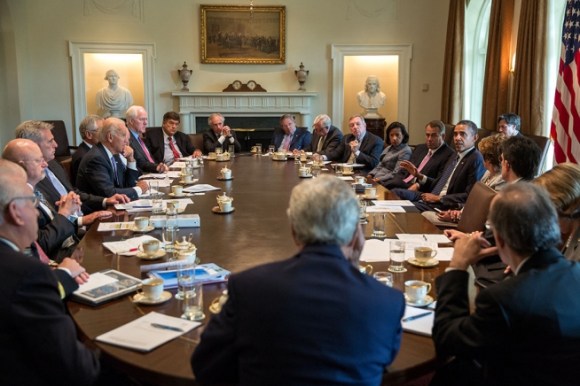
President Barack Obama meets with members of Congress to discuss Syria in the Cabinet Room of the White House on Sept. 3. White House photo by Pete Souza.

President Barack Obama meets with members of Congress to discuss Syria in the Cabinet Room of the White House on Sept. 3. White House photo by Pete Souza

THE BRIEFING | Meredith Flynn

(From Baptist Press) President Barack Obama is poised to address the nation tonight about why he believes U.S. forces should intervene in Syria, currently entrenched in a civil war that has reportedly killed more than 100,000 people since 2011. The President’s appeal to the public and to U.S. lawmakers (expected to vote on military action as early as Wednesday) is primarily the result of a chemical assault on civilians that U.S. intelligence has linked to the regime of Syrian President Bashar al Assad. The gas attack August 21 killed more than 1,400 people.

“This attack is an assault on human dignity. It also presents a serious danger to our national security,” Obama said late last month.

Russell Moore, president of the Southern Baptist Ethics & Religious Liberty Commission, agreed in a recent Religion News Service article that Assad’s regime is “lawless and tyrranical” and that there is just cause for war.

“That said, there are other principles missing here, both to justify action morally and to justify it prudentially,” Moore added. He used points from just war theory, which dates back to the fourth century, to support his position against U.S. intervention in Syria.

Read more about the just war ethic at BPNews.net.

“I do not see, from President Obama, a reasonable opportunity to prevail, or even a definition of what prevailaing would mean.

“Regime change is not the point of this action, and even if it were, we don’t yet know who the good guys are. Replacing one set of terrorists with another does not bring about justice or peace.”

Daniel Heimbach, a professor at Southeastern Baptist Theological Seminary, also disagrees with the President’s plan, but said the U.S. lacks a basis for intervening “in the internal affairs of a distinctly sovereign and separate state.”

He also noted, “The meaning and interpretation of a just cause for war (in a just war ethic) requires the nation being attacked (Syria) to have done, or to be doing, or to be moving toward doing some terrible wrong toward the attacking nation (United States) – not merely doing something bad within their own borders against their own people.”

The U.S. Senate may vote on Obama’s proposal for action against Syria as early as Wednesday of this week, and the House could consider it next week, according to Fox News.

Baptist aid organization helps Syrian refugees

Southern Baptist relief efforts are touching lives in significant ways as an estimated 2 million refugees have fled Syria for neighboring countries. BGR photo

Southern Baptist relief efforts are touching lives in significant ways as an estimated 2 million refugees have fled Syria for neighboring countries. BGR photo

(From Baptist Global Response) The civil war in Syria has displaced more than 5 million people either outside or inside the country, said Jeff Palmer, executive director of Baptist Global Response (BGR).

“The majority of Syrian refugees are women and children and a few older men,” Palmer said. “Husbands, fathers, brothers and uncles stayed behind to protect their precious resources – unfortunately, many times in vain. They were so thankful for the small amount of help we gave them. We promised we would be back the following week with more.”

For more than a year, BGR has assisted the refugees through emergency food packets, hygiene kits, basic shelter materials and some medicines.

While an estimated 2 million refugees have fled Syria for neighboring countries, the prospect of Western powers entering the conflict has dramatically increased the outflow in recent days, Palmer noted.

Americans place terrorism prevention high on list of national priorities
A new survey by Barna released just before the 12th anniversary of the September 11 attacks found a high majority of Americans believe preventing terrorism is as important or more important than healthcare, the break-up of the family, education, unemployment, and immigration.

The survey also found members of the millennial generation, who were children and teens on 9/11, “are among the most likely to prioritize preventing terrorism above other social concerns.”

For more Barna findings, including a comparison of the emotions people associate with 9/11 and the recent Boston Marathon bombings, go to Barna.org.


pull quote_MOORECOMMENTARY | Russell Moore, from Baptist Press

With the Supreme Court’s gay marriage decisions all over the news, some Christian parents wonder how they ought to explain all of this to their small children. I’ve faced the same question as my children have asked, “What is the Supreme Court doing that’s keeping you so busy?” So how does one teach the controversy, without exposing one’s children to more than they can handle?

First of all, you should, I think, talk to your children about this. No matter how you shelter your family, keeping your children from knowing about the contested questions about marriage would take a “Truman Show”-level choreography of their lives. That’s not realistic, nor is it particularly Christian.

The Bible isn’t nearly as antiseptic as Christians sometimes pretend to be, and it certainly doesn’t shrink back from addressing all the complexities of human life. If we are discipling our children, let’s apply the Scriptures to all of life. If we refuse to talk to our children about some issue that is clearly before them, our children will assume we are unequipped to speak to it, and they’ll eventually search out a worldview that will.

This doesn’t mean that we rattle our children with information they aren’t developmentally ready to process. We already know how to navigate that; we talk, for instance, about marriage itself, and we give age-appropriate answers to the “Where do babies come from?” query. The same is true here. There is no need to inform small children about all the sexual possibilities in graphic detail in order to get across that Jesus calls us to live as husbands and wives with fidelity and permanence and complementarity.

Some parents believe that teaching their children the controversies about same-sex marriage will promote homosexuality. Christians and non-Christians can agree that sexual orientation doesn’t work that way. Moreover, the exact opposite is true. If you don’t teach your children about a Christian way of viewing the challenges to a Christian sexual ethic, the ambient culture will fill in your silence with answers of its own.

You can tell your children that people in American culture disagree about what marriage is. You can explain to them what the Bible teaches, from Genesis to Jesus to the apostles, about a man and a woman becoming one flesh. You can explain that as Christians we believe this marital relationship is different than other relationships we have. You can then tell them that some people have relationships they want to be seen as marriages, and that the Supreme Court is addressing that.

You can then explain that you love your neighbors who disagree with you on this. You agree that they ought to be free from mistreatment or harassment. But the church believes government can’t define or redefine marriage, but can only recognize what God created and placed in creation. Explain why you think mothers and fathers are different, and why those differences are good. Find examples in your own family of how those differences work together for the common good of the household, and point to examples in Scripture of the same.

Don’t ridicule or express hostility toward those who disagree. You might have gay or lesbian family members; be sure to express your love for them to your children, even as you say that you disagree about God’s design for marriage. You probably have already had to do that with family members or friends who are divorced or cohabiting or some other situation that falls short of a Christian sexual ethic. If your children see outrage in you, rather than a measured and Christlike biblical conviction, they eventually will classify your convictions here in the same category as your clueless opinions about “kids these days and their loud music.”

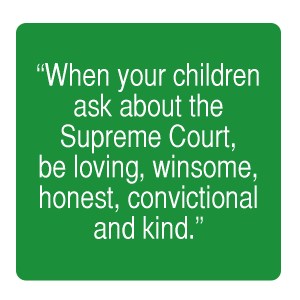
The issues at stake are more important than that. Marriage isn’t ultimately about living arrangements or political structures, but about the Gospel. When your children ask about the Supreme Court, be loving, winsome, honest, convictional and kind.

Russell Moore is president of the Southern Baptist Ethics and Religious Liberty Commission. This column first appeared on russellmoore.com.

Russell Moore (right), the new president of the Ethics and Religious Liberty Commission explains that the ERLC will support principles, rather than specific legislation. President Emeritus Richard Land (left) led the commission for 25 years.

Russell Moore (right), the new president of the Ethics and Religious Liberty Commission explains that the ERLC will support principles, rather than specific legislation. President Emeritus Richard Land (left) led the commission for 25 years.

HOUSTON | Richard Land, President of the Southern Baptist Ethics and Religious Liberty Commission for the past 25 years, turned over the organization’s leadership reigns to new president Russell Moore during the ERLC’s report Tuesday afternoon.

The two men only stood together for a moment, to tag-team answer a question about the ERLC’s stance on immigration reform.

Land’s contribution to the ERLC and to Southern Baptist history was celebrated in a video that showed a lighter side of the long-time culture warrior. Footage of Land telling humorous stories from his past was intercut with words of appreciation from SBC leaders like Al Mohler and Paige Patterson, and from conservative stalwarts on Capitol Hill. Land received a standing ovation from the audience in Houston.

Then, Moore took to the podium. Repeating a phrase he used at Tuesday morning’s “Marriage on the Line” breakfast hosted by the ERLC, he committed to lead churches to act with “convictional kindess” in a world that presents questions that wouldn’t have been asked a generation ago. And referencing Ephesians 6, he urged Southern Baptists to remember who the true enemies are.

“We oppose demons. We don’t demonize opponents.”

He also tried to put in perspective Christians’ ideological differences with the culture.

“We have no reason to be fearful or sullen or mean. We’re not the losers of history,” Moore said.

“Since Jesus is marching onward and since the gates of hell cannot hold Him back, why on earth would we be panicked over the Supreme Court?”


THE BRIEFING | Meredith Flynn

An estimated 60,000 people gathered around video screens and computer monitors on Good Friday for Secret Church, an annual event hosted by Alabama pastor David Platt. Speaking from The Church at Brook Hills in Birmingham, Platt delivered nearly six hours of teaching on heaven, hell and the end of the world.

“We need to pause,” and consider the big questions related to what comes next, Platt said, because we are “continually blinded by the temporal, subtly numbed by the trivial, and we desperately need to contemplate the eternal.”

Platt covered biblical truths about heaven and hell before turning his attention to controversial questions in the book of Revelation. Speaking in rapid-fire sentences, he worked through a 190-page, fill-in-the-blanks notebook while viewers around the world scrambled to keep up, some with the help of a live Twitter feed that provided the answers.

Questions related to heaven, hell and Jesus’ return have always intrigued Christians, and often have been a source of disagreement. A 2010 survey by the Pew Research Center found nearly half of U.S. Christians believe Jesus will definitely (27%) or probably (20%) return to earth in the next 40 years, while 38% disagreed.

In the first few minutes of the Secret Church simulcast, Platt urged his listeners to “leave room for disagreement over secondary (and tertiary) doctrines while celebrating agreement on primary doctrines.” And to live with urgency. He quoted 18th century preacher Jonathan Edwards:

“Resolved, to endeavor to my utmost to act as I can think I should do, if I had already seen the happiness of heaven, and hell torments.”

Read more about Secret Church here.

-David Platt quotes from Secret Church study guide

Other news:

Kerry advocates for Iranian pastor’s freedom
(From Baptist Press) U.S. Secretary of State John Kerry late Friday (March 22) called for the release of pastor Saeed Abedini, a U.S. citizen of Iranian descent who is suffering in a notoriously brutal Tehran prison because of his Christian faith. The American Center for Law and Justice, which represents Abedini’s wife and two young children living in the United States, called Kerry’s statement “a tremendous step forward in our government’s involvement in securing Pastor Saeed’s freedom.” Read more at BPNews.net.
Piper preaches final message at Bethlehem Baptist
Pastor John Piper ended his pastoral ministry at Minneapolis’ Bethlehem Baptist Church over Easter weekend by preaching during the church’s holiday worship services. Christian leaders went online to honor Piper, blogger Justin Taylor. “When all is said and done, John Piper will be remembered for many things. But apart from his own relationship to God and his relationship to family, his most important vocation will remain serving as a faithful, worshipful, prayerful shepherd to a local body of believers,” Taylor wrote at thegospelcoalition.org.
Russell Moore elected next ERLC President
(From Baptist Press) Russell Moore, currently dean of the school of theology at Southern Baptist Theological Seminary, has been elected the next president of the Southern Baptist Ethics and Religious Liberty Commission. Moore, 41, a native of Biloxi, Miss., will be the eighth president of the entity charged by Southern Baptists with addressing moral and religious freedom issues. “I pray for God’s grace to lead the ERLC to be a catalyst to connect the agenda of the kingdom of Christ to the cultures of local congregations for the sake of the mission of the Gospel in the world,” Moore said. Read more at BPNews.net.
In sculpture, Jesus takes on ‘dirt’ of mankind – literally
A Wheaton College art professor has meticulously covered a sculpture of Jesus with dirt and dust collected from all over campus, in an effort to artistically express how Christ took on the sin of mankind through his death and resurrection. David Hooker’s Corpus will be displayed in the college’s biblical and theological studies department, Christianity Today reports. The magazine talked to Hooker about the inspiration and method behind his work.

COMMENTARY | Immediately after the Pew Forum released new findings about the current state of American Protestantism, writers and thinkers took to their blogs to warn us not to put too much stock in the so-called shift, at least not for the reasons we might think.

“…Many will likely trumpet this as a huge shift. It’s not. This is simply the natural progression of what is taking place in our context,” said LifeWay’s Ed Stetzer of the research, which states that for the first time in history, Protestants are not a majority in the United States. Rather, the 48% that claim to be Protestants are a plurality at the top of a list of choices that also includes Catholic (22%), Mormon (2%), Orthodox (2%) and “Other Faith” (6%). That means nearly 20% of Americans aren’t affiliated with any faith, the highest percentage ever in Pew Center polling.

“A big part of what is happening is that the ‘Nominals’…are shifting and becoming the ‘Nones,'” Stetzer wrote. “This makes sense, as the cultural currency (in other words, the value a society places on identifying as a Christian) is decreasing. And thus, we see a movement away from Christian identity as a cultural value.”

Stetzer identifies these three main points from the research:

1. “On a growing basis, identifying oneself as a Christian is not a means to societal advancement but can actually be a means to societal rejection.”

2. What he calls the “squishy middle,” or nominalism, is going away. Southern Seminary’s Russell Moore also blogged about this following the Pew Center’s research. “Most of the old-line Protestant denominations are captive to every theological fad that has blown through their divinity schools in the past thirty years-from crypto-Marxist liberation ideologies to sexual identity politics to a neo-pagan vision of God—complete with gender neutralized liturgies.

“What we should pay attention to instead may be the fresh wind of orthodox Christianity whistling through the leaves-especially throughout the third world, and in some unlikely places in North America, as well. Sometimes animists, Buddhists, and body-pierced Starbucks employees are more fertile ground for the gospel than the confirmed Episcopalian at the helm of the Rotary Club.”

3. “It is still a vast overstatement to see this as a collapse of the Christian faith in North America,” Stetzer wrote. “The reality is that evangelicals have been relatively steady as a percent of the population over the last few years, however there is still great cause for concern here – and for action.”

That action must take shape as a willingness to seize opportunities explain exactly what a Christian is, Stetzer said. “…As society moves away from Christian identification, let’s meet them on the road and say, ‘We did not believe in that expression of Christianity anyway. Let me tell you about Jesus and how he changes everything.'”