Archives For November 30, 1999

Nathan Carter

Nathan Carter

At our church we have a questionnaire that anyone who desires to be an elder has to fill out. One of the questions is, “What are the five solas of the Reformation and would you be willing to be burned alive at the stake for holding these?” We strongly believe these rallying cries of the Reformation are still just as needed today as they were 500 years ago.

Before returning to Germany and facing his eventual martyrdom at the hands of the Nazis, theologian and pastor Dietrich Bonhoeffer lived for a time in the United States. His assessment of the religious scene here was “Protestantism without Reformation.” This critique still largely holds true. We may not be Roman Catholic, but might some of the same problems that precipitated the Reformation in 16th century Europe be present in 21st century evangelicalism? I am afraid so.

The five solas provide a helpful grid for assessing the American church’s current spiritual climate and guide us in how to pray and work for revival.

Sola Scriptura (Scripture alone)
I think there are many churches who say on paper that they believe the Bible to be the inspired, inerrant, authoritative, sufficient Word of God. But in practice, you cannot tell. Scripture does not saturate their worship services. The sermon is cut short and full of stories and tips instead of exposition and proclamation of the whole counsel of God. The Word is not trusted to grow the church, but rather we look to and lean on techniques and tricks. Science is respected over Scripture, psychology prized over theology, experience trusted over exegesis. And many church-goers today are as biblically illiterate as they were in the Middle Ages.

Sola Fide (faith alone)
If we gave Southern Baptist church-goers a test with this true or false question—“People get into heaven by doing good”—I imagine a majority would know enough to say FALSE. But that doesn’t mean they could pass an essay question on what justification by faith entails.

We may have simply lowered the bar or tried to lighten the law, but we still are preaching a form of works-righteousness when we major on what people need to do…to end sex-trafficking, get out of debt, have healthy families…instead of what Christ has done to free us from sin, forgive us our debts, and adopt us into his family. The truth is that you actually have to be perfect to get into heaven, and thus our only hope is having Jesus’ perfect record given to us as a gift, received by faith.

Sola Gratia (grace alone)
We like grace—when it is seen as an assist for our slam dunk. The polls are heart-rending that show the number of Christians who think that the quote “God helps those who help themselves” comes from the Bible. Do we really believe our salvation is wholly of grace? If so, we could never allow our Christianity to be a badge of pride that makes us feel superior to or live in fear of the big, bad world.

Solus Christus (Christ alone)
We may say that we believe Jesus is the only way to God, but do our actions back that up? We live in a highly pluralistic society. Do we really believe that the nice Hindu family living down the street is destined for hell apart from faith in Christ? Do we believe it enough to lovingly and sacrificially share with them the gospel of what Christ has uniquely done?

Our lack of evangelism betrays our lack of belief in the exclusivity of Christ. Furthermore, so much of our faith talk is vague spirituality that does not really need the virgin birth, perfect life, substitutionary death, victorious resurrection, and imminent return of the historical God-man Jesus Christ. We spout meaningless Oprah-esque mumbo-jumbo and it is no wonder that our kids start to think Christianity is not that distinct from the other religions and philosophies of their friends.

Soli Deo Gloria (the glory of God alone)
Ministry can so easily become about our name or brand. We like to take the credit for our successes. Plus, there is a pervasive man-centeredness in our culture which has seeped into our churches. We are not in awe of God, but obsessed with our felt needs. Therefore, we fundamentally view God as there to serve us instead of the other way around. We have not been struck by the utter weightiness of the triune God, but are pathetically shallow and flit easily from this fad to that fad.

In our consumeristic context where everyone is bombarded with endless options all the time, the solas can at first seem like a straightjacket. But they truly represent our only hope. We are in desperate need of a fresh vision of God’s glory, in the face of Jesus Christ, as a result of his grace, perceived by faith, in the pages of the Bible.

Nathan Carter is pastor of Immanuel Baptist Church in Chicago.

Luther: action hero

ib2newseditor —  March 9, 2017
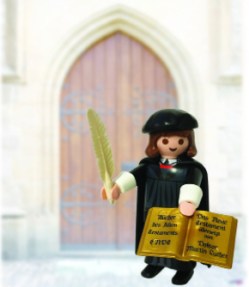
Martin Luther playmobll

This 3” tall toy from Playmobil is a big seller in Germany this year.

His story has all the markings of a summer blockbuster: thunder, lightning, daring escapes, an imprisonment (of sorts) in a German castle. But Martin Luther, born in 1483, was supposed to have been a lawyer and lived a much quieter, less adventurous life.

As a young teen, Luther was sent to school to study the law. His life changed dramatically in 1505 as he was traveling through a thunderstorm and a bolt of lightning struck too close for comfort. In desperation, Luther promised to become a monk.

He was ordained as a priest in 1507, but after 10 years of monastic life and increasing disillusionment with church practices, he sent a letter to leaders protesting the sale of indulgences, or pardons for sin. He included in the letter 95 Theses on faith, grace, sin, redemption, and religious authority. Those concepts, which sparked the Protestant Reformation, will celebrate their 500th anniversary this October 31, the date of Luther’s letter to church leaders.

Of the Scripture passages believed to have inspired Luther’s transformation, it is Romans 1:17 that theologian R.C. Sproul said “turned the lights on for Luther” because it details a righteousness given by God to those who would receive it by faith, rather than to those who could earn it.

In 1523, his life took another unexpected turn when a group of nuns asked for his help to escape their convent. He did so, sneaking them out in fish barrels. One of the sisters, Katherine Von Bora, eventually became Luther’s wife and the mother of his six children. (Von Bora must have been an unlikely partner for Luther; he once said that upon hearing of his choice, his close friends said, “For heaven’s sake, not this one.”)

Luther’s battles with established religion continued throughout his life, leading to his excommunication from the Catholic church after he refused to recant the Reformation’s ideals. Labeled a heretic and an outlaw, he was put in protective custody at Wartburg Castle. There, he translated the New Testament into German.

In the end, Luther left a legacy even larger than the life he led.

– Meredith Flynn, with info from Christianity Today, Ligonier Ministries, and Britannica.com

The Reformation at 500

ib2newseditor —  January 30, 2017
70116rose-parade-jan-2

Rose Parade Jan. 2, 2017

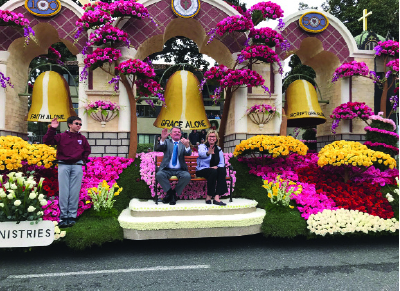
When the Protestant Reformation gets its own float in the Tournament of Roses Parade, something big must be happening. Not that we needed the Pasadena tableau to underscore the upcoming event, but we must admit it was surprising to hear NBC’s Al Roker announce the 500th anniversary of the Reformation as three flower-covered church bells tolling “A Mighty Fortress Is Our God” cruised by at 10 mph.

Would Martin Luther—ex-communicated, jailed, and persecuted for his pursuit of biblical faith—have been shocked to see his life’s work trussed in rose petals and paraded before cheering crowds?

I was.

There, following the surfing dogs, the Rose Queen, and the Salvation Army Band, was the Wittenberg Door, covered in black beans and poppy seeds, commemorating that All Hallow’s Eve in 1517 when the angry priest Luther nailed his complaints against the Catholic Church on the front door. Inscribed on the giant bells was “Faith Alone,” “Grace Alone,” and “Scripture Alone,” the three-sola distillation of Reformation theology.

Also at the front of the float was a man dressed as Jesus, waving to the crowd on one side of Colorado Boulevard and then the other. We can’t fault the sponsors, Lutheran Layman’s League, for their exuberance, for Luther himself redirected the attention of the faithful worldwide to the finished work of Christ as the only means of salvation. Not obeisance to saints or Mary, time served in purgatory, the purchase of “indulgences” for others or ourselves—only God’s grace through faith in Jesus Christ can save us. So commonplace today, this must have sounded radical to Luther’s first audiences. Yet, here we stand, benefactors of his brave actions, celebrating his Halloween escapade and all that resulted from it.

70116luther
But five centuries after the fact, this anniversary is an opportune time for Southern Baptists to ask a few serious questions:

How Reformed are we? What was started by Luther was picked up, refined, and defined by John Calvin and others. The line from Calvin (and other Reformers) to Southern Baptists isn’t as obvious as is the line from John Knox to the Presbyterians or Luther to the Lutherans, but the Reformers have certainly informed our Baptist theology.

Some Southern Baptists fully embrace Calvin’s doctrines of grace, the sovereignty of God, and election, considering themselves “five-point Calvinists.” Others, who defined their position as “traditional” Southern Baptist in the 2012 debate at the New Orleans convention, accept some of Calvin’s points, but rely more on the verses about God’s desire that all would be saved. Some would say they live in the tension between Calvinism and Arminianism, between the sovereignty of God in bringing people to salvation and the free will of man to accept or reject God’s offer.

This anniversary is a good opportunity for churches to study the principles of Reformed theology and ask, How Reformed are we?

What is the appeal of Reformed theology? For people who have grown up in an era of slushy theology and postmodern uncertainty, Reformed theology offers clear, clean delineation of belief. It’s faith with handles on it. That might explain the appeal to Christians who were described as “young, restless, and reformed” in Collin Hansen’s seminal work by that name in 2008. Hansen capsulized a phenomenon that had been in development for two decades by the time he wrote the book, and must be credited in large part, in SBC life, to Albert Mohler. From his position as president of Southern Seminary starting in 1993, Mohler has schooled a generation of young pastors, theologians, and now seminary presidents.

What is the long-term impact of rising Reformed theology on the SBC? Not everyone is enamored by the growth of Calvinism in Southern Baptist ranks. Some leaders have expressed concern about the possible impact on missions and evangelism.

Certainly our theological debate has been invigorated in recent decades. A denomination given to pragmatic, applicable theology through the Baby Boom years has more recently turned to serious consideration of the nature of the gospel. Can committed Calvinists, “traditional” Southern Baptists focused on evangelism, and the “somewhat Reformed” all coexist in the SBC tent, with a shared purpose that unites us, despite differences over finer points of theology? Or is another schism coming?

What will happen to evangelism? Our denomination’s baptism numbers continue to decline. Southwestern Seminary President Paige Patterson, a “traditionalist,” continues to express concern that rising Calvinism will naturally cool the fires of evangelism.

International Mission Board President David Platt might demonstrate a new kind of Reformed pastor, for whom evangelistic work by God’s people has high priority in God’s sovereignty. Will Platt’s zeal prove characteristic of the younger generation who are following his charge: “For the nations!” Or will the soul-winning Calvinist prove to be an anomaly?

Now, 500 years after Luther struck the first blows for Reformation, these are a few of the issues Southern Baptists must address—before the parade passes by.

– Eric Reed is editor of the Illinois Baptist.

61222word_cloud

We live by God’s surprises,” said Helmut Thielicke. The German pastor was speaking in times more trying than ours, but in the darkest days of WW2, he could see the hand of God at work—and was amazed by it.

Dare we say the same of the year just past?

We were surprised by events we witnessed. In their unfolding, we sought the reassurance of God’s sovereignty. Here are some noteworthy moments for Baptists in Illinois—some heavy, some light—and what they may say about the year before us.

– The Editors

SBC candidates: Unity matters

What the U.S. presidential election may have lacked in civility, the 2016 election for Southern Baptist Convention President more than made up for in grace. When a close vote forced a run-off between Steve Gaines and J.D. Greear, the election seemed poised to divide Baptists over matters of theology and generation.

Instead, the candidates talked the night before the third vote was to be taken, and one bowed out, urging his supporters to vote for his opponent.

“It’s time for us to step up and get involved, to keep pushing forward and engaging in the mission with those who have gone before us,” North Carolina pastor Greear posted in support of Tennessee pastor Gaines. “It’s time to look at what unites us.”

On paper, this decade’s SBC presidents are a diverse bunch, not united by much in terms of their backgrounds and interests:

  • Atlanta-area pastor Bryant Wright (2010-2012), who recently spoke out in favor of ministering to refugees
  • Dynamic New Orleans preacher Fred Luter (2012-2014), elected as the SBC’s first ever African American president
  • Ronnie Floyd (2014-2016), pastor of a multi-site church in Arkansas and a prolific blogger who led the denomination toward a laser-like focus on prayer
  • And Gaines, elected in 2016, who has espoused traditional Baptist theology and his own intense focus on evangelism.

What does unite them is a logical progression in the things they have called Baptists toward: For Wright, it was a return to Great Commission principles. Luter’s presidency was marked by impassioned pleas for spiritual awakening and revival. And Floyd called Southern Baptists to their knees—for themselves, their churches, the denomination, the nation, and the world.

Gaines announced he will continue the emphasis on prayer at the 2017 Southern Baptist Convention in Phoenix. It may be a sign that the desire for unity, despite differences in age, theological perspective, and communication style, is actually, in Greear’s words, “what unites us.”

A new missions paradigm

After a season in which budget shortfalls and personnel cuts seemed to limit the future potential for Baptist missions engagement around the world, International Mission Board President David Platt continued to preach a message to the contrary.

“Limitless” is the word Platt has used to describe the mission force needed to take the gospel to places without it. To achieve that goal, he has said, the SBC has to think differently about missions and missionaries than we have in the past.

“Let me be crystal clear: the IMB is still going to send full-time, fully-funded career missionaries just like we’ve always sent,” Platt said during his report at the 2016 Southern Baptist Convention in St. Louis. “They are the priceless, precious, critical core of our mission force.”

But the IMB’s emerging strategy is to put around those missionaries a “limitless” force of students, retirees, and professionals—people who, to borrow Platt’s words, are willing to leverage their jobs and lives so that more might hear and respond to the gospel.

The newly redesigned IMB website reflects the strategy, with buttons for people in a variety of categories to search for opportunities overseas. There are needs for business consultants, healthcare professionals, construction engineers, and more. The IMB also offers training resources for churches to equip and mobilize members for missions, both short-term and longer.

Global mission “is not just for a select few people in the church, but for multitudes of Spirit-filled men and women across the church,” Platt said in St. Louis.

A year ago, when hundreds of IMB missionaries moved back home, the chances of getting the gospel to some of the world’s darkest places seemed dimmer. Now, with a strategy focused on everyday people like the ones who sparked a gospel fire in the New Testament, the opportunities seem endless. Or, limitless.

If I had a hammer

We’ll hear it a lot in the new year. On Halloween night in 1517, disgruntled priest Martin Luther nailed his 95 complaints on the church door in Wittenberg and started an ecclesial revolution. We’re likely to hear about it from all corners, including events at our seminaries, panels at the Southern Baptist Convention in Phoenix, and bus tours of Germany. And we may have a few serious discussions about the theological direction of the SBC. Look for Reformation@500 in the pages of the Illinois Baptist throughout 2017.

Read Cloudy with a chance of surprises, pt. 1