
Archives For November 30, 1999

The BriefingPastors sue Illinois over gay conversion therapy ban
A group of pastors is suing Illinois over a law that bars therapists and counselors from trying to change a minor’s sexual orientation, saying the prohibition violates free speech and religious rights. The federal lawsuit seeks to exclude clergy from the ban that took effect Jan. 1, arguing that homosexuality is “contrary to God’s purpose” and a disorder that “can be resisted or overcome by those who seek to be faithful to God and His Word.”

Olympics wrap-up: God praised by athletes in triumph, defeat
The images and memories of the 2016 Olympics will endure for much longer than the torch’s flame. Several athletes who are professing Christians joined in the medal haul. Helen Maroulis won the first gold medal ever for the United States in women’s wrestling, and said that throughout her competition she repeated to herself the mantra, “Christ in me, I am enough.”

Judge blocks transgender restroom order
A federal judge in Texas has temporarily blocked the Obama administration’s directive forcing schools to allow transgender students to use restroom and locker room facilities based on gender identity, rather than their biological sex. District Judge Reed O’Connor said the departments of Education and Justice failed to follow the Administrative Procedures Act, which requires advanced notice and a public comment period before issuing such guidelines.

Judge under fire for praying in courtroom
A Texas judge could be sued for starting every court session with a short prayer. The Freedom From Religion Foundation alleges that Judge Wayne Mack’s invocation is “unconstitutional,” and the organization is currently considering a lawsuit. Mack pointed out that both the U.S. Supreme Court and the Texas Supreme Court start their opening sessions with an invocation, and he’s just “following in their footsteps.”

Lutherans recognize agreement with Catholic Church
Nearly 500 years after Martin Luther nailed his 95 theses to the Castle Church door, the largest Lutheran denomination in the U.S. has approved a declaration recognizing “there are no longer church-dividing issues” on many points with the Roman Catholic Church. The “Declaration on the Way” was approved 931-9 by the 2016 Evangelical Lutheran Church in America Churchwide Assembly in New Orleans.

Sources: Big Story AP, Baptist Press, World Magazine, Fox News, Religion News Service

If I were your enemy

ib2newseditor —  August 11, 2016

Fear Concept Wooden Letterpress Type

I am part of a very lively, very opinionated Sunday school class. Most of us are in our 50s and 60s, which, of course, means there is also great wisdom in our class (or so we’d like to think!). There are many times when our class discussions veer off into politics, pop culture or current events. This almost always results in hand-wringing, head-shaking, and longing for “the good old days.”

A couple of weeks ago, one of my classmates, a father of two, told us how sad and fearful he had felt that weekend when he was watching his kids play, thinking, “What if this time, right now, is the best time of their lives? What if it’s downhill from here?” What a sad thought!

It reminded me of something I had read in “Fervent,” Priscilla Shirer’s book on prayer:
“If I were your enemy, I’d magnify your fears, making them appear insurmountable, intimidating you with enough worries until avoiding them becomes your driving motivation.”

Shirer says fear is one of Satan’s primary schemes for crippling God’s people. I’m not talking about legitimate concern or warnings of godly wisdom; I’m talking about incessant worry, up-all-night anxiety, and worst-case scenarios that become the only probabilities you can imagine.

These were the kinds of fears my friend in class was talking about. And it made me mad! But not at him. I was mad at the enemy for messing with him, for messing with me, for messing with all of us! In class that day, I felt compelled to tell him, “Don’t give Satan that power over you!”

Satan is NOT God, and he’s not God’s counterpart or peer. They’re not even on the same playing field! Stop allowing his “spirit of fear” to invade our lives. We need to pray fervently and strategically against the enemy, as Shirer writes in “Fervent.” You and I, coming to the Father through the mighty name of Jesus, can pray like the victorious saints of God we’ve been empowered to be!

With all that’s going on in the world, I totally understand where my friend is coming from. But I don’t want him to live with a spirit of fear. I will continue to remind myself and those I love to pray fervently.

He is my God, and I trust him. More than ever before!

Carole Doom is IBSA’s information specialist and a member of Living Faith Baptist Church in Sherman.

Ready for Rio

ib2newseditor —  August 5, 2016

Rio_2016_crop.jpgWith the Olympic Games set to kick off Aug. 5, Southern Baptist volunteers will be in South America to share the gospel both with local residents and with the thousands of visitors from across the globe.

“There exists no greater opportunity to reach people from over 200 nations in 30 days than the Olympic Games,” said John Crocker, a missions pastor from Alabama who is leading a mission team to Rio. Crocker’s team will engage Rio residents with the gospel through evangelistic block parties and Olympic pin trading.

“There is an openness by people to talk with one another and to talk about spiritual things,” said Sid Hopkins a retired director of missions from Georgia who ministers at the Games by distributing pins made especially for the Olympics that tell the story of Jesus.

“We have seen many people who come to the Olympic Games open to listen to the gospel because the atmosphere created is one of friendship on a global level. Ministry during the Olympics is simply electric.”

Pre-event publicity for the Olympics has been largely negative, due to concerns over the Zika virus, Brazil’s economic struggles, the fitness of Rio’s water supply, the Russian doping scandal, and other issues. But Brazil’s hosting of the 2014 World Cup proved to be successful, and Olympic organizers are banking on a repeat of that success in Rio.

Journalist Tim Ellsworth, former editor of the Illinois Baptist, will cover the Games for Baptist Press, focusing largely on Christian athletes who are competing, including diver David Boudia. He won gold in the 10-meter platform competition in 2012 and is looking to add to his medal count in both that event and the men’s 10-meter synchro competition with his partner Steele Johnson. Both men gave strong testimonies of their faith in Christ following the Olympic trials this summer.

“This is not what my identity is going to be in the rest of my life,” Johnson said. “Yeah, I’m Steele Johnson the Olympian, but at the same time, I’m here to love and serve Christ. My identity is rooted in Christ and not in the flips we’re doing.”

The Illinois Baptist blog, iB2news.org, will have more stories from Rio during the Olympic Games.

– From Baptist Press

Walking

One thing I love about summer is the opportunity for long walks. Beth and I have a three-mile circuit that takes us from our house down to a nearby lake and back. Usually we walk it after dinner, but before dark, with our blind dog Willy. Our nest of three sons is empty now, and so we have just this one furry kid to follow us around.

It’s not really the walk itself that I value, though. It’s what happens there. By the time we walk, Beth and I have usually taken dinnertime to catch up with one another on the day’s events, and what arrived in the mail, and what we each heard from friends or family that day.

The walk is for deeper talk. That’s when we tend to discuss longer term plans for the future, or longer view reflections on where we’ve been. We talk not just about our kids’ activities, but about their well-being and their life decisions. We talk not just about short-term purchases, but about long-term investments. We talk not just about our church routines, but about our spiritual lives.

It usually takes a while to get past perfunctory, obligatory prayers I tend to settle for when time is short.

Sometimes our local son, Caleb, and his wife, Laura, walk with us. Those are rich times. Often Laura will walk alongside Beth and engage in one conversation, while Caleb and I will pair up a few steps behind them. Sometimes the two conversations will blend, and mix, and then separate again. We all like to hear as much as possible.

But these aren’t the 10- or 20-word texts we exchange with our kids during the day. These are often significant conversations about problems, and dreams, and life decisions, and dilemmas. Long walks encourage deeper talks.

And then there are the long walks I take by myself, to have deeper talks with God. Sometimes I make time for them during the regular routine of life. But often I need a vacation or a few days off or a different setting in order to pull away.

During the regular rhythms and busyness of life, my prayer times can grow so brief, so repetitive, so lightweight. Like the chitchat of a dinner conversation or the insufficiency of a text, I can settle for such trivial communication with God. But when I walk for a while with him it’s easier to remember that he really knows and loves me in my deepest, innermost parts, and that he longs to meet me there too, and not just in the shallows of a busy life.

Over a few recent days of long walks and deep talks this summer, I remembered again that it usually takes a while just to get past the perfunctory, obligatory prayers that I tend to settle for when time is short. I know there’s nothing wrong with those prayers, just like there’s nothing wrong with catching up over dinner on the day’s activities. It’s just that there are so many more significant things to talk about. But you only seem to get there when you take the time.

This past week I walked and talked to places of deep confession, and pleading, and worship, and peace. Once the lighter weight stuff was off my chest, there were several minutes and miles of silence as I looked for the right words to tell God things I then remembered that he knows already. Yet when those words came, they were cathartic and soothing to my soul.

Long walks can lead to deep talks, with our spouses, our kids, and yes, our God. May you find time for the long walks you need this summer.

– Nate Adams is executive director of the Illinois Baptist State Association. Respond at IllinoisBaptist@IBSA.org.

It’s time to speak up

ib2newseditor —  August 3, 2016

Adron RobinsonThe week of July 4, 2016, was a very dark week in America. It began with my wife and me celebrating Independence Day with our family and watching the local fireworks display. But there would be a different type of fireworks in the days to come.
On July 5, a Baton Rouge police officer pinned down Alton Sterling and shot him several times while he was on the ground, killing him in front of witnesses.

The very next day in Minnesota, Philando Castile was pulled over in a routine traffic stop and shot multiple times by a police officer. Castile’s girlfriend videotaped the aftermath of the shooting and broadcast it live on Facebook for the world to see.

If those incidents weren’t enough, on July 7, at the end of a peaceful protest of these killings, an armed gunman ambushed Dallas police officers, killing five and wounding seven others.

How can the church remain silent when the sin of racism is screaming so loudly?

It truly was a dark week in America. As I sat at my desk praying about how to process these events and address these issues with my congregation, God led me to Matthew 5:13-16.

We live in a dark and decaying world, and the darker the world gets, the more it needs the church to be salt and light. Light shines brightest in darkness, and God has providentially placed the local church in the community to shine the light of the gospel to a world that desperately needs that light.

The killings of African Americans at the hands of police officers, and the denial of justice to the families of those slain, reveal the high level of personal and institutional racism in America.

The truth of the matter is that an encounter with the police is a life or death matter for many people of color in America. We pull over praying. Praying that the officer who stops us will uphold the law and not manipulate it to cover up his own racial prejudice. Praying that we will be treated the same way every other citizen of this country is treated. But most of all, we are praying that we are not killed by the very people our taxes pay to serve and protect us.

This is not the experience of my non-minority brothers and sisters. And it should not be the experience of anyone created in the image of God.

My question is, how can the church remain silent, when the sin of racism is screaming so loudly? How can we stand by as injustice continues against those we say are our brothers and sisters in Christ?

We cannot remain silent. In order for there to be change in our culture, the church must stop being silent and step up and be the church. In Matthew 5:13-16, Jesus calls us to be counter-cultural Christians. This means the church is called to influence our culture with the gospel of Jesus Christ.

Christians and only Christians are the salt of the earth. Christians and only Christians are the light of the world. Christians and Christians alone are responsible for stopping corruption and slowing down the decay of this world.

Notice Jesus did not say “you and the government,” “you and the police department,” or “you and the Supreme Court.” There is only one hope for this world, and that hope is in people of God preventing decay and penetrating darkness.

We need to stop making excuses, stop being divided, stop being deceived by the darkness of this culture, and begin shining the light of righteousness and loving our neighbor as ourselves. We will never overcome a hateful world unless we learn to love one another.

Dr. Martin Luther King Jr., said, “Darkness cannot drive out darkness; only light can do that. Hate cannot drive out hate; only love can do that.” If we love our neighbor as ourselves, we cannot remain silent as our neighbors are being slain in the streets. And we must address the racism in our world, even if it is in our own hearts.

In Acts 10:34, Peter says, “Truly I understand that God shows no partiality.”

I pray that soon and very soon, the church would do the same.

– Adron Robinson is senior pastor of Hillcrest Baptist Church in Country Club Hills and vice president of IBSA.

Graham and Lincoln

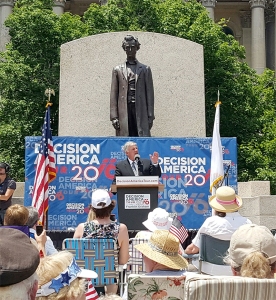
Franklin Graham speaks at the Illinois Capitol. Photo courtesy Micheal Henderson

Springfield | On Tuesday, June 14, thousands gathered in Springfield to hear Franklin Graham, oldest son of evangelist Billy Graham, as he stopped in Illinois for his 50 state, Decision America Tour. Many braved the 90-degree weather and lined the streets and lawns surrounding the Illinois state capitol, as Graham challenged Christians to pray for the country and take a stand for their faith.

Churches from across the state were represented with many bringing vans of supporters. The crowd enthusiastically sang “How Great Thou Art” preceding the rally.

When Graham arrived, he began the time leading everyone in prayer for the people affected by the Orlando shooting. Using the tragedy as an example of our country’s sinfulness, Graham plainly stated that he has no hope in either the Democratic or Republican Party to turn things around.

“The only hope for the United States of America is the Almighty God,” Graham proclaimed, stating that God’s truth and righteousness should be the utmost focus of every evangelical Christian who calls this country home.

Graham went on that Christians must make their voices heard if America is to be preserved, and the Christian heritage restored that has given us the liberties we now enjoy.

Without telling people who to vote for, Graham simply asked those in attendance to consider pledging to: daily live out biblical principles, honor God in public, vote for political candidates if at all possible who uphold biblical standards, pray for our country, and lastly, consider if God so leads, to run for office.

Graham’s parting words: “Our job as Christians is to make the impact of Christ felt in every [area] of life – religious, social, economic, political… But we can only do [this] as we surrender ourselves completely to God, allowing Him to work through us… Let’s elect men and women to office who will lead this nation back to really being one nation under God.”

– Morgan Jackson

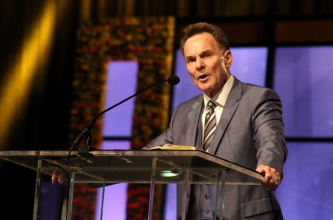
Floyd_presidents_message

SBC President Ronnie Floyd at the 2015 SBC Annual Meeting in Columbus, Ohio.

When Ronnie Floyd was elected president of the Southern Baptist Convention, the denomination was coming to grips with the truth. After several years of describing many churches as “plateaued or declining,” leaders started speaking in frank terms about why, year after year, key measures like church membership, worship attendance, and baptisms were down denomination-wide.

“We are clearly losing our evangelistic effectiveness,” one Baptist leader said in 2014, the year Floyd was elected to his first term.

Things looked bleak, and for the first time in a while, the pressure wasn’t coming from outside opposition or controversy. Rather, the SBC seemed to be at an impasse.

Before his presidency, Floyd was already established as someone who could provide direction. As the pastor of a Southern megachurch, he led his congregation to a regional, multi-campus strategy and a new name—from First Baptist, Springdale, to Cross Church of Northwest Arkansas.

That is perhaps Floyd’s greatest legacy: He has reminded us that revival starts with prayer, and prayer starts with humility.

As chairman of the Great Commission Resurgence Task Force, Floyd helped lead Baptists to renewed commitment to a unified purpose—albeit with some difficult adjustments and plenty of debate over proposed funding changes between national agencies and state conventions.

But when Floyd was elected as SBC president, he looked not to drastic measures or sweeping changes—but to prayer. Unified, solidified, corporate prayer. Prayer that asked Baptists of all stripes to set aside differences for something greater than themselves: pleading with God for a great spiritual awakening.

Putting greater emphasis on the SBC annual meeting, Floyd called Baptists to Columbus, Ohio, in June of 2015 for a special prayer meeting to together confess sin—like racism and evangelism apathy—and to move forward as a humbled Convention that prioritized the work and mission of God.

In advance of the prayer meeting, which will happen again this summer in St. Louis, Floyd kept everyone in the loop through regular blog posts and columns distributed via Baptist Press and state Baptist newspapers. Throughout his presidency, he hasn’t hesitated to use the power of the pen (and keyboard) to inform, encourage, and challenge Baptists about the state of the SBC and our desperate need for spiritual awakening.

At the Southern Baptist Convention next weeek in St. Louis, the Tuesday evening session of the meeting will again be devoted to prayer. That is perhaps Floyd’s greatest legacy: He has reminded us that revival starts with prayer, and prayer starts with humility. For calling us together for that purpose, he deserves our thanks.

Headline prayers

ib2newseditor —  May 30, 2016

Today’s headlines are driving me frequently to deeper and more desperate prayer. Many of us probably whisper something like “God help them” when we see a tragedy reported on the news. But I’m not primarily referring to headlines about a natural disaster, or a rare, heinous crime by an isolated, evil person. The headlines driving me to deeper prayer are those that reveal a declining morality in our culture that seems more and more widely accepted.

My main dose of these daily headlines usually comes in the early morning while I’m exercising in front of the TV. As I flip from one news channel to another, I more and more regularly see behaviors and lifestyles and decisions that would have been considered shameful or scandalous a generation ago. Now they are reported as progressive, or even normal. And the proud spokespeople for many of these decadent trends are interviewed by often adoring news anchors, as if they were the civil rights voices of today.

I often find myself asking “Help them, help us, help me.”

Unrestricted freedom of individual choice, preference, and expression seem to have become idols in American culture today. Just this past week, a story and its follow up interview so shocked and deflated me that I moaned out loud, “Oh God, help them!”

“Help them to see the deception they have bought into, and the damage they are doing, and the long-term consequences of the sinful lifestyle they are advocating, both to themselves and to others. Convict them of sin, God, and show them the same mercy and grace that you show me when you convict me of my sin.”

But as the disturbing interview went on, I also found my prayer deepening. “Yes, God, help them, but also help us! Your gospel had no voice in that headline, and your church had no spokesperson in that panel discussion. Interviewer and interviewee alike just presented that issue totally void of biblical perspective or truth. God, don’t let that happen! Don’t let millions of viewers gradually learn to accept that position as true and normative. Give your truth a voice through your people!”

The story passed, and I don’t know what was on the screen next, because my prayer was driven even deeper. “Yes God, help them, and help us. But oh God, help me too!  My voice is so silent. My life is so impotent. My efforts to carry the truth of your word and the power of your gospel are so weak. I’m going to go to the office in a few minutes to answer some e-mails, sit in some meetings, and move some projects along. But what will I have personally done to make any difference in the cultural decline I have just witnessed?”

My feeling of powerlessness was frustrating. And that frustration made me angry. I found myself wanting to pray for God’s righteous judgment to simply fall upon these people, and upon our land if necessary, and make it all right again.

But I’ve learned to be careful, even fearful, about calling for God’s judgment. I am too often deserving of it myself. And when I was most deserving of it, when I was still a sinner by lifestyle and choice, when I was just as far from God as the frustrating people in the headlines, that’s when God in Christ reached out to me in mercy, and with conviction and grace and forgiveness. And he still does that today.

So I am meeting the morning headlines these days with these three prayers: God, help them. Help us. Help me. I invite you to join me in these prayers.

Nate Adams is executive director of the Illinois Baptist State Association. Respond at IllinoisBaptist@IBSA.org.

Governor Rauner crop

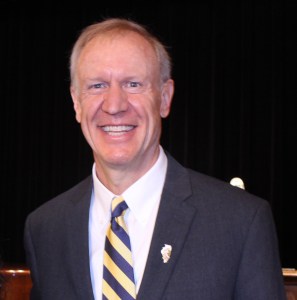
Illinois Governor Bruce Rauner

Religion and faith were on display at the Illinois Governor’s Prayer Breakfast as around 200 Christians, Jews, Muslims, Sikhs, Hindus, and others gathered at the Executive Mansion in Springfield May 26.

Yet, even in this setting with representatives of several religions, Jesus was lifted up. The gospel was clearly presented in song through the harmonies of The Gibson Girls, Scripture readings from Isaiah 2:1-4 and John 17, and prayer.

At the event, Governor Bruce Rauner asked attendees to pray for the state government. “I hope you will join us and people all around the state of Illinois in prayer. Keep us in your prayers. We need prayers for inspiration and to have good judgment.”

He also shared from his own personal faith background. His father is Catholic, while his mother is Swedish Lutheran. Rauner said he was baptized and confirmed in the Episcopalian Church and his wife is Jewish. “We have interesting conversations around the dinner table,” he joked.

But Rauner said he was inspired by his grandparents’ faith and the lessons they taught him: “Do unto others as you would have them do unto you,” from Luke 6:31 and “For whom much is given, much shall be required,” from Luke 12:48. He spoke of the responsibility he felt after earning his own wealth, and said it was their examples that lead him to set up a charitable foundation to give to causes as well as to serve.

The governor shared about the importance of continuing the tradition of the breakfast, which some feared would not take place this year. In early May, a member of the organization that normally hosts the event, told media the breakfast would not be held due to state budget problems. Upon hearing the news, the Rauner expressed his disappointment and his office sought sponsors to host the event. Three organizations — the Abundant Faith Christian Center, the One Nation Under God Foundation, and the Illinois Executive Mansion Association — stepped up to sponsor the event, held every year since 1963. No government dollars were used to pay for this years event.

Bob Vanden Bosch, chairman of the One Nation Under God Foundation, told the Springfield State-Journal Register last week, “For us, this is a faith initiative. It’s not something that’s political. … I believe that prayer could be used by the state of Illinois right now.”

The event did include a reading from the Koran, but the overall tone of the event was Judeo-Christian.

Illinois Southern Baptists were represented at the event by two of the Illinois Baptist newspaper’s editors, Eric Reed and Lisa Sergent.

The BriefingSouthern Baptists called to prayer
On June 14, the entire Tuesday evening session of the 2016 Southern Baptist Convention in St. Louis will be committed to praying for spiritual leaders, our churches, nation, and world. Southern Baptist Convention President Ronnie Floyd issued the call stating, “the critical need of the hour in America, the state of our churches, the needs of our pastors, the status of our evangelism or lack of it, and the exponential lostness of the world while we are bringing home hundreds of our missionaries… it is time to pray.”

New churches outpace dying ones
America is launching new Protestant churches faster than it loses old ones, attracting many people who previously didn’t attend church anywhere, new LifeWay Research studies show. More than 4,000 new churches opened their doors in 2014, outpacing the 3,700 that closed, according to estimates from 34 denominational statisticians.

Christian women most persecuted
A survey of 192 countries has demonstrated scientifically what many have long known anecdotally to be true: Christian women are more religious than Christian men. The lesser known fact: those women bear the brunt of persecution in the 50 countries where it is hardest to be a Christian.

Tax-exemptions for churches questioned
Massachusetts authorities have challenged the tax-exempt status of a Catholic shrine and retreat center. The center offers daily Masses, religious conferences, a soup kitchen for the hungry, and a Christmas festival of lights. The case which has gone to the state’s supreme court, begs a deeper question: Do religious organizations decide for themselves what they require for their devotional and educational missions, or do municipal tax authorities decide for them?

Porn labeled ‘public health hazard’
The effort to reverse the spread of sexually explicit material and its effects received a boost when Utah Gov. Gary Herbert signed a resolution saying pornography is establishing “a public health crisis.” The first-of-its-kind resolution, which National Center on Sexual Exploitation (NCOSE) helped craft and the state legislature approved unanimously, recognizes “the need for education, prevention, research, and policy change” to confront “the pornography epidemic.”

Sources: IB2news, Facts & Trends, Christianity Today, Boston Globe, BPnews.net