Archives For November 30, 1999

Hidden entrances

nateadamsibsa —  February 23, 2015

HEARTLAND | Nate Adams

Several years ago Beth and I had the opportunity to travel overseas to Amsterdam. As Sunday approached, we began scouting out nearby churches with English-speaking worship services. Finding only one within walking distance, we made plans to attend and committed to starting out early. But it was not early enough.

This was before the days of GPS and smart phones, and all we had were verbal directions from the place we were staying. We recognized the various street names and landmarks they told us we would find along the way. We knew we were in the right neighborhood. But we could not find the church.

Nate_Adams_Feb23Did we ask others for directions along the way? Well of course, though as a self-respecting husband who rarely feels lost, I waited as long as possible. But most of the folks in the neighborhood spoke only Dutch, and at least one of our well-intentioned helpers actually directed us to a German-speaking Lutheran service, which only cost us more time.

Finally, as the scheduled worship hour was upon us, we met a nice little man who was willing to walk with us a short way and point down a narrow alleyway. We had probably walked past it several times, but never realized that it led to where we needed to go.

Somewhat by faith, we walked down that narrow passage until it opened up into a beautiful courtyard. And right in the center was a beautiful old stone church, the place of worship for which we had been searching.

What a rich and deep worship experience we had that morning. On the way out, we inquired about a stained glass window that had caught our attention, one that seemed to depict pilgrims gathered for prayer on an ocean shore. It turns out the church in which we were worshiping that morning was the church from which the Mayflower pilgrims had departed for the New World almost 400 years ago.

When we returned to the hotel and told them of our difficulty finding the church, the staff apologetically acknowledged that the neighborhood had grown up quite a bit around the historic church. New buildings and thoroughfares now surrounded and somewhat masked the entrance to the courtyard. They were glad that someone familiar with the entrance had showed us how to find it.

In recent days, I have sometimes wondered what it is that keeps me from feeling a more consistent closeness to God. Like that narrow alleyway in Amsterdam, it seems the path to greater intimacy with God can be hard to find, even when I’m diligently looking for it.

Psalm 100 gives us a wonderful word picture of entering God’s gates with thanksgiving, and entering His courts with praise. Recalling that psalm during some recent soul-searching, I asked myself if I had been feeling or expressing genuine thanksgiving to God.

I began realizing how much my prayer life had been consumed with either asking for things to be different or expressing frustrations,  neither of which came from a heart of gratitude toward God. Like the buildings and thoroughfares that had grown up around that historic church, I had somehow allowed various disappointments and distractions to obscure my vision of God. They were keeping me from recognizing that I enter the courtyard of praise through a gateway of thanksgiving, and that God’s goodness and salvation and sovereignty merit my continual gratitude, even when things aren’t going my way.

Have your circumstances allowed obstacles such as discontentment or frustration or something else to creep in to your spiritual life and block your intimacy with God? Like that kind little man in Amsterdam, let me point you once again to the gateway of thanksgiving. You will be so delighted with where it leads.

Nate Adams is executive director of the Illinois Baptist State Association.

Church leaders from 13 states converge for regional Summit

NEWS | Illinois Baptist

“Listen to me, Midwest, the Father is seeking worshipers,” Frank Page intoned. “Every man woman, boy and girl on this globe needs to hear this message.”

The man who calls himself “the SBC’s Chief Encouragement Officer” rallied local church leaders to advance the gospel in a region where Southern Baptists are relatively few and often far between. “I’m not trying to build a bigger denomination,” the CEO of the Convention’s Executive Committee said, “I’m trying to encourage you to help bring worshipers to Christ.”

Spiritual awakening and church revitalization were main themes of the Midwest Leadership Summit held January 20-22.

“What we need, more than a strategy, more than a plan, we need a fresh awakening,” Kansas pastor Andy Addis preached in the opening session. “We want to see God do amazing things, we want to be his hands and feet, that’s why we’re here!”

More than 1,000 pastors and church leaders from the Upper Midwest convened in Springfield for the inspirational equipping conference held every three years. Called the North Central States Rally since its inception 50 years ago, the Summit was renamed this year as it expanded to include 10 Baptist state conventions representing 13 states, from West Virginia to the Dakotas.

The Illinois Baptist State Association hosted the event at the Springfield Crowne Plaza Hotel, providing a more central location as the Summit’s territory expanded on the western side. IBSA executive director Nate Adams chaired the planning committee.

“We drove 10 hours to get here,” one conferee from South Dakota said at the registration desk, telling how his association invited church leaders and brought them in a van.

“It took us two days,” a North Dakota pastor in a bolo tie responded, “but it’ll be worth it.” The buzz in the lobby was positive, as returning attenders told newcomers the value of meeting for leaders who share the challenges of ministry outside the traditional Southern Baptist stronghold.

Henry Hall has been attending the triennial leadership conference since 1984. The director of missions for Salem South Baptist Association said the event was originally designed “for the smaller churches, mission churches, where the pastors are spread out. And most of our churches in the southern part (of Illinois), we’re not as spread out,” Hall said.

“But around the rest of the country, you’ve got to go a long time to find another pastor. And by getting a group together that are all in the same boat, it’s very effective to help them in learning and being what God would have them to be.”

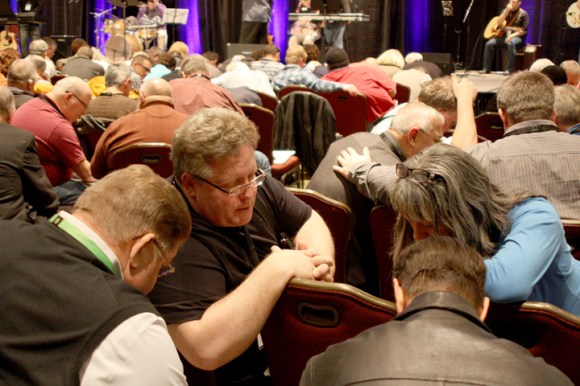
When Gary Frost led Summit attenders to intercede in small groups for children and youth, IBSA’s Pat Pajak (left) prayed with Ken and Kathy Schultz from Crosswinds Church in Plainfield, and a pastor from Iowa.

When Summit speaker Gary Frost led attenders to intercede in small groups for children and youth, IBSA’s Pat Pajak (left) prayed with Ken and Kathy Schultz from Crosswinds Church in Plainfield, and a pastor from Iowa.


Tony Manning lives in Fishers, Indiana, a community of 85,000 people, without a single Southern Baptist church—yet. “The need for everyone is the gospel, and that doesn’t change from East coast to West Coast,” said Manning, a church-planting and mission-teams strategist. “But what does change is how to do things. It’s important to understand the Midwest perspective and how to leverage that in sharing the gospel: How do you do it in Indiana? In Iowa? In Wisconsin?”

Woodie Ladnier has pastored in Iowa since 1991. Recently called to a new congregation, he came looking for fresh ministry ideas. “You know you’re not in the Bible Belt. People in the Midwest are friendly, but you have to earn their trust. You have to be more intentional, because your ol’ buddies aren’t just gonna go to church with you.”

The three-day summit was sponsored by the North American Mission Board, LifeWay Christian Resources, National WMU, and the 10
state conventions. Conferees attended three large-group sessions at the Crowne Plaza, filling the largest ballroom with praises. (“Bless the Lord, O my soul, O-o-o my soul,” they sang; and those three bass thumps ahead of the gutsy response “10,000 reasons for my soul to find…” echoed off the walls.)

Between worship sessions, leaders chose from 135 breakout sessions, state meetings, and affinity groups.

Plan to Pray for Evangelism
Robert Sterling
Imperial, Missouri

Robert Sterling knew his decision to attend the 2015 Midwest Leadership Summit was the right one after the first night. “I called my wife when I got back to the hotel room and said, ‘Well, I just got a spiritual ‘kicking’ and it was just what I needed,’” said the pastor of Windsor Baptist Church in Imperial, Missouri.

Andy Addis, lead pastor of CrossPoint Church, a video-driven multisite church with 11 campuses across Kansas, spoke during the opening session and based his message on Jesus’ parable of the barren fig tree (Luke 13: 6-9). “He reminded us that God expects His church to bear fruit,” Sterling said. “Not hopes; expects. Not wants; expects. That concept really resonated with me.”

Sterling came to the Summit with the intention of finding both guidance and practical tools to bring his church revitalization. He found what he needed in the event’s numerous breakout sessions. He chose sessions on revival, spiritual awakening, evangelism and leadership. He said each of them offered both insight and applicable advice.

“In one of the sessions the speaker said that more than double the baptisms occur in churches that offer evangelism training than those that don’t,” he said. He also learned that though a calendar full of events and programs may not be the best way to win souls to Christ, planning to pray is.

“We need to have more opportunities to pray,” Sterling said. “God uses whatever methods or means to reach people, but the opportunity to seek prayer is vital. Honestly, each of the sessions was very encouraging in terms of reminding us of truths we already
know, but often get lost or forgotten when you are in the middle of the forest.

“Probably my number one takeaway from this is that if I want the church to be revitalized and have a true love of God, I need to make sure that’s where my focus is, too. I need to become what I want them to become.”

Overcome isolation
Tim Batchelor
Princeton, Illinois

Tim Batchelor has pastored Bethel Baptist Church in Princeton, since 2010. Originally from North Carolina, he has found similarities between his upbringing (both of his grandfathers were farmers) and the rural northwest Illinois community he serves. But there are  differences too.

“In North Carolina, if you took the county that I grew up in, there are probably more Southern Baptist churches just in that county than in the entire northwest region of Illinois, and Sinnissippi Baptist Association specifically.”

When asked if his region of Illinois feels unchurched, Batchelor says yes.

“We were talking about that last night at dinner a little bit, and even on our way from our hotel to the session last night. Yeah, it does feel that way, and the need for church planting in particular.

“Sinnissippi Baptist Association has a really ambitious planting strategy; I think it’s just fantastic. But yeah, the need for church planting is huge.”

Second-gen strategies
Aidyl Lesada
Trenton, Michigan

Aidyl Lesada is from a Filipino congregation of about 100 people in Taylor, Michigan. “We are a mother church,” she says of Philippine International Church, which has planted several Filipino congregations in the area, and one just across the Canadian border.

There are about 20,000 Filipino people in Michigan, Lesada says. “Filipinos come here to work and pursue that American dream, and so they give their life, their time for that, and so I guess church will not be a priority. It will just be on the side for them, for them to feel good about it.”

Many have a Catholic background, so making the distinction between faith in Christ and cultural religion is important. Lesada’s church is reaching Filipinos who came to America to work in professional fields, and are now raising second- and third-generation children. Like her own son and daughter. Laughing, she describes them this way: “They’re Filipinos, but they’re not Filipinos.”

Social media for Millennials
Laura Chapman
Red Bud, Illinois

At Laura Chapman’s first Midwest Leadership Summit, the pastor’s wife from Red Bud attended breakout sessions that spoke some of her languages—statistics and social media.

Their congregation is medium-sized and located on the edge of the Metro East area. First Baptist Church of Red Bud, doesn’t have very many Millennials, she said, so a breakout on using social media to reach younger people was helpful.

“You know, there are a lot of people in our churches that don’t know what hashtags are, or keywords, or current things that reach people we’re not reaching,” Chapman said. “And I think just the how-to’s, the nuts and bolts of ‘you gotta update your website, you just have to do that…’ helps bring in generations that we’re not reaching. That was very helpful, and easy to implement.”

One breakout session leader at the Summit said if Millennials can’t find a Facebook page for a church, they wonder what that church is hiding. Chapman understands that kind of thinking. “Nobody in my generation and below trusts people…that’s kind of our thing. So, help them to know you.”

Urban challenges
Donald Johnson
Rock Island, Illinois

This wasn’t the first Midwest Leadership Summit for Donald Johnson, pastor of Destiny Baptist Church of Christ in Rock Island. He traveled to Indianapolis for the “North Central States Rally,” as it was called before this year, and was glad for a slightly shorter commute—three hours instead of five.

“But wherever it is, I’m willing to go, because of the value that we get out of it…We’ve been enriched,” said Johnson, whose church is part of Quad Cities Association.

Destiny’s vision statement is based in Isaiah 56:7, “to be a house of prayer for all races of people.” Their goal is to be multi-racial rather than multi-cultural, Johnson said. “There’s not going to be a segregated heaven, so I don’t want to have a segregated church.”

He was moved by Gary Frost’s closing sermon, which focused in part on the dangers children and teenagers face today. “He got into my neighborhood, which is the same neighborhood he has,” Johnson said. In his community, “We deal with the matter of significant fatherlessness.”

Frost’s message focused on returning to “the valley” after a mountaintop experience. Speaking on Jesus’ transfiguration in Mark 9, he noted how Peter wanted to build shelters for Jesus, Moses and Elijah.

“For me, it was good to be here,” Johnson said. “But I’m not going to be like Peter and John and say, ‘Let’s build three tabernacles here on the mountain and stay.’

“Because we gotta get back to the valley.”

Reported by Meredith Flynn, Eric Reed and Lisa Sergent, with Kayla Rinker and Nick Rynerson.

THE BRIEFING | Meredith Flynn

Three-dimensional map of Illinois. USA.It’s “State of the States” time at Gallup, and the researcher is releasing new findings every other day. Last week’s data covered President Obama’s job approval rating, political party identification, and ideology–each measured by state. To see how Illinois ranked (a quick preview: The state had the 10th highest approval rating for the President), go to Gallup.com.


Phillip Bethancourt examines “Johnny Manziel, Rehab and the Gospel” on FaithStreet.com, in light of the Cleveland quarterback’s entry into a treatment center earlier this month. “As Christians, our response to the collapse of Johnny Manziel should not be an ‘I told you so’ triumphalism or an ‘anyone could see that coming’ dismissiveness,” wrote Bethancourt, executive vice president for the Ethics and Religious Liberty Commission. “Instead it should be a ‘such were some of you’ recognition that, apart from Christ, we might also be there.”


Pew Reseach reports the U.S. Supreme Court could face some religion-themed decisions this year, including two very different cases related to employment. In one, a would-be employee at Abercrombie & Fitch is arguing for her right to wear a head covering. In the other, religiously affiliated non-profits say they shouldn’t have to comply with the Affordable Care Act’s contraceptive mandate.


At the Feb. 5 National Prayer Breakfast, President Barack Obama compared current acts of terrorism committed by ISIS and other groups to past movements–including the Crusades–he said were often committed or justified in the name of Christ.

“His flawed comparison to atrocities that happened hundreds of years ago minimizes the severity of ISIS and other groups that are brutalizing and killing innocent people,” Southern Baptist Convention President Ronnie Floyd told Baptist Press. “Instead of focusing on the past, America needs heroic leadership in the present–leadership that champions religious liberty for all people.”


Christian rapper Lecrae Moore gave credit where credit is due during his Grammy acceptance speech Sunday night.  “…You can’t celebrate gifts without celebrating the giver of all gifts. So I want to celebrate Jesus for gifting us all with the gift of love and sacrifice.” Lecrae’s song “Messengers” (featuring for KING AND COUNTRY) won the Grammy for Best Contemporary Christian Song/Performance. Read more at ChristianPost.com.


THE BRIEFING | Meredith Flynn

International Mission Board workers called for prayer in the wake of devastating terrorist attacks in France, Baptist Press reports. “There exists today a delicate tension in France that teeters toward breaking, and [Wednesday’s] tragic events will likely serve to further stir up the tension,” said Mark Stone, a church planter in southern France. The outbreak of violence started Jan. 7 with a shooting that left 12 people dead at the headquarters of satirical newspaper Charlie Hebdo.

“We are praying that the outcry against these heinous acts committed by religious extremists will not become outcries against anyone who claims to have any sort of religious belief,” IMB worker Tara Chaney told Baptist Press.

“Right now, we are praying that the people of France will turn toward God and not away from Him.”


The_BriefingThe Muslim actor who will play Jesus in an upcoming National Geographic Channel said he didn’t believe Jesus would judge him for playing the part. “I cannot speak for Jesus, but I can quote his teachings and He said, ‘Love your neighbor as yourself,'” Haaz Sleiman told Entertainment Weekly. “…How would He react to me playing Jesus? He wouldn’t judge it. He wouldn’t judge His own enemy…playing this part highlights His teaching in a very nice way.”

Sleiman will portray Christ in “Killing Jesus,” a miniseries based on a book by Bill O’Reilly and Martin Dugard. Read the full story at ChristianPost.com.


North Korea is atop Open Doors’ annual World Watch List for the 13th consecutive year, followed by Somalia, Iraq, Syria and Afghanistan. The list tracks the countries “where it is most dangerous and difficult to be a Christian.”


“Under no circumstances have I been discriminatory or hateful towards any member of the department in the LGBT community or a member of the LGBT community at large,” former Atlanta Fire Chief Kelvin Cochran told Baptist Press Jan. 6. Cochran was fired after an investigation into his self-published book which briefly mentions homosexuality as an immoral behavior, BP reports. Cochran teaches Sunday school and serves as a deacon at Elizabeth Baptist Church, which is affiliated with the Georgia Baptist Convention.


Where do the majority of Congressional representatives fall, faith-wise? Pew Research breaks down the religious makeup of the current U.S. Congress in this full report.


Wondering what else happened in Louis Zamperini’s life that didn’t make it into the recently released feature film Unbroken? Check out this half-hour documentary from the Bill Graham Evangelistic Association about the war hero’s conversion to Christianity.


We’ll give this a few weeks to see how it checks out: LifeWay Research recently found only 15% of churchgoers said they would skip worship to watch their favorite football team.


My best prayerwalking technique came from second graders.

PRAYER | Cheryl Dorsey

Editor’s note: This is the fourth and final post in a series on prayer and spiritual awakening. Read the previous posts: 2015: The Year of Prayer, Revise us, O Lord, and 15 prayer requests for your city.

One of my most profound prayerwalks took place with a pair of 7-year-olds. On that particular Saturday at our church, everyone had already paired up for the half-hour walk through our community of 500 homes. Leaving me with my son, Joseph, and a friend’s grandson, Antoine.

On school days, waking Joseph up was an ordeal. But on prayerwalking Saturdays, he beat me at getting up and ready to head to church. Amazing! We use the simple strategy – walking the neighborhoods around our church in two’s and three’s – to identify needs in our community and pray on the spot for people we encounter, that they might come to know Christ.

Joseph, Antoine and I began to walk three blocks around the church. I launched into a powerful prayer: “Lord, let your salvation come to this house! Send your power, Father. Change hearts, O God!” When I paused to allow the babies to get a word in edgewise, I heard this:

“Lord, help this little boy to help his mommy clean the front yard.”

And another saying, “Jesus, please give the little boy in this house a new Big Wheel because his is broken.”

And then, “Jesus, help them get these beer bottles out of the yard. They shouldn’t be drinking, Lord! Help them to stop.”

Even though I was towering over my prayerwalking partners, I felt seven inches tall.

That morning, the Holy Spirit taught me what prayerwalking is all about. He used Joseph and Antoine to teach me again what it means to pray “on site with insight,” which is how we encourage all our prayerwalking teams. Here’s what it looks like for us:

Each session starts with a 15-minute meeting at the church. This is when we distribute prayer guides, go over prayerwalking basics, and point everyone to a focal Scripture that will set the stage for the next hour.

We send pray-ers out from the church in two’s and three’s, instructing them to go as far as they can and be back in half an hour. As they go, we urge them to pray “on site with insight.” That’s God’s insight and not their own.

Prayerwalkers pray as they’re prompted by the things they encounter. Every street is different. Our prayers should feel conversational, low-key, but powered from on high. If folks across or down the street can hear us, we’re doing it wrong.

Each person in the groups takes a turn praying in short paragraphs, not soliloquies. I like it to making a prayer quilt – everyone brings a piece. If we encounter people along the way, we introduce ourselves and ask if they have any prayer needs. If they say yes, we ask permission to pray for them right there. Or, we take the names and requests back to the church to add to our prayer list for the week.

During our walk, we may pray, quote Scripture, or sing, all as the Spirit prompts the pray-ers. Once everyone is back at the church, we take 15-20 minutes to recap the experience. This is very powerful! Prayerwalking teams share what they encountered and how the Lord had them praying, as well as names they’re adding to the prayer list. As the teams report, a scribe records the headlines on a flip chart, chalkboard, or poster.

The Lord reveals his awesomeness as our teams often see a theme emerge. Even though they prayed on different streets, they see how God loves the community, and works in us through the Holy Spirit to “pray things out” over our neighbors. The prayerwalkers recognize that God has a plan, that they can hear his voice, and that he can use them to bless his people.

That first day I prayerwalked with Joseph and Antoine, I witnessed our youngest pray-ers interceding from their perspective. They prayed for the practical and immediate needs of the house we were passing by, and they hit some spiritual pay dirt. From that point on, they were my favorite prayerwalking partners that summer. I mention them often when I teach, saying kids pray differently because they see things from a different level.

They blessed me, and showed me that children have a place in our prayerwalking ministry. You don’t need to pontificate, just walk, see and pray.

Cheryl Dorsey is a prayer coordinator and pastor’s wife at Beacon Hill Missionary Baptist Church in Chicago Heights. She also serves as prayer leader for Chicago Metro Baptist Association. This column first appeared in the Spring 2015 issue of Resource magazine, online at http://resource.IBSA.org.

HEARTLAND | Charles Lyons

Editor’s note: This is the third post in a series on prayer and spiritual awakening. Read “2015: The Year of Prayer,” and “Revise us, O Lord,” at ib2news.org.

A mid-1800’s revival that started with a small prayer meeting in New York City resulted in thousands upon thousands of people trusting in Christ. We need such a movement today, perhaps using several ideas from this list. Use personally, or with family devotions. Share it with your church prayer group of Bible study group. Share on Facebook.

City HallLead your church to pray for one item each Sunday for 15 Sundays. Use each one for a church prayer focus for a week each.

“Seek the welfare of the city where I have sent you into exile and beseech the Lord on its behalf. For in its welfare you will also have welfare.” (Jeremiah 29:7)

1. Invite the Holy Spirit to teach you to pray as He helps you to pray.

2. Pray for your pastor – his spiritual health, his marriage, his family, his vision, wisdom, and spiritual power. Ask God to enhance his ability to lead your church to reach your city or town.

3. Pray for your church family to enthusiastically engage in serving your community.

4. Pray the same for the pastors in your city.

5. Pray for the newest church you know and the oldest church.

6. Pray that your church family will impact your city or town in 2015 as never before.

7. Pray for your mayor – a sense of accountability to God, humble acknowledgement of need for wisdom, relationship to God, and desire for righteousness and integrity.

8. Pray the same for your police chief.

9. Pray the same for your fire chief.

10. Pray the same for your city council or your local elected official.

11. Pray the same for your superintendent of schools.

12. Pray for the schools closest to you, the high school and its principal, the grade school and its principal.

13. Pray for those who work in the healthcare system in your community – administrators, doctors, nurses, technicians.

14. Pray for your closest neighbors or friends to be saved and be fully devoted disciples of Jesus Christ.

15. Pray for a merchant or clerk you interact with on a regular basis.

Part 1

Part 2

Charles Lyons pastors Armitage Baptist Church in Chicago.

PRAYER | Phil Miglioratti

Editor’s note: This is the second in a series of posts on prayer and spiritual awakening. Read the first, “2015: The Year of Prayer,” here.

Read the headlines in Christianity Today and you’ll being praying for a revival. Read Time magazine and you’ll plead with heaven for a spiritual awakening.

From the church, we have reports of plummeting Sunday attendance: Polls once claiming 40% or more are now reporting a more accurate 17%. And the statistics about disappearing youth are even more appalling.

Plant in dried cracked mudAnd in the culture: States are redefining marriage. Economic collapse is rooted in a corrupt banking system. And for more examples of why we are desperate for a spiritual awakening, we need only to watch the evening news.

The Church needs to be revived. Not merely your congregation, but the Church across North America. A revival that spills out of our sanctuaries and brings spiritual awakening to the tributaries that feed and fuel our culture. Education. Business. Media. Family. Health Care. Entertainment.

But have we considered this: What if God is responding to our prayers for a revival and our pleas for an awakening, but we are failing to notice?

What if God is answering our calls for reviving the Church by His work of revising the Church? Could the revising work of the Holy Spirit be a preparing of the Church for some kind of non-traditional impact on our culture? Should we be looking for new ways the Church is influencing communities with God’s good news?

Since the 1980’s leaders have commented on how several trends have brought correction and health to the Church.

  • Worship has become, well, worship. We are learning to sing songs as an expression of praise and petition rather than as performance or for our entertainment.
  • In many congregations, prayer has matured from reciting lists of sick members to listening to the Spirit; from me, myself, and I, to the least, the lonely, and the lost.
  • Church planting has become a top priority in a growing number of evangelical denominations. The churches my daughters take my grandkids to are new and vibrant, unhindered by traditions and systems designed for 19th century cultures.
  • Cities are no longer merely zip codes. God has raised up “city reachers,” leaders with a citywide vision who call the Body of Christ in a community or city to serve better together in collaborative evangelism. The “100 Cities Invitation” hopes to catalyze acts of kindness and justice to demonstrate the Good News in 100 cities in 2016.
  • That same year, RESET, a new initiative led by under-35 leaders, will call young people to the National Mall in Washington, D.C. for repentance and revival. Could spiritual awakening of their generation be far behind?

In all this, I see God answering our pleas for revival by revising the Church in a Romans 12:2 way. Our methodologies are being transformed by the Holy Spirit’s renewing of our minds. We are rethinking the need to reconnect evangelism and discipleship. Even very small congregations realize they need to get our of their seats and into the streets with the prayer-care-share lifestyle of Christ-followers. We read more and more of a new generation of leaders who bring good news in very different ways that relate to our radically changed culture.

I see signs that God is responding to our “revive us again” supplication and the seeds He is planting for spiritual awakening. What signs do you see?

Part 1

Part 3

Phil Miglioratti heads the National Pastors’ Prayer Network and serves as IBSA’s prayer ministries consultant. This column first appeared in the Spring 2015 issue of Resource magazine, online at http://resource.IBSA.org.

2015: The year of prayer

Meredith Flynn —  January 1, 2015

Editor’s note: This is the first in a series of posts on prayer. In 2014, Illinois Baptists focused on prayer and spiritual awakening at their November Annual Meeting. The national Southern Baptist Convention also will mark a Call to Prayer this year, detailed by Ronnie Floyd during his few few months as SBC President.)

Eric Reed | Our IBSA Annual Meeting focused on prayer, as part of a statewide call to revival and spiritual awakening. Using Isaiah 6:1-8 as our inspiration, moving through this cycle of prayer:

Layout 1


1. We lament the sins of our state. As Isaiah said, after witnessing the holiness of the Lord in the temple, “Woe is me…I am undone.”

2. We repent of apathy among believers and ask God to send revival to our churches. The angel affirmed to Isaiah, “Your sins are forgiven.”

3. We intercede for the needs of the 13 million people of Illinois and especially the 8 million or more who are lost, asking God for spiritual awakening in our state and across the United States. The Lord asked Isaiah, “Who will go?”

4. We commit to pray for their salvation and to minister in the name of Jesus. And He waits to hear, “Here I am. Send me.”

The four video collages from the IBSA Concert of Prayer (held during November’s Annual Meeting) are available for use in your church. Download them here.

Part 2

Part 3

Eric Reed is IBSA’s associate executive director for the Church Communications team, and editor of the Illinois Baptist newspaper.

And what the trends mean for your church

An Illinois Baptist team report

"Imagine if you could spend 10 focused minutes each Sunday morning in extraordinary prayer on two major needs locally, in your church, in America, or across the world.” SBC President Ronnie Floyd’s “Call to Prayer” that began at the Annual Meeting in Baltimore now turns to Sunday mornings, starting with one worship service in January.

SBC President Ronnie Floyd’s “Call to Prayer” that began at the Annual Meeting in Baltimore now turns to Sunday mornings, starting with one worship service in January.

1. Churches respond to “Call to Prayer”
“It is past time for us to prioritize prayer personally and in the church,” SBC President Ronnie Floyd wrote on his blog in early December. “For far too long, we have seen what we can do; it is time for us to see what God can do. This can only happen when we pray.”

Floyd’s continued call to prayer—leading to the June 2015 SBC Annual Meeting in Columbus, Ohio—began about two years ago with a series of meetings for pastors and church leaders. Floyd began quoting famed Puritan preacher Jonathan Edwards who called believers to “extraordinary prayer” for revival in America.

“God’s people will be given a spirit of prayer,” Edwards wrote in 1746, “inspiring them to come together and pray in an extraordinary manner, that He would help his Church, show mercy to mankind in general, pour out his Spirit, revive His work, and advance His kingdom in the world as He promised.”

Today’s growing urgency in prayer coincided with planning for the 2014 IBSA Annual Meeting in November. “We will either hunger for God’s righteousness out of desperation or…out of devastation,” IBSA President Odis Weaver told messengers. The November meeting peaked in a Concert of Prayer for Spiritual Awakening in Illinois and across the U.S.

“I believe we need to cry out to God for spiritual awakening, and for revival in our churches,” said IBSA Executive Director Nate Adams. He led more than 400 pastors and church leaders through a prayer cycle lamenting the lost condition of people in Illinois, repenting of apathy and ineffectiveness, interceding for spiritual awakening, and commiting to pursuit of revival in our churches.

Afterward, many pastors said they would lead similar prayer events when they returned home.

Now Floyd is asking churches to dedicate an entire Sunday morning service to prayer in January: “Just imagine if 100 churches, 500 churches, or several thousand Southern Baptist churches would turn a Sunday morning into insuring that Jesus’ House would be a genuine house of prayer for all the nations.
Just imagine what could happen if, from this point forward, you could spend 10 focused minutes each Sunday morning in extraordinary prayer on two major needs locally, in your church, in America, or across the world.”

Jonathan Edwards imagined the outcome. He called it the “revival of religion.” We would call it “advancement of the Gospel”—the salvation of lost souls, renewal of our churches, and restoration of moral sensibility to the nation.

In your church: SBC churches will likely give prayer a higher profile in 2015, but what are we praying for? How will we sustain prayer in our congregations as more than a once-in-a-while emphasis? Consider a Concert of Prayer in January. As Floyd wrote, “If we do not plan to pray, we will not pray!

2. Evangelicals cope with minority status
Say goodbye to Mayberry. The culture is shifting. What was once called good is now called evil, and vice versa, just as Isaiah said of his own times. The majority opinion in the U.S. approves of same-sex marriage, and many other sexual matters—once outside the norm—are being accepted by society at large. But, while the morals and mores are changing, Southern Baptists are not.

We still stand on the Word.

“One of the biggest challenges for conservative Christians is moving beyond a Bible Belt mentality, or a moral majority mentality,” said Russell Moore, president of the SBC’s Ethics and Religious Liberty Commission, “and seeing ourselves instead as in many cases a prophetic minority speaking to a larger culture about things that matter.”

Moore called on pastors and church leaders to “prepare people for what the future holds, when Christian beliefs about marriage and sexuality aren’t part of the cultural consensus but are seen to be strange and freakish and even subversive.”

“The Bible Belt is collapsing,” Moore has concluded.

The main evidence of that in Illinois is same-sex marriage which became legal June 1. Churches, at one point concerned they would be forced to perform
gay weddings, instead began addressing their bylaws as means of protection.

Another response by evangelicals is to make the church a place of refuge, said John Stonestreet, commentator for Breakpoint Ministries. “People who are enslaved to porn and suffer different forms of brokenness need to be able to come to the church and find answers. The church needs to offer hope and solutions. We need to say, ‘Here’s an option. Here’s the hope; here’s the gospel; here’s the truth; here’s Jesus; and here’s the cross.’”

Moore concurs. “We must have a voice that speaks to the conscience, a voice that is splattered with blood. We are ministers…not of condemnation, the devil can do that, we are ministers of reconciliation, which means that we will speak hard words…truthful words to address the conscience, even when that costs us everything.”

In your church: Church leaders are ministering from a new vantage point, but with the same apologetic. The challenge will be to confront cultural ills in a way that is biblically faithful and yet winsome. The message hasn’t changed, but some in our society today need to hear the truth truly spoken in love.

At a meeting in Asia, young missionaries surround new IMB President David Platt to pray for him as he seeks to mobilize churches. Photo by Hugh Johnson/IMB

At a meeting in Asia, young missionaries surround new IMB President David Platt to pray for him as he seeks to mobilize churches. Photo by Hugh Johnson/IMB

3. Young leaders urge peers to “re-engage”
The evidence has been building for a few years now: young Baptists are back. Or on their way back, at least.

They’re more visible at the Southern Baptist Convention’s annual meetings, and, in 2014, at two meetings on the gospel and marriage hosted by the Ethics and Religious Liberty Commission. They’re also beginning to look remarkably similar in age to the leaders of several of the denomination’s entities. At the ERLC’s October national conference, 125 young leaders had dinner with President Russell Moore and the heads of the SBC’s two missions agencies, Kevin Ezell and David Platt. At four years, Ezell is the longest-tenured at his post; Moore took the ERLC reins in 2013, and Platt was elected in August.

“There’s never been a better time in my lifetime to re-engage as a Southern Baptist than right now,” Ezell, president of the North American Mission Board, said at the meeting. “I really believe that God is up to something very special in the Southern Baptist Convention.”

Many young Baptists likely would cite the election of Platt, 36, as one of the highlights of 2014. Midwestern Seminary President Jason Allen, himself 38, blogged that when he announced Platt’s election during a September chapel service, students (and faculty and staff) broke into applause for the missiologist and author of bestseller “Radical.”

More than 1,000 miles away in Richmond, Va., young missionary appointees gathered around Platt shortly after his election to congratulate him and tell him how “Radical” and his messages on reaching the nations had helped lead them to the international mission field.

After Platt’s election, some Baptist leaders expressed concern that his Birmingham congregation, The Church at Brook Hills, gave a lower amount through traditional Cooperative Program channels, instead sending a large portion of their gifts directly to the SBC Executive Committee and International Mission Board.

But even with those concerns, established leaders affirmed Platt’s ability to mobilize young people to share the gospel to the ends of the earth. Southwestern Seminary President Paige Patterson noted it in a blog post published shortly after Platt’s election, calling for “thanksgiving to God for the presence of a young leader who has obviously garnered the hearts of the younger generation and who will have the opportunity to lead them to a commitment to the world mission enterprise.”

One blogger put it a little more plainly, noting Platt may be just the right voice to deliver tough love to would-be male missionaries outnumbered by female “Journeymen” appointed through the IMB.

“Lend your voice to addressing the issue of young males wimping out of Journeyman service,” William Thornton wrote at SBC Voices. “These guys think you walk on water, Mr. Radical. Give ‘em both barrels on this and see what happens.”

In your church: Look for increased excitement from your own young leaders now that the authors and speakers they’ve followed for several years are in prominent positions. Be prepared for them to want to go to the hard places for ministry and missions. “That’s where we hear young couples saying they want to go, that they want to be radically obedient to what God has called us to do for the nations,” said IMB trustee chairman David Uth. “The passion is there.”

4. Growing persecution: From “the Nun” to “resurrection people”
Before Ebola dominated headlines, another one-word threat struck fear in the hearts of many around the world—and even here. The war of terror and persecution waged by ISIS, or the Islamic State of Iraq and Syria, was the story of the year earlier in 2014.

ISIS chased religious minorities high into the mountains of Iraq. They filmed beheadings and broadcast them as warnings to the rest of the world. And they stirred many in the Western world to stand with the persecuted church. The Arabic letter “Nun” was used on social media pages to symbolize solidarity with those persecuted for their faith in “the Nazarene,” or Jesus.

It’s not just a problem in the Middle East. In Nigeria, 1,505 Christians were killed for their faith in the first seven months of 2014, according to non-profit Jubilee Campaign. North Korea again topped Open Doors’ list of most persecuted countries, highlighted by the imprisonment of American Kenneth Bae, who was finally released in November. Others, including Pastor Saeed Abedini in Iran, remain in prison.

Closer to home, Christians felt a different kind of persecution. Businesses and non-profits faced government fines for not providing abortion-causing contraceptives. The mayor of Houston, Texas, subpoenaed the sermons of pastors who were against the city’s pro-LGBT ordinance.

Christian leaders here urged believers to remember who they belong to. “The answer to the decline of religious freedom and the change in the moral climate is not found in waging incessant cultural wars, filled with rage at our changing culture,” said LifeWay Research President Ed Stetzer. “Simply put, you can’t hate a people and reach a people at the same time.”

Instead, he urged Christians, “Let’s live like the resurrection people, adorning the gospel with lives of grace. Even in our passion to defend freedoms increasingly at risk, let’s remind ourselves this generation is desperately in need of the love of Christ, lived and shared.”

In your church: Be prepared to think globally about persecution. How can your church go beyond your normal prayer times to intercede for those under threat for their faith?

Be alert to what government bodies are doing. Speak out when religious liberties are threatened. The IRS prohibits churches from supporting candidates, but not from speaking on issues related to faith.

SBC’s Frank Page speaks frequently about the future of the Cooperative Program, painting a hopeful picture despite years of declining offerings. Photo by Morris Abernathy

SBC’s Frank Page speaks frequently about the future of the Cooperative Program, painting a hopeful picture despite years of declining offerings. Photo by Morris Abernathy

5. Cooperative missions for a new generation

Most Baptists agreed the Cooperative Program, the denomination’s chief method of funding missions and ministry, is the best way for churches together to pursue the Great Commission. But how to fix the CP, plateaued and trending slightly downward for years, is up for debate. The election of David Platt as IMB president revealed how his church and other large churches have bypassed their state conventions, even though CP gifts for national and international missions are supposed to be routed first through the state level.

“I have heard some people say, ‘The big problem is that the younger generation simply isn’t educated about CP,’” blogged pastor J.D. Greear after Platt’s election. “That may be true for a small percentage of people, but the bigger problem is probably that they are educated about it. The more they find out about CP giving, the less they are motivated to give.”

Meanwhile, blogger Bart Barber spoke up for the reliability of the system itself, calling those who disagree with the way CP funds are allocated to greater involvement in SBC life. “…Within the Cooperative Program approach you can pursue any ministry, reallocate any budget, or adopt any methodology that you can convince enough of your fellow churches and fellow pastors to adopt,” Barber posted at SBC Voices.

“Bring on the changes! Make your proposals! Go to the floor of the SBC Annual Meeting! Attend your state convention meeting! Advocate tirelessly and fearlessly for the improvements you’d like to see. Whatever they are and however much adaptation they would require, I’m betting that almost none of it would actually require any changes at all in the Cooperative Program.”

SBC Executive Committee CEO Frank Page continued his campaign for increased giving through the Cooperative Program, touring the nation (including Chicago) to talk with younger pastors and leaders. “I’ll drop the Cooperative Program if you can show me something else that long-term is effective and engages every church concurrently and consistently in an Acts 1:8 strategy,” Page has said on several occasions. “Show it to me, and I’ll support it….But I
haven’t found it yet.”

In your church: More conversation about CP in the national SBC could mean it’s time for a refresher course in your local church. A class for young or new Baptists is an opportunity to teach about why Baptists give cooperatively. One big reason: CP helps missionaries focus on their mission field, instead of fundraising. Another reason: CP helps the local church have a balanced missions strategy, supporting work on all their Acts 1:8 mission fields.

-With reporting from Baptist Press

Read all of the December 22 Illinois Baptist at http://ibonline.IBSA.org.

COMMENTARY | Meredith Flynn

“Great Awakening: Clear Agreement, Visible Union, Extraordinary Prayer.” The theme for the 2015 Southern Baptist Convention won’t fit easily on a T-shirt. But it’s a clear prescription for the kind of spiritual awakening Ronnie Floyd has been talking about since his election as SBC President.

SBC Annual Mtg logo

Theme art for the 2015 Southern Baptist Convention

The complex rallying cry also is a departure from the themes chosen over the past several years. While past presidents have certainly called Baptists to greater engagement in evangelism and missions, this is the first year in recent memory that a leader has set so direct a path to a common goal.

Floyd, pastor of Cross Church in northwest Arkansas, is uniquely situated to call Baptists to prayer. He’s written books on prayer, fasting and revival. He gathered leaders for regional and national meetings devoted to praying together. He is also leading the SBC at a time when churches are baptizing fewer people and facing more pushback from the culture.

When asked in a recent media conference call what he’s learned in his first few months as president, Floyd said he has found that Southern Baptists are optimistic about the future of the denomination.

“I have also found that while we have our challenges, people are very hopeful that we’re gonna find a way to make things happen together.”

Perhaps that’s why “clear agreement” and “visible union” are two prongs in Floyd’s theme: He’s hearing that Southern Baptists want to move forward as a denomination, despite decline or differing theology. “Southern Baptists need to be together,” he told media, referencing why he wants as many people as possible to be at the SBC Annual Meeting next June.

The Call to Columbus might be a difficult sell—it’s an out-of-the-way convention city for many Baptists, it’s an election “off-year,” and there’s no Disney World or White House anywhere nearby.

But Floyd’s call to “extraordinary prayer”—something he has trumpeted since his election—is intriguing. He drew the phrase from a Jonathan Edwards sermon whose title rivals that of Floyd’s new e-book in length. In “Pleading with Southern Baptists…,” the SBC President lays out the need for a great awakening in our culture and our churches (see sidebar at right), and suggests five action items.

His plan is reminiscent of the Isaiah 6 cycle people prayed through at the IBSA Annual Meeting in November, not because of its content, but because Floyd’s list puts the priority on prayer as the jumping-off point for any great move of God.

“It’s time to pray,” he said shortly after he was elected in Baltimore. “Quite honestly, it’s past time to pray.”

Baptists have heard the call, clearly outlined. Now, the question is whether they’ll heed it.

Meredith Flynn is managing editor of the Illinois Baptist newspaper.