Sandy Wisdom-Martin elected to lead National WMU
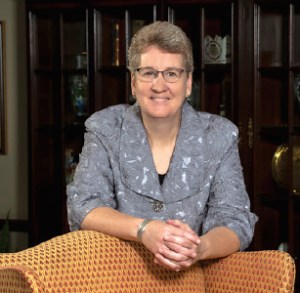 The news spread quickly among Illinois Southern Baptists that one of their own was named to serve as executive director/treasurer of Woman’s Missionary Union.
Sandy Wisdom-Martin, an Illinois native who grew up near the small town of Marissa, was unanimously elected by the WMU executive board at a special-called meeting July 29-30 in Birmingham, Ala. She directed women’s missions and ministries for IBSA from 2001 until 2010, when she moved south to serve as executive director of WMU of Texas.
“Many of us here in Illinois are ‘busting our buttons’ with pride and gratitude for Sandy’s selection, because we consider her one of our own,” said IBSA Executive Director Nate Adams.
The Illinois Baptist paper is not large enough for me to list the ways or the people who have impacted my life. I take with me to Birmingham a priceless heritage passed down to me by faithful Christ-followers.
“People eagerly hear her, respond to her, and follow her because of her personal integrity and character, and because she clearly follows the Lord’s leadership in her own life.”
Wisdom-Martin was highly involved in Illinois WMU as a student, serving on the state Acteens panel and several Acteens Activator mission teams. She also was the first recipient of the Darla Lovell Scholarship from Illinois WMU while studying at The Southern Baptist Theological Seminary in Louisville, Ky.
While at IBSA, she served as president of Mississippi River Ministries and led the first international WMU Habitat for Humanity team, which traveled to Ghana to build houses.
“I am thrilled beyond words in Sandy’s selection as Executive Director of WMU,” said Evelyn Tully, who directed Illinois WMU prior to Wisdom-Martin. “Her missions commitment, her ministry lifestyle, and her exemplary relationships have uniquely prepared her for this tremendous responsibility.
“I know Illinois missions-minded women will be her strong prayer supporters.”
The Illinois Baptist interviewed Wisdom-Martin via e-mail shortly after her election:
Illinois Baptist: Congratulations! We’re so excited one of our own is on her way to Birmingham!
Sandy Wisdom-Martin: Thank you. That means a great deal to me.
IB: Let’s start with the name and role of your organization. What does “woman’s” and “auxiliary” mean in the 21st century?
SWM: Our leaders have all said in different ways, “We are not a women’s organization, we are a missions organization.” My first full-time ministry supervisor, Julia Ketner at the Arkansas Baptist State Convention, said, “We shout missions and whisper WMU.”
We are not about perpetuating an organization. We are about making Christ known in the world. If we focus on who we are, we will fail. If we focus on Christ and the mission he has given us, we cannot fail.
IB: What will you take from your Illinois/IBSA experience to Birmingham?
SWM: I am a product of Illinois Southern Baptists. The daughter of a coal miner and foundry worker. The first Illinois Southern Baptists I knew were my Christian parents who worked hard and served well. I learned lessons too numerous to mention. The members of Clarmin Baptist Church poured their lives into mine giving me every advantage possible as a young Christ-follower.
A new pastor’s wife introduced our church to Acteens and I discovered what God was doing in the world. State missions camps and events, as well as Acteens Activator teams, sealed my heart for missions. Then came the opportunity to rub shoulders with heroes of the faith who served with the Illinois Baptist State Association. In college, the Nine Mile Baptist Associational WMU council invited me to join their team. They let me teach conferences. I was awful. They loved me anyway. Baptist Student Union at SIU-Carbondale became one of the most important discipling influences of my life.
And that’s only the beginning. The Illinois Baptist paper is not large enough for me to list the ways or the people who have impacted my life. I take with me to Birmingham a priceless heritage passed down to me by faithful Christ-followers.
IB: How will you make WMU relevant for a new generation of women?
SWM: We have challenges to be sure. The future will demand higher visibility and more options. I find that when people understand what we really do, they value us.
As WMU, we have these six objectives: pray for missions, engage in mission action and personal witnessing, learn about missions, support missions, develop spiritually toward a missions lifestyle, and participate in the work of the church and denomination. While we want people engaged in all six objectives, ministries seem to be the way to capture people’s heart for missions initially.
So, in Texas, we began doing things like building houses in partnership with local associations. We converted an old bus to a rolling WorldCrafts store and have sold more than $100,000 in WorldCrafts products while teaching shoppers about fair trade and missionaries who work with artisans. We have a truck and generator being converted into a “Suds of Love” laundry unit.
Once we get people involved initially, we invite them to go deeper in missional living. We strive to engage missional disciples for life.
IB: It seems like a lot of churches have moved away from missions education programs like Girls in Action and Royal Ambassadors. Do you think people need to be reminded (or taught for the first time) why missions education is important?
SWM: I think the experience of 2015 should be enough to remind people of the importance of missions education. Between 600-800 international missionaries were brought home (because of budgetary shortfalls at the International Mission Board). When people know about the needs of the field, they respond by praying and by giving. When they don’t know, the reverse happens.
I think we have moved away from missions education because we have moved away from the Great Commission. We are failing at the one thing Jesus told us to do which is “make disciples.” Making disciples is a lifelong process.
I am who at I am today because Illinois Southern Baptists began pouring their lives into mine and discipling me through local church missions education, missions education camps, associational missions, campus ministry and statewide missions activities. I grew up passionate about the Cooperative Program because that was what I was taught. We lived and breathed missions in my small country church. It was not an option. It was part of the DNA of our congregation.
IB: People today are awfully busy. How can WMU leaders find time on the church schedule for missions education?
SWM: We live in a wonderful age where resources are readily available and creativity abounds. There are countless ways to engage in missions education and involvement.
WMU provides premier missions resources. I think the problem is not with church schedules or other issues. I think the primary problem is that we have forgotten our “why.”
Our identity is with Christ. We believe Christ gave his all for us. We follow his teachings and his example. We do it all for the sake of Christ. We believe we are people made in the image of God with infinite worth because we are his creation. We know we are broken people in need of restoration and healing. Through Christ’s forgiveness, mercy, and grace, our lives are being made new. We are passionate about telling his story and how it has changed us. We want every culture to know his story and be changed by it as well. We give our lives to that pursuit. That is why we do what we do.
IB: What does partnering with the International Mission Board look like now, with a new leadership team and reduced missionary force from funding challenges?
SWM: I’m looking forward to discussions with both IMB and NAMB (North American Mission Board) when I get settled, but believe our partnership will focus on reaching the nations for Christ as it always has. WMU actively promotes the Lottie Moon Christmas Offering and Week of Prayer for International Missions, encourages members to pray for missionaries daily through the missionary prayer calendar, coordinates stateside housing, provides water filters through Pure Water, Pure Love, and so much more.
IB: What is WMU’s main point of connection with NAMB, given its church planting focus?
SWM: Through our partnership with NAMB, we help participants live out the six objectives we discussed earlier. We count it a joy to be able to tell the stories of all our missionaries, as well as support their work through extensive promotion of the Annie Armstrong Easter Offering and Week of Prayer. We also support NAMB missionaries through Christmas in August, scholarships for MKs (missionary kids), and more. When it is possible, we continue to invest our lives in their ministries through hands-on involvement.
IB: How do you make missions cool in a world without borders? What is the compulsion to “Go…” when “all the world” seems so close these days?
SWM: For more than 125 years, the name of our organization has been said incorrectly in many venues. We are named Woman’s Missionary Union because it is the individual woman who understands and responds to God’s call on her life.
That is how we make missions cool. We help each individual understand their own giftedness and God’s call on their life to make disciples. It’s not about what you do. It’s about who you are in Christ. You were created in the image of God for His purpose and glory. We are here to help nurture that call.


 When you travel you have to make allowances for some of the local customs. In New Orleans, prepare for Cajun cooking and in coastal southern California enjoy the more relaxed pace of life. In foreign countries the differences can be even more pronounced. But if you’re traveling to another English speaking country it can’t be that different, right? Wrong.
 John Yi is IBSA’s second-generation church planting catalyst in Chicago, founder of a community ministry in Maywood, and a leader at Bethel SBC, a church plant in Mt. Prospect. Visit John at the virtual vision tour sponsored by the IBSA Church Planting Team during the IBSA Annual Meeting Nov. 2-3 at Broadview Missionary Baptist Church in Chicagoland.
 Strong ministry depends on strong churches. More than 20,000 times each year, IBSA trains leaders in worship, evangelism, discipleship, missions, and more. For pastors and leaders who find these to be especially challenging times for their churches, IBSA’s zone consultants are experts in church health and growth who are nearby and available to help. One example is Sylvan Knobloch who has led and lifted up pastors in his 35 years with IBSA. He urges churches to consider the needs of others first and to engage a process of rejuvenation.
  Hundreds of children, teens, and church leaders visit IBSA’s camps at Streator and Lake Sallateeska. Whether for a quiet spiritual retreat, or a fun week filled with games and summertime activities, these sites are home to many fond memories. And many young people have come to know Christ and have committed to ministry. The missions camps challenge students to think about mission work locally and worldwide. And worship and leadership conferences held at Christian colleges train teens to be leaders in their own churches.
  Lily Ohl grew up thinking Chicago is a scary place. But the 17-year-old from Sherman found during ChicaGO Week that many people were open to hearing the Gospel. Each summer, teens travel to the city and assist church planters in reaching their communities. They learn firsthand how new churches are started and get practice sharing Christ. “It’s a big city, but people are willing to listen and you can really change a life,” said Ohl.
  Now is the time of year when most Illinois Baptist churches are preparing to promote and receive the annual “Mission Illinois Offering,” which is devoted to advancing the gospel among more than eight million lost people, right here in our state.
 Report debunks ‘born that way’ narrative
 Having grown up here and very involved in the church, I know well the Baptist beliefs, as well as the spiritual state of this mission field we call home. What I didn’t know, though, is that there are 83 unreached people groups right here in the U.S… and almost 10 in our own backyard!


 iB2 News