Archives For November 30, 1999

HEARTLAND | Eric Reed

When I said to my co-workers, “Well, let’s go meet a thousand of our closest friends,” I didn’t know how true that statement would be. We left our offices and drove the four blocks to Springfield’s Crowne Plaza Hotel, site of the 2015 Midwest Leadership Summit. And like so many of our Baptist gatherings, this one felt like Homecoming Week at Sandy Creek Church. We saw dear friends from across Illinois, and some we knew from the other dozen states in attendance.

Eric_Reed_Feb9But I never expected to see Woodie.

After all, it’s been 35 years. And the last time I saw Woodie, he was a Mormon. In Alabama. Go figure. Woodie and his siblings were fourth-generation Reformed Latter Day Saints (RLDS) living in a fishing town on the Gulf Coast. We all went to high school together. Although our school was a ministry of a conservative fundamentalist church, no one made an issue of Woodie’s religion. All his family
were clean-cut, well-mannered, and better behaved than many in our class who claimed to be Christians. I remember Woodie as a great guy, a good football player, and very well liked. But lost.

Woodie came to that truth while in college. Through a campus ministry he came to a life-saving faith in Jesus Christ and left his family’s religion. Later, he attended Mid-America Seminary and was called to ministry. Eventually Woodie moved to Lamoni, Iowa, the place where Latter Day Saints founder Joseph Smith once lived and present-day home to the RLDS college. Woodie had attended that college for a couple of years until he began question the RLDS religion.

Returning in 1991, Woodie started a Baptist student ministry, reaching out to RLDS students and others.

Eventually he pastored First Baptist Church of Lamoni, the sponsor of his college ministry, for nine years, and just recently was called to lead Calvary Baptist Church in Clinton, Iowa. Woodie said God is opening doors to Brazilian soccer players (in Iowa!) because his son plays soccer and his wife is originally from Brazil. Go figure.

That’s why he was at the Midwest Leadership Summit and standing in the hallway outside the ballroom at the Springfield Crowne Plaza. Woodie is a Southern Baptist pastor in the Midwest, looking for fresh ideas, inspiration, and encouragement.

I stand amazed by all God has done in Woodie’s Christian life and Baptist ministry. And I’m so glad God brought our paths to cross again.

I should be more amazed that 35 years after high school—even though Woodie hasn’t changed much—I recognized him standing there. But that’s the Lord’s doing too.

Go figure.

Eric Reed is IBSA’s associate executive director for the Church Communications team, and editor of the Illinois Baptist newspaper.

When leaders gather

nateadamsibsa —  February 2, 2015

Nate_Adams_February2HEARTLAND | Nate Adams

More than 50 years ago, a small group of leaders from six Baptist state conventions here in the Upper Midwest gathered to discuss how they could help churches reach people with the gospel more effectively. They recognized that, even in that day, our Baptist faith and message were counter-cultural, not only to the spiritually lost, but also to those who had been exposed to the religious traditions that dominated the region. Being Southern Baptist in the north was and is not easy. The Midwest is a challenging mission field.

Those leaders returned home, determined to work with local associations to invite 10 leaders per association to the first North Central States Rally. The objective was to encourage stronger evangelism and church planting, and to deliver highly relevant training along with the clear message that Midwest pastors and church leaders were not alone.

I remember the first of these that I attended, back in January 2006. I was serving with the North American Mission Board, and was asked to come and lead a couple of conferences on the Acts 1:8 paradigm for missions strategy in the local church.

Though I had been assured that it happened every three years, I have to admit that I did not expect to find many leaders gathered in snowy Indianapolis in late January. But I was wrong. Almost 900 pastors, church planters, associational leaders, and lay leaders from all over the Midwest came, and eagerly soaked in the training and inspiration provided by Midwest practitioners and state and national SBC leaders.

In the hallways, in small group gatherings, and around the lunch and dinner tables, two central messages were clear. We are all here to advance the gospel in this region, and we are not alone.

That 2006 Rally, and the 2009 and 2012 Rallies that followed it, were all hosted in Indianapolis, which is fairly central to the six state conventions whose leaders gather. But in January 2015, the gathering expanded to include 10 state conventions. It took on a new name, The Midwest Leadership Summit. It attracted more than 1,000 leaders, the largest ever. And we were blessed to host it right here in Springfield, Illinois.

An all too common mindset these days seems to be that it’s too difficult to attract people to meetings. It’s not just that people are busy and travel is expensive. There seems to be a spirit of independence, sometimes even isolationism that can easily creep in to churches and their leaders. It’s easy to convince ourselves that things will be easier, simpler, cheaper, if we just stay home and focus on our own church.

But it is autonomy pulled together into cooperation, not independence pulled apart into isolation, that has produced missions advance by churches over the years. Sure it’s challenging and costly to get together, especially for busy leaders. But when committed, missions-minded leaders gather and ask how they can work together to more effectively advance the gospel, good things are bound to happen.

In the days ahead, we at IBSA will be working more intentionally with associational and church leaders to facilitate key leadership gatherings that are focused on evangelistic, gospel advance. You will see some of those plans elsewhere in this issue.

Some will be fairly local, in the form of leadership cohorts. Some will be “virtual,” facilitated by webinars or other online tools. And yes, some will continue to be statewide, even though that can involve costly time and travel.

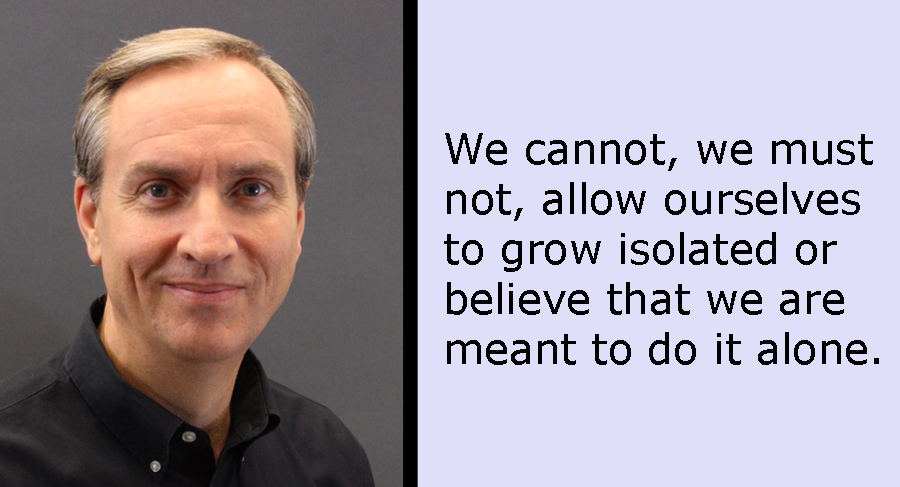
We believe the gathering of leaders is worth it. It’s when leaders gather that we can remind one another that the mission of reaching people with the gospel is urgently important, and bigger than any of our individual lives, or churches. We cannot, we must not, allow ourselves to grow isolated or believe that we are meant to do it alone.

Nate Adams is executive director of the Illinois Baptist State Association.

HEARTLAND | Hundreds of leaders from 13 states across the Midwest were in Springfield, Ill., last week for the Midwest Leadership Summit, a triennial training event facilitated by state Baptist conventions in the region and national Southern Baptist entities. These “man on the street” interviews were conducted on Wednesday, a day full a breakout sessions on evangelism and discipleship, missions, women’s ministry, and dozens of other topics.

Read more about the Midwest Leadership Summit at www.Facebook.com/IllinoisBaptist, and in the next issue of the Illinois Baptist newspaper, online at http://ibonline.IBSA.org.


COMMENTARY | Meredith Flynn

As the crowd thinned and the reception neared an end, one voice could be heard from a table near the chocolate fountain: “Come over here and take my picture so I can go home.”

Thurman Stewart was kidding; he wasn’t looking for press, just laughs. Surrounded by other volunteers in yellow hats and shirts, he and his wife, Carol, marked the end of another day watching kids while their parents attended the IBSA Annual Meeting.

The Stewarts are part of a group of Illinois Baptist Disaster Relief volunteers who provide free childcare every year. Several of them also travel in the summer to the national Southern Baptist Convention to serve families there. And they have a mobile Disaster Relief childcare unit, so they can help kids and parents in crisis across the country.

At the Crowne Plaza in Springfield, their classrooms were stationed on the third floor, one level above the ballroom where the business meeting took place. Downstairs, messengers to the 2014 Annual Meeting adopted several resolutions, including one on including younger leaders in church and denominational life. Among several “resolved” statements, the document encouraged IBSA churches to pray for, identify and train young leaders, “and to release joyfully
young leaders into ministry.”

Callout_1113_edited-1But when they’re released, what kinds of ministries will these young leaders be looking for? Certainly, some will be pastors. Some will serve on committees and trustee boards. Some will lead mission teams to the other side of the world. And some, hopefully, will join the Stewarts’ ranks on the third floor. Or look for similarly vital roles that happen behind the scenes.

George Jones sang, “Who’s gonna fill their shoes,” about country music legends who are hard to replace. No one’s ever going to be like Willie Nelson or Johnny Cash, Jones sings. But who’s next? “Who’s gonna give their heart and soul to get to me and you?” he asks in the chorus.

The Stewarts and their fellow volunteers are the Illinois Baptist version of those country music superstars. Giving their hearts to work that isn’t front and center, ministering to kids and families and underserved communities. Perhaps young leaders can make the greatest contribution to church and denominational life by emulating the example set by the Stewarts and so many others.

Theirs are big shoes to fill.

THE BRIEFING | A Baptist professor who once taught at the convention’s most historic seminary is poised to publicly announce his shift on homosexuality at a national conference in November. Mercer University professor David Gushee, who taught at The Southern Baptist Theological Seminary from 1993-96, will reportedly tell the audience at a conference hosted by The Reformation Project that, “I will seek to stand in solidarity with you who have suffered the lash of countless Christian rejections.”

The_BriefingHis proposed remarks, reported by Religious News Service, do not come as a surprise to Baptist leaders who have known Gushee and watched his theological path over the years, Baptist Press reports. “Gushee is not the future of evangelicalism,” blogged Boyce College professor Denny Burk. “He is the future of ex-evangelicalism. He joins a chorus of others who have left the faith once for all delivered to the saints (Jude 3) and who no longer represent what evangelical Christianity is all about.”


A week after Houston pastors were subpoenaed amid their involvement in a campaign to defeat a city ordinance, Southern Baptists leaders and others in Arkansas are working toward the repeal of a similar ordinance in Fayetteville. Adopted by the city council in August, the ordinance is part of an effort by the Human Rights Campaign to expand equality for the LGBT community in southern states, Baptist Press reports. But some pastors and Christian leaders say their religious liberty is at stake.


Southern Baptist Convention President Ronnie Floyd will take part in a Nov. 2 simulcast designed to show support for the five subpoenaed ministers in Houston. Sponsored in part by Family Research Council, “I Stand Sunday” also will feature former presidential candidate Mike Huckabee and Alan and Phil Robertson from TV’s “Duck Dynasty.”


“Life does not end when tragedy comes into your life,” says Travis Freeman, a one-time high school football player whose life changed drastically when an illness cost him his eyesight. The two-time graduate of Southern Baptist Theological Seminary is the subject of “23 Blast,” a new film released in Oct. 24. Read more about Freeman and the movie at BPNews.net.


In other movie news, Christian Bale says Moses was “barbaric” and “likely schizophrenic.” Bale portrays the biblical hero in the upcoming Ridley Scott film “Exodus: Gods and Kings.”


Having their credit card information stolen tops the list of crimes Americans worry about most, according to a poll by Gallup. 69% of people said they frequently or occasionally worry about computer hackers stealing the credit card info they use at stores, followed by 62% of Americans who worry about their computer or cell phone being hacked. Farther down the list: having your car stolen or broken into (42%), getting mugged (31%), and being a victim of terrorism (28%).


Winning baseball games isn’t the top priority for San Francisco Giants assistant general manager Bobby Evans. “You want your life to point people to Christ,” he told Baptist Press. “It starts for me with my own relationship with Christ. That’s going to direct and dictate what influence I have for Christ in my family, in my marriage and in the workplace.”

What pastors really want

Meredith Flynn —  October 23, 2014

Eric_Reed COMMENTARY | Eric Reed

With one week left in Pastor Appreciation Month, you may be wondering how to appreciate your pastor. What does he need? Or want?

Not a Bible. He has many Bibles on his shelves, and hundreds more on his phone.

Not a painting of Jesus, and certainly not on black velvet.

Maybe a suit, if only for funerals, but let him pick his own.

Not a trip. As a church member, I once gave a pastor and his family a gift certificate for a getaway weekend. The smile on his face said, “I’d rather have cash.”

As a pastor, the remembrances that blessed me most (in addition to the occasional love offering) were handwritten cards and letters. Once while I was on vacation, a deacon had the congregation fill a three-ring binder with thank-you notes. And another time, as the children’s classes presented me with a three-foot tall card they had drawn, a young woman in the choir loft exclaimed, “He’s gonna cry!” I did.

Ted Traylor of Olive Baptist Church in Pensacola, Florida, told a story that still chokes me up. Many years ago during a stormy season in his ministry, Traylor arrived home one night to find three deacons sitting on the curb. “Oh, no,” he thought. “Here it comes.”

“Pastor, remember when you preached on the mighty men of David?” one of them said, “How when David longed for water from home, they snuck across the battle lines and brought it to him?”

Traylor nodded.

“Well, we went to your hometown today and we talked with your parents.” It was a twelve-hour round trip.

The pastor was astonished to learn they had brought him a sapling native to North Alabama to remind him of home, even as he served hundreds of miles away. They fetched a jar of water from the clear mountain springs to remind him of the living water of Christ. And they delivered two large stones from the hillside ledge where as a teenager Traylor was called by God to the ministry. The men instructed him to place the rocks in his own garden and whenever he felt unsure of himself or his calling, to stand on them as a reminder that he stands on the Rock.

And the three mighty men pledged their personal support of their pastor and his ministry, whenever and wherever he needed them, “unless you do something illegal, immoral, or unethical—then we’ll take you out ourselves,” he remembered, smiling.

That’s what pastors want.

Eric Reed is editor of the Illinois Baptist and IBSA’s associate executive director, Church Communications team.

Religious liberty advocates say city still asking too much

THE BRIEFING | Subpoenas requiring pastors to turn over their sermons are a violation of their First Amendment rights, religious freedom advocates argued in the wake of action by the Houston’s mayor and city attorney.

The five subpoenaed ministers had been part of an effort to repeal Houston’s Equal Rights Ordinance (HERO), adopted by the city council in May. The subpoenas are for a lawsuit brought by ordinance opponents, who collected thousands of signatures on a petition to repeal HERO. But the city disqualified enough of the signatures to prevent a vote, Tom Strode and Bonnie Pritchett reported for Baptist Press.

On Friday, Oct. 17, Houston City Attorney Dave Feldman removed “sermons” from the subpoenaed materials, which also include text messages, e-mails, speeches and presentations related to the ordinance, the referendum to overturn it, Mayor Parker, homosexuality, or gender identity.

The removal of the word “sermons” isn’t enough, said the attorneys representing the pastors. And Mayor Parker “acknowledged the new subpoenas do not explicitly preclude sermons from being produced,” the Houston Chronicle reported.

After the initial subpoenas, the Ethics and Religious Liberty Commission called Christians to support the five ministers by using the Twitter hashtag #4Houston5. The Southern Baptist agency also encouraged pastors everywhere to send their sermons on marriage and sexuality to Mayor Parker.

“A government has no business using subpoena power to intimidate or bully the preaching and instruction of any church, any synagogue, any mosque, or any other place of worship,” blogged ERLC President Russell Moore.

“…The separation of church and state means that we will render unto Caesar that which is Caesar’s, and we will. But the preaching of the church of God does not belong to Caesar, and we will not hand it over to him. Not now. Not ever.”

Pastors participate in month-long Pulpit Freedom Sunday emphasis
Hundreds of pastors so far have participated in an annual effort to encourage free speech in church pulpits, even if that expression is about politics. Alliance Defending Freedom, who sponsors Pulpit Freedom Sunday, reported on their website Oct. 10 that 1,517 pastors had “preached sermons presenting biblical perspectives on the positions of electoral candidates and signed a statement agreeing that the IRS should not control the content of a pastor’s sermon.” Additionally, 242 pastors signed the statement only. The campaign began Oct. 5 and extends through Election Day (Nov. 4).

Christianity Today noted that on that before this year’s emphasis began, Pew Research reported  49% of Americans say churches and other houses of worship should express their views on day-to-day social and political questions.

Leaders may return to Mars Hill after Driscoll’s resignation
Pastor Mark Driscoll’s Oct. 14 resignation after 18 years at Mars Hill Church could result in the return of leaders who previously had left the church and Driscoll’s leadership, The Christian Post and other media sources have reported. Former worship coordinator Kevin Potts told KING5 News: “A faith in Christ is a faith in redemption and healing, and if we’re not willing to put that foot forward and say, “I will help with that,” what right do we have to call ourselves followers of Christ?”

Driscoll had been on a leave of absence since August amid charges of anger and unbiblical leadership. Following his resignation, Mars Hill’s Board of Overseers released a statement saying Driscoll had not been asked to resign and that they were “surprised” to receive his resignation.

Bishops’ final report reflects controversy, differences of opinion
After a meeting of Catholic bishops seemed to point to a drastic shift in the Church’s teaching on same-sex lifestyles and relationships, the group’s final report showed the most controversial topics are still unresolved, Catholic News Service reported. The Oct. 13 mid-term report from the Synod of Bishops on the family included a section titled “Welcoming homosexual persons,” and pondered whether Catholic churches could accept and value same-sex lifestyles, “without compromising Catholic doctrine on the family and matrimony.”

That section of the synod’s final report, released Oct. 18, was amended by the bishops, according to CNS, but still failed to receive the super majority usually needed for approval, along with two paragraphs on divorced and remarried Catholics receiving Communion. The Church will hold a world synod on the family in 2015.

Hillsong pastor addresses same-sex marriage views
Pastor Brian Houston sparked controversy when he didn’t clearly define his church’s stance on same-sex marriage at a press conference last week. Now, the pastor of Hillsong Church is clarifying his views, reported The Christian Post. “Nowhere in my answer did I diminish biblical truth or suggest that I or Hillsong Church supported gay marriage,” Houston said in a statement. “I challenge people to read what I actually said, rather than what was reported that I said. My personal view on the subject of homosexuality would line up with most traditionally held Christian views. I believe the writings of Paul are clear on this subject.”

Josh_Laxton_Aug21COMMENTARY | Josh Laxton

For the last eight years, I have been working in churches that were in need of revitalization, or breakout. I know this doesn’t make me an expert, but it has given me field experience. In addition, for the last three years I have been intensely studying the condition of the American church and her impact in contemporary culture.

I have come across many success stories of pastors who led their church to positive breakout. But it seems that for every story of success, there are nine stories of struggle and heartache. In all honesty, leading a church to breakout is like trying to climb Mount Everest. It’s daunting and extremely difficult.
In my last column on Nehemiah, I explained how his breakdown laid the foundation for the breakout of his people. But that’s not the end of the story.

Nehemiah also faced many obstacles in leading the breakout. The king (his boss) had already stopped the rebuilding of the wall years earlier. Nehemiah hadn’t led this kind of work before. He faced a long, dangerous journey to get to the people, and once he arrived, he met a discouraged people in need of motivation and organization.

Just like Nehemiah, those who want to lead a church to breakout will face a variety of obstacles. As leaders, we face obstacles of perceptions, practices, poor theology, and people’s resistance to change. For many, the perception is that the church is fine—we’re paying the bills and ministries are still running. When it comes to practices, over time churches tend to focus on insiders, not outsiders, which can lead to neglecting the building, failing to create hospitable environments, and lacking a defined process for connecting new people.

Poor theology also can be an obstacle. Without being aware, a congregation can lose their passion for the centrality of Jesus and his gospel, their urgency to call people to repentance and salvation, and their missional posture towards the community and the nations.

One of the toughest obstacles is leading people to embrace change. I have found many church members want growth (or, at the very least, they don’t mind it), but don’t want things to change. In short, leading breakout isn’t easy, especially in light of the various obstacles. Nehemiah knew this as well. He navigated through the obstacles by way of breakthrough—an “aha moment.”

His prayer, starting in Neh. 1:4, gives us at least three principles of breakthrough that have implications for our ministry today:

God is the breakthrough power. Immediately after hearing the condition of the people, Nehemiah went to the Lord. “Let Your eyes be open and Your ears be attentive to hear Your servant’s prayer,” he says in verse 6. “…I confess the sins we have committed against You.”

This is paramount for church and denominational leaders to understand, especially given the fact that we live in a self-help culture where there is no shortage of books, conferences, leadership podcasts, and workshops about how churches can breakout from their unhealthy condition. While there’s nothing wrong with many of these resources, I have to constantly remind myself that these are supplements to breakout, not the source.

Humility is the breakthrough position. Nehemiah’s prayer reflects his understanding of God’s position and power, and that he and Israel are His servants (Neh 1:5, 6,10). Our prayers should reflect God’s transcendent position in relations to us—how great, gracious, awesome, faithful, and powerful he is. In addition, our prayers should reflect our humble position to God—a position that’s here to serve him and be used by him to do what he has put in our hearts.
When it comes to leading our churches to breakout may we never confuse our role with God’s—we are simply conduits by which He works to bring his people where He wants them to be.

Faithfulness is the breakthrough pattern. In Nehemiah’s prayer, we see that his going to the Father wasn’t a one-time deal; he did this “for days.” Scholars note that four months passed between chapter one and two. Thus, for over four months, Nehemiah faithfully goes to the Lord, humbling and submitting himself to God’s will and leading. His continued faithfulness reflects both the seriousness of leading a breakout and his belief that only God could do it.

If we desire to lead our churches to breakout, not only must we have a breakdown, but we must have a breakthrough—an “aha moment” were we realize God is the only one who can breakthrough the obstacles we face.

Josh Laxton is lead pastor of Western Oaks Baptist Church in Springfield. His first column on Nehemiah appeared in the July 28 issue of the Illinois Baptist.

Editor’s note: This is the final story in a series of three testimonies about Super Summer, an annual discipleship week for students sponsored by the Illinois Baptist State Association. Click here to read how Hannah Batista met Christ at Super Summer, and here for why youth minister Tim Drury takes his students to Greenville for the week every year.

Zaxxson_NationHEARTLAND | Zaxxson Nation spent Super Summer 2014 teaching high school seniors the most practical parts of discipleship— finding a mentor, building intentional friendships, and investing in a local church. As assistant dean for the green school, which is focused on discipleship, Nation helped transfer to his students some of the same principles he learned as a Super Summer student.

Assistant dean is just one hat Nation has worn since his first week in Greenville 12 years ago. As a 16-year-old student leader from Rochester First Baptist, he realized at Super Summer that his Christianity was based more on head knowledge than faith that had taken root in his heart.

“God really changed everything in my life” that week, Nation said. “And at that point I was ready to serve, to do whatever it took to just serve Him.”

Part of what makes Super Summer different from some other camps is the laser-like focus on knowing Jesus more, Nation said. At his first Super Summer, “When we had free time, we were talking about Jesus. And when we went to bed at night, we were joking around, but we were also sharing our testimonies.”

Years later, he said, “I think it’s the same now as it was 12 years ago when I was a student. It’s still people coming together for the same reason; it’s still students that are serious about their faith.”

Nation acknowledged that Super Summer creates an environment that’s impossible to recreate once students get home and the distractions of life flood back in. Being cut off from regular life for a week is both a blessing and a curse, he said. “God uses it, though; He used it for my life,” he said.

“The other big thing about Super Summer is it’s pretty much where I got my standard for being a godly man,” Nation remembered. He met pastors and leaders who had memorized large chunks of the Bible and shared their faith regularly.

“Super Summer puts you under those guys’ teaching for an entire week, and you leave inspired. And I left personally saying, ‘Wow, I want to be like that.’

“Because as a student I saw that and was challenged by those high standards, I want to go back and work under those guys, and be peers to those guys and continue to learn from them. That’s a huge motivator for me, to think that one day a student could look at me and my life and say that I’m inspiring them in the same way that those guys inspired me.”

THE BRIEFING | Meredith Flynn

As World Cup fever raged across the globe – and even here! – new research from Barna showed most Americans recognize their country’s fascination with sports, and almost two-in-three think the culture cares too much about athletics.

The nationwide survey conducted in February found 89% of adults strongly or somewhat agree that sports are an important part of American culture, with men slightly more likely to strongly agree than women. Interestingly, practicing Christians (55%) were the most likely group to strongly agree.

soccer ballBarna also found 27% of Americans believe the culture cares too much about sports, and 39% agree somewhat. A majority of Americans also agree strongly or somewhat that professional athletes make too much money (86%), and that American professional sports are very corrupt and distract from important global issues (both 62%).

As for America’s favorite sport: Football reigns supreme with regular viewers (53%), followed by basketball and baseball (both 33%). Soccer’s numbers were higher than you might think, especially considering the survey was completed before the World Cup. 11% of Americans regularly watch the beautiful game (that’s what they call soccer), 20% have played it, and 16% say their kids play.

Zamperini remembered as Olympian, war hero, Christian
Former Olympic runner and prisoner of war Louis Zamperini died July 2 at the age of 97. Zamperini, the subject of Laura Hillenbrand’s 2010 book “Unbroken,” also was a Christian. His conversion happened at a Billy Graham Crusade after he returned from a Japanese POW camp, at the height of his bitterness and rage over two years of captivity. Read Denny Burk’s tribute to Zamperini.

Some Nigerian girls escape, more than 200 remain captive
While many Americans were celebrating independence, dozens of women and girls in Nigeria were finding freedom from a much more immediate threat. The Christian Post reports more than 60 women and girls kidnapped by Boko Haram on June 22 escaped around July 4. More than 200 girls reportedly are still held by the terrorist group founded to fight the influence of Western education. In a video message released earlier this year, Boko Haram leader Abubakar Shekau threatened to sell the kidnapped girls.

Book release: Piper’s ‘Pastor’s Kid’
Barnabas Piper’s new book “The Pastor’s Kid: Finding Your Own Faith and Identity,” was written for PKs, pastors and churches, the son of famed pastor John Piper wrote in the introduction. Coinciding with the book’s July 1 release, the author answered questions from culture writer Jonathan Merritt in this Q&A for Religion News Service, including the biggest negative effect of his upbringing (“not connecting with God in a personal way”). Piper also shared a few surprising facts about his dad, like his love for the comedy “What About Bob.”

Four Southern Baptists named to ’33 under 33’ list
Christianity Today’s list of influential young leaders includes four Baptists, Baptist Press reported July 1. They are:

  • Trevin Wax, a blogger and managing editor of LifeWay’s The Gospel Project
  • Hip-hop artist turned pastoral intern Trip Lee
  • Former rapper D.A. Horton, who is now the North American Mission Board’s national coordinator for urban student missions
  • Saira Blair, a 17-year-old candidate for West Virginia’s state legislature

See the rest of the list at ChristianityToday.com.