Archives For November 30, 1999

Especially for leaders, new years require fresh vision. And for Christian leaders, fresh vision requires prayer. But quality prayer takes time and, for me at least, finding that time is one of the biggest challenges I face.

Time is so precious. I often feel I don’t have enough of it simply to do well with my family, my job, my church. So I end up giving almost all my time to those things, and telling myself that God will understand.

He understands, I’m sure. But he can’t be pleased.

shortage-of-prayerIt’s been well said that you spell love: T-I-M-E. And since prayer is an expression of my love for God, and I need quality time with God to gain fresh vision for the future and power for daily living, then I must spell prayer the same way. Prayer deserves my time.

I’m convinced I’m not alone in this struggle. Many of today’s well-intentioned pastors and Christian leaders are so pressed for time. And prayer can become one of the earliest casualties of a busy schedule. Yet the shortage of serious time for prayer becomes quickly evident in a leader’s life, and in the fruit of his or her ministry. I know they are in mine.

That’s why I struggled recently when I was asked to bring a devotional word to a national gathering of SBC prayer leaders in Chicago. With some difficulty, I decided to be vulnerable. I admitted to them that I am ashamed of how little I rely on prayer compared to my own efforts. I too rarely engage God in a way that invites him to override my desires or plans. Mostly, I quickly ask him to bless what I’m rushing off to do. I told them I see this happening with Christian leaders everywhere, and that we as leaders need their help reprioritizing prayer in our lives.

Then we looked at Gideon’s experience in Judges 6-7. Like this timid, reluctant, and frustrated leader, we often toil away in our own strength at things that don’t really help much, rather than inviting God into our challenges, and letting him empower our leadership.

But one life-changing day Gideon and God, as “the Angel of the Lord,” had a conversation that has deeply challenged me about my own prayer life. Here’s a summary of what I said about it in my devotion for those prayer leaders:

Gideon was weak when his extended conversation with God began, but God loves to use weak people. Though God initiated the conversation, Gideon did most of the talking, at first. Then, after questions and fleeces, there was a moment of surrender, when Gideon gave his fears, desires, and plans over to God. After that, God did most of the talking, and acting. Gideon never had to say, “God said obey me…” to the people he led. He simply acted with a new boldness that came out of his personal conversation with God. And the people gladly followed him in his obedience to God, with a powerful result that brought God glory and his people victory.

That’s the kind of prayer encounter I need. Gideon was a small man and a reluctant, fearful leader.But all that changed when he engaged God in extended, serious prayer.

In this coming new year, I have concluded that I must do whatever it takes to meet God like that. And I must encourage and facilitate that in the lives of those I lead and influence. I look around me, in Southern Baptist life and elsewhere, and I see that there are others sensing the same need. By God’s grace, a new year gives us more time. Let’s be leaders who give a great deal of that time to God in prayer.

Nate Adams is executive director of the Illinois Baptist State Association. Respond at IllinoisBaptist@IBSA.org.

Lessons from Tom Adams

ib2newseditor —  March 31, 2016
Tom Adams

Tom Adams

It still surprises and moves me that so many people in Illinois Baptist churches fondly remember my father Tom Adams, or at least his writing. Dad entered his eternal life with the Lord ten years ago, just one month after I began my role here as IBSA’s executive director. Yet more often than not when I visit a church, one or more of its members will tell me how much my dad or his writing meant to them.

In fact, it’s not uncommon for one of those older church members to reach into their Bible and pull out a yellowed clipping of one of his columns because it met a particular, deep need in their lives. Dad wrote for the Illinois Baptist for 34 years, through columns such as “Problem Corner,” or “Ask Tom Adams.” So he became a sort of corresponding counselor to many.

Frankly, I thought I would have my dad’s counsel for a few more years here in Illinois.  Instead I have needed to rely on the years I had to observe him as father, pastor, and associational leader. With his memory in my heart, here are some of the lessons I learned from Tom Adams.

1. Writing broadens and lengthens influence.
Dad never pastored a large church, nor held a position of great stature. But because he wrote down carefully considered thoughts at least every couple of weeks for decades, he touched tens of thousands of people he wouldn’t have otherwise.

2. Few words can be more impactful than many words.
Dad was a man of few words interpersonally, and the format of his columns gave him only a little room to express an opinion or idea in writing. But he demonstrated both in speech and writing that a few, carefully considered words can have great impact. Apparently they also fit better in your Bible.

3. Readers are better leaders.
My dad would be the first to admit that his wisdom didn’t come from his own deep intellect or extensive formal education. But he was one of the more widely read men I have ever known. Just ask my mom, whose house is still filled with an incredible variety of books, even after giving many away. I’ve never been the avid reader my dad was. But I’ve rarely gone in to a serious meeting or problem without doing my homework.

4. Face your fears with faith.
I didn’t know it until years later, but my dad was scared to death to move our family from Southern Illinois to the Chicago area. My mom tells me he became physically ill over the decision to follow God’s call there. What was very hard for him became very good for me, and in their own ways for the rest of our family. For reasons I can’t go into here, I doubt very much if I would be at IBSA today if he hadn’t made that move when I was fourteen. But his example helps me face my fears with faith, even today.

5. Invest fully where you are.
Dad was never a self-promoter, or a ladder-climber. I know he dreamed of another position or two in his life, but he always chose to invest fully where he was called, until God through others beckoned him elsewhere. Me too.

I jotted down some other lessons I learned from Tom Adams: Do what you know is right, and trust God with the consequences. Marry well and let your spouse be herself.  How you say something can be just as important as what you say.  Some burdens are best borne privately.  Leaders come in all personality types.

A few years ago my mom and I helped my dad organize some of his Illinois Baptist columns into a book, titled after one of his columns, “Speaking Out.” If you don’t have a copy and will write me, I will be glad to send you one. He would be pleased for you to have it.  And I will be pleased for his influence to touch your life, as it deeply has mine.

Nate Adams is executive director of the Illinois Baptist State Association. Respond at IllinoisBaptist@IBSA.org.

Eleven Portraits

Lisa Misner —  March 7, 2016

Eleven_portraits

In some ways I’m just getting started and just beginning to figure some things out.

Visitors to the IBSA office building in Springfield sometimes take note of eleven portraits displayed there, acknowledging the men who have served IBSA as executive director since its formation in 1907. Those portraits used to hang in the entrance lobby, and since our building renovation a few years ago they have been on display in our first floor Resource Room.

While it’s hard for me to believe, by God’s grace I have just celebrated 10 years in that executive director role. That milestone recently led me to a few reflective moments in front of those portraits. Four of those men are simply historical figures to me, but I’ve had the privilege of meeting the other six personally. They each served in different times and faced different challenges, but together they form the legacy of leadership on which I now gratefully stand.

I’ve been told by others around the Southern Baptist Convention that 10 years seems to be about the typical length of service in the state executive director role. Since years of service are noted on a little plaque beneath each of the IBSA portraits, I did the math and learned that indeed the average term of service here in Illinois has been just over nine years.

There are, however, two distinct groups of IBSA executive directors among my 10 predecessors. Six men served less than seven years, and four served 12 or more. The smaller, longer-serving group were four of the first five executive directors, all of whom completed their service by the 1970s. The larger, shorter-serving group represent the more current trend. And at 10 years’ service, I now stand in the middle.

There are many reasons why leaders stay in roles for a short time, including some which are beyond their control. So I wouldn’t second guess the Lord’s leadership or providence in any of the shorter terms of service. But after investing 10 years here at IBSA, I have a new appreciation for the men in the longer term group.

It takes time to establish relationships, and to build trust. It takes time to learn the many systems and traditions and landmines inherent in a thousand diverse churches working together. It takes time to learn the regional and ethnic and generational uniqueness of churches and their leaders. It takes time to take necessary risks and make unavoidable mistakes, and then to recover and learn from them. And I’m now discovering that it takes time to do it all again and again, as new pastors and leaders come on the scene.

After 10 years, I feel in some ways I’m just getting started and just beginning to figure some things out. Yet by the law of averages I’ve already had as many years as most executive directors ever get. It makes me admire the men who stayed 12, or 17, or 19 years.

And it makes me want to sprint right past this 10-year mark and see what might be possible in the company of these long-tenured men that preceded me.

It’s certainly possible to overstay your welcome, or to outstay your effectiveness. And it’s always best when a leader can recognize that time long before anyone else does. But for the most part, it can be very good for an organization and its mission when a leader finds favor and stays.

So if you are wondering whether to stay and persevere where you are, let me encourage you to do so if at all possible. One day you will take your place among the portraits of former leaders in your place of service. It may be less and less common for leaders to stay long in one place. But if God gives you grace and favor to do so, I believe you will find a unique influence that only comes with time.

Nate Adams is executive director of the Illinois Baptist State Association. Respond at IllinoisBaptist@IBSA.org.

Teaching Sunday School

Lisa Misner —  February 22, 2016

I have the privilege and challenge of attending a different church almost every week, but this past month I was able to attend my home church two weeks in a row. The first week, at the end of our Sunday school class, our teacher announced that he and his wife would be gone the following Sunday, and asked if any of us were available to substitute.

Our eyes met, and he smiled and said, “I don’t guess you will be here next Sunday.” I replied that actually I would, and a few minutes later I was walking out the door with his teacher’s book under my arm.

Teaching Sunday schoolI love teaching Sunday school. I’ve done my best to learn to preach over the years, but I’m really more at home in a classroom setting. I love the process of studying and organizing a lesson, of thinking through its most relevant, real life applications, and then planning creative illustrations or exercises that will help everyone take home some practical help.

But it’s more than just the teaching process that always made me love leading a Sunday school class. It’s living life with a small group of people week in and week out. It’s coming together outside class for fellowship and ministry. It’s doing missions projects together. And it’s making our class so fun and inviting and loving that we have lots of opportunities to welcome others in, and even send some of them out to do the same thing elsewhere.
That one week I got to teach Sunday school, I really only got to do the teaching part. Most of the rest of those benefits only come with consistent, loving investment in a group of people over time.

But the Lord did give us a special moment during that lesson. Our text in 2 Corinthians spoke of the burdens and hardships that Paul was carrying for the sake of the gospel. It wasn’t in the curriculum, but in my notes I had simply written the question, “Are we carrying any burdens or enduring any hardships for the sake of the gospel?”

When I framed that question for the group, I made it clear that I wasn’t just looking for a list of minor inconveniences, or for the self-absorbed whining in which we can readily engage. I asked them what burdens or hardships they were currently facing because they longed for someone to know Christ.

Frankly, I didn’t expect a lot of response. Sometimes teachers ask questions simply to create reflection or allow for conviction. But in the hallowed moments that followed, several in the class shared with quiet emotion the difficulties they were currently facing while trying to lead someone they loved to Christ, or back to Christ.

After a few minutes of sharing, we encouraged one another, and urged one another “not to give up,” as Paul had written. Paul labeled his own afflictions “momentary” and “light” compared to the glory that is waiting for us. And as our class shared our own burdens with one another in the context of God’s Word, we felt them get lighter as well. We walked out of that class with renewed determination and optimism. Now that’s Sunday school.

My one week back in teaching Sunday school reminded me again how powerful and transformational small group Bible study can be. And it gave me a renewed appreciation for my own Sunday school teacher, Matt, and for the thousands of faithful men and women that lead Bible studies in our churches every week.

Nate Adams is executive director of the Illinois Baptist State Association. Respond at IllinoisBaptist@IBSA.org.

ILS16 Bumgarner_Tuesday

Bob Bumgarner

The two-day Illinois Leadership Summit kicked off January 26 with nearly 250 leaders from around the state filling the IBSA Building in Springfield.

Keynote speaker Bob Bumgarner led participants through the first two phases of IBSA’s four-phase leadership development process: leading self, leading followers, leading leaders, and leading the organization. Bumgarner, a leadership expert, is executive pastor of Chets Creek Baptist Church in Jacksonville, Florida.

He shared that character is the focus of leadership development. “Leading myself is a growing self-awareness of who I am, what my strengths are and where I am headed coupled with the character, commitment, and competence required to get there.”

More simply, he said, “We have to understand that before we can lead others well, we have to learn to lead ourselves.”

Bumgarner shared, “When we develop our heart we are accepting our assignment. The goal for personal responsibility is accepting responsibility for our actions when we lead… We don’t do that because it’s our job, we do that because it’s our calling.”

Stressing the importance of good leadership, Bumgarner noted, “Our impact on the people we lead either makes them better or worse.”

The job of the leader is to help the people your leading see and shape the future. “These are people who said I will trust and follow you,” he said. “What do you really want to accomplish? Until you tell them what you want to accomplish, they don’t know how to contribute.”

The Illinois Leadership Summit is part of IBSA’s ongoing leadership development plan. The conference features 27 speakers in 32 breakout sessions, including some Illinois pastors sharing experiences from their churches.

The Summit continues January 27. For coverage of the event, like us on Facebook and follow us on Twitter. #ILS16

The pipeline

nateadamsibsa —  August 10, 2015

Nate_Adams_August10COMMENTARY | Nate Adams

Recently Beth and I had the opportunity to travel to Alaska for our 30th anniversary, and to see for the first time the famous Alaska Pipeline. It is truly a modern marvel, transporting millions of barrels of oil each week over 800 miles from the north slope of Alaska to its northernmost ice-free port in Valdez. Since the pipeline opened in 1977, more than 17 billion barrels of oil have flowed through it, along a route that travels both underground and over the permafrost, in climates that can vary from -80 to +95 degrees Fahrenheit.

The amazing length, cost, and complexity of the pipeline is a testimony to the value of the oil it carries. At $8 billion, it was the largest privately funded construction project ever at the time, and took 70,000 workers and more than three years to build. But it has paid for itself many times over.

Here in Illinois, Baptist churches are working together to build a different kind of pipeline, one designed to carry something of far greater spiritual value than oil. We are seeking to build a leadership pipeline, one that can deliver church planters and tomorrow’s church leaders, both to current churches, and to the under-churched regions of our state.

This summer we laid some major new sections of that pipeline. For the second year, IBSA hosted “ChicaGO Week” at Judson University in Elgin, a mission week experience designed to connect student groups with church planters in Chicagoland. We were delighted to see participation triple over the previous year, as 181 students and leaders from 14 churches invested a week of their lives in numerous neighborhoods where we are seeking to plant new churches.

Earlier in the summer, we laid yet another track of leadership pipeline through IBSA’s Summer Worship University, hosted by Hannibal-LaGrange University. About 130 students and leaders invested a week learning music and worship leadership skills, and then more than 50 of them went on tour to put those skills into practice through the All State Youth Choir.

Super Summer for student leaders at Greenville College, kids camps at Lake Sallateeska and Streator Baptist Camps, and many other leadership development efforts throughout the year are designed to prepare tomorrow’s leaders, and guide them through childhood and adolescence and internships into tomorrow’s—and today’s—church leadership roles. In fact I frequently meet young adults serving in IBSA churches who say they got their start in church leadership through an IBSA leadership development event for students.

A church leadership pipeline is something that we all have to work together to build, in multiple different ways, whether we’re preparing leaders for our own church, or for a sister church somewhere. If we all work at it together, the value of the leaders the pipeline eventually delivers is well worth the cost.

The last day of the ChicaGO Week student camp happened to fall on July 31, which was also my mother’s 85th birthday. So that morning I showed a picture of her to the almost 200 students, interns, youth leaders, and church planting catalysts, and reminded them that missionaries like my mom and dad had invested their lives for decades in the work those young leaders were just now being challenged to continue. I wanted them to see where the leadership pipeline was leading.

After the group joined me in singing “Happy Birthday” on video to my mom, they loaded up in their respective vehicles. But as they drove away, I told myself that they were not just headed home. They are now on a long but important journey, down a pipeline that will one day deliver them to the church of tomorrow, as its leaders.

Nate Adams is executive director of the Illinois Baptist State Association.

Editor’s note: The following post is a report from the Priority Women’s Resource Conference held in Decatur, Ill., in April. For a full list of ways to get involved in Illinois Baptist Women’s Ministry, go to www.IBSA.org/womensmissions.

HEARTLAND | Lisa Sergent

“You’ve got to minister outside the four walls of your church,” Carmen Halsey told women gathered in Decatur for IBSA’s Priority Women’s Resource Conference.

“When we meet a need, we earn the right to share the gospel. We’ve got to be women who are willing to speak and share our stories…Leadership development involves every one of us.”

Leadership was the focus of the April 24-25 meeting, formerly known as the Women’s Missions Celebration. More than 430 women representing 108 churches came to Decatur for plenary sessions and breakouts designed to give them tools to put to use in their own churches and communities.

“We’re part of a local body that God has put together,” said Halsey, IBSA’s director of Women’s Ministry and Missions. “Why would we want to be trained and equipped if we’re not going to do ministry?”

During the two-day conference, Illinois leaders and national speakers made clear the main message of the meeting: Leadership requires action.

More than a mist

Sowell_blogKimberly Sowell (right), founder of Kingdom Heart Ministries, told the women that leadership means meeting needs. Addressing them during a large-group session in Decatur, Sowell shared the story of the Good Samaritan from Luke 10. In the parable, the priest and the Levite chose to continue down the road to do the things deemed important by them, she recounted. Only the Samaritan man chose to help the beaten man and see to his wellbeing.

Like the priest and the Levite, Sowell said, we get caught up in our religious duties and can get our priorities out of order. “Whatever we choose to do is most important to us.”

When prioritizing our lives, Sowell noted, “There are certain things we should all be involved in; coming into the house of God, worshipping God and studying God’s Word so we can get filled up with the power of the Holy Spirit so it will power us up to go out into this world and be living water.”

However, she cautioned, “Let it not be said of us that in our exuberance we drown out the sounds of the cries for help.”

Following God’s leadership—even as he transforms us—was also a key discussion point at the conference.

“We are not called to stay the same,” said speaker and author Rachel Lovingood. “We are to be informed, we are to be transformed…We are called to be intentional and practical with our lives.”

Reading from James 4:13-17, Lovingood sprayed her travel-size can of hairspray into the air to demonstrate the temporary nature of a fine mist and said, “If I’m obsessed with controlling my own life, it’s just a mist and will have no impact…If I’m willing to give up my own life and invest where God chooses, then the impact can be immeasurable.”

This is only done through a reliance on Christ, she said. “We are doing the best we can sometimes, but we’re doing it by our own strength. We need to rely on Him.”

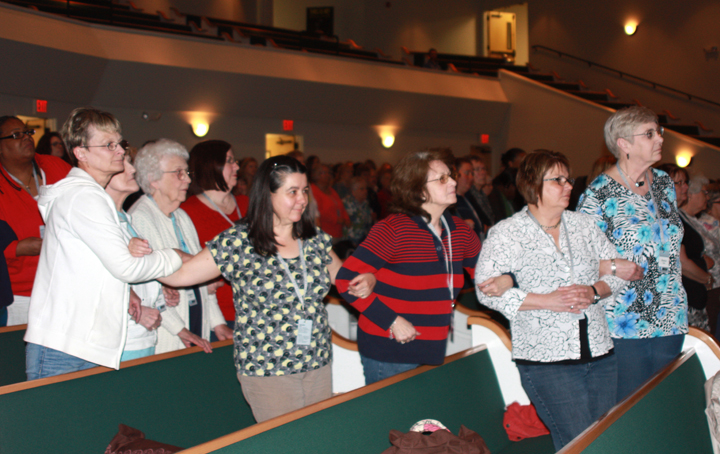
Speaker Rachel Lovingood asked women at the meeting to stand arm-in-arm to demonstrate unity. "There is no telling what can happen in the state of Illinois if we start getting together,” she said. Photo by Lisa Sergent

Speaker Rachel Lovingood asked women at the meeting to stand arm-in-arm to demonstrate unity. “There is no telling what can happen in the state of Illinois if we start getting together,” she said. Photo by Lisa Sergent

Focus on missions
To kick off the Decatur meeting, Halsey and others spoke on needs in Illinois and abroad, and how organizations like Woman’s Missionary Union (WMU) can help engage women in missions. Clella Lee brought greetings from National WMU, headquartered in Birmingham, Ala., and Jill McNicol was re-elected president of Illinois’ state chapter. McNicol is a member of First Baptist Church in Patoka.

Women also elected members of WMU’s lead team, who will serve in a variety of roles throughout the year to organize missions opportunities for children, teens and adults in Illinois.

Early Saturday morning, some meeting attenders participated in a 5K Run/Walk for Missions. Around 30 walkers and runners assembled in Decatur for the inaugural event.

Going home changed
In the meeting’s final session, pastor’s wife and International Mission Board global missions catalyst Lori McDaniel emphasized the importance of faith in women’s lives. “You’ll be ready for tomorrow if you’re OK with God interrupting your normal,” McDaniel said. “God’s interruptions are never convenient.”

She said women have got to stop asking themselves “what if” questions and follow God. “We have so much faith that we’re not going to go backwards. But, we have so much fear that we’re not going to go forward.”

Recounting the Bible story of Gideon, McDaniel said, “God raised Gideon up to be a judge, but not before Gideon back-talked God and showed a lack of faith.” Just as he eventually accepted his assignment, “If we’re going to be ready for tomorrow, then we’ve got to accept the assignment that we’ve been sent,” McDaniel said. “In your ordinary life you have room for an extraordinary God. Where in your life is He at work in a way that can only be explained by Him?”

“Are you going home changed?” Halsey asked the women at the end of the conference.

“Tomorrow begins today,” she said. “We have a personal choice to make whether we are going to live our lives with intention or let someone else decide it for us.”

Read the current issue of the Illinois Baptist online at http://ibonline.IBSA.org.

PriorityHEARTLAND | Living a life with intention is the theme of this year’s IBSA Women’s Resource Conference April 24-25 at Tabernacle Baptist Church in Decatur.

The two-day Priority Women’s Resource Conference is designed to equip leaders serving in the local church. The conference will include worship and large group sessions led by nationally known speakers, 40 breakout offerings on a variety of topics, a luncheon for ministers’ wives, exhibit area with ministry resources, and a 5K walk/run.

A screening of “War Room,” a new film from the creators of “Fireproof” and “Courageous,” will follow the Friday evening session.

Priority begins Friday at 1 p.m. with a missions celebration featuring North American and International Mission Board missionaries and Tajuan McCarty, founder of The WellHouse ministry that seeks to rescue victims of human trafficking. Clella Lee, a leadership consultant for National Woman’s Missionary Union (WMU), will also speak during the opening session.

Lee directs WMU’s Christian Women’s Leadership Center, which engages women in discovering and implementing leadership gifts in their churches and workplaces. Women desiring to express those gifts are sometimes hampered by demands on their time, or by other factors.

“I think women are hesitant sometimes; they don’t want to come across as too aggressive,” Lee said. “And so I think sometimes they aren’t always as apt to take a hold of those leadership skills they have…they have a sense of call or a sense of need, and recognize some of those gifts, but sometimes they’re hesitant.”

Lee will speak about the Christian Women’s Leadership Center, and also will lead three breakout sessions during the conference on the dynamics of a ministry family, the private spiritual life of a leader, and creative approached to missions in a church plant.

Rachel Lovingood will continue the leadership theme in the Friday evening session. The author, pastor’s wife, and speaker at LifeWay events will delve into how women can develop into the leaders God has created them to be. She also will unpack specific topics in several breakout sessions.

The Friday evening session also will feature author and missions advocate Kimberly Sowell, and worship led by Pastor Chad Ozee of Journey Church in Bourbonnais.

Saturday begins early with a 5K fun run or walk, and concludes with an afternoon session featuring Lori McDaniel, an International Mission Board global mission catalyst and church planter wife from Arkansas. Ministers’ wives also are invited to a luncheon with Kathy Litton, the North American Mission Board’s consultant for ministers’ wives ministry.

Cost is $25 for attenders who are part of an IBSA church, and $30 for all others. Conference information and registration is online now at www.IBSA.org/womensmissions. A block of rooms has been reserved at the Decatur Conference Center and Hotel (across the street from Tabernacle Baptist Church). Contact the hotel at (217) 422-8800.

Government leaders need support, encouragement, advice and gospel centered truth, says Carrie Campbell (second from right).

Government leaders need support, encouragement,
advice and gospel centered truth,
says Carrie Campbell (second from right).

COMMENTARY | Carrie Campbell

Every year, my family goes to the Springfield City Basketball Tournament to watch our four city high schools duke it out for the top spot. A few weeks ago, we were sitting at the tournament on a Saturday night when I got a text message from my roommate: Bruce Rauner, Illinois’ newly elected governor, was there.

I quickly scanned the crowd looking for men in suits and a cluster of people. After searching for about 10 minutes, my mom spotted him among the crowd looking just like the rest of us, wearing blue jeans. I immediately decided I wanted to meet him. My sisters and a friend of ours from church headed down to where he was sitting near the court. Gov. Rauner was taking photos with a few other people, and when it was our turn, he smiled at us brightly and told us to come in close and put our heads together.

I introduced myself and told him that I was a middle school teacher. He laughed and said, “God bless you.” We went back to our seats, but later that evening, I went back to talk to him and his team a bit more. I told them that I teach at a diverse school, with students from more than 10 countries. I invited him to meet our students, most of whom have probably never met anyone that influential, especially a government official.

As Christians, I think it’s easy to get intimidated or star-struck by people that lead lives that seem more important than ours. Yes, the governor of Illinois does make many important decisions for our state. But he’s also like the rest of us, a human being put on this earth to glorify God. My introduction to Gov. Rauner reminded me that not only is it extremely important that we lift up our government officials in prayer, but also that we build relationships with them when we have the opportunity. They need our support, encouragement, advice, and gospel centered truth just as much as the next person does.

Romans 13:1 calls Christians to action in just this way: “Let every person be subject to the governing authorities. For there is no authority except from God, and those that exist have been instituted by God.” So I put forth a challenge to you: The next time you come in contact with a government leader, encourage that person with a friendly introduction, handshake, and—as God gives opportunities—with gospel centered truth.

Carrie Campbell is a middle school teacher in Beardstown and a member of Delta Church in Springfield.

Church leaders from 13 states converge for regional Summit

NEWS | Illinois Baptist

“Listen to me, Midwest, the Father is seeking worshipers,” Frank Page intoned. “Every man woman, boy and girl on this globe needs to hear this message.”

The man who calls himself “the SBC’s Chief Encouragement Officer” rallied local church leaders to advance the gospel in a region where Southern Baptists are relatively few and often far between. “I’m not trying to build a bigger denomination,” the CEO of the Convention’s Executive Committee said, “I’m trying to encourage you to help bring worshipers to Christ.”

Spiritual awakening and church revitalization were main themes of the Midwest Leadership Summit held January 20-22.

“What we need, more than a strategy, more than a plan, we need a fresh awakening,” Kansas pastor Andy Addis preached in the opening session. “We want to see God do amazing things, we want to be his hands and feet, that’s why we’re here!”

More than 1,000 pastors and church leaders from the Upper Midwest convened in Springfield for the inspirational equipping conference held every three years. Called the North Central States Rally since its inception 50 years ago, the Summit was renamed this year as it expanded to include 10 Baptist state conventions representing 13 states, from West Virginia to the Dakotas.

The Illinois Baptist State Association hosted the event at the Springfield Crowne Plaza Hotel, providing a more central location as the Summit’s territory expanded on the western side. IBSA executive director Nate Adams chaired the planning committee.

“We drove 10 hours to get here,” one conferee from South Dakota said at the registration desk, telling how his association invited church leaders and brought them in a van.

“It took us two days,” a North Dakota pastor in a bolo tie responded, “but it’ll be worth it.” The buzz in the lobby was positive, as returning attenders told newcomers the value of meeting for leaders who share the challenges of ministry outside the traditional Southern Baptist stronghold.

Henry Hall has been attending the triennial leadership conference since 1984. The director of missions for Salem South Baptist Association said the event was originally designed “for the smaller churches, mission churches, where the pastors are spread out. And most of our churches in the southern part (of Illinois), we’re not as spread out,” Hall said.

“But around the rest of the country, you’ve got to go a long time to find another pastor. And by getting a group together that are all in the same boat, it’s very effective to help them in learning and being what God would have them to be.”
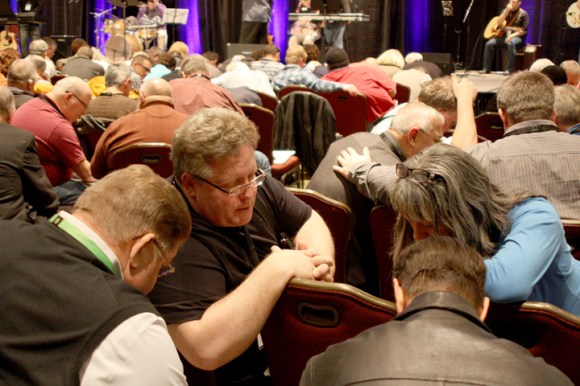
When Gary Frost led Summit attenders to intercede in small groups for children and youth, IBSA’s Pat Pajak (left) prayed with Ken and Kathy Schultz from Crosswinds Church in Plainfield, and a pastor from Iowa.

When Summit speaker Gary Frost led attenders to intercede in small groups for children and youth, IBSA’s Pat Pajak (left) prayed with Ken and Kathy Schultz from Crosswinds Church in Plainfield, and a pastor from Iowa.


Tony Manning lives in Fishers, Indiana, a community of 85,000 people, without a single Southern Baptist church—yet. “The need for everyone is the gospel, and that doesn’t change from East coast to West Coast,” said Manning, a church-planting and mission-teams strategist. “But what does change is how to do things. It’s important to understand the Midwest perspective and how to leverage that in sharing the gospel: How do you do it in Indiana? In Iowa? In Wisconsin?”

Woodie Ladnier has pastored in Iowa since 1991. Recently called to a new congregation, he came looking for fresh ministry ideas. “You know you’re not in the Bible Belt. People in the Midwest are friendly, but you have to earn their trust. You have to be more intentional, because your ol’ buddies aren’t just gonna go to church with you.”

The three-day summit was sponsored by the North American Mission Board, LifeWay Christian Resources, National WMU, and the 10
state conventions. Conferees attended three large-group sessions at the Crowne Plaza, filling the largest ballroom with praises. (“Bless the Lord, O my soul, O-o-o my soul,” they sang; and those three bass thumps ahead of the gutsy response “10,000 reasons for my soul to find…” echoed off the walls.)

Between worship sessions, leaders chose from 135 breakout sessions, state meetings, and affinity groups.

Plan to Pray for Evangelism
Robert Sterling
Imperial, Missouri

Robert Sterling knew his decision to attend the 2015 Midwest Leadership Summit was the right one after the first night. “I called my wife when I got back to the hotel room and said, ‘Well, I just got a spiritual ‘kicking’ and it was just what I needed,’” said the pastor of Windsor Baptist Church in Imperial, Missouri.

Andy Addis, lead pastor of CrossPoint Church, a video-driven multisite church with 11 campuses across Kansas, spoke during the opening session and based his message on Jesus’ parable of the barren fig tree (Luke 13: 6-9). “He reminded us that God expects His church to bear fruit,” Sterling said. “Not hopes; expects. Not wants; expects. That concept really resonated with me.”

Sterling came to the Summit with the intention of finding both guidance and practical tools to bring his church revitalization. He found what he needed in the event’s numerous breakout sessions. He chose sessions on revival, spiritual awakening, evangelism and leadership. He said each of them offered both insight and applicable advice.

“In one of the sessions the speaker said that more than double the baptisms occur in churches that offer evangelism training than those that don’t,” he said. He also learned that though a calendar full of events and programs may not be the best way to win souls to Christ, planning to pray is.

“We need to have more opportunities to pray,” Sterling said. “God uses whatever methods or means to reach people, but the opportunity to seek prayer is vital. Honestly, each of the sessions was very encouraging in terms of reminding us of truths we already
know, but often get lost or forgotten when you are in the middle of the forest.

“Probably my number one takeaway from this is that if I want the church to be revitalized and have a true love of God, I need to make sure that’s where my focus is, too. I need to become what I want them to become.”

Overcome isolation
Tim Batchelor
Princeton, Illinois

Tim Batchelor has pastored Bethel Baptist Church in Princeton, since 2010. Originally from North Carolina, he has found similarities between his upbringing (both of his grandfathers were farmers) and the rural northwest Illinois community he serves. But there are  differences too.

“In North Carolina, if you took the county that I grew up in, there are probably more Southern Baptist churches just in that county than in the entire northwest region of Illinois, and Sinnissippi Baptist Association specifically.”

When asked if his region of Illinois feels unchurched, Batchelor says yes.

“We were talking about that last night at dinner a little bit, and even on our way from our hotel to the session last night. Yeah, it does feel that way, and the need for church planting in particular.

“Sinnissippi Baptist Association has a really ambitious planting strategy; I think it’s just fantastic. But yeah, the need for church planting is huge.”

Second-gen strategies
Aidyl Lesada
Trenton, Michigan

Aidyl Lesada is from a Filipino congregation of about 100 people in Taylor, Michigan. “We are a mother church,” she says of Philippine International Church, which has planted several Filipino congregations in the area, and one just across the Canadian border.

There are about 20,000 Filipino people in Michigan, Lesada says. “Filipinos come here to work and pursue that American dream, and so they give their life, their time for that, and so I guess church will not be a priority. It will just be on the side for them, for them to feel good about it.”

Many have a Catholic background, so making the distinction between faith in Christ and cultural religion is important. Lesada’s church is reaching Filipinos who came to America to work in professional fields, and are now raising second- and third-generation children. Like her own son and daughter. Laughing, she describes them this way: “They’re Filipinos, but they’re not Filipinos.”

Social media for Millennials
Laura Chapman
Red Bud, Illinois

At Laura Chapman’s first Midwest Leadership Summit, the pastor’s wife from Red Bud attended breakout sessions that spoke some of her languages—statistics and social media.

Their congregation is medium-sized and located on the edge of the Metro East area. First Baptist Church of Red Bud, doesn’t have very many Millennials, she said, so a breakout on using social media to reach younger people was helpful.

“You know, there are a lot of people in our churches that don’t know what hashtags are, or keywords, or current things that reach people we’re not reaching,” Chapman said. “And I think just the how-to’s, the nuts and bolts of ‘you gotta update your website, you just have to do that…’ helps bring in generations that we’re not reaching. That was very helpful, and easy to implement.”

One breakout session leader at the Summit said if Millennials can’t find a Facebook page for a church, they wonder what that church is hiding. Chapman understands that kind of thinking. “Nobody in my generation and below trusts people…that’s kind of our thing. So, help them to know you.”

Urban challenges
Donald Johnson
Rock Island, Illinois

This wasn’t the first Midwest Leadership Summit for Donald Johnson, pastor of Destiny Baptist Church of Christ in Rock Island. He traveled to Indianapolis for the “North Central States Rally,” as it was called before this year, and was glad for a slightly shorter commute—three hours instead of five.

“But wherever it is, I’m willing to go, because of the value that we get out of it…We’ve been enriched,” said Johnson, whose church is part of Quad Cities Association.

Destiny’s vision statement is based in Isaiah 56:7, “to be a house of prayer for all races of people.” Their goal is to be multi-racial rather than multi-cultural, Johnson said. “There’s not going to be a segregated heaven, so I don’t want to have a segregated church.”

He was moved by Gary Frost’s closing sermon, which focused in part on the dangers children and teenagers face today. “He got into my neighborhood, which is the same neighborhood he has,” Johnson said. In his community, “We deal with the matter of significant fatherlessness.”

Frost’s message focused on returning to “the valley” after a mountaintop experience. Speaking on Jesus’ transfiguration in Mark 9, he noted how Peter wanted to build shelters for Jesus, Moses and Elijah.

“For me, it was good to be here,” Johnson said. “But I’m not going to be like Peter and John and say, ‘Let’s build three tabernacles here on the mountain and stay.’

“Because we gotta get back to the valley.”

Reported by Meredith Flynn, Eric Reed and Lisa Sergent, with Kayla Rinker and Nick Rynerson.