Archives For November 30, 1999

Layout 1“Father, … I commit my spirit!”
Read Luke 23:46-49, John 19:31-42

Here are some signs that Jesus’ work really worked: The earth shakes, as God’s own creation trembles at the mighty act just finished on a barren hill outside the city. The massive temple curtain separating the place of God’s holy presence from sinful people is ripped from top to bottom, signifying the Creator’s invitation to humanity to enter into restoration. And on the cross, Jesus makes his own great declaration of faith in the Father’s plan: I trust You.

How could Jesus say this?

No prisoner in solitary confinement was ever more alone than our Christ on the cross. It had to be that way.

faithOnly Jesus could serve as the sacrifice for our sins. Only Jesus could be our spotless lamb. Only Jesus could be the human qualified to pay the penalty for sin. Because he was sinless. And in this he was unique in all of the universe. In this he was alone.

All he had to hold to was the Father’s promise of life on the other side of the grave. Soon he would rest, his salvation work complete. Soon all heaven would celebrate.

PRAY Lord, because of Your great love and completed work on the Cross, into Your hands I, too, commit my Spirit.

Layout 1“It is finished!”
Read John 19:30, Hebrews 1:1-3

When its payment is completed, a bill is customarily stamped “paid in full.” No more payment is expected. The cancelled paperwork is proof that the debt is no longer held against the debtor. In New Testament times, the word written across the final invoice was tetelestai. This Greek word means “it is finished.”

Tetelestai (pronounced “tuh-TELL-uh-sty”) appears only twice in Scripture, in John 19:28 and 19:30. In the first verse, “Scripture” is described as tetelestai. Often translated as fulfilled or completed, it is finished. Jesus did everything the prophets said he would do. He left no job undone, no stone unturned.

finishedOnly two verses later in John’s account, Jesus himself declares his mission accomplished. After six hours on the cross, painfully pulling his body up to swallow every breath, it is almost impossible for Jesus to seize enough air to shout this news.

But he does. And everyone is stunned.

Tetelestai!

PRAY Lord, I am amazed by all you did to save me. Thank you for completing my redemption. Your work is finished, and I am paid for in full.

movie_filmstripCOMMENTARY | Meredith Flynn

Watching actors portray Jesus on film is a little like Goldilocks trying out chairs at the three bears’ house. This Jesus is too small (“Jesus Christ Superstar”). This one is too passive (“Son of God”). Or just too weird (“Godspell”).

Even when Jesus resembles the one you met in Sunday school, like in the 1965 epic “The Greatest Story Ever Told,” you still find yourself looking for the inconsistencies that prove this Jesus isn’t as satisfying as the one in the Bible.

And when his suffering is gut-wrenchingly authentic (“The Passion of the Christ”), you want to see this Jesus during the rest of his life, and not just the last few hours.

Movies can’t capture him, and they’re not the best way to connect with him. But there’s still a reason to watch. Jesus on film may be undersized compared to the real-life version, but the other humans in the movies are caught in brilliant living color.

Judas, Nicodemus, Barabbas and the others are fully life-sized, and watching them interact with the film version of Jesus is downright convicting.

See the shades of jealousy you’ve never noticed in the “Greatest Story” Judas, and his belief that he was actually doing what was right for his people. Or listen to him wail in “Superstar,” narrating the whole story in what he believes is the voice of reason.

Watch Nicodemus in “Son of God” draw close and then pull away, again and again, as he’s torn between this new gospel and what he’s always known.

Simon of Cyrene comes to life in “The Passion,” starting off skeptical and reluctant to help Jesus carry his cross, but defending him at the end of their long march. In the same movie, Mary Magdalene can’t turn away from the gruesome crucifixion scene, her current reality mixing with memories of how Jesus rescued her from the Pharisees.

Even in “Godspell,” the loopy 1975 musical, we watch the disciples have their world turned upside down as Jesus teaches them things that are the opposite of the status quo.

The filmmakers created some of the dialogue to fill in places Scripture doesn’t describe in detail, so we don’t know exactly what was said or felt. But Judas’ jealousy and Mary’s neediness and Nicodemus’ doubts are relatable all the same because we’ve been in their shoes.

There’s a young church in San Diego called Barabbas Road. The founding pastor picked the name because all redeemed Christians have walked Barabbas’ path, he said. In fact, one of their early promotional videos featured different church members each proclaiming, “I am Barabbas.”

These Jesus movies elicit the same reaction: I am Barabbas. I am Nicodemus. You are Peter. You are Simon of Cyrene. Watching Jesus interact with vividly human people like us is the most moving thing about all these motion pictures.

And as a bonus feature, these abridged versions of Jesus will drive many viewers back to Scripture for the full story.

Meredith Flynn is managing editor of the Illinois Baptist.

Layout 1“I thirst.”
Read John 19:28-29, Psalm 69:21,
Zechariah 12:10

Several times the Gospel writers say the events of the crucifixion happened to fulfill Scripture. Jesus sipped the sour wine. His bones were not broken, which would have sped up the dying process. His side was sliced open, and the water separated from the blood that spilled out showed he had died. Why was it necessary to fulfill the Scriptures?

Doubters might say that Jesus, sweet but deluded, had sacrificed himself unnecessarily. They might say there was no divine plan from before creation to redeem humanity from sin and death. They might say it was all miserable happenstance, a bad turn of events.

fulfilledBut as the pivotal point in all history, the crucifixion was no accident. And to prove it, the Author of the plan had it written down hundreds, even more than 1,000 years before it happened. Bible scholars point to over 300 Old Testament prophecies of the birth, life, death, and resurrection of the Messiah.

And for it all to be proven true for those of us who stand on the A.D. side of time, Scripture was fulfilled. Down to the last sop of vinegar. Down to the last spear point.

PRAY Lord, thank you for the details of the crucifixion proving Jesus’ humanity, the reality of his death, and your divine plan over it all.

Layout 1“Why have you forsaken me?”
Read Matthew 27:45-49, Psalm 22

The crowd on Golgotha thinks Jesus is calling on Elijah for rescue, but he isn’t. He’s calling on Elohim. With the opening to Psalm 22, he invokes the entire prophetic psalm. It’s a word picture written a thousand years earlier showing the Messiah, abandoned to die.

How can someone who lives in constant contact with two others ever be alone? That has never happened before. The Trinity is the perfect picture of community: three persons enjoying complete unity, holy boon companions always in agreement.

forsakenBut for three hours Jesus feels nothing but the weight of our sin, and the one who knew no sin becomes sin for us. It’s so revolting that the Father who ordained it can have nothing to do with it. And Jesus, for the first time in all eternity, is alone.

Standing beneath the cross, disciple John and mother Mary witness in the skies what’s happening within Jesus Himself. The sky grows dark. The sun is blotted out. And rain falls on them all, the tears of heaven, as Jesus cries, Why have you left me?

PRAY Lord, when I feel alone, remind me that you know how it feels. And because You bore my sins, I need never be separated from God anymore.

Layout 1“Woman, behold your son.”
Read John 19:25-27

Jesus’ most tender word from the cross is to Mary; perhaps his most challenging is to John. Behold. To both of them he says “behold,” a command meaning to look, see, and understand.

“Behold your son…behold your mother.” Behold my provision; behold your responsibility.

To Mary, Jesus is affirming his love for her. As the eldest son in the family, it is Jesus’ duty to provide for his mother in his earthly father’s absence. He entrusts her care to his dearest friend on earth, his beloved follower John.

familyTo John, what an awesome responsibility this must be, that his friend, teacher, and Lord would give to him this duty as if Mary were his very own mother. If he never knew it before, John must realize it now: he really is one of the family. Jesus’ family.

Behold. Could there be any greater statement of the love of God than to be made part of the family?

PRAY Lord, when I behold you, help me to understand that you are the Son, and you have welcomed me into your family.

COMMENTARY | Jonathan Davis

Jesus_forpage1

WHAT A SAVIOR – “But he was wounded for our transgressions, he was bruised for our iniquities: the chastisement of our peace was upon him; and with his stripes we are healed” (Isaiah 53:5). Sculpture by Libby Morecraft of Harrisburg

Our culture loves blood. The latest vampire novel, graphic movies, every CSI crime drama, the nightly news – they’re all pictures painted in blood. Even the walking dead are promoting a bloody afterlife every Sunday night on cable. But our culture’s bloodthirst is biting into the wrong vein.

As God’s people, we also are to be marked as lovers of blood. Not because of an obsession with gore, but because of the Savior who shed his life’s blood
on our behalf.

Yet, for some reason, we often shy away from the bloody language of the cross. Our culture, so fascinated with blood stories, turns away from the most
important blood lines of all. Talk of the cross is offensive to many, and to bring up the blood as central to faith will bring many conversations to a halt. And
rather than offend, some Christians will stick to the more polite apologetic: Jesus loves you, and has a great plan for your life.

But that’s a bloodless Christianity. And a bloodless Christianity is no Christianity at all.

Flesh and blood isn’t just Easter language; it is Gospel language to be used at all times and in all places. We are to embrace the bloodiness of Scripture, for to do opposite is quite dangerous.

Our bloody theology

The Bible presents us with a robust theology of blood. Because Christ was crucified, we reap a multitude of benefits for His glory and our good.

• We once were people without hope, but have been brought near to God by the blood of Christ (Ephesians 2:12-13).

• In Christ Jesus, whom God put forward as a propitiation by his blood, we have redemption, the forgiveness of our sins (Romans 3:24-25; Ephesians 1:7).

• We have been justified by Christ’s blood (Romans 5:9).

• We have peace with God by the blood of the cross (Colossians 1:20).

From Adam and Eve’s first sacrifice outside the garden to our High Priest’s completed work, and everywhere in between, the history of God’s people is marked by blood. For several thousand years, it’s the blood of animals, offered as a covering for sins. And finally, it’s the once-and-for-all sacrifice that
washes whiter than snow.

When it comes to salvation, nothing but blood will do.

Maybe the most startling example of flesh and blood language in the Bible is found in John 6. Jesus tells his followers they must eat his flesh and drink his
blood. On the surface, it’s a revolting concept. “Is he advocating cannibalism?” they must be thinking.

Then, at his last meal with the disciples, Jesus enacts the teaching, tying together eternal life with eating his flesh and drinking his blood. Jesus notes that
we are abiding in him when we do so. To commune with Christ is to embrace this bloody language.

Now, it’s not too hard for us to talk about the crucifixion and the blood this time of year, especially in our churches. At Easter, the person and work of Jesus
come to the forefront of our minds, and rightly so. This is the time of year we celebrate Christ’s crucifixion, and it makes sense that flesh and blood speech
is on our lips.

But what concerns me is our post-Easter language, and how we share the Gospel with people who don’t know Christ. Too often, we avoid talking about Christ’s suffering, and in doing so, we drain our faith of its very power.

Power in the blood

The next time you’re on break at the water cooler, try dropping this line from Jesus into the conversation: “Hey, did you know that Jesus said, ‘Unless you
eat the flesh of the Son of Man and drink his blood, you have no life in you.’”

I can hear the crickets chirping.

The Corinthians felt the shame of flesh and blood preaching, and this led them away from boasting in the cross to boasting in worldly wisdom. Preaching
a crucified king sounded so un-wise that they forsook the very message they had heard and believed.

But Paul argues that crucifixion language is the very language the Holy Spirit empowers. He had come to the Corinthian believers in weakness and fear. His speech and message were not in plausible words of wisdom, but in demonstration of the Spirit and of power (1 Corinthians 2:3-4).

We must recover that kind of speech in our churches and as we go out into the world. Sin is serious, so serious that it warrants death. This is why there is
great danger in bloodless Christianity. To remove the bloody language of the cross is to remove man’s only hope of being made right with God.

The Gospel of the cross is the good news that God is holy, you are not, and the necessary sacrifice to make you right with God is found in Jesus Christ and Him crucified.

As believers we have tasted and seen the goodness of salvation applied to our hearts, and our desire is to see the lost know this same salvation. Is talking
about the cross offensive? Yes. Is it difficult to speak? Yes.

But let’s not run from it. Rather, let us press into it, speaking Christ and Him crucified plainly and with conviction, trusting the Holy Spirit to draw the lost to the Father through the Son.

When we do, people will begin to understand there’s power in the blood.

Jonathan Davis pastors Delta Church in Springfield.

Layout 1“Today … in paradise.”
Read Luke 23:39-43

One thief spits curses and ridicule. The other pleads, Remember me. Both deserve death for their crimes. The law said so. The judge said so. The hammer said so. The executioner agreed. But their reactions to their punishment are exactly opposite. Why?

One gives up hope, even when hope is right before him. The other holds onto hope, not because he can see it, but because it’s the only thing he has left.

futureOne man believes in death there is no future. The other believes in the future there is no death. And in response to his faith, Jesus holds before the believing thief the promise of paradise.

What a contrast to the utter degradation of the executioner’s hill beside the smoking city garbage dump: Paradise. Eternity. Joy. A never-ending future in the presence of a loving God.

PRAY Lord, help me remember there is a future and a hope as I face death, even though I deserve it.

Layout 1To prepare for celebration of the Resurrection, we must first witness the agony of the cross. Crucifixion is a most torturous form of execution. It may last several hours or several days. The body’s systems shut down and the condemned man’s lungs fill with fluid. In effect, he drowns. As he pulls against the spikes in his flesh, trying to lift his body just enough to gulp another breath, Jesus uses his last energies to make seven bold declarations.

Standing at the foot of the cross with his most devoted follower, John, and his mother, Mary, we watch as Jesus pours out his life. We listen for clues to his future – and ours – as the Lord of all creation bows to his Father’s will on our behalf.

Use these devotionals once a day during Holy Week, or as an hour’s contemplation on Good Friday.

“Father forgive them,”
Read John 19:17-24, Luke 23:32-34

forgivenIt’s brazen. The soldiers who beat Jesus then stripped him and nailed him to the beam. They raised the cross and let it drop into the hole that held it up, letting Jesus’ full weight pull against the severed flesh where the great nails affixed him. Now they have the nerve, stooping to the ground before that very cross, to gamble for the only nice thing Jesus had on earth, his seamless robe.

And yet, their brazen offense, to kill a man and rob him of his clothes as payment, is not the most heinous crime Jesus suffered that day. He had laid on his back all the sins of all people of all time. And still, he says, Forgive them.

Who else could offer such a word? Only the one who is offended has the right to forgive the offender. Only he could extend grace to the one who sins against him. Jesus’ desire is always that we accept his forgiveness and live in his grace.

PRAY Lord, I, too, am responsible for your death. Help me to live in gratitude for your forgiveness.

potteryHarrisburg, Ill. chalk_art| Worship in a sanctuary is usually reserved for church days. But on a recent Friday morning at First Baptist in Harrisburg, a handful of people focused on Jesus as artist Libby Morecraft turned a 75-pound mound of clay into a sculpture of his face.
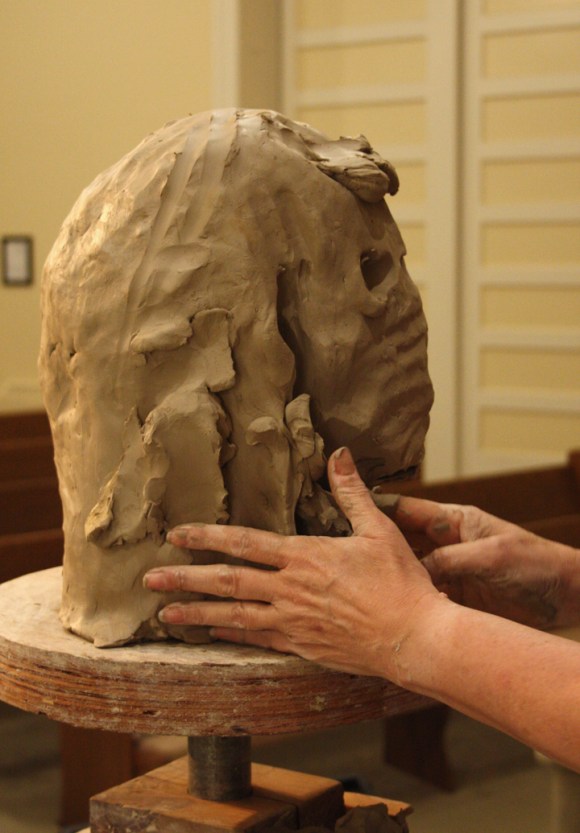
She demonstrated her skills for the Easter issue of the Illinois Baptist (online here), but sculpture is just one part of the outreach she calls “Work of Art Ministries.” She also uses pottery and chalk art to lead people in worship during services, conferences and retreats. Libby, who’s married to Saline Association director of missions Rusty Morecraft, recently led during the annual IBSA Ministers’ Wives’ Retreat.

Check out how the sculpture came to life in the slideshow below, and go to the Work of Art Ministries Facebook page for more on her work.

LM_1LM_2LM_4LM_5LM_6LM_8LM_10LM_12