Archives For November 30, 1999

The_BriefingTHE BRIEFING | A new survey shows 21% of same-sex couples in Illinois have opted to wed since it became legal in the state June 1, but a second survey asks how long those marriages will last. And two more new polls cast doubt on the percentage of homosexuals in the U.S.

Equality Illinois, a group that advocates for lesbian, gay, bisexual and transgender issues in Illinois, surveyed the state’s 102 counties and found at least 3,274 marriage licenses have been issued to same-sex couples and 1,694 civil unions have been converted to marriages. According to the most recent U.S. Census, 23,409 same-sex couples reside in Illinois. Using this data, 21.2% of same-sex couples in the state have married or plan to marry.

The group stated the exact number of licenses issued or civil union conversions is difficult to determine because not all of the state’s county clerks recorded whether licenses were issued to same-sex couples, while others recorded conversions together with licenses, not separately.

Nine counties reported no licenses issued to same-sex couples or civil union conversions and five counties did not respond to the survey.

What might the future hold for these couples? The National Review’s online blog, The Corner, reported this month in a new Scandinavian study of civil unions (more heavily equated to marriage than in the U.S.) over the nearly two decades that they have been legal in that region of the world. The study reported male couples were 35% more likely to divorce than heterosexual couples, and female couples were over 200% more likely to divorce. It also found, whether or not the couples had children made little difference in the divorce rate.

Gay, more or less

In related news, the Centers for Disease Control and Prevention reported July 15 that less than 3% of the U.S. population identify themselves as gay, lesbian or bisexual. It’s the first time the government has measured American’s sexual orientation through the National Health Interview Survey.

According to the 2013 survey just out, 1.6% of adults self-identify as gay or lesbian, and 0.7% consider themselves bisexual.

And these findings conflict with a new Pew Research Center survey that says there are more homosexuals in the United States than previously reported. The figure cited for years was 10%, based mostly on the Kinsey Report of 1948. Critics called Kinsey’s methods flawed, and said the number was more like 4% to 8%.

Pew used two survey methods, allowing for indirect responses. While the “direct report” method shows 11% of U.S. adults “do not consider themselves heterosexual,” the “veiled report” showed considerably higher numbers: 19% of U.S. adults said they “do not consider themselves heterosexual.” That’s 15% of men and 22% of women.

Using the “veiled method,” Pew also found that 27% of U.S. adults admitted having a sexual experience with someone of the same sex.

Overall, the public perception of the number of homosexuals in the U.S. has grown as same-sex marriage has dominated the news. A 2013 Gallup poll that found Americans believe 25% of the population is gay, lesbian or transgendered.

-Reported by Lisa Sergent for the Illinois Baptist

Other stories:

SBC leaders tour Texas border shelters
Southern Baptist Convention President Ronnie Floyd and ethicist Russell Moore will today visit two border facilities tending to the needs of children detained after attempting to cross into the U.S. The Department of Homeland Security reports 57,000 such kids have been detained in the last nine months. The children “need immediate attention that elevates their health and safety above all,” Floyd wrote for Baptist Press last week. “From my point of view, the children must become our number one priority.” Read more at BPNews.net

Research guages ‘religious temperatures’
Americans view Jews, Catholics and evangelical Christians warmly, according to a new study from Pew Research that measures perceptions about different religious groups. Respondents ranked groups on a “feeling thermometer” of 0 to 100. The “warm” groups all received average rankings in the low 60s, while atheists (41) and Muslims (40) received the lowest numbers. Read more at PewForum.org.

Baptist school gets partial win in court
A California Superior Court ruled in July that a Southern Baptist university had the right to expel a transgender student for violating its code of conduct. Domaine Javier, a former California Baptist University nursing student who identifies as a female, sued the school for gender discrimination after being expelled for claiming to be female on his application.

Judge Gloria Connor Trask ruled the school didn’t violate the state’s Unruh Civil Rights Act because its on-campus activities do not constitute a “business enterprise.” But Trask did award attorney’s fees and $4,000 in damages to Javier because he was excluded from off-campus enterprises open to the public. Read more at BPNews.net.

Movies to explore Tolkien/Lewis friendship
Christianity Today reports on two upcoming movies that will look at the relationship between beloved Christian authors C.S. Lewis and J.R.R. Tolkien. The films “Tolkien and Lewis” and “Jack and Tollers” are expected in 2015, and another movie about Tolkien’s life also is in the works.


Illinois Governor Patrick Quinn is expected to attend a same-sex marriage ceremony today at the Museum of Contemporary Art in Chicago.

Same-sex marriage became legal throughout the entire state of Illinois yesterday. Although it was a Sunday, some county clerks’ offices opened to allow couples to get their licenses.

According to the Chicago Tribune, the church, Unity in Chicago located in Rogers Park, held a group wedding ceremony for 40 couples, same-sex and straight, Sunday evening.

David Viggiano, co-organizer of the event told the Tribune, “Now that we have gay marriage we need to push past labeling any marriages as gay, lesbian or straight and talk about marriage equality. Unity’s thought is that there is one God and many paths to that. One marriage, many paths to that.”

Governor Quinn issued a statement Sunday declaring, “All couples across Illinois can now receive the rights and protections under the sacred vow of marriage. The Land of Lincoln has always been a place to embrace all people and today we stand as an example for the rest of the nation.”

Couples already joined by civil unions can have them converted to marriages backdated to the start of the civil union or have a new marriage ceremony date issued.

The Illinois General Assembly voted Nov. 5, 2013 to legalize marriage between same-sex partners effective Jun 1, 2014, but some counties began issuing licenses in February after a Cook County judge allowed a terminally ill woman to marry her partner four months before the official start date.  Illinois Attorney General Lisa Madigan then left it up to each individual county clerk as to when they would begin issuing licenses. The group Equality Illinois estimates around 1,300 couples have already married since the February ruling.

Growing trends among second-generation and multi-site congregations

By Eric Reed
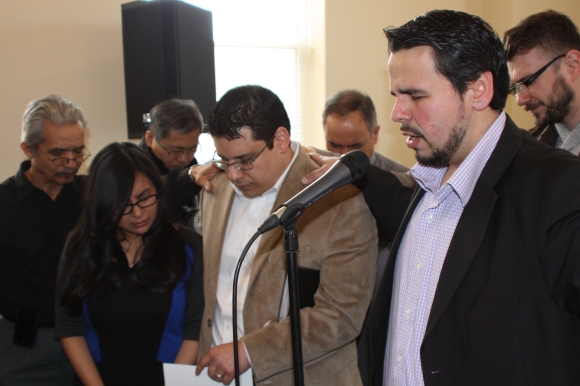
Starting Point in Chicago: Pastor Marvin del Rios of Iglesia Bautista Erie (right) prays for the new congregation his church is sponsoring, led by Pastor Jonathan de la O and his wife, Emely, surrounded by leaders from Chinese, Korean, and Romanian church plants who attended the April 6 launch service.

Starting Point in Chicago: Pastor Marvin del Rios of Iglesia Bautista Erie (right) prays for the new congregation his church is sponsoring, led by Pastor Jonathan de la O and his wife, Emely, surrounded by leaders from Chinese, Korean, and Romanian church plants who attended the April 6 launch service.


Across Illinois |
Five new churches held their “grand opening” events during the two weekends before Easter.

The congregations couldn’t be any more different: They are Hispanic, Korean, Anglo, and multicultural. They meet in the inner city, in new suburbs and older neighborhoods, and way out in the countryside.

Yet their worship services are remarkably alike: all in English, all contemporary, all enthusiastic, and mostly loud.

Collectively they show how some important ministry trends are reaching both main roads and back roads in Illinois:

➢ After decades of planting ethnic language churches, English-language ministries may be the next wave as the grown children of immigrants aren’t feeling comfortable in their parents’ churches.

➢ Starting new churches is getting more complicated and expensive and harder for planters to do solo. That is resulting in more multi-site churches and in new networks among church leaders.

➢ And in some situations, starting from scratch may prove a better strategy than re-engineering a faltering ministry.

Jonathan de la O was born in the United States, but his parents are from El Salvador. He is the product of two countries. “I wasn’t 100% Latino or 100% American, at least in the eyes of those around me,” he said. “It made it difficult to identify with a people group.”

When called to pastor a church, he asked what kind? “I didn’t know where I fit in,” he said in a video.

That tension produced a new kind of church in the Humboldt Park neighborhood: Hispanic worship in English. It’s designed to reach people like him, second-generation young adults, the children of immigrants who are often more like the kids they went to school with than their own parents.

De la O cites a statistic showing 60% of second-gen adults have markedly different culture, language, education, and income than first-gen immigrants. If they don’t find a different kind of church than mom and dad’s, he said, they are likely to drop out.

At home, and not at home

If the very different needs of younger people sound familiar, there’s good reason, said IBSA’s multicultural church planting specialist, Jay Noh. “The gap between first-gen immigrants and their U.S.-born second-gen children includes every challenge that the mainstream U.S. churches have faced, compounded by differences in languages and culture.” In his words, “The paternalistic assumptions of the first-gen won’t be accepted” by their children.

“As soon as they are able to escape the world of their parents and other people of authority, they find a place that is somewhere between their ethnic heritage and the dominant American culture,” said Van Kicklighter, who heads church planting for IBSA.

De la O hopes that place will be his new church. Starting Point Church is meeting in the newly refurbished building owned by Chicago Metro Baptist Association. Noh is assisting another second-gen church start that also shares the space, The Way Bible Church, reaching young Romanians. The Romanian congregation, and second-gen Koreans, Chinese, and international students from Moody Bible Institute, packed out the launch service to show support for De la O and the new church.
Bethel Church in Mt. Prospect: A multi-ethnic crowd feasted on an international menu following the church's first public service. Pastor John Yi (in the green shirt) shakes hands and bows to almost every guest. Yi has led a ministry to poor families in another Chicago suburb since 2008.

Bethel Church in Mt. Prospect: A multi-ethnic crowd feasted on an international menu following the church’s first public service. Pastor John Yi (in the green shirt) shakes hands
and bows to almost every guest.

Later that same day, northwest of Chicago in Mt. Prospect, a worship band rehearsed prior to the first public service of Bethel Church. On the platform was the expected array of guitar players and drummers, plus one violinist. Mostly Korean, they sang in English and the music was loud.

“Is this typical of Korean worship services?” a guest asked two teenage girls who were thumbing their phones while sitting on the back row of the borrowed sanctuary.

“No,” one girl said. “Not the Korean-language services. They are very traditional.”

“Very,” the other added, “but EM – that’s English Ministry – those services are contemporary. Not as, um, Korean,” she said, smiling.

“Not as, um, Korean” might be a good slogan for Bethel Church. Pastor John Yi has led a multicultural community ministry to poor families in Maywood, about 15 miles away. Now he is starting a new church, also multicultural, which is expected to draw several ethnic groups, but especially second-generation Asians. Like the young women on the back row.

“Our principal attention has been on unchurched English-speaking people in our surrounding neighborhoods in Mt. Prospect even though Bethel Church is made up of a largely Asian-American base,” Yi said. “Interestingly, our ethnic affinity is difficult to dismiss and thus, we have attracted a lot more Korean-speaking people than we had planned.”

The disconnect between generations becomes evident as older people filled the pews, then attempted to sing English worship songs. It’s not only the linguistic gap, there’s a musical gap that many churches have had to bridge.
Their discomfort is evident, but clearly the older people support Yi and his effort to reach their children’s generation. It’s all smiles and bows as about 300 people filled the fellowship hall after the service and shared an inaugural meal of stir-fried rice, Buffalo wings, and Italian spaghetti.

“The first generation has a growing understanding of the necessity of having a gospel ministry that’s culturally indigenous for their U.S.-born second gen,” Noh said. “This may have come about belated as a result of a decade or more of the young generation’s silent exodus from their ethnic churches.”

New networks, new sites

Grace Point in Frankfort: Pastor Emanuel Istrate greets worship attenders at his church's first service. Grace Point is a church plant of Crossroads Community Church in Carol Stream.

Grace Point in Frankfort: Pastor Emanuel Istrate (right) greets worship attenders at his church’s first service. Grace Point is a church plant of Crossroads Community Church in Carol Stream.

In the far south Chicago suburbs, another church launched this day. Meeting in a middle school amid large new houses, this church plant is a restart. “First Baptist Church of New Lennox approached us asking for help,” said Scott Nichols, pastor of Crossroads Community Church in Carol Stream, another suburb 40 miles away. “They sold their building and had been meeting in a school….Unfortunately, they were…near to closing the doors.”

Nichols and his team did what they have done twice before: they brought in leaders and vision. First they offered Saturday night services utilizing the Carol Stream staff. Then, after calling a campus pastor to lead the new work, they restarted Sunday morning worship.

On opening day, Grace Point Community Church in Frankfort welcomed about 60 people from the area. Their target is not based on ethnicity but proximity. “Our target is anyone who will hear us,” Nichols said. “We have gone door to door and mailed about 20,000 postcards to the area.”

Nichols recounts how he’s often said, “You could blindfold an ape and give him a dart. Any place on the Chicagoland map he hits is a good place to plant a church!”

The Crossroads/Grace Point plant demonstrates two trends: the trend toward shutting down a foundering church, then allowing a stronger church to restart a ministry with new vision and new DNA; and the emergence of networks among churches that produce multi-site ministries.

“I believe this is happening both out of necessity and a new valuing of multiplication and reproduction,” Kicklighter said. “Necessity, because churches and pastors are hungry for connection with others,” but also from “a passionate commitment to impact lostness and to do whatever it takes to reach people and give them a local church in which to grow as disciples.”

North by northwest

Grace Fellowship in Davis Junction: Pastor Brad Pittman's church meets in a renovated electrician’s shop at an Ogle County crossroad. Pittman (left) is leading Grace Fellowship's third campus.

Grace Fellowship in Davis Junction: Pastor Brad Pittman’s church meets in a renovated electrician’s shop at an Ogle County crossroad. Pittman (left) is leading Grace Fellowship’s third campus; the other sites are in Ashton and Amboy.

As at Crossroads, the leaders of Grace Fellowship have a broad vision. On Palm Sunday weekend, in a small metal building in north central Illinois south of Rockford, that vision is becoming reality – for the third time.

“I got my first job when I was 13,” Brad Pittman said, “tasseling corn. Anybody know what tasseling corn is?” Hands shot up across the room, along with a few chuckles. “Best job in the world,” he said, before describing his journey from corn tasseler to full-time church planter. A member at Grace Fellowship for 13 years, Pittman eventually joined the staff with pastors Jeremy Horton and Brian McWethy. From the main campus in Ashton, the trio launched Grace Fellowship in Amboy in 2012, and next in rural Davis Junction.

“This is a part of the state where Southern Baptists have had little presence,” said Kicklighter. “When Baptists moved from the south, they settled primarily in the metropolitan areas of the north to work in industry. They did not come to Illinois to buy farms…so we have few churches in these kinds of settings.”

The mainline denominations were better established here, but their churches are in steep decline. So, there is potential here.

“There are over 4 million people living in the non-urban context in Illinois,” said IBSA’s John Mattingly, who leads church planting in the northwest quadrant. “I believe God has prepared many more churches like Grace Fellowship to step out in faith and do something remarkable.”

The three pastors targeted Davis Junction (called “DJ” by the locals) because there was only one faltering mainline church there to serve more than 4,000 people. “We hung over 800 door hangers” in the week before the launch, Pittman said. “We don’t know what the Lord is going to do; we’ll have to wait and see,” he said, before describing how deeply he feels the spiritual need in the area.

“This is not the typical multi-site church plant,” Kicklighter said, “but a commitment to reproduction and, even more importantly, sending people who will impact another place with the Gospel. This is a value system commitment that says extending the reach of the Gospel and the church is at least as important as how many we gather in our own building on Sunday morning.”

More than 60 turned out for the first Saturday evening service, some from the church’s other locations, but many new visitors from DJ. After the service in the brightly rehabbed building, there are lots of hugs, as at each of the launches, and cake.

It is a birthday, after all.

After closure, new hope
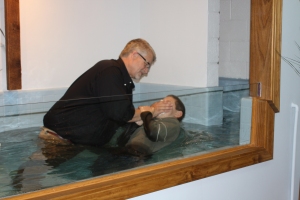
New Hope in Rock Falls: Pastor Jon Sedgwick prays with IBSA church planting leaders Van Kicklighter (left), John Mattingly (right) and Jordan Van Dyke, a future church planter in Galesburg, prior to the launch service. Later Sedgwick baptized a brother and sister.

New Hope in Rock Falls: Pastor Jon Sedgwick baptized a brother and sister at his church’s launch service.

The next morning Jon Sedgwick is all smiles as he baptizes two new believers. Sedgwick didn’t intend to plant a church in northern Illinois. “I didn’t like Illinois,” the former Missouri pastor said emphatically. Illinois was just a place to get through when traveling home to Indiana for visits with family. “But God gave us a love for Illinois!”

“We love Rock Falls!” his wife, Rhadonda, added, equally enthusiastically.

Mattingly had visited the Sedgwicks’ Missouri church describing the need for planters in the Northwest quadrant of Illinois. After Mattingly’s second appeal – “Is God calling someone here to come and help?” – the couple realized, “It was us. God was calling us. God said, ‘Why not you?’”

In 2012, they arrived and began building a new ministry at the building that once housed First Southern Baptist Church of Rock Falls. To the usual round of Bible studies and home meetings, Sedgwick added “Celebrate Recovery,” a faith-based twelve-step program originated by Rick Warren and Saddleback Community Church in California. Reaching out to people with addictions, Sedgwick found doors opening that once were closed to Baptist ministry.

At the worship service, greeters David and John freely told guests how they came to be part of New Hope Church through the recovery ministry.

Also in attendance was Jordan Van Dyke, a planter who is gathering a core group for a new church in Galesburg.
It is commonly observed that ministry in northwest Illinois is especially challenging. “It’s because of the soil,” Van Dyke said. “It’s hard. Sometimes I wish I’d been sent to southern Illinois where, when it’s Sunday, people go to church. In the northwest, it’s Sunday and church is an option. ‘Will I go to church?’ Maybe. Maybe not.”

On this day they do, because there’s new hope in Rock Falls.

Eric Reed is editor of the Illinois Baptist newspaper. In the May 26 issue of IB, we’ll continue our series on The Midwest Challenge with a focus on church revitalization. Go to http://ibonline.IBSA.org to read past issues.

The_BriefingTHE BRIEFING | Half of all Illinois residents said they’d move out of state if they could, putting the Land of Lincoln at the top of a Gallup survey of all 50 states. But it’s a dubious honor: On average, only 33% of residents in all states would like to move, compared to 50% in Illinois.

19% of Illinois residents said they are extremely, very or somewhat likely to move in the next year, compared to about 14% across all 50 states.

Gallup linked their most recent poll to similar studies that measure how negative residents are about their state’s taxes, and how much they distrust their government. Illinois topped the latter list too – only 28% of residents said they had a great deal or fair amount of trust in their state government. As for taxes, 71% of Illinoisans said they were too high, placing the state fourth on a list topped by New York, New Jersey and Connecticut.

One piece of good news amid the bad: A study from the University of Colorado-Boulder named Chicago the country’s funniest city, largely because of its improv scene. Judging from the Gallup numbers, it may be a good time to learn to laugh at ourselves, too. Read more at Gallup.com.

Supreme Court rules in favor of town meeting prayers
The U.S. Supreme Court on Monday ruled that prayers before town meetings in Greece, N.Y., can continue. The Second Circuit Court of Appeals in New York City had ruled the prayers “had the effect of affiliating the town with Christianity,” but the Supreme Court’s 5-4 decision overturned that ruling. “This is a victory for all of those who believe in the freedom of speech, including religious speech, as a prized part of our God-given religious liberty,” said Russell Moore, president of the Southern Baptist Ethics and Religious Liberty Commission. Read the full story at BPNews.net.

Oklahoma school district bars pre-game prayers
The Freedom From Religion Foundation successfully lobbied an Oklahoma school district to stop pre-game prayers led by baseball coach Larry Turner and his staff. In a letter written by his attorney, Owasso School District Superintendent Clark Ogilvie said his district “will not allow any District employees to participate with any District students in any prayer or other religious activities in connection with any school-sponsored events.” Read more at ChristianPost.com.

Page appoints SBC Mental Health Advisory Council
Frank Page, president of the Southern Baptist Executive Committee, has named a 23-member advisory council to assist churches as they respond to mental health needs in their congregations. The group, chaired by Kentucky pastor Tony Rose, will address concerns brought by messengers at the 2013 SBC Annual Meeting in Houston. There, Baptists approved a motion by Arkansas pastor Ronnie Floyd to ask Southern Baptist entities “to assist our churches in the challenge of ministry to those suffering from mental health issues…” Messengers also approved a resolution on “Mental Health Concerns and the Heart of God.” Read more at BPNews.net.

Disaster Relief volunteers respond to southern storms
Southern Baptist Disaster Relief teams moved quickly into the Southeast U.S. following a spate of tornadoes and severe storms two weeks, and are still at work in several states.

“These storms were so strong that the slabs were swept clean by the wind,” said Disaster Relief director Joe Garner in Arkansas, where teams were serving the Mayflower and Vilonia areas. “There is very little chainsaw work to do. It is mainly clearing debris.”

Since April 26, destructive storms have affected 13 states, Baptist Press reports. For more Disaster Relief updates, go to BPNews.net.

wedding_bandsCOMMENTARY | Lisa Sergent

It wasn’t an exorcism, not in the way most people think of it: priests confronting the possessed with crosses and commands, the possessed responding with spinning heads and levitation. You know, like in the movies.

Instead, this was a worship service in a cathedral, led by a bishop. And its content was the rejection of Satan and his lies, affirmation of God and His truth, and repentance for the actions of our leaders in government.

The service was held at the same time Governor Quinn was signing the newly-passed same-sex marriage bill into law at an exuberant celebration in Chicago. Inside the Cathedral, it was prayerful and peaceful. A quick glance outside showed only a few protesters. And while the service was well attended by Catholics and some conservative Christians who had fought legalization of same-sex marriage, it went mostly unreported outside Illinois.

Until now.

It was one year ago last week, on February 14, 2013, that the State Senate passed SB 10. The succeeding flurry of rallies and legislative maneuverings produced a roller coaster of emotions for people on both sides, until the House passed the bill on November 5, 2013. Same-sex marriages will begin in Illinois on June 1.

Until then, what remains are the questions: How will churches respond when same-sex couples seek use of their facilities for wedding ceremonies?

Will churches allow the threat of lawsuits to have a chilling effect on other outreach ministries to their communities?

Will Christians remember the actions of their local legislators when they enter the voting booths in March and November?

And how long will mainstream media continue to depict people who hold to a biblical definition of marriage – Protestants and Catholics alike – as intolerant and extremist?

In answer to the last question: For a long time to come.

In January, Salon.com published excerpts of an interview with Springfield Bishop Thomas John Paprocki, calling the November event “a massive exorcism.”

“Certainly the redefinition of marriage is an opposition to God’s plan for married life,” the Bishop explained. “So I thought that would be a fitting time to have that prayer, really for praying for God and his power to drive out the Devil from his influence that seems to be pervading our culture.”

Now, three months later, Paprocki equates his actions with parenting: “Perhaps it’s the permissiveness of our society that people think…that you’re somehow being hateful, if you don’t give them what they want. But sometimes, like any good parent will tell you, that sometimes you have to discipline your child, sometimes you have to say no.”

Lisa Sergent is IBSA’s director of communications.

Six Illinois volunteers, arriving in the Philippines this week, will help rebuild this school on Gibitngil Island.

Six Illinois volunteers, arriving in the Philippines this week, will help rebuild this school on Gibitngil Island. Photo is from the project’s Facebook page.

THE BRIEFING | Meredith Flynn

A team of six Illinois Disaster Relief volunteers will travel to the Philippines this week to help rebuild after last fall’s Typhoon Haiyan.

The group, composed of “blue cap” leaders from around the state, is part of a multi-week, multi-crew project to rebuild a school on Gibitngil Island. The team is the first from Illinois to join the long-term relief effort in the Philippines coordinated by Baptist Global Response. Keep up with their project here.

Other news:

Forum to focus on biblical sexuality
“The Gospel and Human Sexuality” is the theme of a Nashville summit planned for pastors and leaders this spring. The Southern Baptist Ethics and Religious Liberty Commission will host the April 21-23 meeting on marriage, family, purity, morality and culture.

“So many of the questions pastors grapple with today deal with situations that would not even have been possible a generation ago,” said ERLC President Russell Moore. “…We’ll talk about these questions, and how we can be faithful in ministry, Gospel-focused in engagement and Christ-shaped spiritual warriors in the ways we seek to wrestle with the principalities and powers of this age.” Read more at ERLC.com.

Blessed are the … athletic?
Just before the Super Bowl and Winter Olympics took over our TV screens, Americans weighed in on whether God rewards faithful athletes with health and success. Opinion is evenly split, according to the Public Religion Research Institute, with 48% saying yes and 47% disagreeing. But among white evangelicals, 62% believe God rewards faithful athletes. Read more at ChristianityToday.com.

Military’s religious climate questioned
The U.S. military has long been serious about protecting the religious freedom of its troops, said retired Gen. Doug Carver in submitted testimony before a House subcommittee last month. But Carver, who directs the North American Mission Board’s chaplaincy ministry, noted a climate within the military that could restrict religious liberty. Rep. Brad Wenstrup (R.-Ohio) summarized the prevailing concern: “There is a fine line between accommodation and respecting all religions and restricting religious freedom and that’s the line we are walking on here.”

Subcommittee chairman Joe Wilson (R.-S.C.) called for another hearing on the issue in the next 60 days. Read more at BPNews.net.

Bible-themed movies coming soon
2014 may well be the “Year of the Bible,” says culture writer Jonathan Merritt. At the movies, at least. Merritt lists five movies that will have the Bible front and center in the country’s consciousness, beginning with this month’s “Son of God.” Biblical biopics “Noah” and “Mary, Mother of Christ” are due late this year, along with “Exodus.” And although “Heaven is for Real” (April) isn’t based on the Bible, Merritt includes it on his list because “it will likely riff on popular Bible themes such as heaven, Jesus, and salvation.” Read more at JonathanMerritt.com.

Our moral minority

Meredith Flynn —  December 6, 2013

pull quote_ADAMSCOMMENTARY | Nate Adams

On November 5 our Illinois state legislature voted to legalize same-sex marriage, effective next June. Much could be written about how and why that happened, and what its consequences will be for churches, in the culture, and within families. Right now, however, none of those lamentations are as important as the need for individual churches to get prepared for the future under this new law.

To begin with, churches that haven’t already done so need to review their bylaws and written policies to make sure they protect their beliefs and practices as much as possible. At http://www.IBSA.org/ssm, you can find some recommended language, as well as other resources, and further information on the legislation that was just passed.

Churches would also be wise to clearly and intentionally communicate to their members the biblical reasons for their position on same-sex marriage. During last month’s IBSA Annual Meeting, messengers unanimously approved a resolution concerning “The Preservation of Biblical Marriage and Affirmation of Religious Liberty of Illinois Churches and Faith-based Organizations.”

This resolution is also available at http://www.IBSA.org/ssm, and presents a brief, biblically supported rationale for opposition to same-sex marriage that can be used as a teaching tool or handout for church members.

At the same time, churches also need to prepare themselves and their members to minister in a culture where LGBT (lesbian, gay, bisexual, transgender) citizens more openly assert themselves. I’ve read several good articles on this recently that challenge churches to stand firmly on biblical conviction, but also to look for opportunities to reach people in this new environment, and to recognize the double standards that may unwittingly exist in the church related to other sinful behaviors.

Like it or not, churches also need to recognize that in surveys, a majority of Americans now appear to have an accepting or at least apathetic attitude toward same-sex marriage and individual sexual expression.

That means that even professing Christians may disagree or have varying opinions on what the church’s posture should be toward the changing culture. Nurturing a balanced, biblical unity in the church will mean equipping and encouraging members to neither condemn people, nor to condone sin.

During this fall’s convocation at Golden Gate Baptist Theological Seminary President Jeff Iorg, referring to the moral decline described in Romans 1:32, said, “Sexual sins are not the final step on this downward spiral. The last step of rejecting biblical morality is when people applaud or celebrate those who legitimize immoral practices. We have reached that point in America.”

Iorg went on to refer to 1 Peter 4:1-11 and stated, “As a result of your unwillingness to affirm their choices, unbelievers will slander you. I predict that today’s slander is a precursor to more serious social, legal and physical opposition coming in the next few years.”

Dr. Iorg concluded his warning, however, with an exhortation to a loving Christian response: “Believers cannot become preoccupied with opposing immoral behavior; instead, they must realize that moral choices come from a person’s spiritual condition. Unbelievers act like unbelievers. While we uphold our moral convictions, expecting unbelievers to model Christian behavior is a misplaced hope.

“Your first and best response to immorality in your community is to preach, teach, share, witness and live the Gospel. The greatest need of every person in the world – lesbian, gay, bisexual, transgender, adulterer, fornicator or straight-laced puritan is still the Gospel.”

After November 5, we as Bible believing Christians may feel like a moral minority. But so did the early Christians, and most of the Old Testament prophets, and certainly Abraham when he pled for the city of Sodom. Our shifting culture simply makes our own pursuit of holiness as believers more important, and our advancement of the Gospel here in Illinois more urgent.

Nate Adams is executive director of the Illinois Baptist State Association.


HEARTLAND | Eric Reed

Yellow_shirts_blog

Disaster Relief volunteers got to work in southern Illinois just two days after a tornado hit the area Nov. 17.

It’s a clear day in Springfield. The storms have passed. But in the third floor conference room of the IBSA Building, the effects of the tornado-band that killed six people in Illinois are real and present in the minds of those at the table. By this time on Monday morning, IBSA’s Rex Alexander has been working since just after the first storms touched down on Sunday, gathering reports from the Illinois Disaster Relief field teams on the scene, taking calls from across the nation with offers of help, and readying the response of Southern Baptists in Illinois.

In the “situation room,” the leadership team shares news of churches and members affected by the tornadoes, discusses their emergency needs, and our actions. Illinois Baptists are already headed to hard-hit communities. In at least two churches, DR workers prepare meals – more than 2,000 a day. And chainsaw teams from 13 associations are on standby for their assignments.

The yellow shirts are on the move.

What many people don’t know is that Southern Baptists nationwide have 82,000 trained volunteers. Our state conventions and associations have 1,550 mobile units for every need that arises after disaster, from childcare to showers to mobile kitchens, and more. Southern Baptist Disaster Relief is the third largest relief agency, after the American Red Cross and The Salvation Army. And a lot of people don’t know that.
But they do know in the northeast U.S., where our teams are present still in the wake of Hurricane Sandy and mission teams are planning return visits this summer.

And they know in New Orleans, where mission teams from churches and colleges and Campers on Mission are still helping devastated residents muck out, tear down, and rebuild eight years after Hurricane Katrina. A recent letter to the editor decried the fact that certain Catholic churches are still not repaired. The Catholics should ask the Baptists to help, the writer said, because Baptists could get the job done.

“You have changed the image of Southern Baptists in New Orleans,” SBC President and New Orleans pastor Fred Luter told Illinois Baptists during a visit here in April.

And they know in South Dakota and Colorado, where Illinois teams served last month. And they know in Moore, Oklahoma. National news anchor (and Methodist) Harry Smith said at the time of the tornado there, “…if you’re waiting for the government, you’re going to be in for an awful long wait. The Baptist men, they’re going to get it done tomorrow.”

And they know in Peoria, where spring floods drove hundreds from their homes, and Illinois Baptists were there mudding out, feeding hungry people, and sharing Christ.

And now they know in Washington and Brookport, and wherever help is needed.

The yellow shirts are on the move.

IBSA Executive Director Nate Adams visited Disaster Relief volunteers working today in storm-damaged areas of the state.

“Southern Baptist Disaster Relief volunteers, including those here in Illinois, work very hard year-round to be prepared when disaster strikes,” Adams said. “It is their love for Jesus that compels them to stand ready like that, and it’s that same love that they deliver with every act and word of kindness as they serve victims and relief workers.”

Crews are meeting needs in Washington as they can, but access is limited to the areas that sustained the worst damage. Pekin and other communities in the Peoria area also have received Disaster Relief help since tornadoes and severe storms tore through the area Nov. 17. At Woodland Baptist in Peoria, volunteers are cooking several hundred meals a day for storm victims and responders.

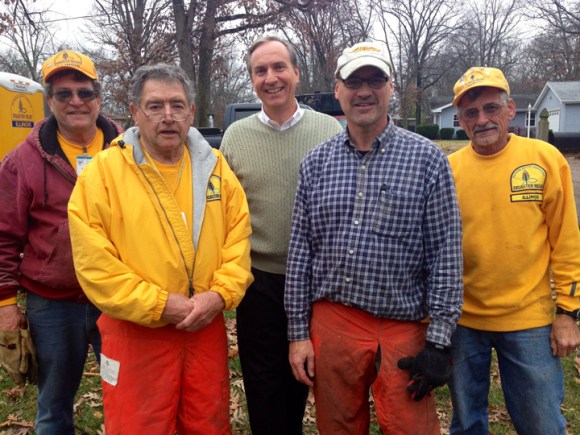
The Disaster Relief team from Sullivan Southern Baptist Church, with Nate Adams (center).

The Disaster Relief team from Sullivan Southern Baptist Church, with Nate Adams (center).

Kitchen volunteers starting preparing meals Monday evening, working out of Woodland Baptist in Peoria. The church has graciously rearranged schedules and plans to accommodate the storm response teams.

Kitchen volunteers starting preparing meals Monday evening, working out of Woodland Baptist in Peoria. The church has graciously rearranged schedules and plans to accommodate the storm response teams, said IBSA’s Mark Emerson.

Adams visits with Linda Blough, a Disaster Relief volunteer from Dayton Avenue Baptist in Peoria.

Adams visits with Linda Blough, a Disaster Relief volunteer from Dayton Avenue Baptist in Peoria.

Washington, Ill. | Joshua Monda stood just outside his church Sunday morning, watching a powerful tornado churn on the horizon a half a mile away. He shot video with his cell phone before calling the few other church members standing outside to get inside. Sirens sound just as the video ends.

Twenty-four hours later, Monda stands in a WalMart parking lot in a part of Washington not blocked by police and first responders. Pastor Monda made it to First Baptist Church briefly that morning, but his office is on the move as he tries to meet immediate needs in the aftermath of an EF-4 tornado that flattened parts of Washington. Several other communities all over the state suffered fatalities and severe damage from tornadoes on November 17.

A chainsaw team from Sullivan Southern Baptist Church was in Washington two days after the storm, and others are on standby to help as needs become clear. Disaster Relief volunteers set up a feeding trailer at Woodland Baptist Church in Peoria, preparing more than 1,000 lunches and dinners for responders and residents in Washington.

Volunteers also moved quickly into several other communities affected by the swath of severe weather that wreaked havoc all over the Midwest, doing its worst in Illinois. Pekin and other Peoria-area communities reported damage, as did Diamond and Coal City, 100 miles to the northeast. In New Minden, seven miles north of Nashville, Ill., officials reported two storm-related deaths.

In extreme southern Illinois, First Baptist Church in Metropolis served as a Red Cross shelter for families who lost their homes in tiny Brookport, where an EF-3 tornado killed three people. Church members cooked 300 meals a day for victims and relief workers.

Chainsaw teams also began working in the Brookport and New Minden areas last week. “I am so grateful for our volunteers who have taken the time to prepare to respond during a disaster,” said Rex Alexander, IBSA’s Disaster Relief coordinator. “When a disaster strikes there are many people with good hearts that want to help. But we primarily rely on those who have been trained to help.”

For more tornado recovery news, follow IBSA at Facebook.com/IllinoisBaptist, and look for a full report in the November 25 Illinois Baptist, online Friday here.