Archives For November 30, 1999

Personal belief, salvation, spiritual disciplines, formation

With echoes of banjoes and a recent chorus ringing in their ears, messengers left the 109th Annual Meeting of the Illinois Baptist State Association with fresh words for prayer:

Heal our streets and land,

Show your mighty hand;

win this nation back…

Build Your kingdom here!*

With that seminal statement comes fresh focus on evangelism.

In the Wednesday evening session, messengers were invited to commit to gospel outreach in their own mission fields by placing a pinpoint on a giant map of Illinois and investing in one or more of five commitments for kingdom growth. (The “commitments” are detailed HERE, and will be featured in the Nov. 23 issue of the Illinois Baptist newspaper and in Nate Adams’ column online next week.)

“Unhealthy churches are filled with people who know about God, but they don’t know God,” IBSA President Odis Weaver said in his address concluding the first business session. “If the Kingdom of God is going to advance in Illinois, or anywhere, we’ve got to move beyond knowing about God to knowing God, and living that.”

Weaver, pastor of First Baptist Church of Plainfield, urged church leaders to repent complacency and bolster their courage. “We have too often allowed our churches to become merely places of comfort and rest, rather than being fortresses against the darkness,” he said.

2015-2016 IBSA Officers

IBSA Officers for 2015-2016 were elected witout opposition at the meeting in Marion. Pictured (l to r) President Kevin Carrothers, pastor of Rochester FBC; Vice President Adron Robinson, pastor of Hillcrest Baptist Church in Country Club Hills; Assistant Recording Secretary Teresa Ebert of Temple Baptist Church in Canton; and Recording Secretary Patty Hulskotter of Living Faith Baptist Church in Sherman.


Weaver completed his second one-year term as president and was succeeded by vice president Kevin Carrothers, pastor of Rochester FBC. Adron Robinson, pastor of Hillcrest Baptist Church in Country Club Hills was elected vice president.

State of the State

In his report, Executive Director Nate Adams explained that IBSA has narrowed its focus from 12 goals to 4 over a two-year period: develop leaders, inspire cooperation, stimulate church health and growth, and catalyze evangelistic church planting and missions. “We are seeking to focus less on goals that simply measure IBSA staff activities and more on goals that indicate true, positive results in churches, Adams said. He charted positive results in most areas, and noted in particular that new church plants are up from 10 to 22 or more by year’s end. Of concern is last year’s report that baptisms are down from around 5,000 to 4,500. The current totals are not yet available from the 2014-2015 Annual Church Profiles submitted by IBSA-member congregations, but the previous figures are driving the focus on church commitments that produce baptisms.

Messengers approved a 2016 budget with an anticipated Cooperative Program commitment of $6.3 million. The ratio for distributing CP dollars remains at 56.75% for work in Illinois and 43.25% forwarded to the national SBC for international and North American missions.

William Towne, finance director of the SBC Executive Committee reported that 107 IBSA churches had taken the “1% Challenge,” raising their Cooperative Program giving by an additional one-percent of their undesignated offerings, and that 15 of those churches had done so for a second year in a row. While CP giving is down about one-percent year-to-date in Illinois, nationally the trend appears to have turned and CP giving is notching upward.

Messengers received reports from the Baptist Foundation of Illinois (BFI) and the Baptist Children’s Home and Family Services (BCHFS). They also adopted five resolutions, including two addressing current culture and religious liberty.

In addition, an offering of $2799.36, was designated to assist International Mission Board personnel returning from the field due to IMB’s staff reduction.

Strong words

The 109th Annual Meeting coincided with the 150th anniversary of the host church, First Baptist of Marion. The church’s pastor, Bob Dickerson, brought the annual meeting sermon. “Reaping a harvest almost never happens on the same day as sowing the seed,” he said, pointing to the problem of weariness.

Citing Galatians 6:9, Dickerson urged tired workers to seek new strength. “There are times when not getting weary is very difficult,” he said “But we need to keep planting good seeds… even if the harvest takes longer than expected, we have a promise here that in God’s perfect time we shall reap!

The 2016 IBSA Annual Meeting will be Nov. 2-3 at Broadview Missionary Baptist Church in metro Chicago. Adron Robinson, pastor of Hillcrest Baptist Church in Country Club Hills, will preach the sermon.

* Theme song for the meeting was “Build Your Kingdom Here” by Rend Collective, © 2011, Thankyou Music

– Team report by Illinois Baptist staff

Is preaching passe?

Meredith Flynn —  August 6, 2015

COMMENTARY | Nathan Carter

Nathan_Carter_August4In his little book, “The Priority of Preaching,” Christopher Ash writes what every pastor has thought at some point.

“Is it really helping when we spend so much of our week laboring at the Word of God, preparing to preach it to the churches we serve…Is it worth slogging away preparing Sunday’s sermon with such a world of need outside?”

Maybe you are a pastor and you have doubted whether your preaching is really doing anything. Maybe you are a church member who sometimes falls asleep during sermons and you wonder if there is a better way of connecting with today’s postmodern culture. Is preaching a thing of the past?

We are far from the Puritan days when one minister apologized to his congregation for preaching a two-hour sermon and they all replied, “For God’s sake sir go on, go on!” During the era of the Baby Boomers, preaching in many churches became a casual talk on how biblical principles can address felt needs, bolstered by the use of multimedia technology.

Many Gen Xers and Millennials are now looking for new expressions of church, and the very idea of preaching is being re-imagined. Wouldn’t it be more authentic to have a dialogue about the Bible where everyone could share his or her own experiences and insights?

I define preaching as one-directional, verbal proclamation of God’s Word culminating in the gospel. And I still maintain that this is an absolutely essential practice for the church. Why? For one, we see it happening all over the Bible (i.e. Acts 10:33-44). That’s descriptive, not necessarily prescriptive, you might say. Well, it is also expressly commanded elsewhere (i.e. 2 Tim. 4:2).

But couldn’t the intent behind “preach the word” be fulfilled in other ways than one person talking at other people for an extended time? I certainly believe there are several different legitimate styles of preaching. But the method of preaching is critical.

We need times when we bite our tongues as we are confronted by the authority of God’s Word. In an age of relativism and rebellion against authority, it makes sense why we don’t want to sit under preaching. We don’t want doctors; we’d rather self-diagnose. The idea of a wiki-sermon that we all have a hand in constructing is much more appealing. But our great need is to hear, “Thus saith the Lord,” and let his external word rebuke us, call us to repent, make us ready to receive the message of the gospel, and then respond in faith and obedience.

Hearing a declaration of something that has happened, something to which you can’t contribute a thing but must respond to with either belief or disbelief, best comports with the gospel. Since there is a constant need to have the double-edged sword of God’s Word pierce our souls to expose our sinful hearts and then graciously present Christ to us in all his resplendent glory so that we can trust in him as our righteousness and healer, preaching will always be indispensable.

There is a place for small group discussions and seminars and life-on-life mentoring. But preaching is an essential element of the life and health of a church. The practice of preaching can be abused (when it becomes a chance to express one’s own ideas instead of expound a text), but that shouldn’t cause us to avoid its proper use. Some preachers are more gifted than others, but the mark of a mature believer is to be easily edified as long as the Word of God is being preached.

Charles Spurgeon said, “I do not look for any other means of converting men beyond the simple preaching of the gospel and the opening of men’s ears to hear it. The moment the Church of God shall despise the pulpit, God will despise her. It has been through the ministry that the Lord has always been pleased to revive and bless His Churches.”

May he do it again today!

Nathan Carter is pastor of Immanuel Baptist Church in Chicago.

THE BRIEFING | Meredith Flynn

Baptists will hear from two presidential hopefuls at next week’s SEND North America Conference in Nashville, Tenn. Russell Moore, president of the Ethics and Religious Liberty Commission, will interview former Florida Governor Jeb Bush Aug. 4. The conference also will include a pre-recorded interview with Florida Sen. Marco Rubio.

The_Briefing“Evangelicals are looking for leaders who not only understand their convictions about human dignity and family stability but have plans to address them,” Moore said in a press release, “and this event will provide the opportunity for precisely this kind of discussion with some of the leading presidential candidates, and I am greatly looking forward to it.”

The SEND Conference, which is hosted by the North American and International Mission Boards, is expected to see 13,000 attenders.

In its press release, the ERLC said the leading candidates from each major party were invited to participate, including Democratic frontrunner Hillary Clinton, Moore said in a July 22 blog post. The Aug. 4 conversations will be the first in a series of discussions with candidates, Moore added.


Pakistani woman’s execution temporarily stayed pending court review
The Pakistani Supreme Court said July 22 they will review the case of Aasiya Noreen, known in media reports as Asia Bibi. The mother of two (and stepmother of three other children) was sentenced to death in 2010 for allegedly making derogatory comments about Muhammad. Read the full story from Morning Star News via Baptist Press.


San Diego’s landmark cross will stay
A veterans memorial in San Diego has been sold to a private group, effectively ending years of legal battles over its constitutionality. The Mt. Soledad Veterans Memorial, which includes a 43-foot cross, was purchased from the U.S. Defense Department by the Mt. Soledad Memorial Association for slightly less than $1.4 million, The Christian Post reports. The group hopes to turn it into a tourist destination on par with the San Diego Zoo.


GuideStone appeals to Supreme Court
GuideStone Financial Resources has filed an appeal with the U.S. Supreme Court against a health care mandate that would require some companies it works with to provide abortion-inducing drugs. GuideStone, a Southern Baptist entity, and the churches it represents are exempt from the mandate, Baptist Press reports. But some other religious employers are at risk, they contend, even as the federal government argues it offers an accommodation for them.


Kenyan mall reopens almost two years after terrorist attack
Westgate Shopping Mall in Nairobi reopened July 18, 22 months after extremist group al-Shabab staged a multi-day attack that killed 67 people and wounded 175. Katherine Walton, an International Mission Board “missionary kid” now living in Kenya with her own family, was in the mall with her children during the attack, Baptist Press reports.

“It has been and still is a difficult journey in recovery. The children have all dealt with their own issues, but on the whole have done remarkably well,” she told BP. “God has been really good to us, and we keep moving forward, learning more about ourselves and about God during recovery.”

HEARTLAND | Nate Adams

Many Illinois Baptists know by now that Melissa Phillips, who was Associate Executive Director of IBSA’s Church Cooperation (Business) Team, went home to be with the Lord on July 2, almost a year after her initial cancer diagnosis.

Melissa was strong and determined, and she managed her initial months of chemo and radiation treatments so amazingly well that we all grew optimistic. And of course we were praying, diligently and daily (often wearing “Team Melissa” buttons). So her rapid health decline in June and then her passing have seemed sudden, especially to those who only saw her occasionally. For those of you just joining us in that grief, I am truly sorry for your loss, too.

Nate_Adams_July20Near the end of the movie, “The Last Samurai,” Tom Cruise’s character, Nathan Algren, travels to Tokyo to present the emperor with the sword of Samurai Lord Katsoumoto, who has just heroically given his life in battle. Somberly, the emperor says to Captain Algren, “Tell me how he died.” And with great respect and tear-filled eyes, Algren instead replies, “I will tell you how he lived.”

So let me write just a few words here about how Melissa Phillips lived. Melissa was one of the most loving, serving, capable professionals I have ever known. She was intelligent, intuitive, poised and articulate. I trusted her completely, and she brought the highest integrity and work ethic to every decision she made and every task she performed. She was often the first person at her desk in the morning, and the last to leave at night.

Melissa was 18 when she started at IBSA. It was just a few days after graduating from high school, and marrying her sweetheart Doug. As I said during her funeral service, in her 35 years at IBSA she not only trained a husband and two daughters, she trained six different executive directors. I am privileged to have been the most recent, and now the last.

Melissa was a reluctant executive, preferring to serve others and work behind the scenes for the good of IBSA, its churches and leaders. Yet she led well, and was strong and decisive when she needed to be, or when I needed her to be. Her moral compass and her wisdom were rooted deeply in her relationship to Jesus Christ and her understanding of God’s Word and his ways.

A few years ago, our son Caleb and Melissa’s daughter Laura got reacquainted at the annual IBSA family picnic. Talking led
to writing, and writing led to visits, and then a courtship led to marriage. So while Melissa has now gone on to be with the Lord, our families continue to be lovingly intertwined. And so in addition to all she gave me personally as a friend and staff member, through God’s providence she and Doug also gave us a daughter, one who seems to me to grow more like her mother every day.

As I watched hundreds of people patiently file through during the funeral visitation, and then pack every square foot of Springfield Southern Baptist Church for Melissa’s home-going service the next day, it became evident to me how many people loved and respected Melissa. The sentiment many expressed could be summed up by the question, “How can we go
on without her?”

This of course is the question Jesus’ disciples were asking themselves after his seemingly sudden death. Yet because Jesus then conquered death, and because he sent his Spirit to be present with us, and help us continue his example and his mission to the world, we find joy and purpose in moving forward, longing eagerly to see him again. How like Melissa to follow Jesus’ example, and leave those of us who loved and depended on her so much with that same wonderful assurance and hope.

Nate Adams is executive director of the Illinois Baptist State Association.

COMMENTARY | Charles Lyons

Floyd and Rad certainly stood out when they showed up in our tiny congregation. I had been pastoring a couple years. Obviously not from around here, they did seem familiar with church. Conversation revealed they were both from Arkansas; one from a Baptist church, the other from an Assembly of God church. Maybe they were 20 years old. My guess is they met in high school.

Charles_Lyons_July16They, like thousands before them, had fled home and familiarity for faraway, big-city anonymity. I’m not sure why, but they didn’t hide their homosexuality from me. I’ll never forget the anguished question during one tearful conversation with Floyd:
“How can this be wrong?” He was overwhelmed with need, emotion, passion, and counterfeit love.

I have to say, getting to know them as individuals radically changed my rabid hostility toward those I before would have called “perverts.” I didn’t change what I believed. My conviction that God’s Word is true was not threatened. But I had an overwhelming desire to be a channel of grace and, as John puts it, “love in truth.”

It was God’s truth and love by God’s definition that eventually contributed to Floyd and Rad drifting away from the church,
looking for something else I could not offer.

Let me tell you! I’m as opinionated a person as you’ll ever meet. Furthermore, I am able to passionately, hey, vehemently
articulate my views. I’m especially dogmatic and emphatic when it comes to behavior I don’t engage in, and I can really preach against that stuff!

Many of us have gone through a process to get where we are today. We used to regularly rant against “easy targets” like communists and hippies, and these days those targets have been replaced by homosexuals, transgender, and “gay marriage” (as if there really were such a thing). And some continue to rant rather than to take a Bible approach.

Should we ignore these things or begin to accept them? Of course not, but we need to confront them biblically. After all, we
are not just guarding our culture or doing battle with sinners. We are representing God and his grace as well as his warning.

Jesus’ harshest condemnations target self-righteous religious zealots. His greatest compassion is expressed to those most
ignorant of, rebellious toward, or distant from God. He said, “I didn’t come to call the righteous but sinners to repentance.”

It goes without saying, those who are determined to pursue any kind of sin are not going to be comfortable or in close fellowship in a Bible-preaching church.

That said, there is a whole slice of “sinnerdom,” and for sure some wrestling with same-sex attraction, who would seek help
from people they knew loved them. Is that not the spirit of Jesus?

How do we communicate God’s love?

How do we communicate God’s love to those who are out of bounds in any way, shape, or form? Think over-indulgence. Adultery. Consider any form of destructive behavior. What about unnecessarily angry people?

How do we express God’s love to those who are way, way out of bounds?

Is God’s love unconditional? Is the love I live, preach, teach, and lead our congregation to demonstrate just as unconditional?

Should the church be the last place these out-of-bounds think of for seeking help?

Do the kids attending our churches know these are safe places to bare their souls and share their secrets?

Understand me. There is always someone reading between the lines looking for compromise if not sellout, and I am not advocating in any way changing or messing with what God says about any particular sin. I am saying our churches need to be havens of hope, dispensaries of love and deliverance, places of grace.

The rebels and unrepentants will cast themselves into an eternity without God… but they should go with the knowledge that we loved them. Those willing to believe God’s promises, trusting him for rescue, and willing to fight the flesh in fellowship with God’s people should never wonder if they have a home.

Charles Lyons pastors Armitage Baptist Church in Chicago.

The_Briefing

THE BRIEFING | Meredith Flynn

While 62% of American adults believed nationwide legalization of same-sex marriage was inevitable, slightly less than half (49%) are in favor of the U.S. Supreme Court’s June 26 decision in favor of it, Barna reports. 43% disagreed with the decision, and 7% were unsure how they felt about it, according to the researcher’s July 1 report.

When it comes to how Christians feel about the Court’s decision, Barna found, 28% of practicing Christians (defined as “those who say their faith is very important to their life and who have attended one or more church services during the past month”) approve of legalized same-sex marriage, compared to 43% of people who identify as Christians but don’t qualify as practicing.

Only 2% of evangelicals support the Court’s decision. Read the rest of Barna’s report at Barna.org.


U.S. Episcopal Church votes to approve same-sex marriage
Right after the Supreme Court made it legal nationwide, the U.S. Episcopal Church moved to approve same-sex marriage in the denomination, The Christian Post reports. Episcopal clergy are now authorized to perform same-sex marriages, but can opt out, according to two marriage-related resolutions passed in late June at the denomination’s General Convention.

The resolutions were opposed by 20 bishops who issued a minority report stating, “The nature, purpose, and meaning of marriage are linked to the relationship of man and woman,” and by Archbishop of Canterbury Justin Welby, who said the decision “will cause distress for some and have ramifications for the Anglican Communion as a whole, as well as for its ecumenical and interfaith relationships.”


Church violence survivors share in Charleston grief
After nine people were killed in a South Carolina church last month, Southern Baptists who have experienced similar tragedies expressed their sympathy and grief over the June 17 shooting.

“I don’t know if you ever recover from something like that,” said Cindy Winters, whose husband, Fred, was killed in his Maryville, Ill., pulpit in 2009. “I think you learn how to get through it, but I don’t think you ever get over it this side of eternity,” Winters told Baptist Press. “I know one day I will when I’m with Jesus. Obviously only by the grace of God am I able to get up each day and go forward, and find beauty and meaning…and find goodness in living.”


Burned churches receive assistance from Baptist missions agency
African American churches in need of assistance after a recent spate of church fires can receive help from a fund established by the North American Mission Board, the domestic missions agency of the Southern Baptist Convention. “Southern Baptists should be the first to condemn acts of hatred toward African Americans,” NAMB President Kevin Ezell said, according to Baptist Press. “Regardless of the causes of these fires, as brothers and sisters in Christ, we need to come alongside and offer whatever assistance we can.”

None of the fires have been deemed hate crimes, and only some are suspected arsons. However, one confirmed arson case is Charlotte’s Briar Creek Road Baptist, a predominantly black Southern Baptist church.


Barnabas Piper: Parents, ‘Don’t fight unbelief in your kids’
“At least don’t think of it as fighting,” Piper said in an interview about his new book “Help My Unbelief.” “Belief, ultimately, is a miracle, death made life by the Holy Spirit. The Spirit can work in myriad ways, and questioning is a significant one,” Piper, son of preacher and author John Piper, told Ed Stetzer.

“As parents our job is to declare and display the work of the Spirit, our relationship with God, so that children can see where the answers to those questions truly lie. Don’t argue; answer. Don’t fight; exemplify. Don’t give up; pray.”

IBSA Executive Director Nate Adams (left) interviews former Atlanta Fire Chief Kelvin Cochran at the Southern Baptist Convention in Columbus.

IBSA Executive Director Nate Adams (left) interviews former Atlanta Fire Chief Kelvin Cochran at the 2015 Southern Baptist Convention.

Columbus, Ohio | Lisa Sergent

I’ve been reflecting on the 2015 Southern Baptist Convention, now that it and Columbus, Ohio, are in my rearview mirror.

The city and the Convention were a study in contrasts. While we were there, the city was issuing proclamations welcoming the LGBT community and celebrating the upcoming Gay Pride Week. The Convention featured panel discussions, sermons and press conferences emphasizing biblical marriage.

An article in the Columbus Dispatch newspaper celebrated that Jim Obergefell, the Cincinnati man at the center of the Supreme Court case Obergefell v. Hodges, was in Columbus to lead the gay pride parade the Saturday following the convention. Meanwhile, discussions at the Convention expressed concern that the case, which could cause the legalization of same-sex marriage in all 50 states, will lead to further encroachment on religious freedoms in the U.S.

That concern is very real.

Former Atlanta Fire Chief Kelvin Cochran spoke at the SBC Pastors’ Conference held just prior to the Convention. Cochran was fired from his position for stating on one page of his 160-page book, “Who Told You That You Were Naked?” that homosexuality is sinful.

Barronelle Stutzman, the Washington state florist who was sued for not providing flowers for a same-sex wedding, made an appearance during the Ethics and Religious Liberty Commission’s report. She lost her case and is in danger of losing her home and business. After ERLC President Russell Moore shared her story, she came to the stage for prayer.

As International Mission Board President David Platt noted at the Pastors’ Conference, “There is no question we live in a culture increasingly hostile to Christ. We cannot pick and choose what issues we will preach and which issues we will ignore.”

In his report, Moore said, “For most of this last century Southern Baptists have been comfortable in the culture in their soft cocoon…Some said that the Southern Baptist Zion was below the Mason-Dixon Line. Those days are gone and not a moment too soon; those days are over thankfully.”

Much of the time devoted to discussing issues affecting our SBC churches was made possible by a new Convention schedule and format. Much of the business took place on Tuesday afternoon, which allowed time for the Wednesday afternoon panel discussion on the Supreme Court and same-sex marriage.

One of my favorite parts of the Convention has always been the SBC Pastors’ Conference which precedes it. But this year, with SBC President Ronnie Floyd and others following God’s leading, the Convention itself was a must see and hear. The best was yet to come.

I think the same is true for the Southern Baptists and evangelicals. While I do believe our freedom of speech and right to freely practice our religion are going be infringed upon to an even greater extent, I do know God will honor those who stand firm and follow His Word. For this we shall grow closer to Him and find strength. And that is truly the best to come.

Lisa Sergent is contributing editor of the Illinois Baptist newspaper and director of communications for the Illinois Baptist State Association.

Columbus, Ohio | Meredith Flynn

The most personal testimony shared publicly during the 2015 Southern Baptist Convention in Columbus, Ohio, came from a source most Baptists probably had never heard of prior to the meeting.

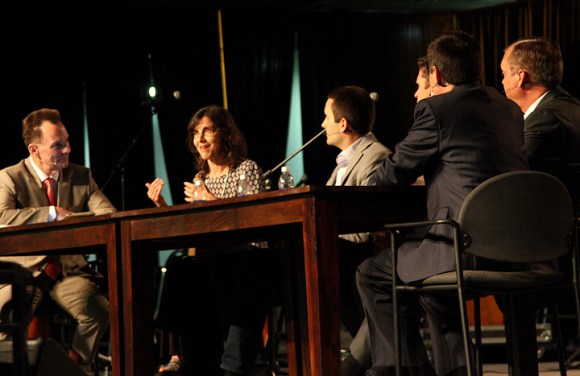
Rosaria Butterfield (second from left) was part of a panel discussion on same-sex marriage at the 2015 Southern Baptist Convention.

Rosaria Butterfield participated in a panel discussion Wednesday afternoon with some very familiar faces—men that have been instrumental in calling Baptists to a deeper reliance on the gospel when it comes to understanding how it intersects with cultural issues.

When it was her turn to speak, she delivered the truth, plain and simple:

“I often tell people I was not converted out of homosexuality,” said Butterfield, a former lesbian. “I was converted out of unbelief. And then the Lord started working on some other stuff.”

One reporter in the press room later commented they were glad Butterfield had been in Columbus, so that more people could hear her story. Her past and, in a different way, her present—her husband pastors a Reformed Presbyterian Church—set her apart from her audience in Columbus. But as she nodded encouragingly as the other panelists talked, and when she delivered the short version of her testimony with an almost-constant smile, the value of hearing from a new voice at the Southern Baptist Convention was clear.

As a professor at Syracuse University, Butterfield said she had finished the book she needed to write to achieve tenure and turned her attention to what she really wanted to write: “a critique of the religious right from a lesbian feminist point of view.”

In the process, she met a Christian pastor and his wife who invited her into their home (and visited hers) and truly befriended her. At first, “I thought I simply got free research assistants,” Butterfield told the audience in Columbus.

But after two years and reading through the Bible seven times, she said, “The Bible simply got to be bigger inside me than I. And one of the things that I realized was that I wanted Jesus.”

Butterfield’s fascinating testimony, detailed in her book “The Secret Thoughts of an Unlikely Convert: An English Professor’s Journey Into Christian Faith,” stands alone as encouragement to churches trying to reach out to their neighbors with genuine love and the truth of the gospel.

But it was what she said later in the discussion that could prove to be most helpful. In just a few minutes, Butterfield laid out a prescription for how the church can minister compassionately to the LGBT community:

Make your Christian community an accessible community. That means giving up ownership of our time, Butterfield said, and also gaining a more “collective” understanding of sin.

She quoted 1 Corinthians 10:13, about God providing a way of escape from temptation. “What if your home is the way of escape?” she asked.

Share “the means of grace” in a public way. How can Christians make repentance more known (and understood) among their neighbors?

Get to know the Bible—better than we do now. Time with the Lord is “a public community service,” Butterfield said. It’s how Christians get ready to speak a word of truth.

“Don’t deny the power of the gospel to change lives and to travel at the grassroots level,” Butterfield said near the end of the conversation. “Your friendships matter.”

For those listening to her story in Columbus, the power of the gospel was undeniable.

Watch the panel discussion, held during the Wednesday afternoon session of the Southern Baptist Convention, at http://live.sbc.net.s3-website-us-east-1.amazonaws.com/ondemand.html.

The_BriefingTHE BRIEFING |  The murder of nine people at a Charleston, S.C., church prayer meeting “should shock the conscience of every person,” a group of Southern Baptist leaders said in a joint statement after the June 17 shooting.

“There is hardly a more vivid picture of unmasked evil than the murder of those in prayer,” said Ronnie Floyd, president of the Southern Baptist Convention; Russell Moore, president of the Ethics and Religious Liberty Commission; K. Marshall Williams, president of the SBC National African American Fellowship; and A.B. Vines, NAAF’s immediate past president.

Dylann Roof, 21, sat through the Wednesday evening prayer meeting at Emanuel AME Church in Charleston, and then opened fire in what police have called a hate crime, Baptist Press reports.

“This act of bloodshed is wicked and more than wicked,” the leaders’ statement continues. “It is literally satanic, as our Lord taught us that the devil is a ‘murderer from the beginning’ (John 8:44).”

Read the full story at BPNews.net.


InterVarsity welcome again at Cal State campuses
Christianity Today reports that after being “derecognized” on all 23 campuses of the California State University system, InterVarsity is back in business as a recognized student organization. InterVarsity’s leadership policy, which requires that leaders affirm Christian doctrines, was previously found to be in conflict with a Cal State rule that requires recognized student groups to accept all students as potential leaders.

“Cal State has not changed the language of their ‘all comers’ policy,” InterVarsity’s Greg Jao told CT. “They have clarified that the policy only requires that (a) we allow all students to become members, which we have always done, and (b) we allow all students to apply for leadership positions.”


Southern Baptist ethics entity will open office in the Middle East
The Ethics and Religious Liberty Commission of the Southern Baptist Convention announced last week it will open a Mideast office for international religious freedom. “We must contend for religious freedom for our brothers and sisters in Christ and for everyone else wherever they are on the globe,” ERLC President Russell Moore said at the 2015 Southern Baptist Convention in Columbus, Ohio, according to reporting by Baptist Press. “We will not stand idly by while those with whom we will share eternity are being led to the slaughter.”


How can Christians pray for Muslims during Ramadan?
Former International Mission Board president Jerry Rankin encourages Christians to use the traditional Muslim month of fasting and prayer (which begins this Thursday) to pray for spiritual awakening among Muslims. “Rather than hardening our hearts and dismissing their lostness to the judgment of God as something they deserve,” Rankin writes for ChristianityToday.com, “we should plead for their hearts to be open to God revealing himself.”


‘Inside Out’ puts emotions on the big screen
It’s official: The latest Disney/Pixar movie is a hit (although even it couldn’t defeat the dinosaurs of “Jurassic World” at the box office). In his review of “Inside Out” for PluggedIn.com, Paul Asay writes that the team behind the PG-rated film are communicating “a message that feels truly countercultural: Happiness isn’t everything.”

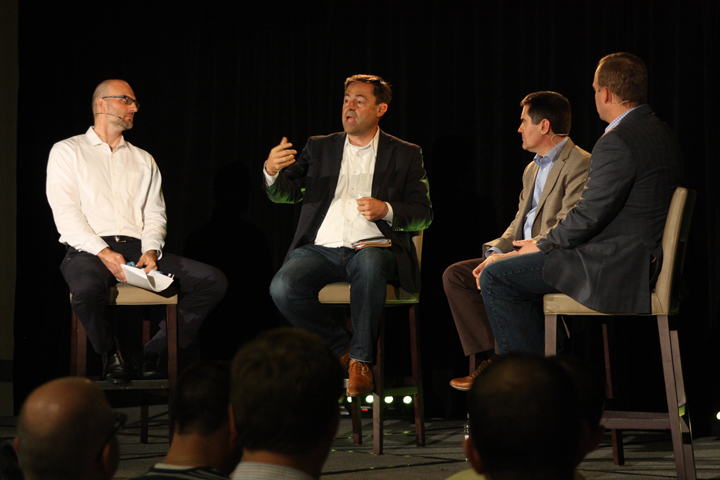
Mark Dever and Russell Moore (center) answered questions from 9Marks' Jonathan Leeman (left) and Phillip Bethancourt of the Ethics and Religious Liberty Commission (right).

Mark Dever and Russell Moore (center) answered questions from 9Marks’ Jonathan Leeman (left) and Phillip Bethancourt of the Ethics and Religious Liberty Commission (right).

Columbus | The culture has changed and is continuing to change–there’s no mistaking it. But Christians don’t have to live in fear, leaders said Monday night at a post-Pastors’ Conference gathering.

When asked what he would tell churches in the face of sweeping cultural change, Ethics and Religious Liberty Commission President Russell Moore quoted Luke 12:32: “Fear not, little flock, for it is the Father’s good pleasure to give you the Kingdom.”

“The main thing that I would say,” Moore said at the meeting hosted by the 9Marks ministry, “is let us be joyful, hopeful, convictional people who are not panicked, who are not distressed, and who are not tossed about by the wind.”

Moore echoed his Sunday evening Pastors’ Conference message, when he referred to the argument some have made about Christians being on the wrong side of history when it comes to cultural change.

“Brothers and sisters, we started on the wrong side of history. The right side of history was the Roman Empire. The wrong side of the history was a Roman cross. And the Roman Empire is dead, and Jesus is feeling fine.”

At the 9Marks meeting, Moore and Mark Dever, pastor of Capitol Hill Baptist Church in Washington, D.C., fielded questions submitted by the audience. The questions on current social issues covered a variety of topics, including homosexuality, transgenderism, and race. Dever, who also serves as president of 9Marks, urged pastors to pray with their congregations about pressing issues, and not just 3-minute prayers during transitions in the worship services. One of the main sources for his pastoral prayers, Dever said, is The Washington Post.

“…You need to pray for five or ten minutes; I mean, give some thought to your prayer.” When the Westminster Assembly of the 1640s would hold a day of prayer, they would pray as long as they would preach, Dever said. An hour-long sermon, followed by an hour-long prayer. “And the pastors would prepare their prayers every bit as much as they would work on preparing their sermons.”

Nearly 400 years later, maybe that’s an idea worth revisiting.