Archives For November 30, 1999

Personal belief, salvation, spiritual disciplines, formation

We all matter to God

As Americans we look forward to summer with excitement and nostalgia for summers’ past. For many, the summer of 2016 will be one they’ll most likely want to forget.

So far we’ve seen multiple terrorist attacks overseas and even in our own country, with the killing of 49 Americans in Orlando, FL in June. In the most recent attack in Nice, France, at least three Americans, including a father and son, were among the 84 people killed.

Our own country is also being torn apart from within by racial strife. The killings of two black men, one in Baton Rouge, LA, the other near Minneapolis, MN, by police. In seeming retaliation, five police officers were assassinated in Dallas, TX, followed just more than a week later, by the assassinations of three officers in Baton Rouge.

One of the Baton Rouge officers slain was Montrell Jackson, a 32-year-old who had been married only a few years and recently become a father. Jackson was also black.

The Washington Post reported his sister, Joycelyn Jackson, learned of her younger brother’s death while sitting in a Sunday worship service at her church. According to the Post, “She understands the anger behind the movement Black Lives Matter but that ‘God gives nobody the right to kill and take another person’s life…It’s coming to the point where no lives matter whether you’re black or white or Hispanic or whatever.’”

Jackson is expressing what many feel. As a society we argue over the semantics of whose lives matter, while the killing continues. It should hardly be a surprise that life has so little value in a culture where more than 56 million infants have been aborted since the U.S. Supreme Court legalized abortion in 1973. Earlier this month, the Supreme Court struck down a Texas law that tightened abortion clinic standards. The ruling, which made access to abortion clinics in that state and others with similar laws even easier, was celebrated by many Americans.

As summer temperatures heat up, so are tensions. A spirit of evil and chaos seems to have taken hold. But we need not despair, God is with us and he is merciful and just.

Joycelyn Jackson knows this and so should we.  When the Post asked Jackson what she would say to her brother’s killer or anyone considering violence, she replied, “If I could say anything to anyone, it is to get their lives right with God. Hell is a horrible, horrible place to be.”

– LMS

I did not grow up a Southern Baptist. In fact, I only stumbled into the denomination 12 years ago. But every year I become happier and happier to be associated with this great tradition and organization. And this year’s Southern Baptist Convention in St. Louis made me more pleased than ever before to be a Baptist.

Maybe I am set up for future disappointment. I hear that these meetings are not always as eventful. This year, attendance was up. Emotions were high. We gathered in the immediate wake of the mass shooting in Orlando, the worst in our country’s history. We remembered the tragic shooting in Charleston one year earlier and acknowledged the racially charged atmosphere reflected in nearby Ferguson. “Election” also loomed large. The theological understanding of the term was a subtext for the hotly contested SBC presidential election. And the upcoming U.S. presidential election was in everyone’s mind.

One of the most memorable moments for me, though, came amid a flurry a motions presented to convention messengers. One brother from Arkansas had requested the removal of Southern Baptist officials or officers who support a right for Muslims in America to build mosques. The next day, after the Ethics & Religious Liberty Commission’s report, the same brother pressed ERLC President Russell Moore on the issue, likening the defense of the right to construct mosques to Jesus endorsing the erection of temples for Baal in ancient Israel.

As our culture unravels, we must remember our hope is in Christ, not country.

Dr. Moore’s response was sharp and received by the majority of messengers with applause. “The answer to Islam is not government power,” he said. “The answer is the gospel of Jesus Christ and the new birth that comes from that.”

In defending the idea of soul freedom for every individual, he illuminated a critical theological concept that lies at the heart of being Baptist. I am referring to religious liberty—the belief that no religion should be established by the state, but all faiths should be free to win adherents through the power of persuasion and not the sword.

In our history, Baptists have been persecuted by the government for non-conformity. We have seen the damage done by state churches to true religion. We do not baptize babies, in part, because we believe you cannot be born a Christian. Everyone must be genuinely converted without coercion. This should compel us to a radical witness to our Muslim neighbors and refugees, not to seek political action against them.

Recently there was a debate between a Christian and an atheist at the university near our church. It was sponsored by an evangelical campus ministry. To get there, you took the escalators to the third floor and turned left to find a small room with perhaps 100 mostly Anglo attenders. That same night, in the large room to the right of the escalators, there was a banquet for Islam Awareness Week with hundreds of Muslims from places like the Middle East and South Asia.

The lesson is this: We can wring our hands at the growing influence of Islam in the U.S., or we can get to work witnessing in new ways. Now is not the time for fear, but for bold faith.

In the New Testament era, the church is an altogether different institution than the state, with distinct ends and means. The two cannot be confused. So today, the proper analog to Baal altars in Israel is not Islamic Centers in Wheaton. It is idolatry in the corporate worship of the Church.

Patriotism definitely has its place, but perhaps one appropriate application would be to examine whether nationalism has crept into our Christianity. There are many forms of syncretism. As former SBC President James Merritt eloquently said in favor of a resolution to cease display of the Confederate battle flag, “Southern Baptists are not a people of any flag. We march under the banner of the cross of Jesus and the grace of God.”

As our culture continues to unravel and even the Bible Belt unbuckles, we must remember that our hope is in Christ, not country. His kingdom is unshakeable. And in many ways the dismantling of cultural Christianity that fused God and country is a good thing for the cause of the gospel. We Baptists want real believers that worship Christ alone, even if they are persecuted by a secular state or Islamic State.

– Nathan Carter is pastor of Immanuel Baptist Church in Chicago.

The BriefingTransgender troop ban repeal called ‘disastrous’
The Obama administration’s decision to allow openly transgender people to serve in the U.S. military has been classified by Southern Baptist leaders as “deluded,” “disastrous” and a step toward self-inflicted “national weakness.” Mark Coppenger, a former Illinois pastor and retired Army officer, said lifting the ban imperils “decency” and “military readiness.

Justice Alito’s warning about religious freedom
The Court’s decision not to hear a case challenging a Washington state law that forces a family-owned pharmacy to dispense emergency contraceptives is an “ominous sign” for those who value religious freedom, Justice Samuel A. Alito Jr. said. “If this is a sign of how religious liberty claims will be treated in the years ahead, those who value religious freedom have cause for great concern,” Alito said in a critical dissent.

SCOTUS marriage ruling sparked ministry
Numerous Baptist state conventions have helped equip churches for ministry in the new marriage culture. “Our energy is going into making sure churches understand their religious freedoms regarding same-sex marriage assertions, and helping them take steps to protect those liberties through their bylaws and written operating procedures,” said IBSA Executive Director Nate Adams. We have used conferences, articles and especially downloadable resources on our website to make these protections as accessible to churches as possible.”

We’re talking about religion
When it comes to who’s having those religious conversations with family and friends, it’s particularly evangelicals and black Protestants. The majority of evangelicals talked about religion in the last month with their immediate family (70%) and people outside their family (55%). Most black Protestants also had religious conversations with immediate family (61%) and extended family (51%). \

Russian law would prohibit evangelizing
The proposed Russian laws, considered the country’s most restrictive measures in post-Soviet history, place broad limitations on missionary work, including preaching, teaching, and engaging in any activity designed to recruit people into a religious group. To share their faith, citizens must secure a government permit through a registered religious organization, and they cannot evangelize anywhere besides churches and other religious sites. The restrictions even apply to activity in private residences and online.

Sources: Baptist Press, Daily Signal, Baptist Press, Facts and Trends, Christianity Today

Braveheart screengrab via YouTube

Braveheart screen grab via YouTube

The great experiment in democracy is in trouble.

We have only to look at the presidential election to see the truth in that statement. Apparently anyone can become president.

It is hardly believable that same-sex marriage was legalized in the U.S. only one year ago. In the brief time since, the moral ground beneath us has shifted with the force of tectonic plates in quake.

Not since William Wallace painted his face blue and led his native Scotland to a rousing victory over England has the world so needed someone to raise his fist and shout “freedom!”

On Broadway, the most popular show lauds our founding fathers (who, little did we know, were hip-hop artists!). But the freedom today’s culture celebrates is license, not liberty. In a few short decades the nation has abandoned the very principles on which it was founded.
Our founding fathers established this nation with a few basic understandings: individual rights are derived from a Creator and our civil laws are based on “the laws of nature and Nature’s God.” The great experiment in American democracy is also built on the presumption of an educated electorate, culture with a conscience, and society with a solid moral foundation. Tocqueville observed that in a democratic republic, education about the constitution and morality must remain inseparable.

Yes, our founders were sinners: ambitious, schemers, slaveholders, adulterers. But knowing the wickedness of the human heart, they crafted a system they hoped would hold those wills and ills in check. They held high the rights to “life, liberty, and the pursuit of happiness,” and more specifically, the basic freedoms of religion, the press, peaceable assembly, and the redress of grievances against the government.

Good luck with that. We can’t even get the Social Security Administration to answer the phone without a three-month appointment.

Congress is in gridlock, the Supreme Court issues endless rulings irrespective of morality, and the Administration makes edicts that endanger the psychosexual well-being of our children—all in the name of freedom. All in violation of basic common sense.

Not since William Wallace painted his face blue and led his native Scotland to a rousing victory over England has the world so needed someone to raise his fist and shout “freedom!” But it’s not freedom to have our own way that we need. What America needs is a fresh understanding that true freedom is liberty to be and do what God intends. Freedom that truly respects human dignity doesn’t allow people to destroy themselves and the nation by liberty gone wild.

Whom the Son sets free is free indeed.

The rest is just illusion.

– DER

The Briefing3 reasons evangelicals should care about Brexit
Although American evangelicals might think Brexit has little or no significance for them, the opposite is true. It shows we must find a way to mitigate the negative effects of globalization and trade on those who do not benefit. If we do not, we will be pouring gasoline on the fire of populist anger and passing up an evangelical opportunity to love our (populist) neighbor by helping find solutions to his very real problems.

Pew: Christians face more terrorism but less government hostility
From some angles, it looks like the beginning of a hopeful trend among the steady stream of persecution headlines. Both government and societal harassment of religion dropped worldwide in 2014, according to a recently released Pew Research Center study. This is the second year in a row that researchers found such a drop.

Court strikes down abortion provider regulations
In a 5-3 opinion, the Supreme Court ruled portions of a Texas law that regulate abortion doctors and clinics constitute an “undue burden” on a woman’s right to abort her child and are therefore unconstitutional. The high court’s reversal of the Fifth Circuit Court of Appeals in New Orleans invalidated a requirement an abortion clinic must meet the health and safety standards of other walk-in surgical centers.

Obama designates first national monument to gay rights
President Obama on Friday designated the first national monument to the gay rights movement, commemorating the Stonewall uprising in New York City. The site memorializes the six-day uprising that started after police raided the Stonewall Inn, a Mafia-owned bar frequented by gay men.

California’s religious liberty moment—coming to a state near you
Many faith-based universities hold to the traditional Christian view that sex and gender are distinct and united. If SB 1146 is passed without amendment, the state of California would drastically limit the religious freedom of such institutions to believe and live according to these traditional beliefs. In other words, the “free exercise of religion” becomes meaningless or restricted to only those schools that train pastors for ministry.

Sources: BruceAshford.net, Christianity Today, Baptist Press,  Washington Post, Christianity Today

Princesses and Hot Dogs

A lesson in leadership from a bold five-year-old.

A few days ago I saw a brief news story about a dance class for five- and six-year-olds, where the instructor had invited the little girls to wear costumes at their next rehearsal. She dubbed it “Princess Day,” knowing how many of her tiny dancers would enjoy dancing as princesses, and also how many of them already had princess costumes.

What helped the story go viral and hit the headlines, however, was the photo of seven little girls in princess costumes standing with one very unique little girl, dressed in a hot dog costume. Five-year-old Ainsley chose to come to Princess Day not with a tiara on her head, but with a stripe of mustard down her front. One of the many captions and tweets that circulated with the photo simply read, “In a world of princesses, dare to be a hot dog.”

“In a world of princesses, dare to be a hot dog.”

There are so many things that encourage me about this story. First, there is the individuality, confidence, and boldness of the little girl. Many times I have found myself wanting, even needing, to be the hot dog in a group of princesses. I had a minority opinion, or a different point of view, or simply knew that the direction of the group was not right. It’s just easier to conform than to stand alone.

Then there was the dad who encouraged little Ainsley. He later tweeted, “No parent is ready to learn that their daughter is trending…Best part is it was all her idea!” The courage and confidence to be different, and the empowerment to act on that difference, often comes from those closest to us.

But for me, the most encouraging character in this little real-life drama was dance teacher Sarah, who was suddenly placed in the position of leading a group with a non-conformist. Sarah could have taken offense at the little girl who didn’t follow instructions or apparently respect her position as teacher. She could have sent her home, or embarrassed her in front of the class, or not included her in the dance or the picture.

Instead, this good-natured teacher embraced the little hot dog’s uniqueness, accepted both her and her costume into the group, and proudly took the picture that ended up making her class famous.

In doing so, Sarah challenged me as a leader. And I think she should challenge all of us who lead as pastors, Sunday school teachers, and ministry leaders. As hard as it is to be the hot dog in a group of princesses, it may be even harder to effectively lead a group of presumed princesses when a hot dog shows up.

That hot dog may be the deacon with an outreach idea that would take a church outside its comfort zone. It may be the sincere new believer in a Sunday school class who asks questions that don’t have tidy or pat answers. It may be the church member who presses an uncomfortable budget issue in a business meeting, when it would be easier to just vote yes and go home.

A confident, secure leader embraces multiple points of view and even minority opinions as ways to potentially make the final decision or outcome even better. An insecure leader wants only quick, compliant agreement.

After the picture became famous, teacher Sarah revealed that Ainsley was actually wearing a princess costume underneath her hot dog costume. Ainsley explained that she was still a princess on the inside. I found that to be an extra encouragement. When we’re patient and accepting of hot dogs, even on Princess Days, we often find that deep down they want to dance too. And God may even use them, or you or me, to make the dance more famous.

Nate Adams is executive director of the Illinois Baptist State Association. Respond at IllinoisBaptist@IBSA.org.

Race panel

Resolution urges no more use of Confederate battle flag

The Southern Baptist Convention rejected use of an iconic Southern emblem, the Confederate battle flag still commonly seen in the South, because it is for many representative of slavery and ongoing racism against African Americans. The resolution states: “We call our brothers and sisters in Christ to discontinue the display of the Confederate battle flag as a sign of solidarity of the whole Body of Christ, including our African-American brothers and sisters.”

Its passage by a considerable majority was met with enthusiastic applause.

The vote came after an impassioned plea by Georgia pastor and former SBC President James Merritt, himself the descendant of two Confederate war veterans.

“Make no mistake, this is a seminal moment in our convention,” said Merritt. “I believe God has brought the SBC to both the kingdom and our culture for such a time as this. What we do today with this issue will reverberate in this nation, not just today, but I believe a hundred years from now. This is not a matter of political correctness, it is a matter of spiritual conviction and biblical compassion.”

Merritt proposed an amendment which strengthened the resolution, and removed a phrase some had used about “honor(ing) their loved one’s valor.” He substituted language to “discontinue the display of the Confederate battle flag as a sign of solidarity of the whole Body of Christ, including our African-American brothers and sisters.”

The amendment passed. While not all messengers who spoke supported the resolution, the will of the Convention was clear: Southern Baptists have broken with the racism of their past. After statements in 1995 and the election of an African American president in 2013, some expressed hope the sins of the past are repudiated as well as the flag.

SBC President Ronnie Floyd chose the St. Louis convention, just a few miles from Ferguson, Missouri, as the place to discuss racial reconciliation. Convention week began with outreach ministry in Ferguson, site of riots in 2014 following the police shooting of a black teenager.

Floyd told convention messengers, “America is…experiencing a racial crisis. Any form of racism defies the dignity of human life. Regardless of the color of human skin, God has put his imprint on each of us…Racism is a major sin and stronghold in America.”

Floyd staged a panel discussion, a rarity in SBC business sessions, called “A National Conversation on Racial Unity in America,” with 10 leaders.

“I am absolutely, totally convinced that the problem in America can be put totally at the doorsteps of our churches,” said Jerry Young, president of a mostly African American denomination, the National Baptist Convention.

Young noted Christ told his disciples to be the salt and light of the world, and he said Christians are failing in the task. “I challenge you to know that the problem in America is a problem with the church being what God called it to be….Here’s what needs to happen in America: Somebody needs to pass the salt and turn on the lights.”

The panel discussed the killing of nine people at Emanuel AME Church in Charleston, South Carolina last year. “That racially motivated murder hurt all of us,” said Marshall Blalock, pastor of the mostly white First Baptist Church in Charleston. “The white community for the first time began to understand.”

Blalock noted, “The killer was a terrorist, he wanted to create fear and cause hopelessness. But he went to church where there is no room for fear, or hate, or hopelessness…Only the gospel can eliminate racism.”

Kenny Petty, pastor of the Gate Church in St. Louis, said incidents such as the Charleston church shooting and police shooting of Michael Brown in Ferguson, Mo., exposed an infection. “That wound opened up and it reeked.” Since the shooting, “there has been some healing (in Ferguson), but we’ve got a long way to go. We found out that infection didn’t just stop with the culture, it went on to the doorstep of the church.”

“What we need is the mind of Christ,” Young said. “If we want to change racism in our churches and America we’re going to have to change our attitude through Christ.”

President of the SBC’s Ethics and Religious Liberty Commission Russell Moore called the convention’s action “an extraordinary moment.”

“We watched a denomination founded by slaveholders vote to repudiate the display of the Confederate battle flag in solidarity with our African American brothers and sisters in Christ,” Moore said.

– Lisa Sergent

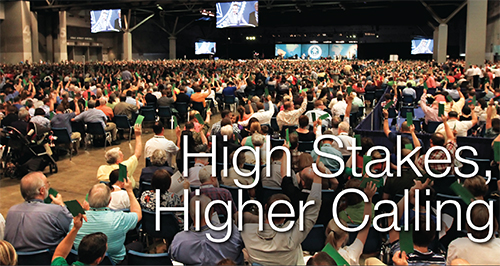
High stakes higher calling

Facing cultural decline and denominational woes, Southern Baptists leave St. Louis amazed by grace.

St. Louis | The stakes are high, Southern Baptist Convention President Ronnie Floyd declared to Southern Baptists gathered in St. Louis. And perhaps they’ve never been higher.

Christians are being martyred around the world. Refugees are fleeing for their lives. There are still thousands of people groups unreached with the gospel, but limited funds required the SBC this year to reduce its missions force by more than 1,000.

“As followers of Jesus Christ, everything we believe in and place in high value is at stake,” said Floyd, an Arkansas pastor who finished his second one-year term as SBC president.

At home, spiritual lostness is growing. Religious freedom is under fire. And the threat of domestic terrorism looms large, exhibited in Orlando just hours before Southern Baptists convened in St. Louis.

The attack on a gay nightclub early June 12 that left 50 people dead cast a shadow on the St. Louis meeting, and sent Southern Baptists to their knees in prayer. Because all human beings are made in the image of God, Floyd said, the attack “is against each of us.”

Every pastor or leader who prayed from the platform during the meeting included Orlando in his prayer.

Baptists’ commitment to missions and evangelism also were on display in St. Louis, in messages preached at the Pastors’ Conference and through a joint presentation by the SBC’s two mission agencies that highlighted the role of the local church and individual Christians in taking the gospel to unreached communities.

And at the heart of the meeting was a show of humility by SBC leaders, as two men vying for the denomination’s presidency met before their run-off election, each telling the other one to take the post.

When Baptists dispersed from St. Louis, they left having unified around a new president, and having heard a call to urgency for and commitment to the gospel of Christ.

Good thing, because the stakes are historically high.

Grassroots participation

As pastors and churches struggle to navigate social change and growing lostness, the stakes are high for people in the pew as well, Floyd said.

“Our pastors and churches need you to be engaged more on Sundays than ever before,” he preached in his president’s address Tuesday morning. “But we also need you to intentionally integrate your faith on the front lines of culture.” In everything you do, no matter where you are.

At the St. Louis meeting, everyday Baptists were urged to take the gospel to the communities as they live their everyday lives, and were shown examples of regular people who are doing just that.

During his agency’s presentation, North American Mission Board President Kevin Ezell interviewed a group of church planters who have started new congregations in Iowa college towns and are moving next to Columbia, Missouri. On large video screens, meeting attenders heard from a college student planning to pay out-of-state tuition so she can be part of the new church in the state next door, and share the gospel with people who don’t know Christ.

“When you really get to it, we talk about the gospel more than we actually advance the gospel,” Floyd preached.

If we had just one-fourth of the passion for evangelism that we have for American politics, SBC politics, theological discourse, blogging, and a whole host of things, we could change the world for Christ, Floyd said before adding, “I can’t be president again, so I might as well be honest.”

We must recapture a vision for evangelism, Floyd preached, starting in our own towns. “This is where it begins.”

Class action

Many thought the election of a new SBC President would signal whether it was time for a generation of older pastors to pass the baton. There were theological issues at play too: Two of the candidates for president—Steve Gaines, 58, and J.D. Greear, 43—are established leaders of different theological streams within the SBC.

In the end, age and theology differences gave way to the greater good. A first vote between Gaines, Greear, and third candidate David Crosby of New Orleans forced a run-off between Gaines and Greear. A second vote was still too close to call, with Gaines narrowly edging Greear but not receiving the needed majority due to 108 disallowed votes. Greear announced Wednesday morning there was no need for another vote, because he was withdrawing his name from contention.

“Through this whole process, I’ve been praying for unity,” Greear, pastor of The Summit Church in Raleigh-Durham, posted on his website. “…If we go to a third vote, and one of us wins by one-half of one percent, it doesn’t matter which of us it is—it’s hard to see how that makes us a united body.”

After announcing his intention to withdraw, Greear received a long standing ovation from those in the convention hall. Floyd asked Greear to pray for Gaines and for the denomination, and messengers elected Gaines president by acclamation.

“I think it was a transcendent moment for the Convention because it embodies the spirit of humility that we as Christians are called to have,” said Kevin Carrothers, pastor of Rochester First Baptist Church and president of the Illinois Baptist State Association. “I think it was well-timed. I think it was a God thing. So, I’m excited about moving ahead, and admire both men and respect their decisions, both willing to step aside for the sake of something bigger than them.”

At a press conference after the election, Gaines said he and Greear “both were sensing the Holy Spirit moving in the same direction.” As both men considered dropping out of the race, they met together with SBC leaders the evening before the third vote was to be taken.

“I looked at him and I said, ‘Man, you can have it,’” recounted Gaines, who pastors Bellevue Baptist Church in Memphis. “He said, ‘No, I want you to have it.’” The meeting prompted Gaines to remember Psalm 133: “How good and pleasant it is when brothers dwell in unity!”

“When the leaders are unified in the Lord Jesus Christ, it brings unity to the body,” Gaines said. As president, he plans to emphasize spiritual awakening, soul winning, and stewardship.

Greear encouraged his supporters also to exhibit a unified spirit. “The task for those of you who voted for me is not to complain that things didn’t go our way,” he posted the morning of his announcement. “It’s to follow the example of our Savior, who came not to be served, but to serve.

“It’s time for us to step up and get involved, to keep pushing forward and engaging in the mission with those who have gone before us. It’s time to look at what unites us.”

Munton elected

It took a little longer than expected for messengers to elect Illinois’ Doug Munton as First Vice President. Because Tuesday’s business proceedings ran over time, Munton’s election didn’t happen until Wednesday afternoon. The pastor of First Baptist Church in O’Fallon, who ran unopposed, told the Illinois Baptist the St. Louis convention was in some ways the most unusual one he’s been to, but also encouraging.

“God brought some unity, much-needed unity, to our Convention. That’s encouraging for our future. I’m grateful for it, and hopeful because of it,” Munton said. “The Lord is obviously at work. He is not done with the Southern Baptist Convention.”

Also elected as officers were Malachi O’Brien, pastor of The Church at Pleasant Ridge in Harrisonville, Mo., as second vice president; John Yeats, executive director of the Missouri Baptist Convention, to his 20th term as recording secretary; and Jim Wells, retired member of the Missouri Baptist Convention staff, to a 15th term as registration secretary.

The 2017 Southern Baptist Convention convenes in Phoenix June 13-14.

– Meredith Flynn

The BriefingFloyd among evangelicals to meet with Trump
Southern Baptist Convention President Ronnie Floyd is among 500 evangelicals and other conservatives planning to meet with presumptive Republican presidential nominee Donald Trump about his faith and values at a June 21 meeting in New York. Floyd is part of a small group of leaders to spearhead the meeting as the steering committee.

Trump’s other outreach efforts include an address at the Washington conference of conservative Christians sponsored by the Faith & Freedom Coalition and Concerned Women for America June 10.

Military chaplains need the Russell Amendment
Last week, the U.S. House of Representatives kept in place an amendment to this year’s National Defense Authorization Act (NDAA) that protects the rights of military chaplains. The Russell Amendment is a provision that applies to the religious exemption of the Civil Rights Act of 1964 to federal contractors. It provides important protection to chaplains who have substantial discretion to supplement religious support programs via Department of Defense contractors and vendors.

Methodists postpone debate of LGBT issues
Amid protest, song and fears of a denominational breakup, United Methodists at their quadrennial General Conference decided yet again not to decide anything regarding LGBT rights. However, delegates voted 428-405 to allow the church’s Council of Bishops to appoint a commission to discuss whether to accept same-sex marriage or ordain LGBT clergy.

Same-sex marriage advocates work to oust WY judge
In what could be the nation’s first religious litmus test for holding a judicial post, the Wyoming Supreme Court is being asked to dismiss a municipal court judge because of her biblical views about marriage. Attorneys for Judge Ruth Neely argue the efforts of an unelected state commission to remove her from office are rooted in religious bias and misinterpretation of the law.

Churches hosting job fairs
Churches are partnering with Church Job Fairs, a faith-based organization that helps churches plan and promote job recruitment events. The events take place in local churches for the local community. The idea is simple: A church is meant to be a place of hope, encouragement, and love to its community. So why not host a job fair in a church and meet both physical and spiritual needs?

Sources: Baptist Press, Religion News, The Hill, Religion News, Baptist Press, WORLD Magazine

Ready with a reason

ib2newseditor —  May 19, 2016

Crossover volunteers prepare for St. Louis

Steven_Glover[2]

Stephen Glover

Last summer, Steven and Robin Glover went home again—kind of. The Chicago couple and their children traveled to Columbus, Ohio, for the Southern Baptist Convention and Crossover, the annual evangelistic outreach held prior to the SBC.

Steven Glover, born and raised in Columbus, is an IBSA zone consultant in Chicagoland. His wife, Robin, is a writer and homeschool teacher to their four daughters. The Glovers lived in Ohio before moving to Chicago in January 2015, where Steven began a church planting internship at Uptown Baptist Church.

Each year before the SBC’s annual meeting, Uptown sends a team to work with a church in the convention host city. In Columbus, Uptown’s volunteers led a practicum on prayer, evangelism and discipleship at United Faith International Church. They gathered for training, then went out into the community to put into practice what they’d learned.

“Two groups comprised of 8-10 people targeted a neighborhood near the church for prayer walking as well as evangelism,” Steven said. “Upon arrival, the evangelism team had an immediate opportunity to share the gospel with young men hanging out in a local park who happened to be Muslims from Ethiopia.”

Glover and a man from the partnering church launched into an apologetics discussion with one of the young men who was interested in talking about his faith. They talked about Jesus, discussing the places where Islamic and Christian scriptures differed. “[We] took the opportunity to explain the purpose of Christ coming and the importance of his death, burial, and resurrection,” Glover said.

Nearby, his wife, Robin, and others on the team prayed for the conversation, even asking God for a break from the heat. “We were very hot and the sun was beaming down, so we prayed for a breeze,” she remembered. “Soon thereafter, there was a nice breeze and some light rain. The sun then returned to its work of warming.

“God was with us in Columbus. I was blessed to have joined him while he worked.”
Their Columbus experience gave the Glovers some advice for volunteers who will serve through Crossover in St. Louis.

“It is important that mission teams participating in Crossover 2016 be familiar with the demographic make-up of St. Louis,” Steven advised. “Through prior research, our mission team discovered that Columbus is known to have a large Islamic population, therefore, I brought with me a Quran (in English) to use in a witnessing conversation in order to establish the true identity and ministry of Jesus Christ.”

He referenced 1 Peter 3:15: “But sanctify the Lord God in your hearts and be ready always to give an answer to every man that asketh you a reason of the hope that is in you with meekness and fear” (KJV).

For a list of Crossover projects in Illinois, go to meba.org/crossover-st-louis-2016. Watch the Crossover St. Louis video at namb.net/crossover.