Archives For November 30, 1999

Personal belief, salvation, spiritual disciplines, formation

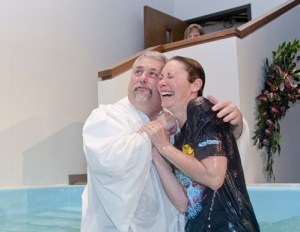
Sonja Conrad was baptized during a spring crusade at First Baptist Church, O'Fallon, Ill.

Sonja Conrad was baptized during a spring crusade at First Baptist Church, O’Fallon, Ill.

THE BRIEFING | Meredith Flynn

A task force appointed to study declining baptisms in the Southern Baptist Convention released its report May 12, detailing five problems they believe have contributed to the recent downward trend. The task force, appointed last year by the North American Mission Board and comprised mostly of pastors, also suggested five solutions focused on prayer, evangelism and discipleship.

When it was published in June 2013, the Annual Church Profile (ACP) report showing the previous year’s facts and figures sounded several alarm bells: 25% of Southern Baptist churches reported zero baptisms. And 60% of churches baptized no one in the 12-17 age bracket.

“We have a spiritual problem,” the task force acknowledged in its report. “Many of our SBC pastors and churches are not effectively engaged in sharing the gospel and yet continue business as usual. We need a sense of brokenness and repentance over the spiritual climate of our churches and our nation.”

Churches also need to get back to celebrating baptisms, the group said. “Many of our churches have chosen to celebrate other things as a measure of their success rather than new believers following Christ in baptism. We have drifted into a loss of expectation.”

To address the decline, the task force suggested five focus areas for pastors that correlate to five problem areas (spiritual, leadership, discipleship, next generation, and celebration):

1. Pray for spiritual awakening.

2. Model personal evangelism and provide pathways. (NAMB has introduced a new evangelism tool called “3 Circles: Life Conversation Guide.)

3. Create a disciple-making culture.

4. Serve the next generation.

5. Celebrate evangelism and baptism.

“…We encourage our fellow SBC pastors to join us in owning this problem,” the task force said. “Together, we can seize this opportunity to lead our churches and be part of the solution.”

For more on the task force’s report, evangelism tools, and a new video challenge, go to www.namb.net/baptismtaskforce.

Boko Haram offer to release kidnapped girls may be ploy, Nigerian Southern Baptist says
Terrorist group Boko Haram released a video Monday offering to release about 100 of the Christian girls they’ve kidnapped, in exchange for the release of Boko Haram prisoners in Nigeria. But the offer could be a tactic to buy time to strategize, Adeniyi Ojutiku told Baptist Press. Ojutiku is a Southern Baptist and co-founder of Lift Up Now, a Christian-based grassroots organization addressing political, economic and social challenges in his homeland Nigeria.

“They have wiped out families. They have killed generations of people, even infants,” Ojutiku said of Boko Haram. “They have maimed people for life. They have killed hundreds and thousands of people. And then to conceive that you would negotiate with such very, very despicable … people who commit such heinous crimes, it is unthinkable to me.

“These people must be prosecuted,” he said. “There cannot be sustainable peace without justice.” Read the full story at BPNews.net.

Arkansas becomes first southern state to issue marriage licenses to same-sex couples
County clerks in Arkansas were thrown into a state of confusion by Judge Chris Piazza’s decision to overturn the state’s ban on same-sex marriage on Friday, May 8. By Monday, clerks in some counties were issuing marriage licenses to same-sex couples, while others had decided not to. Attorney General Dustin McDaniel filed paperwork to temporarily extend the ban Monday, the Associated Press reported, but clerks can continue to issue marriage licenses to same-sex couples until the state’s Supreme Court processes documents from both sides on Tuesday.

Translators work to get Bible into dangerous territory
Ten million landmines may still be buried in Angola, left over from a 27-year civil war that ended in 2002. But Wycliffe Associates, known for their efforts to translate the Bible into every language, is working to take God’s Word to the southern African nation, The Christian Post reports. “These people have been ravaged by brutality and poverty,” said Bruce Smith, president and CEO of Wycliffe Associates. “They live in daily danger of stumbling onto hidden land mines. But worst of all, many have never even heard a word of scripture in their own language.” Read more about Wycliffe’s Angola project at ChristianPost.com.

HGTV stops production on show starring Christian brothers
A reality show in the works about two house-flipping brothers was shelved after the group Right Wing Watch posted about David and Jason Benham’s beliefs about marriage, homosexuality and abortion. “Flip it Forward” would have followed the Benham brothers as they helped six families renovate homes, reports ChristianityToday.com. “We promised we would give Jesus glory whether in victory or defeat,” David Benham said after the show’s cancelation. “Sure seems like we’ve been defeated lately. But you know what? God is bigger than all of this.”


Russell Moore, president of the Ethics and Religious Liberty Commission, has used the phrase “convictional kindness” to describe how Christians ought to engage a vastly different culture than the one their parents and grandparents knew.

Russell Moore, president of the Ethics and Religious Liberty Commission, has used
the phrase “convictional kindness” to describe how Christians ought to engage a vastly different culture
than the one their parents and grandparents knew.


NEWS | Meredith Flynn

Southern Baptists’ generals in the culture war demonstrated their new strategy at an April meeting for church leaders. But the tactic, softer in decibels but not doctrine, was met by criticism from opponents using modern weaponry – social media.

“The way that we are going to be able to speak to the people in our culture…is not by more culture war posturing, but by a Christ-shaped counter-revolution,” said Russell Moore, president of the Southern Baptist Ethics and Religious Liberty Commission.

The conference on sexuality and the Gospel was the ERLC’s first major event since Moore assumed leadership from Richard Land, who served as the denomination’s main voice on issues such as abortion and first amendment rights.

The event came with a sort of confession: the culture war as we knew it is over.

“We’re all in agreement that the cultural war is over when it comes to homosexuality, certainly when it comes to gay marriage,” Florida pastor Jimmy Scroggins said at the ERLC’s summit. In his urban context of West Palm Beach, Scroggins said, “The question is what are we going to do in the church.”

Some might call this “post-culture war America.” Others might conclude that we’ve entered a new phase, culture cold war, with new weapons such as Twitter and a new battlefield, ironically, inside the church.

Embrace the strangeness
This new culture has been on the horizon for a while: Marriage rates across all demographic groups have fallen continuously since 1970, Andrew Walker of the ERLC noted during his summit breakout session. Cohabitation rates are up too: USA Today reported last year that for almost half of all women between ages 15 and 44, their “first union” was cohabitation instead of marriage.

Also on the rise: Approval for redefining marriage. A recent ABC News/Washington Post poll reported 59% of Americans approve of same-sex marriage.

Addressing sweeping social and cultural changes was one emphasis of the April 21-23 meeting in Nashville, but speakers also talked about how church leaders ought to interact with increasingly specific questions arising at their churches. Like what to do when a transgender person expresses repentance and belief in Christ. Or how to counsel college students when premarital sex is not only accepted, it’s expected on the first date.

A few days before the ERLC summit, Moore appeared on ABC’s “This Week” to discuss religion and politics with a panel of evangelical and conservative leaders. He talked about the falling away of nominal, in-name-only faith, and the increasing “strangeness” of Christianity. Moore told moderator Martha Raddatz, “It’s a different time, and that means…we speak in a different way.”

“We speak to people who don’t necessarily agree with us. There was a time in which we could assume that most Americans agreed with us on life, and on abortion, and on religious liberty and other issues. And we simply had to say, ‘We’re for the same things you’re for, join us.’

“It’s a different day. We have to speak to the rest of the culture and say, ‘Here’s why this is in your interest to value life, to value family, to value religious liberty.’”

During the Nashville meeting, social media provided plenty of evidence of the divide. The meeting was one of Twitter’s top trending topics on its first day. Feedback from attenders was positive, but others watching the summit online spoke out, often harshly, against what speakers said.

That Christian views are seen as strange isn’t surprising, Moore said on the ABC broadcast.

“Many people now when they hear about what evangelical Christians believe, their response is to say, ‘That sounds freakish to me, that sounds odd and that sounds strange. Well, of course it does. We believe that a previously dead man is now the ruler of the universe and offers forgiveness of sins to anyone who will repent and believe.”

Reclaim the strangeness of Christianity, he urged at the Nashville meeting, basing it on the death and resurrection of Jesus.

So, what should we say?
Throughout the summit, speakers stressed the supremacy of the Gospel and clarity of what the Bible teaches about sexuality. Christians shouldn’t apologize for it, said Andrew Walker. Preaching an almost-Gospel is no match for the sexual revolution, Moore said.

Or, as Southern Seminary’s Denny Burk put it, “We have to be grave about these things.”

Scripture calls Christians to speak the truth, but to speak it in love. “We have to reject ‘redneck theology’ in all of its forms,” Jimmy Scroggins said during a panel discussion on the Gospel and homosexuality. “Let’s stop telling ‘Adam and Steve’ jokes.” (God created Adam and Eve, not Adam and Steve…)

As the audience chuckled, Scroggins continued, “Let’s be compassionate because these are people that are in our community, these are people who are in our churches, these are people who have grown up in our youth groups, and these are people that we’re trying to win to Christ, and we want to care for them as a people created in God’s image.”

Speaking with “convictional kindness” has been a major part of Moore’s message in his first year as ERLC president. “I hope to speak with civility and with kindness and in dialogue with people with whom I disagree,” he told Christianity Today last year.

It’s a timely endeavor, especially when social norms run ever more contrary to the Gospel. J.D. Greear pastors The Summit Church in Raleigh-Durham, N.C. At a church that reaches a large number of college students, sexual ethics are a topic of constant conversation.

“Sex gets at the core of who we are. Its dysfunction and its damage is deep, but the Gospel goes deeper still,” Greear said. “Because where sin abounds, grace much more abounds, and the great brokenness of sex presents an even greater opportunity for the Gospel.”

The May 26 issue of the Illinois Baptist will examine in more detail how speakers at the summit addressed contemporary threats to biblical sexuality and marriage. The ERLC also will look more closely at “The Gospel, Homosexuality, and the Future of Marriage” at a conference scheduled for Oct. 27-29 in Nashville.

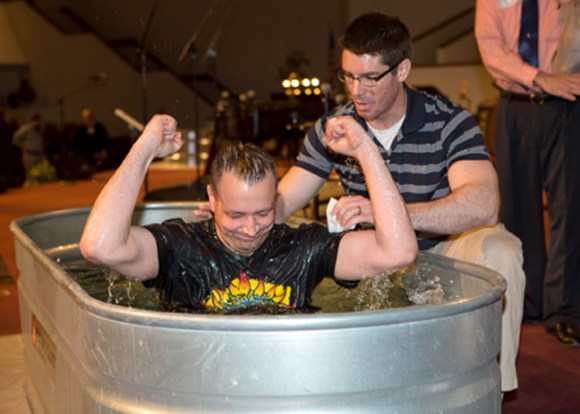
After being baptized in a horse trough, David Vittetoe celebrates as John Howard, minister to students, assists. The troughs gave the church three locations to baptize the 103 people who came forward.

After being baptized in a horse trough, David Vittetoe celebrates as John Howard, FBC O’Fallon minister to students, assists. The troughs gave the church three locations to baptize the 103 people who came forward.


HEARTLAND | Lisa Sergent

Over a single weekend, more people were baptized at First Baptist, O’Fallon, than in all of 2013. The church’s crusade March 29-30 resulted in 103 baptisms, 17 salvation decisions, and 15 rededications.

Tom Dawson, FBC’s minister of adult education who helped organize the crusade, described it as “a wonderful event.” He called Texas evangelist Ronnie Hill “electric. He brought God’s Word straight to peoples’ hearts.”

Dawson said the church did “quite a bit of preparation” in the month before the crusade. Prayer, training, and logistics were key. Groups spent time praying for Hill and for those who would come and make decisions. Church members were trained to be “encouragers,” or counselors, to talk with people as they came forward.

Carol Cluff, adult ministries specialist, said the encouragers were trained a few days in advance of the crusade. “We wanted to make sure every person who stepped forward had someone to come with them, to talk with them about what prompted them to come forward, and to make sure they fully understood the commitment they were making.”

She noted many of those who were baptized had come to understand they had been “baptized out of order. Several people realized they had been baptized as a baby or even as a child without knowing Christ and wanted to be baptized now as believers in Jesus. Others had accepted Christ at youth events some time ago, but not taken that step.”

Sarah Schultz rejoices with Skip Leininger, associate pastor of FBC O’Fallon, after being baptized at the church’s March 29-30 crusade.

Sarah Schultz rejoices with Skip Leininger, associate pastor of FBC O’Fallon, after being baptized at the church’s March 29-30 crusade.

Hill urged the church to be ready to baptize people in each session and not make them wait until a later date. In anticipation of a large number of baptisms, the church made sure to have plenty of T-shirts, shorts and towels on hand. Plus, they placed two horse troughs filled with water on either side of the platform giving them three locations, including the baptistery, to baptize people in a single service.

“We were ready to baptize people on the spot,” Dawson said.

First Baptist has made follow-up a priority, stressing the importance of continued discipleship. In a series of follow-up actions, encouragers are keeping in touch with those they counseled and are connecting them with small groups within the church. As part of the effort, Senior Pastor Doug Munton is leading a special sermon series covering the Good News and the importance of baptism along with why Christians should share their faith and be fishers of men.

Munton is pleased with the crusade’s outcome. “We had a great crusade,” he shared. “The Gospel was preached clearly and the response was great. Many people trusted Christ as Savior and that never gets old to me. And, it was such a privilege to see more than 100 people follow the Lord in believer’s baptism.”

Leininger prepares to baptize Sonja Conrad.

Leininger prepares to baptize Sonja Conrad.

Dawson said church members are excited. The momentum continued into Easter as the church had its largest Easter Sunday worship attendance – 2,569 people.

“The crusade was wonderful,” said Cluff. “It lit us on fire.”

Mark_Coppenger_blog_calloutCOMMENTARY | Mark Coppenger

You know the scene: A troubled family member arrives at home only to find various loved ones seated in the living room. They ask him or her to sit down and hear what they have to say. One by one, they read prepared statements of love and admonition. The subject, eyes brimming with tears or flashing with indignation, endures as much as possible before caving in, pushing back or storming out.

The poor soul has bottles hidden around the house and in the flowerbed, and she can find another pint as soon as her prime stashes are blown.

Or there’s the trash addict who can’t throw anything away, even dead animals. (I was called in on a cleanup with some church members in my seminary days; we found a dead, dried out cat under matted stained clothes under stacks of newspapers in one of the closets.)

An intervention is very uncomfortable but worth it, whether the addiction is drugs or drink, clutter or cussedness. They’re ruining themselves, as those around them are grieving if not outright harmed. And they don’t much appreciate your suggestion that something is out of whack.

I know that people can come to Christ in a lot of tender ways. An immigrant wife is touched by her Christian neighbor’s shopping and language tips. A lost welder is disarmed by the warmth of a church softball team he’s been asked to join. A “singing Christmas tree” rendition of Joy to the World brings tears to the eyes of a cranky, unchurched parent who shows up to watch his high school senior perform.

But the Lord has also used Jonathan Edwards’ Sinners in the Hands of an Angry God and the chaste slap of a godly college girl knocking some sense into a unbelieving suitor, whose advances were unseemly, a jolt which caused him to reassess his secular worldview. Or how about Mordecai Ham’s scathing anti-alcohol parades, which salvifically grieved some drunks standing outside bars on the roadside?

God may well use a sequence of happy and scary events and items to lead an individual to Himself. (I think I once heard the late evangelism professor Roy Fish say the average was seven Gospel touches before conversion.)

So Bob may have been providentially prepped for salvation by, in order, a Vacation Bible School lesson he heard at age 8; a highway sign reading, “Prepare to Meet God”; a Jack Chick tract named Holy Joe; the stellar performance of a homeschooled spelling bee champ who thanked Jesus for helping her; five minutes of a Joel Osteen sermon; and a friend who repeated something he heard in an Alistair Begg broadcast.

Truth is, we risk looking silly when we declare, well beyond our competency and theological warrant, that all evangelistic approaches other than our own are tacky, pompous, dated, specious, trendy, dopey, sleepy, grumpy, sneezy and bashful.

That being said, there is an irreducible kernel of awkwardness and agony in conversion — repentance. I compare it to throwing up. I hate it. I fight it. (On a bucking airplane I close my eyes, turn the air full blast on my face, breathe deeply and sit very still.) I suppress it with every fiber of my being. But when it comes, oh, the relief — the blessed cooling of a sweaty brow, the relaxation of suppressed muscles.

Yes, it’s that gross, as is repentance, as we hurl up and out the poison and rot of self and sin and damnable, willful stupidity — the sort of thing you find in James 4:8-10: “Cleanse your hands, sinners, and purify your hearts, double-minded people! Be miserable and mourn and weep. Your laughter must change to mourning and your joy to sorrow. Humble yourselves before the Lord, and He will exalt you.”

Sometimes we hear and say that a witnessing Christian is “just one beggar telling another one where to find bread.” I’d suggest it’s more like a formerly-suicidal fellow who was talked off the ledge trying to talk a currently-suicidal fellow off the ledge. Or it is like a repentant Taliban terrorist in Gitmo going on TV to dissuade current Taliban terrorists to cut it out.

Of course, most don’t think that a law-abiding, philanthropic citizen — working the NYT crossword in Starbucks on Sunday morning, sitting across from his wife Khloe enjoying a half double decaffeinated half-caf with a twist of lemon, beside their jogger stroller bearing little Nash — is a suicidal terrorist. But he is just as we were. He’s bound for a well-deserved sinner’s hell, indifferent to the godly stewardship of his life, harming innocents along the way by his passive, aggressive and passive-aggressive defiance of the Kingdom and its gospel of grace, Khloe and Nash being his prime victims as his “spiritual leadership in the home” couples them to his downgrading train.

And so we intervene. If, that is, we love the person, are convinced of his plight and are willing to risk the alienation of affection. It doesn’t take licenses or programs or eloquence, though those can help. It simply demands compassion, courage, a firm grasp of the hard truth and, yes, a life which reflects a better way.

Mark Coppenger is director of the Nashville extension center and professor of Christian apologetics at Southern Baptist Theological Seminary in Louisville, Ky. This column first appeared at BPNews.net.

movie_filmstripCOMMENTARY | Meredith Flynn

Watching actors portray Jesus on film is a little like Goldilocks trying out chairs at the three bears’ house. This Jesus is too small (“Jesus Christ Superstar”). This one is too passive (“Son of God”). Or just too weird (“Godspell”).

Even when Jesus resembles the one you met in Sunday school, like in the 1965 epic “The Greatest Story Ever Told,” you still find yourself looking for the inconsistencies that prove this Jesus isn’t as satisfying as the one in the Bible.

And when his suffering is gut-wrenchingly authentic (“The Passion of the Christ”), you want to see this Jesus during the rest of his life, and not just the last few hours.

Movies can’t capture him, and they’re not the best way to connect with him. But there’s still a reason to watch. Jesus on film may be undersized compared to the real-life version, but the other humans in the movies are caught in brilliant living color.

Judas, Nicodemus, Barabbas and the others are fully life-sized, and watching them interact with the film version of Jesus is downright convicting.

See the shades of jealousy you’ve never noticed in the “Greatest Story” Judas, and his belief that he was actually doing what was right for his people. Or listen to him wail in “Superstar,” narrating the whole story in what he believes is the voice of reason.

Watch Nicodemus in “Son of God” draw close and then pull away, again and again, as he’s torn between this new gospel and what he’s always known.

Simon of Cyrene comes to life in “The Passion,” starting off skeptical and reluctant to help Jesus carry his cross, but defending him at the end of their long march. In the same movie, Mary Magdalene can’t turn away from the gruesome crucifixion scene, her current reality mixing with memories of how Jesus rescued her from the Pharisees.

Even in “Godspell,” the loopy 1975 musical, we watch the disciples have their world turned upside down as Jesus teaches them things that are the opposite of the status quo.

The filmmakers created some of the dialogue to fill in places Scripture doesn’t describe in detail, so we don’t know exactly what was said or felt. But Judas’ jealousy and Mary’s neediness and Nicodemus’ doubts are relatable all the same because we’ve been in their shoes.

There’s a young church in San Diego called Barabbas Road. The founding pastor picked the name because all redeemed Christians have walked Barabbas’ path, he said. In fact, one of their early promotional videos featured different church members each proclaiming, “I am Barabbas.”

These Jesus movies elicit the same reaction: I am Barabbas. I am Nicodemus. You are Peter. You are Simon of Cyrene. Watching Jesus interact with vividly human people like us is the most moving thing about all these motion pictures.

And as a bonus feature, these abridged versions of Jesus will drive many viewers back to Scripture for the full story.

Meredith Flynn is managing editor of the Illinois Baptist.

COMMENTARY | Jonathan Davis

Jesus_forpage1

WHAT A SAVIOR – “But he was wounded for our transgressions, he was bruised for our iniquities: the chastisement of our peace was upon him; and with his stripes we are healed” (Isaiah 53:5). Sculpture by Libby Morecraft of Harrisburg

Our culture loves blood. The latest vampire novel, graphic movies, every CSI crime drama, the nightly news – they’re all pictures painted in blood. Even the walking dead are promoting a bloody afterlife every Sunday night on cable. But our culture’s bloodthirst is biting into the wrong vein.

As God’s people, we also are to be marked as lovers of blood. Not because of an obsession with gore, but because of the Savior who shed his life’s blood
on our behalf.

Yet, for some reason, we often shy away from the bloody language of the cross. Our culture, so fascinated with blood stories, turns away from the most
important blood lines of all. Talk of the cross is offensive to many, and to bring up the blood as central to faith will bring many conversations to a halt. And
rather than offend, some Christians will stick to the more polite apologetic: Jesus loves you, and has a great plan for your life.

But that’s a bloodless Christianity. And a bloodless Christianity is no Christianity at all.

Flesh and blood isn’t just Easter language; it is Gospel language to be used at all times and in all places. We are to embrace the bloodiness of Scripture, for to do opposite is quite dangerous.

Our bloody theology

The Bible presents us with a robust theology of blood. Because Christ was crucified, we reap a multitude of benefits for His glory and our good.

• We once were people without hope, but have been brought near to God by the blood of Christ (Ephesians 2:12-13).

• In Christ Jesus, whom God put forward as a propitiation by his blood, we have redemption, the forgiveness of our sins (Romans 3:24-25; Ephesians 1:7).

• We have been justified by Christ’s blood (Romans 5:9).

• We have peace with God by the blood of the cross (Colossians 1:20).

From Adam and Eve’s first sacrifice outside the garden to our High Priest’s completed work, and everywhere in between, the history of God’s people is marked by blood. For several thousand years, it’s the blood of animals, offered as a covering for sins. And finally, it’s the once-and-for-all sacrifice that
washes whiter than snow.

When it comes to salvation, nothing but blood will do.

Maybe the most startling example of flesh and blood language in the Bible is found in John 6. Jesus tells his followers they must eat his flesh and drink his
blood. On the surface, it’s a revolting concept. “Is he advocating cannibalism?” they must be thinking.

Then, at his last meal with the disciples, Jesus enacts the teaching, tying together eternal life with eating his flesh and drinking his blood. Jesus notes that
we are abiding in him when we do so. To commune with Christ is to embrace this bloody language.

Now, it’s not too hard for us to talk about the crucifixion and the blood this time of year, especially in our churches. At Easter, the person and work of Jesus
come to the forefront of our minds, and rightly so. This is the time of year we celebrate Christ’s crucifixion, and it makes sense that flesh and blood speech
is on our lips.

But what concerns me is our post-Easter language, and how we share the Gospel with people who don’t know Christ. Too often, we avoid talking about Christ’s suffering, and in doing so, we drain our faith of its very power.

Power in the blood

The next time you’re on break at the water cooler, try dropping this line from Jesus into the conversation: “Hey, did you know that Jesus said, ‘Unless you
eat the flesh of the Son of Man and drink his blood, you have no life in you.’”

I can hear the crickets chirping.

The Corinthians felt the shame of flesh and blood preaching, and this led them away from boasting in the cross to boasting in worldly wisdom. Preaching
a crucified king sounded so un-wise that they forsook the very message they had heard and believed.

But Paul argues that crucifixion language is the very language the Holy Spirit empowers. He had come to the Corinthian believers in weakness and fear. His speech and message were not in plausible words of wisdom, but in demonstration of the Spirit and of power (1 Corinthians 2:3-4).

We must recover that kind of speech in our churches and as we go out into the world. Sin is serious, so serious that it warrants death. This is why there is
great danger in bloodless Christianity. To remove the bloody language of the cross is to remove man’s only hope of being made right with God.

The Gospel of the cross is the good news that God is holy, you are not, and the necessary sacrifice to make you right with God is found in Jesus Christ and Him crucified.

As believers we have tasted and seen the goodness of salvation applied to our hearts, and our desire is to see the lost know this same salvation. Is talking
about the cross offensive? Yes. Is it difficult to speak? Yes.

But let’s not run from it. Rather, let us press into it, speaking Christ and Him crucified plainly and with conviction, trusting the Holy Spirit to draw the lost to the Father through the Son.

When we do, people will begin to understand there’s power in the blood.

Jonathan Davis pastors Delta Church in Springfield.

My job and the Gospel

Meredith Flynn —  April 7, 2014

Carrie_Campbell_blog_calloutHEARTLAND | Carrie Campbell

Looking around my middle school classroom in Springfield, I’m struck by how different it is than where I was eight months ago, surrounded by the beautiful mountains of eastern Kentucky.

Or five months ago, when I was immersed in the bright and flashing lights of New York City.

After college, I decided to take a season of my life and do full-time ministry. I spent two years in Kentucky working with at-risk kids. I followed that up with a
few months in Brooklyn, learning about ministry in an urban context. I came back home to Illinois in November and felt called to live out a personal dream: becoming a teacher. I received an exciting job offer to teach current events to sixth, seventh and eighth graders.

My classroom isn’t as scenic as the mountains or the city, but it’s certainly a mission field.

Going from a mission-minded environment to a secular workplace was a big jump for me. In many ways it was one of my biggest life challenges. I went from being surrounded by those who have the same eternal goal in mind, to working with people who have lots of different goals. I quickly learned that the “harvest is plentiful but the workers are few.” But God has given me opportunities to share the Gospel.

One of the first things I noticed among my co-workers was that the environment in my school was very negative. I started writing encouraging notes to the teachers on my team as well as the administrative staff. My coworkers quickly took notice of that and sought me out to talk about their struggles. A before-school prayer meeting started up again. People are more positive now. I realized that sharing the Gospel starts with the small things, and God can take those small things and transform a school.

The most valuable part of my job is getting to know my students and letting them know I care about their needs. Even though I’m not allowed to say, “Christ has a future for you,” I can give positive feedback and point them toward their strengths.

One student recently was placed in my room for a behavior problem. He quickly got bored, so I gave him the simple task of fixing my three-hole punch. He liked that I gave him some attention and that he was able to accomplish this task for me. We’ve had a positive relationship since then, and he knows that I care about him and want him to do better in school.

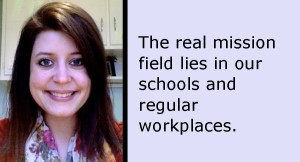
Even with the challenges this new workplace brings, I have been constantly reminded that Christ is in control, and that the real mission field lies in our schools and regular workplaces. People with needs are crying out and, for us who are Christians, being able to step into those places and bring the Gospel is an honor.

Carrie Campbell is a member of Delta Church in Springfield.

Noah_movie_posterTHE BRIEFING | Meredith Flynn

Director Darren Aranofsky’s controversial “Noah” movie (rated PG-13) grabbed the top spot at the box office over the weekend, grossing $44 million in the U.S. and Canada and almost $100 million worldwide. Many Christians voiced objections to the movie’s content prior to its release, and the debate continued over social media as people went to the theater to see what all the fuss was about. The verdict: Christians are still divided on the film’s value.

“This is not a ‘buy up a block of tickets’ moment for churches…,” National Religious Broadcasters President Jerry Johnson blogged at ChristianityToday.com before the film’s release. “Noah, the film, may be inspired by the biblical character and events – but it is not a straightforward retelling of that story. Churches who are looking for that kind of movie will not find it here.

“However, many people will go to this film and enjoy it. The main events from the Noah story are depicted in a powerful way on the big screen by name brand actors and quality production. Christians should be ready to engage moviegoers in conversation about biblical and cultural themes that are portrayed in this movie.”

Your turn: Have you seen “Noah”? What did you think? Leave us a comment below.

Other news:

Saddleback, Warrens host conference on the church and mental health
Nearly a year after their son, Matthew, committed suicide, Rick and Kay Warren invited experts in the field of mental health to a one-day conference at Saddleback Church. More than 3,300 people attended the meeting March 28, which featured workshops for people and families struggling through mental illness, as well as church leaders who want to be better equipped to handle mental health issues in their churches and communities. “We do this in honor and memory of our son and others lost to mental illness, realizing there is hope for others dealing with this condition,” Kay Warren said, according to a report by The Christian Post.

Judge makes Michigan latest state to take up same-sex marriage issue
Judge Bernard Friedman overturned Michigan’s ban on gay marriage last week, and about 300 couples were married after his decision. The ruling was stayed, and Michigan Governor Rick Snyder has said the state will not recognize those marriages as of now. But U.S. Attorney General Eric Holder said the government will offer federal benefits to the married couples, mirroring the action it took in Utah earlier this year. Click here to read about action in other states and to view the updated marriage map.

Barna researches why 64% of Americans aren’t regular church attenders
Author Donald Miller sparked controversy recently with a blog about why he doesn’t attend church (he feels more connected to God through his work than through a worship service). Research from Barna indicates many people feel the same way. Of the 64% of Americans who don’t attend church regularly, 40% say they find God elsewhere, and 35% say church is not relevant to them personally. Read more, including details about church attendance for the millenial generation, at Barna.org.

Faith, family more important than mirror ball trophy for former ‘Full House’ star
Candace Cameron Bure, who came to fame as DJ Tanner on 90’s TV series “Full House,” is also a contestant on this season of “Dancing with the Stars.” During a recent episode, she explained the modest choices she made when planning her rumba with professional partner Mark Ballas: “My life revolves around my relationship with Jesus Christ so with the overall tone of the dance or the costumes, it’s not going to take a backseat.”

Bure told host Erin Andrews after the dance: “I want to reserve some things for my husband so I think we did the best that we could with the rumba that I still felt comfortable doing.” Read more at ChristianPost.com.


Thom_Rainer_blog_calloutCOMMENTARY | Thom Rainer

Editor’s note: Thom Rainer is president and CEO of LifeWay Christian Resources. This article was originally published Feb. 12 at ThomRainer.com.

Many churches are busy, probably too busy. Church calendars fill quickly with a myriad of programs and activities. While no individual activity may be problematic, the presence of so many options can be.

An activity-driven church is a congregation whose corporate view is that busier equals better. More activities, from this perspective, mean a healthier church. The reality is that churches who base their health on their busyness already have several problems. Allow
me to elaborate on seven of those challenges:

1. Activity is not biblical purpose. Certainly some activities can move a congregation toward fulfilling her biblical purposes. But busyness per se should not be a goal of a healthy congregation.

2. Busyness can take us away from connecting with other believers and non-believers. It is sadly ironic that local churches are often a primary reason we do not connect on a regular basis with people in our community and in the world. We are too busy “doing church.”

3. An activity-driven church often is not strategic in its ministries. Leaders do not think about what is best; they often just think about what is next on the activity list.

4. A congregation that is too busy can hurt families. Sadly, some church members are so busy with their churches that they neglect their families. Our churches should be about strengthening families, not pulling them apart.

5. An activity-driven church often has no presence in the community. Christians should be Christ’s presence in the communities their churches serve. Some Christians are just too busy doing church activities to have an incarnational presence in the community.

6. Activity-driven churches tend to have “siloed” ministries. So the student ministry plans activities that conflict with the children’s ministries that conflict with the senior adult ministries, and so on. Instead of all the ministries and activities working together for a strategic purpose, they tend to work only for their particular areas.

7. Churches that focus on activities tend to practice poor stewardship. Many of the activities are not necessary. Some are redundant. Others are sacred cows. Ministry effectiveness can often be enhanced with less instead of more.

Many of our churches have traded effectiveness for busyness. Good use of the resources God has given us demands that we rethink all we are asking our members to do in our churches. We really need more simple churches. Now that’s a novel concept.

Nate_Adams_blog_callout_3HEARTLAND | Nate Adams

I’ve recently found myself in several different settings where I have been asked to help clarify what Baptists believe, and how those beliefs may be distinct or different from those of other groups. Sometimes the question comes from Christians of another faith background. Sometimes it’s from a non-Christian who wants to understand if his or her perception is accurate. Occasionally, those from a different Baptist denomination simply want to understand why all Baptists aren’t alike.

I have to admit, dialoguing with that latter group sometimes has made me wonder if we Baptists aren’t too quick to stand apart from one another, or to divide into different groups over relatively minor issues. But in most cases, looking for the reasons that we stand apart as Baptists makes me glad that we do.

Late last year, my more frequent conversations along these lines led me to set aside 18 weeks of our weekly chapel at the IBSA building, and to devote one week to each of the articles in The Baptist Faith & Message. We only have 30-45 minutes for chapel, which includes worship and prayer. So we did not do an in-depth study. But each week, I asked the staff to look at a different article from The Baptist Faith & Message, and to ask with me, “What is distinct here? How are Southern Baptists different from other groups, even other conservative, Christian groups?”

Our staff agreed it was a helpful and enlightening exercise. Often we found ourselves saying, “Well, many Christians believe that, or certainly most conservative or evangelical Christians would say something similar to that.” But every week, on almost every doctrinal topic, we also found ourselves identifying distinct beliefs or practices that make our Baptist faith and message meaningfully unique.

After the chapel series was over, I sat down with my notes and jotted my own personal summary of the Baptist beliefs that, to me, seem to differentiate Baptists from others. This list will help me summarize our Baptist identity when I am asked to do so. And, with great love and respect for my many Christian and evangelical friends from other denominations, these are the reasons I will always look for a Baptist church when I move to a new town, or when I choose to declare a doctrinal identity.

My list didn’t simply include a high view of Scripture, or faith in Jesus as the only way to salvation, or a literal resurrection and second coming, because many Christians share those beliefs. But it did include things like believer’s baptism, by immersion and symbolic. It included local church autonomy and congregational governance, combined with passionate, organized cooperation in missions. And it included belief in eternal security, biblical marriage, and personal responsibility for evangelism.

This rich discussion of “What does it mean to be Baptist, and does it really matter?” has also contributed to the creation of a new feature, beginning in this issue of the Illinois Baptist. You will find it on pages 9 and 10. This new “Baptist 101” section will help clarify and reinforce what it means today to be Baptist, not just doctrinally, but also in cooperative missions endeavors and practical church matters. In fact, I hope it will help all of us who read the Illinois Baptist become more articulate proponents of Baptist, evangelical, Christian faith.

Of course the autonomous nature of Baptist churches and people makes it impossible, even undesirable, to try and paint everyone with the same broad stroke. Baptists are a diverse group! But while we are not uniform, we are strangely, almost miraculously, unified. Our best understanding of the Bible has led us to stand, with humility and respect for others I trust, on core Baptist beliefs and practices. If we believe these are important enough to protect and
preserve for our children and grandchildren, then we must continue to understand them and articulate them for others. Across the centuries, and I believe now and into the future, Baptist faith matters.

Nate Adams is executive director of the Illinois Baptist State Association.