Archives For November 30, 1999

DallasThe Briefing Chief Brown relies on his faith
In the wake of the July 7 ambush that killed five Dallas police officers and throughout his life, Police Chief David Brown believes in bedrock Christian doctrine — faithful submission to God’s plan followed by an eternal reward. He sees his job as a “divine assignment” and brings a Biblical perspective to all his decision-making, said his pastor, the Rev. Tony Evans of Oak Cliff Bible Fellowship.

Iowa claims it won’t muzzle pastors
The Iowa Civil Rights Commission, in a “clarification,” says it will not muzzle churches that teach on matters of biblical sexuality, nor force them to open single-sex restrooms to members of the opposite sex. The commission said it has revised its brochure on “Sexual Orientation & Gender Identity” to state that churches generally are exempt from certain provisions of the state’s civil rights law.

Is Trump the end of the Religious Right?
The evangelical divide over Trump has been widening for months, but it was only in recent weeks that the pro- and anti-Trump camps definitively split, with an increasing number of conservative evangelicals coming out forcefully against the candidate. The breaking point came on June 21, when Trump—ironically in an effort to appease the religious right—met with nearly a thousand evangelical leaders and announced a 25-person “evangelical advisory board” to help him reach conservative Christian voters.

Perry Noble fired
NewSpring Church, a multi-campus megachurch based in Anderson, S.C., announced Sunday that the church’s board of directors and pastor advisory team fired Senior Pastor Perry Noble for alcoholism, marital problems, and other “unfortunate” choices. Noble served as pastor of the Southern Baptist Convention–affiliated church since its founding in 2000.

Bill Nye tours Ark Encounter
When evolutionist Bill Nye “the science guy” visited a life-size replica of Noah’s Ark in northern Kentucky, he wanted to learn how children were reacting to what he has called a danger to science education. By the time he left the Ark Encounter theme park, he had also learned the story of Christ’s atoning death on the cross for humanity’s sins, Ark Encounter’s chief executive Ken Ham said, underscoring the park’s value as an evangelistic tool.

Sources: Dallas Morning News, Daily Signal, Politico, World Magazine, Baptist Press

Fractured alliances

ib2newseditor —  July 11, 2016

Fractured alliances

As the national political conventions approach, it’s time for evangelicals to decide. For some, it’s a choice they’d rather not make.

With the national conventions for both major American political parties just days away and the nominees all but a foregone conclusion, the only remaining question is how voters in November will react to this most unusual presidential election.

Christian voters in particular have yet to coalesce behind either candidate, although a June meeting between presumptive Republican nominee Donald Trump and nearly 1,000 evangelicals signaled things may be changing, at least for some conservative leaders.

And Trump’s announcement of an evangelical advisory committee, including several Southern Baptists, reverberated around the Twitter-sphere, shaking the unified front Baptists had shown just days before at the 2016 Southern Baptist Convention in St. Louis.

The divide is growing between conservatives who support Trump over Hillary Clinton’s liberal ideals, and those who say they won’t vote for the businessman-turned-reality TV star with a penchant for saying whatever is on his mind. Along with the differences among Christians, some pundits see a growing split between the traditional “religious right” and the Republican party.

“In the coming weeks, we are going to be learning a great deal more about the presidential candidates,” forecasted Southern Seminary President Albert Mohler in a recent edition of his Briefing podcast. “But it’s also increasingly true that we’re going to be learning a great deal about ourselves as evangelical Christians in America.

“Perhaps we’d better brace ourselves for what we’re going to learn.”

Meeting the Donald

On June 20, Donald Trump met in New York City with nearly 1,000 Christian leaders, including immediate past president of the Southern Baptist Convention Ronnie Floyd and newly elected president Steve Gaines, along with several other Southern Baptists.

The gathering, emceed by former Republican candidate Mike Huckabee, included a Q&A time with Trump, who has won over conservative voters in the primaries even as Christian leaders have decried his volatile speaking style and confession last year that he wasn’t sure he had ever asked God for forgiveness of his sins.

Following the meeting, Trump named a 25-member evangelical advisory board, which includes Floyd and at least seven fellow Southern Baptists. Floyd is among the members of the board who say their participation doesn’t constitute an endorsement of the candidate, rather “as an avenue to voice what matters to evangelicals,” he told The Christian Post.

Floyd also cited several key issues that compelled him to participate on Trump’s advisory board, including Supreme Court appointments, the sanctity of human life, religious liberty, Israel and the Middle East, and racial tension.

But many Christian and conservative leaders took issue with the meeting and the participation of those appointed to the advisory board. Russell Moore, president of the Ethics and Religious Liberty Commission and a recent Trump target on Twitter, took on the seeming divide between Trump’s public persona and his coziness with evangelicals:

“If you wondered why younger, theological, gospel-centered evangelicals reacted (negatively) to the old guard Religious Right, well, now you know,” Moore tweeted June 21, following up with, “If character matters then character matters.”

Moore wasn’t the only voice to question the authenticity of Trump’s relationship with Christians. Writing for The Federalist online, film critic Rebecca Cusey described reading through the meeting transcript, “thinking maybe Trump might exhibit some charm, some thoughtfulness in a smaller setting that is lost on the large stage, something that would explain why people who profess to believe in Jesus would be so taken in by Trump.

“Sadly, no. The transcript is shocking in its pandering: of Trump to evangelicals, yes—we expected that—but also in their pandering to Trump.”

Floyd acknowledged the widespread criticism, blogging a few days after the meeting that his short time out of the office of SBC president had been in some ways more difficult than leading the denomination for two years. He listed several Bible characters who had opportunity to speak into the lives of national leaders, including Old Testament prophet Daniel.

“What if Daniel had refused to acknowledge King Nebuchadnezzar and acted like he was too righteous to relate to him?” Floyd asked.

Similarly, Richard Land, who preceded Moore as president of the ERLC, asked critics of the Trump meeting what they would have the advisory team do instead of participate when asked.

“Would they really have us spurn the opportunity to give spiritual counsel and advice to Mr. Trump and his team?” Land wrote in a column for The Christian Post. “How would that be obedience to our Saviour’s command to be the salt of the earth and the light of the world?”
Fractured alliances 2

 Weighing other options

Some evangelicals are looking to Democratic candidate Hillary Clinton as an alternative to Trump, in spite of her policies on abortion and LGBT issues that run counter to traditionally-held conservative views.

Thabiti Anyabwile, in a column for The Gospel Coalition, said in May he planned, for the time being, to vote for Clinton. “…However we might evaluate her as a leader or her platform as a vision for America, we could say more or less the exact same things about Trump—with one glaring exception,” wrote Anyabwile, pastor of Anacostia River Church in Washington, D.C.

“We have no way of predicting Trump’s behavior from one hour to the next. None. Except to predict that the behavior will be vile and repulsive for any person who cares about civility, truth, and the dignity of the office.”

Deborah Fikes, executive advisor to the World Evangelical Alliance, gave Clinton her endorsement in June, saying of Trump, “…I worry that allowing religious and ethnic intolerance here in America will undermine our ability to have a prayer of fighting it around the world.”

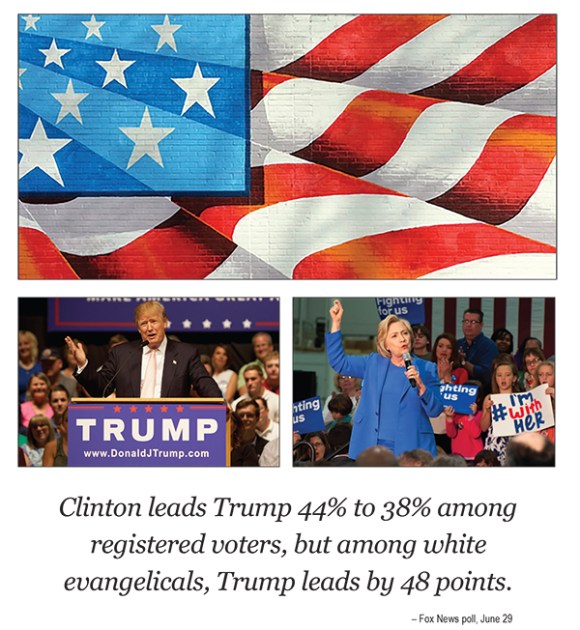
Still, Trump has branded himself as the candidate most invested in religious liberty and other Christian concerns. So far, a majority of voters agree: A June poll by CBS found Trump leads Clinton among evangelical voters by a margin of 62% to 17%.

However, as Religion News Service’s analysis of the poll pointed out, Trump’s 62% is lower than the percentage of white evangelical voters who favored George Bush (79%), John McCain (73%) and Mitt Romney (79%) in the last three elections.

Gallup polling from May found the two candidates neck and neck among those who identify as “Protestant” or “Other Christian”—36% had a favorable opinion of Clinton, and 38% had a favorable opinion of Trump. Both candidates’ numbers were slightly lower among the “Highly religious”—35% for Clinton and 37% for Trump.

For those voters who don’t foresee an appealing option for November, Christian and conservative leaders have floated other ideas, including third-party candidates, write-in voting, and abstention. Alan Noble, a professor at Oklahoma Baptist University, wrote for Vox that “unless a third-party candidate with broad appeal emerges, evangelical Christians would be better served by abstaining from that vote and shifting their energy toward electing people to Congress and local and state governments who have the opportunity to restrain whichever candidate is elected as needed.”

But many Christian leaders have been vocal about getting out the vote, even for candidates that are less than ideal. On his tour of state capitals, evangelist Franklin Graham has urged Christians to vote, but hasn’t endorsed specific candidates. Graham has instead warned against inactivity, citing a statistic that reports 20 million evangelicals did not vote in the 2012 presidential election.

In Springfield, Graham told several thousand gathered in front of the Capitol, “Our job as Christians is to make Christ felt in every [area] of life—religious, social, economic, political.”

Keep the lines open

No matter who believers support in the election, said Wheaton College’s Ed Stetzer, the rhetorical tone should be loving.

“In years past, I generally had to encourage evangelicals to avoid scorning fellow evangelicals who voted Democrat. Now, perhaps we need exhortation to avoid scorning those who vote for Donald Trump….Rather than looking down with scorn on evangelical Trump supporters, perhaps we should sit down with them, listen to them, and hear their concerns.”

Mohler prescribed similar action in his June 22 podcast, urging Christians to think through the issues at hand.

“In this difficult political season, evangelicals must not demonize one another as to how we’re thinking through these issues, but I must plead with all evangelicals that we must indeed think through these issues carefully and faithfully, and think very biblically and candidly.”

To fail to remember oneness in Christ and fall instead into factions and camps could result in a loss of the unity achieved during the recent Southern Baptist Convention, wrote Pastor Ted Traylor following the meeting with Trump, which he attended. At the June 14-15 convention in St. Louis, Baptists united around one presidential candidate, Steve Gaines, after another, J.D. Greear, bowed out prior to a second run-off election.

Now, as Baptists consider another election, Traylor, pastor of Olive Baptist Church in Pensacola, Fla., advised them to think carefully in a blog post titled, “What I learned from a conversation with Donald Trump.”

“There has been much vitriol on social media about the Trump meeting within the tribe of Southern Baptists. We left our convention last week in unity. Demonizing each other over secular politics will quickly destroy what we saw and hailed as God-given unity. We are in the Gospel business.

“However, as we render to Caesar what is his we must be wise, kind and discerning.”

Braveheart screengrab via YouTube

Braveheart screen grab via YouTube

The great experiment in democracy is in trouble.

We have only to look at the presidential election to see the truth in that statement. Apparently anyone can become president.

It is hardly believable that same-sex marriage was legalized in the U.S. only one year ago. In the brief time since, the moral ground beneath us has shifted with the force of tectonic plates in quake.

Not since William Wallace painted his face blue and led his native Scotland to a rousing victory over England has the world so needed someone to raise his fist and shout “freedom!”

On Broadway, the most popular show lauds our founding fathers (who, little did we know, were hip-hop artists!). But the freedom today’s culture celebrates is license, not liberty. In a few short decades the nation has abandoned the very principles on which it was founded.
Our founding fathers established this nation with a few basic understandings: individual rights are derived from a Creator and our civil laws are based on “the laws of nature and Nature’s God.” The great experiment in American democracy is also built on the presumption of an educated electorate, culture with a conscience, and society with a solid moral foundation. Tocqueville observed that in a democratic republic, education about the constitution and morality must remain inseparable.

Yes, our founders were sinners: ambitious, schemers, slaveholders, adulterers. But knowing the wickedness of the human heart, they crafted a system they hoped would hold those wills and ills in check. They held high the rights to “life, liberty, and the pursuit of happiness,” and more specifically, the basic freedoms of religion, the press, peaceable assembly, and the redress of grievances against the government.

Good luck with that. We can’t even get the Social Security Administration to answer the phone without a three-month appointment.

Congress is in gridlock, the Supreme Court issues endless rulings irrespective of morality, and the Administration makes edicts that endanger the psychosexual well-being of our children—all in the name of freedom. All in violation of basic common sense.

Not since William Wallace painted his face blue and led his native Scotland to a rousing victory over England has the world so needed someone to raise his fist and shout “freedom!” But it’s not freedom to have our own way that we need. What America needs is a fresh understanding that true freedom is liberty to be and do what God intends. Freedom that truly respects human dignity doesn’t allow people to destroy themselves and the nation by liberty gone wild.

Whom the Son sets free is free indeed.

The rest is just illusion.

– DER

Almost a thousand evangelical Christian leaders gathered in New York City Tuesday to meet with presumptive Republican presidential nominee Donald Trump. Among them were a number of prominent Southern Baptists. Eight were among the 25 leaders appointed to Trump’s evangelical advisory panel.

They are: Ronnie Floyd, immediate past president of the Southern Baptist Convention and pastor of Cross Church in northwestern Arkansas; Jerry Falwell Jr., president of Liberty University; Jack Graham, pastor of Prestonwood Baptist Church in Plano, Texas, and a former SBC president; Robert Jeffress, pastor of First Baptist Church in Dallas; David Jeremiah, pastor of Shadow Mountain Community Church; Richard Land, president of Southern Evangelical Seminary and former Ethics and Religious Liberty Commission president; James MacDonald, pastor of Harvest Bible Chapel in Chicago, which only recently joined the SBC; and Jay Strack, motivational speaker and founder and president of Student Leadership University.

Being on the advisory board does not amount to a full public endorsement (Falwell, Jr. is the only one who has publicly endorsed Trump) , however to many it does imply a tacit endorsement. Some have been critical of the leaders’ action, to which Land replied via an editorial in the Christian Post. “What would our critics have us do?,” he asked. “Would they really have us spurn the opportunity to give spiritual counsel and advice to Mr. Trump and his team? How would that be obedience to our Savior’s command to be the salt of the earth and the light of the world? (Matthew 5:13-16). After all, as Evangelicals we all believe that the heart of the king “is in the hand of the Lord . . . He turneth it whithersoever He will” (Proverbs 21:1).”

Current ERLC president, Russell Moore, has been a vocal opponent of Trump, tweeting Tuesday afternoon, “If you wondered why younger, theological, gospel-centered evangelicals reacted neg to the old guard Religious Right, well, now you know.”

And, a few minutes later, “Forget the politics. Forget the country. An unrepentant lost person pronounces himself to be a believer. And you stand there and applaud?”

At last week’s Southern Baptist Convention, in the President’s message, Floyd stated, “Our nation is divided. We are known more for being the divided states of America than the United States of America. The national political races we have observed over this past year personify the fractured, dysfunctional condition in America relationally.”

Floyd also led a panel on Pastor’s and Politics at the convention. He introduced the panel saying, “Disagreement doesn’t have to result in a strained relationship with brothers and sisters in Christ…This presidential panel is an attempt to address this conversation.”

Graham, who was one of the panelists urged Southern Baptists not to sit at home but to get involved in the process. “One concern we should all have 30-40 million stayed home and did not participate…This is a critical election for the future of America,” he said.

He pointed to three primary issues Christians should be looking at when voting for a presidential. They are choosing Supreme Court justices, belief in the sanctity of life, and maintaining religious liberty. Graham noted, “We must not abdicate our responsibility to pray and to vote.”

There words appeared to be at odds with other convention leaders. At the B21 Luncheon during the convention, Moore and Albert Mohler, president of the Southern Baptist Theological Seminary were among the panelists speaking. Replying to a question about the 2016 U.S. presidential elections, Mohler said, “I find myself in a situation I’ve never found myself in as a Christian. I’m going to find myself unable to vote for either candidate.”

Moore agreed and said he plans to write in a name on his ballot.

One thing is certain, there will be continued disagreement regarding the presidential election. Another thing is also certain, many in the U.S. appear to be having flashbacks to 1976 and having their own Howard Beale, “Network” moments in this election cycle.

– Lisa Misner Sergent

The BriefingEvangelical leaders quiz Trump
The event with as many as 1,000 social conservative leaders – mostly evangelical – starts at 10:15 a.m. Tuesday and ends around midday. There isn’t a poll or endorsement coming at the end and participants say they are coming with an open mind. However, polls show a majority of white evangelicals – and social conservatives in particular – leaning towards Trump. The question is how strongly.

Inside today’s Trump meeting with evangelicals
What started as a closed-door gathering of 400 social conservative leaders to test Trump’s values has grown to a daylong conference of 1,000, involving nearly all the traditional political influencers of the religious right. For some, it is an effort to get Trump to better understand their policy positions.

Baptists go beyond conservative politics
The Southern Baptist Convention has been closely associated with conservative politics for years, but at its annual meeting this week the denomination showed that its concerns are becoming more diverse along with its membership. Where 20 years ago the convention voted to boycott Disney for promoting homosexuality, last week delegates passed a resolution extending love and compassion to the victims of the recent shooting at an Orlando gay night club.

Chicago’s deadly weekend
On Father’s Day weekend in Chicago, 12 people were murdered in 54 different shootings across the city. Among the dead is a 16-year-old boy. The youngest of the injured is just 3. This weekend is unfortunately not atypical in Chicago, where shooting deaths this year are on track to be the worst in two decades.

Refugees arrive in St. Louis
This time of year is when refugee resettlement is the busiest in the U.S. And with President Barack Obama announcing in September that he would bump to 85,000 from 70,000 the number of refugees accepted into the U.S. this year — 10,000 of them from Syria — St. Louis is seeing a higher-than-usual number of refugees.

Sources: Washington Post, Time, Washington Post, CNN, St. Louis Post-Dispatch

Graham and Lincoln

Franklin Graham speaks at the Illinois Capitol. Photo courtesy Micheal Henderson

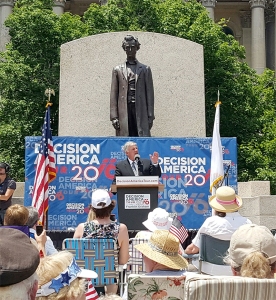
Springfield | On Tuesday, June 14, thousands gathered in Springfield to hear Franklin Graham, oldest son of evangelist Billy Graham, as he stopped in Illinois for his 50 state, Decision America Tour. Many braved the 90-degree weather and lined the streets and lawns surrounding the Illinois state capitol, as Graham challenged Christians to pray for the country and take a stand for their faith.

Churches from across the state were represented with many bringing vans of supporters. The crowd enthusiastically sang “How Great Thou Art” preceding the rally.

When Graham arrived, he began the time leading everyone in prayer for the people affected by the Orlando shooting. Using the tragedy as an example of our country’s sinfulness, Graham plainly stated that he has no hope in either the Democratic or Republican Party to turn things around.

“The only hope for the United States of America is the Almighty God,” Graham proclaimed, stating that God’s truth and righteousness should be the utmost focus of every evangelical Christian who calls this country home.

Graham went on that Christians must make their voices heard if America is to be preserved, and the Christian heritage restored that has given us the liberties we now enjoy.

Without telling people who to vote for, Graham simply asked those in attendance to consider pledging to: daily live out biblical principles, honor God in public, vote for political candidates if at all possible who uphold biblical standards, pray for our country, and lastly, consider if God so leads, to run for office.

Graham’s parting words: “Our job as Christians is to make the impact of Christ felt in every [area] of life – religious, social, economic, political… But we can only do [this] as we surrender ourselves completely to God, allowing Him to work through us… Let’s elect men and women to office who will lead this nation back to really being one nation under God.”

– Morgan Jackson

Politics and religion

Bloomington, Champaign, Decatur, Peoria, Springfield – these Illinois cities were all visited in the last few days by candidates vying for the U.S. presidency. As the March 15 Illinois primaries loomed so did the candidates.

I had the opportunity to attend one of these rallies, where I was packed into an auditorium with other would be voters. It wasn’t my first political rally, but I was struck as always by the sense of camaraderie displayed by the participants. You may not know anyone there, but you know you belong. You can speak freely with total strangers who won’t shout you down for your beliefs.

As we waited for the candidate to take the stage, organizers led us in enthusiastically chanting the candidate’s name. A local pastor came to the platform and lead a prayer for the nation. Then it was time to recite the Pledge of Allegiance. I almost said “amen” at its conclusion.

The candidate finally appeared on stage to much cheering and applause. As the speech continued the candidate’s voice fell into a rhythm as any good pastor’s would. Elderly women could be heard shouting, “Amen,” when something was said that they agreed with strongly. Soon they were joined by others. A few men even held their hands in the air as some do during worship services on Sunday mornings.

I realized then that for many, this was something akin to a religious experience and wondered if the churched and unchurched in the room knew it too. It frightened me in a way, and saddened me too. When was the last time I had been in a church service filled with such excitement? When had I last experienced such a sense of camaraderie and acceptance among fellow Christians?

There has been much debate lately about how Christians should behave as citizens of this nation and as citizens of heaven. Such debate is good and should take place. But what I’ll continue to ponder is how to be more loving and Christ-like to others inside and outside the walls of the church.

Lisa Sergent is a contributing editor to the Illinois Baptist.

The Briefing‘LSD in the water,’ says Moore
Here & Now’s Jeremy Hobson interviewed Russell Moore, president of the Ethics and Religious Liberty Commission, Feb. 29 covering the issues evangelical voters are most concerned about and how the tone of the campaign is resonating with them. “I think this campaign gives me reason to think someone has released LSD into the water system in this country, and every single day one looks at the news and cannot even fathom that it’s happening,” Moore cracked.

Baptist group: Keep church, political parties separate
Jon Akin wants members of his congregation in Lebanon, Tenn., to be politically engaged, but the Southern Baptist pastor thinks sermons should focus on the issues, not a particular candidate or political party. He belongs to Baptist21, a group of young Southern Baptist ministers who want a clear division between their denomination and the Republican Party.

Survey spotlights refugees, churches & fear
When it comes to helping refugees, Protestant churches and their pastors are often separated by faith and fear, according to a new survey from LifeWay Research. Most pastors say Christians should lend a hand to refugees and foreigners, and believe caring for refugees is a privilege. But pastors say their churches are twice as likely to fear refugees than they are to help them.

Kasich tells Christian bakers, ‘Make them a cupcake’
Republican presidential candidate John Kasich said that social conservatives need to “move on” from the issue of gay marriage and Christian wedding vendors shouldn’t deny service to same-sex weddings. Although Kasich, an Anglican, believes marriage is a union between one man and one woman, he said conservatives need to move on to more important issues.

Bible removed from POW/MIA display inside VA clinic
A Bible and Bible verse were removed from a POW/MIA display inside an Ohio Veteran’s Administration clinic after the Military Religious Freedom Foundation complained. They were part of a “Missing Man Table” recently erected by volunteers at an outpatient clinic in Akron.

Sources: Baptist Press, Christian Post, Fox News, Here and Now, USA Today

I Voted!With the nation’s first few presidential primaries and caucuses out of the way, pundits are scratching their heads and wondering why evangelical voters aren’t behaving as predicted. Among the three candidates most popular with evangelical voters, Donald Trump, a Presbyterian with a less than pious past, continues to best his two closest rivals – Ted Cruz, a Southern Baptist, and Marco Rubio, a Catholic who attends a Baptist church.

Now, many are starting to ask: “Who are these evangelical voters?” “Who are they really supporting, and why?” Some analysts say not all the people pollsters are calling “evangelicals” really qualify for that label. That may be the reason it appears the evangelical voting bloc is split. It may also be the reason Trump is claiming the support of evangelicals despite the outcry among some devout leaders that his lifestyle and apparent values clash with their own evangelical beliefs.

A survey by LifeWay Research and the National Association of Evangelicals (NAE) determined last fall that evangelicals (as most Southern Baptists would describe them) hold four common beliefs: the Bible is their highest authority, it is very important to share Christ with non-Christians, Christ’s death on the cross is the only sacrifice that can remove sin, and only those who accept Christ as their savior will receive eternal salvation

The survey surprisingly found just 41% of self-identified evangelicals hold all four beliefs, and 21% of those who rejected the evangelical label actually agree with all four. Other polls and studies have found many define evangelical in much broader terms, or as LifeWay’s Trevin Wax stated on The Gospel Coalition’s website, “’Evangelical’ sometimes means ‘cultural Christianity.’”

Later in that same article, Wax also blamed a lack of discipleship as a factor in evangelical voting writing, “A 30-minute sermon once a week or a brief morning prayer are not nearly as formative as the hours and hours a congregant may spend watching cable news, or listening to talk radio, or frequenting conspiratorial websites, or sharing articles that fan the flames of fear and anger.”

The National Review also weighed in after Trump’s win in South Carolina, the fifth most religious state according to Pew Survey. Writer JD Vance cited lack of church attendance by self-identified evangelicals as a factor in the second and third place finishes of Marco Rubio and Ted Cruz. “While approximately 80 percent of the country identifies as Christian, only about one in five regularly attend church services,” Vance wrote.

Based on this, he believes Cruz, who has most actively sought the evangelical vote, may be depending “on a group of religious voters who increasingly spurn church services and, consequently, traditional social conservatives like him.”

There is still much to be said. Next week is Super Tuesday, when Bible Belt states will have their say. While Illinois voters won’t go to the polls until March 15.

Perhaps Rubio, may have had the best insight when speaking after learning of this second place finish in South Carolina. “If it is God’s will that we should win this election, then history will say that on this night in South Carolina we took the first step forward in the beginning of a New American Century.” Truly, the outcome of the 2016 presidential election does hinge on God’s will.

Trump wins evangelicals in S.C.
Billionaire Donald Trump easily won the Republican presidential primary Feb. 20 in the evangelical Christian stronghold of South Carolina. The success among self-identified evangelicals in South Carolina of Trump nearly mirrored his total among all Republican voters in the state.

Planned Parenthood videos mostly ignored
Over the past six months, a series of undercover videos focused on Planned Parenthood made national headlines, provoked outrage in Congress, and prompted investigations in about a dozen states. However, LifeWay Research found 7 out of 10 people are either not aware of the videos (43%) or have not spoken out after seeing them (27%).

More sue home-school guru for sexual harassment
The sexual harassment lawsuit against Bill Gothard, whose ministry preached the subordination of women to men, has grown again. Now 18 people — 16 women and two men — are suing the 81-year-old founder of the Institute in Basic Life Principles, and the Oak Brook, Ill.-based institute. Thousands of conservative Christian families have relied on the IBLP’s home schooling curriculum.

‘Risen’ takes first in new releases
“Risen,” a film that tells of Jesus’ resurrection from the eyes of an unsaved soldier who participated in His crucifixion, opened in first place at the box office among new wide releases the weekend of Feb. 19–21.

Nike drops boxer over anti-gay comments
World champion boxer-turned-politician Manny Pacquiao apologized on social media for saying that people who engage in homosexual acts are “worse than animals,” but not before the remark cost him Nike’s sponsorship.

Sources: Baptist Press, Facts & Trends, RNS, World Magazine