Archives For November 30, 1999

The BriefingWhen it rains, it pours for weary south Louisiana
For the second time in five months, historic flooding has left widespread devastation and suffering through south Louisiana. As of Sunday afternoon, four people have been killed in the flooding, thousands have been displaced and thousands of homes, businesses and churches have been affected by the flooding. Louisiana Southern Baptist churches are responding amid the devastation.

Five Christian gold medalist Olympians at Rio 2016
Athletes from across the globe have gathered in search of gold at the 2016 Olympic Games, and five Christian sportspeople have managed to overcome obstacles to earn the top honor. Simone Manuel, Caeleb Dressel, Laurie Hernandez, Osea Kolinisau, and Anna Van Der Breggen are five Olympians whose Christian faith has helped them prevail when stumbling blocks could have prevented them from winning gold medals in Rio De Janeiro.

Egyptian sent home from Rio for refusing to shake Israeli’s hand
An Egyptian athlete who refused to shake his Israeli opponent’s hand after their judo bout has been reprimanded and sent home from the Rio Olympics. When Sasson extended his hand, El Shehaby backed away, shaking his head. The referee called the 34-year-old El Shehaby back to the mat and obliged to him to bow; he gave a quick nod and was loudly booed as he exited.

Russia’s ban on evangelism is now in effect
Last month, Russia’s new anti-terrorism laws restricting Christians from evangelizing outside of their churches, went into effect. The “Yarovaya package” requires missionaries to have permits, makes house churches illegal, and limits religious activity to registered church buildings, among other restrictions. Individuals who disobey could be fined up to $780, while organizations could be fined more than $15,000. Many are wondering how strictly will it be enforced.

Countries make Christian charity harder to give and receive
Nearly 20% of the world’s population could lose access to the ministry efforts of Western Christians next year. In April, China banned foreign nongovernmental organizations (NGOs) from engaging in or funding religious activities. The measure could expel Christian groups that are doing medical, developmental, or educational work in the world’s largest country by population, with 1.4 billion people.

Sources: Louisiana Baptist Message, Christian Post, Christianity Today, Christianity Today

The BriefingTransgender troop ban repeal called ‘disastrous’
The Obama administration’s decision to allow openly transgender people to serve in the U.S. military has been classified by Southern Baptist leaders as “deluded,” “disastrous” and a step toward self-inflicted “national weakness.” Mark Coppenger, a former Illinois pastor and retired Army officer, said lifting the ban imperils “decency” and “military readiness.

Justice Alito’s warning about religious freedom
The Court’s decision not to hear a case challenging a Washington state law that forces a family-owned pharmacy to dispense emergency contraceptives is an “ominous sign” for those who value religious freedom, Justice Samuel A. Alito Jr. said. “If this is a sign of how religious liberty claims will be treated in the years ahead, those who value religious freedom have cause for great concern,” Alito said in a critical dissent.

SCOTUS marriage ruling sparked ministry
Numerous Baptist state conventions have helped equip churches for ministry in the new marriage culture. “Our energy is going into making sure churches understand their religious freedoms regarding same-sex marriage assertions, and helping them take steps to protect those liberties through their bylaws and written operating procedures,” said IBSA Executive Director Nate Adams. We have used conferences, articles and especially downloadable resources on our website to make these protections as accessible to churches as possible.”

We’re talking about religion
When it comes to who’s having those religious conversations with family and friends, it’s particularly evangelicals and black Protestants. The majority of evangelicals talked about religion in the last month with their immediate family (70%) and people outside their family (55%). Most black Protestants also had religious conversations with immediate family (61%) and extended family (51%). \

Russian law would prohibit evangelizing
The proposed Russian laws, considered the country’s most restrictive measures in post-Soviet history, place broad limitations on missionary work, including preaching, teaching, and engaging in any activity designed to recruit people into a religious group. To share their faith, citizens must secure a government permit through a registered religious organization, and they cannot evangelize anywhere besides churches and other religious sites. The restrictions even apply to activity in private residences and online.

Sources: Baptist Press, Daily Signal, Baptist Press, Facts and Trends, Christianity Today

Jimmy Scroggins

Jimmy Scroggins

St. Louis | Speakers at the SBC Pastors’ Conference preached on one passage during the 2016 meeting in the Gateway City, diving deep into the apostle Paul’s instruction to younger church leader Timothy.

“Live This,” the theme of this year’s Pastors’ Conference, was taken from 2 Timothy 4:5-6, when Paul urges Timothy to “be serious about everything, endure hardship, do the work of an evangelist, fulfill your ministry.”

Ten preachers unpacked the Scripture passage, using their messages to urge leaders toward greater obedience, particularly the area of evangelism, and to be mindful of the legacy they’re leaving.

Do the work

“The last thing the nations need is the exportation of nominal Christianity from North America,” International Mission Board David Platt preached in a message on “do the work of an evangelist.”

In his post at the IMB, Platt says he sees much of the broader missions world that is “gospel-less and gospel-lite.” Debates about whether or not to call Jesus the Son of God when conversing with Muslims. Practices that minimize the call to Christ in the gospel, assuring people that they can be both Christian and Muslim.

Platt asked, What does that have to do with us? “Missionaries are reflections of the pastors who train them and the churches who send them,” he said.

“If we preach a small view of God, people will have a small view of the gospel. If we preach a glorious view of God, people will have a glorious view of the gospel.”

Jimmy Scroggins preached on Paul’s proclamation that he had “poured himself out” for the task of evangelism. The West Palm Beach, Fla., pastor opened his message by describing his diverse community. His congregation, Family Church, was named the 9th fastest growing church by a magazine, Scroggins said, which is the way it ought to be, because they live in an area with a lot of people who are far from God.

But even with their fast growth, “we are not making a dent in the millions of lost people right there within a few miles of our church,” he said.

Looking at recent statistics from LifeWay Christian Resources, it’s apparent churches across the SBC are facing similar challenges, Scroggins added. He gave conference attenders four steps churches and leaders can pour themselves out for the task of evangelism, starting with investing in far-from-God people.

Scroggins told the audience how, as a pastor in Kentucky, his church had been winning people to the Lord, but they were “nearly saved” people. In West Palm Beach, it was a different story. Some people may say evangelism just isn’t their lane, he said.

“If your lane does not take you and your church to far-from-God people, change lanes.”

Read the June 20 issue of the Illinois Baptist for additional coverage of the SBC Pastors’ Conference.

– Meredith Flynn

Idlewild

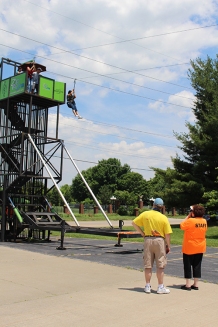
Members of the Idlewild Baptist, Tampa, Fla. Crossover team: (l-r) Catherine Corpus, Lina Freeman, Frank Mira, and Elroy Rodriguez.

“The walk to the top was the hardest part,” Armando Fernandez shared. “The ride down was easy.”

Fernandez, a Crossover volunteer from Idlewild Baptist Church in Tampa, Fla., was talking about the zip line ride at the Crossover block party at Sterling Baptist Church in Fairview Heights, IL. His description was not unlike the efforts to share the gospel through the many Crossover events that took place June 11. It can be tough to get started sharing the gospel, but once you do, it’s easy.

Sharing the gospel with the local community is what Crossover is all about. Each year hundreds of volunteers come to the Southern Baptist Convention a few days early to participate in Crossover evangelism outreach projects in and around the host city.

The St. Louis metro area – in both Missouri and Illinois – was the recipient of the the outpouring of the gospel. “We’re in love with the metroplex,” said David Gray, Sterling’s pastor. It’s that love that inspired the church to be a Crossover ministry site. Jesse Wilham, student pastor at Sterling, worked to lay the ground work for the evangelistic event.

Zip line

For many, the zip line was the highlight of the block party.

Whether it’s sharing the gospel story or planning an evangelistic event, the groundwork must be laid. Cooperation from a number of Christian ministries and agencies made the it easy for volunteers to be placed in situations where they could share Christ.

The North American Mission Board funded the zip line rides, which normally run $30-$50 per person. Five hundred hamburgers and hotdogs were donated by a local company. A children’s ministry from Chicago provided drinks. The city of Fairview Heights loaned tents to the church. Gray said the local Chick-Fil-A even set up a stand “because the manager said they needed to be part of the event.”

Seventy-five people from eight churches representing Florida, Illinois, and Missouri made it their mission to come to Sterling Baptist Church to help its members reach the diverse neighborhood around them — some 20,000 Anglo Americans, African Americans, Guatemalans, Puerto Ricans and Nepalese for starters.

Idlewild’s Hispanic ministries pastor, Eloy Rodriguez, said the team came to Illinois because, “We’re doing what the Lord has asked us all to do. This is our Samaria.” In Acts 1:8 Jesus instructs his followers to share the gospel in their “Jerusalem, Judea, Samaria, and the ends of the earth.”

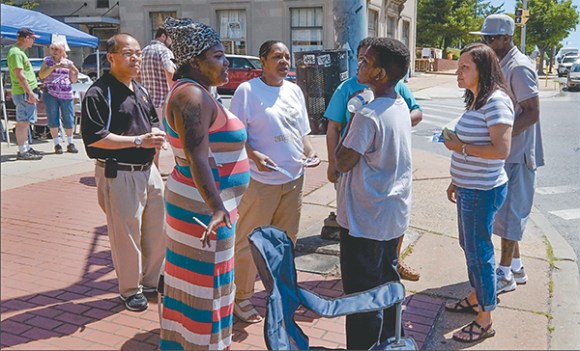
Their church has made it a practice to prayer walk their own community and others sharing Christ with the people they meet. “We’re doing what the Lord asked us to do, bring the Lord to the people,” said Lina Freeman.

The team arrived on Wednesday night and started canvassing the neighborhood Thursday. It was then that Rodriguez had a life-changing encounter with a neighborhood man. “We were asking people if there was anything we could pray with them about. Many said they had recently lost loved ones. But, one man said, ‘Last Sunday, I was going to kill myself.’”

The man told Rodriguez he had been in his car and was going to drive into traffic, put pulled back when he realized not only would he kill himself, but the people in the other cars as well.

Rodriguez and his team shared the gospel with the man who accept Christ as his savior. After wards, “That guy gave me the biggest hug I’ve ever had,” shared Rodriguez.

Down the street from the block party the church hosted a soccer tournament, and Saturday night featured a concert by the praise bands from Anna Heights Baptist Church and Iglesia Bautista Latina in Effingham. A Sunday night concert by the southern gospel trio Sons of the Father capped off the Crossover weekend.

Gray said his goal was to reach 1,000 people through Crossover, and by mid-Saturday the church was well on its way with 500 people registered at the block party and soccer tournament. The best news was 12 people had accepted Christ.

“It’s been phenomenal what’s happening,” Gray said.

– Lisa Sergent

Ready with a reason

ib2newseditor —  May 19, 2016

Crossover volunteers prepare for St. Louis

Steven_Glover[2]

Stephen Glover

Last summer, Steven and Robin Glover went home again—kind of. The Chicago couple and their children traveled to Columbus, Ohio, for the Southern Baptist Convention and Crossover, the annual evangelistic outreach held prior to the SBC.

Steven Glover, born and raised in Columbus, is an IBSA zone consultant in Chicagoland. His wife, Robin, is a writer and homeschool teacher to their four daughters. The Glovers lived in Ohio before moving to Chicago in January 2015, where Steven began a church planting internship at Uptown Baptist Church.

Each year before the SBC’s annual meeting, Uptown sends a team to work with a church in the convention host city. In Columbus, Uptown’s volunteers led a practicum on prayer, evangelism and discipleship at United Faith International Church. They gathered for training, then went out into the community to put into practice what they’d learned.

“Two groups comprised of 8-10 people targeted a neighborhood near the church for prayer walking as well as evangelism,” Steven said. “Upon arrival, the evangelism team had an immediate opportunity to share the gospel with young men hanging out in a local park who happened to be Muslims from Ethiopia.”

Glover and a man from the partnering church launched into an apologetics discussion with one of the young men who was interested in talking about his faith. They talked about Jesus, discussing the places where Islamic and Christian scriptures differed. “[We] took the opportunity to explain the purpose of Christ coming and the importance of his death, burial, and resurrection,” Glover said.

Nearby, his wife, Robin, and others on the team prayed for the conversation, even asking God for a break from the heat. “We were very hot and the sun was beaming down, so we prayed for a breeze,” she remembered. “Soon thereafter, there was a nice breeze and some light rain. The sun then returned to its work of warming.

“God was with us in Columbus. I was blessed to have joined him while he worked.”
Their Columbus experience gave the Glovers some advice for volunteers who will serve through Crossover in St. Louis.

“It is important that mission teams participating in Crossover 2016 be familiar with the demographic make-up of St. Louis,” Steven advised. “Through prior research, our mission team discovered that Columbus is known to have a large Islamic population, therefore, I brought with me a Quran (in English) to use in a witnessing conversation in order to establish the true identity and ministry of Jesus Christ.”

He referenced 1 Peter 3:15: “But sanctify the Lord God in your hearts and be ready always to give an answer to every man that asketh you a reason of the hope that is in you with meekness and fear” (KJV).

For a list of Crossover projects in Illinois, go to meba.org/crossover-st-louis-2016. Watch the Crossover St. Louis video at namb.net/crossover.

Stirring the Waters

After three years of declining baptisms, SBC leaders are calling it what it is—an evangelism crisis.

What happened to evangelism in the Southern Baptist Convention?”

The question, posed by SBC President Ronnie Floyd, came after the Annual Church Profile reports completed by Southern Baptist churches showed a third consecutive year of declining baptisms.

In fact, the total for 2014 (the most recent year for which national statistics are currently available) is the lowest number of baptisms since 1947. Southern Baptist churches baptized 305,301 people, a 1.63% decrease from the previous year. An in Illinois, the annual number of baptisms, which has hovered around 5,000, dropped to 4,400 in 2015.

“Deplorable” is how Floyd described the reality that even though there are more SBC churches than ever, and an ever larger population to reach with the gospel, it’s simply not happening—at least, not according to the baptism numbers.

Recently, Floyd and other SBC leaders have been increasingly vocal about how the numbers reflect an even bigger problem: an evangelism crisis.

“Lostness in North America is having a bigger impact on Southern Baptists than Southern Baptists are having on lostness,” New Orleans Theological Seminary President Chuck Kelley said at a recent chapel service.

The picture is bleak, but all is not lost, SBC leaders seem to agree. A turnaround is dependent on renewed appreciation for and dedication to evangelism in the Southern Baptist Convention and in individual churches. Church members need models, leaders who are soul winners themselves and can train people in the pews to share their faith.

“Let’s not be paralyzed,” Floyd wrote on his blog, urging Baptists to action. “Do something. Do more than you are doing now. Take a risk.

“Return to the importance of reaching and baptizing people.”

Mission drift

One reason some leaders cite for the SBC’s decline in baptisms, and overall in evangelism, is a culture that sidelines those things. In an address to the SBC Executive Committee in February, Floyd spoke about a critical shift that has brought the denomination to this point:

“Years ago, something happened where pastors and churches that reached and baptized people effectively came under the microscope of other Baptists who oftentimes did not have a heart for evangelism themselves. A culture of skepticism about evangelism began to creep into our convention. Evangelism began to die.”

Even the way we talk about evangelism is different, said IBSA’s Pat Pajak. The weekly opportunity to go out “soul winning” has been replaced with more politically correct titles such as outreach, or more often the practice has been lost altogether. “In the process, born-again believers have lost the passion and emphasis on reaching into the pagan pool and bringing the lost to Christ,” said Pajak, who leads the Church Consulting Team.

Recent research supports this: A 2012 study by LifeWay Research found that while 80% of Protestant church-goers believe they have a personal responsibility to share their faith, 61% hadn’t told anyone how to become a Christian in the previous six months. Nearly half (48%) hadn’t invited an unchurched person to attend a church event or service in six months.

LifeWay Research President Ed Stetzer broke down the research this way: “…The typical churchgoer tells less than one person how to become a Christian in a given year. The number for more than half of respondents was zero. The second most frequent answer was one.”
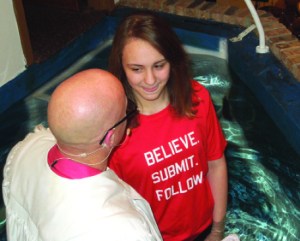
The shirt says it all -- Emily Zimmer is baptized by Pastor Tracy Smith at First Baptist Church in Mt. Zion.

The shirt says it all — Emily Zimmer is baptized by Pastor Tracy Smith at First Baptist Church in Mt. Zion, one of many congregations in Illinois that experienced large increases in baptisms in 2015.

To right the ship, SBC leaders have pointed first to the need for spiritual awakening—first in churches, then in the culture at large. But there are also solutions to be found at the denominational level and in local churches, starting with leaders.

Floyd recalled a time when only preachers who led strong evangelistic churches were invited to speak at the SBC Pastors’ Conference and annual meeting. Those leaders were also the ones nominated for denominational offices. In his November blog post about the state of evangelism in the SBC, Floyd seemed to call for a return to those principles.

“Quite honestly, I am not impressed by how many books a pastor sells, how many Twitter followers he may have, at how many conferences he speaks, how great of a preacher he is, or how much his church does around the world if he pastors or is associated with a church that has a lame commitment to evangelizing and baptizing lost people and reaching his own community with the gospel of Christ.”

At the local level, too, leaders can help reverse the decline by creating an environment that is conducive to evangelism, said IBSA’s Mark Emerson.

“The pastors who are effectively reaching people for Christ are creating an environment of evangelism in their churches,” said Emerson, whose Church Resources team equips churches in evangelism.

“They are making sure every ministry has an evangelistic purpose, they are designing their worship services to communicate the gospel and offer an opportunity for people to make a decision. These churches are training their members to effectively enter into gospel conversations.”

Modeling evangelism

Scott Foshie is one pastor currently training his congregation to have those gospel conversations. Steeleville Baptist Church will start evangelism training in April, based on the “Can We Talk?” program created by Texas pastor (and FBC Pastors’ Conference President) John Meador.

“When it’s time to bridge a conversation from small talk to gospel talk, that’s an awkward transition for people to make,” said Foshie, who has pastored the church since early 2015. The six-week curriculum combines training with practical experience; teams of three people go out into the community, visiting neighbors and practicing gospel conversations.

Foshie’s personal stake in the training goes beyond the fact that it’s happening at his church. As a student of the F.A.I.T.H. evangelism training tool, he led his future wife, Audra, to faith in Christ.

“Personal evangelism training is very important to me because it changed my life. So, I want people to experience that. Personal evangelism training unleashes the army of the Lord, (it’s) what God has called us to do.”

But first, people have to face down a common obstacle: fear. The pastor likened sharing the gospel to someone handing you the keys to their sports car and telling you to take it around town.

“What we need to teach them is, hey, you step out in faith, you begin to learn to share, you simply share, and the Holy Spirit’s going to help you,” Foshie said.

“Once people learn to share the gospel, it changes their life completely.”

Crossover makes a difference in host city and back at home

Uptown_Crossover

COLUMBUS – Mission volunteers from Uptown traveled to Columbus, Ohio in 2015, where they worked for two days training and encouraging local believers in prayer walking and evangelism.

The words of an old praise chorus aptly describe the effect missions can have in a local church:

“It only takes a spark to get a fire going…”

Once church members who have engaged in missions start “passing on” their experiences to their friends, it can ignite a missions fire of sorts, causing a church to look in their own neighborhood and beyond for ways they can reach more people with the gospel.

That’s how IBSA zone consultant Steven Glover describes the impact of Crossover, an annual outreach event held prior to the Southern Baptist Convention. This year’s Crossover initiative in St. Louis is planned largely for Saturday, June 11, although some projects start earlier (see planning checklist below).

Last year, Glover and his family participated in Crossover with a team from Uptown Baptist Church in Chicago. The volunteers worked with a church in urban Columbus, Ohio, to prayer walk their community and share the gospel with people they met. Glover and the team also helped train the Ohioans in prayer walking and evangelism, equipping them for the ministry they did together.

Once they got back to Chicago, they shared with the rest of the congregation what had happened in Columbus. As with any mission trip, the resulting benefits could have stopped there, Glover said.

“But if you have people who have participated in and are excited about it, they’ll continue to talk about it,” he said. That’s why the key is getting as many people involved as possible.

This year, Uptown will take a team to St. Louis to work with a church in a similar ministry setting as their own inner-city church. In Columbus, said Uptown’s missions coordinator Doug Nguyen, the church worked with “an urban congregation that ministered to Muslims and immigrants, as well as families around the neighborhood in downtown Columbus.
“And we’re looking to do the same in St. Louis.”

Uptown_Crossover_2014

BALTIMORE – Members of Uptown Baptist’s Crossover team share the gospel prior to the 2014 Southern Baptist Convention.

 
After Uptown partnered with a Baltimore church for Crossover in 2014, they were able to pray for the congregation specifically when rioting broke out in the city the next spring. “We’re all praying for them right now, for churches to really step up and be the salt and light in that community,” Nguyen told the Illinois Baptist at the time.

When mission volunteers help other Christians reach their community, they’re bearing each other’s burdens, Glover said. They’re energized by helping fulfill the Great Commission, by doing what God has called his people to do.

They’re also more likely to come back home and find ways to do the same in their own city.

“It’s a good investment,” Glover said, “because it’s an ongoing thing.” Iron sharpens iron, he said, referencing Proverbs 27:17. “Getting next to someone who has gone out and done that has such an impact.”

Crossover checklist

Making plans to join Uptown and hundreds of other churches at Crossover prior to this year’s Southern Baptist Convention? Start now by working through this checklist of questions:

Who’s going?
As you recruit volunteers for your Crossover team, think about who they are. What are their ages, ministry skills, and spiritual gifts?

View the list of Illinois Crossover projects at meba.org/crossover-st-louis- 2016, and look for those that fit your team. For example, if you have Spanish speakers in your group, consider joining Iglesia Bautista Maranatha in Granite City for prayer walking and door-to-door evangelism in their community.

Interested in sports outreach? Help Sterling Baptist Church host a 3-on-3 basketball tournament.

What time can they give?
Most Crossover projects happen the Saturday before the Convention begins—this year, that’s June 11. But some initiatives cover a longer span of time:

  • A church plant in Fairmont City needs help with a home makeover
    project June 6-11.
  • Two congregations in Hartford and East Alton are working together on a week-long canvassing project, capped off with a community block party.
  • A new church in Collinsville will utilize volunteers for community surveying and sharing the gospel on  Saturday, and then will host a preview worship service Sunday.
  • Check the full project list at meba.org for more multi-day opportunities.

What’s next?
Start thinking now about how to share your ministry experiences with the congregation back at home.

Which stories best illustrate how God worked through your team to increase your partner church’s influence and favor in their community? Did anyone accept Christ? What spiritual needs can your church pray for over the next year?

Also, how might you extend the relationship with your Crossover partner church? Uptown kept in touch with Baltimore pastor Ryan Palmer, who they worked with in 2014. He visited Uptown when he was in Chicago the next year. As you plan your Crossover project, consider how it might spark a ministry partnership that goes beyond one day.

ACP tallies reveal challenge

Lisa Misner —  February 29, 2016

Good attendance tempered by fewer baptisms

For IBSA churches, 2015 was a year of ups and downs: giving and attendance were up, but baptisms were down.

“It seems clear to me that being a Baptist here in Illinois, indeed being a Christian in America, is becoming increasingly counter-cultural,” IBSA executive director Nate Adams said. “We no longer reach people and grow churches simply by opening the doors on Sunday morning.”

A rebounding economy and continued emphasis on missions giving may be behind a 1.53% increase in Cooperative Program giving to $6,230,082 (reported prior to completion of the annual audit) and a 10% hike in the Mission Illinois Offering last year at $403,595, according to the tallies of the Annual Church Profiles submitted by IBSA churches.

Total membership is up by more than 1,000 in IBSA churches (to 193,972), and worship attendance is up by almost 5,000 (7.3%) over the previous year. But baptisms declined by 2.4% to 4,400. That’s down 105 from the previous year, and down from recent averages around 5,000 per year.

On the positive side, the number of churches reporting baptisms was 591, up 29 churches from the previous year; and the number reporting zero baptisms was down by 25 churches to 366.

“The need has never been greater to live out 1 Corinthians 9 and become all things to all people to reach some, while also living out Romans 12 and refusing to be conformed to the culture in which we find ourselves,” Adams said.

Another bright spot in the 2015 ACP report is participation in missions and leadership development: Just under 24,000 volunteers from IBSA churches were mobilized for missions projects in Illinois and worldwide. And IBSA trained 8,932 leaders from 592 churches in a variety of ways, for a total of 20,203 personal training sessions.

And in a new reporting category, IBSA set a goal for 2015 of at least 100 new Bible study groups; churches blew past that goal and started 229 groups.

“One way to summarize those two contrasting pictures of our mission here in Illinois might be to simply say that fewer people are doing more with less,” Adams concluded. “Another way might be to say that some churches are doing well, while others are struggling. My primary concern is that, in total, our churches’ cumulative statewide impact on lostness in Illinois is not growing, at least not numerically.”

And with at least 8 million people in Illinois who do not know Jesus Christ personally, there’s plenty of room for improvement.

IBSA has targeted five areas for kingdom growth in 2016, rolled out at the Annual Meeting in November: evangelistic prayer, witness training, outreach events, expanded VBS, and new groups. A study in the Midwest showed that churches engaging in these activities were more likely to lead people to faith in Christ and to grow disciples. The IBSA Church Resources Team is assisting all churches that want equipping in these areas.

Look for a full report on baptisms and the evangelistic activity of IBSA churches in a future issue of the Illinois Baptist.

– Staff

The State of the Mission

Lisa Misner —  January 25, 2016

Nate Adams State of the MissionI’m writing this the day after watching President Obama’s final State of the Union Address. After almost an hour of evidence and persuasion, the President neared the end of his address by declaring, “And that’s why I stand here, as confident as I have ever been, that the state of our Union is strong.”
A few minutes later, South Carolina Governor Nikki Haley delivered the Republican response, acknowledging that President Obama “spoke eloquently about grand things,” and that “he is at his best when he does that.” Then she quickly added, “Unfortunately, the President’s record has often fallen short of his soaring words.” She went on to describe what she called a weak economy, a crushing national debt, an ineffective healthcare plan, chaotic unrest in many cities, and “the most dangerous terrorist threat our nation has seen since September 11th.”

And so viewers were left to wonder which facts to believe, which leader to trust, and which picture of America is most accurate.

I understand the dilemma, though. Here at IBSA, we are at the time of year when we cumulate and analyze data from almost a thousand churches’ Annual Church Profiles (ACPs).

Looking at some measurements, the state of our mission here in Illinois appears strong, at least compared to the previous year. The number of new church plants rebounded from 7 in 2014 to 22 in 2015. Cooperative Program missions giving was up 1.5% in 2015, and Mission Illinois Offering giving was up more than 10%. Mission trip participation remained strong at just under 24,000 volunteers.

But other measurements might produce a different picture. Baptisms reported by IBSA churches in 2015 are down from 2013 for the second straight year, and overall worship attendance and Bible study participation were flat to down as well.

My primary concern is that, in total, our churches’ statewide, cumulative impact on lostness in Illinois is not growing, at least not numerically.

President Obama quipped near the beginning of his address that he would try to be brief, because he knew there were several in Congress who were anxious to get back to Iowa (to campaign for the 2016 Presidential election). His joke underscored the reality that, whatever you may think about the current state of things, the more important issue is where we go from here.

To advance our mission here in Illinois, I would challenge us toward two primary imperatives—evangelism and leadership development.

I wrote recently about five actions in churches that, statistically speaking, most often result in people coming to faith in Christ. They are an evangelistic prayer strategy, Vacation Bible School, witness training, outreach events, and starting intentional new groups. If your church could use some help in these areas, our IBSA staff would love to assist.

I would also challenge us all to develop leaders more intentionally in our churches. At this month’s Illinois Leadership Summit, more than 200 church leaders are gathering at the IBSA Building in Springfield to explore what it means to “lead self, lead followers, lead leaders, and lead organizations” more effectively. Even if you miss the Summit, our IBSA staff will welcome the opportunity to help you and your church leaders with an intentional leadership development process.

In many ways, the state of our churches’ mission here in Illinois is still strong. But to keep it that way, and to advance the gospel into the lostness of Illinois, we must recommit to the important work of evangelism and leadership development.

Nate Adams is executive director of the Illinois Baptist State Association. Respond at IllinoisBaptist@IBSA.org.


Higher resolution

Lisa Misner —  December 31, 2015

Higher resolutionWe have a new TV at our house. It was probably overdue, because our previous TV was 15 years old, square, and only showed about two-thirds of the information that now seems to scroll continuously along the bottom of the screen.

But that outdated, misshapen, low resolution, antiquated TV simply would not die on its own, though I would occasionally toss the dog a ball in its direction, hoping something would happen. The old TV was still functional, and so year after year, we kept settling for that increasingly dated picture of our world.

As we now enter a new year, I feel the need for higher resolution in my spiritual life as well. Perhaps you do too. I don’t want to keep settling for an old picture of how things are, or how they should be, while the rest of the world is so quickly changing around me. I want my life and my church to have a sharp, accurate new picture of our purpose and mission in the world.

What does that mean? Well first, I think I need a new, higher-resolution picture of lost people. I need to stop seeing those around me who don’t know Christ as satisfied, self-sufficient neighbors who deserve their privacy. I need to see them clearly as hollow souls, spiritually dead on the inside, who are living life with quiet, inward desperation until someone finds a way to break through with the good news about Jesus.

I also need a higher resolution picture of what it actually takes for me and my church to deliver this good news. I can’t keep seeing the routine weekly schedule of my church as an adequate witness in my community. I need to see clearly what behaviors and changes are needed to actually share the gospel with people, and welcome them into the family of disciples that we call church.

I wrote recently about five actions that, statistically speaking, most often result in people coming to faith in Christ. They are an evangelistic prayer strategy, Vacation Bible School, witness training, outreach events, and starting intentional new groups. If my church and I don’t at least embrace those proven actions, we’re probably not seeing clearly at all.

Finally, I also need a higher resolution on what people, organizations, and partners are actually advancing the gospel, and most deserving of my time and resources. A couple of years ago, my wife and I updated our estate plan, and it made us think carefully about where we want the resources of our life to go. Sadly, in just a short time, some of those organizations or people have changed or drifted enough that we feel a need to rethink our plan. We want to generously give our best, but with a clear, current picture of where our investment brings the greatest Kingdom return. I’m happy to say that our cooperative missions work here in Illinois is still on the top of that list.

You should see our new TV. It’s not only larger than the old one, the picture is incredibly sharp, it’s relatively lightweight, and because it’s a “smart” TV, we can now access all kinds of new features through the Internet. It’s amazing. Yet it cost less than half of what we paid for its antique predecessor 15 years ago.

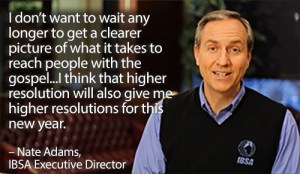
I can see things so much more clearly now. It makes me wonder why I waited so long to get a better picture. I don’t want to wait any longer to get a clearer picture of what it takes to reach people with the gospel either. I think that higher resolution will also give me higher resolutions for this new year.

Nate Adams is executive director of the Illinois Baptist State Association. Respond at IllinoisBaptist@IBSA.org. This column appears in the 1/4/16 issue of the Illinois Baptist.