Archives For November 30, 1999

Mark_Coppenger_blog_calloutCOMMENTARY | Mark Coppenger

You know the scene: A troubled family member arrives at home only to find various loved ones seated in the living room. They ask him or her to sit down and hear what they have to say. One by one, they read prepared statements of love and admonition. The subject, eyes brimming with tears or flashing with indignation, endures as much as possible before caving in, pushing back or storming out.

The poor soul has bottles hidden around the house and in the flowerbed, and she can find another pint as soon as her prime stashes are blown.

Or there’s the trash addict who can’t throw anything away, even dead animals. (I was called in on a cleanup with some church members in my seminary days; we found a dead, dried out cat under matted stained clothes under stacks of newspapers in one of the closets.)

An intervention is very uncomfortable but worth it, whether the addiction is drugs or drink, clutter or cussedness. They’re ruining themselves, as those around them are grieving if not outright harmed. And they don’t much appreciate your suggestion that something is out of whack.

I know that people can come to Christ in a lot of tender ways. An immigrant wife is touched by her Christian neighbor’s shopping and language tips. A lost welder is disarmed by the warmth of a church softball team he’s been asked to join. A “singing Christmas tree” rendition of Joy to the World brings tears to the eyes of a cranky, unchurched parent who shows up to watch his high school senior perform.

But the Lord has also used Jonathan Edwards’ Sinners in the Hands of an Angry God and the chaste slap of a godly college girl knocking some sense into a unbelieving suitor, whose advances were unseemly, a jolt which caused him to reassess his secular worldview. Or how about Mordecai Ham’s scathing anti-alcohol parades, which salvifically grieved some drunks standing outside bars on the roadside?

God may well use a sequence of happy and scary events and items to lead an individual to Himself. (I think I once heard the late evangelism professor Roy Fish say the average was seven Gospel touches before conversion.)

So Bob may have been providentially prepped for salvation by, in order, a Vacation Bible School lesson he heard at age 8; a highway sign reading, “Prepare to Meet God”; a Jack Chick tract named Holy Joe; the stellar performance of a homeschooled spelling bee champ who thanked Jesus for helping her; five minutes of a Joel Osteen sermon; and a friend who repeated something he heard in an Alistair Begg broadcast.

Truth is, we risk looking silly when we declare, well beyond our competency and theological warrant, that all evangelistic approaches other than our own are tacky, pompous, dated, specious, trendy, dopey, sleepy, grumpy, sneezy and bashful.

That being said, there is an irreducible kernel of awkwardness and agony in conversion — repentance. I compare it to throwing up. I hate it. I fight it. (On a bucking airplane I close my eyes, turn the air full blast on my face, breathe deeply and sit very still.) I suppress it with every fiber of my being. But when it comes, oh, the relief — the blessed cooling of a sweaty brow, the relaxation of suppressed muscles.

Yes, it’s that gross, as is repentance, as we hurl up and out the poison and rot of self and sin and damnable, willful stupidity — the sort of thing you find in James 4:8-10: “Cleanse your hands, sinners, and purify your hearts, double-minded people! Be miserable and mourn and weep. Your laughter must change to mourning and your joy to sorrow. Humble yourselves before the Lord, and He will exalt you.”

Sometimes we hear and say that a witnessing Christian is “just one beggar telling another one where to find bread.” I’d suggest it’s more like a formerly-suicidal fellow who was talked off the ledge trying to talk a currently-suicidal fellow off the ledge. Or it is like a repentant Taliban terrorist in Gitmo going on TV to dissuade current Taliban terrorists to cut it out.

Of course, most don’t think that a law-abiding, philanthropic citizen — working the NYT crossword in Starbucks on Sunday morning, sitting across from his wife Khloe enjoying a half double decaffeinated half-caf with a twist of lemon, beside their jogger stroller bearing little Nash — is a suicidal terrorist. But he is just as we were. He’s bound for a well-deserved sinner’s hell, indifferent to the godly stewardship of his life, harming innocents along the way by his passive, aggressive and passive-aggressive defiance of the Kingdom and its gospel of grace, Khloe and Nash being his prime victims as his “spiritual leadership in the home” couples them to his downgrading train.

And so we intervene. If, that is, we love the person, are convinced of his plight and are willing to risk the alienation of affection. It doesn’t take licenses or programs or eloquence, though those can help. It simply demands compassion, courage, a firm grasp of the hard truth and, yes, a life which reflects a better way.

Mark Coppenger is director of the Nashville extension center and professor of Christian apologetics at Southern Baptist Theological Seminary in Louisville, Ky. This column first appeared at BPNews.net.

browniesTHE BRIEFING | Meredith Flynn

A new Barna study shows 70% of American adults (and 72% of Christians) are aware of the Lenten tradition of giving something up in order to draw closer to God. But only 17% plan to observe Lenten sacrifice this year. Here’s Barna’s list of what they’re giving up:

88% of adults plan to fast from food or drink:

  • Chocolate (30%)
  • Meat (28%)
  • Sugar (28%)
  • Soda drinks (26%)
  • Alcohol (24%)
  • Fruit (14%)
  • Butter or cream (11%)

31% will give up some form of technology:

  • Social networks (16%)
  • Smartphones (13%)
  • TV (11%)
  • Video games (10%)
  • Movies (9%)
  • Internet (9%)

Barna found the millenial generation (born after 1980) is the least likely to know about Lent, but millenials are more likely than other age groups to fast during the season. Read more at Barna.org.

Other news:

Prayer ‘more popular than ever’ says Reader’s Digest
“Organized religion may be losing members, but prayer is more popular than ever,” according to an article in the April issue of Reader’s Digest. The story points to research in the 2010 General Social Survey, which found 86% of Americans pray and 56.7% do so at least once a day. But how they’re praying may look different. Writer Lise Funderburg cites several examples of how the prayer umbrella is widening, including sidewalk chalk prayers outside a Presbyterian church in San Francisco, and the use of Twitter to start prayer movements like #pray4philippines.

The Illinois Baptist examined prayer and spiritual awakening in a January cover story. And Southern Baptist leaders have met together twice recently to pray for individual and corporate revival. Read more at BPNews.net.

Menlo Park Presbyterian leaves denomination over doctrinal, evangelistic differences
A San Francisco church “increasingly out of alignment” with their denomination has voted to sever ties with the Presbyterian Church (USA). Earlier this month, 93% of members at the 4,000-member Menlo Park Presbyterian approved the move, Baptist Press reports. The church, led by Pastor John Ortberg, has for years referred to itself as a “Jesus church,” according to a statement by church leaders. “We believe that God has expressed himself uniquely in his son Jesus, who lived, taught, died and rose again for our sakes.”

BP reports a 2011 survey of PCUSA pastors found only 41% agreed with the statement, “Only followers of Jesus Christ can be saved.”

The decision will cost Menlo Park $9 million because the denomination owns its property. “This points to the fact that theology matters,” Southern Seminary President Albert Mohler said of the decision. “Keeping the faith is worth infinitely more than $9 million.” Read more at BPNews.net.

‘Son of God’ in top 5 over first two weekends
The movie built from last year’s “The Bible” miniseries was the second-highest grossing movie during its opening weekend, and fell to #5 after its second. Some had thought “Son of God” would reach the numbers posted by 2004’s “The Passion of Christ”, The Christian Post reports, but the new movie’s grosses so far aren’t half of what “The Passion” took in during its debut weekend. Read more at ChristianPost.com.

More Africa stories
Five volunteers from Illinois recently spent a week in Guinea, telling true stories from the Bible to people who had never heard them. For people in the West African nation to know Jesus, “it can only be a move of God,” said one mission volunteer. Read more about their team’s experiences in the current issue of the Illinois Baptist.

Nate_Adams_blog_callout_2HEARTLAND | Nate Adams

Last month Directors of Missions and other associational leaders from around the state gathered at the IBSA Building for a time of leadership development, fellowship, and strategic thinking about how best to assist churches. Dr. Chuck Kelley, president of New Orleans Baptist Theological Seminary, was invited to speak to us on “Fostering a Positive Baptism Trend in an Association.”

To set the stage, Dr. Kelley reminded us that the number of baptisms in SBC churches overall has been on a 50-year plateau, and has now actually declined six of the past eight years. Nationwide data for 2013 is not yet available, but in 2012 baptisms declined 5.5% from 2011, to only 314,956. That’s the lowest level since 1948, when SBC churches reported only 6 million members rather than the current 16 million. In fact, to give those numbers some further context, baptisms totaled 445,725 in 1972, and 429,063 in 1959.

Here among IBSA churches, baptisms were actually up 3.1% in 2013 to 5,063, building on the previous year’s 2.6% increase. Still, 2013 is our churches’ first year above 5,000 baptisms since 2009. And in 2005, IBSA churches reported 6,499 baptisms.

While all of us were eager to hear what Dr. Kelley would suggest, none of us were really surprised when he said there are no easy answers to reversing the current baptism trend. I was personally grateful to hear him underscore that we shouldn’t seek to affix blame or pass the buck. Instead, we all need to focus passionately and sacrificially on the urgent need to reach people with the Gospel in an increasingly challenging environment.

While I don’t have space here to recap everything Dr. Kelley shared with us, I can share his alliterated outline. He said we need to Focus on Filling (of the Spirit, or revival), on Fruitfulness (intentional evangelism), on Faithfulness (a return to true discipleship), and even on Fighting (embracing the inevitable conflict that comes when change is needed, yet with Christ-like attitudes and righteousness).

All of these points hit home deeply with me, and couldn’t have come at a better time. Not only are we beginning a new year of ministry here at IBSA, and in all our churches, but we are also beginning our planning and budgeting for 2015. We can’t keep doing ministry as usual and expect a much different result.

As Dr. Kelley urged, we must persistently ask God to fill us afresh with His Spirit, and bring revival to our churches and spiritual awakening to our land. We must focus much more intentionally on fruitfulness, starting new Bible studies and Sunday School classes and evangelistic ministries, and equipping believers to courageously share the Gospel. We must more carefully embrace true discipleship, investing God’s Word deeply in those who will be faithful to live the Gospel and pay it forward into the lives of others. And yes, we must be so committed to a different level of fruitfulness that we are
even willing to engage the conflict that often seems to come with change, even in churches.

Those of us leading and serving churches today have lived most of our adult lives on the downwardly sloping plateau of this baptism trend. In many ways we have been maintaining our processes and doing church in comfortable ways, and if we simply continue our current patterns in the face of a changing culture, we will soon see the downward slope of the current trend steepen dramatically.

So as we prepare to plot one more year of baptisms on the chart of history, it is this urgency of reaching spiritually lost people with the Gospel that must compel us, and our churches. Baptisms may not be the only measure of fruitfulness, but they are a measure that we cannot be content to see in even gradual decline.

Nate Adams is executive director of the Illinois Baptist State Association.

CONVERSIONS COUNT – “We have to help our churches focus on bearing fruit, and to keep up with that as a measure of how they’re doing,” NOBTS President Chuck Kelley told associational leaders in Illinois. “Fruitlessness is becoming endemic in Southern Baptist Life.”

CONVERSIONS COUNT – “We have to help our churches focus on bearing fruit, and to keep up with that as a measure of how they’re doing,” NOBTS President Chuck Kelley told associational leaders in Illinois. “Fruitlessness is becoming endemic in Southern Baptist Life.”

The SBC’s declining numbers are real. But there are solutions, says seminary president Chuck Kelley.

NEWS | Eric Reed

Since he began studying and teaching evangelism more than 30 years ago, New Orleans Baptist Theological Seminary President Dr. Chuck Kelley, told associational leaders in Illinois in January, we’ve been quoting the same statistic: 30% of our churches are growing, and 70% of all Southern Baptist churches are plateaued or declining. “The difference today is the 70% aren’t so much ‘plateauted;’ our churches are declining. We are a convention at a crossroads.”

Kelley is one voice in a chorus of national leaders calling on Southern Baptists to end the decline in baptisms and missions giving in our churches that threatens fulfillment of our kingdom work and the future of the denomination itself.

The head of the convention’s executive committee, Dr. Frank Page, also delivered a stark address in January. “…You say, ‘What is our future?’ I do not know. I’m asked that every week by someone, and I say, ‘I cannot answer.’ If things do not change, I can tell you in 20 years we will be happy to have 27,000, not 47,000 churches,” Page said.

In a “State of the SBC” address at Midwestern Seminary, Page cited “fault lines” in the denomination, where pressure has built and the fabric of the organization is threatened. Among them are the arguments over the nature and authority of Scripture in the 1980s, and more recently the debate over Reformed theology, methods of funding missions, and democratic-based church governance.

The effect of these “fault lines” is seen in declining baptisms and a 20-year downward trend in missions funding through the Cooperative Program. “We have argued over issues that have taken away our evangelistic fervor to the point that now our baptismal rates have reached a low not seen since 1948,” Page said. “God help us.”

Southern Baptists baptized 314,956 people in 2012, the most recent tally available. That was a decline of 5.5%. The figure compares to the post-war baptismal rate, when Southern Baptists numbered 6 million, in contrast to today’s 16 million. A decade-long focus on evangelism after World War II produced the denomination’s greatest surge of conversions, peaking at 445,725 baptisms in 1972, and the steam to power the next six decades downhill from there.

Leaders are hopeful that a final tally on 2013 baptisms and Cooperative Program giving, due soon, will show a slight uptick, and perhaps end the slippery slope. And in Illinois, baptisms and giving are up for 2013.

Still, national leaders are now talking publicly and regularly about the SBC as a denomination that is plateaued and declining, mostly declining.

Page’s speech, now being viewed widely on the internet, comes on the heels of “an open letter” from LifeWay President Thom Rainer calling on members of what is still the largest Protestant denomination in the United States to recapture their zeal for evangelism.

“Where is the passion in most of our churches to reach the lost?” Rainer asked. “I thank God for our affirmation of the total truthfulness of Scripture. I thank God for orthodoxy. But I pray that it is not becoming a dead orthodoxy – an orthodoxy that has lost its first love.”

“I have no proposal,” Rainer summarized. “I have no new programs for now. I simply have a burden.”

Kelley’s proposal

The history of every church and denomination is growth, plateau, and decline, Kelley told associational leaders meeting at the Illinois Baptist State Association building January 27-28. Pointing to Methodists, Presbyterians, and other mainline

denominations, Southern Baptists for many years expressed thanks we weren’t following their decline. Now we are. “We are seeing a growing gap in the rhetoric about Southern Baptists and the reality of where we are,” he said.

And the declines are in all parts of the U.S. “We’re losing the South,” Kelley said. “You need to be aware that the South is becoming more like Illinois; large blocks of unreached people, and churches that are smaller.”

And a new generation that is not following their parents’ lead by staying in church after they reach adulthood.

Kelley likened the denomination’s downward turn to an airplane in a tailspin: beyond a certain point, the pilot can’t pull the nose upward and right the plane. “We’re nearing that point,” Kelley said.

He identified four factors in this precipitous decline, problem areas that also point to possible solutions:

Elephant 1: Awakening

“We have a power problem,” Kelley said. “We have gotten so used to working without the filling of the Spirit of God, we don’t know it’s not normal. Kelley called for church leaders to encourage prayer for spiritual awakening: “This is like stacking the firewood for God to light the fire.

“We need to have solemn assemblies, for our people to seek a move of God… If God isn’t moving, there is an issue within us,” he said, pointing to the need for repentance.

Elephant 2: Conversions

As the numbers have dropped, Southern Baptists have moved away from publically counting baptisms as a measure of our fruitfulness. While Kelley acknowledged there have been misuses of the system in the past, he said our churches must return to a focus on fruitfulness. Specifically, we need to see conversions as a measure of “what God is doing in our churches.”

“Many of our churches have the Sunday school attendance posted somewhere, and last week’s offering,” Kelley said, “but I have been in very few churches that have in a public place how many people they have baptized – and even fewer that have a public goal of how many they want to baptize.”

He offered three measures of fruitfulness: beyond conversions, churches should measure ministry to the community. “Most churches do not have a muscle set for ministry to the community,” he pointed out, but it is community ministry that opens doors for evangelism.

And churches should measure church planting, their own participation in the reproductive process that brings healthy new congregations into existence, with members fueled by the salvations of their lost family and friends.

Elephant 3: Discipleship

While the rhetoric in our high-point decades was about evangelism (“A million more in ’54!”), the real genius of the period, Kelley contends, was in our dis

ciple-making mechanisms: Sunday school and training union. These methods focused on making new believers into disciples, who then led more people to Christ.

But, he said following extensive study, “Every methodology has a shelf life, and as the methodology wore out its shelf life, we did not replace it…. Our discipleship processes have been dismantled, not intentionally, but by attrition. Our discipleship has become a patchwork that is reinvented every year. It’s a series of things, not a cohesive strategy.”

In the last 20 years, Kelley said there has been a “megashift” in SBC life from the priority of discipleship to the priority of worship. One result is under-educated people who call themselves Christian, but whose lifestyles are little different from unbelievers.

“When I grew up, we still had a sense of being a stranger is a strange land. We were counter-culture…. I’m not calling for a return to the sixties. I am saying we have to find for today what a distinctly Christian lifestyle looks like and teach our people what living distinctly Christian lives is, so that we have evangelism that will impact our society.”

One of our needed conversations is how we will lead our congregations to spiritual maturity in this new era.

Elephant 4: Fighting

Finally, Kelley pointed to a significant shift he has witnessed from the seminary campus: “Today’s seminary students are not interested in going into existing churches, because they are scared. They have seen the results and heard the horror stories of church fights,” Kelley said.

Yet, that’s where the need is, in existing churches that are plateaued or declining. “If a pastor comes to bring growth, there will be conflict. We need to have conversations about how to have conflict.”

Kelley said leaders need to help their churches process conflict in ways that bring positive change and do not harm the Body of Christ. “Not all church fights are the result of failure on the part of the pastor, or of having ungodly people in the pews. It is the result of change. Leading change creates conflict,” Kelley said.

It also turns declining churches – and denominations.

Mark_Warnock_blog_calloutCOMMENTARY | Mark Warnock

I resigned in December from my church, First Baptist Columbia, to return to my home state of Florida. God has burdened me with the vast lostness of South Florida, and impressed upon me a duty to be closer to my aging parents. I’m moving down to join a church planting movement in South Florida, and to shine my little Gospel light in that darkness.

This move brings to a close 17 years of ministry in Illinois – six-and-a-half years in Chicagoland, and eleven years in the Metro East. I leave behind a host of people at my church and throughout the state that I love and respect. As I leave Illinois, I see both a lingering challenge and a great hope.

The primary challenge I see is the same one the church faces everywhere: selfishness. On a personal level, a church level, and a denominational level, we must fight constantly the Satanic gravity of our own selfishness that wants to make our lives all about us, our churches all about us, and our denomination all about us.  Jesus our Savior came not to be served, but to serve, and He calls us to deny ourselves, to take up our cross and to follow Him.

God formed a church to be a light to the world, for His glory. He has graciously allowed us to cooperate as a denomination to pool our efforts to fulfill the Great Commission, for His glory. So to the leaders in Illinois: Do not stop calling us outward, to the lost. Remember Luke 15, and the priority of God our Father: “…there is joy in the presence of God’s angels over one sinner who repents.”

This fight to keep our eyes outward is not in vain, because there are signs of hope everywhere. Here are three I see:

Planting churches. I learned during my time at Columbia that one key to a healthy church is a steady stream of new converts. Like families, which continue to exist only if new babies are regularly born into them, churches begin to die without new spiritual life, and denominations begin to die without new churches.

I’m encouraged that God is calling men and women to devote their lives to starting new churches, and that IBSA is giving great priority to new church starts all across the state. Even more, I’m encouraged that increasingly, established IBSA churches are beginning to discover the joy and adventure of partnering with, supporting and working alongside church plants for the advancement of the Gospel.

Thinking students. I began teaching high school students at IBSA’s Super Summer in the late 90s. Many of the students I had in the early years are now pastoring or leading in churches across our state. I have been consistently impressed with the quality of the students in Illinois. They are passionate about the Gospel, hungry to be taught, and eager to love God with their minds. If our churches fail to equip our students with a clear understanding of the Gospel and the intellectual tools to be apologists in a hostile culture, we are in deep, deep trouble. The good news is that when presented with the challenge, our students – our future leaders – consistently rise to it.

A saving God. The real reason I have hope for the Gospel in Illinois and in South Florida? God keeps saving people. In my Monday night men’s group in Columbia, God kept saving some of the most unlikely men. In my first Sunday at my new church in West Palm Beach, I met a woman who came to church without an invitation, just stirred by the Spirit, and not knowing why she was there. She came to faith that week.

Consider Jesus’ answer to the scribes in Mark 2:17 who asked why He was eating with unlikely dinner guests – sinners and tax collectors. “Those who are well don’t need a doctor, but the sick do need one. I didn’t come to call the righteous, but sinners.”

No one is as passionate as our God to save sinners like us.

So to my colleagues in the Gospel across Illinois: Thank you for 17 years of friendship and love. Don’t lose heart. Let your light shine in the darkness. Keep speaking of Jesus. Keep fighting the good fight. Keep holding out the Gospel, because our God is willing and mighty to save.

Mark Warnock formerly served as associate pastor of First Baptist, Columbia.

Layout 1NEWS | “Where are you?”

That simple question, asked from the Youth Encounter stage, has stuck with Kendra Lorton ever since she attended IBSA’s annual conference for students.

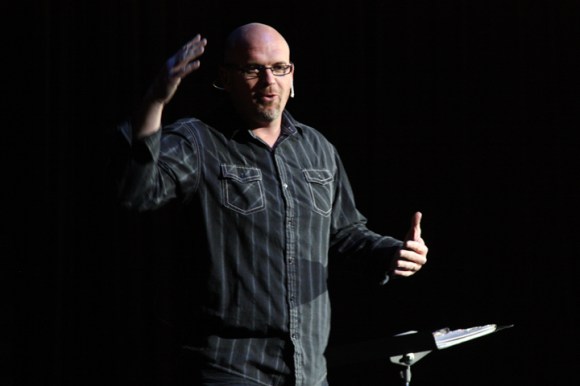
“When God asks where are you, are you right behind him, or are you away from him?” Lorton paraphrased speaker Brian Burgess’ final message of the weekend.

“That’s been in my mind every day since then.”

Lorton attended her first Youth Encounter December 27-28 as a leader from Herrick Baptist Church. The church sent a group of 20 students and chaperones, including Pastor Jay Huddleston. He told the Illinois Baptist three students from his church made decisions to follow Christ, including a brother and sister. Four Herrick students recommitted their lives to Christ. Huddleston also remembers Burgess’ “where are you” message:

“I’m telling you, the spirit of God touched all of us … it was unbelievable.”

Final reports indicate 32 people at Youth Encounter made decisions to follow Christ; 1,003 students and leaders were registered for the conference, representing 91 churches.

At the heart of Youth Encounter is the desire to present the Gospel in clear, creative ways, said Tim Sadler, IBSA’s director of evangelism. That’s why Sadler and his team work to recruit a variety of artists and personalities for the YE stage. In addition to Burgess, the 2013 conference featured bands Citizen Way and 33Miles, evangelist/illusionist Bryan Drake, entertainment from 321 Improv, and local rapper Loudmouth. And they didn’t come just to perform.

“I was super impressed with the time our artists took with the students out in the lobby,” Sadler said. “They were willing to pour into the lives of the students.” Huddleston agreed. His group took pictures with Loudmouth and Drake and came to see the artists as “down-to-earth people.”

Breakout sessions, new to Youth Encounter this year, gave attenders another opportunity to engage with leaders in a smaller group setting. After the opening session, students streamed downstairs to the lowest level of the Prairie Capital Convention Center. They lined the walls of two large rooms to hear about summer missions opportunities in Haiti, Dominican Republic, Guatemala, El Salvador and Jamaica.

Students also crowded into a classroom to learn from Sadler about sharing their faith; others met with IBSA’s Steve Hamrick to hear about Illinois’ All State Youth Choir. And a group of leaders listened as Pinckneyville native Brent Lacy gave suggestions on how to make the most of youth ministry in a rural context.

GO Week, a new student experience from IBSA, also got its own breakout session. The inaugural project, scheduled for July 13-18, is an opportunity for those in grades 7-12 to work alongside church planters in Chicagoland. Students will stay at Judson University in Elgin, and also gather there for worship led by Ben Calhoun of Citizen Way. GO Week is part of a partnership between IBSA and Judson to involve more students and graduates in church planting.

Missions was a major focus at Youth Encounter on purpose, Sadler said. “The wedding between missions and IBSA’s student events finds its roots in the Bible,” he said, referencing James 1:22-23. “The rightful response of every believer is to live the mission; to impact the neighborhoods and the nations with the Gospel.”

For Kendra Lorton’s group, Youth Encounter was such a good experience that she wishes they could go more than once a year. Her youth group runs 18 to 20 on Wednesday nights in Herrick, a town of less than 500.

“I think being in a big arena like that and that many kids, it opened their eyes up to a whole new experience.”

Speaker Brian Burgess

Speaker Brian Burgess

Students prepare for a breakout session about upcoming summer missions opportunities.

Students prepare for a breakout session about upcoming summer missions opportunities.

Ben Calhoun of the band Citizen Way

Ben Calhoun of the band Citizen Way

IBSA's Tim Sadler leads a session on sharing your faith.

IBSA’s Tim Sadler leads a session on sharing your faith.

Evangelist/illusionist Bryan Drake

Evangelist/illusionist Bryan Drake

Charles Campbell meets with students interested in church planting.

Charles Campbell meets with students interested in church planting.

Thom Rainer, president of LifeWay Christian Resources

Thom Rainer, president of LifeWay Christian Resources

THE BRIEFING | Posted by Meredith Flynn

Thom Rainer, president of LifeWay Christian Resources of the Southern Baptist Convention, shared his “broken heart” over the denomination’s loss of passion for people who don’t know Christ.

In an open letter at ThomRainer.com, the leader of the convention’s publishing arm asked, “Where is the passion in most of our churches to reach the lost? Where is the passion among our leaders, both in our churches and in our denomination?

“Jesus told those at the church at Ephesus that they had sound doctrine, that they hated evil (Revelation 2:1-7). But He also told them they had lost their first love. When we truly love Jesus with all of our hearts, we can’t help but tell others about Him. We can’t help but share the good news.”

Rainer’s letter echoed the theme of a resolution passed by messengers to the November 2013 annual meeting of the Illinois Baptist State Association. The resolution on repentance and evangelism encouraged Illinois Baptists to repent of failure to share the Gospel regularly and faithfully, and to commit to do so.

As for Rainer’s letter, “I have no proposal. I have no new programs for now. I simply have a burden,” he wrote. And, he added, renewal must start with him. And with pastors.

“Evangelism must be as natural to me as breathing,” Rainer blogged.

“Pastors, will you join me in this plea? Will you be an evangelistic example for the churches God has called you to serve? Laypersons, will you pray for evangelistic hearts in your own lives? I must make that prayer a part of my life every day.

“Have we lost our first love? Is that love reflected in how we share the gospel of Christ every day?

“May God break me until I am all His, telling others about His Son every day.”

Read the full text of Rainer’s letter at ThomRainer.com.

New podcast answers ethical questions
The Southern Baptist Ethics and Religious Liberty Commission launched a new podcast series this week to address ethical and cultural questions submitted by listeners. Russell Moore, president of the ERLC, hosted the first episode January 13. The inaugural “Questions and Ethics” podcast focused on the question: When should you ask your potential spouse about their sexual history and how much should you know?

“‘Questions & Ethics’ allows us to answer the more difficult moral and ethical questions of our day in a short, accessible format,” said Dan Darling, ERLC’s vice president for communications, in a written release. “This podcast allows Dr. Moore to answer a variety of questions people are asking or should be asking.'” Read more at BPNews.net and listen to the first episode of “Questions and Ethics” at ERLC.com.

Hobby Lobby gets its day in court
The U.S. Supreme Court has set a date for oral arguments in a case pitting craft retailer Hobby Lobby against the Department of Health and Human Services. The Christian Post reports the high court will hear from Hobby Lobby on March 25, as the craft retailer argues business owners should be able to exercise religious freedom by objecting to the abortion/contraceptive mandate in President Obama’s healthcare reform package. Hobby Lobby has been one of the businesses at the center of the dispute over the mandate, which requires employers to cover abortion-inducing drugs in their employee health care plans.

“This legal challenge has always remained about one thing and one thing only: the right of our family businesses to live out our sincere and deeply held religious convictions as guaranteed by the law and the Constitution,” Hobby Lobby founder David Green said in a written release in November. “Business owners should not have to choose between violating their faith and violating the law.”

Read more at ChristianPost.com.

Pastors praying today for spiritual awakening

A group of Baptist pastors and leaders are meeting this week in Atlanta to pray together for revival and spiritual awakening. This is the second prayer meeting called by Arkansas pastor Ronnie Floyd. The gathering “is time for us to pray in an extraordinary way, to seek the God of heaven to revive His church and awaken our nation,” Floyd, senior pastor of Cross Church in northwest Arkansas, told Baptist Press.

The meeting raises a question, says Illinois Baptist editor Eric Reed: What can believers do to bring spiritual awakening to a nation lulled to disinterest by its tolerance of sin? Read his feature story on the next great awakening in the current issue of the IB, and read more about the prayer meeting at BPNews.net.

MIO_blogDAY 7: Watch “Nations at our Doorstep”

Campus ministry is effective for evangelism. Young and exploring, college students are often open to the Gospel. But campus ministry is also a challenge. Illinois has 172 campuses and 800,000 students. Some 34,000 of those students are from foreign countries. Chase Abner welcomes those challenges as opportunities.

Since we first told of Chase’s work at SIU Carbondale, where he met and led students such as Feng Yu to Christ, Chase has joined the IBSA leadership team. He is leading ministry on campuses across the state. And he is helping churches reach out to the college and university students near them.

“Time and presence” is what it takes to minister to college students, he says. Often far from home, as Feng was, students simply need someone who will “be there” for them. And that opens a door to introduce the greatest friend of all, Jesus Christ.

Read: Jonah 4:7-11; Acts 17:10-12

Think: Coming to faith sometimes involves hard questions. What questions have you faced that may help others believe?

Pray for the 30 campuses with Baptist-led student ministries. Pray for collegiate evangelism strategist Chase Abner and campus pastors and leaders. Pray for IBSA churches to reach out to local college students.

MIO_blogDAY 5: Watch “Choose2 Pray”

Together Illinois Baptist churches baptized more than 5,000 people last year. That’s good, but it’s only a start when you realize at least 8 million people in Illinois do not know Jesus Christ.

At the heart of it, Mission Illinois is about sharing the Gospel with lost people. Ultimately, it comes down to one person telling another person about Jesus. That’s why IBSA’s evangelism director Tim Sadler created Choose2, a prayer strategy that helps people and churches make evangelism a priority.

When we told Mindy Burwell’s story last year, she was one of two people her pastor’s wife, Vicki Hayes, was praying for. Since then, Mindy’s salvation has been part of a chain leading almost a dozen people in three states to faith – all because one person committed to pray twice a day for two lost friends.

Read: Jonah 3:5-10; John 4:19-26

Think: When Jonah preached, the people of Nineveh believed. When Vicki shared her faith, Mindy believed. How does God use ordinary people in saving others?

Pray for the 100 missionaries supported in part by the Mission Illinois Offering. Pray for Tim Sadler and others who help share Christ.

“Leila’s Big Difference” is 7-year-old Mackenzie Howell’s latest project to help Haiti. Photo by Kristi Burden

“Leila’s Big Difference” is 7-year-old Mackenzie Howell’s latest project to help Haiti. Photo by Kristi Burden

NEWS | August 26, 2013

On the first page of “Leila’s Big Difference” by Mackenzie Howell, a little girl stands with her arms crossed as the words “Too Little” float around her.

As the baby of her Haitian family, Leila sometimes feels held back by her youth. But when a teacher tells her class the story of a young shepherd who kills a giant that’s been menacing his community, it inspires Leila and her schoolmates to band together to make a difference.

First-time author Mackenzie likely can empathize with her main character. The 7-year-old Texan started trying to make a difference in Haiti when she was just five years old. The book is her latest project to raise money for relief efforts in the country where hundreds of thousands were displaced after a massive earthquake three years ago.

The first 400 copies of “Leila’s Big Difference” are nearly sold out, and Mackenzie has spoken at two local churches about the project. Her story was also featured in the Beaumont Enterprise newspaper. She has already sent $1,565 in book sales to the Illinois Baptist State Association for continued work in Haiti.

“When you hear about missions in action, Mackenzie is a true example,” said Bob Elmore, IBSA’s short-term missions coordinator, who has led several mission teams from Illinois to Haiti since the quake. “Her heart was touched by a need, she determined what she could do and didn’t limit herself. Her efforts are truly making a difference.

“This is commendable for anyone, but astounding for a 7-year-old.”

It started two years ago, when Mackenzie saw a TV show about the one-year anniversary of the earthquake and told her mom she wanted to do something to help. The Howells organized a coin drive at her preschool and a bake sale at their church. They raised more than $1,400 and sent the money to International Mission Board missionaries Jo and David Brown, who were instrumental in the re-building process.

The missionaries then connected Mackenzie with Elmore and IBSA’s continued work in Haiti through short-term mission trips. She sent IBSA the proceeds from her next project – selling homemade sidewalk chalk, playdoh, crayons and finger paints through a local mall’s program for enterprising kids. Her donation helped build a church in Port-au-Prince that doubles as a school.

This summer, with a 15-month-old brother in the house, Mackenzie decided she needed a project he couldn’t get in the middle of. “So we decided to do a book,” she said.

She enlisted the help of Jace Theriot, a 9-year-old in the Sunday School class her mom teaches at their church, Hillcrest Baptist in Nederland, Texas. Jace illustrated Mackenzie’s story, giving life to Leila, her kind-hearted teacher Mr. Bertin, and her lush homeland.

The two recently had a signing party where they autographed 150 copies of their book. And ate pizza and cookies, Mackenzie added.

Watching her daughter “gives me such an appreciation of the Lord being willing to use us,” Alison Howell said. “Because for her, the calling is so clear, and we could see how genuine it was, that it reminded me that the Lord really wants to use us.”

Mackenzie corresponded with Elmore as she created the story, e-mailing him questions about Haiti. Alison said he asked the questions of a young boy and girl in Haiti, so Mackenzie could use their input too. The young writer also researched the country online.

“She was so adamant,” Alison said about her daughter’s will to write the book. “And that’s been the really neat thing in this process, that she has wanted to do this. She has had the passion. Not one time has she said, ‘Mom, this is getting old,’ or ‘I don’t want to work on this story.’”

And while the book has made Mackenzie a bit of a local celebrity, her parents are careful to remind her of the spiritual lessons she’s learning.

“One of the things we’ve learned…is how blessed we are to live in America, and how much we have,” Alison said. “And so we’ve tried to teach her that when much is given to you, much is expected from you.”

“Leila’s Big Difference” by Mackenzie Howell is available for order here.