Archives For November 30, 1999

And why it matters to Baptists now

HEARTLAND | Eric Reed

After his election as president of the Southern Baptist Convention, Arkansas pastor Ronnie Floyd has called Southern Baptists to prayer, but not just any prayer—extraordinary prayer. The phrase is not original to Floyd, as he stated from the start. It’s almost 300 years old.

Credit Jonathan Edwards, the Puritan preacher with poor eyesight who often read from a manuscript his most famous sermon, “Sinners in the Hands of an Angry God.”

Floyd adopted the term “extraordinary prayer” from a book by Edwards called “An Humble Attempt to Promote Explicit Agreement and Visible Union of God’s People, in Extraordinary

Prayer, for the Revival of Religion and the Advancement of Christ’s Kingdom on Earth, Pursuant to Scripture Promises and Prophecies Concerning the Last Time.” (Titling was not their strong suit in the 18th century.)

But what did he mean by extraordinary prayer?

The 2014 IBSA Annual Meeting theme is Mission Illinois: A Concert of Prayer. For more information, go to IBSA.org/ibsa2014.

Mission Illinois: A Concert of Prayer is the theme of the 2014 Annual Meeting of the Illinois Baptist State Association. For more information, go to IBSA.org/ibsa2014.

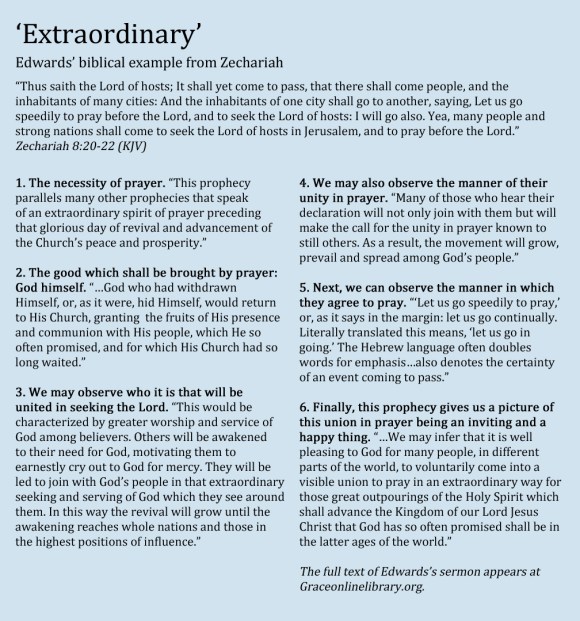
From Zechariah, Edwards drew a picture of prayer that would result first in revival of the church, then awakening and regeneration of lost people. “God’s people will be given a spirit of prayer,” Edwards wrote, “inspiring them to come together and pray in an extraordinary manner, that He would help his Church, show mercy to mankind in general, pour out his Spirit, revive His work, and advance His kingdom in the world as He promised.

“Moreover, such prayer would gradually spread and increase more and more, ushering in a revival of religion.”

Edwards offered an example he had witnessed personally. In 1744, a group of ministers in Scotland called on believers to engage in prayer. “They desired a true revival in all parts of Christendom, and to see nations delivered from their great and many calamities, and to bless them with the unspeakable benefits of the Kingdom of our glorious Redeemer, and to fill the whole earth with His glory.”

The group pledged to pray every Saturday evening, Sunday morning, and all day on the first Tuesday of each quarter—for two years.

During that time, many churches were renewed. In one town alone, 30 groups of young people formed and committed themselves to prayer for revival. Buoyed by the results, the ministers sent 500 letters to pastors in New England urging their own two-year commitment.

Edwards noted: “Those ministers in Boston said of this proposal: ‘The motion seems to come from above, and to be wonderfully spreading in Scotland, England, Wales, Ireland and North America.’”

And they extended the two-year pledge to seven years of prayer.

Edwards, who with George Whitefield and others, was at the heart of the First Great Awakening, cited prayer as vital to the movement of God’s spirit in the colonies.
Extraordinary prayer sidebar


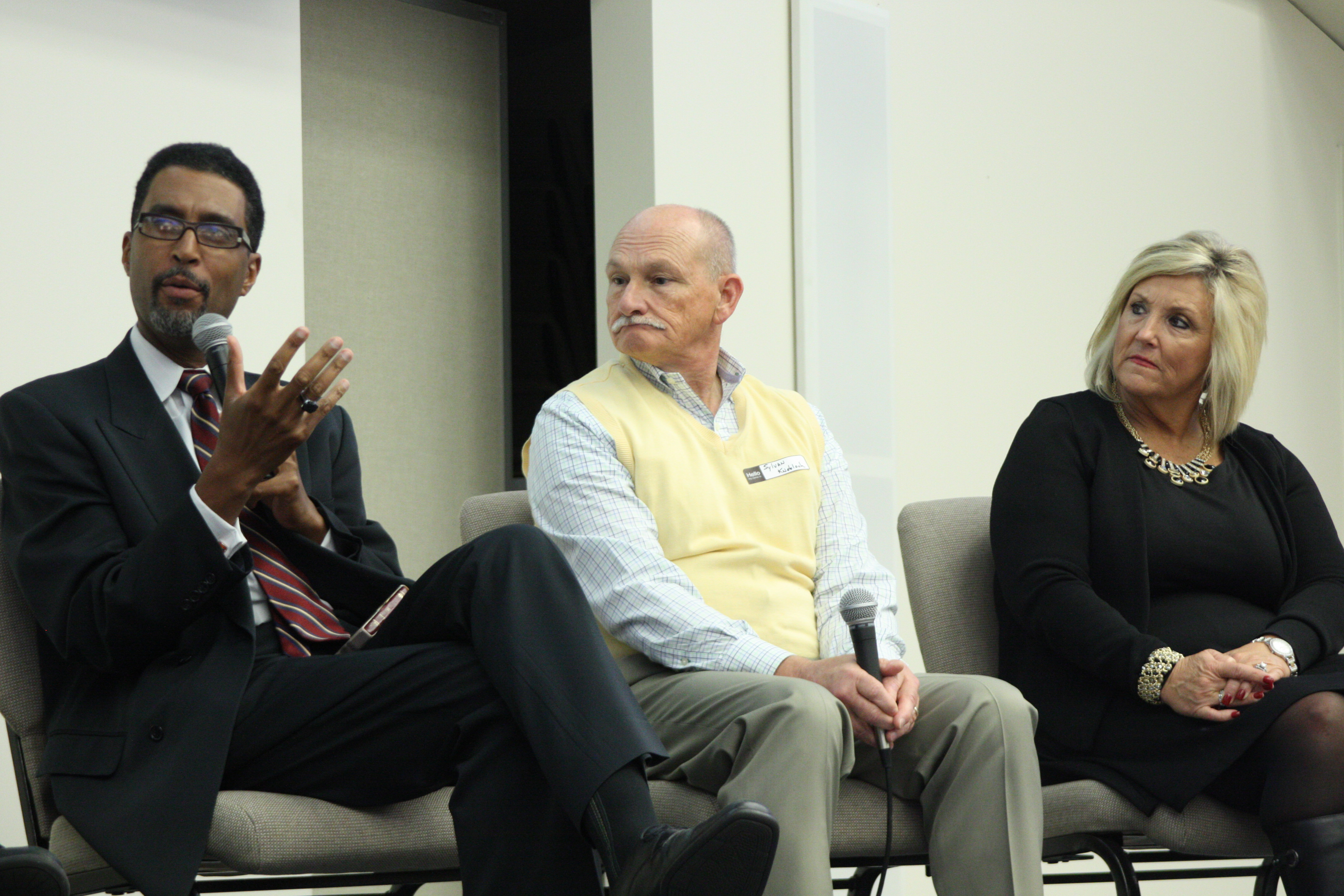
Kevin Smith (left) and Jill Finley (right) joined local ministry specialists including IBSA's Sylvan Knobloch (center) for the Elevate Marriage conference Oct. 16 in Springfield.

Kevin Smith (left) and Jill Finley (right) joined local ministry specialists including IBSA’s Sylvan Knobloch (center) for the Elevate Marriage conference Oct. 16 in Springfield.

NEWS | Preachers don’t have to make the Word of God relevant, said Kevin Smith, a pastor and professor in Louisville, Ky. “The teaching of Scripture is relevant. But we must teach Scripture.”

In practicing the prophetic role of the pulpit as it relates to biblical marriage and sexuality, pastors need to preach systematically the whole of Scripture, including its teachings on those topics, Smith said during the “Elevate Marriage” conference held Oct. 16 in Springfield, Ill.

Pastors and church leaders gathered at the Illinois Baptist State Association to hear from national and local experts, including Smith, Jill Finley, women’s ministry director from Bethel Baptist Church in Troy, and Andrew Walker of the Ethics and Religious Liberty Commission. IBSA sponsored the one-day conference to help leaders navigate the shifting marriage culture in Illinois and nationwide.

Illinois’ state legislature legalized same-sex marriage last November, and unions officially began in June. The U.S. Supreme Court decided this month to let stand lower-court rulings on marriage. Their action plus a subsequent appeals court decision means a total of 35 states could soon have legal same-sex marriage.

But the wave of support for same-sex marriage isn’t the only cultural shift threatening biblical marriage. It is a symptom of the decline of marriage, Walker told conference attenders in a video message, not the cause. The ERLC’s director of policy studies urged church leaders to be “happy warriors” in defending biblical marriage. “To speak the truth as we’re called to do, is to do so in love,” he said.

Ministry specialists from the Illinois Baptist State Association also were on hand to update churches on constructing their bylaws and membership policies in ways that protect marriage, and preaching on the topic in a way that elevates it. The process, said IBSA’s Mark Emerson, starts at home.

“Before we can elevate marriage in the church, we have to elevate our own marriage. We have to take a look at our own life.” Tim Sadler, IBSA’s director of evangelism, followed Emerson with four tips for preachers preaching on marriage:

1. Preach the truth of God’s word as a sinner/saint,
2. Preach biblical marriage, instead of “traditional” marriage,
3. Root your theology of marriage in creation, and
4. Understand and preach the role of Christian marriage in evangelism.

“Christian marriage done properly is a picture of how Christ loves the church and sacrificially gave himself for her,” Sadler said, referencing the apostle Paul’s words in Ephesians. “So, in our preaching we need to elevate biblical marriage and the living out of biblical marriage before a watching world, because it is only in biblical marriage, marriage done rightly, that the watching world gets a beautiful picture of how Christ loves the church.

“And any time we mar the picture, then we convolute the picture the world has of how Christ loves the church and is in relationship with the church.”

Look for more on on the “Elevate Marriage” conference in the next issue of the Illinois Baptist, and watch for videos of presentations by Kevin Smith and Jill Finley on www.e-quip.net, IBSA’s online training resource. Go to www.Vimeo.org/IBSA.

“The more our lives are devoted to spreading this gospel,” said David Platt at an October meeting near St. Louis, “…do we really think that our adversary and the spiritual forces of evil in the heavenly realms are going to sit back and just watch that take place?"

“The more our lives are devoted to spreading this gospel,” said David Platt at an October meeting near St. Louis, “…do we really think that our adversary and the spiritual forces of evil in the heavenly realms are going to sit back and just watch that take place?”

NEWS | Meredith Flynn

Arnold, Mo. | Voice crackling with intensity, David Platt painted a picture of the current status of the gospel: With seven billion people in the world, even the most liberal estimates leave 4 or 5 billion who do not know Christ. And a couple billion of those have never even heard the gospel, added the recently elected president of the Southern Baptist International Mission Board.

“If that’s true in the world…then we don’t have time to play games in the church,” he told the crowd gathered at First Baptist Church in Arnold, south of St. Louis.

“We don’t have time to waste our lives on a nice, casual, comfortable, cultural version of Christianity. Because, number one, that’s not Christianity. Number two, God’s created us for something so much greater than that.”

Hundreds of people gathered Oct. 6 for the St. Louis-area stop of the Send North America Experience Tour. The two-hour service, facilitated by the North American Mission Board, was part of a multi-city effort leading up to the national Send North America Conference in August 2015.

Worshipers of all ages stood and sang before Platt came to the podium. He started his message with the bleak reality of billions of people who don’t know Christ. Then, he preached better news from the Book of Acts. Reading from the end of chapter 7 through the beginning of 8, he told the audience that it’s “ordinary people” through whom the gospel is spread.

In a part of northern India known as a spiritual graveyard, Platt said, a chicken farmer and a school superintendent attended a disciple-making training session where they were assigned to go out into the villages and ask how they could pray for the people there. The two men didn’t expect success, Platt said, but they went anyway. Near the end of their time in the village, they met a man who said he had heard about Jesus, and wanted to know more. The man went to get his family so that they could hear the good news too. Around 20 people in the village came to Christ. A few years later, there are 350 churches in villages in that part of India.

“Let’s put aside an unhealthy dependence on places and programs and realize that the gospel in ordinary people has power,” Platt said. But it’s not their own power. The extraordinary power of the Holy Spirit was at work in Acts and is still at work in Christians today, and through that it, believers proclaim the gospel, Platt said.

Many believers say they witness through their lives, by being kind. “Hopefully, that’s a given,” he said, as the audience laughed. “Nobody gets on a witness stand and smiles. They speak. They testify. And this is why the spirit is in us, that we might speak the gospel.”

Through the power of the Holy Spirit, early disciples also prayed and fasted, he continued. And they suffered.

“How will we ever show the world a proper, clear picture of Jesus if everything always goes right for us?” Platt asked. Suffering makes sense in the life of a believer.

“If our lives are on the front lines making the gospel known in our communities and cities and to the ends of the earth, we can expect to be met with the full force of hell.”

Alan and Jean Lasley sat three rows from the front of the auditorium with their pastor and his wife and another couple from First Baptist Church in Red Bud. Platt’s simple delivery was the thing he would take away from the evening, Alan said.

“Just be more intent on telling others about Jesus,” Jean said of what she had heard. A simple message for sure, and clear. As Platt concluded his message, he appealed to every ordinary disciple in the room.

“In a world and a time and a place where God has put us, in a city where God has put you, let’s say we consider our lives worth nothing to us if only we may finish this race and complete this task the Lord Jesus has given us.

“Ordinary people in this room, every single follower of Christ with extraordinary power….wherever God leads you, whether he leaves you here the rest of your life, or sends you to people who’ve never heard the gospel. Testify. Preach. Pray. Give. Even suffer, for the spread of this gospel, to the ends of the earth.”

Meredith Flynn is managing editor of the Illinois Baptist newspaper.

Note: The column below is excerpted from a response to “Is ‘missional Calvinist’ an oxymoron?” by Eric Reed. Read the original column here.

COMMENTARY | Josh Flowers

Two weeks ago I sat in a village in Brazil where I have been ministering alongside a Presbyterian national missionary. Over lunch that day, I had challenged the methodology of this brother for being too theological. I asked him if he really thought they were ready for this level of deep thinking. He defended his methodology. A few hours later, in front of our small group, my partner asked those in attendance if the material was too deep or too theological. The aged spokesman of the group stood up and emphatically responded, “Absolutely not!” He continued to explain that they must hear and study the deep teachings of the Bible to grow in their faith.

…My family left Illinois in 2009 to attend seminary and are now in serving the IMB in the Amazon Basin. I left a good job and proximity to family and friends. These were not decisions taken lightly. The Lord called our family to share Jesus Christ with the many UPGs in the Amazon Basin. The cost has been high in the eyes of the world, yet Acts 20:24 has remained an important verse during our transition to the mission field. It has been worth it. I say all this in response to your apparent fear that evangelistic zeal might be in jeopardy. With all my heart I want every group in Brazil to hear the message of the gospel and respond affirming their need for Christ. However, one day I will return to the United States. On that day, I don’t want the then current missionaries redoing what I’m investing my life into right now. I want those brothers of the villages where we’re working to be active in their faith reaching into the furthest corners of the Amazon to reach every tribe for Christ. If that means that baptism numbers don’t look as good, so be it.

David Platt is a man who has the anointing hand of God upon his life. His passion for reaching the lost is incredible. While his theology may be different than the status quo, I believe his selection is providential for driving Southern Baptist missions endeavors. I pray that our national and state convention leaders will choose to support the leader of the IMB as God’s anointed man for this time. As for me, my family, and my colleagues, we will support David Platt as he pushes Southern Baptists to attack lostness around the globe.

Respectfully,
Josh Flowers
IMB Missionary, Brazil

John Calvin, 1509-1564

John Calvin, 1509-1564

COMMENTARY | Eric Reed

Like “jumbo shrimp” and “paid vacation,” some phrases bring together contradictory words and give them new meaning. They’re called oxymorons. Even that is an oxymoron, connecting two Greek words meaning “sharp” and “dull.” And there’s “awfully good,” “near miss,” “minor miracle,” and “adult children.”

Some would say we should add to the list “missional Calvinist.”

The election of David Platt as president of the International Mission Board prompted this hallway conversation:

“What’s the effect of Calvinism on missions?”

“Historically, not so good.”

“Oh, I guess I’d better read up on Calvin.”

Yes, that may be helpful in understanding some objections raised about the choice of Platt, but there’s a new breed of Calvinists today, identified by the editorial director of The Gospel Coalition, Collin Hansen, as “Young, Restless, and Reformed.” In his 2008 book, Hansen coined the term “the new Calvinism.”

Historically, strongly Reformed denominations weren’t strongly committed to missions. It is true that a couple of brands of Presbyterians were early leaders in the missions movement, sometimes blazing trails that Southern Baptists would later follow. Lottie Moon’s own biography is littered with Presbyterian missionaries who shared her field in China and, as deeply, her passion for converting lost peoples.

But for most Reformed denominations the passion didn’t last. The record of “old Calvinism” is that conversions declined over the years as the emphasis on evangelism was eclipsed by the dedication to discipleship and doctrine.

Although Southern Baptists generally would say “evangelistic discipleship” is not an oxymoron, the two seem to get pitted against each other in the debate over how people are actually saved. The challenge for Platt will be to bolster the evangelistic zeal of missionaries on the field while he espouses more disciple-making and less easy-believe-ism.

If he’s concerned about abuse of “the sinner’s prayer” in leading people to Christ (at the 2012 Convention, Platt famously tried to explain his challenge of Southern Baptists’ favorite evangelism tool), then he must clearly explain how IMB missionaries are to guide converts to the point of public commitment.

Baptists, historically, have been good at helping seekers commit to Christ and show it by believer’s baptism. We’ll have to watch the baptism numbers from our foreign fields to see how well the union of Reformed theology and missional praxis works. Is it—or isn’t it—an oxymoron? Platt, and his IMB, will be Southern Baptists’ most public test of that question.

No one doubts Platt’s passion. Even his biggest supporters rib him for his intensity. “Do it for the nations, David,” a famed Reform pastor teased during a panel discussion in Baltimore. The crowd laughed, recognizing one of Platt’s driving phrases. But Platt is serious about it.

“For the Nations” might serve well as IMB’s motto under Platt’s leadership. There’s nothing oxymoronic about that.

Eric Reed is editor of the Illinois Baptist newspaper.

The Tennyson family was baptized in June by Pastors Bryan Henderson and Jacob Gray (left) of Ten Mile Baptist Church.

The Tennysons were baptized in June by Pastors Bryan Henderson and Jacob Gray (left) of Ten Mile Baptist Church.

HEARTLAND | On a summer Saturday evening, more than 200 people from Ten Mile Baptist Church gathered at the Tennyson family’s home for a cookout and baptism celebration. A pond on the property provided plenty of space to baptize
seven people at once—Bob and Lisa Tennyson and their kids, April, Alec, Austen, Alijah and Anthony.

“The Lord started dealing with them,” Pastor Jacob Gray said of the family, and “they started asking around” about churches. After five or six months at Ten Mile, the Tennysons made professions of faith and wanted to be baptized.

They are part of a wave of growth the church has experienced over the past two years, on a foundation built by former pastor
John Smith, Gray said. He estimated close to 80 people have been baptized over the past two-and-a-half years, and around 270 families have visited.

“It has been all the Lord, absolutely,” said Gray, who, at 29, is in his first pastorate. A native of Hamilton County, he served as associate pastor under Smith before assuming the lead pastor role in 2012. His family started attending the church before he was called to preach.

“They licensed me, ordained me, helped me pay for my college,” Gray said. “They’ve been a fine group of people.”

And a growing group, too.

COMMENTARY | Jill Waggoner

I never gave hunger much thought until I became a mother.

Motherhood begins with conversations about “the schedule” and bottles and quickly turns to the veggie/fruit count, snack monitoring, and introduction of potential allergens. The advice you receive about what your child needs and when he needs it can be overwhelming. Yet, my troubles only amounted to worrying about how I would get my one-year-old to drink the non-sweetened, organic, vanilla almond milk, not how we would pay for it.

For many, including mothers, the question of where their next meal will come from is a daily, if not hourly, worry. In the United States alone, 89% of households with children are considered “food insecure,” meaning they do not know how they will provide their next meal, according to the 2014 “Hunger in America” study by Feeding America. Today, one in seven Americans receives support through a feeding program, including 12 million children. This is a reality I have not known and, I
confess, have taken for granted.

Jill_Waggoner_calloutNumbers like these are an important reminder that hunger happens everywhere—not just in the slum of a foreign country or the housing developments of urban cities. Hunger is a part of my life and part of yours, by proximity, whether we realize it or not.

My church uses the phrase “as you go” when talking about sharing the Gospel. We share Christ with others as we live our lives in our communities, in our families and in our jobs. It’s incorporated into everything we do—that as we walk with Christ, knowing and serving Him, we would make disciples by encouraging others to join us.

On a personal level, “as we go,” means we must have our eyes opened to the hunger needs in our communities and neighborhoods. I believe you will find many ministries and governmental organizations meeting the critical needs where you live. I challenge you to join forces with those who do effective, Christ-centered ministry and seek out those who still might be overlooked.

On an international level, Global Hunger Relief operates from a similar mindset. The work of Southern Baptists around the world is vast, varied and Gospel-focused. Yet, “as we go” we encounter physical needs that must be met in order to effectively minister. GHR, formerly known as World Hunger Fund, is a cooperative initiative that comes alongside existing Southern Baptist partners and provides the funding to meet those needs. And while most humanitarian organizations keep 30-70% for administrative overhead, GHR is able to devote 100% of resources given to this life-saving work.

Southern Baptists around the globe will be drawing attention to both this critical need and the important work of Global Hunger Relief Oct. 12 with World Hunger Sunday. I encourage you to visit globalhungerrelief.com to learn how you and your church can participate and help us to change forever lives and communities in the name of Christ.

Jill Waggoner is deputy press secretary for the Ethics and Religious Liberty Commission and lead brand strategist for Global Hunger Relief.

COMMENTARY | Chase Abner

Note: This article originally appeared on Collegiate Collective, a new resource that features articles, podcasts, and videos designed to equip leaders to advance the gospel on college campuses.

Chase_Abner_calloutI’ve been around collegiate ministry for about eleven years. In those years, I’ve been witness to all sorts of public hubbub on the world stage of evangelicalism. At first, there was the challenge posed by Dan Brown’s “The Da Vinci Code.” Then there was a lot of back-and-forth about the Emergent Church and how post-modernism was going to erode all of Christendom. And that was just a precursor to Rob Bell’s “Love Wins” and the battle for the doctrine of hell. And Mark Driscoll has been the subject of his fair share of controversies. Throw “The Shack” and Calvinism into the mix and you’ve got yourself enough blog fodder to last you until the other side of eternity.

Early on, I somehow got the impression that a big part of my job as a campus minister was to help students be on the “right side” of all these public controversies. I read a lot of blogs and way too many blog comments. I sought out what side my heroes were on. I studied the Bible hard and I tried to provide my students with all the right answers.

However, there was one big problem.

They weren’t even asking the questions. Most of them didn’t even know who Brown or Driscoll or Bell or Calvin was. They were more concerned about passing their biology test or paying tuition in the spring or what they were going to say to their roommate struggling with depression.

So I gave up. I stopped trying to be up-to-date on the controversy of the day. I decided that if it wasn’t something that was directly impacting my students, then I wouldn’t bother with it.

And guess what? I found that I had a lot more time to hear from God, rather than about Him from someone on a podcast. I found that I was freer to hear the questions the students actually had, rather than the ones I forced on them. And I found that it’s a lot easier to follow Jesus when you’re not fighting over Jesus.

So last week, a video of Victoria Osteen made the rounds. If you didn’t know, she is the wife of America’s most famous mega-pastor Joel Osteen. The clip is from a sermon in August wherein Victoria makes some…how do you say…provocative claims about proper motivation for obeying God. (If you haven’t seen it yet, then count yourself blessed and forget I mentioned it.)

Here’s what naïve Chase would’ve probably done in response to this clip if it had come along in my early days of ministry: I would’ve torn the thing to bits, shared all the parody videos, and read every blog that critiques the Osteens’ errant theology. I might’ve even used one of the parody videos in our weekly gathering or taught an entire lesson in response. In other words, I would’ve wasted a lot of time doing battle against something that had virtually zero influence on the people in my care.

Let me suggest this template for responding to public Christian controversies in your collegiate ministry context.

  1. Pray for the individuals caught in sin or espousing false teaching.
    • Example: Pray for the Osteens and those influenced by their teaching ministry.
  2. Examine yourself in light of Scripture.
    • Example: Ask God to show you where you have selfish motives in your obedience to him. Repent as necessary.
  3. Listen to your students. Respond when necessary.
    • Example: If your students aren’t being influenced by the controversy, then press on in your disciple-making as if nothing has happened. If they have questions about it, then address the controversy.

You see, as you focus your energy on developing mature Christians who believe and apply the gospel to all of life, they will be equipped to address the counterfeits on their own. If at times, the controversies catch their attention and your students have questions, then embrace those as teachable moments. But remember, they are just that—moments—and not the normal pattern for your ministry.

Most of all, avoid the temptation to define yourself and your ministry by what you’re against. Is the gospel exclusive? Yes. Does God draw some hard lines in Scripture? Yes. But most clearly, he reveals himself in the person and work of Jesus Christ who gave most of his energy on earth to proclaiming the good news of the Kingdom.

Chase Abner is Collegiate Evangelism Strategist for the Illinois Baptist State Association.

The Mission Illinois Offering and Week of Prayer, marked this week in churches across the state, focuses on ministry to kids and families. The crucial “4-14 window” is the best opportunity for churches to effectively share the gospel with the next generation. Use this daily devotion guide, and go to http://www.IBSA.org/mio for videos, stories, mission study teaching plans, and ideas for prayer and worship.

oneDay 1: Scott Kelly, Pastor, Campus Minister
A century-old house in Evanston, Ill., is a home base for ministry to students at Northwestern University. Scott and Megan Kelly and their three kids open their home on a regular basis to students who come for parties, prayer meetings, or just dinner. “The students I meet are open to speaking with me about Jesus and what the Bible says, as we meet in the dorm or over Dunkin coffee at the student center,” said Scott, who also pastors Evanston Baptist Church. “But the best conversations I have with students are when they are around my family.” Pray for Pastor Scott as he leads his church and the campus ministry at Northwestern University.

twoDay 2: Tim Sadler, IBSA Evangelism Director
IBSA churches baptized just over 5,000 people last year, but more than 400 of our churches baptized no one. Tim says, “Generous giving through the Mission Illinois Offering allows me to assist churches taking the Gospel to their mission fields. I can provide resources such as Gospel tracts and training to churches who want to reach their communities for Christ. It allows me to do customized training and strategy development for IBSA churches.” Pray for Tim and for renewed evangelism in IBSA’s 1,000 member churches.

threeDay 3: Chet Cantrell, Christian Activity Center Director
Every day after school at the Christian Activity Center, kids in East St. Louis get a healthy snack and help with their homework. They learn Bible stories and songs, play in the gym, and spend time in the computer lab. It’s a world far removed from how this street—known as a center of prostitution—used to operate. “In the early days our mission was to keep our kids alive,” said Chet Cantrell, who directs the CAC, “but our mandate was bigger than that. We want to help them thrive, so they can be what God intends them to be.Pray for Chet, the ministry team at the Christian Activity Center in East St. Louis, and the hundreds of young lives they touch each year.

fourDay 4: Carmen Halsey, Mission Mobilization Director
There are 13 million people in Illinois, and at least 8 million of them do not know Christ. Carmen sees tremendous opportunity for the Gospel. “Our lives begin to make sense when we realize that they are a platform for God’s word to be demonstrated to others. Illinois Baptist Women are embedded into society all across our state. With our resources, we are developing women to recognize and seize everyday opportunities to share the gospel.” Pray for Carmen and Illinois Baptist Women who are mobilized to share Christ. Pray for spiritual awakening in Illinois.

fiveDay 5: Brad Pittman, Church Planter
Davis Junction in Northwest Illinois was a community of more than 3,000 people, but only one church. Until recently. In this town 15 miles south of Rockford, Brad Pittman and his family are planting Grace Fellowship Church. It’s the third location for a multi-site church that started in Ashton and also meets in Amboy.

Brad was a member of the Ashton location for 13 years before joining the staff with pastors Jeremy Horton and Brian McWethy. “We want to be an Acts 1:8 church that not only plants here locally,” he said, “but we’re going into our state, that we’re going into our nation, we’re also going into our world.” Pray for The Pittman family and all church planters in Illinois. Pray for the 322 places and people groups where new churches are needed.

sixDay 6: Chase Abner, Collegiate Evangelism Strategist
“God changed my life through a college ministry supported by IBSA,” Chase says. His salvation as a young adult at SIU Carbondale urges him forward. “Generous giving by Illinois Baptists helps me to assist churches as they reach out to students on campuses across Illinois. These campuses are home to nearly one million students. Before they leave school, we must share Christ with them.” Pray for Chase and the campus ministries he helps start and facilitate.

sevenDay 7: John Mattingly, Church Planting Catalyst
24 new churches were started in Illinois last year. And 13 are in progress in the northwestern region. “Our new church plants in northwest Illinois are building relationships that help bridge the gap of misunderstanding of who Southern Baptists are in the North,” John says. “They are also enjoying a harvest of souls that is due to the on-going relationships between planters and our established rural churches. It is a testimony of the power behind steady giving and praying.” Pray for new ministries to reach the 4 million people who live in non-urban settings in Illinois.

eightDay 8: Rex Alexander, Disaster Relief Coordinator
Rex is one of 85 IBSA missionaries, ministry staff, and church planters. This offering makes it possible for all the team to represent Christ wherever and whenever needed. “We provide opportunities for Disaster Relief workers to bring help, healing, and hope to victims of natural disasters in Illinois and North America,” Rex says. “God uses their skills, and the additional training IBSA provides, to help people physically and spiritually as they attempt to rebuild their lives.” Pray for all the IBSA team, including staff and volunteers. Pray that we will reach the $475,000 goal to keep them serving on our Illinois mission field.

THE BRIEFING | A group of church planters worked together Aug. 13 to help clean up Ferguson, Mo., a St. Louis suburb rocked by rioting and protests since 18-year-old Michael Brown was killed by Police Officer Darren Wilson on Aug. 9.

The_BriefingJoe Costephens pastors The Passage Church on the border of Ferguson and Florissant. “We bring in anywhere between 8 to 15 mission teams every summer to serve the cities of Florissant and Ferguson—putting on block parties and reaching out to the community,” he said. “So when this came up, I called some church planting buddies, and said, ‘Hey we want to bless our city, let’s do a cleanup day.’”

Costephens and other church planters mobilized between 100 and 200 people to pick up trash and clean up looted storefronts. The group also attended a citywide prayer service at First Baptist Church in Ferguson. According to a Baptist Press report, Pastor Stoney Shaw said the interracial prayer service exuded a spirit of reconciliation, with participants recognizing the need to love and understand one another. Read more at BPNews.net.


Nigerian cities threatened by terrorist group
A Nigerian relations expert said the crisis precipitated by the Boko Haram terrorist group has reached a “new dimension.” Adeniyi Ojutiku told Baptist Press the group has started using tactics associated with ISIS (Islamic State in Iraq and Syria), the militant group responsible for recent persecution of Christians and other religious minorities in Iraq. Boko Haram’s takeover of the town of Gwoza has resulted in nearly 1,000 deaths, rather than the 100 reported by some sources, Ojutiku said.


“They attack, they occupy, they hold the town,” he said. “Now that they have started adopting ISIS methodology, they should be receiving the type of treatment that ISIS is receiving.”


Read more about the persecuted church in the August 18 issue of the Illinois Baptist, online now.

Pew: In 30 nations, specific religious affiliation is requirement for head of state
Analysis by Pew Research found that 15% of the world’s countries require their head of state to be affiliated with a certain religion. In 17 of those nations, the head of state must be a Muslim, while two countries (Lebanon and Andorra) require the person who holds the post to have a Christian affiliation. Interestingly, Lebanon also requires its prime minister to be a Sunni Muslim.


Gay songwriter urges church to rethink views on sexuality
Vicky Beeching, author of popular worship songs like “Glory to God Forever,” told culture writer Jonathan Merritt that “the church needs to become more comfortable with people not being on the same page about everything.” Beeching, who came out as gay in an interview with The Independent Aug. 13, told Merritt, “God loves us unconditionally, so we should aim to model that to those who see things from a different angle, even if that’s really hard to do. I’m trying my best to keep extending that love today to all the conservative Christians who are telling me I am ‘siding with the devil’ because they are still my brothers and sisters in Christ.”


Blogger and professor Denny Burk responded to Beeching’s comments, referencing Matthew 12:46-50. “Jesus draws a line between those who are his brothers and sisters and those who are not. The line runs between those who are allied to God’s will and those who are in open defiance against it.”

LifeWay exploring sale of corporate offices
LifeWay Christian Resources is studying the advantages and disadvantages of selling part or all of its property in downtown Nashville, President Thom Rainer told staff in an Aug. 1 letter. Citing demand for property in the area and fewer employees working at the downtown location, Rainer said, “…It would be poor stewardship for the organization not to explore the possibilities this situation could present for our ministry.” About 1,100 employees currently work at LifeWay’s corporate offices, Baptist Press reported. LifeWay spokesman Marty King estimated nearly one-third of the building is vacant or leased.