Archives For November 30, 1999

Layout 1“Why have you forsaken me?”
Read Matthew 27:45-49, Psalm 22

The crowd on Golgotha thinks Jesus is calling on Elijah for rescue, but he isn’t. He’s calling on Elohim. With the opening to Psalm 22, he invokes the entire prophetic psalm. It’s a word picture written a thousand years earlier showing the Messiah, abandoned to die.

How can someone who lives in constant contact with two others ever be alone? That has never happened before. The Trinity is the perfect picture of community: three persons enjoying complete unity, holy boon companions always in agreement.

forsakenBut for three hours Jesus feels nothing but the weight of our sin, and the one who knew no sin becomes sin for us. It’s so revolting that the Father who ordained it can have nothing to do with it. And Jesus, for the first time in all eternity, is alone.

Standing beneath the cross, disciple John and mother Mary witness in the skies what’s happening within Jesus Himself. The sky grows dark. The sun is blotted out. And rain falls on them all, the tears of heaven, as Jesus cries, Why have you left me?

PRAY Lord, when I feel alone, remind me that you know how it feels. And because You bore my sins, I need never be separated from God anymore.

Layout 1“Woman, behold your son.”
Read John 19:25-27

Jesus’ most tender word from the cross is to Mary; perhaps his most challenging is to John. Behold. To both of them he says “behold,” a command meaning to look, see, and understand.

“Behold your son…behold your mother.” Behold my provision; behold your responsibility.

To Mary, Jesus is affirming his love for her. As the eldest son in the family, it is Jesus’ duty to provide for his mother in his earthly father’s absence. He entrusts her care to his dearest friend on earth, his beloved follower John.

familyTo John, what an awesome responsibility this must be, that his friend, teacher, and Lord would give to him this duty as if Mary were his very own mother. If he never knew it before, John must realize it now: he really is one of the family. Jesus’ family.

Behold. Could there be any greater statement of the love of God than to be made part of the family?

PRAY Lord, when I behold you, help me to understand that you are the Son, and you have welcomed me into your family.

COMMENTARY | Jonathan Davis

Jesus_forpage1

WHAT A SAVIOR – “But he was wounded for our transgressions, he was bruised for our iniquities: the chastisement of our peace was upon him; and with his stripes we are healed” (Isaiah 53:5). Sculpture by Libby Morecraft of Harrisburg

Our culture loves blood. The latest vampire novel, graphic movies, every CSI crime drama, the nightly news – they’re all pictures painted in blood. Even the walking dead are promoting a bloody afterlife every Sunday night on cable. But our culture’s bloodthirst is biting into the wrong vein.

As God’s people, we also are to be marked as lovers of blood. Not because of an obsession with gore, but because of the Savior who shed his life’s blood
on our behalf.

Yet, for some reason, we often shy away from the bloody language of the cross. Our culture, so fascinated with blood stories, turns away from the most
important blood lines of all. Talk of the cross is offensive to many, and to bring up the blood as central to faith will bring many conversations to a halt. And
rather than offend, some Christians will stick to the more polite apologetic: Jesus loves you, and has a great plan for your life.

But that’s a bloodless Christianity. And a bloodless Christianity is no Christianity at all.

Flesh and blood isn’t just Easter language; it is Gospel language to be used at all times and in all places. We are to embrace the bloodiness of Scripture, for to do opposite is quite dangerous.

Our bloody theology

The Bible presents us with a robust theology of blood. Because Christ was crucified, we reap a multitude of benefits for His glory and our good.

• We once were people without hope, but have been brought near to God by the blood of Christ (Ephesians 2:12-13).

• In Christ Jesus, whom God put forward as a propitiation by his blood, we have redemption, the forgiveness of our sins (Romans 3:24-25; Ephesians 1:7).

• We have been justified by Christ’s blood (Romans 5:9).

• We have peace with God by the blood of the cross (Colossians 1:20).

From Adam and Eve’s first sacrifice outside the garden to our High Priest’s completed work, and everywhere in between, the history of God’s people is marked by blood. For several thousand years, it’s the blood of animals, offered as a covering for sins. And finally, it’s the once-and-for-all sacrifice that
washes whiter than snow.

When it comes to salvation, nothing but blood will do.

Maybe the most startling example of flesh and blood language in the Bible is found in John 6. Jesus tells his followers they must eat his flesh and drink his
blood. On the surface, it’s a revolting concept. “Is he advocating cannibalism?” they must be thinking.

Then, at his last meal with the disciples, Jesus enacts the teaching, tying together eternal life with eating his flesh and drinking his blood. Jesus notes that
we are abiding in him when we do so. To commune with Christ is to embrace this bloody language.

Now, it’s not too hard for us to talk about the crucifixion and the blood this time of year, especially in our churches. At Easter, the person and work of Jesus
come to the forefront of our minds, and rightly so. This is the time of year we celebrate Christ’s crucifixion, and it makes sense that flesh and blood speech
is on our lips.

But what concerns me is our post-Easter language, and how we share the Gospel with people who don’t know Christ. Too often, we avoid talking about Christ’s suffering, and in doing so, we drain our faith of its very power.

Power in the blood

The next time you’re on break at the water cooler, try dropping this line from Jesus into the conversation: “Hey, did you know that Jesus said, ‘Unless you
eat the flesh of the Son of Man and drink his blood, you have no life in you.’”

I can hear the crickets chirping.

The Corinthians felt the shame of flesh and blood preaching, and this led them away from boasting in the cross to boasting in worldly wisdom. Preaching
a crucified king sounded so un-wise that they forsook the very message they had heard and believed.

But Paul argues that crucifixion language is the very language the Holy Spirit empowers. He had come to the Corinthian believers in weakness and fear. His speech and message were not in plausible words of wisdom, but in demonstration of the Spirit and of power (1 Corinthians 2:3-4).

We must recover that kind of speech in our churches and as we go out into the world. Sin is serious, so serious that it warrants death. This is why there is
great danger in bloodless Christianity. To remove the bloody language of the cross is to remove man’s only hope of being made right with God.

The Gospel of the cross is the good news that God is holy, you are not, and the necessary sacrifice to make you right with God is found in Jesus Christ and Him crucified.

As believers we have tasted and seen the goodness of salvation applied to our hearts, and our desire is to see the lost know this same salvation. Is talking
about the cross offensive? Yes. Is it difficult to speak? Yes.

But let’s not run from it. Rather, let us press into it, speaking Christ and Him crucified plainly and with conviction, trusting the Holy Spirit to draw the lost to the Father through the Son.

When we do, people will begin to understand there’s power in the blood.

Jonathan Davis pastors Delta Church in Springfield.

Layout 1“Today … in paradise.”
Read Luke 23:39-43

One thief spits curses and ridicule. The other pleads, Remember me. Both deserve death for their crimes. The law said so. The judge said so. The hammer said so. The executioner agreed. But their reactions to their punishment are exactly opposite. Why?

One gives up hope, even when hope is right before him. The other holds onto hope, not because he can see it, but because it’s the only thing he has left.

futureOne man believes in death there is no future. The other believes in the future there is no death. And in response to his faith, Jesus holds before the believing thief the promise of paradise.

What a contrast to the utter degradation of the executioner’s hill beside the smoking city garbage dump: Paradise. Eternity. Joy. A never-ending future in the presence of a loving God.

PRAY Lord, help me remember there is a future and a hope as I face death, even though I deserve it.

Layout 1To prepare for celebration of the Resurrection, we must first witness the agony of the cross. Crucifixion is a most torturous form of execution. It may last several hours or several days. The body’s systems shut down and the condemned man’s lungs fill with fluid. In effect, he drowns. As he pulls against the spikes in his flesh, trying to lift his body just enough to gulp another breath, Jesus uses his last energies to make seven bold declarations.

Standing at the foot of the cross with his most devoted follower, John, and his mother, Mary, we watch as Jesus pours out his life. We listen for clues to his future – and ours – as the Lord of all creation bows to his Father’s will on our behalf.

Use these devotionals once a day during Holy Week, or as an hour’s contemplation on Good Friday.

“Father forgive them,”
Read John 19:17-24, Luke 23:32-34

forgivenIt’s brazen. The soldiers who beat Jesus then stripped him and nailed him to the beam. They raised the cross and let it drop into the hole that held it up, letting Jesus’ full weight pull against the severed flesh where the great nails affixed him. Now they have the nerve, stooping to the ground before that very cross, to gamble for the only nice thing Jesus had on earth, his seamless robe.

And yet, their brazen offense, to kill a man and rob him of his clothes as payment, is not the most heinous crime Jesus suffered that day. He had laid on his back all the sins of all people of all time. And still, he says, Forgive them.

Who else could offer such a word? Only the one who is offended has the right to forgive the offender. Only he could extend grace to the one who sins against him. Jesus’ desire is always that we accept his forgiveness and live in his grace.

PRAY Lord, I, too, am responsible for your death. Help me to live in gratitude for your forgiveness.

potteryHarrisburg, Ill. chalk_art| Worship in a sanctuary is usually reserved for church days. But on a recent Friday morning at First Baptist in Harrisburg, a handful of people focused on Jesus as artist Libby Morecraft turned a 75-pound mound of clay into a sculpture of his face.
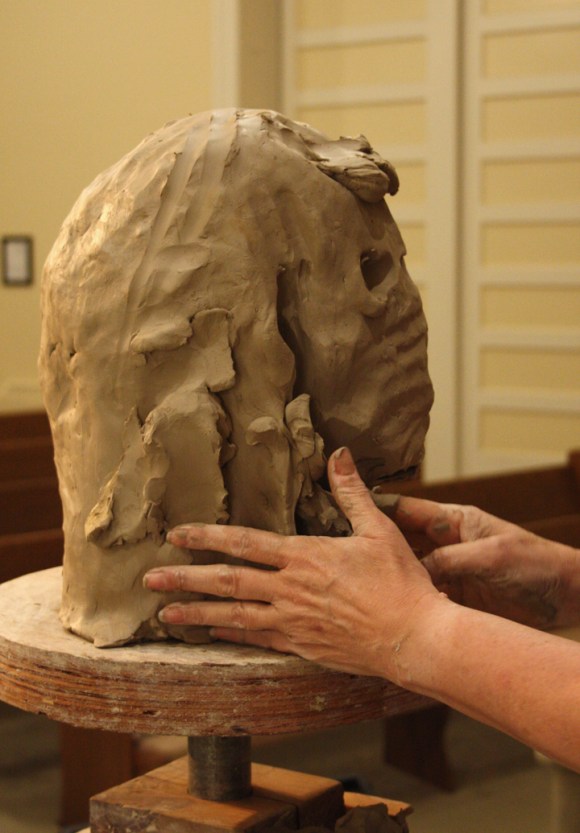
She demonstrated her skills for the Easter issue of the Illinois Baptist (online here), but sculpture is just one part of the outreach she calls “Work of Art Ministries.” She also uses pottery and chalk art to lead people in worship during services, conferences and retreats. Libby, who’s married to Saline Association director of missions Rusty Morecraft, recently led during the annual IBSA Ministers’ Wives’ Retreat.

Check out how the sculpture came to life in the slideshow below, and go to the Work of Art Ministries Facebook page for more on her work.

LM_1LM_2LM_4LM_5LM_6LM_8LM_10LM_12

Nate_Adams_blog_callout_AprilCOMMENTARY | Nate Adams

In churches both here and around the world, so much preparation goes into getting ready for Easter. Of course, that’s as it should be. Easter is arguably the church’s greatest single day of celebration. Though surrounded by distractions like bunnies, egg hunts and new spring fashions, it suffers far less
secularization than Christmas. And because Easter is always Sunday, it gives every local church a special opportunity to shine in its own community. Yet, in an effective, evangelistic church, Easter is only the beginning.

Several years ago, I was part of a group that helped start a new church in the suburbs of Chicago. We decided to hold our first public worship service on Easter Sunday. We called it our church’s birthday.

Prior to that “launch Sunday,” we had prepared for a full year. For weeks, four families prayed and studied and planned. Then three neighborhood Bible studies grew into a core group of about 40. Then we met for weeks in teams to plan ministries and outreach strategies and worship services that would be relevant and inviting to our community.

In the days leading up to Easter, we stuffed envelopes, hung door hangers, and placed ads in the local papers. And on Easter Sunday, 182 people came to the grade school gym where we held our first Easter celebration.

But Easter was only the beginning. Because that first Sunday was our new church’s “birth,” we decided that birthday cakes would be great welcome gifts for all our first time guests. So we baked birthday cakes – dozens of them. And for hours after we packed up our portable church that afternoon, our core group delivered both a welcome and a friendly witness to those who lived in our Jerusalem.

Across North America, including right here in Illinois, new churches often still choose Easter to begin a new witness in a new Jerusalem. But even in churches like yours and mine that have been around a while, Easter can be preceded by special preparations that invite new people to come and meet Christ, and followed by tireless effort to make them feel welcome, both at church and in the family of God.

Do you feel comfortable, even enthusiastic, inviting your friends and neighbors to come to your church? Are you confident in what they will experience there? Is your church ready, not only to welcome and accept first time guests, but also to go the extra mile to understand their needs and questions, and respond with compassion to their imperfect lives?

It takes love and great intentionality to continually invite new people to church, and even more to be truly ready for them when they find the courage to come. The great thing is that Easter Sunday gives a church one of its best opportunities all year to welcome new people, and even churches that do little
inviting are often blessed with first-time guests on that special Sunday.

Let’s be ready this Easter. In fact, let’s be ready each and every Lord’s Day. Let’s be winsome and sensitive and compassionate and good listeners. Let’s
make sure we prepare and invite, and that the Gospel message is clear, and lovingly delivered in multiple ways. And let’s not let Sunday lunch be the end of it.

For the early church, Easter was not the grand finale; it was the start of something big. The risen, ascended, and returning Lord sent His Spirit to fill His
disciples with power, and with boldness. And He said they would be His witnesses, from Jerusalem to the ends of the earth.

It’s the same for us today. The ends of the earth still really need the Gospel, and so do the people who live in our Jerusalems. Again this year, Easter is only the beginning.

pull quote_KINGHEARTLAND | Claude King (From Baptist Press)

In 1995 a Texas pastor called and asked me to pray for his church and give some counsel. From the evidence of love and unity in the congregation, the pastor believed the church had experienced a revival – not a series of services but a return to right relationships with God and one another. The church had two concerns: first, they wanted to become more of a people of prayer; and second, they wanted tPraying Up To Pentecost_Final o be part of a spiritual harvest.

This Texas congregation began 50 days of prayer starting Easter Sunday and continuing through Pentecost Sunday. Families were given a 50-day calendar with a Scripture for each day. They were asked to gather as a family to read and discuss a Scripture each day, decide what they needed to do to apply the truths to their lives, and pray. With a focus on reaching lost people, they began making a list of people in their circles of relationships who were not Christians. Families (some praying together for the first time) faithfully lifted these names to the Lord in prayer.

The church also held a six-week study of prayer in all their Sunday School classes from sixth grade through senior adults. They used a workbook now titled “Growing Disciples: Pray in Faith.” Participants were learning to pray during the week, and then they conducted prayer meetings in their classes to practice what they were learning. One lesson each week helped them learn how to pray together more effectively. During the worship services, they collected prayer request cards. A team of intercessors prayed during the services for the spiritual needs of the people present.

Following the model for “Pentecostal Prayer Meetings” described by Andrew Murray of South Africa (in “The Prayer Life”), the church conducted 10 days of corporate prayer meetings on the days leading up to Pentecost. One night they commissioned a mission team that left for Russia. Another night they invited the other Baptists in their small county to join them for prayer. They invited other denominations to join them one night in praying for their town. Other corporate prayer experiences included cottage prayer meetings, prayerwalking around town, prayer-driving in the county, and other kinds of corporate prayer.

For a free reproducible guide for “Praying Up To Pentecost” click here.

I had the privilege of joining this church for their celebration of Pentecost, including wonderful testimonies and a Baptist feast (dinner on the grounds). They even received a special “first fruits” offering to provide ministry to needy people outside of the church membership. I was amazed at the quality of corporate prayer I observed.

People were expecting a huge response at invitation time, but only one young boy made a public profession of faith. Their enthusiasm for a spiritual harvest seemed to burst. Only one other “first fruit” of spiritual harvest happened that afternoon as a woman from the community came to seek counsel from the pastor. She had seen the service on the local cable channel. She wanted to know God the way people described their experiences in their testimonies that morning. I returned home a bit discouraged.

But three months later, I received a follow-up report from the pastor that reignited my heart. Their mission team to Russia had led more than 400 people to the Lord. Additionally, although the church had been involved in prison ministry for many years, that summer they saw nearly 300 prisoners accept Christ. And in their small community, 25 of the lost people for whom they had prayed between Easter and Pentecost professed their faith in Jesus Christ! Many members said, “Pastor, we can’t go back to the old way of doing things.”

Jesus instructed his disciples, “Open your eyes and look at the fields, for they are ready for harvest” (John 4:35). The early church experienced a great spiritual harvest on the Day of Pentecost described in Acts 2. But, like the church in Texas, the Jerusalem harvest was preceded by a period of intense personal and corporate prayer.

Claude King is discipleship and church health specialist at LifeWay Christian Resources. He is coauthor of “Experiencing God, Fresh Encounter, The Mind of Christ, Pray in Faith,” and other resources.

Step by Step: Following Jesus from the Palms Parade to the Resurrection

EasterDay 8: Easter Sunday, March 31
The Resurrection (Matthew 28:1-10)

They held him by the feet, Scripture says, of the faithful women who first came to the tomb after the Sabbath to tend the body of Jesus. Finding him alive, as the angel on duty had announced, they fell at his feet, those feet still bloodied, still pierced by the great nails from the cross.

In moments, the reality of Jesus’ resurrection from death would take over, and there would be much running and telling, weeping and fearing, hugging and shouting, doubting and cheering.

But for this moment, they held on.

Lord, rekindle in us the sheer joy of finding you alive this morning and every morning. May we always be moved by the sight of your pierced feet and hold tightly to you.

Devotion by Eric Reed, artwork by Kerry Jackson


Step by Step: Following Jesus from the Palms Parade to the Resurrection

EasterDay 7: Saturday, March 30
Waiting (Matthew 27:62-66; Hebrews 10:11-14)

This is a universal truth: no one likes waiting. And yet, in Passion Week, Saturday is for waiting. Little is said of the events of the day, other than the conspiracies of religious leaders to keep their victim under wraps and their deed from coming undone. We can see the guards posted to their first shifts outside the tomb, but we are left to wonder about the disciples in fearful hiding. Robbed of their master’s funeral by sunset and Sabbath obligation, it’s a long wait. As long as the time any of us experience between the death of a loved one and the final goodbye. Long, immeasurable hours in grief.

Yet, for Jesus, there is relief. Like the temple priest after a long day at the butcher block, our High Priest sat down. At the right hand of God, resting in his mission accomplished on our behalf, he is waiting…to prop up his feet.

Lord, help us to wait. While we do, build in us anticipation as again we celebrate your breaking open the tomb and emerging from the darkness, radiant.

Devotion by Eric Reed, artwork by Kerry Jackson