Archives For November 30, 1999

Trends and news about secular culture

THE BRIEFING | Meredith Flynn

Boy Scouts of America President Robert Gates said last week that the organization should end its ban on gay leaders, a move that some Baptist leaders said was inevitable following the Scouts’ decision two years ago to allow gay-identifying youth to join.

The_Briefing“Back when they changed their thinking regarding the boys themselves, I knew that within a year or so they would reverse their stand with the leadership,” Georgia pastor Ernest Easley, chairman of the SBC Executive Committee in 2013, told Baptist Press. That year, messengers to the Southern Baptist Convention adopted a resolution affirming “the right of all families and churches prayerfully to assess their continued relationship with the BSA,” and urging the removal of leadership who sought the policy change “without seeking input from the full range of the Scouting family.”

Gates said May 21 that “Between internal challenges and potential legal conflicts, the BSA finds itself in an unsustainable position, a position that makes us vulnerable to the possibility the courts simply will order us at some point to change our membership policy. We must all understand that this probably will happen sooner rather than later.”

Mentioning councils already operating in defiance of the policy on gay leaders and the Supreme Court’s expected decision on same-sex marriage this year, Gates said, “We must deal with the world as it is, not as we might wish it would be.” The councils’ charters could be revoked, he said, but “such an action would deny the lifelong benefits of scouting to hundreds of thousands of boys and young men today and vastly more in the future. I will not take that path.”

Gates’ remarks reflect “an attitude that has infected many faith-based and religious organizations—and even entire Christian denominations,” blogged Joe Carter of the Ethics and Religious Liberty Commission. “Like Gates, many religious leaders simply lack the courage to stand up to internally destructive dissidents for fear of losing the broader organization.”


LA Governor signs executive order for religious liberty
After legislators in his state struck down a religious freedom bill May 21, Louisiana Gov. Bobby Jindal signed an executive order designed to protect “people, charities and family-owned businesses with deeply held religious beliefs that marriage is between one man and one woman.”

“We don’t support discrimination in Louisiana and we do support religious liberty,” Jindal said in the order. “These two values can be upheld at the same time.”


Gallup: Support for same-sex marriage at all-time high
60% of Americans support same-sex marriage, Gallup reported last week, up from 55% in 2014. The pollster also found Americans continue to overestimate the number of people who are gay or lesbian.


Theology debate among Arizona churches goes public
A group of churches in Arizona are working across denominational lines against the “progressive Christianity” they see evidenced at a sister church, Bob Smietana reports at ChristianityToday.com. The campaign, which includes a sermon series delivered at eight churches and advertised in the local paper, opposes the theology of The Fountains, a United Methodist church in Fountain Hills, Arizona. Pastor David Felten’s views include support for LBGT rights and rejection of the Virgin Birth, according to CT.


IMB missionary remembered in Malawi
An International Mission Board missionary who died of malaria last week is being remembered as “a mother to all.” Susan Sanson, 67, had been serving in Malawi with her husband, Billy, since 2000. The couple had no children, “but she didn’t feel the gap because we were all [her] children,” posted one student who knew her from her ministry at Chancellor College in Zomba, Malawi.


Illinois pastor details journey through anxiety
In an interview on Crossway.org, Joe Thorn, pastor of Redeemer Fellowship in St. Charles, shares about what he calls “the most difficult season in my personal life,” when anxiety got so bad he considered leaving ministry.


Millennials slightly less tuned in to TV
Barna’s report on what we watch on TV is fun and full of interesting facts, like the number of hours of television Millennials watch compared to older adults. (It’s two hours a day versus five for people 69 and over.) Other findings: Procedural shows scored big among Boomers and Elders, and almost everyone likes “The Big Bang Theory.”

The_BriefingTHE BRIEFING | A new study from Pew Research stopped short of breaking the internet after it was released last week, but it did spark debate between leaders about what the report actually says about Christianity in America. The gist: Pew reported the percentage of American adults who describe themselves as Christians has dropped almost eight percentage points in the last seven years–from 78.4% to 70.6%. And the number of Americans who are religiously unaffiliated has risen from 16.1% to 22.8%.

Religion News Service writer Jonathan Merritt said the research shows political and theological ideology isn’t as important a factor in predicting decline: “Yes, mainline denominations remain in sharp decline, and yes, evangelicals have fared slightly better overall,” Merritt wrote. “Yet many evangelical bodies have begun shrinking as a share of the population as well. Roman Catholics—also theologically and politically conservative—are also declining significantly. This, despite these groups’ evangelistic zeal, orthodox theology, and conservative political stances.”

Joe Carter of the Ethics and Religious Liberty Commission (ERLC) countered Merritt’s piece with one of his own, pointing out that the Pew research also shows the share of evangelicals in America has stayed relatively steady: from 26.3% in 2007 to 25.4% in the new study.

“Merritt is correct that a key concern is the ‘growing number of people who are apathetic or antagonistic to the claims of Christianity,'” Carter wrote. “But that should not lead us to conclude that is evangelicalism that must change.” (Merritt responded here.)

Other observers explained why evangelicals shouldn’t necessarily view the report as a crisis:


Jeb Bush on religious liberty
“A big country, a tolerant country, ought to be able to figure out the difference between discriminating [against] someone because of their sexual orientation and not forcing someone to participate in a wedding that they find goes against their moral beliefs,” possible presidential candidate Jeb Bush told CBN’s David Brody. Read the full story at ChristianPost.com.


2016: Who gets your vote?
Both evangelicals and the overall American population say they place little importance on a presidential candidate’s age, physical appearance, endorsements, or education. But unsurprisingly, the two groups differ on a candidate’s religious faith, according to Barna’s 2016 election preview: 45% of evangelicals count faith among the most important factors in choosing a candidate to support, compared to 9% of all Americans.


International Mission Board adopts new missionary qualifications
Trustees for the Southern Baptist International Mission Board have approved a new, unified set of qualifications for missionaries applying for its various pathways of service. The new policy replaces old qualifications on the topics of divorce, baptism, families with teenage children, and speaking in tongues.
IMB President David Platt said, “[T]his policy does not mean we are lowering the standards for missionaries. Indeed, quite the opposite is true….The ultimate aim of this policy revision is to enable limitless God-exalting, Christ-following, Spirit-led, biblically-faithful, people-loving, high-quality Southern Baptist missionaries to serve with IMB through a multiplicity of pathways in the days ahead.”


Oscar idolatry?
Academy Award-winning actress Natalie Portman told The Hollywood Reporter recently she doesn’t keep her Oscar in plain view because “it’s a false idol.” Writing at Relevant.com, Josh Hayes (an editor for LifeWay’s The Gospel Project) explores her argument, and what the Bible says about idolatry.

NEWS | Illinois Baptist

As the U.S. Supreme Court prepared to hear oral arguments April 28 in the case of Obergefell v. Hodges, much of the conversation swirled around the ultimate outcome: Will the Court decide this summer that same-sex marriage is a constitutional right?

But during the arguments and in subsequent analysis, a new issue emerged, mostly due to an exchange between Justice Samuel Alito and Solicitor General Donald B. Verrilli.

If the Court legalizes same-sex marriage, will religious institutions—for example, Christian schools—stand to lose their tax exempt status if they oppose same-sex unions?

Verrilli’s response that “it’s certainly going to be an issue” set off warning bells for Christians, churches, schools and other religious organizations that before had been merely waiting for the Court to likely decide in favor of same-sex marriage.

Instead, the focus shifted from the Fourteenth Amendment and equal protection under the law, to the First Amendment and freedom of religion. The Court is expected to issue its decision in June, making the Southern Baptist Convention’s focus on prayer for spiritual awakening in America all the more timely.

“Unfortunately, the defense of marriage in our culture has now turned into a defense of religious freedom,” said IBSA Executive Director Nate Adams. “I pray for a miracle in the Supreme Court’s decision in June, for if that doesn’t happen churches will find themselves in a precarious new position.

“Even churches that have not been actively engaged in the defense of marriage issue must now be vigilant in defending their freedoms of speech and religious expression.”

Obergefell v. Hodges centers around a surviving spouse in a same-sex marriage who wanted his name listed on his partner’s death certificate. The couple was from Ohio, but their marriage had been performed in Maryland. The issue involves whether a state where a same-sex marriage is not legal must recognize a marriage performed in another state. The Supreme Court subsequently joined three other lawsuits from Michigan, Kentucky and Tennessee in one case.

Framed as a Fourteenth Amendment issue, the case asks two questions: 1. Does the Fourteenth Amendment require a state to license a marriage between two people of the same sex, and 2. Does the Amendment require a state to recognize marriage between two people of the same sex when their marriage was lawfully licensed and performed out of state?

But Justice Alito’s question to Solicitor General Verrilli echoed a concern churches have expressed since the marriage debate began. Verrilli’s answer “confirms with candor the threat we have long seen coming,” said Albert Mohler, president of The Southern Baptist Theological Seminary.

In inquiring about how same-sex marriage could affect religious liberty, Justice Alito referenced a 1983 case in which Bob Jones University was denied tax exempt status because it barred interracial marriage and interracial dating among its students. Will the same happen for schools that oppose same-sex marriage, Alito asked?

Verrilli said he couldn’t answer without more specifics, “but it’s certainly going to be an issue.”

In a presentation on religious liberty following the Court arguments, Washington University law professor John Inazu agreed it will indeed be an issue. He referenced a brief filed by a same-sex marriage supporter Douglas Laycock that nonetheless outlined religious liberty concerns. In the brief, Laycock, a University of Virginia law professor, posed these questions:

• Will clergy have to provide marriage counseling to same-sex couples?
• Will religious colleges be required to provide married student housing for same-sex couples?
• Will churches be required to employ people in same-sex marriages?
• Will religious organizations have to provide spousal fringe benefits for same-sex spouses?
• Will religious social service agencies have to place children for adoption with same-sex couples?

In addition, Laycock says, other organizations could be sued for refusing their facilities or services, including religious colleges, camps and retreats, day care centers, counseling centers, meeting halls, and adoption agencies.

Following the oral arguments, Russell Moore and Andrew Walker of the Ethics and Religious Liberty Commission summed up the religious liberty issue this way:

“The Founders warned us that the power to tax is the power to destroy. The Solicitor General is signaling that at least this Administration is quite open to destroying those who hold a view of marriage held by the Roman Catholic Church, the Eastern Orthodox, evangelical Protestants, Orthodox Jews, Muslims, many Sikhs and Buddhists. It was even a position held by the President himself until his most recent ideological evolution.”

Some observers have said the impact on churches of the Court’s ruling—likely in favor of same-sex marriage—will depend on how the decision is written and how many justices vote in favor of it. A split decision, it would appear, would give the government less authority to limit the liberty of local congregations.

Evangelical ‘winnowing’
At a May 11 meeting in Peoria, IBSA church leaders talked about how churches can respond to the changing marriage culture, and specifically how bylaws and membership policies can protect their right to practice their convictions.

“Some of our leaders have raised the concern [about same-sex marriage], and wanted to know more about how can churches protect themselves, and what are the issues as they stand now in the state of Illinois and the Supreme Court,” said Joe Gardner, an IBSA zone consultant in Metro Peoria.

As they wait for a decision for the Court, Gardner says leaders in his area are concerned about whether they will be required to allow groups that endorse same-sex marriage to use their church facilities, and how to protect themselves against lawsuits that could come with the Court’s decision. Personally, he’s concerned about how the verdict will affect Christian schools,
since his wife is superintendent of one in Peoria.

Of churches in his area, he said, “I would say we are committed to standing firm on the Scripture, and biblical teaching on marriage and home….But we don’t know what kind of challenges [will result from that stand]. So, we’re just waiting to see what kind of challenges will present themselves when we take that stand.

Because, he said, as churches, “We don’t really have a choice, do we?”

During the last several years, and increasingly more recently, churches and pastors are asking themselves that very question. Where do we stand on this? And will we stay there, even when it gets difficult?

Professor Denny Burk of Boyce College said same-sex marriage “will cause a winnowing of our ranks, and we are about to find out who will willing to follow Jesus when it gets hard.”

In a blog post on the day of the Supreme Court arguments, Burk referenced a recent CNN article about how religiously affiliated people now think about same-sex marriage. According to data from the Public Religion Research Institute in the CNN story, a majority within many religious groups favor same-sex marriage, including Jews (77%) and Catholics (60%). A
higher percentage of those groups favor same-sex marriage than the share of all Americans: 54%.

Smaller percentages of black Protestants (38%) and white evangelicals (28%) favor same-sex marriage, but young people—even Christians—are more likely to accept it. According to the PRRI research, 43% of Millennial white evangelicals are in favor of same-sex marriage. “That last number is the one that should stand out,” Burk wrote.

Even before the Court makes its decision known, many congregations are wondering how to handle less conservative views in the pews, particularly on the issue of marriage and particularly among young people. The shift makes for a “watershed moment” for Christianity, Burk said.

“As popular opinion and legal precedent move decisively in favor of gay marriage, those who call themselves Christians have a choice. They can either join the revolution or they can follow Jesus.”

Read the Illinois Baptist online at http://ibonline.IBSA.org.

THE BRIEFING | Meredith Flynn

Christian colleges and schools and other religious institutions–including churches–could face the loss of their tax exempt status if the Supreme Court declares same-sex marriage a constitutional right, writes college chancellor Michael Farris in an editorial for USA Today.

The_Briefing“Christian colleges and churches need to get prepared,” says Farris, chancellor of Patrick Henry College and chairman of the Home School Legal Defense Association. “We must decide which is more important to us–our tax exemption or our religious convictions.”

Over at The Christian Post, Washington University law professor John Inazu examines the issue with help from a brief filed by a same-sex marriage advocate, who nonetheless outlines potential religious liberty concerns.


Bill would protect Missouri college groups
The Missouri Senate is considering a bill that allows religious student groups on public college campuses to limit membership based on their religious convictions. House Bill 104, the “Student Freedom of Association Act,” comes amidst a string of cases in other states where campus groups came under fire for who they allowed to join or serve as leaders. Last year, InterVarsity Christian Fellowship was “derecognized” by the schools in the California State University system because the ministry’s leadership requirements were found to be in conflict with a university policy that required recognized groups to accept all students as potential leaders. Read more about the Missouri measure at ChristianPost.com.


Post-ruling marriage event planned
The Ethics and Religious Liberty Commission announced this month it will host a church equipping event in Austin, Texas, following the Supreme Court’s decision on same-sex marriage. “The Gospel and Same-Sex Marriage: Equipping the Church for a Post-Marriage Culture,” is scheduled to be held at Austin Stone Community Church July 29. The event will also be available via free simulcast.


Is your church Google-friendly?
Due to changes at Google, some older church websites may not appear at the top of the list when web users search for churches in their city, Baptist Press reports. At issue is the “mobile friendliness” of your site, which can be tested at Google’s Mobile Friendly Test website.


‘Desperate days’ need uncommon prayer
Texas pastor Jack Graham called for extraordinary and uncommon prayer during the National Day of Prayer gathering in Washington, D.C., May 7. “We are facing a crisis in America. These are desperate days,” said Graham, pastor of Prestonwood Baptist Church and honorary chairperson of the National Day Of Prayer Task Force. “Uncommon times call for uncommon prayer, and so we cry out to God. We cry out to God.”


Dictionary mulls ‘Mx.’ title
Editors of the Oxford English Dictionary are considering adding a new pre-name title similar to Mr. and Mrs. The new moniker—Mx.—would denote transgender individuals. Mx. is used more commonly in the United Kingdom than in America, “but we are monitoring its development and will be interested to see if it takes root here in the same way it has in the U.K.,” Emily Brewster, an associate editor with Merriam-Webster, Inc., told The Christian Post.

Recent arguments in  the Supreme Court have raised religious liberty concerns.

Recent arguments in the Supreme Court have raised religious liberty concerns.

An exchange between Supreme Court Justice Samuel Alito and U.S. Solicitor General Donald B. Verrilli Jr. on Tuesday is raising concerns about religious liberty.

The Supreme Court was hearing arguments April 28 in the case of Obergefell v. Hodges, which challenges the Fourteenth Amendment of the U.S. Constitution regarding same-sex marriage and state’s rights. While the Solicitor General was arguing for same-sex marriage on behalf of the Obama Administration.

In the exchange, which has sounded alarm bells for many religious leaders, Justice Alito referenced a 1983 Supreme Court decision which stripped Bob Jones University of its tax exempt status for barring interracial dating and marriage among its students.

Justice Alto questioned, “Well, in the Bob Jones case, the Court held that a college was not entitled to tax exempt status if it opposed interracial marriage or interracial dating. So would the same apply to a university or a college if it opposed same-sex marriage?”

Solicitor General Verrilli replied, “You know, I – I don’t think I can answer that question without knowing more specifics, but it’s certainly going to be an issue. I — I don’t deny that. I don’t deny that, Justice Alito. It is — it is going to be an issue.” (Read the transcript)

After the audio and transcripts of the hearing were released, Albert Mohler, president, Southern Baptist Theological Seminary, wrote about the exchange on his blog, “Keep that in mind as you consider the oral arguments in Obergefell v. Hodges, the same-sex marriage case that sets the stage for the legalization of same-sex marriage in all fifty states — and sets the stage for what may well be, in the United States, the greatest threat to religious liberty of our lifetime.”

“Make no mistake,” Mohler warned. “The Solicitor General of the United States just announced that the rights of a religious school to operate on the basis of its own religious faith will survive only as an ‘accommodation’ on a state by state basis, and only until the federal government passes its own legislation, with whatever ‘accommodation’ might be included in that law.”

In an article for the Ethics and Religious Liberty Commission’s website, the organization’s President Russell Moore and Director of Policy Studies Andrew Walker called the exchange the “most shocking moment in the arguments.”

They wrote, “If a revisionist view of redefined marriage is treated as a matter of civil rights, then the government could seek to use its tax power to coerce religious institutions to violate their own God-given consciences and their constitutionally guaranteed free exercise of religion. The Founders warned us that the power to tax is the power to destroy. The Solicitor General is signaling that at least this Administration is quite open to destroying those who hold a view of marriage held by the Roman Catholic Church, the Eastern Orthodox, evangelical Protestants, Orthodox Jews, Muslims, many Sikhs and Buddhists. It was even a position held by the President himself until his most recent ideological evolution.”

Other Christian leaders released a document expressing their fears for religious liberty prior to the oral arguments taking place.

The “Pledge in Solidarity to Defend Marriage” calls for the defense of biblical definition of marriage and for the state not to interfere by changing that definition. It is signed by several nationally known religious leaders, including Franklin Graham, president and CEO of the Billy Graham Evangelistic Association and Samaritan’s Purse; Dr. Paige Patterson, President Southwestern Baptist Theological Seminary; Dr. James C. Dobson, President and Founder Family Talk Action; and Dr. Robert Jeffress, Senior Pastor, First Baptist Church, Dallas.

The pledge states, “Redefining the very institution of marriage is improper and outside the authority of the State. No civil institution, including the United States Supreme Court or any court, has authority to redefine marriage.

According to the document, “Experience and history have shown us that if the government redefines marriage to grant a legal equivalency to same-sex couples, that same government will then enforce such an action with the police power of the State. This will bring about an inevitable collision with religious freedom and conscience rights.”

It ends with a warning of civil disobedience if the Supreme Court should rule the same-sex marriage is the law of the land. “We will view any decision by the Supreme Court or any court the same way history views the Dred Scott and Buck v. Bell decisions. Our highest respect for the rule of law requires that we not respect an unjust law that directly conflicts with higher law. A decision purporting to redefine marriage flies in the face of the Constitution and is contrary to the natural created order. As people of faith we pledge obedience to our Creator when the State directly conflicts with higher law. We respectfully warn the Supreme Court not to cross this line.”

A ruling by the Supreme Court is expected in June.

Lisa Sergent is contributing editor of the Illinois Baptist newspaper.

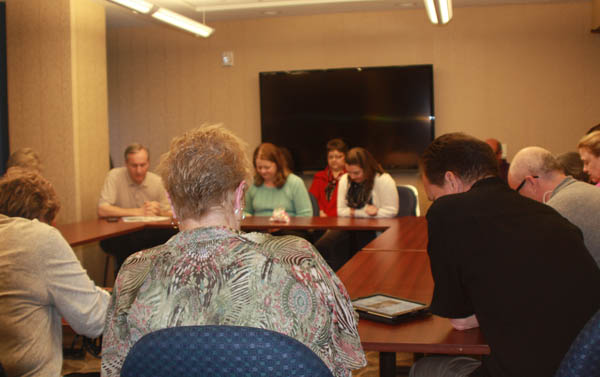
The IBSA staff, led by Executive Director Nate Adams, gathered this morning to pray for marriage.

The IBSA staff, led by Executive Director Nate Adams, gathered this morning to pray for marriage.

Christians in the U.S. have been asked to pray for marriage today as the Supreme Court is hearing arguments in a case which could decide if same-sex marriage will be made legal in all 50 states. The outcome could also have far-reaching consequences for churches, military chaplains, Christian business owners, and others.

Many have warned that the case being presented today is of paramount importance comparing it to the Court’s 1972 decision in Roe v. Wade which legalized abortion in the U.S. SBC President Ronnie Floyd wrote on his blog, “What is at stake is great. This is undeniable. We do not control the Supreme Court. At this point, our number one role must be to pray. Regardless of the outcome, may God have mercy on America and teach us how to live daily.”

Russell Moore, president of the Ethics and Religious Liberty Commission (ERLC), stood outside the Court this morning and described the scene as “circus-like.” He wrote on his blog, “Rainbow flags were waving, as protesters on either side lifted aloft contesting signs. A man screamed through a megaphone about how ‘God hates queers’ right next to men in stiletto heels and nun’s habits. The whole scene drove me to pray, and almost to tears.”

The IBSA staff gathered this morning to pray for marriage. Executive Director Nate Adams led in prayer for attorneys arguing both sides of the case, for the justices, for those involved in homosexuality, for our nation to turn to God, and for Christians and pastors to share Christ in love, not condemnation.

Adams likened what is happening today to how the “Israelites must have felt facing the Red Sea as they heard the pharaoh’s chariots pounding behind them” and noted that God provided a way. No matter the outcome, he reminded, “God is still sovereign and on His throne.”

Regardless of the court’s decision, which is expected to come in June, Moore recognized, “We then must have enough confidence in our gospel to stand with conviction, even when the world thinks we’re crazy. And we must have enough confidence in our gospel to stand with kindness toward those who disagree with us.”

What are the facts in today’s case?

The Supreme Court is hearing arguments in the case of Obergefell v. Hodges, which is consolidated with three other cases from Kentucky, Michigan, and Tennessee. The case challenges the Fourteenth Amendment of the U.S. Constitution regarding same-sex marriage and state’s rights.

According the ERLC, the court’s decision will determine:

  1. Does the Fourteenth Amendment require a state to license a marriage between two people of the same sex?
  2. Does the Fourteenth Amendment require a state to recognize a marriage between two people of the same sex when their marriage was lawfully licensed and performed out-of-state?

Read the full explanation from the ERLC.

THE BRIEFING | Meredith Flynn

In the wake of Saturday’s massive earthquake near Kathmandu, Nepal, Christian workers asked for prayer for the devastated country:

• Pray for basic shelter, water and food. These necessities are a high priority right now since no one is allowed back in their homes.

• Pray for God’s people to deeply know His comfort and peace during this time. Pray they will share Him with people around them.

• Pray for people in Nepal and surrounding areas during the continuing aftershocks and aftermath of this disaster. Southern Baptist assessment teams will began the damage Monday to find the best ways to respond.


Potential presidential candidate Dr. Ben Carson will not address the Southern Baptist Pastors’ Conference this summer as scheduled, Baptist Press reports. Several Baptists, including the Baptist 21 group of younger SBC leaders and pastors, had expressed concern about Carson’s membership in a Seventh-day Adventist Church, and that his appearance at the conference could look like a political endorsement.


Three years after the death of Prison Fellowship founder Charles Colson, Russell Moore reflects on media coverage surrounding the Watergate conspirator’s life and eventual conversion to Christianity. For those who were cynical about Colson’s transformation, writes the president of the Ethics and Religious Liberty Commission, “…we shouldn’t be angered by those who don’t get the full measure of the man. We should instead hear in some of this cynicism the cry of every human heart, a disbelief that there can be any such thing as final and total forgiveness of sin.”


Zondervan announced last week Charles Colson’s last book, “My Final Word: Holding Tight to the Issues that Matter Most,” will be released Aug. 4. Topics in the collection of writings will include “the rise of Islam, same-sex marriage, the persecution of Christians, crime and punishment, and natural law,” The Christian Post reports.


Atlanta-area pastor Andy Stanley says local churches should be the “safest place on the planet for students to talk about anything, including same-sex attraction.”

“We just need to decide, regardless of what you think about this topic–no more students are going to feel like they have to leave the local church because they’re same-sex attracted or because they’re gay,” said Stanley, pastor of North Point Community Church, at the Catalyst West conference April 17. Read the full story at ChristianPost.com.

A controversial Houston ordinance is now in effect, following a judge’s ruling on a petition drive led in part by some pastors in the city. HERO, or Houston Equal Rights Ordinance, made headlines last year when the city subpoenaed the sermons and other communications of five pastors who were against the ordinance. (The subpoenas were later withdrawn.)


Religious leaders are encouraging President Barack Obama to appoint a special envoy to monitor religious freedom in the Middle East and parts of Asia. The special envoy position has been vacant since it was created last year in the Near East and South Central Asia Religious Freedom Act, Baptist Press reports.


Are you one of the many football fans bent out of shape since Tim Tebow’s exit from the NFL? Good news: A Philadelphia pretzel company has created a way to celebrate his return. The “Tebowing” pretzel, shaped like the quarterback kneeling in his famous praying pose, started as a publicity stunt but soon went viral. The New York Daily News reports the Philly Pretzel Factory plans to donate proceeds from the pretzels to a charity involving Tebow, who has signed a one-year contract with the Philadelphia Eagles.


Diana_Davis_blog_calloutEditor’s note: Diana Davis is an author, columnist and minister’s wife. This column appeared in the April 6 Illinois Baptist. Visit Diana’s website at http://www.dianadavis.org.

HEARTLAND | Diana Davis

When a first-time guest completes a guest registration card at your church, what happens next? The most common answer to that question: absolutely nothing. No, it’s not an intentional oversight, but without an ongoing, immediate follow-up plan, your church may miss the opportunity to reach guests for Christ and include them in your church family.

Need fresh ideas? Tweak some of these to fit your unique church:

First-time guest online survey. People love to give an opinion! Create a brief survey on your church’s website. (See a sample survey at dianadavis.org) Carefully study survey responses.

Same-day contact. A specially trained volunteer makes a brief phone call to each guest on Sunday afternoon after they visit your church.

E-mail and/or snail mail. Assign volunteers to send a swift, personal email or card to each first-time guest.

Small group personal invitation. Provide contact info to an appropriate small group or Sunday School class for each family member. A member of that small group may offer to meet the guest at a specific door to escort them to class the next time they visit.

Coffee, anyone? An Indiana church delivers three coupons for a free drink in their coffee area, encouraging the guest to return for three consecutive Sundays. In a different church, volunteers deliver a church coffee mug to the guest’s door before they get home from church.

Pastor’s letter. Many pastors prepare a warm letter or e-mail to welcome first-time guests; some even jot a handwritten note. Pastor Ted Traylor at Olive Baptist, Pensacola, often texts or phones first-time guests on Saturdays, inviting them to come back on Sunday.

Notice that church members—not just ministry staff—accomplish the majority of follow-up. Newcomers want to hear what you love about your church. They desire relationships, and relationships provide evangelistic opportunities.

When God brings a first-time guest to your church this Sunday and they complete a guest registration card, what will happen next?

“The harvest is abundant…pray to the Lord of the harvest to send out workers into His harvest” (Luke 10:2).

THE BRIEFING | Meredith Flynn

The uproar over Indiana’s Religious Freedom Restoration Act continued as lawmakers introduced changes to the bill that opponents say put business owners at risk to be forced to compromise their beliefs.

The original RFRA, signed into law March 26 by Gov. Mike Pence, came under national fire from corporations, celebrities, and others who said it would allow discrimination against gay people. Supporters of the law said it would protect the religious liberty of business owners by shielding them from government action if they refused to provide services for same-sex weddings.

The_BriefingThe changes to the law, signed by Pence one week after he approved the original RFRA, say “no member of the public may be refused services by a private business based on sexual orientation or gender identity,” Baptist Press reports.

The controversy, wrote Philip Bethancourt of the Ethics and Religious Liberty Commission, has served to make religious liberty “a new culture war wedge issue.”

“One indication of this change is the frequent use of ‘religious freedom’ in scare quotes, suggesting that it is merely a cover for something more malicious,” Bethancourt wrote on ERLC.com. “Danger arises when our first freedom becomes a second-class culture war issue.”


Christians in Kenya grieved on Easter Sunday for 148 people killed at a university last week by terror group al-Shabaab. The Associated Press reported on the Easter service at Our Lady of Consolation Church in Garissa, where Bishop Joseph Allessandro said, “We join the sufferings of the relatives and the victims with the sufferings of Jesus. The victims will rise again with Christ.”

During the April 2 terror attack at Garissa University College, the shooters separated Christian students from Muslims and killed the Christians, AP reported.


What do Americans believe about Jesus? According to new research by Barna, most say he was a real person, a little over half believe he was God, and 62% say they have made a personal commitment to him that is still important in their life today.


And what about the church? LifeWay Research found that while 55% of Americans say the church in America is declining, 65% believe attendance is admirable.


More interesting research: Pew says current trends forecast that Muslims will almost equal Christians in number by 2050, and the global percentage of “nones” who have no religious affiliation will actually decrease.


“We’ve got a long way to go” on race relations, said Ethics and Religious Liberty Commission President Russell Moore at a March summit on racial reconciliation and the gospel. “Our sin keeps wanting us to divide up. But to the faithful, Jesus promises, ‘You will be called overcomers.’” Read the Illinois Baptist‘s coverage of the summit here at ib2news.org.


Did you catch the premiere episode of “A.D.: The Bible Continues” on Sunday? Christianity Today is recapping each installment of the new miniseries produced by Mark Burnett and Roma Downey, which details the history of the early church following Jesus’ death and resurrection.

COMMENTARY | Meredith Flynn

PrintOne of the major stories out of last year’s Leadership Summit hosted by the Ethics and Religious Liberty Commission was the negative reaction on social media. In fact, the “Reporter’s Notebook” column space in the following issues of the Illinois Baptist was devoted to “angry birds” who spoke out on Twitter about the speaker line-up, the subject matter, and the opinions expressed.

It seemed like almost everything that was said (or tweeted or blogged) at last year’s meeting made somebody mad.

This year, not so much. Yes, there was some chatter, according to tweets after the event, about Baptists having an agenda for tackling this year’s topic, racial reconciliation. At least one poster noted the Southern Baptist Convention should be honest about its past in regards to slavery and racial division. (One whole panel discussion and pieces of other messages were devoted to the topic.)

But most of the Twitter feedback was positive. Maybe it was because much of it came from inside the summit. Racial reconciliation may not have drawn the same large online audience as last year’s topic: sexuality. Or, there’s this possibility: At its core, the summit was a meeting about a problem that every Christian can identify with, and one for which even those outside the church see the need for a solution.

Divisions exist around racial identity, and in recent days, they have been especially ugly, violent, frightening and real.

Leaders at the summit seemed to view racism as a common enemy. And, for Christians, as sin. There are some things you don’t do anymore once you have a relationship with Christ, said recent Southern Baptist Convention President Fred Luter.

“Don’t tell me you’re saved and still lying like a rug. Don’t tell me you’re saved and still cussing like a sailor. Don’t tell me you’re saved and still mean as a pit bull. Don’t tell me you’re saved and still don’t like someone because of the color of their skin.”

From the podium in Nashville, summit speakers talked about racial division as a universal problem, and a universal responsibility. Thabiti Anyabwile compared having skewed ideas about racial identity to walking into a cafeteria and seeing one table of diners that look like you, and one that doesn’t. You immediately think the table that looks like you has something in common with you, and is therefore safe for you.

“The mind is a relentless stereotyper,” Anyabwile said. No matter who you are. At the ERLC Summit, speakers and attenders were unified by that knowledge, and in the belief that the gospel is the only thing that has the power to reconcile people to God and to one another.

And the angry birds, for the most part, stayed away.

Meredith Flynn is managing editor for the Illinois Baptist newspaper.