Archives For November 30, 1999

What are we going to do?

Lisa Misner —  October 12, 2015

HEARTLAND | Nate Adams

Nate AdamsI remember vividly my Dad talking about the final hours he spent with his mother, my grandma, in the hospital before she died. Grandma was a devoted Christian and churchwoman, a member for more than 60 years of First Baptist Church in Murray, Kentucky, where the Cooperative Program was born in 1925.

As she came to the end of her life, and was only semi-conscious, Dad said she would occasionally rise up out of her hospital bed and say over and over, “What are we going to do? What are we going to do? What are we going to do?” Then he said she would relax back into her pillow with these words: “I guess we’ll just trust the Lord.”

For devoted Southern Baptists, recent news from the International Mission Board that as many as 600 to 800 missionaries soon need to return from the mission field leads us to that same, urgent question. What are we going to do?

I don’t have space here to go into all the details, which you can read at the imb.org or sbc.net web sites. But in summary, the IMB has been drawing down on financial reserves and selling properties for years in order to keep as many missionaries on the field as possible. It has been an unsustainable situation, that IMB leadership reports must now be corrected.

What are we going to do? I submit that trusting the Lord is still the best and right answer. Let me suggest five specific ways we here Illinois can do that.

First, we should pray. We should intercede for those in leadership at IMB as they make decisions, and for those missionaries and others who are affected by those decisions. We should pray for solutions, and for generosity from givers and churches, and for the Lord to send laborers into the harvest fields, even as it seems the opposite may be happening.

Second, we should trust the IMB trustees and executive staff to do their jobs. More than once over the years I have thought to myself that I would do things differently if I were in charge of some organization. Sometimes time proves me right, and sometimes time proves me wrong. But in our autonomous, cooperative family of churches we elect trustees to give oversight to the gifted and called leaders of our entities. They are closer to the facts, finances, and circumstances than any of us. And the Bible says that one of the ways we trust the Lord is to trust the leaders He providentially allows to have positions of authority.

Third, we should renew and increase our churches’ commitment to missions through the Cooperative Program. Even the surges and higher levels of giving to the Lottie Moon Christmas Offering over the past decade have apparently not been enough to prevent this downsizing of the missionary force. But ten percent giving through the Cooperative Program would have. Nationally, CP giving from SBC churches has dropped from an average of 10% in 1989 to 5.5% in 2014 (6.8% here in Illinois). If churches’ CP giving had continued to average at least 10% over those years, the number of international missionaries would have grown dramatically, along with the rest of our cooperative missions and ministries.

Fourth, we should of course consider giving our most generous gifts ever through the Lottie Moon Christmas Offering. IMB says that will not change the need for many of the missionaries to return home. But it may speed the rate at which they can be replaced.

And finally, as churches, associations, state conventions, and individual Christians, we should look for ways to directly assist the missionaries who will be returning stateside. Temporary housing, transportation, job placement, and personal encouragement will all be needed by returning missionary families. IBSA will be establishing a Missionary Relief Fund, and the offering received at this year’s IBSA Annual Meeting will be designated for that fund. I will also be contacting IMB with a list of IBSA’s currently open positions.

Many of us were surprised at the need for these missionaries to return home. But God is not. And so let us answer that urgent question with one or all of these very tangible actions that demonstrate we are trusting the Lord.

Nate Adams is executive director of the Illinois Baptist State Association. Respond at IllinoisBaptist@IBSA.org. Read this and other articles in the 10/12 issue of the Illinois Baptist online.

HEARTLAND | Nate Adams

My work has always involved a fair amount of travel. And so early on, I discovered the value of joining various reward programs, where the airline or hotel chain or rental car company gives you a certain number of reward points each time you use their services. Those reward points can then be redeemed for free flights or stays or rentals.

Nate_Adams_June8I know many travelers actually choose the company with which they travel based on the reward points they are seeking to accumulate. That’s exactly the kind of loyalty the company is seeking to achieve with its program.

However, I’ve always felt that I should try to choose the least expensive option, whether using my employer’s travel funds or my own. So over the years, I’ve ended up joining multiple rewards programs, hoping to earn at least a few points, no matter what hotel or airline happens to be least expensive.

I think that’s why a certain television commercial caught my attention a few days ago. It was advertising a new rewards program, one that multiple companies of all different types were cooperating to sponsor. There were nationwide chains of supermarkets, gas stations, retailers, and insurance companies, as well as the option of earning points through online ordering. And not only could you earn points in these multiple ways, you could spend them in multiple places!

Now I’m not mentioning this program to endorse it or encourage anyone to try it. But I have to admit it was very attractive to someone like me, who wants to choose the best option for my employer or me, regardless of which company is providing the service. These individual companies had chosen to work together to provide rewards in ways that were more beneficial to me, their shared customer.

It then occurred to me that this is actually one of the reasons that I find our Southern Baptist Cooperative Program so attractive and compelling. What if individual SBC mission boards or ministries chose to compete with one another for my loyalty and support? What if I had to choose between state missions, North American missions, and international missions?
What if my missions dollar only “earned points” with one “service provider,” to the exclusion of the others?

Part of the genius and effectiveness of Cooperative Program missions is that it allows me to “earn points” in multiple mission fields and ministries, along with every other faithful giver in my church. A portion of each dollar I give through my church is set aside for the larger cause of SBC missions and ministries. And as those points are accumulated with the gifts of other
churches, they grow and can be “redeemed” through multiple service providers, not just one.

How many “points” for missions does your weekly giving through your church earn? If you don’t know, that’s a good question to ask your missions or finance committee, or your pastor. My home church designates 10% of its undesignated offerings for Cooperative Program missions. That means a dime out of every dollar I give each week earns multiple “rewards,” through the International Mission Board, the North American Mission Board, the Ethics and Religious Liberty Commission, our six world-class seminaries, and, of course, right here in Illinois through IBSA.

I really like the title of that rewards program I saw on that TV commercial. They simply call it “Plenti.” The idea, I think, is that there are plenty of points to be earned, and plenty of service providers to provide plenty of benefits to plenty of customers. It’s not competition and scarcity, but rather cooperation and generosity that lead to plenty. It’s a truth that we as God’s people should model, especially through our missions giving. Cooperation is the pathway to plenty.

Nate Adams is executive director of the Illinois Baptist State Association.

HEARTLAND | Nate Adams

Nate_Adams_March23Recently a bivocational pastor shared with me a difficult decision he needed to make, whether or not to stay as pastor of the church he was serving. He had already accepted the reality that the small church could not afford both his insurance and a full-time wage, and that he needed employment outside the church to support his family. What seemed to have him questioning whether he could stay were recent remarks by a couple of his church members.

“We had to cancel Sunday services one week because of a snowstorm,” he explained, “and a couple of the members raised the question of whether or not they should still pay me that week, since I hadn’t actually preached.”

I could hear the hurt in his voice, and read the disappointment in his face. He was still a few years away from retirement, and had recently lost his job outside the church. At a time when being valued by the church was very important to him, a couple of unthinking church members had made him feel less valued than ever.

But the pastor went on to explain that, in his view, the problem probably ran deeper than a careless statement or two. “I really think some of them think that way. They aren’t giving generously to the Lord, or even to support me as their pastor. They feel they are merely purchasing a service from me, and that if that service is not delivered, the church shouldn’t have to pay.”

After a few minutes of talking it through, it seemed clear to me that the pastor was going to stick it out. He loved his congregation, and I suspect that even the ones who made the hurtful statements loved him. But he and I agreed that if he was going to feel appreciated, and perhaps even more importantly, if his people were to have their hearts matured and transformed into generous, godly givers, that he needed to provide some candid teaching, and loving but direct conversation, on tithing and giving.

I think one of the reasons I was able to understand this pastor’s hurt and encourage him to press on is that this same dynamic of consumerism can also affect our cooperative missions work as churches. Not often, but occasionally, I will hear someone ask, “Why should we give to that? What do they do for us?”

They could be referring to a mission offering, or the Cooperative Program, or the local association, or any ministry where the investment is largely in people that are doing ministry among and on behalf of the churches. If there’s not some direct, tangible benefit back to the church, the value is questioned. “If they aren’t here, helping us, maybe they don’t deserve our support.” If the sermon isn’t preached, the ongoing, continual ministry of the pastor isn’t valued.

The next Sunday after that conversation, a snowstorm hit here in Springfield. Several area churches cancelled services, but our church did not.

With that pastor’s pain still in the back of my mind, I got up early to clear the snow from our driveway, and make sure we could get to church. As we headed out the door, I asked my wife to make sure we had our offering envelope with us. I remembered in a fresh way that our tithe was the Lord’s, and that our church’s staff and ministries count on our support, whether we’re there benefitting from them or not.

I also remembered that the portion of my weekly offering that goes through the Cooperative Program supports thousands of missionaries and other ministries that operate literally around the clock and around the world. The Lord and they are at the heart of my giving, not the benefits I receive. And I’m grateful for each one of you that feels and gives from that heart too.

Nate Adams is executive director of the Illinois Baptist State Association.

One Baptist leader says Scripture’s case for cooperation is the most compelling reason to work together.

Micah_Fries_blog“My entire life growing up, what I heard about the Cooperative Program was, ‘give to it because it works,’” said Micah Fries (left), vice president of LifeWay Research.

Indeed, historical evidence supports it—CP does work. Southern Baptists’ main method of supporting missions and ministry here and around the world, will turn 100 in 10 years, and has helped mobilize one of the largest missionary forces in the world.

Last year, Baptists gave more than $186 million through the CP Allocation Budget to send and support church planters in rural America and the country’s largest cities, and to get the gospel to places and people around the world that have never heard it. At a meeting of the SBC Executive Committee last year, CEO Frank Page called CP the best way to “concurrently, consistently and, yes, completely fulfill Acts 1:8 as a church body. Through that, you’re involved in missions and ministries all over the world, all the time.”

But the average percentage churches give through CP has fallen over the years, from 10.7% in 1982, to less than 5.5% the last few years.

In this climate of decline when it comes to cooperative engagement, there is a better, more compelling reason to work together than to do so “because it works,” Fries said during a breakout session at the recent Midwest Leadership Summit in Springfield, Ill. He argued for a theological foundation, rather than pragmatic justification.

“…I want to plead with you to go back to your churches and plead with your churches, go back to your associations and your state conventions and plead with them to be faithful at partnership mission, but not because it works. But because the Bible tells me so.”

A better rationale
Our need for a biblical foundation for cooperation, Fries said, starts with characteristics we have that are specifically human, and specifically American. In our consumer-driven culture, most people shop for churches like they shop for blue jeans. Where can I get the best product for the lowest cost? If the personal price is too high, they’ll look elsewhere.

That consumerism, along with pride, independence, and the valuing of perception over reality, runs counter to the ideas of community and cooperative engagement.

“…When you and I call for community in the context of the local church, and cooperation or collaboration between local churches, we need to understand that what we’re calling for is a radically counter-cultural identity,” Fries said. “It strips away the core of who we are, and calls us to be like Jesus.

CP charts are complicated, Fries said, even for those who have long understood the system. “Stop making it so confusing for people.” “That’s what the Cooperative Program does," Fries said.

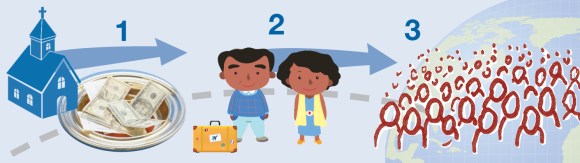
CP charts are complicated, Fries said, even for those who have long understood the system. “Stop making it so confusing for people. You put money in the plate, money goes to a missionary, missionary tells people about Jesus. That’s what the Cooperative Program does.”


“This is challenging. This is why it’s not enough to say, ‘We need to give to the Cooperative Program because it works.’ Because ‘it works’ is not a compelling enough reason to deny the core of who we are.

“Because it makes us to be like Jesus, because it helps to advance the gospel, because it helps to glorify God; those are compelling reasons to engage in counter-cultural activity.”

Younger Baptists are looking for more than pragmatic justification too, Fries said. The generation raised after the Conservative Resurgence spends more time thinking about what the Bible actually says, than arguing its truth. “So, you’re not going to compel them with pragmatic arguments, it’s going to have to a biblical rich, theologically rooted argument.”

Toward gospel advance
“Without a doubt, the high calling and common cause that unites diverse Baptist churches in cooperation is the Great Commission of Jesus to make disciples of all the world’s peoples,” IBSA Executive Director Nate Adams wrote for Resource magazine last year. “Wherever else Baptists may disagree, we are agreed on the priority of advancing the gospel, both across the street and around the world.”

CP also helps involve different kinds of churches in that mission, Page noted during the Midwest Leadership Summit. The SBC is a convention of small churches, including many ethnic congregations. “The Cooperative Program levels the playing field so everyone has opportunity to bring worshipers to God.”

Ultimately, biblical cooperation leads to an advanced gospel, which is “the compelling apologetic for collaborative mission,” Fries said. Choosing for the gospel to go forward through believers wasn’t the most pragmatic choice for God to make, he said; rather, he designed it that way because it brings him glory and brings us joy.

Read more from the Feb. 2 issue of the Illinois Baptist, online at http://ibonline.IBSA.org.

And what the trends mean for your church

An Illinois Baptist team report

"Imagine if you could spend 10 focused minutes each Sunday morning in extraordinary prayer on two major needs locally, in your church, in America, or across the world.” SBC President Ronnie Floyd’s “Call to Prayer” that began at the Annual Meeting in Baltimore now turns to Sunday mornings, starting with one worship service in January.

SBC President Ronnie Floyd’s “Call to Prayer” that began at the Annual Meeting in Baltimore now turns to Sunday mornings, starting with one worship service in January.

1. Churches respond to “Call to Prayer”
“It is past time for us to prioritize prayer personally and in the church,” SBC President Ronnie Floyd wrote on his blog in early December. “For far too long, we have seen what we can do; it is time for us to see what God can do. This can only happen when we pray.”

Floyd’s continued call to prayer—leading to the June 2015 SBC Annual Meeting in Columbus, Ohio—began about two years ago with a series of meetings for pastors and church leaders. Floyd began quoting famed Puritan preacher Jonathan Edwards who called believers to “extraordinary prayer” for revival in America.

“God’s people will be given a spirit of prayer,” Edwards wrote in 1746, “inspiring them to come together and pray in an extraordinary manner, that He would help his Church, show mercy to mankind in general, pour out his Spirit, revive His work, and advance His kingdom in the world as He promised.”

Today’s growing urgency in prayer coincided with planning for the 2014 IBSA Annual Meeting in November. “We will either hunger for God’s righteousness out of desperation or…out of devastation,” IBSA President Odis Weaver told messengers. The November meeting peaked in a Concert of Prayer for Spiritual Awakening in Illinois and across the U.S.

“I believe we need to cry out to God for spiritual awakening, and for revival in our churches,” said IBSA Executive Director Nate Adams. He led more than 400 pastors and church leaders through a prayer cycle lamenting the lost condition of people in Illinois, repenting of apathy and ineffectiveness, interceding for spiritual awakening, and commiting to pursuit of revival in our churches.

Afterward, many pastors said they would lead similar prayer events when they returned home.

Now Floyd is asking churches to dedicate an entire Sunday morning service to prayer in January: “Just imagine if 100 churches, 500 churches, or several thousand Southern Baptist churches would turn a Sunday morning into insuring that Jesus’ House would be a genuine house of prayer for all the nations.
Just imagine what could happen if, from this point forward, you could spend 10 focused minutes each Sunday morning in extraordinary prayer on two major needs locally, in your church, in America, or across the world.”

Jonathan Edwards imagined the outcome. He called it the “revival of religion.” We would call it “advancement of the Gospel”—the salvation of lost souls, renewal of our churches, and restoration of moral sensibility to the nation.

In your church: SBC churches will likely give prayer a higher profile in 2015, but what are we praying for? How will we sustain prayer in our congregations as more than a once-in-a-while emphasis? Consider a Concert of Prayer in January. As Floyd wrote, “If we do not plan to pray, we will not pray!

2. Evangelicals cope with minority status
Say goodbye to Mayberry. The culture is shifting. What was once called good is now called evil, and vice versa, just as Isaiah said of his own times. The majority opinion in the U.S. approves of same-sex marriage, and many other sexual matters—once outside the norm—are being accepted by society at large. But, while the morals and mores are changing, Southern Baptists are not.

We still stand on the Word.

“One of the biggest challenges for conservative Christians is moving beyond a Bible Belt mentality, or a moral majority mentality,” said Russell Moore, president of the SBC’s Ethics and Religious Liberty Commission, “and seeing ourselves instead as in many cases a prophetic minority speaking to a larger culture about things that matter.”

Moore called on pastors and church leaders to “prepare people for what the future holds, when Christian beliefs about marriage and sexuality aren’t part of the cultural consensus but are seen to be strange and freakish and even subversive.”

“The Bible Belt is collapsing,” Moore has concluded.

The main evidence of that in Illinois is same-sex marriage which became legal June 1. Churches, at one point concerned they would be forced to perform
gay weddings, instead began addressing their bylaws as means of protection.

Another response by evangelicals is to make the church a place of refuge, said John Stonestreet, commentator for Breakpoint Ministries. “People who are enslaved to porn and suffer different forms of brokenness need to be able to come to the church and find answers. The church needs to offer hope and solutions. We need to say, ‘Here’s an option. Here’s the hope; here’s the gospel; here’s the truth; here’s Jesus; and here’s the cross.’”

Moore concurs. “We must have a voice that speaks to the conscience, a voice that is splattered with blood. We are ministers…not of condemnation, the devil can do that, we are ministers of reconciliation, which means that we will speak hard words…truthful words to address the conscience, even when that costs us everything.”

In your church: Church leaders are ministering from a new vantage point, but with the same apologetic. The challenge will be to confront cultural ills in a way that is biblically faithful and yet winsome. The message hasn’t changed, but some in our society today need to hear the truth truly spoken in love.

At a meeting in Asia, young missionaries surround new IMB President David Platt to pray for him as he seeks to mobilize churches. Photo by Hugh Johnson/IMB

At a meeting in Asia, young missionaries surround new IMB President David Platt to pray for him as he seeks to mobilize churches. Photo by Hugh Johnson/IMB

3. Young leaders urge peers to “re-engage”
The evidence has been building for a few years now: young Baptists are back. Or on their way back, at least.

They’re more visible at the Southern Baptist Convention’s annual meetings, and, in 2014, at two meetings on the gospel and marriage hosted by the Ethics and Religious Liberty Commission. They’re also beginning to look remarkably similar in age to the leaders of several of the denomination’s entities. At the ERLC’s October national conference, 125 young leaders had dinner with President Russell Moore and the heads of the SBC’s two missions agencies, Kevin Ezell and David Platt. At four years, Ezell is the longest-tenured at his post; Moore took the ERLC reins in 2013, and Platt was elected in August.

“There’s never been a better time in my lifetime to re-engage as a Southern Baptist than right now,” Ezell, president of the North American Mission Board, said at the meeting. “I really believe that God is up to something very special in the Southern Baptist Convention.”

Many young Baptists likely would cite the election of Platt, 36, as one of the highlights of 2014. Midwestern Seminary President Jason Allen, himself 38, blogged that when he announced Platt’s election during a September chapel service, students (and faculty and staff) broke into applause for the missiologist and author of bestseller “Radical.”

More than 1,000 miles away in Richmond, Va., young missionary appointees gathered around Platt shortly after his election to congratulate him and tell him how “Radical” and his messages on reaching the nations had helped lead them to the international mission field.

After Platt’s election, some Baptist leaders expressed concern that his Birmingham congregation, The Church at Brook Hills, gave a lower amount through traditional Cooperative Program channels, instead sending a large portion of their gifts directly to the SBC Executive Committee and International Mission Board.

But even with those concerns, established leaders affirmed Platt’s ability to mobilize young people to share the gospel to the ends of the earth. Southwestern Seminary President Paige Patterson noted it in a blog post published shortly after Platt’s election, calling for “thanksgiving to God for the presence of a young leader who has obviously garnered the hearts of the younger generation and who will have the opportunity to lead them to a commitment to the world mission enterprise.”

One blogger put it a little more plainly, noting Platt may be just the right voice to deliver tough love to would-be male missionaries outnumbered by female “Journeymen” appointed through the IMB.

“Lend your voice to addressing the issue of young males wimping out of Journeyman service,” William Thornton wrote at SBC Voices. “These guys think you walk on water, Mr. Radical. Give ‘em both barrels on this and see what happens.”

In your church: Look for increased excitement from your own young leaders now that the authors and speakers they’ve followed for several years are in prominent positions. Be prepared for them to want to go to the hard places for ministry and missions. “That’s where we hear young couples saying they want to go, that they want to be radically obedient to what God has called us to do for the nations,” said IMB trustee chairman David Uth. “The passion is there.”

4. Growing persecution: From “the Nun” to “resurrection people”
Before Ebola dominated headlines, another one-word threat struck fear in the hearts of many around the world—and even here. The war of terror and persecution waged by ISIS, or the Islamic State of Iraq and Syria, was the story of the year earlier in 2014.

ISIS chased religious minorities high into the mountains of Iraq. They filmed beheadings and broadcast them as warnings to the rest of the world. And they stirred many in the Western world to stand with the persecuted church. The Arabic letter “Nun” was used on social media pages to symbolize solidarity with those persecuted for their faith in “the Nazarene,” or Jesus.

It’s not just a problem in the Middle East. In Nigeria, 1,505 Christians were killed for their faith in the first seven months of 2014, according to non-profit Jubilee Campaign. North Korea again topped Open Doors’ list of most persecuted countries, highlighted by the imprisonment of American Kenneth Bae, who was finally released in November. Others, including Pastor Saeed Abedini in Iran, remain in prison.

Closer to home, Christians felt a different kind of persecution. Businesses and non-profits faced government fines for not providing abortion-causing contraceptives. The mayor of Houston, Texas, subpoenaed the sermons of pastors who were against the city’s pro-LGBT ordinance.

Christian leaders here urged believers to remember who they belong to. “The answer to the decline of religious freedom and the change in the moral climate is not found in waging incessant cultural wars, filled with rage at our changing culture,” said LifeWay Research President Ed Stetzer. “Simply put, you can’t hate a people and reach a people at the same time.”

Instead, he urged Christians, “Let’s live like the resurrection people, adorning the gospel with lives of grace. Even in our passion to defend freedoms increasingly at risk, let’s remind ourselves this generation is desperately in need of the love of Christ, lived and shared.”

In your church: Be prepared to think globally about persecution. How can your church go beyond your normal prayer times to intercede for those under threat for their faith?

Be alert to what government bodies are doing. Speak out when religious liberties are threatened. The IRS prohibits churches from supporting candidates, but not from speaking on issues related to faith.

SBC’s Frank Page speaks frequently about the future of the Cooperative Program, painting a hopeful picture despite years of declining offerings. Photo by Morris Abernathy

SBC’s Frank Page speaks frequently about the future of the Cooperative Program, painting a hopeful picture despite years of declining offerings. Photo by Morris Abernathy

5. Cooperative missions for a new generation

Most Baptists agreed the Cooperative Program, the denomination’s chief method of funding missions and ministry, is the best way for churches together to pursue the Great Commission. But how to fix the CP, plateaued and trending slightly downward for years, is up for debate. The election of David Platt as IMB president revealed how his church and other large churches have bypassed their state conventions, even though CP gifts for national and international missions are supposed to be routed first through the state level.

“I have heard some people say, ‘The big problem is that the younger generation simply isn’t educated about CP,’” blogged pastor J.D. Greear after Platt’s election. “That may be true for a small percentage of people, but the bigger problem is probably that they are educated about it. The more they find out about CP giving, the less they are motivated to give.”

Meanwhile, blogger Bart Barber spoke up for the reliability of the system itself, calling those who disagree with the way CP funds are allocated to greater involvement in SBC life. “…Within the Cooperative Program approach you can pursue any ministry, reallocate any budget, or adopt any methodology that you can convince enough of your fellow churches and fellow pastors to adopt,” Barber posted at SBC Voices.

“Bring on the changes! Make your proposals! Go to the floor of the SBC Annual Meeting! Attend your state convention meeting! Advocate tirelessly and fearlessly for the improvements you’d like to see. Whatever they are and however much adaptation they would require, I’m betting that almost none of it would actually require any changes at all in the Cooperative Program.”

SBC Executive Committee CEO Frank Page continued his campaign for increased giving through the Cooperative Program, touring the nation (including Chicago) to talk with younger pastors and leaders. “I’ll drop the Cooperative Program if you can show me something else that long-term is effective and engages every church concurrently and consistently in an Acts 1:8 strategy,” Page has said on several occasions. “Show it to me, and I’ll support it….But I
haven’t found it yet.”

In your church: More conversation about CP in the national SBC could mean it’s time for a refresher course in your local church. A class for young or new Baptists is an opportunity to teach about why Baptists give cooperatively. One big reason: CP helps missionaries focus on their mission field, instead of fundraising. Another reason: CP helps the local church have a balanced missions strategy, supporting work on all their Acts 1:8 mission fields.

-With reporting from Baptist Press

Read all of the December 22 Illinois Baptist at http://ibonline.IBSA.org.

Nate_Adams_1110HEARTLAND | Nate Adams

Recently the city council in Seattle, Washington, voted unanimously to change their designation of the second Monday in October from Columbus Day to Indigenous Peoples Day. “Nobody discovered Seattle, Washington,” said one Indian nation president during the council meeting. And so, at least on one day in October, the city of Seattle will go its own way.

And yet, Seattle is not alone. The Minneapolis, Minnesota, city council passed a similar measure earlier this year. In Hawaii, they now celebrate “Discoverers’ Day” instead of Columbus Day, while in South Dakota it’s now “Native Americans Day.”

As much as I appreciate our nation’s Native American heritage, actions like these seem to me to denote a troublesome attitude or mindset, and yet one that I’m noticing more and more, even in Baptist life. It’s a mindset that says, “We’re mainly interested in what’s relevant and valuable to us here at home, and less interested in the bigger picture of what others are doing.”

In a way, it’s a mindset that’s compatible with the deeply held Baptist belief in autonomy. “No one outside our church is going to tell us what to do!” Yet at the same time it’s a mindset that tugs against the very spirit of unity and cooperation that have always been the hallmarks and strength of Baptist churches.

The way I see it expressed more these days is through practices such as designated rather than cooperative giving, or ecumenical rather than denominational partnerships. For example, one large Baptist church in the south that used to give more than $1 million through the Cooperative Program recently shifted more than 90% of that directly to their preference, international missions. And I see Baptist churches of all sizes occasionally doing missions or benevolence projects with partners whose doctrinal positions I daresay they have not examined.

Some of this is people just naturally doing what they want, or supporting what they find most compelling. But in those individual choices or preferences, there are often also great losses. When we each do what we prefer locally, we diminish what we can all accomplish collectively.

As we come to the close of another year here in Illinois, and perhaps finalize our church budgets, I would encourage us to do more pulling together and less pulling apart. There is already great individuality and diversity among our churches. And yet it is our unity around Baptist doctrine and cooperative missions that pulls us together, and allows us to accomplish together things that no individual church could do on its own.

Recently I’ve been invited to a number of churches to share, usually in a combined adult Sunday school class, how and why “cooperative missions” works, and then to preach in the morning worship service. Each time I do, there are older adults who come and say something like, “That’s why I’ve been Southern Baptist all my life.” And there are younger adults, many of whom didn’t grow up in a Baptist church or receive any childhood missions education, who say, “You know, I don’t think I really understood how we work together with other churches, but that really makes sense.”

In other words, our churches are already full of indigenous peoples, who naturally go their own ways. Our responsibility as autonomous but cooperating Baptist churches is to pull people together around the Word of God and the Mission of God.

Columbus wasn’t the first or only discoverer of America, and he wasn’t perfect. But when we celebrate in his name, we pull together as a nation, and we affirm the spirit of adventure and discovery. Likewise we should enthusiastically pull together as Baptists, around the name of Jesus Christ, and in support of the wonderful adventure we share, establishing His Kingdom in a new world.

Nate Adams is executive director of the Illinois Baptist State Association.

Gifts that keep on giving

nateadamsibsa —  September 29, 2014

HEARTLAND | Nate Adams

Years ago when I worked in Christian magazine publishing, one of my jobs was to help write headlines for our subscription promotions. Almost every Christmas, we would go back to the tried and true headline, “Give the gift that keeps on giving.”

With one act of generosity you could send your gift recipients magazines several times throughout the coming year. It was a gift that allowed people to give over and over and over again.

In the days ahead, I believe that principle of year-round giving is something that we as Illinois Baptists need to apply more and more to the needs of our Illinois mission field. For one thing, those needs are now greater than ever.

Nate_Adams_blog_calloutAs I mentioned in my last column, North American Mission Board funding shifts have necessitated that IBSA absorb full responsibility for our state WMU and Women’s Ministry Director, for other missions positions and initiatives that are not specifically church planting, and for funding that assists local associations. We have also received notice that areas such as collegiate ministry, urban ministry centers, and disaster relief coordination will not be funded by NAMB in future budget years.

With Cooperative Program giving from churches currently about 4% lower than last year, it will be difficult to sustain many of these important ministries unless there is a substantial increase in gifts through the Mission Illinois Offering.

The “season of prayer” and emphasis on Illinois missions has traditionally been in September of each year. Thank you in advance for the gift you may have already given through your church this past month! But here are three additional ways that Illinois Baptists can think, pray and give through the Mission Illinois Offering, throughout the year.

1. Starting in 2015, IBSA will provide Mission Illinois Offering promotional materials starting in January, giving your church the option of promoting and receiving an offering for Illinois missions at any time during the year. This will also allow churches that have an annual missions conference to access videos and other information about Illinois missions at any time during the year.

2. Whether your church receives a formal Mission Illinois Offering or not (about half of IBSA churches do not), individuals can now give directly to the Mission Illinois Offering at any time during the year, though the IBSA website. Simply go to http://www.IBSA.org and choose “Give to MIO” from the Donate menu. This option will be especially helpful to those seeking to make an additional, tax-deductible gift before the end of the year.

3. Through the Baptist Foundation of Illinois, you can set up your own “Family Giving Fund,” sometimes referred to as a donor advised fund. It’s like a savings account for your or your family’s charitable giving. You can place money in the fund with BFI, and decide later the non-profit causes to which you want to disperse those funds.

Perhaps you want to save in order to help with the next disaster relief effort in the state. Or save to send Christmas gifts to students at the Christian Activity Center or the Baptist Children’s Home. Or maybe you want to invest in the statewide ministries of IBSA that I mentioned above, simply by directing your fund to the Mission Illinois Offering. For help setting up a
Family Giving Fund, simply contact Doug Morrow at the Baptist Foundation of Illinois (doug.morrow@baptistfoundationil.org or 217-391-3102).

Year-round giving isn’t for everyone, but if you are one of the Illinois Baptists whose heart God is stirring to give more than once a year, I hope one of these year-round options will help you do just that. Your gift to missions in Illinois is one that keeps on giving, even into eternity.

Nate Adams is executive director of the Illinois Baptist State Association.

Nate_Adams_blog_callout_JuneHEARTLAND | Nate Adams

One big event that pulls many of us together each June is the annual Southern Baptist Convention. This year’s gathering in Baltimore was filled with inspirational music, messages and reports. But at its core, the annual SBC is a business meeting where messengers from autonomous churches gather to affirm or determine how they will cooperate.

Those messengers elect board and committee members. They agree on how to invest shared resources in missions and ministry. And they declare to one another and to many onlookers the biblical truths on which they will continue to stand.

It’s a big event with big consequences. But the reality is that there are relatively few messengers at the annual meeting compared to the number of churches and church members that cooperate as the Southern Baptist Convention. Most of us trust a few of us to determine which leaders, strategies, and priorities should direct the resources that we all have shared.

That’s why I would argue that the real big event for Southern Baptists does not take place in a convention center, or in a single city, or even on the same day. The real big event that determines at least the financial strength of our Great Commission cooperation happens in multiple locations at multiple times. It’s called the local church business meeting. That is where each church determines the percentage of its budget that will go through the Cooperative Program to support Southern Baptist missions and ministries. And that is the “big event” that really determines the degree to which we will cooperate in fulfilling our shared, Great Commission purpose.

For more than 20 years now, the percentage given by all SBC churches through the Cooperative Program as a percentage of undesignated giving has ever so slowly declined. It’s only been a fraction of a percent each year. But over time, national CP giving as a percentage of churches’ undesignated giving has declined to 5.4%, when it used to be almost 11%.

Here in Illinois, our churches are doing a little better than the national average. IBSA churches’ CP giving is about 7% of their undesignated gifts. But that is still well below the level being given 20 years ago.

There are some indications, however, that the trend in CP giving may be on the verge of a reversal. Annual Church Profile data for 2013 was recently released, revealing a second consecutive year of uptick rather than decline in national CP giving. The “One Percent Challenge” that Dr. Frank Page has been championing for 2-3 years now appears to be gaining traction, and numerous churches are accepting that challenge to intentionally increase the percentage of their CP giving.

Other churches are starting to give a percentage of their offerings, rather than a flat amount. It’s only two years, but it’s enough to encourage optimism that churches may be recapturing their vision for the power and effectiveness of cooperative missions giving.

So whether you were able to attend the big event of the Southern Baptist Convention this year or not, I hope you will consider attending the big event of your church’s business meetings, especially the one where the annual budget is discussed. Challenge your church to be one that’s helping reverse the trend by increasing your commitment to SBC missions and ministries through the Cooperative Program.

The Big Event of all history, of course, will be that day when Jesus returns and our Great Commission task as His church draws to a close. All our churches’ big events should anticipate and point to that one. And our churches’ business meetings are a good place to start, because that’s where we can choose priorities that demonstrate we believe He’s coming back soon.

Nate Adams is executive director of the Illinois Baptist State Association.

Baptist_hymnalHEARTLAND | Nate Adams

Our youngest son, Ethan, recently mentioned to his mom and me that he had heard a couple of great new Christian songs he really liked. We asked what they were, hoping that we had been listening to enough Christian radio to perhaps recognize them.

Imagine our surprise when the songs he named were 100-year-old hymns.
We couldn’t help but show our disbelief. “Have you never heard those hymns before?” we asked. “Have you not been in churches that sang either of those?”

Perhaps he had, we decided, but apparently not often, or not at a time that he remembered. As we then reviewed the churches our family attended since Ethan was born, we realized that each of those churches had a contemporary worship style, or at least a blend of contemporary music and hymns. Therefore, hymns that I know by heart, sometimes even by page number, have become almost lost treasures to my son.

Music is just one example of the things in church life that sometimes need to change or evolve over time in order to stay relevant to new generations. But as my son’s new love for old hymns illustrates, sometimes we let treasures that have lasting value slip away simply because we have not properly maintained them, or passed them along effectively.

Nate_Adams_blog_callout_4Cooperative missions giving is one of those time-proven treasures that I fear we risk losing in the next generation if we do not more intentionally teach its value and practice its power. As with hymns, we may be assuming that what we have known so well by heart will always be with us, even if we’re not rehearsing it regularly with new church leaders and members.

That’s one reason many Southern Baptist churches set aside one special Sunday in April to inform and educate their church members on the incredible, week-after-week power of our ongoing missions support system known as the Cooperative Program. This year the national Cooperative Program promotion Sunday is April 13, but since that happens to fall on Palm Sunday, many churches may choose another nearby date for this emphasis.

Whether it’s April 13 or some other time, intentionally educating everyone in the church about Cooperative Program missions is extremely important. Church members need to understand that the Cooperative Program portion of their church budget provides
foundational support for thousands of faithful Baptist missionaries, throughout North America and around the world. They need to know that hundreds of people groups in more than 150 countries are receiving the Gospel through these missionaries, and that thousands of new churches are being planted as a result. Right here in North America, more than 900 new churches are being established each year, and coordinated ministries such as Disaster Relief help place thousands of Southern Baptist volunteers and chaplains right in the middle of people’s deepest physical and spiritual needs.

Cooperative Program giving helps make theological training at six world-class seminaries affordable for tomorrow’s pastors, church staff, and missionaries. And it gives us an important voice in the culture through the Ethics and Religious Liberty Commission and the SBC Executive Committee. Right here in Illinois, CP helps train more than 23,000 leaders each year, and start 25 new churches.

There are lots of good resources at http://www.IBSA.org/CP and http://www.sbc.net to help church members understand how the CP works, and, more importantly, how many lives are being transformed through it as the Great Commission is advanced. There are short videos to use in worship services or small groups, and well-designed print pieces ranging from bulletin inserts to multiple-page articles.

Many of us may assume that, like a treasured hymn, the Cooperative Program will always be there, always fueling the most effective and far-reaching missionary system in history. But that will only happen if we consistently and continually teach new
generations of church leaders to carry the tune.

Nate Adams is executive director of the Illinois Baptist State Association.

The IBSA Board of Directors votes to affirm sending an additional $31,392 for national Cooperative Program ministries.

The IBSA Board of Directors votes to affirm sending an additional $31,392 for national Cooperative Program ministries.

SPRINGFIELD | By Lisa Sergent

On Tuesday, the IBSA Board of Directors affirmed Executive Director Nate Adams’ decision to send an additional $31,392 to the SBC Executive Committee for national Cooperative Program ministries. The funds come from IBSA’s 2012 income over expenses, and bring the amount sent from 2012 CP receipts to the equivalent of 43.75%, the highest percentage in IBSA’s history.

IBSA currently sends 43.25% of its receipts through the SBC Executive Committee for Cooperative Program, the fifth highest among state conventions. Just prior to the affirmation vote, the Board voted to keep the Association’s 56.75%/43.25% split at the same level in 2014.

In his report to the Board, Adams said that, prior to the recent Great Commission Resurgence actions of the national SBC, Illinois had already begun gradually increasing its percentage of Cooperative Program funds sent on to national CP ministries. The down economy, combined with reductions in funding from the North American Mission Board, have led IBSA to hold its CP percentage steady.

“This gift from our year-end income over expenses gives us a way to continue that heart of giving more through CP to national and international SBC ministries,” said Adams. “It brings our total CP gifts for the year to the equivalent of 43.75%, a higher percentage than Illinois Baptists have ever sent beyond our state to national CP ministries.  We feel this is a creative way to help us manage reduced resources and still be generous as God provides.

“It will be my pleasure to send [SBC Executive Committee President] Frank Page a letter and a check, saying we are grateful to be able to do more this year.”

Board Chairman Duncan Locke said Adams was acting in the scope of his responsibilities in his decision to forward the extra 2012 funds, but had asked for “the full board’s affirmation.” Locke shared, “This is a testimony to the way our executive director is being used by the Holy Spirit to make decisions to do something that’s often unheard of, to give a little more.”

IBSA churches gave nearly $6.3 million to the Cooperative Program in 2012.

Look for additional coverage of the March 5 IBSA Board Meeting at the IBSA Building in Springfield in the March 25 issue of the Illinois Baptist.