Archives For November 30, 1999

Leadership developers

ib2newseditor —  February 27, 2018

MENTORING sketch on notebook

I don’t recall aspiring to be a leader. I do have childhood memories of realizing that I was one of the fastest on the playground, or that I got better grades than my friends. But the moments when I realized that I might be able to lead were different. Almost always, those moments involved the recognition and encouragement of someone else.

Mr. Showers asked me to consider joining my high school’s student council. Mr. Hsieh encouraged me to apply to be a resident advisor in the college dorm. My parents and then Pastor Oliver assured me that I could lead youth ministry on a church staff.

I would not have considered myself ready for any of those challenges. I believed in their value, and I respected those who were already leading in those ways. But in each case, it wasn’t until someone told me I was ready, and told me they believed in me, and gave me an opportunity, that I was willing to try leading in those areas.

It’s a pattern that I now see looking back over my career and ministry too. Keith told me I was ready to be a manager. Roy told me I was ready to be a director and then a vice president. Tim told me that I could help lead a new church plant.

Churches only stay healthy when they intentionally develop and enable new leaders.

Each of those leadership encouragers in my life were also leadership developers. They not only told me I could do it and gave me an opportunity. They also came alongside me to show me how to lead in those areas, and to support me, both as I grew, and when I failed.

In most cases, they were able to stay nearby until I didn’t need their help anymore. By then, they often had moved on to something else, because my development as a leader actually enabled their own development and opportunities.

In fact, as I look back, not many of my leadership developers had my development as their primary goal. In almost all cases, they were people who had some larger goal, some important job to get done, some mission about which they were passionate. It was their passion to advance that mission that led them to enlist help. And along the way, they discovered that additional leaders are the best kind of help for a mission.

Every healthy church needs leadership developers. In fact, churches only stay healthy and have opportunities to grow when they intentionally develop and enable new leaders. It always involves some risk, and it always requires patience with mistakes. It always demands that current leaders be willing to let go, even in areas where they are leading effectively, because there is always something else that needs to be done.

The “something else that needs to be done” is so important, too, because leaders are not just needed in each local church, but also in the state, national, and international mission fields of that church. One pastor I know has a “preaching school” within his church, where he develops pastors to help other churches in the area. Another pastor I know is intentionally developing church planters and campus pastors so that their church’s witness can expand to other communities.

If you are in any way a leader in your church, or in other settings, you too can probably list the leadership developers in your life, those who encouraged you and gave you opportunities. They are probably among the most respected people of your life. Let me encourage you, in your church setting in particular, to be one of those leadership developers. New leaders are desperately needed to advance the gospel, both in your church, and the mission fields of the world.

Nate Adams is executive director of the Illinois Baptist State Association. Respond at IllinoisBaptist@IBSA.org.



Fundamental change

ib2newseditor —  February 19, 2018

church pews hymnals

Church planting changed me. It was a fundamental change that has continued to influence not only the way I think and feel about church planting, but also the way I think and feel about churches in general.

Before planting, I saw the church as an organization that primarily served its members. It was the group of people that employed my dad, and later me as a youth minister. Our job was to lead worship services and classes, plan programs and activities, and nurture positive relationships. The church membership’s job was to participate, learn more about the Bible, and relate to one another with love and service. Sometimes new people visited and considered joining us.

During and after planting, I saw the church as those who seek and save the lost, and help nurture them into maturing believers who also seek and save the lost. As disciples, we worshiped and studied the Bible and enjoyed fellowship and served. But those weren’t the primary focus; they were things we did along the way as we pursued the mission of seeking and saving the lost.

How can we prioritize the lost and unchurched?

When we left our church plant in the hands of its first full-time pastor and moved to Georgia, we were fortunate enough to find a church that was still behaving like a church plant. Frankly, we had to visit several churches before finding it, and it was a half hour from our home. But it was worth it.

Though this church had its own building, full-time staff, and basic programs, it was clearly focused on engaging and serving its community, more than its members, and on being an inviting environment that expected guests every week. It created multiple entry points for the unchurched, and trained its members to engage them with relationship and with the gospel.

It doesn’t seem right to characterize my before-planting view of church as self-serving, because other church members and I often served each other selflessly. Sometimes we would even invite unsaved friends to what we were already doing, and sometimes we would go on mission trips to look for unsaved people. But we didn’t re-order our thinking and plans and resources toward the lost and unchurched. So, as a church, we were basically self-serving.

This fundamental change in my own life is on my mind and heart right now, because 2017 Annual Church Profile reports have just been totaled. They tell us that total baptisms reported by IBSA churches were lower by more than 11% for the second consecutive year. And about 40% of reporting IBSA churches did not record a baptism.
I love our IBSA churches, including the ones that didn’t see a baptism in 2017! I see so many positive ministries and sacrificial servants in every church I visit, and I recognize that churches are in different situations and settings, and have different strengths. If the gospel is proclaimed faithfully and the Lord Jesus is worshiped sincerely, and believers are maturing and serving, then there is much to celebrate.

At the same time, I would invite us all to simply ask whether a fundamental change is needed in our perspective. Many, many good things happen in a church where the members worship God and serve one another. But the best thing happens when the lost are saved and welcomed into the family of God. And that happened almost a thousand times less in our churches over the past two years.

For me, planting a church brought fundamental change to my heart and mind, that the church should seek and save the lost as its first priority. That’s now what I look for, and long for, in every church I enter. I believe it is the fundamental change that is needed in many churches, to reach the millions of lost people that live in our Illinois mission field.

Nate Adams is executive director of the Illinois Baptist State Association. Respond at IllinoisBaptist@IBSA.org.

Leaning into the challenge

ib2newseditor —  February 12, 2018

Amid decline, churches called to new commitments

Pioneering Spirit

Throughout 2018, Southern Baptist churches in Illinois are invited to accept challenges in four key areas: evangelism, church planting, missions giving, and leadership development.

The challenges, focused on the “pioneering spirit” needed to advance the gospel among more than 8 million lost people in Illinois, were laid out last November at the Annual Meeting of the Illinois Baptist State Association. Their urgency was reinforced by new data based on the 2017 Annual Church Profile reports completed by 95% of IBSA churches.

“The 2017 ACP data from IBSA churches tells us that, while some churches are thriving, many are struggling,” said IBSA Executive Director Nate Adams. “For example, about 40% of IBSA churches didn’t report a baptism in 2017. And the sum total of information from all churches shows flat or steadily declining dynamics in many key indicators, including baptisms, worship attendance, Bible study participation, and church planting.

“This doesn’t do justice to the many bright spots where effective ministry and growth is happening, but it does give an overall picture.”

In 2017, IBSA churches baptized 3,441 people, a 13% decrease from last year’s total of 3,953. Other measurements also were down, including professions of faith, church membership, and missions giving. Giving through the Southern Baptist Cooperative Program totaled $5,924,029 in 2017, compared to $6,032,407 the previous year.

A highlight of 2017 was growth in the area of missions participation, as 21,607 people engaged their Acts 1:8 mission fields through projects and partnerships.

“It was studying last year’s ACP numbers, and really the last several years’, that led us to the important theme for the 2017 IBSA Annual Meeting,” Adams said. “Advancing the gospel through Baptist churches in Illinois has, and always will, require a ‘Pioneering Spirit.’ That means continuously engaging new people, developing new leaders, making new sacrifices, and going new places with the gospel.

“Churches that are not intentionally and effectively reaching out into their communities with a pioneering, missionary spirit, face inevitable decline.”

The lower numbers in Illinois reflect national trends, according to the most recent data available. (National ACP data for the previous year is released in the summer, prior to the annual Southern Baptist Convention.) In 2016, baptisms in SBC churches decreased by 4.9% from the previous year, and worship attendance declined 6.8%.

“I would encourage any church that is struggling or simply desiring assistance to invite IBSA, its local association, or perhaps another like-minded church to come alongside and help,” Adams said. “Often another trusted leader’s perspective can make all the difference, along with the experience and resources that others can bring.

“For our part, IBSA is eager to bring training, consulting, and resources in any of these areas, and to any IBSA church. That’s why we’re here, and we really want to help.”

The power of ‘one’
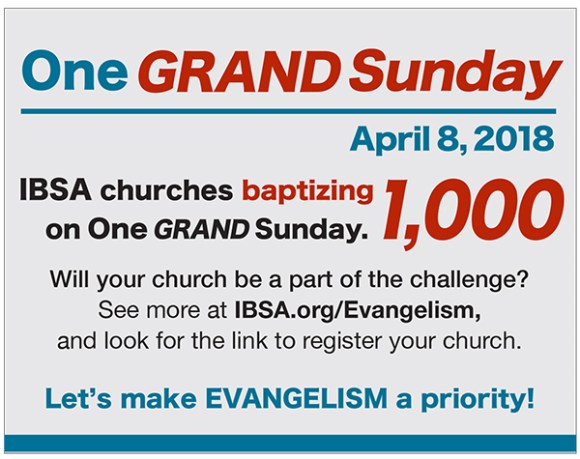
A decline in baptisms over the past decade is behind this spring’s “One GRAND Sunday” emphasis, which calls IBSA churches to participate in baptizing at least 1,000 people on April 8, the Sunday after Easter.

Last year, 352 IBSA churches reported zero baptisms. The churches that did report baptisms had an average of 6.4 baptisms per church.

The ‘GRAND’ goal is lofty, IBSA’s Evangelism Director Pat Pajak has acknowledged, particularly amid the current downward trend. But he’s urging church members to focus on the “one” part of the challenge, and to pray for one person to come to Christ and be baptized. That idea was recently echoed by prayer leader Phil Miglioratti.

“And as my ‘one’ is added to your ‘one’…as their church’s ‘one’ is matched by that church’s ‘one’…as a Sunday class prays for ‘one’ and is joined by a fellowship group asking for ‘one’…a youth group in a southern association, a seniors’ class in the center of the state, a planting team up north, a children’s ministry along the eastern border, and a WMU along the western border, each claiming, petitioning, pleading for ‘one’…one plus one equals two. But in God’s mathematics, ‘one’ plus ‘one’ times prayer could equal ‘One GRAND Sunday!’

“Even the smallest church among us can ask in faith for ‘one,’” Miglioratti said.

Sign up for the “Pioneering Spirit” challenge at pioneeringspirit.org. Register for One GRAND Sunday at IBSA.org/Evangelism.

Fully staffed Court poised to rule on religious liberty issues

Christians and other conservatives hoped the U.S. Senate’s confirmation of 49-year-old Neil Gorsuch to the Supreme Court in April would tilt the court toward a favorable view of religious liberty concerns. As a U.S. Court of Appeals judge, Gorsuch’s rulings supported Hobby Lobby and other organizations that opposed—based on their religious convictions—healthcare legislation requiring their employee plans to cover abortions and abortion-inducing drugs.

So far, Gorsuch’s previous rulings have extended to his time on the High Court. In June, he was part of 7-2 ruling that found Christian schools should have the opportunity to be awarded government grants for playground upgrades. And this year, the court has agreed to hear the case of Jack Phillips, the Colorado cake artist who refused to design a wedding cake for a same-sex wedding celebration.

In 2017, other cases related to religious liberty played out elsewhere in the judicial system:

On Oct. 6, the Department of Health and Human Services issued new rules to provide relief from the requirement that employers provide their workers with coverage for contraceptives, including those that can potentially induce abortions. But a Dec. 15 ruling by a federal court in Philadelphia blocked enforcement of the new rules.

And late last year, the Oregon Court of Appeals ruled that the state did not violate the First Amendment rights of Aaron and Melissa Klein, who were fined $135,000 in 2015 for refusing to design and bake a cake for a lesbian couple’s commitment ceremony. The three-judge panel upheld a decision by the Oregon Bureau of Labor and Industries that found the Kleins’ refusal was based on unlawful discrimination against homosexuals.

While Gorsuch’s presence on the Supreme Court was a victory for religious freedom advocates, mixed results from other courts could indicate a contentious year ahead, and new territory for the church to navigate.

– With reporting from Baptist Press

Table Grace

It starts with a simple invitation.

“Have dinner with us.”

In a world where people tend to isolate themselves from their neighbors, Chad Williams and his family are recapturing an old-school concept to make a gospel difference in their community.

The family of five has a vision for biblical hospitality. They’re on a mission to bring people into their home and around their table to hear the gospel.

“They need Jesus, so we want them to come over to our house and see what it looks like to be a family that follows Christ,” said Williams, former family pastor at Tabernacle Baptist Church in Decatur and the new senior pastor of Rochester First Baptist Church.

“All of our flaws, all of our issues, our dirty house,” Williams said. “This is who we are.”

The Williamses try to designate one night a week to invite people to their home for a meal. It’s not fancy—tacos or chili. And it’s not necessarily reciprocated. But the family has been able to sow seeds of the gospel, and they’ve seen results. Recently, they invited a family from church to dinner. The father, not yet a Christian, engaged in several hours of conversation with the Williamses.

“If we really want to make an impact and get to know our neighbors, we’ve got to start engaging them in a way that they’re not expecting.” – Chad Williams, Rochester FBC

“He had a perception of who Christians were…as he got to spend time with us, there became this openness,” Williams said. A few weeks later, the man decided to follow Christ.

Asked if the commitment to spend time with others each week impinges on their family time, Williams said no, because it’s a shared commitment. The family is still at home, still sharing a meal together. They’re just inviting another family to join them. “We see this as part of our mission,” he said, “and we want to be on mission as a family.”

How can we help?
Chris Merritt and his wife, Alyssa, moved to Blue Mound, Ill., seven years ago. Both raised in central Illinois, the couple knew they wanted to live in a smaller town. Blue Mound, a community of around 1,200, is where they’re raising their two pre-teen sons.

Their church, Tabernacle Baptist in Decatur, sponsors two small groups in the region where the Merritts live. Along with their fellow life group members, the family is invested in building relationships in Blue Mound through community activities and by simply looking for opportunities to meet needs.

About a year ago, the Merritts approached their local school to see how they could help out. When the principal identified mentoring as an area of need, the couple and others from their church started a mentoring program.

“If I’m going to dedicate time for our children to be at these things, it’s logical for us to be there not just to support our children, but to build relationships in our community too.” – Chris Merritt, Tabernacle BC

“It’s just a regular, consistent positive influence of adults into kids’ lives who maybe need an extra positive influence,” said Merritt, who serves as church administrator at Tabernacle. The 12 students in the mentoring program have lunch every other week with their mentors. For that hour, he said, someone is asking them questions, encouraging them, and helping them make good decisions.

Outside of the mentoring program, the Merritts also are involved in Blue Mound through community sports leagues—the kids as players, and Merritt as a coach. He said being involved in the community through their kids’ activities is a natural choice. And they try to be intentional about making the most of their opportunities.

“If I’m going to dedicate time for our children to be at these things, it’s logical for us to be there not just to support our children, but to build relationships in our community too.”

Faith in action
Erica Luce credits her husband’s upbringing for her children’s willingness to serve their neighbors. “Dan spent his life serving others because his parents were so others-focused,” said the member of Delta Church in Springfield. That’s why their three children can often be found raking or shoveling to help a neighbor, or baking a welcome present for neighborhood newcomers.

“It’s given us so much room to speak truth into other people’s lives that are not really even seeking God,” Luce said. “They see faith in action, whether they want it or not.”

“It’s given us so much room to speak truth into other people’s lives that are not really even seeking God.” – Erica Luce, Delta Church

It’s been contagious on their block too, she said, recalling a time when her 12-year-son was shoveling a neighbor’s driveway and another neighbor came out to help.

Seeing the family home as missionary tool—whether it’s a place to invite people to, or a place missionaries are sent out of—is something Christians needs to recapture, Chad Williams said. Too often, we’ve lost the idea that our neighborhoods and workplaces are mission fields. Instead of seeing people’s need for Jesus, we see our co-workers and neighbors simply as people we interact with—and, if they’re hurting, we often don’t know it.

Rather than backing away from a culture that seems increasingly far from the gospel, Christian families have an opportunity to lean in closer, Williams said.

“If we really want to make an impact and get to know them, we’ve got to start engaging them in a way that they’re not expecting.”

Silent no more, abuse victims speak out

Movie producer Harvey Weinstein was only the first of countless celebrity men disgraced by allegations of sexual harassment and assault in 2017. And as the names added up—each seemingly more famous and more familiar and more unlikely than the last—so did the names and faces of their victims.

On social media, #metoo became a rallying cry for women who have been abused or oppressed or pushed aside or used by men in power. When Time named their most influential people of 2017, “the silence breakers” topped the list.

And lest those outside of Hollywood or Washington fall prey to a cavalier “who’s next” attitude, another hashtag soon appeared on Twitter: #churchtoo, used to denote people who have been abused by religious leaders, or those whose church has failed to support them when they reported an abusive situation.

In January, an associate pastor at non-denominational Highpoint Church in Memphis admitted an instance of sexual misconduct 20 years ago after the victim, then a high school student, shared her #metoo story. When the pastor, Andy Savage, spoke to his church the Sunday after the story broke, he received a standing ovation. His accuser, Jules Woodson, told The New York Times the ovation was “disgusting.”

“It doesn’t matter if I was his only victim,” Woodson said. “What matters is that this was a big problem and continues to go on.”

Late last year, more than 140 evangelical women signed on to a statement decrying abuse with the hashtag #SilenceIsNotSpiritual. “This moment in history is ours to steward,” reads the statement. “We are calling churches, particularly those in our stream of the Christian faith—evangelical churches—to end the silence and stop all participation in violence against women.”

As churches and their leaders move into a 2018 still reeling from scandal, the most pressing challenge may well be discerning how the Bible should inform and instruct Christians living in a #metoo culture. And answering this question: When a few women are silence breakers on behalf of a great many, what does that say about what the church is saying to and about women?

“The contributions of women in the advancement of the kingdom are essential and indispensable,” author and teacher Jen Wilkin said at a conference recently. “If we have crafted a vision for the church in which women are extra, in which women are nice but not necessary, we have a crafted a vision for the church that is foreign to the Scriptures.”

Churches challenged to baptize 1,000 on one day

One Grand social

One thousand baptisms on a single Sunday. That’s the challenge behind One GRAND Sunday, an initiative designed to help IBSA churches train church members in evangelism, share the gospel, and follow-up with believer’s baptism.

One GRAND Sunday is scheduled for April 8, one week after Easter.

“Easter is normally a high attendance day, and the strategy of scheduling April 8 as One GRAND Sunday is to encourage people to return the following week to witness an historic event—their church being a part of 1,000 people being baptized on one day!” said Pat Pajak, IBSA’s associate executive director of evangelism.

The baptism-focused Sunday is part of a series of “Pioneering Spirit” challenges put before IBSA churches at the 2017 Annual Meeting. The evangelism challenge is for 200 or more IBSA churches to baptize 12 or more people each year, or to baptize more than the church’s previous three-year average. In other words, the commitment is for IBSA churches to become “frequently baptizing churches.” So far, 57 churches have accepted the challenge to engage new people with the gospel.

“Unfortunately, baptisms across our state have been declining over the past several years, and I would like to see One GRAND Sunday serve as a reminder that the church exists to evangelize and baptize those in the communities where God has planted them,” Pajak said.

The One GRAND Sunday emphasis coincides with a North American Mission Board-sponsored effort to promote gospel conversations, or opportunities to share the gospel. NAMB is urging Southern Baptists to have one million gospel conversations by next summer’s Southern Baptist Convention in Dallas. At gcchallenge.com, people can upload videos of themselves sharing about gospel conversations they’ve had, and get more information about gospel-sharing resources, like the “3 Circles” guide.

With just under three months left until April 8, Pajak suggested this timeline for churches preparing for One GRAND Sunday:

January: Collect your church’s baptism numbers for the past three years. Prayerfully set a new goal for this year.

February: Announce the baptism event and launch gospel conversations. Register your goal at IBSA.org/Evangelism. Conduct the training for church members. Consider teaching the “3 Circles” method.

March: Promote One GRAND Sunday. Personally follow-up with prospects and new believers. Teach about baptism, either personally or in a group setting.

April 8: Baptize!

April 9: Start over again.

One thousand is a large number, but Pajak put the goal in perspective. “What may look like a very lofty goal can easily be accomplished if every one of our 1,000 churches simply committed to baptizing one person.”

For more information about One GRAND Sunday and evangelism resources, or to register to participate in the April 8 emphasis, go to IBSA.org/Evangelism.

Back to basics

ib2newseditor —  January 15, 2018

The recent holiday season gave me a little more time than usual to watch football on TV. As the regular season gave way to playoffs and bowl games, it seemed pre-game analysts spent increasing amounts of time discussing “what it will take to win” the next, tougher game. The more serious the consequence of the game, and the fewer games that remain, the more critical it seems to be able to think, and not just play.

Yet as I’ve listened to experts talk again and again about what it takes to be successful, it seems they often come back to the same basic advice. Focus on fundamentals. Block and tackle well. Everyone do your assignment. Establish the ground game. Everything else you need for success will flow from there.

In these big games, will there be an occasional trick play, or a key turnover, or a missed call that influences the game? Probably. But everyone seems to agree that the best you can do to prepare for victory is simply get back to the basics.

Now is the time to consider what it takes to be truly effective in our mission.

I found myself wondering if there is a reminder, even an exhortation, for churches to consider here. Among the most “basic” practices of Baptist churches as we follow the Lord and pursue his mission are celebrations of the Lord’s Supper and believer’s baptism. Yet these can sometimes seem like occasional, even rare, ceremonies, rather than the very blocking-and-tackling basics on which the rest of church life is built.

More than an occasional or routine ceremony, the Lord’s Supper was given to us to be a time of frequent, intimate church fellowship and worship, one that draws each participant to introspection and confession of sin, and to a carefully considered reminder of the price Jesus paid for that sin. The Lord’s Supper is, in itself, a symbol-rich proclamation of the gospel message, one that should, each time, lead us to humble worship and gratitude, and fresh motivation to live out our salvation and to share Jesus with others.

What if we got that “basic” right, every one of us, in every church, every time we celebrated the Lord’s Supper?

If we did, I think it would have a dramatic effect on the other, more neglected, “basic” of baptism. Think of it this way: What if a church were to schedule baptism celebrations as often as it scheduled Lord’s Supper celebrations? More importantly, what if that church adjusted all its other priorities with the goal of seeing at least one person baptized by that time?

In fact, what if the church filled its baptistery on that date, no matter what? If no one was ready to be baptized, the church would simply pray in lament over the unstirred waters, and ask the Lord to guide them to a different result next time.

If the core, blocking-and-tackling tasks of the church are to remember the redeeming sacrifice of Jesus, and continue his mission of seeking and saving the lost, then maybe we need to get back to the basics of the Lord’s Supper and baptism. Maybe we need to let them drive our churches’ priorities and resources and schedules more than the things that drive them now.

As the football analysts remind us at this time of year, the closer we get to the end, and the fewer days that remain, the more critical it is to reflect carefully on what it takes to be truly effective in our mission. That careful reflection will almost always lead us back to the basics, and then forward to victory.

Nate Adams is executive director of the Illinois Baptist State Association. Respond at IllinoisBaptist@IBSA.org.

The 8 people Americans trust more than their pastor
Less than half of the country—just two out of every five Americans—believe clergy are honest and have high ethical standards, a recent Gallup poll found. Pastors are now seen as less trustworthy than judges (43%), day care providers (46%), police officers (56%), pharmacists (62%), medical doctors (65%), grade school teachers (66%), military officers (71%), and nurses (82%).

The new pro-life generation
High-school students are organizing and engaging in the fight for life, despite sharp opposition from some administrators and peers. Many are members of Students for Life of America, best known for its work with college students, which now has 604 high-school chapters—334 at religiously affiliated schools and 270 at public campuses.

Churches can now get direct FEMA funding after disasters
Houses of worship damaged during natural disasters will be able to rebuild using federal funds from the Federal Emergency Management Agency, the Trump administration announced, a shift traditional faith groups have been requesting from presidents for decades without success.

Ancient DNA said to support Bible’s Babel account
A study published Jan. 3 in the journal Nature claims DNA extracted from the remains of an infant girl buried in central Alaska suggests an ancient migration of people from East Asia, across a frozen land bridge, to North America. Nathaniel Jeanson, a Harvard-trained research biologist with Answers in Genesis (AiG), said some details of the find corroborate the account in Genesis 11 of mass human migration following attempted construction of the Tower of Babel.

The salvation of ‘Napalm Girl’
Kim Phuc Phan Thi was the subject of a Pulitzer Prize-winning photograph during the Vietnam War in 1972 where she was pictured at age 9, running along a puddled roadway with arms outstretched, naked and screaming, with the dark contour of a napalm cloud billowing in the distance. Kim writes how she came to faith in Christ.

Sources: Christianity Today, World Magazine, Washington Post, Baptist Press, and Wall Street Journal

Meeting Of Bible Study Group

The month-long prayer emphasis “In All Things Pray” opens 2018 on the Southern Baptist Convention calendar, encouraging churches to pray corporately for 60 minutes at least weekly in January.

Standing on Acts 1:8 and 2 Chronicles 7:14, In All Things Pray encourages 10 minutes of Scripture reading, public leadership and worship; 20 minutes of vocalized prayer requests, and 30 minutes of guided prayer in each hour-long service, event organizers said.

“We are hopeful churches will use the 10-20-30 corporate prayer model in at least one of their weekly gatherings during January,” said Roger “Sing” Oldham, SBC Executive Committee vice president for convention communications and relations. “The 10-20-30 model is very interactive and is ideal for a midweek prayer service.”

Oldham represents the Executive Committee on PrayerLink, a national organization of prayer ministry leaders that helped the Executive Committee develop this year’s prayer focus.

“We think people will be refreshed by spending a complete hour in focused prayer,” Oldham said, “and encouraged at how quickly a one-hour time of prayer will pass, perhaps spurring them on in their personal times of prayer at home.”

Four categories of prayer concerns drawn from Acts 1:8 are offered among resources at InAllThingsPray.net for suggested use, all or in part.

Family and friends

Target this group by creating a prayer list of family members to pray for daily. Using the CrossRoads Prayer Evangelism ministry referenced at InAllThingsPray.net, encourage congregants to list five friends and track their prayer and outreach targeting the individuals. Ask church members to write on note cards the names of unchurched and lost family members, bring the cards to the altar and place them before the Lord.

Church and community:

Lead church members in praying specifically for evangelistic events on the first half of the church’s 2018 calendar, such as Vacation Bible School, revivals or special music programs. The church’s continued health, ministry teams and committees are among other suggested prayer concerns.

The United States and its peoples:

Read 1 Timothy 2:1–6 aloud during the morning worship service and encourage prayer for the nation. Mention the names of elected officials during the pastoral prayer. Ask the Lord to call from within your congregation members who will serve as pastors, missionaries and church planters. Pray for the different ethnicities living within the nation and for the racial reconciliation that is possible only through salvation in Jesus Christ.

The world and its people groups:

During the pastoral prayer, petition the Lord on behalf of those within the congregation who may be sensing a call to international ministry. Ask the Lord to give International Mission Board trustees and leaders divine wisdom and guidance in challenging Southern Baptists to be on mission with God. Ask for wisdom and mercy for international missionaries working in dangerous locations.

PrayerLink is composed of prayer coordinators from Southern Baptist entities and the Executive Committee, the Woman’s Missionary Union, state Baptist conventions, and Southern Baptist ethnic and language fellowships. PrayerLink collaborates with groups represented in its membership to foster a Great Commission prayer mindset among Southern Baptists and other Christ-followers, and to promote Great Commission prayer ministries for Southern Baptist churches.

Additional resources and promotional materials are available at InAllThingsPray.net.

This article first appeared at BPnews.net.