Archives For November 30, 1999

A popular hotel chain is running a television commercial that cleverly depicts several groups of people trying to decide whether or not to attend a wedding. One is a group of bridesmaids, who clearly aren’t thrilled about the turquoise dresses the bride has chosen. Another group is former boyfriends of the bride, wondering why on earth they all got invited. And one sad lady simply doesn’t want to see Uncle Joe dance in public again. I think it might be Uncle Joe’s wife.

The musical background for the commercial is a rock song from the 1980’s. Over and over that song chants the simple question, “Should I stay, or should I go?”

Because Chicago is our state’s largest and most diverse mission field, we all need to get more familiar with, and comfortable in, this world class city.

As the November 2-3 IBSA Annual Meeting approaches, I imagine there are Illinois Baptists asking themselves that same question. For the first time in several years, the meeting is being hosted near Chicago, at Broadview Missionary Baptist Church. The drive will be quite a distance for those in other parts of the state, just as last year’s location in Marion was a long drive for northern churches.

And of course some will not want to brave the congestion and the traffic. In fact, I don’t know any Chicagoland natives who look forward to that part.

The message of the hotel chain’s commercial is that their comfortable, affordable hotels give even reluctant travelers reasons to go, rather than stay home. So let me suggest some reasons to go to the IBSA Annual Meeting this year.

We need to see and care about and partner with its churches.

First, the challenging theme of this year’s gathering is “Cross Culture.” The program will intentionally showcase the diversity of Illinois Baptists and also point to multiple cultures in our state that desperately need the gospel. There’s no better place in Illinois to receive the challenge to “cross culture” than in Chicago.

Second, because Chicago is our state’s largest and most diverse mission field, we all need to get more familiar with, and comfortable in, this world class city. We need more practice going there. We need to better understand its neighborhoods, its problems, its needs, and its people. We need to see and care about and partner with its churches.

Third, a lot of advance preparation has already gone in to making your stay in Chicagoland as easy as possible. Broadview is a wonderful, generous church, with lots of parking and lots of practice hosting large events. Catered meals have been arranged on site at the church to make the dinner hour easier and more convenient. Nearby hotels have provided very reasonable rates that include breakfast. And Broadview’s near west suburban location makes it a wonderful home base for seeing more of the city, either on your own or as part of two pre-planned vision tours.

Should you stay or should you go?

I could go on and on, but let me cite just one more reason, one that really applies to every Annual Meeting, regardless of location. It’s just very, very good for our Baptist family in Illinois to be together. Throughout the year, we as pastors and leaders and devoted church members work hard in our various local contexts to fulfill the Great Commandment and the Great Commission of Jesus. As the year draws to a close, it is good for us to assemble, and network, and be inspired, and remember that we are not alone in this mission.

Should you stay or should you go? If at all possible, you should go. It may surprise you what the Lord has done across our state over the past year. And it may surprise you how he and the fellowship of your brothers and sisters in Christ will inspire you for the year to come. I look forward to seeing you there.

For more information about the IBSA Annual Meeting and Pastors’ Conference, visit www.IBSAAnnualMeeting.org.

Nate Adams is executive director of the Illinois Baptist State Association. Respond at IllinoisBaptist@IBSA.org.

Great Partners

ib2newseditor —  September 19, 2016

Recently my wife, Beth, left town for a few days to visit our sons in the Chicago area and to attend a bridal shower for our soon-to-be daughter-in-law Alyssa. I had a couple of local commitments, and so I agreed to take care of the home front while she was gone. I thought to myself, “This won’t be that hard. I’ll just do all the things she normally does, plus my stuff. There should be plenty of time left over to relax as well.”

How wrong I was. After a few days of preparing my own meals, doing the laundry, tending to the dog, and a dozen other surprisingly time-consuming duties, I realized the lawn needed mowing. Now before you judge me, let me point out that my wife says she likes to mow the lawn. She loves being outside, considers it good exercise, says it gives her a sense of accomplishment, and even uses it as prayer time. So I let her mow.

Our missionaries and staff couldn’t do what we do without the partnership of IBSA churches and the generous gifts of Illinois Baptists, especially through the Mission Illinois Offering.

Beth chose to be absent, however, on one of the hottest and most humid Saturdays of the summer. On top of that, our self-propelling mower recently stopped self-propelling. Its handle is held together by little plastic ties. And at least two of its wheels wobble badly. As I forced it up the hills and around the curves of our yard, I seemed to remember Beth saying something about perhaps needing a new one.

During the many times I stopped to wipe the perspiration off my brow and out of my eyes, I found myself thinking how much I missed not just my wife, but my life partner. I pictured trying to do both of our jobs all the time, plus parenting and serving in the church, and all the other responsibilities that we share. And I realized again that I can only do what I do because of what she does.

The following Sunday I was scheduled to speak at one of our state’s most generous missions-giving churches, though they are far from the largest. In 2015, this faithful church gave by far the state’s largest Mission Illinois Offering.

They are between pastors right now, and I had already planned to try and encourage them from Philippians 1, where Paul says, “I thank my God every time I remember you. In all my prayers for all of you I always pray with joy, because of your partnership in the gospel from the first day until now.”

As I introduced the text, I found myself telling them about the unsustainable few days I had just spent without my wife. I told them those days had really made me appreciate the value of a good partner. And then I thanked them sincerely, from my heart, for their partnership in the gospel, not just this year, but for so many years.

Without the partnership of local IBSA churches, we could not have planted 23 new congregations last year, or delivered 20,000 trainings to pastors and church leaders, or mobilized more than 24,000 missions volunteers.

Across the state this month, hundreds of IBSA churches will receive the Mission Illinois Offering, focused on reaching more than 8 million lost people here in our state. Some offerings will total a few hundred dollars, and some several thousand. But together, they help form a powerful partnership in the gospel that gives my prayers joy as well.

Beth is back, and this week we bought a new lawnmower. It’s one small way I can thank my wife for being a great partner. Our missionaries and staff couldn’t do what we do without the partnership of IBSA churches and the generous gifts of Illinois Baptists, especially through the Mission Illinois Offering. Thanks for being great partners.

Nate Adams is executive director of the Illinois Baptist State Association. Respond at IllinoisBaptist@IBSA.org.

The Midwest Takeover

ib2newseditor —  September 8, 2016

The Midwest has been big this summer. Big enough that we in our office coined the phrase, “The Midwest Takeover,” as a way to describe how Baptist leaders from our region have been significantly more visible than in recent years.

The takeover started with the new slate of officers elected at the Southern Baptist Convention in St. Louis: An Illinois pastor and three Missourians were chosen to fill national SBC posts, while an Iowan will head up next year’s Pastors’ Conference.

Then, Sandy Wisdom-Martin, who led Illinois Woman’s Missionary Union before moving to Texas, was chosen to lead National WMU.

There’s even evidence of a Midwestern swing in the national election, as Indiana Governor Mike Pence works to bring solid, traditional values to Donald Trump’s controversial campaign.

Our region isn’t the buckle of the Bible Belt…but God can do things people say can’t be done, like growing a church in the Midwest.

The national election has crystallized the need for “Midwestern values,” as the culture shifts in ways most thought it never would, and as leadership we can be proud of seems hard to come by.

In the SBC, the election of Midwestern leaders may well represent a new day for the denomination. One with the understanding that Baptist thought and doctrine isn’t just rooted in the Deep South, and that while traditionally SBC-strong states have much to offer in the way of ministry innovation, so do “pioneer” regions.

Like Illinois, where FBC O’Fallon pastor and newly elected SBC First Vice President Doug Munton has served for more than 20 years. He is strong in his support for the Cooperative Program, Southern Baptists’ chief method for funding ministry and missions. But he’s also honest about the challenges of pastoring in a suburban community made even more transient by its proximity to Scott Air Force Base.

Midwestern leaders understand the challenges Baptists face in a changing world, because they’ve met those challenges as workers in regions with few evangelical churches. Our region isn’t the buckle of the Bible Belt, Munton told the Illinois Baptist in May, but God can do things people say can’t be done, like growing a church in the Midwest.

We usually think of pioneers as starters, people who are willing to do hard, unheard-of things—impossible even—for the sake of a better future.

As the work of sharing the gospel and making disciples gets more difficult, this influx of the “pioneer spirit” could be just what the SBC needs.

– MDF

Investing in churches

ib2newseditor —  September 5, 2016

MIO-box-smallNow is the time of year when most Illinois Baptist churches are preparing to promote and receive the annual “Mission Illinois Offering,” which is devoted to advancing the gospel among more than eight million lost people, right here in our state.

Most of the time when we describe our mission priorities here in Illinois, we talk about the desperate need for new churches, especially in northern Illinois, and in large, lost cities like Chicago. And indeed, the MIO is helping start about 25 new churches every year.

And many times we talk about the vast and strategic mission field of Illinois college campuses, where thousands and thousands of tomorrow’s American and international leaders are being trained, often with little or no exposure to the gospel. The MIO supports collegiate ministries too, on more than two dozen campuses.

MIO supports our greatest missionary asset: the local church.

Your gift through the Mission Illinois Offering also helps support the Christian Activity Center in East St. Louis, and human need ministries like disaster and hunger relief, and IBSA-coordinated mission trips from Illinois to the ends of the earth.

But I received a promotional e-mail the other day that reminded me we often don’t talk enough about one of the most important ministries that the MIO makes possible—the ongoing investment of our missionaries and staff in the health and evangelistic growth of IBSA churches. Local churches are our greatest missionary asset as Illinois Baptists, and our investment in their health, growth, and leaders is as important as planting new churches, reaching college campuses, or meeting human and spiritual needs.

Watch the video, “Turn on the Light,” to learn more about why Nate Adams supports the Mission Illinois Offering.

The e-mail was from a church consulting firm. It offered training over a 3-day period on topics like church health models, conflict resolution, overcoming barriers to church growth, and individual church leader development. I thought to myself, ‘That’s what our staff does all the time!”

IBSA carefully measures our staff’s time investment in training and consulting with local churches. Consistently we have had direct consultation with 750-800 churches each year. Considering that ministry is delivered primarily by about 20 traveling staff, that means each staff member is serving an average of 40 churches, all year long!

But what really caught my attention about the church consulting firm’s letter was the cost of its 3-day training—$950 per student, with a minimum of 15 students. That would be over $14,000 for three days of help. To do that for 800 churches would cost more than $11 million. Our Mission Illinois Offering goal this year is $475,000.

I realize that’s not a precise apples-to-apples comparison, since Cooperative Program giving also funds our state mission work, and since IBSA does far more than training and consulting. But I hope it makes the point for you that it made for me. Every IBSA church has a staff of church health and growth consultants at its disposal, and their help is valuable! Your church’s gifts through the MIO and CP enable that staff to be available for your and hundreds of other IBSA churches—week in and week out.

Sometimes it’s awkward to ask for financial support. And maybe it’s a little easier to ask churches to support church planting and missions than to point to the “return on investment” that churches also receive through training and consulting. But if you stop and think about the value of what your church both receives and provides for other churches through your state missions giving, I hope it will make you want to give a truly generous gift through the Mission Illinois Offering this year.

Learn more about the Mission Illinois Offering and Week of Prayer September 11-18 at MissionIllinois.org.

Nate Adams is executive director of the Illinois Baptist State Association. Respond at IllinoisBaptist@IBSA.org.

It’s time to speak up

ib2newseditor —  August 3, 2016

Adron RobinsonThe week of July 4, 2016, was a very dark week in America. It began with my wife and me celebrating Independence Day with our family and watching the local fireworks display. But there would be a different type of fireworks in the days to come.

On July 5, a Baton Rouge police officer pinned down Alton Sterling and shot him several times while he was on the ground, killing him in front of witnesses.

The very next day in Minnesota, Philando Castile was pulled over in a routine traffic stop and shot multiple times by a police officer. Castile’s girlfriend videotaped the aftermath of the shooting and broadcast it live on Facebook for the world to see.

If those incidents weren’t enough, on July 7, at the end of a peaceful protest of these killings, an armed gunman ambushed Dallas police officers, killing five and wounding seven others.

How can the church remain silent when the sin of racism is screaming so loudly?

It truly was a dark week in America. As I sat at my desk praying about how to process these events and address these issues with my congregation, God led me to Matthew 5:13-16.

We live in a dark and decaying world, and the darker the world gets, the more it needs the church to be salt and light. Light shines brightest in darkness, and God has providentially placed the local church in the community to shine the light of the gospel to a world that desperately needs that light.

The killings of African Americans at the hands of police officers, and the denial of justice to the families of those slain, reveal the high level of personal and institutional racism in America.

The truth of the matter is that an encounter with the police is a life or death matter for many people of color in America. We pull over praying. Praying that the officer who stops us will uphold the law and not manipulate it to cover up his own racial prejudice. Praying that we will be treated the same way every other citizen of this country is treated. But most of all, we are praying that we are not killed by the very people our taxes pay to serve and protect us.

This is not the experience of my non-minority brothers and sisters. And it should not be the experience of anyone created in the image of God.

My question is, how can the church remain silent, when the sin of racism is screaming so loudly? How can we stand by as injustice continues against those we say are our brothers and sisters in Christ?

We cannot remain silent. In order for there to be change in our culture, the church must stop being silent and step up and be the church. In Matthew 5:13-16, Jesus calls us to be counter-cultural Christians. This means the church is called to influence our culture with the gospel of Jesus Christ.

Christians and only Christians are the salt of the earth. Christians and only Christians are the light of the world. Christians and Christians alone are responsible for stopping corruption and slowing down the decay of this world.

Notice Jesus did not say “you and the government,” “you and the police department,” or “you and the Supreme Court.” There is only one hope for this world, and that hope is in people of God preventing decay and penetrating darkness.

We need to stop making excuses, stop being divided, stop being deceived by the darkness of this culture, and begin shining the light of righteousness and loving our neighbor as ourselves. We will never overcome a hateful world unless we learn to love one another.

Dr. Martin Luther King Jr., said, “Darkness cannot drive out darkness; only light can do that. Hate cannot drive out hate; only love can do that.” If we love our neighbor as ourselves, we cannot remain silent as our neighbors are being slain in the streets. And we must address the racism in our world, even if it is in our own hearts.

In Acts 10:34, Peter says, “Truly I understand that God shows no partiality.”

I pray that soon and very soon, the church would do the same.

– Adron Robinson is senior pastor of Hillcrest Baptist Church in Country Club Hills and vice president of IBSA.

Church in the United StatesThe election for President of the Southern Baptist Convention last month understandably attracted a lot of attention. But I was just as intrigued with the election for President of the annual SBC Pastors Conference that took place the day before.

Dave Miller, pastor of a medium-sized church in Sioux City, Iowa, somewhat surprisingly prevailed with 55% of the vote. The Pastors Conference President has traditionally been a megachurch pastor, often from a southern or larger state.

From my perspective, Pastor Miller ran not so much on his personal ministry resume as on a platform of ideas that proposed taking at least the 2017 Pastors Conference in a very new direction. Conference speakers would be only from SBC churches. No one who has spoken at the Pastors Conference in the past five years would speak at the 2017 meeting. Speakers would represent a diversity of geography, age, ethnicity, preaching style, and perspective. And there would be a focus on inviting pastors to speak who lead churches of 500 or fewer.

I’m glad we are reminded that these churches have a lot
to offer.

Not many of these parameters describe the Pastors Conferences of recent years, and the new ideas clearly resonated with a majority of those voting. Pastor Miller was elected, and his response the next day in his SBC Voices blog reminded me a little of the old adage, “Be careful what you wish for.” He wrote, “The budget of this two-day event is pretty much the annual budget of my church…But we are in this together and we are going to be looking to expand our circle.”

While I personally would have been glad for either candidate to lead next year’s Pastors Conference, I can’t help but feel a sense of satisfaction in the ideas that it appears will now influence next year’s program. I too have wondered why the same men sometimes speak in consecutive years of the Pastors Conference, or why speakers aren’t always from SBC churches.

Most of all, as a Midwestern Southern Baptist, I celebrate the idea that there are gifted preachers in small to medium-sized churches, and in churches outside the Deep South, and in churches of diverse cultural settings. The Pastors Conference will benefit from some of these voices, as it has from the gifted communicators who lead many of our megachurches.

After 10 years at IBSA, I still speak in or visit a church for the very first time at least once or twice a month. Many times someone in those churches will say something like, “We didn’t think you would come to a church our size,” or “We waited until our 100th anniversary to invite you because we know you’re so busy.”

I’m always humbled and a little embarrassed by those assumptions. So I want to say again that IBSA and I personally truly desire to serve and assist each and every local church we can, regardless of size, location, ethnicity, or age. Especially if I’ve never been there, I would love to come to your church, to get to know your church family, and to listen to your pastor or give him a week off, whatever serves the church best.

The average Southern Baptist church in Illinois had about 80 in worship last year. Across the SBC, the average was around 110. It may be that larger churches tend to have more full-time pastors and more practiced and polished preachers. But the ones I’ve been learning from all my life lead these wonderful, average churches. I’m glad a pastor from western Iowa reminded us that pastors from these churches have a lot to offer. And I’d love to come and worship in yours sometime soon.

Nate Adams is executive director of the Illinois Baptist State Association. Respond at IllinoisBaptist@IBSA.org.

The BriefingFloyd among evangelicals to meet with Trump
Southern Baptist Convention President Ronnie Floyd is among 500 evangelicals and other conservatives planning to meet with presumptive Republican presidential nominee Donald Trump about his faith and values at a June 21 meeting in New York. Floyd is part of a small group of leaders to spearhead the meeting as the steering committee.

Trump’s other outreach efforts include an address at the Washington conference of conservative Christians sponsored by the Faith & Freedom Coalition and Concerned Women for America June 10.

Military chaplains need the Russell Amendment
Last week, the U.S. House of Representatives kept in place an amendment to this year’s National Defense Authorization Act (NDAA) that protects the rights of military chaplains. The Russell Amendment is a provision that applies to the religious exemption of the Civil Rights Act of 1964 to federal contractors. It provides important protection to chaplains who have substantial discretion to supplement religious support programs via Department of Defense contractors and vendors.

Methodists postpone debate of LGBT issues
Amid protest, song and fears of a denominational breakup, United Methodists at their quadrennial General Conference decided yet again not to decide anything regarding LGBT rights. However, delegates voted 428-405 to allow the church’s Council of Bishops to appoint a commission to discuss whether to accept same-sex marriage or ordain LGBT clergy.

Same-sex marriage advocates work to oust WY judge
In what could be the nation’s first religious litmus test for holding a judicial post, the Wyoming Supreme Court is being asked to dismiss a municipal court judge because of her biblical views about marriage. Attorneys for Judge Ruth Neely argue the efforts of an unelected state commission to remove her from office are rooted in religious bias and misinterpretation of the law.

Churches hosting job fairs
Churches are partnering with Church Job Fairs, a faith-based organization that helps churches plan and promote job recruitment events. The events take place in local churches for the local community. The idea is simple: A church is meant to be a place of hope, encouragement, and love to its community. So why not host a job fair in a church and meet both physical and spiritual needs?

Sources: Baptist Press, Religion News, The Hill, Religion News, Baptist Press, WORLD Magazine

Denominational tags have fallen on hard times. History and tradition have become baggage.

I would be surprised if you know of a new church that can be identified with any recognizable branch of Christianity. If you can get creek, river, brook, or tree into your church name, for sure it will grow. The more bland, comforting, serene; the more easily confused with a country club or a rock band your church name is, the more in tune with the times you appear.

And the latest trend has moved beyond nature: Bridge. Liquid. Radiance. Paradox. Propulsion.

In the interest of transparency, I began a move to change our church name 15 or 20 years ago, then I chickened out. Baptist is still our middle name.

Here is my attempt to give a bit of context and explanation for our church name to a deep blue, urban, postmodern population.

What’s in a name?
John the Baptist, eccentric prophet. William Carey, linguist, humanitarian extraordinaire. Fredrick Douglas, abolitionist-orator. Charles Spurgeon, urban crusader. Nannie Helen Borroughs, women’s leader. Walter Rauschenbusch, social justice warrior. Lottie Moon, China champion. Martin Luther King, renowned activist. Billy Graham, global evangelist. Mahalia Jackson, vocalist without equal. Rick Warren, mega-church pastor, best-selling author. Baptist is a name associated with colorful, controversial, influential figures here and around the world.

There are approximately 32 million Baptists in the U.S., half of them are “Southern Baptists,” over 100 million in the world. As for “The Baptist Church,” there isn’t one. Each Baptist congregation is independent, autonomous, self-governing. Many churches participate in larger entities, but those affiliations do not infringe upon congregational self-determination. Yes, this lends itself to some craziness and confusion; it is what it is.

Baptists are not self-named. Our persecutors began using this label in derision beginning in the 1400s. Theologically and historically, Baptists are those who hold the Word of God, the Scriptures, the Bible, as sole authority in all matters of faith, church order, and practice rather than looking to tradition, human hierarchies, committees, or governments.

Many historians seemingly fail to notice that many who came to America for religious freedom, instituted the same state church systems, persecuting those who did not adhere, repeating the sins of the governments they fled.

In U.S. history, Rhode Island, the first colony with complete religious freedom, was founded by Baptist Roger Williams. Williams’s life was a crusade for freedom of conscience and religious liberty. He founded Rhode Island in 1636 after purchasing the land from the Narragansett Indians.

A refuge from religious persecution, Rhode Island became home to the first Jewish synagogue in America and a sanctuary for Quakers who were being persecuted and killed by anti-Quaker laws in Massachusetts and other colonial territories. Rhode Island was an open door to all people, a safe harbor in a sea of tyranny and oppression.

In the flurry of activity around the colonies becoming states, the constitution presented for ratification did not provide for religious liberty. Baptists supported the proposed constitution on the condition an amendment on religious freedom would be added.
Finally, Massachusetts and Virginia became the pivotal states in the process. James Madison was running for the state legislature of Virginia against Baptist pastor John Leland.

Madison was about to lose the election. Leland knew this. He also knew without Madison’s golden voice and political influence there would be no constitution. With victory already in his hand, Leland dropped out of the race, giving Madison an open road on the promise that he would pursue language providing for religious liberty.

So sympathetic was Congress, urged on by President Washington, that they made it their first business to consider the issue Baptists were pressing. As a result, the line of the First Amendment reads, “Congress shall make no law respecting an establishment of religion or prohibiting the free exercise thereof…”

Baptist then is not a “brand name” so much as it is a historical, theological descriptor of people who adhere to biblical authority over human authority and are advocates of religious liberty for all.

Charles Lyons pastors Armitage Baptist Church in Chicago.

Editor’s note: After an often tearful year, the Christian’s counterattack is hope.  The enemy may use the events of last year to strike chords of fear, but in reporting them, we offer notes of hope for 2016. God is in control of this world, and whatever happens, this history being made before our eyes will turn people toward him. He is our hope.
This is our certainty as we anticipate the new year, our hope.

Steeples-squareBy Meredith Flynn| In late 2015, Southern Baptist Convention President Ronnie Floyd wrote a blog post titled “Why we are where we are.”
It could well have been the slogan so far for Floyd’s year-and-a-half as SBC president. The Arkansas pastor has used his platform and his online presence to paint a picture for Southern Baptists of the state of things, and how to move forward together.

Throughout his presidency, Floyd has identified pressing issues for Baptists. He has written about how to think and pray on global issues like immigration and terrorism. Within the Convention, he has highlighted the need to pray for spiritual awakening, culminating in a corporate prayer meeting last summer in Columbus, facilitated by Floyd.

He also has championed the Cooperative Program, calling for it to be “the financial priority of each of our churches” after the International Mission Board announced a plan to cut personnel in light of budgetary shortfalls.

“If you are concerned about some of our missionaries having to come home and the decrease of our missionary forces,” Floyd wrote, “the greatest thing your church can do to help turn it around is increase your giving through the Cooperative Program. It helps build our base of support financially, which in turn will increase our ability to reach the world.”

Looking ahead: Giving through the Cooperative Program was up 1.39% for the 2014-15 fiscal year, an encouraging increase following several years of calls from SBC leaders for churches to increase their giving. In 2016, look for more information about “Great Commission Advance,” an initiative introduced at the Convention in Columbus. It’s set to run through 2025, the 100th anniversary of the Cooperative Program.

When Southern Baptists elect a new president in St. Louis this summer, the “Floyd factor” likely will be in play, as the denomination looks for another leader able to bring Baptists together around key issues inside and outside the Convention.

The New Seekers

Lisa Misner —  December 21, 2015

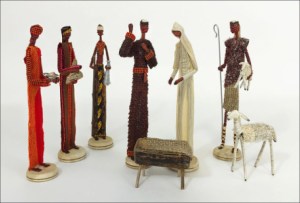
Today’s magi are young and worldly wise, but naïve about Christ

Worldly wise, spiritually curious

Worldly wise, spiritually curious | The magi in this nativity hail from Uganda. http://www.worldcrafts.org

By Mark Coppenger | While a 60-year-old church planter in a university town just north of Chicago, I had at least one big personal question: Why would college students come to a basement rental space to hear a balding, overweight preacher who was often the only one in the service wearing a tie? At least I knew it wasn’t my effort to “dress for success,” which used to mean gray slacks, a blue blazer, rep tie, and such, but had come to mean work jeans and an untucked shirt. The best I could tell, sartorial and tonsorial factors were not much in play.

And lest you have the impression that I was some sort of maven at reaching Millennials, I should hasten to say that a lot of them stayed away, and a lot of them who gave us a look never came back. As the old joke goes, “We had three decisions on Sunday. One was for God, and two were against.” I think that goes with the territory when you preach “the whole counsel of God” in an age when feelings, relativism, and political correctness rule.

In our 11 years in Evanston reaching out to the Northwestern University campus, our church plant grew about five per year in average attendance, ending with about 55 a week. Of course, college communities are very fluid, and we’d regularly have our heart broken by graduations, where we’d lose a chunk of our treasure. But we labored on in joy and with some fruitfulness, and today we take great satisfaction as seeing our former parishioners on the mission field in Germany, India, and China; as Christian faculty at such universities as Maryland and North Carolina; in corporate positions from New York to San Francisco; in military service bands, medicine, the urban classroom, magazine staffs, NASA consultancies, symphony orchestras, etc.

Many of these folks were already walking with the Lord, and we simply had the privilege of walking with them on a segment of their journey. But some were also coming in from the pagan pool. Some were old guys—one was an aging veteran of Iwo Jima who was concerned with “studying for finals”; another was a middle-aged Baha’i, who wanted a chance to bone up on one of the many faiths they somehow embraced.

All this being said, here are some things that come to mind about our linkup with Millennials, many of whom were not believers when we met them.

They’re seeking a way out

First, let me say that in the talk about “seekers” and “seeker-friendly churches,” we see something of a duel between those who point to Romans 3:11 (“there is no one who seeks God”) and Jeremiah 29:13 (“You will seek me and you will find me, when you seek me with all your heart”).

The former say that the lost have little or no appetite for the true God, at least until he intervenes in their hearts. The latter emphasize the human will and point to cases, whether biblical (John 12:21), historical, or contemporary, in which people did, indeed, come looking for the Lord.

Of course, this leaves open the question of why they were looking. (For what it’s worth, I’m persuaded that the overarching answer is that God puts it in their hearts to seek him, and they’re not really seeking him until he does this.)

I think it’s fair to say that most of our seekers were looking more for a door out of their current spiritual situation than for one into the Kingdom of Christ. They’d made a mess of their lives or come up empty in one way or another. They were unlucky in love, academics, employment; depleted and damaged by addictions, sexual sin; exhausted by the grind, betrayed by friends, marginalized by the culture and such, and they were willing to try something new. So they weren’t so much homing missiles intent on pursuing the righteousness of God, as they were anxious travelers thrashing about in the woods, spotting a cabin light in the distance and walking toward it.

Some were happy to join in the life of the cabin, glad to receive the mercies and life of the one who had invited those who were “weary and heavy laden” to come to him for rest. But others soon got cabin fever and sought the exit.

They loved the warmth and camaraderie and words of grace and love, but they couldn’t abide the language of Zion or imposition of the biblical prerogatives, and so, after warming their hands at the hearth, they plunged back into the darkness. There were, for instance, those who couldn’t or wouldn’t give up their intimate co-habitation without benefit of marriage. If they had been looking for the true God, they would have stayed, but they were only interested in trying out a new drug.

I was struck by the testimony of one of our Chinese students that her father had urged her to check out Christianity since it seemed connected with human and economic wellbeing. He wanted her to get a fix on what those Christian birds were up to that made them fly so high.

For those who had a heart to stay, we made a way for them to grow “in wisdom and stature and favor with God and man.” For the others—the rich young rulers, if you will—they’d had a look at what discipleship meant, like it or not.

Despite what the critics say, the church still has a lot of cachet, and we should expect people to give us a look if only to figure out, “What is it with those guys?”

Spiritual nomads need roots

Fewer and fewer young adults come from gratifying homes, and those that do so miss what they had when they move away. Either they don’t much know what a family is supposed to look like, or they long for a substitute. And that’s where the church can come in big time.

In Evanston, Sharon and I were empty nesters for most of our years as a church-planting couple, so we had a lot of freedom to connect in fatherly/motherly (or grandfatherly/grandmotherly) ways. We’d go to their plays, recitals, sporting events, and such, taking photos, making over them at receptions, and basking in the moments of their achievement.

I remember one night at a club in Rogers Park, we went to hear a group called the Blind Anabaptist Blues Band, formed by one of our Northwestern students. They performed in all sorts of venues, high and low, in the Chicago area. They offered a mix of secular and sacred music, the lead singer with something of a Bob Dylan/Tom Waits sound. That night they led with several of their “worldly” numbers (e.g., “Girl With Gin on Her Lips”), but then, 20 minutes or so into the set, they gave a straightforward rendition of an old hymn.

You might think this would come off like fingernails on the blackboard, for overnight hookups were shaping up at the bar, pitchers of beer sloshed everywhere, and a lesbian couple had taken to the dance floor in front of the band. But a sweet reverence came over the room, with strangers mouthing some of the words, and with, perhaps, a tear or two at this or that table.

Perhaps they remembered the days when their mommy took them to Sunday school, they sang in the youth choir, or they sat on the back row of some church, barely attentive to what was going on, but with their young impressionable minds absorbing those gospel strains. So we need to be careful about throwing old stuff under the bus, for it may well be a linkage point.

What they know, what they don’t

I may have this all wrong, but I don’t think the current young adults read or learn as much background material as we Boomers did. I’ve seen several studies showing that, in high school and college, they’re writing fewer and fewer term papers.

They’re juiced with music in their ear buds, tweeted to insensibility, selfie’d into the third celestial ring of narcissism, and often remindful of the French, who after their 18th-century revolution, started the calendar all over again, declaring themselves the founders of a new age, no longer beholden to the BC/AD business.

So while you may stumble on syncing your iPhone or some other item of technological arcana, you know who Lottie Moon was, how William Carey fought widow burning in India, what turned Wales upside down in 1904, how ‘Messiah’ and ‘Christ’ connect with oil, the connection between Nineveh and Mosul, and what difference Mordecai Ham and William Randolph Hearst made to Billy Graham.

Today’s seekers don’t. Of all the people in that list, they may not even know Billy Graham. They may know a lot of stuff, but they’ve missed a lot of important stuff their filters have kept them from learning.

These are folks who’ve been brainwashed in the paralyzing ideology of political correctness and overweening sensitivity, ever alert to the “gotcha,” by which they’ll lose their social standing, if not more.

They know that “Islam is a religion of peace,” that “gay is okay,” and any number of other secular pieties. They learn that the greatest sin is perceived intolerance (a foolish conviction exposed in Allen Bloom’s “The Closing of the American Mind”), and they’ve likely joined in the witch burnings of those designated “phobic” in one way or another.

But there you are, speaking the plain language of the Bible, whether the exclusivity of Christ, the reality of sin and hell, male headship in the home, and the sanctity of marriage and unborn human life. “You can’t say that!” they say.

“Oh, really,” I respond. “Well, here it goes again.”

Sure, some will stomp out grumbling, but others will be intrigued by the spectacle and stick around to see what the fundie mine sweeper will set off next as he covers his ears and goes lumbering through the fields of biblical teaching.

Some veteran missionaries in our church introduced “storying” for internationals, working off graphic wall hangings replete with Bible scenes, from Genesis to maps. The non-Christian Asian students were particularly receptive. (And, in this connection, I’ve really enjoyed my work at biblemesh.com—“One God. One Book. One Story.”)

I think stories in the form of illustration can also take sermons to a higher level. Some call them “raisins in the oatmeal.” Whatever. I know Jesus used them a lot, in the form of parables. And I know they connect powerfully—and legitimately, if they serve the task of true exposition.

Culture also offers opportunities to connect with Millennials. They’ve been taught to stereotype “fundamentalists” or “chauvinists” or whatever class of vermin is au courant, and they may be queuing up for their own Mizzou protest or Wall Street grump-in according to the demands of the professionally offended. After all, thanks to the modern university, Millennials are hothouse plants, oblivious to thinkers who don’t fit the school’s suffocating ideological template.

So when you suggest that you prefer Booker T. Washington to W.E.B. Dubois, Edmund Burke to Howard Zinn, or Norman Rockwell’s “Saying Grace” to Matthew Barney’s “Cremaster Cycle,” they have a tough time processing your comments.

You might tell them you prefer poems that rhyme to those that don’t, maybe like the work of Robert Frost and Robert Service. That’ll drive ‘em nuts. But do it with a mischievous smile, letting them know that you don’t wish them harm, and that we’re happily a part of a Divine Comedy, not a Divine Tragedy.

My tactic: unruffledness

With the breakup of the family and society’s precipitous descent into the abyss of relativism, hedonism, narcissism, and even nihilism, we are confronted with all sorts of waywardness and frowardness, and we do well to handle these with unruffledness. Today’s seekers will show up with alarming tattoos, mad theories, “father wounds,” and promiscuities, and we should not think it a virtue to swoon in the face of affronts to holiness.

Don’t blink.

Let them tell their story and even put on their displays of lawlessness. Then pick up as you can. That’s what Jesus did. He didn’t cover his ears and go “La-La-La-La” when he heard or saw something unpleasant. Unlike Jesus, we realize that we’re all a mess without his touch, and that none of us could endure a moment-by-moment projection of our lives in Times Square.

Don’t flinch from speaking a biblical word to sin, but don’t flinch from ministering to the sinner.

I’ve heard that, and have come to believe that, God honors our efforts even when they seem futile. We knocked on miles and miles of doors in Evanston, held a range of special events in city parks, and did a mass mailing to the city’s residents. In the end, very few came to church as a result. Or I should say, very few of those we contacted came to church. But a lot of others did, from sectors we’d not anticipated.

One congregant was a dear fellow who told the same stories over and over again over lunch, forgetting that he was repeating and repeating himself; another was a new convert from Islam; another was a theater student, working in constant tension with the values of the secular stage and the claims of Christ; yet another was a Messianic Jew who, as a policeman in uniform, dropped in on our services from time to time; another a pastor’s kid from Arkansas.

Call it an application of the “law of sowing and reaping”—that God keeps account of our witness efforts and rewards us with fruit from fields we’d not cultivated. We’d not sought them, but by his grace they sought out us.

Mark Coppenger is professor of Christian apologetics at The Southern Baptist Theological Seminary in Louisville, Kentucky. He is former president of Midwestern Baptist Theological Seminary and a church planter and pastor in Evanston, Illinois.