Archives For November 30, 1999

THE BRIEFING | Meredith Flynn

All 50 states have begun issuing marriage licenses to same-sex couples, Baptist Press reports, even those in which officials disagree with the U.S. Supreme Court’s June 26 ruling to legalize same-sex marriage nationwide.

The_Briefing“We don’t have a choice but to comply,” said Louisiana Governor and presidential candidate Bobby Jindal, “even though I think this decision was the wrong one.”

In Texas, the state’s attorney general said “numerous lawyers” are willing to defend officials who refuse to issue same-sex marriage licenses and therefore could face lawsuits and fines. Gov. Greg Abbott said, “Despite the Supreme Court’s ruling, Texans’ fundamental right to religious liberty remains intact.”

Read the full story at BPNews.net. And here’s a state-by-state update from CNN.

The Supreme Court’s decision continued to dominate headlines over the weekend, as Christian leaders and others offered a range of perspectives on what the country now faces:


In other news:

Six people were arrested after heckling Houston pastor Joel Osteen during a church service Sunday.

Among Barna’s findings on women and church: While only 5% name church or religious activities as their top time commitment, 22% say that’s the area of their life they’d most like to improve.

Almost the same number of Americans believe Islam is a threat to religious liberty at home and abroad, LifeWay Research reports in a new survey.

Church_blogNEWS | Following the Supreme Court’s decision Friday to legalize same-sex marriage nationwide, Christian leaders quickly weighed in on how churches should respond to the ruling.

“The challenge for Christians now is to speak the truth in love & to speak love in truth. Love of neighbor means we cannot lie about marriage,” tweeted Albert Mohler, president of The Southern Baptist Theological Seminary in Louisville, Ky.

Russell Moore, president of the SBC’s Ethics and Religious Liberty Commission, released a statement calling himself a “conscientious dissenter” from the Court’s decision.

“Despite this ruling,” Moore continued, “the church of Jesus Christ will stand fast. We will not capitulate on this issue because we cannot. To minimize or ignore a Christian sexual ethic is to abandon the message Jesus handed down to us, and we have no authority to do this.

“At the same time, now is not the time for outrage or panic. Marriage is resilient. God created it to be so. Marriage in the minds of the public may change, but marriage as a reality created by God won’t change at all. The church must now articulate and embody a Christian vision of marriage and work to rebuild a culture of marriage.”

Moore also issued a statement Friday along with other evangelical leaders, opposing the ruling and offering six “points of engagement” for churches:

1. Respect and pray for governing authorities.
2. Teach the truth about biblical marriage.
3. Affirm all persons are created in God’s image and deserve dignity and respect.
4. Love our neighbors regardless of disagreements over marriage.
5. Live respectfully alongside those with whom we disagree.
6. Cultivate a common culture of religious liberty.

Other leaders who signed the statement include Focus on the Family’s Jim Daly, author and radio host Nancy Leigh DeMoss, pastors Tony Evans, David Jeremiah and Matt Chandler, and theologian J.I. Packer. For the full statement and a list of signatories, go to ERLC.com/erlc/herewestand.

Prior to the Court’s decision, several past SBC presidents at the June 16-17 Southern Baptist Convention in Columbus, Ohio, signed a statement vowing they would not participate in same-sex unions. The presidents also stressed the need for churches to be prepared with clear bylaws and constitutions that say what it means to be married in their churches.

Paige Patterson, president of Southwestern Baptist Theological Seminary, said what concerns him most are the small and medium-sized churches “that have never thought through their bylaws and constitutions. Challenges will probably come to those small churches that are ill-prepared.”

GuideStone Financial Resources of the Southern Baptist Convention said Friday in a statement that while it will likely take weeks to determine the impact of the decision and next steps, “In the meantime, churches should work with their legal and accounting advisors to determine whether their governing, employment, building use and other documents or policies need to be reviewed in light of the expanding definition of marriage.”

GuideStone President O.S. Hawkins said, “GuideStone remains committed to advocating for the churches, ministries and pastors we serve during these days and will share information to help churches remain compliant in their health care and retirement plans.”

Springfield, Ill. | Illinois Baptist pastors and leaders shared what they will say Sunday to their congregations following Friday’s ruling by the Supreme Court to legalize same-sex marriage.


Fear and anger are responses that reflect lack of faith. Only in the gospel of Jesus Christ can all people find identity, hope, and peace. We as the church have our priorities set: Love the LORD your God…and love your neighbor…Nothing has changed about that. In fact, our opportunity is greater than ever. Now let’s continue our purpose of making, baptizing, and teaching disciples.
Scott Nichols, Crossroads Community Church, Carol Stream


Exactly what Dr. Ronnie Floyd said at the SBC Annual Meeting—love them, show them Jesus, but in no way will I or our church be involved in a same-sex union. We must not compromise God’s Word, even if it means lawsuits and jail time.
Bob Stilwell, First Baptist Church, Paxton


This is a matter that I have addressed before, especially in light of the fact that Illinois had previously declared same-sex marriage to be legal. I have spoken clearly from God’s Word about how and why it is wrong. I have spoken privately with numerous persons in my church family about this issue. I have discussed the potential ramifications for our church ministry and pastoral leadership.

Through it all, I have repeatedly reminded people that to declare this act as sin does not mean we don’t love those who practice it. God’s call to holiness leaves no sin untouched or insignificant. We are heartbroken by this decision from the Supreme Court. We pray for God’s mercy upon our nation and, as always, we seek to be messengers of God’s reconciling message of grace.
Odis Weaver, Friendship Baptist Church, Plainfield


Psalm 33:10-12 says that God’s purposes will always prevail no matter what. The very ruling of the Supreme Court will be used by God to further his purposes. We do not need to throw our hands up and think that God did not know this was going to happen.

Our very faith says that the worst possible legal decision [was] handed down by both Jewish and Roman courts to accomplish the salvation of God’s people. If God accomplished that much through the legal proceedings that sent our Lord to the cross, then we have no reason to fear any decision from any court under heaven. God reigns over every legal decision ever handed down so let us rejoice in our sovereign God who has his way in the whirlwind.
Phil Nelson, Lakeland Baptist Church, Carbondale


We will continue to teach God’s design for marriage and we will agree with God and call any activity that falls short of his design what the Bible calls it: sin. Since the Bible says in Romans 3:23-24 (NKJV), “For all have sinned and fall short of the glory of God, being justified freely by His grace through the redemption that is in Christ Jesus,” we will love those who disagree with God’s design the way Jesus told us to love them, we will share with them how to receive His grace and redemption in Christ, and we will teach them to embrace God’s design by turning from what they want to what God wants.
Bob Dickerson, First Baptist Church, Marion


At Delta, we are going to use our pastoral prayer time to address all that has taken place today. We are going to shepherd our people by guiding them on what to do/not do and how to think/not think. We will point to Scripture as to the goodness of marriage and God’s design in how it relates to the gospel (Eph. 5). Then we will point our people toward the gospel, pointing out that it is all-sufficient even in times such as these, and that the gospel compels us to love our neighbor. We will look to the scriptures for encouragement on how all this holds together and then pray.
Jonathan Davis, Delta Church, Springfield


I understand it, I believe that we should love other folks, people that believe in same-sex marriage. I believe that we should love them and try to share the gospel with them just like we would anyone else. But when a person rejects the word of God, there’s nothing else we can do.

It’s not about us, it’s just about the Word of God. And I think it’s very plain and simple that [the ruling is] against what he says. I’m not concerned about how politicians feel about it, or the president, or the Supreme Court, or even [church members]. It’s just against the Word of God, and we are people who believe in the Word of God.

I know a lot of Christians may have different points of view on it, but that’s our take on it.
Marvin Parker, Broadview Missionary Baptist Church


This is just one more attempt to undermine God’s authority. But God will not be mocked. Keep praying to Jesus; and continue reaching out to the individual and show God’s love anyway we can to save them from an eternity in hell.
Jerry Higdon, New Hope Baptist Church, Coal Valley


While we may be outraged and angry about the Supreme Court’s ruling…our response must follow the biblical mandate to do what is honorable in the sight of God and thus the world. Anger only begets bitterness and eventually hate.

The church needs to steadfastly stand firm for biblical marriage and simultaneously demonstrate godly love, mercy and grace towards those bound up in sexual immorality and racial hatred by being light in the darkness.
Kevin Carrothers, Rochester First Baptist Church, who’s finishing a series of messages from Romans 12 on “Elevating Others”


The world around us is changing, but our God is unchanging and his Word stands forever. As a pastor, I would want my congregation to know that what God identifies as sin we must also identify as sin. Marriage in the Bible is the union of one man and one woman and is described in the Book of Ephesians, by the Apostle Paul, as a picture of Christ and his bride.

Therefore, I would declare before my congregation that if it meant being sued, fined, prosecuted or ultimately jailed, I WOULD NOT perform a same-sex marriage or allow the church to be used for such a union. And once I made that public statement, I would stand on my conviction, just as the early apostles did when it says in Acts 4:18-20, “So they called them and commanded them not to speak at all nor teach in the name of Jesus. But Peter and John answered and said to them, ‘Whether it is right in the sight of God to listen to you more than to God, you judge. For we cannot but speak the things which we have seen and heard.'”
Pat Pajak, Illinois Baptist State Association


It’s a sad day in America when five of the nine justices of the U.S. Supreme Court voted to legalize same-sex marriage as a constitutional right. While the U.S. Supreme Court has spoken, they are not the final nor supreme word on this subject.

Long before there was a U.S. Supreme Court, there was and is and ever will be The Universal Supreme Court of Heaven which has the final and most supreme word on this subject. Here it is:

“Then God said, ‘Let us make man in our image, in our likeness, and let them rule over the fish of the sea and the birds of the air, over the livestock, over all the earth,b and over all the creatures that move along the ground.’ So God created man in his own image, in the image of God he created him; male and female he created them. God blessed them and said to them, ‘Be fruitful and increase in number; fill the earth and subdue it.’ (Gen. 1:26-28, NIV)

“The LORD God said, ‘It is not good for the man to be alone. I will make a helper suitable for him.'” (Gen. 2:18, NIV)

“So the LORD God caused the man to fall into a deep sleep; and while he was sleeping, he took one of the man’s ribs and closed up the place with flesh. Then the LORD God made a woman from the rib he had taken out of the man, and he brought her to the man. The man said, ‘This is now bone of my bones and flesh of my flesh; she shall be called ‘woman, for she was taken out of man.’ For this reason a man will leave his father and mother and be united to his wife, and they will become one flesh. The man and his wife were both naked, and they felt no shame.” (Gen. 2:21-25)

May God add His blessing to the reading and obedience to His word.
Michael Allen, Uptown Baptist Church, Chicago

Kevin Ezell, president of the North American Mission Board

Kevin Ezell, president of the North American Mission Board

Columbus | Missionaries aren’t sent out on their own. Or even solely through the power of missions agencies like the North American and International Mission Boards. Churches–supporting, sending churches–are central to the process.

David Platt, president of the International Mission Board

David Platt, president of the International Mission Board

That was the main idea behind this morning’s Sending Celebration, hosted by Southern Baptists’ two mission agencies following brief reports by both. Instead of their traditional separate presentations highlighting missionaries, NAMB and IMB joined forces to celebrate people serving around the world, and the churches who have helped send them. In hopes that more will catch the vision for how they can be engaged with taking the gospel to the world.

Worship leaders Shane & Shane

Worship leaders Shane & Shane

“Churches almost unknowingly begin to farm out missions to missions organizations,” Platt said. “But this is not how God designed it.” You won’t see IMB or NAMB in the New Testament, he said. Instead, you see churches like the one at Antioch.

“We want to see 46,000-plus Antiochs,” Platt said at the beginning of the sending celebration.

As worship artists Shane & Shane led music from the stage, slides introduced church planters serving across North America and others working across the globe. As their slides showed on giant screens in the convention hall, many of the missionaries stood, illuminated only by simple, book-shaped lights fanned out in front of them.

At the end of the service, they stood again together, and people sitting around them stood and prayed over them as Platt and Ezell led from the stage.

“Not one of us is guaranteed today, much less tomorrow,” Platt had said during his final charge to those in the audience. “So, brothers and sisters, let’s make it count. Let’s make our lives and our churches and churches in this convention count.”

THE BRIEFING | Meredith Flynn

‘Unequally yoked’ couples may be more common in 21st century
Most married people–almost 70%–still share the same faith, Pew Research reports in its Religious Landscape Study. But the last few decades have seen an increase in interfaith marriages. 39% of those who have gotten married since 2010 have married someone of another faith–or no faith at all. 18% of the interfaith marriages since 2010 are between a Christian and someone not affiliated with a religion.

The_BriefingOf people who got married prior to 1960 (and are still married), only 19% are interfaith marriages. But Pew is careful to note the rise in interfaith marriages “may not be as pronounced as it appears,” if in fact marriages between people of the same religious group are more likely to last. Because the study only measures intact marriages, it’s possible that there were more interfaith unions prior to 1960 that ended in divorce.


What’s in a (church) name?
The presence of a denomination in a church’s name doesn’t necessarily deter even non-religious people, LifeWay Research reports. In a new survey, Americans were asked to respond to several denominations based on the statement, “When I see a church named the following, I assume it is not for me.” Pentecostal had the highest percentage of yes responses, with 45%, followed by Catholic (42%) and Lutheran (41%). Southern Baptist fell toward the end of the list, with 39%, and Baptist came in last (or first?) with only 36% of respondents saying they assume Baptist churches aren’t for them when they see the label.


Pro-choice views outgaining pro-life position
For the first time since 2008, pro-choice “has a statistically significant lead in Americans’ abortion views,” over pro-life views, Gallup reports. 50% of Americans now say they are pro-choice, compared to 44% who identify as pro-life.


One more poll: Measuring presidents’ popularity
CNN/ORC reports more Americans think favorably about former President George W. Bush (52%) than do current President Barack Obama (45%). Besting them both: Presidents George H. W. Bush and Bill Clinton, who both have a 64% approval rating.


Campolo announces new view on same-sex marriage
Christian author and speaker Tony Campolo said via a statement on his website June 8 that he is “finally ready to call for the full acceptance of Christian gay couples into the Church.” Campolo, author of many books including 2012’s “Red Letter Revolution,” said his decision was influenced by same-sex couples he and his wife have come to know “whose relationships work in much the same way as our own.”


Seminary President films video for ‘Openly Secular’ website
Southeastern Baptist Theological Seminary President Danny Akin appears in a new video on the website of Openly Secular, an organization dedicated to eliminate discrimination against atheists, agnostics, and other non-religious people. We disagree on some very important issues, Akin says in the video, but we also agree on some important things, like that no one should be coerced when it comes to their religious beliefs.

Akin told Christianity Today, “I’m not going to endorse the organization [Openly Secular], but I’m happy to do a video as an evangelical who believes we all have the right to religious liberty. That’s all I endorsed.”


New movie tells how ‘Purpose Driven Life’ helped resolve hostage situation
A film scheduled for release this fall will tell the true story of Ashley Smith, an Atlanta woman who read Rick Warren’s book “The Purpose Driven Life” to a man holding her hostage in her home. Smith’s captor, Brian Nichols, eventually surrendered to authorities. “Captive” stars Kata Mara as Smith and David Oyelowo, who recently played Martin Luther King, Jr., in the film “Selma,” as Nichols.

When war comes home

Meredith Flynn —  June 8, 2015

How can the church help families struggling with PTSD?

Special for the Illinois Baptist by Kayla Rinker

Sterling, Ill. | The young soldier sat in the chair across from Army Chaplain Aaron Jackson and described the grisly scene that reoccurred in the private’s nightmares.

But Jackson was only half listening. Instead, his own anxiety that he had spent years suppressing flooded his mind, and images of violence and death caused his hands to become clammy and his heart to race.

IB_art_blog“Until that point I had always felt stronger than it,” said Jackson. “No way was it going to overtake me. In the military we are taught to improvise, adapt and overcome. You don’t want to be the one who’s hurting.”

The more he counseled others, the more Jackson’s post-traumatic stress disorder came to the surface.

PTSD is a mental health condition triggered by experiencing or seeing a terrifying event. It’s closely connected to military service; the National Center for PTSD reports 11-20% of veterans who served in Operations Iraqi Freedom and Enduring Freedom have PTSD, as do 12% of veterans of the Gulf War.

But it’s not only war-related. The Center says 7-8% of the U.S. population will have PTSD at some point, about 5.2 million adults in a given year.

Churches and pastors can play a vital role in the healing process, said Kip Troeger, a National Guard chaplain based in Springfield and a member of Living Faith Baptist, Sherman.

Troeger said the church holds a unique position to reach out to all people and their families who are battling PTSD.

“If you are dealing with something that has put a bruise on your soul or is surrounded by a tremendous amount of shame, or maybe you were even put in a situation that goes contrary to your moral conscience, what better place than at the cross of Jesus Christ to find healing?” he said. “That’s the answer that the secular world can’t provide.”

‘The God of all comfort’
In the 1990s and early 2000s, before God called him into the ministry as a pastor and a chaplain, Aaron Jackson served as an Air Force cop for the security forces in Iraq.

“I was an assistant flight sergeant on the midnight shift for combat controls,” he said. “It was a busy time and that was a busy part of the war.”

To this day, Jackson prefers not to talk about the details.

But it was during his chaplaincy, just three years from full military retirement, when Jackson knew he had to quit. He was asked to identify the remains of one of the men in his unit.

“That was the straw that broke the camel’s back,” Jackson said. “I had to get away from it.”

That was in 2008. Now seven years later, Jackson is pastor of Emmanuel Baptist Church in Sterling. Though his PTSD hasn’t gone away, Jackson said the Lord has brought comfort and blessings in the middle of his afflictions, just like the Apostle Paul writes about in 2 Corinthians 1: 3-4:

“Blessed be the God and Father of our Lord Jesus Christ, the Father of mercies and God of all comfort, who comforts us in all our affliction, so that we may be able to comfort those who are in any affliction, with the comfort with which we ourselves are comforted by God” (ESV).

“I’ve clung to this verse and it’s helped me realize a purpose in the post-traumatic stress disorder and a purpose in my going through combat,” he said.

Jackson can shine a light in the deep darkness that most have never walked through. Whether a person has experienced a war zone, sexual abuse, natural disasters, serious accidents or another type of traumatic event, Jackson knows what it means to live with PTSD. But he also knows where hope is found.

And though Jackson still battles his symptoms of anxiety, depression, flashbacks, nightmares, memory loss, anger, social issues, and physical struggles, they don’t overwhelm him like they once did.

In fact, Jackson recently visited a local Veterans Affairs (VA) office and underwent a series of tests. His VA therapist said his symptoms have greatly improved in the last year.

“He attributed that to my being around people of the same faith that I have,” Jackson said. “I certainly know that’s true. My church family and support system throughout Sinnissippi Baptist Association is an awesome blessing. I also know Jesus Christ is providing his healing power and comfort. Oh and of course Archer; he is a tangible of God’s grace.”
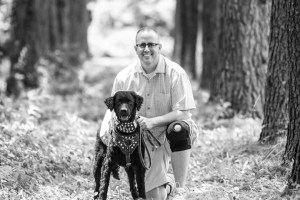
Pastor Aaron Jackson’s dog, Archer, has helped him overcome symptoms of PTSD and also is the official greeter at his church, Emmanuel Baptist in Sterling. Photo courtesy of Aaron Jackson

Pastor Aaron Jackson’s dog, Archer, has helped him overcome symptoms of PTSD and also is the official greeter at his church, Emmanuel Baptist in Sterling. Photo courtesy of Aaron Jackson

Archer is a service dog that Jackson acquired through an organization associated with Disabled Veterans. He said Archer has helped him with anxiety, parts of his depression, and even his nightmares.

“He sleeps by my bed and when he sees me start to struggle in my sleep, he wakes me up,” Jackson said. “He’s also the official greeter at our church. Everyone loves Archer.”

His dog also encourages Jackson to overcome social reservations. When dog-lovers see Archer with Jackson, they can’t help but approach the pair.

“Most people think I’m training him. I explain that he’s my service dog, but my scars are unseen,” Jackson said. “With Archer I am able to celebrate and rejoice through these struggles, just like Paul and the thorn in his side. I would love God to just release me of PTSD, but the truth is that might not happen. You have to learn to live with it and live through it. You don’t have to stay down with it and you don’t have to accept the hurt it brings.”

Once Jackson started receiving the holistic help he needed to deal with his PTSD, he was finally able to live with it and allow God to work in a mighty way.

Caring for families
Chaplain Troeger said those who are most successful at working through PTSD take advantage of every resource available to them.

“And above that, those with the best results are willing to address the spiritual side of the issue,” Troeger said. “PTSD is the mind’s normal response to an abnormal experience. In my perspective, the guys who finally pray to God and say, ‘I can’t do this. You are going to have to take it from me,’ are the ones who come through it the best.”

Another way the church can help is to encourage connection through Sunday school classes and small groups. Duane Smith, pastor at First Baptist Church, Mascoutah, and a former member of the U.S. Air Force, said PTSD often causes people to withdraw and, in turn, compound PTSD with alcohol abuse, phobias, obsessive-compulsive issues and eating disorders.

“The church body and pastors must be encouraging and not let anyone slip through the cracks,” he said. “Pastors think they’re not experts on PTSD, but they don’t have to be. They are equipped to handle a wide range of hurts. We can help folks if we truly believe that we worship a God who knows all things.”

Military veterans may be most susceptible to PTSD, but their families often suffer too. When mom or dad comes home and things aren’t the same, spouses and children can bear the brunt of the “new normal.” Troeger said another way churches can be proactive, especially when it comes to ministering to service members and their families, is by participating in the Illinois National Guard Joint Force Partners in Care.

Through the partnership, member churches agree to provide the Illinois National Guard a list of services, ministries and support, and the Guard provides training and resources to churches on how to assist members and their families in times of crisis, stress and need.

“I can tell you that our church and many churches around this area are a tremendous support, whether it’s through a formal thing like Partners in Care or just a willingness to help,” Troeger said.

“PTSD awareness is a great thing. One of the biggest hurdles is de-stigmatizing mental health issues. Dealing with PTSD does not mean you’re somehow broken or have a weak mind. Again, it’s the mind’s normal response to an abnormal experience. That’s it.”

For more information about Partners in Care or other ways your church can help military families, send an email to Kip Troeger at illinoisbaptist@IBSA.org.

Read the June 8 issue of the Illinois Baptist newspaper at http://ibonline.IBSA.org.

THE BRIEFING | Meredith Flynn

Wheaton College has removed the name of former U.S. House Speaker Dennis Hastert from the school’s public policy center, following Hastert’s indictment on charges he paid $1.7 million to cover up past sexual misconduct, and then lied to the FBI about it. J. Dennis Hastert Center for Economics, Government, and Public Policy opened in 2007.

Hastert resigned from the board of the J. Dennis Hastert Center for Economics, Government, and Public Policy May 29, and college officials announced the name change two days later in a statement on its website:

“We commit ourselves to pray for all involved, including Speaker Hastert, his family, and those who may have been harmed by any inappropriate behavior, and to continue the work and mission of the Wheaton College Center for Economics, Government, and Public Policy.”


Gallup: Americans are thinking less traditionally on moral issues
American views on key moral issues continue to trend in a less conservative direction, Gallup reports. According to research from May, “gay or lesbian relations” is morally acceptable to 63% of people, up from 40% in 2001. Also on the rise: perceived acceptability of having a baby outside of marriage, sex between an unmarried man and woman, divorce, and embyronic stem cell research.


Young people key in Ireland’s marriage vote
After a majority of Irish citizens voted to legalize same-sex marriage, Dublin’s Archbishop Diarmuid Martin said the vote is indicative of the Catholic Church’s relationship with young people. “I ask myself, most of these young people who voted yes are products of our Catholic school system for 12 years,” Martin told national Irish broadcaster RTE. “I’m saying there’s a big challenge there to see how we get across the message of the church.”

A new Gallup poll of American adults found 60% support same-sex marriage, an all-time high.


Coach withdraws from fundraiser amid controversy over group’s marriage stance
Clemson University football coach Dabo Swinney was to be honored by South Carolina’s Palmetto Family Council today along with “defenders of religious liberty” in the state. But after Swinney’s appearance at the conservative group’s fundraiser raised objections from Clemson students, GLAAD, and others, he withdrew from the event.

“I appreciate the recognition of my and the foundation’s efforts,” Swinney said, according to this ESPN report. “However, after much thought, in order to avoid a distraction for the team and the entire football program, I’ve decided it is in the best interests of all involved that I not attend the event on June 2.”


Subsidiary wins bid to purchase bankrupt Family Christian Stores
Family Christian Stores, the country’s largest Christian bookstore chain in number of locations, has avoided closure for now, Christianity Today reports. A bid to purchase the bankrupt company by FC Acquisitions, a subsidiary of Family Christian’s parent company, was awarded last week and must be approved by a bankruptcy court this month. The chain filed for bankruptcy in February.


Black Hawk Down vet graduates from Baptist seminary
Jeff Strueker, a hero of the Somalian conflict portrayed in the 2001 movie “Black Hawk Down,” recently received his Ph.D. in Christian leadership from Southeastern Baptist Theological Seminary, Baptist Press reports.


Church’s photo project restores Joplin
After a massive tornado barreled through Joplin, Mo., five years ago, First Baptist Church in nearby Carthage started a ministry to help restore and return lost family photos. The “Lost Photos of Joplin” project, begun by Minister of Music Thad Beeler, has returned more than 17,500 photos to people through reunification events.

“Why God landed [this ministry] here, I don’t know,” Beeler told The Pathway newspaper in Missouri. “But I do know that we chose to follow His lead, and we’re going to keep doing that until He shuts the door.”

COMMENTARY | Eric Reed

When we first heard that Bruce Jenner was in multi-year gender reassignment,

I thought the doubtable story must be some tabloid concoction. Then when the legitimate news outlets reported it as true, I knew I wasn’t ready for this. Whenever the thought crossed my mind, my jaw dropped. Literally. A boyhood hero was becoming a girl. More or less. I wondered, Am I ready for this?

When the adult son of a character in a popular book series showed up at his mother’s house in a tasteful sweater and skirt set—and set the small town on its collective ear—I thought, That’s fiction.

When a female Sunday school teacher told me about the man who attended the ladies class in women’s clothes and calling himself Jackie*, I thought, That’s Chicago.

Then recently a pastor showed me a photo of bearded fellow and said, “When we were in college, we used to sing together and lead revivals. This is Shane. Shane used to be Sharon.” I thought, That’s it. It’s here. And I’m not ready.

In a February meeting with Baptist editors, Russell Moore, president of the SBC’s Ethics and Religious Liberty Commission, said the issue of ministry to transgender people has arrived on the church doorstep, but not at the sanctuary or the church office. Instead, it’s showing up first in the youth department. Moore mentioned assisting a church that had a transgender teenager attend their youth meetings.

While everyone else is concerned about same-sex marriage issues, I’ve added transgender teens to the checklist. Issues similar to those faced by a few public schools could be headed to church:

• If a boy presents himself as a girl, does he get to use the girls’ room?
• If there are any gender-segregated classes left in the world, which one is the transgender teen to attend?
• Is this the end of the overnight lock-in, the Acteens slumber party, or the RA’s camp out?
• And the deeper issue: How do we tell a genuinely hurting, confused person who is desperately seeking acceptance that God doesn’t make mistakes—boys are boys and girls are girls—with enough compassion that we don’t drive them from the
only hope they have?

At one time, it was enough to know three forms of “trans”—transvestite (wearing clothes of the opposite sex), transgender (identifying psychologically with the opposite sex), and transsexual (having hormone treatment and surgery for gender reassignment). But the sexual identity landscape has gotten more complicated. And teens especially are trying a variety of labels, if they choose any label at all.

How can we help?

Yes, there is clear biblical teaching to be shared, starting in Genesis: God made people male and female (1:27). We are all made in God’s image, but we have distinct assignments (2:21-23). Paul’s criticisms of the culture in which he lived included the abandonment of one’s own sexual role for that of the opposite sex (Rom. 1:26-28, 1 Cor. 6:9).

And yes, there are practical issues to consider: Will “questioning” or “trans” youth be allowed to crossdress at church, even in limited ways such as wearing earrings and nail polish? The Old Testament forbade wearing the other sex’s clothing (Deut. 22:5). And there’s that restroom question.

But more to the point, can such a struggling person be loved and made welcome without endorsing their behavior, or confusing other adolescents whose stage of life is already confused enough?

The Southern Baptist Convention adopted a resolution on transgender identity in June 2014. The resolution urges churches to “extend love and compassion to those whose sexual self-understanding is shaped by a distressing conflict between their biological sex and their gender identity.” Further it encourages churches to “welcome them to our churches and, as they repent and believe in Christ, receive them into church membership (2 Cor. 5:18–20; Gal. 5:14),” all the while opposing public and government efforts “to validate transgender identity as morally praiseworthy (Isa. 5:20).”

Messengers to IBSA’s 2014 Annual Meeting adopted the same resolution six months later.

Perhaps these examples teach us something: That Chicago Sunday school class took Jackie in for a year until he emerged one Sunday in a suit and tie and went to the men’s class under his birth name, Willie. And Shane’s Christian friend, a pastor, maintains a Facebook friendship as a reminder of how much we all need the gospel.

Ministry in the face of sexual pain and confusion, now including the needs of transgender people, will be required of all church leaders eventually. Also required is the call for faithfulness to biblical truth without driving hurting people from the only
hope they have in Jesus Christ.

I hope we’re ready for this.

Eric Reed is editor of the Illinois Baptist.

*This class’s story was told in our May 26, 2014, issue. You can read it online at http://ibonline.IBSA.org.

NEWS | Illinois Baptist

As the U.S. Supreme Court prepared to hear oral arguments April 28 in the case of Obergefell v. Hodges, much of the conversation swirled around the ultimate outcome: Will the Court decide this summer that same-sex marriage is a constitutional right?

But during the arguments and in subsequent analysis, a new issue emerged, mostly due to an exchange between Justice Samuel Alito and Solicitor General Donald B. Verrilli.

If the Court legalizes same-sex marriage, will religious institutions—for example, Christian schools—stand to lose their tax exempt status if they oppose same-sex unions?

Verrilli’s response that “it’s certainly going to be an issue” set off warning bells for Christians, churches, schools and other religious organizations that before had been merely waiting for the Court to likely decide in favor of same-sex marriage.

Instead, the focus shifted from the Fourteenth Amendment and equal protection under the law, to the First Amendment and freedom of religion. The Court is expected to issue its decision in June, making the Southern Baptist Convention’s focus on prayer for spiritual awakening in America all the more timely.

“Unfortunately, the defense of marriage in our culture has now turned into a defense of religious freedom,” said IBSA Executive Director Nate Adams. “I pray for a miracle in the Supreme Court’s decision in June, for if that doesn’t happen churches will find themselves in a precarious new position.

“Even churches that have not been actively engaged in the defense of marriage issue must now be vigilant in defending their freedoms of speech and religious expression.”

Obergefell v. Hodges centers around a surviving spouse in a same-sex marriage who wanted his name listed on his partner’s death certificate. The couple was from Ohio, but their marriage had been performed in Maryland. The issue involves whether a state where a same-sex marriage is not legal must recognize a marriage performed in another state. The Supreme Court subsequently joined three other lawsuits from Michigan, Kentucky and Tennessee in one case.

Framed as a Fourteenth Amendment issue, the case asks two questions: 1. Does the Fourteenth Amendment require a state to license a marriage between two people of the same sex, and 2. Does the Amendment require a state to recognize marriage between two people of the same sex when their marriage was lawfully licensed and performed out of state?

But Justice Alito’s question to Solicitor General Verrilli echoed a concern churches have expressed since the marriage debate began. Verrilli’s answer “confirms with candor the threat we have long seen coming,” said Albert Mohler, president of The Southern Baptist Theological Seminary.

In inquiring about how same-sex marriage could affect religious liberty, Justice Alito referenced a 1983 case in which Bob Jones University was denied tax exempt status because it barred interracial marriage and interracial dating among its students. Will the same happen for schools that oppose same-sex marriage, Alito asked?

Verrilli said he couldn’t answer without more specifics, “but it’s certainly going to be an issue.”

In a presentation on religious liberty following the Court arguments, Washington University law professor John Inazu agreed it will indeed be an issue. He referenced a brief filed by a same-sex marriage supporter Douglas Laycock that nonetheless outlined religious liberty concerns. In the brief, Laycock, a University of Virginia law professor, posed these questions:

• Will clergy have to provide marriage counseling to same-sex couples?
• Will religious colleges be required to provide married student housing for same-sex couples?
• Will churches be required to employ people in same-sex marriages?
• Will religious organizations have to provide spousal fringe benefits for same-sex spouses?
• Will religious social service agencies have to place children for adoption with same-sex couples?

In addition, Laycock says, other organizations could be sued for refusing their facilities or services, including religious colleges, camps and retreats, day care centers, counseling centers, meeting halls, and adoption agencies.

Following the oral arguments, Russell Moore and Andrew Walker of the Ethics and Religious Liberty Commission summed up the religious liberty issue this way:

“The Founders warned us that the power to tax is the power to destroy. The Solicitor General is signaling that at least this Administration is quite open to destroying those who hold a view of marriage held by the Roman Catholic Church, the Eastern Orthodox, evangelical Protestants, Orthodox Jews, Muslims, many Sikhs and Buddhists. It was even a position held by the President himself until his most recent ideological evolution.”

Some observers have said the impact on churches of the Court’s ruling—likely in favor of same-sex marriage—will depend on how the decision is written and how many justices vote in favor of it. A split decision, it would appear, would give the government less authority to limit the liberty of local congregations.

Evangelical ‘winnowing’
At a May 11 meeting in Peoria, IBSA church leaders talked about how churches can respond to the changing marriage culture, and specifically how bylaws and membership policies can protect their right to practice their convictions.

“Some of our leaders have raised the concern [about same-sex marriage], and wanted to know more about how can churches protect themselves, and what are the issues as they stand now in the state of Illinois and the Supreme Court,” said Joe Gardner, an IBSA zone consultant in Metro Peoria.

As they wait for a decision for the Court, Gardner says leaders in his area are concerned about whether they will be required to allow groups that endorse same-sex marriage to use their church facilities, and how to protect themselves against lawsuits that could come with the Court’s decision. Personally, he’s concerned about how the verdict will affect Christian schools,
since his wife is superintendent of one in Peoria.

Of churches in his area, he said, “I would say we are committed to standing firm on the Scripture, and biblical teaching on marriage and home….But we don’t know what kind of challenges [will result from that stand]. So, we’re just waiting to see what kind of challenges will present themselves when we take that stand.

Because, he said, as churches, “We don’t really have a choice, do we?”

During the last several years, and increasingly more recently, churches and pastors are asking themselves that very question. Where do we stand on this? And will we stay there, even when it gets difficult?

Professor Denny Burk of Boyce College said same-sex marriage “will cause a winnowing of our ranks, and we are about to find out who will willing to follow Jesus when it gets hard.”

In a blog post on the day of the Supreme Court arguments, Burk referenced a recent CNN article about how religiously affiliated people now think about same-sex marriage. According to data from the Public Religion Research Institute in the CNN story, a majority within many religious groups favor same-sex marriage, including Jews (77%) and Catholics (60%). A
higher percentage of those groups favor same-sex marriage than the share of all Americans: 54%.

Smaller percentages of black Protestants (38%) and white evangelicals (28%) favor same-sex marriage, but young people—even Christians—are more likely to accept it. According to the PRRI research, 43% of Millennial white evangelicals are in favor of same-sex marriage. “That last number is the one that should stand out,” Burk wrote.

Even before the Court makes its decision known, many congregations are wondering how to handle less conservative views in the pews, particularly on the issue of marriage and particularly among young people. The shift makes for a “watershed moment” for Christianity, Burk said.

“As popular opinion and legal precedent move decisively in favor of gay marriage, those who call themselves Christians have a choice. They can either join the revolution or they can follow Jesus.”

Read the Illinois Baptist online at http://ibonline.IBSA.org.

THE BRIEFING | Meredith Flynn

Barna’s most recent list of the country’s most unchurched cities is dotted with Illinois metro areas, but only two have populations that rank above the national unchurched percentage: 38%. (Barna defines “unchurched” as those who haven’t attended a church service in the last six months, except for a holiday or special occasion.)

The_BriefingThe metro area composed of Davenport, Iowa, and Rock Island and Moline in Illinois ranked 27th on Barna’s list of most unchurched cities, with an unchurched population of 42%. Chicago is a few places down the list, at No. 32 with 39% of the population unchurched.

Other familiar cities: St. Louis is 45th, Champaign/Springfield/Decatur is 53rd, and Harrisburg and Mt. Vernon (along with Paducah, Ky., and Cap Girardeau, Mo.) are 80th.


Does young = pacifist? Maybe not necessarily, according to a Harvard poll of young Americans that found nearly 60% approve of sending ground troops to fight ISIS.


Imprisoned pastor urges prayer | Saeed Abedini’s 35th birthday coincides May 7 with the National Day of Prayer in the U.S., which is the focus of a letter he wrote from prison in Iran. “As Ezra cried out to God in repentance and the Israelites joined him in weeping bitterly and turning from their sin, I would like to ask you to join me in repenting and praying for revival,” Abedini wrote. This story from The Christian Post also reports on the political chaos swirling around the pastor’s captivity and the fight for his release.


New nominees for persecuted countries list | The U.S. Commission on International Religious Freedom has recommended the State Department add eight countries to a list of the “world’s worst violators of religious liberty,” Baptist Press reports. The Central African Republic, Egypt, Iraq, Nigeria, Pakistan, Syria, Tajikistan and Vietnam all were nominated for the list of CPC’s (countries of particular concern), along with nine nations already on the list.


10 questions from Court’s marriage arguments | Transcripts of last week’s U.S. Supreme Court oral arguments on same-sex marriage are available online, as is this guide–provided by the Ethics and Religious Liberty Commission–to the 10 most important questions asked by the justices. For example, would it be unwise for the Court to redefine an institution as ancient as marriage? And would redefining marriage impose on institutions’ religious liberty, like the loss of tax-exempt status?