Archives For November 30, 1999

THE BRIEFING | A group of church planters worked together Aug. 13 to help clean up Ferguson, Mo., a St. Louis suburb rocked by rioting and protests since 18-year-old Michael Brown was killed by Police Officer Darren Wilson on Aug. 9.

The_BriefingJoe Costephens pastors The Passage Church on the border of Ferguson and Florissant. “We bring in anywhere between 8 to 15 mission teams every summer to serve the cities of Florissant and Ferguson—putting on block parties and reaching out to the community,” he said. “So when this came up, I called some church planting buddies, and said, ‘Hey we want to bless our city, let’s do a cleanup day.’”

Costephens and other church planters mobilized between 100 and 200 people to pick up trash and clean up looted storefronts. The group also attended a citywide prayer service at First Baptist Church in Ferguson. According to a Baptist Press report, Pastor Stoney Shaw said the interracial prayer service exuded a spirit of reconciliation, with participants recognizing the need to love and understand one another. Read more at BPNews.net.


Nigerian cities threatened by terrorist group
A Nigerian relations expert said the crisis precipitated by the Boko Haram terrorist group has reached a “new dimension.” Adeniyi Ojutiku told Baptist Press the group has started using tactics associated with ISIS (Islamic State in Iraq and Syria), the militant group responsible for recent persecution of Christians and other religious minorities in Iraq. Boko Haram’s takeover of the town of Gwoza has resulted in nearly 1,000 deaths, rather than the 100 reported by some sources, Ojutiku said.


“They attack, they occupy, they hold the town,” he said. “Now that they have started adopting ISIS methodology, they should be receiving the type of treatment that ISIS is receiving.”


Read more about the persecuted church in the August 18 issue of the Illinois Baptist, online now.

Pew: In 30 nations, specific religious affiliation is requirement for head of state
Analysis by Pew Research found that 15% of the world’s countries require their head of state to be affiliated with a certain religion. In 17 of those nations, the head of state must be a Muslim, while two countries (Lebanon and Andorra) require the person who holds the post to have a Christian affiliation. Interestingly, Lebanon also requires its prime minister to be a Sunni Muslim.


Gay songwriter urges church to rethink views on sexuality
Vicky Beeching, author of popular worship songs like “Glory to God Forever,” told culture writer Jonathan Merritt that “the church needs to become more comfortable with people not being on the same page about everything.” Beeching, who came out as gay in an interview with The Independent Aug. 13, told Merritt, “God loves us unconditionally, so we should aim to model that to those who see things from a different angle, even if that’s really hard to do. I’m trying my best to keep extending that love today to all the conservative Christians who are telling me I am ‘siding with the devil’ because they are still my brothers and sisters in Christ.”


Blogger and professor Denny Burk responded to Beeching’s comments, referencing Matthew 12:46-50. “Jesus draws a line between those who are his brothers and sisters and those who are not. The line runs between those who are allied to God’s will and those who are in open defiance against it.”

LifeWay exploring sale of corporate offices
LifeWay Christian Resources is studying the advantages and disadvantages of selling part or all of its property in downtown Nashville, President Thom Rainer told staff in an Aug. 1 letter. Citing demand for property in the area and fewer employees working at the downtown location, Rainer said, “…It would be poor stewardship for the organization not to explore the possibilities this situation could present for our ministry.” About 1,100 employees currently work at LifeWay’s corporate offices, Baptist Press reported. LifeWay spokesman Marty King estimated nearly one-third of the building is vacant or leased.

prayer_1

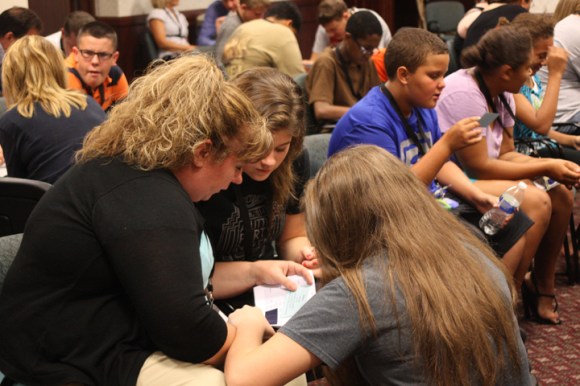
Students and their leaders at ChicaGO Week pray for specific neighborhoods that are in need of a new church.


HEARTLAND |
How do you introduce junior high and high school students to the intricacies of church planting in one of the country’s largest cities?

Take them there, and let them try it out.

More than 50 teens will spend this week working alongside five church planters in Chicagoland as part of the first-ever ChicaGO Week, a project sponsored by the Illinois Baptist State Association. The week kicked off July 13 at Judson University in Elgin, where youth groups from Harrisburg, Chicago, and several places in between will gather for worship after days at their project sites.

prayer_2During the opening worship service, the students heard from someone with lots of experience juggling the responsibilities of church planting.

And lots of experience with actual juggling too.

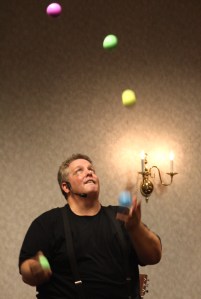
Ken Schultz is a professional entertainer with the stage name “The Flying Fool.” He’s also co-pastor of Crosswinds Church in Plainfield, a church he started several years ago with nuclear engineer John Stillman.

“God uses my juggling and John as a nuclear engineer to help grow a church,” Schultz told the students. Crosswinds has an average weekly attendance of 120 people, and 60% of those came to Christ through the church’s ministry.

“John makes killer spreadsheets,” Schultz said of his co-pastor. “I do this,” he said, before wowing the crowd by juggling three long knives.

juggling

Pastor Ken Schultz used his juggling and unicycle-riding skills in a message on boldness.

“What are you good at?” Schultz asked the students. “Can God use that to build his church?

“He can. You just need to give it to him.”

This week, they’ll do just that at Backyard Bible Clubs, through prayer walking and community clean-up projects, and by offering their time to church planters working hard to get to know their neighbors. It’s a lot to juggle, but God empowers His people to do His work.

“Let this generation be bold, let them be bold as lions for your glory and your good,” Schultz prayed at the end of his message. “If You can use a silly guy who juggles, You can use anybody.”


Growing trends among second-generation and multi-site congregations

By Eric Reed
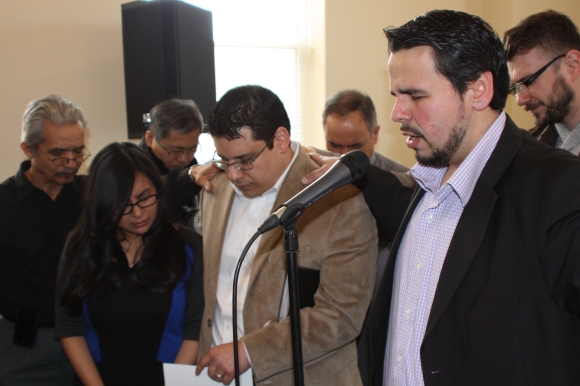
Starting Point in Chicago: Pastor Marvin del Rios of Iglesia Bautista Erie (right) prays for the new congregation his church is sponsoring, led by Pastor Jonathan de la O and his wife, Emely, surrounded by leaders from Chinese, Korean, and Romanian church plants who attended the April 6 launch service.

Starting Point in Chicago: Pastor Marvin del Rios of Iglesia Bautista Erie (right) prays for the new congregation his church is sponsoring, led by Pastor Jonathan de la O and his wife, Emely, surrounded by leaders from Chinese, Korean, and Romanian church plants who attended the April 6 launch service.


Across Illinois |
Five new churches held their “grand opening” events during the two weekends before Easter.

The congregations couldn’t be any more different: They are Hispanic, Korean, Anglo, and multicultural. They meet in the inner city, in new suburbs and older neighborhoods, and way out in the countryside.

Yet their worship services are remarkably alike: all in English, all contemporary, all enthusiastic, and mostly loud.

Collectively they show how some important ministry trends are reaching both main roads and back roads in Illinois:

➢ After decades of planting ethnic language churches, English-language ministries may be the next wave as the grown children of immigrants aren’t feeling comfortable in their parents’ churches.

➢ Starting new churches is getting more complicated and expensive and harder for planters to do solo. That is resulting in more multi-site churches and in new networks among church leaders.

➢ And in some situations, starting from scratch may prove a better strategy than re-engineering a faltering ministry.

Jonathan de la O was born in the United States, but his parents are from El Salvador. He is the product of two countries. “I wasn’t 100% Latino or 100% American, at least in the eyes of those around me,” he said. “It made it difficult to identify with a people group.”

When called to pastor a church, he asked what kind? “I didn’t know where I fit in,” he said in a video.

That tension produced a new kind of church in the Humboldt Park neighborhood: Hispanic worship in English. It’s designed to reach people like him, second-generation young adults, the children of immigrants who are often more like the kids they went to school with than their own parents.

De la O cites a statistic showing 60% of second-gen adults have markedly different culture, language, education, and income than first-gen immigrants. If they don’t find a different kind of church than mom and dad’s, he said, they are likely to drop out.

At home, and not at home

If the very different needs of younger people sound familiar, there’s good reason, said IBSA’s multicultural church planting specialist, Jay Noh. “The gap between first-gen immigrants and their U.S.-born second-gen children includes every challenge that the mainstream U.S. churches have faced, compounded by differences in languages and culture.” In his words, “The paternalistic assumptions of the first-gen won’t be accepted” by their children.

“As soon as they are able to escape the world of their parents and other people of authority, they find a place that is somewhere between their ethnic heritage and the dominant American culture,” said Van Kicklighter, who heads church planting for IBSA.

De la O hopes that place will be his new church. Starting Point Church is meeting in the newly refurbished building owned by Chicago Metro Baptist Association. Noh is assisting another second-gen church start that also shares the space, The Way Bible Church, reaching young Romanians. The Romanian congregation, and second-gen Koreans, Chinese, and international students from Moody Bible Institute, packed out the launch service to show support for De la O and the new church.
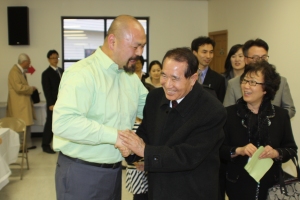
Bethel Church in Mt. Prospect: A multi-ethnic crowd feasted on an international menu following the church's first public service. Pastor John Yi (in the green shirt) shakes hands and bows to almost every guest. Yi has led a ministry to poor families in another Chicago suburb since 2008.

Bethel Church in Mt. Prospect: A multi-ethnic crowd feasted on an international menu following the church’s first public service. Pastor John Yi (in the green shirt) shakes hands
and bows to almost every guest.

Later that same day, northwest of Chicago in Mt. Prospect, a worship band rehearsed prior to the first public service of Bethel Church. On the platform was the expected array of guitar players and drummers, plus one violinist. Mostly Korean, they sang in English and the music was loud.

“Is this typical of Korean worship services?” a guest asked two teenage girls who were thumbing their phones while sitting on the back row of the borrowed sanctuary.

“No,” one girl said. “Not the Korean-language services. They are very traditional.”

“Very,” the other added, “but EM – that’s English Ministry – those services are contemporary. Not as, um, Korean,” she said, smiling.

“Not as, um, Korean” might be a good slogan for Bethel Church. Pastor John Yi has led a multicultural community ministry to poor families in Maywood, about 15 miles away. Now he is starting a new church, also multicultural, which is expected to draw several ethnic groups, but especially second-generation Asians. Like the young women on the back row.

“Our principal attention has been on unchurched English-speaking people in our surrounding neighborhoods in Mt. Prospect even though Bethel Church is made up of a largely Asian-American base,” Yi said. “Interestingly, our ethnic affinity is difficult to dismiss and thus, we have attracted a lot more Korean-speaking people than we had planned.”

The disconnect between generations becomes evident as older people filled the pews, then attempted to sing English worship songs. It’s not only the linguistic gap, there’s a musical gap that many churches have had to bridge.
Their discomfort is evident, but clearly the older people support Yi and his effort to reach their children’s generation. It’s all smiles and bows as about 300 people filled the fellowship hall after the service and shared an inaugural meal of stir-fried rice, Buffalo wings, and Italian spaghetti.

“The first generation has a growing understanding of the necessity of having a gospel ministry that’s culturally indigenous for their U.S.-born second gen,” Noh said. “This may have come about belated as a result of a decade or more of the young generation’s silent exodus from their ethnic churches.”

New networks, new sites

Grace Point in Frankfort: Pastor Emanuel Istrate greets worship attenders at his church's first service. Grace Point is a church plant of Crossroads Community Church in Carol Stream.

Grace Point in Frankfort: Pastor Emanuel Istrate (right) greets worship attenders at his church’s first service. Grace Point is a church plant of Crossroads Community Church in Carol Stream.

In the far south Chicago suburbs, another church launched this day. Meeting in a middle school amid large new houses, this church plant is a restart. “First Baptist Church of New Lennox approached us asking for help,” said Scott Nichols, pastor of Crossroads Community Church in Carol Stream, another suburb 40 miles away. “They sold their building and had been meeting in a school….Unfortunately, they were…near to closing the doors.”

Nichols and his team did what they have done twice before: they brought in leaders and vision. First they offered Saturday night services utilizing the Carol Stream staff. Then, after calling a campus pastor to lead the new work, they restarted Sunday morning worship.

On opening day, Grace Point Community Church in Frankfort welcomed about 60 people from the area. Their target is not based on ethnicity but proximity. “Our target is anyone who will hear us,” Nichols said. “We have gone door to door and mailed about 20,000 postcards to the area.”

Nichols recounts how he’s often said, “You could blindfold an ape and give him a dart. Any place on the Chicagoland map he hits is a good place to plant a church!”

The Crossroads/Grace Point plant demonstrates two trends: the trend toward shutting down a foundering church, then allowing a stronger church to restart a ministry with new vision and new DNA; and the emergence of networks among churches that produce multi-site ministries.

“I believe this is happening both out of necessity and a new valuing of multiplication and reproduction,” Kicklighter said. “Necessity, because churches and pastors are hungry for connection with others,” but also from “a passionate commitment to impact lostness and to do whatever it takes to reach people and give them a local church in which to grow as disciples.”

North by northwest

Grace Fellowship in Davis Junction: Pastor Brad Pittman's church meets in a renovated electrician’s shop at an Ogle County crossroad. Pittman (left) is leading Grace Fellowship's third campus.

Grace Fellowship in Davis Junction: Pastor Brad Pittman’s church meets in a renovated electrician’s shop at an Ogle County crossroad. Pittman (left) is leading Grace Fellowship’s third campus; the other sites are in Ashton and Amboy.

As at Crossroads, the leaders of Grace Fellowship have a broad vision. On Palm Sunday weekend, in a small metal building in north central Illinois south of Rockford, that vision is becoming reality – for the third time.

“I got my first job when I was 13,” Brad Pittman said, “tasseling corn. Anybody know what tasseling corn is?” Hands shot up across the room, along with a few chuckles. “Best job in the world,” he said, before describing his journey from corn tasseler to full-time church planter. A member at Grace Fellowship for 13 years, Pittman eventually joined the staff with pastors Jeremy Horton and Brian McWethy. From the main campus in Ashton, the trio launched Grace Fellowship in Amboy in 2012, and next in rural Davis Junction.

“This is a part of the state where Southern Baptists have had little presence,” said Kicklighter. “When Baptists moved from the south, they settled primarily in the metropolitan areas of the north to work in industry. They did not come to Illinois to buy farms…so we have few churches in these kinds of settings.”

The mainline denominations were better established here, but their churches are in steep decline. So, there is potential here.

“There are over 4 million people living in the non-urban context in Illinois,” said IBSA’s John Mattingly, who leads church planting in the northwest quadrant. “I believe God has prepared many more churches like Grace Fellowship to step out in faith and do something remarkable.”

The three pastors targeted Davis Junction (called “DJ” by the locals) because there was only one faltering mainline church there to serve more than 4,000 people. “We hung over 800 door hangers” in the week before the launch, Pittman said. “We don’t know what the Lord is going to do; we’ll have to wait and see,” he said, before describing how deeply he feels the spiritual need in the area.

“This is not the typical multi-site church plant,” Kicklighter said, “but a commitment to reproduction and, even more importantly, sending people who will impact another place with the Gospel. This is a value system commitment that says extending the reach of the Gospel and the church is at least as important as how many we gather in our own building on Sunday morning.”

More than 60 turned out for the first Saturday evening service, some from the church’s other locations, but many new visitors from DJ. After the service in the brightly rehabbed building, there are lots of hugs, as at each of the launches, and cake.

It is a birthday, after all.

After closure, new hope
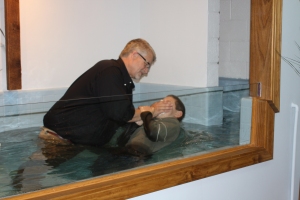
New Hope in Rock Falls: Pastor Jon Sedgwick prays with IBSA church planting leaders Van Kicklighter (left), John Mattingly (right) and Jordan Van Dyke, a future church planter in Galesburg, prior to the launch service. Later Sedgwick baptized a brother and sister.

New Hope in Rock Falls: Pastor Jon Sedgwick baptized a brother and sister at his church’s launch service.

The next morning Jon Sedgwick is all smiles as he baptizes two new believers. Sedgwick didn’t intend to plant a church in northern Illinois. “I didn’t like Illinois,” the former Missouri pastor said emphatically. Illinois was just a place to get through when traveling home to Indiana for visits with family. “But God gave us a love for Illinois!”

“We love Rock Falls!” his wife, Rhadonda, added, equally enthusiastically.

Mattingly had visited the Sedgwicks’ Missouri church describing the need for planters in the Northwest quadrant of Illinois. After Mattingly’s second appeal – “Is God calling someone here to come and help?” – the couple realized, “It was us. God was calling us. God said, ‘Why not you?’”

In 2012, they arrived and began building a new ministry at the building that once housed First Southern Baptist Church of Rock Falls. To the usual round of Bible studies and home meetings, Sedgwick added “Celebrate Recovery,” a faith-based twelve-step program originated by Rick Warren and Saddleback Community Church in California. Reaching out to people with addictions, Sedgwick found doors opening that once were closed to Baptist ministry.

At the worship service, greeters David and John freely told guests how they came to be part of New Hope Church through the recovery ministry.

Also in attendance was Jordan Van Dyke, a planter who is gathering a core group for a new church in Galesburg.
It is commonly observed that ministry in northwest Illinois is especially challenging. “It’s because of the soil,” Van Dyke said. “It’s hard. Sometimes I wish I’d been sent to southern Illinois where, when it’s Sunday, people go to church. In the northwest, it’s Sunday and church is an option. ‘Will I go to church?’ Maybe. Maybe not.”

On this day they do, because there’s new hope in Rock Falls.

Eric Reed is editor of the Illinois Baptist newspaper. In the May 26 issue of IB, we’ll continue our series on The Midwest Challenge with a focus on church revitalization. Go to http://ibonline.IBSA.org to read past issues.

Chuck Kelley concluded the Pastors’ Conference Wednesday with a challenge about leading the next generation, followed by the first day of the IBSA Annual Meeting. The schedule of business and budgets and reports was interspersed with worship led by LifeWay’s Mike Harland and Gospel trio Sons of the Father. Wednesday evening’s worship service highlighted church planting, including a charge by NAMB’s Gary Frost to be bold for the sake of the Gospel.

Carmen Halsey, Tammie Emerson, and Andrea Cruse at the annual Ministers' Wives' Conference.

IBSA’s Carmen Halsey joined Tammie Emerson and Andrea Cruse, both from Living Faith Baptist in Sherman, at the annual Ministers’ Wives’ Conference.

DeAndre Williams from Eternity Baptist in Centralia reads along with Dr. Chuck Kelley during the final message of the IBSA Pastors' Conference.

DeAndre Williams from Eternity Baptist in Centralia reads along with Dr. Chuck Kelley during the final message of the IBSA Pastors’ Conference.

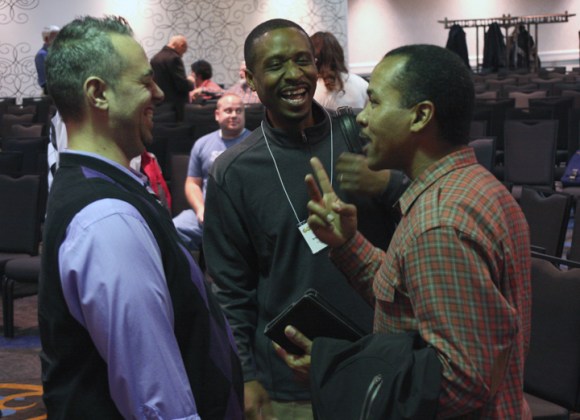
Outgoing Pastors' Conference president Chad Ozee (left) laughs with new president Michael Allen (right) and newly elected treasurer David Sutton.

Outgoing Pastors’ Conference president Chad Ozee (left) laughs with new president Michael Allen (right) and newly elected treasurer David Sutton.

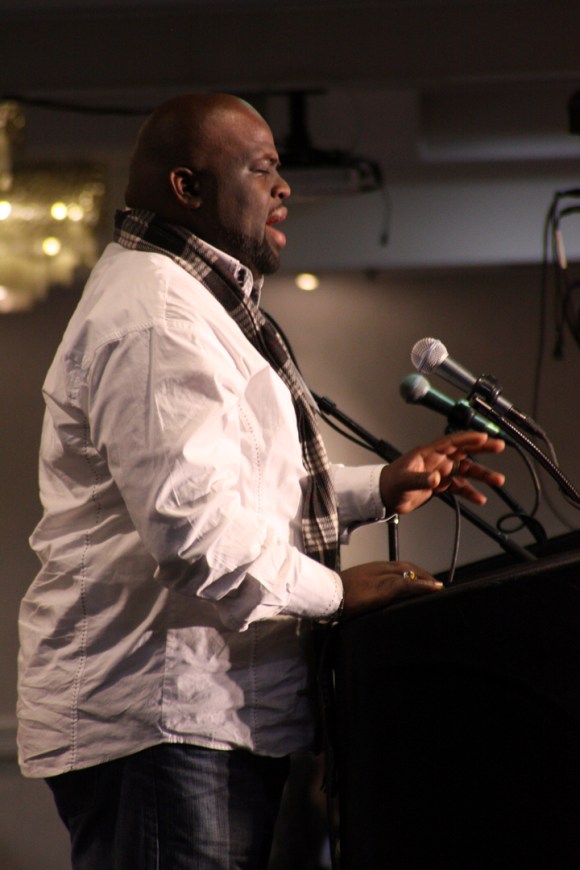
East St. Louis church planter Barnicio Cureton prays during the opening session of the Annual Meeting.

East St. Louis church planter Barnicio Cureton prays during the opening session of the Annual Meeting.

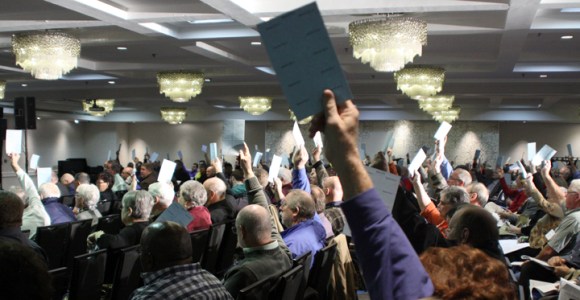
Messengers approve the 2014 IBSA budget.

Messengers conduct the meeting’s first official vote.

Jonathan Peters,  finishing his second year as IBSA President, preached on Jonah to end the Tuesday afternoon session.

Jonathan Peters, finishing his second year as IBSA President, preached on Jonah to end the Wednesday afternoon session.

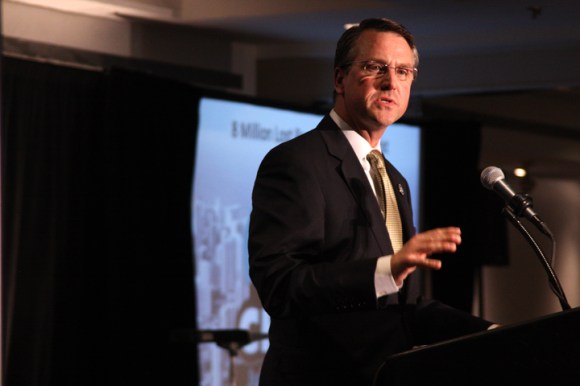
IBSA Executive Director Nate Adams presenting the board's report.

IBSA Executive Director Nate Adams presenting the board’s report.

Les, Chris and Brent Snyder, or Sons of the Father, opened the Wednesday evening session with a worship concert.

Les, Chris and Brent Snyder, or Sons of the Father, opened the Wednesday evening session with a worship concert.

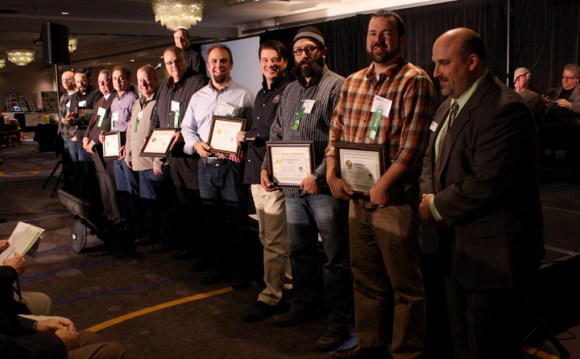
Churches affiliating with IBSA are presented to messengers.

Churches affiliating with IBSA are presented to messengers.

Gene Crume, president of Judson University, shared about a partnership between IBSA and the school that will bring students to the campus this summer for a "Go Week" focused on missions.

Gene Crume, president of Judson University, shared about a partnership between IBSA and the school that will bring Illinois students to the campus this summer for a “Go Week” focused on missions.

IBSA's Van Kicklighter (left) interviewed Alton church planter Steven Helfrich during the worship service focused on Mission Illinois: Churches Together Advancing the Gospel.

IBSA’s Van Kicklighter (left) interviewed Alton church planter Steven Helfrich during the worship service focused on Mission Illinois: Churches Together Advancing the Gospel.

Boldness manifests itself in confidence for a believer in Christ, Gary Frost said. But, "don't confuse confidence with arrogance," added the North American Mission Board's Midwest vice president.

Boldness manifests itself in confidence for a believer in Christ, Gary Frost said. But, “don’t confuse confidence with arrogance,” added the North American Mission Board’s Midwest vice president.

Meeting attenders committed to pray for church planters, partner with them in their work, or explore planting opportunities themselves.

Meeting attenders committed to pray for church planters, partner with them in their work, or explore planting opportunities themselves.

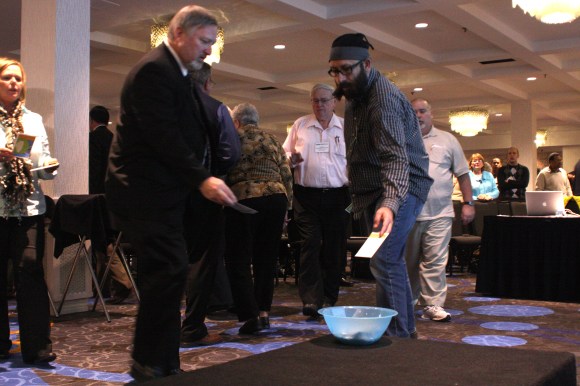
After the session, messengers visited with Illinois church planters at a dessert reception. (Pie was served in the lobby, but attenders had to visit a church planter in order to get a fork.)

After the session, messengers visited with Illinois church planters at a dessert reception. (Pie was served in the lobby, but attenders had to visit a church planter in order to get a fork.)

I want you to know

Meredith Flynn —  November 4, 2013
MI_logo

The IBSA Annual Meeting Nov. 13-14 will explore the theme “Mission Illinois: Churches Together Advancing the Gospel.”

HEARTLAND | Nate Adams

Opportunities for our entire Illinois Baptist family of churches to be together at once are all too rare.  But the IBSA Annual Meeting each November is one of those precious opportunities.  This year the meeting returns to the downtown Springfield Hilton for the first time since our 100th anniversary meeting in 2007. I hope to see you there November 13-14, or perhaps earlier at the Pastors Conference or one of the other related gatherings.

Click here for more on the IBSA Annual Meeting.

But in case you can’t come, let me preview some highlights of the information that I plan to share during that meeting.

I want you to know that Illinois Baptists are going into their Acts 1:8 mission fields in dramatically increased numbers. After several years of our churches reporting around 20,000 missions volunteers, last year churches reported more than 27,000 volunteers, a 34% increase! And there is no indication of that rate slowing down this year.

I want you to know that 28 new churches were planted across our state last year, and through August of this year at least 19 more have been planted. During our Wednesday night worship session at the Annual Meeting we will be hearing from seven of those creative and hard-working planters, and you will be able to meet them and others in person during a dessert reception following the session.

Dr. Gary Frost of the North American Mission Board will bring a challenging message that evening, and you will also meet Dr. Gene Crume, Judson University’s new president, and hear about an exciting new church planting partnership we are working on together in Chicagoland.

I want you to know that our dedicated staff continues to crisscross the state helping churches, and that through September they have already delivered 17,000 trainings in strategic ministry and mission skills to IBSA church leaders and workers.  Baptisms in IBSA churches were up over 2% last year, and the continued momentum of evangelism strategies like “Choose 2” give us hope of another increase when all the 2013 Annual Church Profiles are tabulated.

Finally, in case you can’t come to the annual meeting, I want you to know that the IBSA Board is exploring the option of acquiring a new property in Springfield, a retreat-like facility devoted to leadership development and pastoral renewal. You can read more about that possibility in this issue of the Illinois Baptist, and there will be additional information on http://www.IBSA.org.

Last year when the IBSA Board was exploring this possibility, I invited feedback, both positive and cautionary, from IBSA churches.  The responses were relatively few, but were favorable toward the idea by about a two-to-one margin.

The cautionary and even negative responses were just as helpful as the supportive and enthusiastic ones, however. They helped lead me to recommend to the IBSA Board that we not make an offer on the property unless or until we had the cash in hand to acquire it, even though that probably meant missing the opportunity. And they helped me discover some concerns about developing our camp properties that I felt could be addressed in time.

To my surprise, the potential leadership center property we looked at last year is still available, now at a further reduced price. That doesn’t necessarily mean we should acquire it. In fact, I’ve been praying that someone else would, if it’s not God’s best for IBSA churches. But the IBSA Board and I believe it’s in our best interest to at least explore the option again, because leadership development and renewal among pastors and church leaders is such a strategic need, and we think this property might play a role in meeting that need.

So please let me hear from you again, certainly if you support the idea, because often we leave positive feedback unexpressed. But if you have cautions about the idea, please patiently express them as well. Either way, I want you to know I’m listening.  And I hope to see you soon.

Nate Adams is executive director of the Illinois Baptist State Association.

MIO_blogDAY 4: Watch “Big City, Big Challenge”

Metro Chicago is a mix of neighborhoods and small towns and mid-size cities, all stitched together into the urban patchwork we call “Chicagoland.” With 2,000 people groups and 200 languages spoken, Chicago has many people who desperately need the Gospel.

As God draws missionaries, pastors, and church planters to share the Gospel with the region’s 10 million people, he calls some to come from far away. Others he calls to invest their lives in their hometowns.

“When God first called me, I wanted to go far away, like Jonah,” Pastor Marcus Randle said. “But he sent me right back here to the Southside.”

When we first introduced Randle, his congregation was moving into an old church-school complex, with big plans to expand their outreach to at-risk kids and homeless women. Settled in now, the challenges are big for Resurrection House, but the opportunities are bigger.

Read: Jonah 3:1-4; Isaiah 6:1-6

Think: Why does God send people to minister in places where, at first, they refuse to go?

Pray for 80 church planters and their families working in Illinois today. Ask that they have favor in the many neighborhoods without a church.

MIO_blogHEARTLAND | More and more, churches in Illinois are responsible for missions in Illinois. This is where we live, work, shop, and go to school. This is where our families, friends, and neighbors live – 13 million of them. And at least 8 million don’t yet know Jesus Christ as Savior and Lord.

In the face of such great spiritual need, some of our denominational partners are focusing on church planting as their main method of evangelism. That is a worthy tactic. But it means that Illinois Baptists must make up the difference in other areas that are still fertile for advancing the Gospel. We must focus on missions that remain vital to us here in Illinois, including compassion and crisis ministries, outreach on college campuses and in inner cities, and the education and mobilization of church members for missions. Children, students, and families in Illinois need the life-saving Gospel of Jesus Christ. And Illinois churches need help in dozens of ways that are funded only by Illinois Baptists.

Many of these ministries and missions efforts would not be possible if not for the Week of Prayer and Offering for state missions each September.

DAY 1: Watch “Partner to Plant”

Pastor Peters is passionate about winning lost people. Perhaps it’s because as a kid growing up in Chicago, he never heard the Gospel. Or because so many family and friends still living there do not have a relationship with Jesus Christ. “We have to win the cities, because that’s where the people are,” Peters says of the teeming metro areas. Pastoring a church near St. Louis, Peters has led his congregation to engage in ministries nearby. And he has led them to partner with several churches in metro Chicago.

Read: Jonah 1:1-9; Isaiah 62:6-7

Think: Is our reaction to big cities and people we don’t know more like Jonah’s opinion of Nineveh, or Pastor Peters’ feelings about Chicago?

Pray for the 200 places in Illinois already identified as needing an evangelical church. Pray for IBSA churches to pray, partner with existing churches, and plant new churches.

Scott Venable shares his story of planting a church in Chicago at the WMU Missions Celebration in Houston.

Scott Venable shares his story of planting a church in Chicago at the WMU Missions Celebration in Houston.

HOUSTON | God used bungee jumping to move church planter Scott Venable to Chicago. At the WMU Missions Celebration, Venable told women he and his wife, Ashley, knew they were called to start a new church, and had visited the city several times in search of housing. But they were waiting to sell their house in Texas before fully committing.

On his 30th birthday, Venable went bungee jumping, and hesitated mightily before finally taking the plunge. Later that day, Venable said, he heard God say, “I want you to jump.”

“I had to go back and tell my wife that God has used bungee jumping to get us to go to Chicago,” Venable said to laughter from the audience. They found an apartment online, put down a deposit, and 10 minutes later, got a call that someone wanted to put a contract on their house in Texas.

The Venables’ church, Mosaic, is now two years old and averaging 75-80 in worship. They just baptized four people in Lake Michigan. The church also runs a busy program for kids in their neighborhood.

Venable thanked WMU specifically for their unflinching focus on missions, like the mounds of cards they send to missionaries on their birthdays. “Don’t ever underestimate what those mean to us on the field,” he said. “[They] brighten our day and strengthen our hearts and our courage.”

A veteran of Southern Baptist missions education programs, Venable told the audience he was a Mission Friend (the SBC program for preschoolers), and later accepted the call to ministry as an RA (Royal Ambassador).

“Missions is at the very center of what the church should be about,” he said, congratulating WMU on its first 125 years, and urging women to maintain that focus on missions.

HEARTLAND | David Choi’s made the decision to plant a church in Chicago after God asked him a simple question:

“Is my presence enough?”

As he struggled to discern where God was leading him, Choi also sensed God’s assurance. “I felt God tell me, ‘I’m going to lead you to a place to plant,’” he said. “You’re not going to be alone because I’m going to be with you. Is my presence enough?”

Now, Choi is planting a very multi-cultural church near the University of Illinois-Chicago. Click on the video below to find out more about Church of the Beloved, or read the full story here.

HEARTLAND (From Baptist Press) | Murders had become too frequent in the south St. Louis neighborhood where August Gate church meets.

Neighbors were fed up – including a few August Gate members who were leading a small group in the church’s Tower Grove East neighborhood. When they called to ask the three-year-old Southern Baptist church plant for help, August Gate community pastor Todd Genteman urged the young adults to get involved.

“You’re the Gospel Community in the neighborhood,” Genteman said, referencing the name by which the small group is known. “You should do something.”

So they did. The Gospel Community group organized a pancake breakfast at the church, bringing in community leaders, business leaders and residents to start a conversation about change. Organizers thought 10 to 20 people might show up, but more than 100 did.

The outreach echoed what the church plant’s lead pastor, Noah Oldham, has been teaching to the church which draws its name, figuratively meaning “harvest the city,” from the 10th chapter of the Gospel of Luke. For August Gate members, Gospel Community groups play a critical role in living out the teaching that every member is a missionary. These neighborhood-based small groups commit to learning the Bible, being a family and living on mission together.

“We want the vast majority of our congregation to be living on mission,” said Oldham, who also serves as the North American Mission Board city coordinator for Send North America: St. Louis. “God calls us to be missionaries in particular places.”

Click on the video below for more about August Gate, or go to BPNews.net for the full story.

<p><a href=”http://vimeo.com/57384208″>Noah Oldham: Empty on the Inside</a> from <a href=”http://vimeo.com/namb”>North American Mission Board</a> on <a href=”http://vimeo.com”>Vimeo</a&gt;.</p>