Archives For November 30, 1999

A popular hotel chain is running a television commercial that cleverly depicts several groups of people trying to decide whether or not to attend a wedding. One is a group of bridesmaids, who clearly aren’t thrilled about the turquoise dresses the bride has chosen. Another group is former boyfriends of the bride, wondering why on earth they all got invited. And one sad lady simply doesn’t want to see Uncle Joe dance in public again. I think it might be Uncle Joe’s wife.

The musical background for the commercial is a rock song from the 1980’s. Over and over that song chants the simple question, “Should I stay, or should I go?”

Because Chicago is our state’s largest and most diverse mission field, we all need to get more familiar with, and comfortable in, this world class city.

As the November 2-3 IBSA Annual Meeting approaches, I imagine there are Illinois Baptists asking themselves that same question. For the first time in several years, the meeting is being hosted near Chicago, at Broadview Missionary Baptist Church. The drive will be quite a distance for those in other parts of the state, just as last year’s location in Marion was a long drive for northern churches.

And of course some will not want to brave the congestion and the traffic. In fact, I don’t know any Chicagoland natives who look forward to that part.

The message of the hotel chain’s commercial is that their comfortable, affordable hotels give even reluctant travelers reasons to go, rather than stay home. So let me suggest some reasons to go to the IBSA Annual Meeting this year.

We need to see and care about and partner with its churches.

First, the challenging theme of this year’s gathering is “Cross Culture.” The program will intentionally showcase the diversity of Illinois Baptists and also point to multiple cultures in our state that desperately need the gospel. There’s no better place in Illinois to receive the challenge to “cross culture” than in Chicago.

Second, because Chicago is our state’s largest and most diverse mission field, we all need to get more familiar with, and comfortable in, this world class city. We need more practice going there. We need to better understand its neighborhoods, its problems, its needs, and its people. We need to see and care about and partner with its churches.

Third, a lot of advance preparation has already gone in to making your stay in Chicagoland as easy as possible. Broadview is a wonderful, generous church, with lots of parking and lots of practice hosting large events. Catered meals have been arranged on site at the church to make the dinner hour easier and more convenient. Nearby hotels have provided very reasonable rates that include breakfast. And Broadview’s near west suburban location makes it a wonderful home base for seeing more of the city, either on your own or as part of two pre-planned vision tours.

Should you stay or should you go?

I could go on and on, but let me cite just one more reason, one that really applies to every Annual Meeting, regardless of location. It’s just very, very good for our Baptist family in Illinois to be together. Throughout the year, we as pastors and leaders and devoted church members work hard in our various local contexts to fulfill the Great Commandment and the Great Commission of Jesus. As the year draws to a close, it is good for us to assemble, and network, and be inspired, and remember that we are not alone in this mission.

Should you stay or should you go? If at all possible, you should go. It may surprise you what the Lord has done across our state over the past year. And it may surprise you how he and the fellowship of your brothers and sisters in Christ will inspire you for the year to come. I look forward to seeing you there.

For more information about the IBSA Annual Meeting and Pastors’ Conference, visit www.IBSAAnnualMeeting.org.

Nate Adams is executive director of the Illinois Baptist State Association. Respond at IllinoisBaptist@IBSA.org.

Investing in churches

ib2newseditor —  September 5, 2016

MIO-box-smallNow is the time of year when most Illinois Baptist churches are preparing to promote and receive the annual “Mission Illinois Offering,” which is devoted to advancing the gospel among more than eight million lost people, right here in our state.
Most of the time when we describe our mission priorities here in Illinois, we talk about the desperate need for new churches, especially in northern Illinois, and in large, lost cities like Chicago. And indeed, the MIO is helping start about 25 new churches every year.

And many times we talk about the vast and strategic mission field of Illinois college campuses, where thousands and thousands of tomorrow’s American and international leaders are being trained, often with little or no exposure to the gospel. The MIO supports collegiate ministries too, on more than two dozen campuses.

MIO supports our greatest missionary asset: the local church.

Your gift through the Mission Illinois Offering also helps support the Christian Activity Center in East St. Louis, and human need ministries like disaster and hunger relief, and IBSA-coordinated mission trips from Illinois to the ends of the earth.

But I received a promotional e-mail the other day that reminded me we often don’t talk enough about one of the most important ministries that the MIO makes possible—the ongoing investment of our missionaries and staff in the health and evangelistic growth of IBSA churches. Local churches are our greatest missionary asset as Illinois Baptists, and our investment in their health, growth, and leaders is as important as planting new churches, reaching college campuses, or meeting human and spiritual needs.

Watch the video, “Turn on the Light,” to learn more about why Nate Adams supports the Mission Illinois Offering.

The e-mail was from a church consulting firm. It offered training over a 3-day period on topics like church health models, conflict resolution, overcoming barriers to church growth, and individual church leader development. I thought to myself, ‘That’s what our staff does all the time!”

IBSA carefully measures our staff’s time investment in training and consulting with local churches. Consistently we have had direct consultation with 750-800 churches each year. Considering that ministry is delivered primarily by about 20 traveling staff, that means each staff member is serving an average of 40 churches, all year long!

But what really caught my attention about the church consulting firm’s letter was the cost of its 3-day training—$950 per student, with a minimum of 15 students. That would be over $14,000 for three days of help. To do that for 800 churches would cost more than $11 million. Our Mission Illinois Offering goal this year is $475,000.

I realize that’s not a precise apples-to-apples comparison, since Cooperative Program giving also funds our state mission work, and since IBSA does far more than training and consulting. But I hope it makes the point for you that it made for me. Every IBSA church has a staff of church health and growth consultants at its disposal, and their help is valuable! Your church’s gifts through the MIO and CP enable that staff to be available for your and hundreds of other IBSA churches—week in and week out.

Sometimes it’s awkward to ask for financial support. And maybe it’s a little easier to ask churches to support church planting and missions than to point to the “return on investment” that churches also receive through training and consulting. But if you stop and think about the value of what your church both receives and provides for other churches through your state missions giving, I hope it will make you want to give a truly generous gift through the Mission Illinois Offering this year.

Learn more about the Mission Illinois Offering and Week of Prayer September 11-18 at MissionIllinois.org.

Nate Adams is executive director of the Illinois Baptist State Association. Respond at IllinoisBaptist@IBSA.org.

My spiritual blind spot

ib2newseditor —  August 29, 2016

Reaching the unreached in Illinois

unreached

I’ve lived in Illinois my entire life. I was born and raised in the capitol and attended college at ISU (Illinois State University). I’ve visited family each year in southern Illinois and taken countless road trips to Chicago and the northern suburbs. I’ve also been an Illinois Baptist my entire life.

MIO-box-smallHaving grown up here and very involved in the church, I know well the Baptist beliefs, as well as the spiritual state of this mission field we call home. What I didn’t know, though, is that there are 83 unreached people groups right here in the U.S… and almost 10 in our own backyard!

One (or both) of two barriers typically define what qualifies as an unreached people group: understanding and acceptance.

The issue of understanding largely comes down to language. And where many may think this is only a problem in third world countries and isolated jungles, you may be surprised to learn as I was that in Illinois, we have 9 official unreached people groups that fall into this category. Then there are many more who fall into the latter—those who are unengaged and simply refuse to accept the truth of the Bible.

Watch “Reaching the Unreached” to learn more about the unreached people groups in Illinois.

Combined, the total adds up to more than 8 million here who are lost.

And I’m sure it comes as no surprise to anyone that many of these unreached, unengaged people reside in the greater Chicagoland area—a region where approximately 70% of our state’s population lives. It’s not only the biggest, most diverse region in Illinois, but one of the nation’s largest cultural melting pots. Which is why the work of church planters there is as crucial as ever.

In this one city are millions of people from all walks of life and backgrounds. Isolated neighborhoods that look and function as if you were in a completely different country. Unreached people groups hiding among the throngs.

The potential reach of the gospel in Chicago is astounding. But the message of Jesus Christ is only going to go forth there as long as there are generous, prayerful people and willing church planters willing to support this Great Commission endeavor. To bridge the gap and meet these lost and searching individuals where they are, we must pray, give, and go.

Read the Sept. 12 edition of the Illinois Baptist to learn more about one Chicago church planter, Kenyatta Smith, and his mission to reach unbelievers and give people another chance in Christ.

My eyes have been opened to the unreached. What’s in your spiritual blind spot?

Learn more about the Mission Illinois Offering and Week of Prayer September 11-18.

– Morgan Jackson is an editorial contributor for IBSA and freelance writer living in Bloomington, IL.

Save

Save

coffee cup with a world map

I am ashamed to admit that I haven’t always understood why being on mission both personally and as a church is so vital. I used to skip the “missions” chapel services in seminary because I wrongly believed that missions and being a pastor were two separate callings. I just wanted to be a pastor. Sadly, the first church I pastored wasn’t very mission-minded because I wasn’t.

However, I am now convinced that one of the vital roles of pastors and church leaders is to lead the church to fully embrace God’s call to be involved in their local community and beyond. My heart now understands that the church should be a strong community of mobilized missionaries. It is now my desire to lead the church through preaching, mission trips, and other creative ways so that missions becomes part of our church’s DNA.

I believe that one of the first ways to lead your church to be on mission is to be a leader who is on mission. I am convinced that when the leader of a church is passionate about the mission of God and living a missional life, that focus and zeal will naturally overflow into the hearts of those in the pew.

When a leader is passionate about the mission of God, that zeal will overflow to people in the pews.

All throughout Scripture we clearly hear God’s call to missional living. We see a clear gospel focus when Christ sends out the 12 disciples in Luke 9 and again when he sends out the 70 in Luke 10. We hear God’s heart when we read the Great Commission and Acts 1:8. In our head, we can know that God wants us to live this life with passion for the gospel, but it is so hard to keep the main thing the main thing.

When being on mission becomes part of the leader’s DNA, the church hears about it through his preaching, sees it through his life, and feels it through his tears for people who are lost without Christ.

Though my mind is now thoroughly convinced of the importance of leading my church to be on mission, I must continually remind my heart about God’s mission. Here are some of the practices that help my heart to be missions-minded:

Personally participating in at least one mission trip a year. These times are good for my walk with God. I need to see God move in ways I cannot explain. Often these trips become spiritual revivals for my heart. I try to alternate between going overseas and going somewhere in the U.S. each year.

Reading missions books and biographies of missionaries. Some of the books that make me cry are “10 Who Changed the World” by Daniel Akin, “The Insanity of God” by Nik Ripken, “The Hole in our Gospel” by Richard Stearns, and “Seven Men” by Eric Metaxas.

Attending missions training sponsored by IBSA, and conferences sponsored by the North American Mission Board. Some of the conferences that have recently helped my missions heart are NAMB’s Send Conference, the Midwest Leadership Summit hosted by IBSA, an IMB Missionary Commissioning service, and the IBSA and SBC Annual Meetings.

I’m not always looking for new programs or new ideas at these conferences, though I often come home with an idea for how we can do missions differently or better at Immanuel.

Talking with missionaries. I love hearing their heart, their struggles, and their successes. You can connect with church planting missionaries on a vision tour hosted by NAMB or IBSA, and the International Mission Board is always happy to send a missionary on furlough to preach at your church.

Most missionaries also send out regular e-mail prayer newsletters. While these messages remind me to pray for the missionary, they also encourage me as I read about some creative things others are doing all across the world for King Jesus.

Spending time with other believers who are on fire for Jesus and who are getting it done sharing the gospel. Often, these lunches and the time I spend with these kinds of believers greatly challenges me.

What a joy it can be when a church understands that God has commissioned them to be the light in a dark world. What a joy it can be when church members leave to plant churches, surrender to ministry, lead their co-worker to Christ, and go to the nations.

The steps you take to fuel your missions heart are steps toward God’s heart, enabling your entire church to be on mission! Keep chasing him, my friends.

– Sammy Simmons is pastor of Immanuel Baptist Church in Benton.

Who’s at the table?

ib2newseditor —  August 18, 2016

Office chairLooking around the table at a leadership meeting, I noted who was there. More important, I realized who wasn’t.
This was the first meeting under the church’s new leadership structure. Most of the people had served in leadership capacities and most of them had served together at one time or another. But they had not all served together at the same time.

So we brought them together.

The need in this congregation was enhanced communication among ministry planners. The church’s various ministries had a history of bumping heads. There was confusion over use of rooms and recruiting workers. There was often a sense that no one really knew what was going on. And it was evident that the ministry teams held differing views on their own purposes, and different interpretations of the vision of the church.

Surely a regular meeting of the leaders would help to fix this. But it didn’t.

Not all the leaders were there. One man who said he hated meetings chose not to attend, so his cause had no voice in the allocation of dates and resources. Another team had three people in attendance, so the discussion felt tilted to their interests.

Sitting there, I made a few notes:

• Everyone here is a longtime member. Are there new people with fresh ideas we should bring to the table?

• Everyone is from the same generation. How can we bring other age groups to the discussion?

• Everyone is from an elected position, but not all ministries are represented. And a couple don’t need this level of input. Which are the right ministries to include so the vision is accomplished?

• Our discussion seems dominated by a few not-well-prepared people. How can we improve their preparation or dismiss them from the group?

• After this meeting, we still need buy-in from “unelected” leaders. How can we bring opinion leaders to the table?

Next time you’re at a leadership meeting, give some thought to who’s at the table.

 This article first appeared in the Fall 2016 issue of the Resource Magazine. Read it online at Resource.IBSA.org.

 – Eric Reed is editor of the Illinois Baptist

ChicaGO Week mobilizes youth to missions—and inspires me deeply.

Chicago Week Group

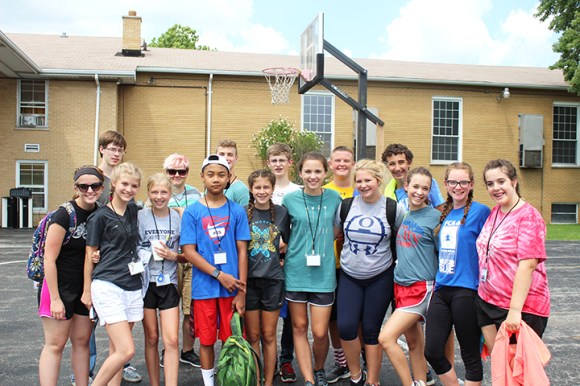
Photo op | Part of the group from First Baptist Church O’Fallon poses for a picture before starting the daily commute back to Judson University.

Two summers in a row now I have been completely immersed in the world of the Mission Illinois Offering – helping provide churches with state missions Bible studies, crafting guides for Illinois Baptists to prayerfully walk through with one another, and working to prepare hearts for giving and supporting missions right here in our own state.

MIO-box-smallThere is one area, though, which Mission Illinois giving supports that has become especially near and dear to me: ChicaGO Week.


I have had the opportunity to cover a number of incredible stories about work that IBSA churches are doing across the state – a small, rural congregation feeding thousands of people each month, urban church planters gathering together for mutual encouragement and solidarity, children whose Christlike actions have touched the lives of adults and entire communities.

Watch the MIO video, “Students on Mission in Chicago.”

But when I reflect on which stories have had the most impact on me personally – which testimonies and experiences have managed to stand out above all the rest – hands down they revolve around the selflessness and joy I’ve had the privilege to witness during ChicaGO Week.

As you can read about more in the upcoming August 22 edition of the Illinois Baptist, ChicaGO Week offers youth a unique opportunity to travel to this huge mission field and partner with local church planters whose goal is to reach the 9 million Chicagoland residents with the gospel, a large majority of whom don’t have a relationship with Jesus.

And trust me when I tell you that these students don’t take this partnership lightly.

Chicago Week Bubbles

Sports Camp | Local kids came to Transformation Church each day during ChicaGO Week as IBSA youth partnered with them to put on a sports camp — complete with bubbles and chalk drawing galore.

Last summer I watched as kids braved the summer heat and accomplished more yard work in a few hours than that church planter and his family could have gotten done all week. I thanked God for a young group of girls as they bravely talked to strangers and told others about Christ in this huge city they’d never even been to before. And this summer I couldn’t help but be filled with joy as 30+ students poured their time and energy into simply playing games with kids in the local community – eating ice cream together and showing them the love of Jesus.

Letting them know that they matter.

And the planters. The students during ChicaGO Week only get a brief glimpse into the daily lives of these church planters – seeing just a peek into the challenging, sometimes grueling and heartbreaking, yet oh so rewarding world of starting a new congregation. But getting to speak to these men and their families gives youth the opportunity to see the need for the gospel in our state, and it has given me such a greater appreciation for where my MIO dollar is going.

So I encourage you to give to the Mission Illinois Offering, and give generously. Because I’ve seen firsthand the life change and the souls that are won for the Lord when these planters have the resources they need to fulfill the mission that has been placed on their hearts.

Learn more about the Mission Illinois Offering and Week of Prayer.

– Morgan Jackson is an editorial contributor for IBSA and freelance writer living in Bloomington, IL.

Save

South Loop of Chicago

South Loop of Chicago.

My wife, Cindy, and I have moved to a new home in a mid-rise building in Chicago’s South Loop. Relocating from the Uptown neighborhood where we lived the past two years, this feels like a new mission field. We’re approaching the community as missionaries.

Our seven-year old Australian Shepherd, Yabbo, has proven an effective missionary in his own right. He provides the opportunity to initiate conversations easily. In keeping with the breed, Yabbo is well mannered, charming, and appreciates attention. With Yabbo’s help, Cindy and I have begun to meet the wide variety of people in our mission field and to engage them in conversation. We’re learning what is important to them, how they think, and who they are.

Among our new neighbors are a 60-something couple who moved in a week after we did from a nearby condo. They waited two years for the right place in this building to hit the market. We’ve met a cautious 60-something mother and her hard-charging adult daughter who live together. One woman is single-again in her 40s and has an energetic, vocal small dog. Another couple, in their early 30s, has daughters who are ages three years and four months.

“Who are the people in the neighborhood?” Engage them in conversations. Common ground becomes an opening for the gospel.

If the condo association permits us, we’ll host monthly Sunday brunches as a means of getting to know our neighbors and develop relationships with them. Our objective is to bless our neighbors. We believe, deeply, that the place we live should be better because Jesus-followers are here. We seek to add value to their lives.

The relationships we develop will provide conduits for the gospel and opportunities for disciple making. We’re confident that some will hear the gospel for the first time. Others may have heard the gospel, but have never understood how it applies to their daily lives.
Our hope is that a new community of believers—a church—will emerge from the new believers and those who seek to grow in Christ-likeness.

Regardless of whether we’ve lived in the same place for decades or just moved some place new, we all have the opportunity to listen and learn. Ask as they do on Sesame Street, “Who are the people in the neighborhood?” Engage them in conversations. Common ground becomes an opening for the gospel. And we can begin to make disciples while going about our daily lives.

Dennis Conner is IBSA’s Church Planting Director for the Northeast Region.

The BriefingSouthern Baptists called to prayer
On June 14, the entire Tuesday evening session of the 2016 Southern Baptist Convention in St. Louis will be committed to praying for spiritual leaders, our churches, nation, and world. Southern Baptist Convention President Ronnie Floyd issued the call stating, “the critical need of the hour in America, the state of our churches, the needs of our pastors, the status of our evangelism or lack of it, and the exponential lostness of the world while we are bringing home hundreds of our missionaries… it is time to pray.”

New churches outpace dying ones
America is launching new Protestant churches faster than it loses old ones, attracting many people who previously didn’t attend church anywhere, new LifeWay Research studies show. More than 4,000 new churches opened their doors in 2014, outpacing the 3,700 that closed, according to estimates from 34 denominational statisticians.

Christian women most persecuted
A survey of 192 countries has demonstrated scientifically what many have long known anecdotally to be true: Christian women are more religious than Christian men. The lesser known fact: those women bear the brunt of persecution in the 50 countries where it is hardest to be a Christian.

Tax-exemptions for churches questioned
Massachusetts authorities have challenged the tax-exempt status of a Catholic shrine and retreat center. The center offers daily Masses, religious conferences, a soup kitchen for the hungry, and a Christmas festival of lights. The case which has gone to the state’s supreme court, begs a deeper question: Do religious organizations decide for themselves what they require for their devotional and educational missions, or do municipal tax authorities decide for them?

Porn labeled ‘public health hazard’
The effort to reverse the spread of sexually explicit material and its effects received a boost when Utah Gov. Gary Herbert signed a resolution saying pornography is establishing “a public health crisis.” The first-of-its-kind resolution, which National Center on Sexual Exploitation (NCOSE) helped craft and the state legislature approved unanimously, recognizes “the need for education, prevention, research, and policy change” to confront “the pornography epidemic.”

Sources: IB2news, Facts & Trends, Christianity Today, Boston Globe, BPnews.net

Six missionary families who have accepted God’s call are featured during the Annie Armstrong Easter Offering Week of Prayer for North American Missions, set for March 6-13. The goal for the 2016 Annie Armstrong Easter Offering is $70 million.

The Rager family

The Rager family

Three years ago Barry Rager was the pastor of a small Kentucky church. Most of his days were centered on important church business. He prepared sermons, visited sick members and mediated church disputes. All good work. All important work. All kingdom work.

“I was kind of like the coach saying, ‘Hey, reach the people you are with,’ but I wasn’t actually the one doing it,” Rager says.

Three years later, and his life couldn’t be more different. Living in the Mapleton-Fall Creek neighborhood of Indianapolis’ core, his mission field is everywhere.

A trip to Indianapolis for the 2008 Southern Baptist Convention first opened Rager’s eyes to the needs of the city. It wasn’t until 2012 that James Edwards came to him with an offer: “We want to plant a church in a major U.S. city, and we want you to be the planter.” Rager didn’t have to think hard about which city.

Edwards, pastor of Pleasant Valley Community Church, and the congregation felt the call to plant a church in an urban city, which eventually led to a strong calling for a church plant in Indianapolis. Edwards had met the Ragers on a playground where a strong friendship was formed. For years, the Ragers and Edwards encouraged and supported each other and their ministries. When Pleasant Valley felt God tell them to plant a church, they prayerfully considered who would lead the church plant.

“Barry Rager’s name continued to surface,” said Edwards. Pleasant Valley asked the Ragers to pray about planting a church in Indianapolis. “It was clear to Barry and Amy that God was calling them to plant a church in the heart of Indianapolis,” said Edwards. “Our strong inclination to partner with Barry and Amy came primarily through the leadership of the Holy Spirit.”

A once thriving city in the 1920s, by the 1960s many residents had moved to the suburbs.

Today, 41.5% of residents do not have a high school diploma. A 2013 NeighborhoodScout.com article called the northern half of the area the 17th most dangerous neighborhood in the U.S.

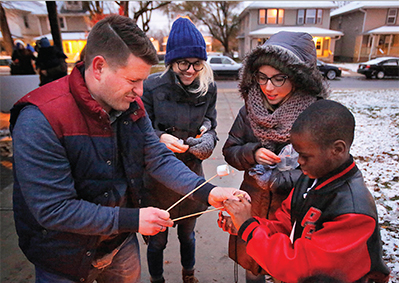
Indianapolis church planter Barry Rager (left) and New Circle Church use events like S’mores and Snow in the Park to reach a neighborhood many describe as dangerous.

Indianapolis church planter Barry Rager (left) and New Circle Church use events like S’mores and Snow in the Park to reach a neighborhood many describe as dangerous. The Ragers are North American Mission Board 2016 Week of Prayer Missionaries. NAMB photo by John Swain

Once the Ragers relocated to Indianapolis, they were told it would likely take them years to connect with their neighbors and build disciple-making relationships.

“When we moved in, we decided that we were going to be as open and positive as we possibly could be,” Amy Rager says. “Most of the people around here keep their blinds shut 24-7. They’re very closed. So we thought, you know what? Our blinds are going to be open. We’re going to act like we trust these people. We’re going to do anything we can to initiate that relationship.”

Before their boxes were even unpacked, the family showed up on their neighbors’ doorsteps with freshly-baked homemade cookies. They also invited their neighbors into their home for dinner.

As they continued to build community, the Ragers eventually started worship services with 40 people attending in September 2014. That was the launch of New Circle Church, Indianapolis. A year later their worship attendance more than doubled and they had seen 22 people baptized.

Barry focuses the church on a simple-yet-comprehensive mission—introducing people to Jesus, developing gospel-centered community and commissioning them to reach people for Christ.

“What I get to do is brag on Jesus and what He has done,” Rager says. “It is such an honor to brag on Jesus.”

“I think if it is never our intention to live on mission, then we won’t live on mission,” Rager says. “We have to be intentional in the way we use our time, and in the meetings we have with people.

– By Tobin Perry on www.AnnieArmstrong.com

The New Seekers

Lisa Misner —  December 21, 2015

Today’s magi are young and worldly wise, but naïve about Christ

Worldly wise, spiritually curious

Worldly wise, spiritually curious | The magi in this nativity hail from Uganda. http://www.worldcrafts.org

By Mark Coppenger | While a 60-year-old church planter in a university town just north of Chicago, I had at least one big personal question: Why would college students come to a basement rental space to hear a balding, overweight preacher who was often the only one in the service wearing a tie? At least I knew it wasn’t my effort to “dress for success,” which used to mean gray slacks, a blue blazer, rep tie, and such, but had come to mean work jeans and an untucked shirt. The best I could tell, sartorial and tonsorial factors were not much in play.

And lest you have the impression that I was some sort of maven at reaching Millennials, I should hasten to say that a lot of them stayed away, and a lot of them who gave us a look never came back. As the old joke goes, “We had three decisions on Sunday. One was for God, and two were against.” I think that goes with the territory when you preach “the whole counsel of God” in an age when feelings, relativism, and political correctness rule.

In our 11 years in Evanston reaching out to the Northwestern University campus, our church plant grew about five per year in average attendance, ending with about 55 a week. Of course, college communities are very fluid, and we’d regularly have our heart broken by graduations, where we’d lose a chunk of our treasure. But we labored on in joy and with some fruitfulness, and today we take great satisfaction as seeing our former parishioners on the mission field in Germany, India, and China; as Christian faculty at such universities as Maryland and North Carolina; in corporate positions from New York to San Francisco; in military service bands, medicine, the urban classroom, magazine staffs, NASA consultancies, symphony orchestras, etc.

Many of these folks were already walking with the Lord, and we simply had the privilege of walking with them on a segment of their journey. But some were also coming in from the pagan pool. Some were old guys—one was an aging veteran of Iwo Jima who was concerned with “studying for finals”; another was a middle-aged Baha’i, who wanted a chance to bone up on one of the many faiths they somehow embraced.

All this being said, here are some things that come to mind about our linkup with Millennials, many of whom were not believers when we met them.

They’re seeking a way out

First, let me say that in the talk about “seekers” and “seeker-friendly churches,” we see something of a duel between those who point to Romans 3:11 (“there is no one who seeks God”) and Jeremiah 29:13 (“You will seek me and you will find me, when you seek me with all your heart”).

The former say that the lost have little or no appetite for the true God, at least until he intervenes in their hearts. The latter emphasize the human will and point to cases, whether biblical (John 12:21), historical, or contemporary, in which people did, indeed, come looking for the Lord.

Of course, this leaves open the question of why they were looking. (For what it’s worth, I’m persuaded that the overarching answer is that God puts it in their hearts to seek him, and they’re not really seeking him until he does this.)

I think it’s fair to say that most of our seekers were looking more for a door out of their current spiritual situation than for one into the Kingdom of Christ. They’d made a mess of their lives or come up empty in one way or another. They were unlucky in love, academics, employment; depleted and damaged by addictions, sexual sin; exhausted by the grind, betrayed by friends, marginalized by the culture and such, and they were willing to try something new. So they weren’t so much homing missiles intent on pursuing the righteousness of God, as they were anxious travelers thrashing about in the woods, spotting a cabin light in the distance and walking toward it.

Some were happy to join in the life of the cabin, glad to receive the mercies and life of the one who had invited those who were “weary and heavy laden” to come to him for rest. But others soon got cabin fever and sought the exit.

They loved the warmth and camaraderie and words of grace and love, but they couldn’t abide the language of Zion or imposition of the biblical prerogatives, and so, after warming their hands at the hearth, they plunged back into the darkness. There were, for instance, those who couldn’t or wouldn’t give up their intimate co-habitation without benefit of marriage. If they had been looking for the true God, they would have stayed, but they were only interested in trying out a new drug.

I was struck by the testimony of one of our Chinese students that her father had urged her to check out Christianity since it seemed connected with human and economic wellbeing. He wanted her to get a fix on what those Christian birds were up to that made them fly so high.

For those who had a heart to stay, we made a way for them to grow “in wisdom and stature and favor with God and man.” For the others—the rich young rulers, if you will—they’d had a look at what discipleship meant, like it or not.

Despite what the critics say, the church still has a lot of cachet, and we should expect people to give us a look if only to figure out, “What is it with those guys?”

Spiritual nomads need roots

Fewer and fewer young adults come from gratifying homes, and those that do so miss what they had when they move away. Either they don’t much know what a family is supposed to look like, or they long for a substitute. And that’s where the church can come in big time.

In Evanston, Sharon and I were empty nesters for most of our years as a church-planting couple, so we had a lot of freedom to connect in fatherly/motherly (or grandfatherly/grandmotherly) ways. We’d go to their plays, recitals, sporting events, and such, taking photos, making over them at receptions, and basking in the moments of their achievement.

I remember one night at a club in Rogers Park, we went to hear a group called the Blind Anabaptist Blues Band, formed by one of our Northwestern students. They performed in all sorts of venues, high and low, in the Chicago area. They offered a mix of secular and sacred music, the lead singer with something of a Bob Dylan/Tom Waits sound. That night they led with several of their “worldly” numbers (e.g., “Girl With Gin on Her Lips”), but then, 20 minutes or so into the set, they gave a straightforward rendition of an old hymn.

You might think this would come off like fingernails on the blackboard, for overnight hookups were shaping up at the bar, pitchers of beer sloshed everywhere, and a lesbian couple had taken to the dance floor in front of the band. But a sweet reverence came over the room, with strangers mouthing some of the words, and with, perhaps, a tear or two at this or that table.

Perhaps they remembered the days when their mommy took them to Sunday school, they sang in the youth choir, or they sat on the back row of some church, barely attentive to what was going on, but with their young impressionable minds absorbing those gospel strains. So we need to be careful about throwing old stuff under the bus, for it may well be a linkage point.

What they know, what they don’t

I may have this all wrong, but I don’t think the current young adults read or learn as much background material as we Boomers did. I’ve seen several studies showing that, in high school and college, they’re writing fewer and fewer term papers.

They’re juiced with music in their ear buds, tweeted to insensibility, selfie’d into the third celestial ring of narcissism, and often remindful of the French, who after their 18th-century revolution, started the calendar all over again, declaring themselves the founders of a new age, no longer beholden to the BC/AD business.

So while you may stumble on syncing your iPhone or some other item of technological arcana, you know who Lottie Moon was, how William Carey fought widow burning in India, what turned Wales upside down in 1904, how ‘Messiah’ and ‘Christ’ connect with oil, the connection between Nineveh and Mosul, and what difference Mordecai Ham and William Randolph Hearst made to Billy Graham.

Today’s seekers don’t. Of all the people in that list, they may not even know Billy Graham. They may know a lot of stuff, but they’ve missed a lot of important stuff their filters have kept them from learning.

These are folks who’ve been brainwashed in the paralyzing ideology of political correctness and overweening sensitivity, ever alert to the “gotcha,” by which they’ll lose their social standing, if not more.

They know that “Islam is a religion of peace,” that “gay is okay,” and any number of other secular pieties. They learn that the greatest sin is perceived intolerance (a foolish conviction exposed in Allen Bloom’s “The Closing of the American Mind”), and they’ve likely joined in the witch burnings of those designated “phobic” in one way or another.

But there you are, speaking the plain language of the Bible, whether the exclusivity of Christ, the reality of sin and hell, male headship in the home, and the sanctity of marriage and unborn human life. “You can’t say that!” they say.

“Oh, really,” I respond. “Well, here it goes again.”

Sure, some will stomp out grumbling, but others will be intrigued by the spectacle and stick around to see what the fundie mine sweeper will set off next as he covers his ears and goes lumbering through the fields of biblical teaching.

Some veteran missionaries in our church introduced “storying” for internationals, working off graphic wall hangings replete with Bible scenes, from Genesis to maps. The non-Christian Asian students were particularly receptive. (And, in this connection, I’ve really enjoyed my work at biblemesh.com—“One God. One Book. One Story.”)

I think stories in the form of illustration can also take sermons to a higher level. Some call them “raisins in the oatmeal.” Whatever. I know Jesus used them a lot, in the form of parables. And I know they connect powerfully—and legitimately, if they serve the task of true exposition.

Culture also offers opportunities to connect with Millennials. They’ve been taught to stereotype “fundamentalists” or “chauvinists” or whatever class of vermin is au courant, and they may be queuing up for their own Mizzou protest or Wall Street grump-in according to the demands of the professionally offended. After all, thanks to the modern university, Millennials are hothouse plants, oblivious to thinkers who don’t fit the school’s suffocating ideological template.

So when you suggest that you prefer Booker T. Washington to W.E.B. Dubois, Edmund Burke to Howard Zinn, or Norman Rockwell’s “Saying Grace” to Matthew Barney’s “Cremaster Cycle,” they have a tough time processing your comments.

You might tell them you prefer poems that rhyme to those that don’t, maybe like the work of Robert Frost and Robert Service. That’ll drive ‘em nuts. But do it with a mischievous smile, letting them know that you don’t wish them harm, and that we’re happily a part of a Divine Comedy, not a Divine Tragedy.

My tactic: unruffledness

With the breakup of the family and society’s precipitous descent into the abyss of relativism, hedonism, narcissism, and even nihilism, we are confronted with all sorts of waywardness and frowardness, and we do well to handle these with unruffledness. Today’s seekers will show up with alarming tattoos, mad theories, “father wounds,” and promiscuities, and we should not think it a virtue to swoon in the face of affronts to holiness.

Don’t blink.

Let them tell their story and even put on their displays of lawlessness. Then pick up as you can. That’s what Jesus did. He didn’t cover his ears and go “La-La-La-La” when he heard or saw something unpleasant. Unlike Jesus, we realize that we’re all a mess without his touch, and that none of us could endure a moment-by-moment projection of our lives in Times Square.

Don’t flinch from speaking a biblical word to sin, but don’t flinch from ministering to the sinner.

I’ve heard that, and have come to believe that, God honors our efforts even when they seem futile. We knocked on miles and miles of doors in Evanston, held a range of special events in city parks, and did a mass mailing to the city’s residents. In the end, very few came to church as a result. Or I should say, very few of those we contacted came to church. But a lot of others did, from sectors we’d not anticipated.

One congregant was a dear fellow who told the same stories over and over again over lunch, forgetting that he was repeating and repeating himself; another was a new convert from Islam; another was a theater student, working in constant tension with the values of the secular stage and the claims of Christ; yet another was a Messianic Jew who, as a policeman in uniform, dropped in on our services from time to time; another a pastor’s kid from Arkansas.

Call it an application of the “law of sowing and reaping”—that God keeps account of our witness efforts and rewards us with fruit from fields we’d not cultivated. We’d not sought them, but by his grace they sought out us.

Mark Coppenger is professor of Christian apologetics at The Southern Baptist Theological Seminary in Louisville, Kentucky. He is former president of Midwestern Baptist Theological Seminary and a church planter and pastor in Evanston, Illinois.