Archives For November 30, 1999

Who’s at the table?

ib2newseditor —  August 18, 2016

Office chairLooking around the table at a leadership meeting, I noted who was there. More important, I realized who wasn’t.

This was the first meeting under the church’s new leadership structure. Most of the people had served in leadership capacities and most of them had served together at one time or another. But they had not all served together at the same time.

So we brought them together.

The need in this congregation was enhanced communication among ministry planners. The church’s various ministries had a history of bumping heads. There was confusion over use of rooms and recruiting workers. There was often a sense that no one really knew what was going on. And it was evident that the ministry teams held differing views on their own purposes, and different interpretations of the vision of the church.

Surely a regular meeting of the leaders would help to fix this. But it didn’t.

Not all the leaders were there. One man who said he hated meetings chose not to attend, so his cause had no voice in the allocation of dates and resources. Another team had three people in attendance, so the discussion felt tilted to their interests.

Sitting there, I made a few notes:

• Everyone here is a longtime member. Are there new people with fresh ideas we should bring to the table?

• Everyone is from the same generation. How can we bring other age groups to the discussion?

• Everyone is from an elected position, but not all ministries are represented. And a couple don’t need this level of input. Which are the right ministries to include so the vision is accomplished?

• Our discussion seems dominated by a few not-well-prepared people. How can we improve their preparation or dismiss them from the group?

• After this meeting, we still need buy-in from “unelected” leaders. How can we bring opinion leaders to the table?

Next time you’re at a leadership meeting, give some thought to who’s at the table.

 This article first appeared in the Fall 2016 issue of the Resource Magazine. Read it online at Resource.IBSA.org.

 – Eric Reed is editor of the Illinois Baptist

Stirring the Waters

After three years of declining baptisms, SBC leaders are calling it what it is—an evangelism crisis.

What happened to evangelism in the Southern Baptist Convention?”

The question, posed by SBC President Ronnie Floyd, came after the Annual Church Profile reports completed by Southern Baptist churches showed a third consecutive year of declining baptisms.

In fact, the total for 2014 (the most recent year for which national statistics are currently available) is the lowest number of baptisms since 1947. Southern Baptist churches baptized 305,301 people, a 1.63% decrease from the previous year. An in Illinois, the annual number of baptisms, which has hovered around 5,000, dropped to 4,400 in 2015.

“Deplorable” is how Floyd described the reality that even though there are more SBC churches than ever, and an ever larger population to reach with the gospel, it’s simply not happening—at least, not according to the baptism numbers.

Recently, Floyd and other SBC leaders have been increasingly vocal about how the numbers reflect an even bigger problem: an evangelism crisis.

“Lostness in North America is having a bigger impact on Southern Baptists than Southern Baptists are having on lostness,” New Orleans Theological Seminary President Chuck Kelley said at a recent chapel service.

The picture is bleak, but all is not lost, SBC leaders seem to agree. A turnaround is dependent on renewed appreciation for and dedication to evangelism in the Southern Baptist Convention and in individual churches. Church members need models, leaders who are soul winners themselves and can train people in the pews to share their faith.

“Let’s not be paralyzed,” Floyd wrote on his blog, urging Baptists to action. “Do something. Do more than you are doing now. Take a risk.

“Return to the importance of reaching and baptizing people.”

Mission drift

One reason some leaders cite for the SBC’s decline in baptisms, and overall in evangelism, is a culture that sidelines those things. In an address to the SBC Executive Committee in February, Floyd spoke about a critical shift that has brought the denomination to this point:

“Years ago, something happened where pastors and churches that reached and baptized people effectively came under the microscope of other Baptists who oftentimes did not have a heart for evangelism themselves. A culture of skepticism about evangelism began to creep into our convention. Evangelism began to die.”

Even the way we talk about evangelism is different, said IBSA’s Pat Pajak. The weekly opportunity to go out “soul winning” has been replaced with more politically correct titles such as outreach, or more often the practice has been lost altogether. “In the process, born-again believers have lost the passion and emphasis on reaching into the pagan pool and bringing the lost to Christ,” said Pajak, who leads the Church Consulting Team.

Recent research supports this: A 2012 study by LifeWay Research found that while 80% of Protestant church-goers believe they have a personal responsibility to share their faith, 61% hadn’t told anyone how to become a Christian in the previous six months. Nearly half (48%) hadn’t invited an unchurched person to attend a church event or service in six months.

LifeWay Research President Ed Stetzer broke down the research this way: “…The typical churchgoer tells less than one person how to become a Christian in a given year. The number for more than half of respondents was zero. The second most frequent answer was one.”

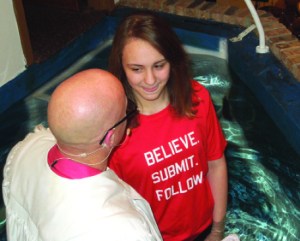
The shirt says it all -- Emily Zimmer is baptized by Pastor Tracy Smith at First Baptist Church in Mt. Zion.

The shirt says it all — Emily Zimmer is baptized by Pastor Tracy Smith at First Baptist Church in Mt. Zion, one of many congregations in Illinois that experienced large increases in baptisms in 2015.

To right the ship, SBC leaders have pointed first to the need for spiritual awakening—first in churches, then in the culture at large. But there are also solutions to be found at the denominational level and in local churches, starting with leaders.

Floyd recalled a time when only preachers who led strong evangelistic churches were invited to speak at the SBC Pastors’ Conference and annual meeting. Those leaders were also the ones nominated for denominational offices. In his November blog post about the state of evangelism in the SBC, Floyd seemed to call for a return to those principles.

“Quite honestly, I am not impressed by how many books a pastor sells, how many Twitter followers he may have, at how many conferences he speaks, how great of a preacher he is, or how much his church does around the world if he pastors or is associated with a church that has a lame commitment to evangelizing and baptizing lost people and reaching his own community with the gospel of Christ.”

At the local level, too, leaders can help reverse the decline by creating an environment that is conducive to evangelism, said IBSA’s Mark Emerson.

“The pastors who are effectively reaching people for Christ are creating an environment of evangelism in their churches,” said Emerson, whose Church Resources team equips churches in evangelism.

“They are making sure every ministry has an evangelistic purpose, they are designing their worship services to communicate the gospel and offer an opportunity for people to make a decision. These churches are training their members to effectively enter into gospel conversations.”

Modeling evangelism

Scott Foshie is one pastor currently training his congregation to have those gospel conversations. Steeleville Baptist Church will start evangelism training in April, based on the “Can We Talk?” program created by Texas pastor (and FBC Pastors’ Conference President) John Meador.

“When it’s time to bridge a conversation from small talk to gospel talk, that’s an awkward transition for people to make,” said Foshie, who has pastored the church since early 2015. The six-week curriculum combines training with practical experience; teams of three people go out into the community, visiting neighbors and practicing gospel conversations.

Foshie’s personal stake in the training goes beyond the fact that it’s happening at his church. As a student of the F.A.I.T.H. evangelism training tool, he led his future wife, Audra, to faith in Christ.

“Personal evangelism training is very important to me because it changed my life. So, I want people to experience that. Personal evangelism training unleashes the army of the Lord, (it’s) what God has called us to do.”

But first, people have to face down a common obstacle: fear. The pastor likened sharing the gospel to someone handing you the keys to their sports car and telling you to take it around town.

“What we need to teach them is, hey, you step out in faith, you begin to learn to share, you simply share, and the Holy Spirit’s going to help you,” Foshie said.

“Once people learn to share the gospel, it changes their life completely.”

Grappling with leadership

Lisa Misner —  February 15, 2016

A better grip

It may be hardest part of ministry, but the local church’s future depends on leaders who understand who—and how—they lead.

Michael Kanai came to the Illinois Leadership Summit excited about recent happenings at his church. “We had a retreat and we made many plans and casted our vision,” the pastor of Orchard Valley Baptist Church in Aurora said. “Now,” he continued, “we need to implement and execute the plans.”

For many pastors and church leaders, that’s the hard part: turning plans into action and leading the congregation to achieve the goals. A stumble or two at this stage can stall the work and cause the people to wonder about the abilities of the leader.

But, don’t be mistaken, this article is not about goals and action plans. It’s about what happens in the heart of the leader who realizes he can’t do the ministry alone. He needs a team, and more important, he needs a team of leaders.

“We are at a point where we are needing to lead leaders,” Kanai said. “It’s really helpful learning the difference between leading followers and leading leaders. The ‘collective’ we just attended just told us there is a steep step between those two types of leadership—it’s a pivotal shift in the way you lead.”

Halfway through the Summit, Kanai was clearly “getting it.”

Setting the (grappling) hook

For two days in January, pastors, staff, and church leaders convened at the Springfield facilities of the Illinois Baptist State Association. Last year at the same time, almost 1,300 leaders from 10 Baptist state conventions across 13 states gathered for the Midwest Leadership Summit at the nearby Crowne Plaza.

Previously called the North Central States Rally, the triennial event schooled ministry leaders in programming and skills to help grow their churches and fulfill their callings in their Upper Midwest mission fields. But this meeting was different: First, it was an Illinois-only event. With the two-year break between conferences, IBSA sought to build on the momentum from the 2015 event by bringing Illinoisans together to address the leadership issues we face here. And second, this event was not so much about skills, but about the heart and character of the leader.

“When most pastors think about leadership in ministry, they view it as administrative duties, supervisory oversight, or managing some new project,” said associate executive director Pat Pajak. “Until a pastor discovers the necessity of leading himself, especially in the areas of spiritual disciplines and character development, he will never be able to lead followers, lead leaders, or lead an organization in the way God intended.”

That’s why this Summit was different.

“IBSA frequently offers ministry skill training, but we made it clear from the outset that the Summit would focus on one’s personal growth as a leader,” said executive director Nate Adams. “That shift appears to have both met a felt need, and also created an itch among leaders that IBSA hopes to help scratch in the days ahead.”

ILS16 Bumgarner_Tuesday

Bob Bumgarner

The centerpiece for the event was the new leadership development process that the IBSA team has been crafting for more than a year. The main speaker for the event was Bob Bumgarner, a leadership expert who has contributed to the creative process. He was joined by four Illinois pastors in the main sessions (called “collectives”), and by 28 other pastors and ministry leaders in breakout sessions (called “intensives”).

“I think we would all agree that leadership development is forefront and needed in Southern Baptist life,” Bumgarner said. “And I also think we all would agree that it’s not as easy as it sounds.” Bumgarner (pictured above) headed leadership development for the Florida Baptist Convention and currently serves as executive pastor of Chets Creek Baptist Church in Jacksonville, Florida, a large, multi-campus congregation.

Bumgarner sought to dispel the myth that all leadership is alike no matter the group or setting; and that leadership is innate and there’s nothing that can be done to improve it.

Not true.

IBSA’s four-part plan

Leading self is about growing your capacity to be on Jesus’ mission as a person of influence.

“The hardest person I ever lead is me,” Bumgarner said, as he began to unpack the four phases in IBSA’s leadership process. “We have to understand that before we can lead others well, we have to learn to lead ourselves.”

Bumgarner pointed to the iceberg as a good illustration of the issues in self-leadership. Most of it is under the surface. That’s why character is so important. “You can get so successful that your character can’t support (your ministry)….If you want to be a better self-leader, figure out how you can hunger for God’s wisdom.”

He recommended spending five hours per week developing character and 50-60 hours developing ministry.

“Ministry is a place where you can be completely busy or completely lazy, and people won’t know,” said Heath Tibbetts, pastor of First Baptist Church of Machesney Park. He brought some personal applications for pastors. “I’ve realized strong self-leading means that even if no one else is looking, the Holy Spirit is keeping me accountable.”

Table_fellowship

Eric Trout, Ashby Tillery, and Mark Mohler, all from Marion, were among Summit attenders who watched the large-group collective session in the room adjacent to IBSA’s auditorium.


Leading followers
is about leading individual contributors, people who are not leading others, often serving as a ministry head or teacher in small groups or classes.

There are official followers, such as deacons or committee members, but there are also unofficial followers, the people who like or respect the leader, who have bought into the vision and want to be part of making it happen.

Bumgarner said at this stage, the objective is to identify your followers, inspire them by giving them a leader worth following, initiate followers by casting vision, and invest in their personal development. Make a goal, he advised: “By the end of next year, I want to have invested this amount of time into this number of people.”

“Our church grew when I stopped trying to lead big and started trying to lead through small groups,” said Mark Mohler, pastor of Second Baptist Church of Marion. He described bringing his congregation into a new vision for the church that found its most vital point of connection at the level of Sunday school classes.

Leading leaders is directed toward those who lead others. It requires a different skill set to keep those people who have leadership abilities of their own on your team.

Here is the pivotal point in the four phases of leadership. Adams described an image of stairs. In this case, not all the stairs are of equal height. Some have a short rise, others have a tall rise. The step between leading followers and leading leaders is the biggest jump for most people. And as Kanai described his own discovery at the Summit, it’s the most critical.

A leader who can only lead followers is limited by his own capacity; but a leader who can lead those who lead multiplies his capacity. But leading leaders is challenging and it’s risky. Other leaders have their own ideas, and they may set their own agendas.

“It can be one of the scariest moments of our life,” Bumgarner said, “nurturing your baby and then handing the baby to another person to raise….Regardless of the pain sharing a ministry can cause, something bigger and better can happen as a result.”

At this stage, empowerment of additional leaders must be balanced with clear, ongoing vision-casting: “85% of your success in leading leaders is wrapped up in common purpose and clear communication,” Bumgarner advised. “Do enough (communication) so that downstream from that work, we can see the fruit we’re looking for.”

Leading organizations is about leading leaders who lead other leaders. It’s about having a vision for the whole ministry and communicating that effectively to the whole organization.

In church life, this leader is usually the senior pastor, but not every pastor is actually leading at this level. He may be leading followers, or even leaders, but not effectively guiding the work of the whole ministry.

“Leading organizations requires working on the ministry versus in the ministry,” Bumgarner said. Many listeners in the room seemed to connect with this comment. He described a season when his ministry was consumed by the work of ministry rather than giving adequate attention to the purpose of the ministry, its vision and goals.

Leadership at this level requires strategic planning about how to do the ministry. “Your church needs you to facilitate the things that need to be done in order to share the gospel. If you find time to get the top 20% done, the other 80% will be done right.”

Bumgarner concluded, “The point of organizational functionality is to keep the main thing the main thing.”

– Coverage of the Illinois Leadership Summit by Meredith Flynn, Kris Kell, Kayla Rinker, Lisa Sergent, and Eric Reed

The State of the Mission

Lisa Misner —  January 25, 2016

Nate Adams State of the MissionI’m writing this the day after watching President Obama’s final State of the Union Address. After almost an hour of evidence and persuasion, the President neared the end of his address by declaring, “And that’s why I stand here, as confident as I have ever been, that the state of our Union is strong.”

A few minutes later, South Carolina Governor Nikki Haley delivered the Republican response, acknowledging that President Obama “spoke eloquently about grand things,” and that “he is at his best when he does that.” Then she quickly added, “Unfortunately, the President’s record has often fallen short of his soaring words.” She went on to describe what she called a weak economy, a crushing national debt, an ineffective healthcare plan, chaotic unrest in many cities, and “the most dangerous terrorist threat our nation has seen since September 11th.”

And so viewers were left to wonder which facts to believe, which leader to trust, and which picture of America is most accurate.

I understand the dilemma, though. Here at IBSA, we are at the time of year when we cumulate and analyze data from almost a thousand churches’ Annual Church Profiles (ACPs).

Looking at some measurements, the state of our mission here in Illinois appears strong, at least compared to the previous year. The number of new church plants rebounded from 7 in 2014 to 22 in 2015. Cooperative Program missions giving was up 1.5% in 2015, and Mission Illinois Offering giving was up more than 10%. Mission trip participation remained strong at just under 24,000 volunteers.

But other measurements might produce a different picture. Baptisms reported by IBSA churches in 2015 are down from 2013 for the second straight year, and overall worship attendance and Bible study participation were flat to down as well.

My primary concern is that, in total, our churches’ statewide, cumulative impact on lostness in Illinois is not growing, at least not numerically.

President Obama quipped near the beginning of his address that he would try to be brief, because he knew there were several in Congress who were anxious to get back to Iowa (to campaign for the 2016 Presidential election). His joke underscored the reality that, whatever you may think about the current state of things, the more important issue is where we go from here.

To advance our mission here in Illinois, I would challenge us toward two primary imperatives—evangelism and leadership development.

I wrote recently about five actions in churches that, statistically speaking, most often result in people coming to faith in Christ. They are an evangelistic prayer strategy, Vacation Bible School, witness training, outreach events, and starting intentional new groups. If your church could use some help in these areas, our IBSA staff would love to assist.

I would also challenge us all to develop leaders more intentionally in our churches. At this month’s Illinois Leadership Summit, more than 200 church leaders are gathering at the IBSA Building in Springfield to explore what it means to “lead self, lead followers, lead leaders, and lead organizations” more effectively. Even if you miss the Summit, our IBSA staff will welcome the opportunity to help you and your church leaders with an intentional leadership development process.

In many ways, the state of our churches’ mission here in Illinois is still strong. But to keep it that way, and to advance the gospel into the lostness of Illinois, we must recommit to the important work of evangelism and leadership development.

Nate Adams is executive director of the Illinois Baptist State Association. Respond at IllinoisBaptist@IBSA.org.


Learning how to learn

Lisa Misner —  January 7, 2016

LeadershipIf you have been in a leadership role for very long, you have experienced organizational insanity! It can be described as doing what you have always done, the way you have always done it and expecting different results. We chuckle when we hear that because we know how easily it can happen.
It would be nice if annually articulating a clear vision based on the Great Commission, creating a strategy based on the five functions of the church, and then providing training for our staffs and volunteers were all it took to be effective in ministry. Unfortunately, it is not. In addition to these important leadership activities, we must help the churches we lead become learning organizations to prevent drifting off mission.

A church that is a learning organization will stay responsive to its ministry environment. It will learn better ways to meet the needs of its community and create new on-ramps for the gospel.

We see the principle of being a learning organization in Acts 6:1-7. When the early church had success in reaching Greek people with gospel, the need for reorganization and new staffing to meet the growing ministry needs became evident. These believers learned what needed realignment by looking at the ineffectiveness of their food distribution system and were able to transform their ministry structure, resulting in greater disciple-making capacity.

We live in a time when there is a lot of talk about church revitalization and church planting. I am for both. Let me suggest that when churches need revitalization, often it is because they have quit learning. They no longer know how to make adjustments to their mission efforts because they are not learning from their field efforts. They might not even think that it is necessary to learn from their results in the field. I contend that after we have done our theological homework, the next source for vital organizational learning is the mission field we are trying to reach.

Here are three ways churches can stop the insanity and become learning organizations.

1. Establish a supportive learning environment. Create opportunities for staff or volunteers to express their thoughts about the work they are currently doing without fear of being belittled. Help people become aware of opposing ideas that are present. Help them move beyond fixing problems to creating novel solutions. I have found asking these four questions about how things are going is a helpful place to start:

  • What is right about our methods and results?
  • What is confusing about our methods and results?
  • What is missing from our methods and results?
  • What is wrong about our methods and results?

2. Create helpful learning processes and practices. In order for an organization to learn, helpful facts and information must be gathered, processed, interpreted, shared and acted on. Probably the best known example of this approach is the U.S. Army’s After Action Review. It is a systematic debriefing after every mission:

  • What did we set out to do?
  • What actually happened?
  • Why did it happen?
  • What will we do next time?

3. Model learning at the senior leadership level. Senior leaders who model learning:

  • Invite input from peers and subordinates in critical discussions.
  • Ask probing questions.
  • Listen attentively.
  • Encourage multiple viewpoints.
  • Provide time, resources and venues for reflecting and improving past performance and for identifying challenges.

Remember, you will lead the organization that you allow or the one that you create.

Bob Bumgarner is executive pastor at Chets Creek Church in Jacksonville, Fla. He will be the featured speaker at the Illinois Leadership Summit, January 26-27, 2016. Reprinted by permission from the Florida Baptist Witness.


No more Twinkies?

Meredith Flynn —  November 29, 2012

COMMENTARY | Nate Adams

Hostess Brands, the baker of sweet treats that include Twinkies, Ho Hos, and Ding Dongs, recently announced its intent to go out of business and lay off its 18,500 workers. Executives blamed a labor strike by two key unions, which they said compounded already high labor and pension costs. Union leaders countered that mismanagement had kept the company in bankruptcy for all but three of the past eight years, and that executives received large pay raises while asking for 30% wage and benefit cuts from the other workers.

I’m not in a position to judge which side bears more responsibility for the company’s failure. But as a consumer, I simply find myself thinking, “What? No more Twinkies?”

And I’m not alone. Texas-based Hostess has about $2.5 billion in annual sales. So if something’s not done, there could be literally millions of people bemoaning the loss of their Hostess Cupcakes, Susie Q’s, and Sno Balls.

And then of course there are the thousands of workers in 33 plants across the United States that face unemployment. At least from the outside, we can’t help but wonder, “Couldn’t this have been avoided? Couldn’t the leaders and the workers have worked out their differences, and in doing so protected the mission of the organization, the value of its products, and the very livelihoods of their families?”

Sadly, we sometimes see the same tragic dynamic at work in churches today. A pastor insists that the people he leads are apathetic, or unwilling to change or sacrifice. Or leaders in a congregation assert that the pastor isn’t effective, or isn’t listening to the right people. They find themselves in conflict over direction, or style, or who should make what compromises or sacrifices.

I guess it’s no longer shocking to me that those kinds of disagreements can arise in a church. What does surprise me is how much the pastor, or congregation, or both are often willing to sacrifice to hold their position. And what sometimes surprise me even more are the words or behaviors that can flow from God’s people in those circumstances.

Recently I talked to two different pastors whose wives were urging them to leave not only their churches but also the ministry. I simply asked them how things were going at their church, and agony, disappointment and disillusionment flowed freely from their hurting souls.

Not long before that a lay leader lamented to me that his pastor had led the church in decline down to practically nothing before leaving. Another said that the pastor had left with most of the younger members to start another church nearby.

As with the Hostess Brand, I’m not always in a position to judge which side bears the greater responsibility in these church conflicts. But in every case, the loss is so much greater than Twinkies. The loss is often the effective Gospel witness of the church, at least for a while.

I’m told that some other company is almost sure to step in and rescue Hostess. Even though the current executives and many of the laborers have probably forfeited their roles, the brand and the product line continue to have incredible value. Someone will continue to make Twinkies.

And by God’s grace and providence someone will continue to deliver the Gospel. Whether it’s Hostess or the local church, leaders and workers who are willing to risk the mission and the health of the organization itself for the sake of their preferences or personal benefits always make the wrong choice. Those who submit lovingly to one another in the spirit of Philippians 2 make the right choice. And in the case of the church, they protect the wonderful privilege of delivering the Gospel.

Nate Adams is executive director of the Illinois Baptist State Association.