Archives For November 30, 1999

The BriefingFlorist aims for Supreme Court for religious liberty
The Washington Supreme Court upheld a lower court ruling Feb. 16 convicting Barronnelle Stutzman of violating the federal and state civil rights of Robert Ingersoll and Curt Freed when she refused to design floral arrangements for their homosexual wedding nearly four years ago. The Southern Baptist grandmother remains liable for the plaintiffs’ attorney fees and damages but will appeal the decision to the U.S. Supreme Court.

Remembering Jane Roe’s change of heart
Norma McCorvey was 22, unmarried, and pregnant with her third child in 1969 when she sat down across from two abortion-advocate lawyers. They urged her to sign paperwork, and not wanting her real name known, she scrawled “Jane Roe.” That signature allowed the lawyers to use her story in the case that prompted the 1973 Supreme Court decision to legalize abortion nationwide, Roe v. Wade. McCorvey, who died Feb. 18 at age 69, spent the years of her middle age fighting to overturn the ruling that bore her pseudonym—a decision she came to see as a tragedy.

MO governor to fight St. Louis abortion ‘sanctuary’
Missouri Gov. Eric Greitens has pledged to lead a fight to repeal a bill passed by the St. Louis Board of Aldermen essentially making St. Louis a “sanctuary city” for abortion, with critics contending it threatens the religious freedom of citizens and institutions opposing it. Known as Board Bill 203, it places pregnancy and reproductive health — including the decision to abort a child — alongside already protected classes such as race, gender, religion and disability in St. Louis’ anti-discrimination ordinance.

TX Christian university opens Muslim prayer room
The Methodist-affiliated McMurry University dedicated the space in one of the school’s residential dorms for its Muslim students’ daily prayers. Before its creation, Muslim students met for prayer in a nearby hotel, a student who helped establish the new prayer room. Of the university’s roughly 1,000 students, about 60 are Muslim and many come from Saudi Arabia.

Church seeks to establish police force
Briarwood Presbyterian Church near Birmingham, AL is trying to establish its own police force. The move requires approval from state lawmakers. The church calls this a way to create a safer campus in a fallen world. Some lawmakers argue allowing a private church to have its own police force could begin a slippery slope.

Sources: Baptist Press, World Magazine, Baptist Press, The College Fix, ABC 33/40

Follow the follower

ib2newseditor —  February 16, 2017

follow-jesus

Christian leadership training experts like to cite Jesus as an example of the best leader ever, Michael Kramer told Illinois Leadership Summit breakout attenders. While he agrees, the pastor also believes Jesus is an example of the best follower the world will ever see.

The education pastor from Immanuel Baptist in Benton based his claim on this: “Christ called us to be followers. Even Jesus followed the will of the Father. Jesus was the greatest follower and his disciples followed him… As followers we are to be deeply dependent on Jesus.”

As leaders, Kramer stressed, we are to follow the tenet of John 3:30—He must increase, I must decrease. “Our intake of Jesus must be greater than our outtake,” he said. “We need to be spending much time in the Word. Not time in sermon preparation, don’t count that.”

Kramer suggested several ways to increase private prayer time and Bible reading. “Read through the Bible in a year or read a Psalm a night. Download a Bible app and listen. Buy the Jesus Storybook Bible, it’s the most creative Bible I’ve come in contact with. It goes straight to the heart. Memorize a Bible verse a week.”

“Pray the Lord’s Prayer every morning before your feet hit the floor,” Kramer said. “Go away for a few hours or an even longer period of time once a month just for prayer.” Kramer will spend a few hours in the woods walking and talking with God. He also recommended praying through a prayer list with your spouse, children, or grandchildren

By increasing time spent with God, you begin to decrease your focus on self. “What’s it look like to decrease?” he asked. “When God wants to go after your heart he’s going to do it in an unexpected way. Christ is going to go after the places that he wants to claim in our hearts.”

The BriefingTrump admin. policy change on transgender students

The Trump administration signaled Feb. 10 that it was changing course on the previous administration’s efforts to expand transgender rights. The administration will no longer defend transgender students use of restrooms that do not match their anatomical gender identity. The move by the Justice Department does not change the situation for the nation’s public schools; a federal judge had already put a temporary hold on the guidance as a lawsuit by a dozen states moved through the courts.

Pregnancy resource centers sue Gov. Rauner
Eighteen Illinois women’s health organizations have sued Gov. Bruce Rauner over a law requiring pregnancy centers to tell patients about the benefits of abortion despite conscience-based objections. The measure requiring the dispensing of abortion information changed a 1977 law allowing health care professionals to refuse services they consider morally objectionable. The centers say the law violates the First Amendment.

Chicago restaurants’ Planned Parenthood bake sale
A baker’s dozen of Chicago’s upscale restaurants and bakeries are hosting a cookie sale to benefit Planned Parenthood. Supporters can purchase a box with one cookie each from the 13 restaurants for $75 with 100% of the proceeds directly benefit Planned Parenthood Illinois.

DeVos confirmation leaves Baptists hopeful
With the confirmation of Betsy DeVos as U.S. secretary of education, some Southern Baptists hope that emphases at the Department of Education will parallel themes expressed in Southern Baptist Convention resolutions on education adopted in 2014 and 2006. David Dykes, chairman of the 2014 SBC Resolutions Committee, noted he is “very encouraged by President Trump’s choice of people [for cabinet posts] who are outside the circle of politicians and the status quo for these positions. I think he really wants to shake things up, and I’m in favor of doing that.”

Strobel’s ‘The Case for Christ’ now a movie
Atheist-turned-Christian Lee Strobel’s 1998 best-selling book The Case for Christ heads to the screen April 7, with its first trailer revealed on usatoday.com. Mike Vogel plays Strobel as a Chicago Tribune investigative reporter in 1980, when Strobel begins to investigate Christianity, compelled by his wife Leslie’s (Erika Christensen) newfound faith.

 Sources: Washington Post, News Channel 20, Chicago Tribune, Baptist Press, USA Today

Illinois Leadership Summit January 24, 2017

Nate Adams, IBSA Executive Director, talks with a pastor at the Illinois Leadership Summit January 24, 2017 in Springfield.

“Personal development requires surrender and sacrifice,” shared leadership expert Mac Lake.

“If I want to grow myself there’s a price I have to pay…Discipline is often the cost we’re not willing to pay.”

More than 250 leaders gathered in Springfield for the Jan. 24-25 Illinois Leadership Summit. Mac Lake, the architect of The Launch Network, a church planting network, served as the summit’s keynote speaker and was joined by 18 break out session leaders. Together, they taught the men and women in attendance practical ways to became better leaders and how to use what they’ve learned to develop leaders in their own churches.

Visit our Facebook page to watch video from Tuesday evening’s session, and learn from Lake:

– Why people don’t do what you want them to do
– About the strengthen conversation
– How to do one minute goal setting

Follow us on Facebook and Twitter hear from some of the breakout session leaders, and read the Feb. 6 Illinois Baptist newspaper for complete coverage of the Illinois Leadership Summit.

The BriefingChurches are open for Christmas
Nearly 9 out of 10 Protestant senior pastors say their churches plan to hold services on Christmas Day and New Year’s Day, as both fall on a Sunday, according to LifeWay Research. Small churches and large churches are slightly less likely to be open for Christmas. Pastors in the Midwest (92%) and South (89%) are more likely to say their church will be open on Christmas.

Hark! The herald hipster sings
For those that have wondered what it would be like if Jesus was born in 2016 or what a modern day wise man would look like — hint: he wears skinny jeans — the folks at Modern Nativity have the answer. The company has created a hipster version of the classic nativity scene featuring a young Mary and Joseph taking a selfie with baby Jesus in a solar-paneled stable.

Macy’s ends Planned Parenthood gifts
Macy’s Inc.’s latest 990 tax form verifies that the retail giant no longer includes the Planned Parenthood Federation of America in its community contributions, the research group 2ndVote said, describing the news as the latest “miracle on 34th Street.”

Compassion International out of India
Compassion International, a Christian nongovernmental organization (NGO) that aids 145,000 impoverished Indian children, has three weeks left in the country unless officials give it a reprieve. It is the largest humanitarian presence in the second most populated country in the world—providing $50 million in annual relief funds. But India is cracking down on foreign NGOs based on fears that groups are using humanitarian work to mask evangelization efforts.

Graffiti welcomes Muslims in MO
At a time when reports of anti-Muslim sentiment are rising, an Islamic Center in Missouri has received a different message. Kamel Ghozzi, imam at the Islamic Center of Warrensburg, says “Welcome” and “Thank you for choosing our community” were written in chalk on the center’s sidewalk during the weekend.

Sources: Facts and Trends, CNBC, Baptist Press, World Magazine, Fox News

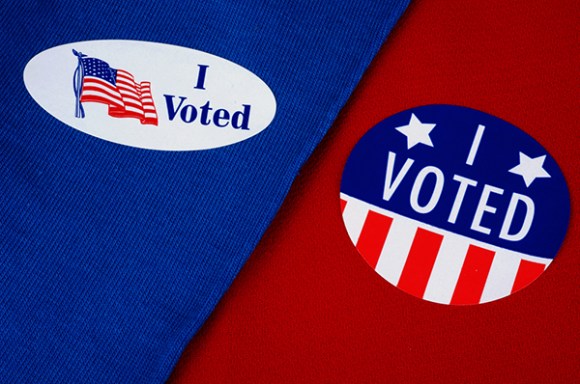
ivoted

A look at the electoral map says it all. A swath of blue on the West Coast and Northeast, and mostly red in the vast middle. Except for Illinois and Minnesota. We live in a divided nation.

For Christians, the issue today is how do we live Christ-like, now that the nation has chosen a president after a divisive and nasty two-year contest. Can we begin, as one observer put it, to love our neighbor who has “the wrong political sign” in his yard? Or to pray for political leaders of all parties to overcome division for the sake of the nation?

White evangelicals, white Catholics, and Mormons all supported Republican Donald Trump according to exit polls, while Black Protestants and Latino Catholics went for Democrat Hillary Clinton in the November 8 presidential election.

At 81%, the majority support for Trump by white evangelicals was a surprise to some, after leading evangelical leaders split on the candidate. His conservative stance on moral and political issues traditionally important to born-again believers was at odds with his irreligious lifestyle.

Russell Moore of the SBC’s Ethics and Religious Liberty Commission, is one of the few Southern Baptists who spoke against Trump, based on the candidate’s behaviors. Moore consistently urged Southern Baptists to keep conservative politics from swamping biblical beliefs. And his view the day after the election? He tweeted congratulations and called for prayer.

“The most important lesson we should learn is that the church must stand against the way politics has become a religion, and religion has become politics,” Moore wrote on his blog. “We can hear this idolatrous pull even in the apocalyptic language used by many in this election—as we have seen in every election in recent years—that this election is our ‘last chance.’”

But Robert P. Jones, CEO of the Public Religion Research Institute, counters, “Trump’s line—‘Let’s make America great again’—and his last-minute saying—‘look folks, I’m your last chance’—was really powerful for white evangelicals who see their numbers in the general population slipping.

“White Christians are declining every year by a percentage point or more as a proportion of the population,” Jones told Religion News Service. “So when Trump says, ‘I’m your last chance, folks,’ there’s a real truth to that.”

Some analysts attribute Trump’s victory to a middle-class, middle-of-the-country rebuke of the Obama legacy and the liberal cultural shift during his administration, as exemplified by the legalization of same-sex marriage and the recent actions on transgender issues. Others say Clinton lost, in part, because she ignored evangelicals.

“We asked for the votes of evangelicals and the Clinton campaign didn’t,” said Michael Wear, who served as faith outreach director for President Barack Obama’s 2012 re-election campaign. “It’s a campaign, you ask for people’s votes. And Hillary asked for just about every vote except this group of voters,” he told World magazine.

More prayer, more power

Arkansas pastor Ronnie Floyd didn’t endorse Trump while he served as SBC President. But the week after he was succeeded by Tennessee pastor Steve Gaines, Floyd was one of a handful of SBC leaders who attended Trump’s meeting with nearly 1,000 evangelicals. Now, Floyd advises prayer.

“Please prioritize praying for Trump….(and) for Vice President-Elect Mike Pence,” Floyd wrote on his blog. “Pray for wisdom, future, security, protection and leadership that will be extended to our nation. Pray for Trump as he selects members for his cabinet and begins the appointments of hundreds of people.”

The next move by evangelicals is to “stay in the game,” says Ed Stetzer of the Billy Graham Center at Wheaton College. Evangelicals who helped give Trump the office have a responsibility to help mold his presidency.

“There are many evangelicals who voted for Trump, and many Evangelicals who advised him,” Stetzer wrote for Christianity Today. “It’s time to advise him now that immigrants are made in the image of God, women are not tools and toys, racial and religious prejudice must be confronted, and so much more.”

Stetzer noted the decided shift on the importance of a candidate’s character to evangelical voters who supported Trump. “The answer is not for us to change our views on character, it’s to help a flawed candidate become a President of character.

“Evangelicals elected Trump,” Stetzer said. “Now they need to call him to a better way,” Stetzer said.

Eric Reed is editor of the Illinois Baptist.

Well, here we are

ib2newseditor —  November 9, 2016

Old Glory Flag

Though the majority of the nation is still surprised and in shock, half the nation is angry and hurting, and way more than half the nation is still overwhelmingly discontent with the outcome of last night’s election, here we are. The election process is over. Half of the country helped elect what they consider to be “the lesser of two evils” and the other half is stunned that the victorious candidate is considered by anyone to be “the lesser of two evils”.

As I have spent time reflecting on this election – this crazy, unbelievable, disappointing, and astonishing election – I have found myself ending up at the same place over and over again.

Though (I hope) few, if any, Christians would actually say this, most seem to view their political party of choice as the primary agent of cultural change and hope for our nation. Then again, I know many who would actually say that. But the idea that the Democratic Party is the party of God because it prioritizes things like diversity, equality, harmony, and caring for the poor, or, likewise, the idea that the Republican Party is the party of God because it prioritizes things like religious freedom, pro-life movements, and a conservative supreme court – needs to go.

Now, let me be clear – part of the beauty of our democracy is that we all have the freedom to care about certain issues and vote our conscience. That freedom is a gift from God for which every American should be grateful. But, Christians cannot continue to allow the church to become as polarized as our nation. Yes, our nation is more polarized than it has been in a long time because of this election and the events surrounding it. But in the face of such polarization, the church ought respond with unification, re-commitment to the Kingdom of God and the gospel message, and submission to the Lordship of Jesus Christ. Our identity as the Church defines us infinitely more deeply and profoundly than our identity as Republicans or Democrats. To see so much passion and so much anger surrounding this election only reminds us that so many have slipped into the idolatrous idea that our government is our savior and king.

Neither candidate was messiah and neither party is God’s chosen agent of change in this world – His Church is that agent of change. Neither party will deliver us from evil – only God will. Neither party can save us from a downward spiral, only God can. Neither party can offer true hope, only God can. There is no easier day and no easier year to see these truths than on this day of this year.

American is not God’s chosen nation. The Democratic Party is not God’s chosen party. The Republican Party is not God’s chosen party. And most importantly, neither party is His great love. The Church alone is God’s chosen people, whom he has drawn to himself and called to be the greatest agent of change the world has ever seen. The church alone is God’s embassy of hope, left here to represent his kingdom in this foreign land.

As we begin a new four year “reign” under a new political regime, may we constantly remind ourselves that Jesus alone is King and that his gospel message is the only message that matters.

Noah Adams is associate pastor at Calvary Baptist Church in Elgin, IL. He is also the son of IBSA Executive Director Nate Adams and wife Beth. This article was originally posted on Noah’s blog, Honest Thoughts About Church.

Lost in London

ib2newseditor —  November 7, 2016

london-sceneWhen you travel you have to make allowances for some of the local customs. In New Orleans, prepare for Cajun cooking and in coastal southern California enjoy the more relaxed pace of life. In foreign countries the differences can be even more pronounced. But if you’re traveling to another English speaking country it can’t be that different, right? Wrong.

A week the southwest of England shined a spotlight on some of those differences.

A crosswalk isn’t a crosswalk. It’s a Zebra (pronounced with a short “e” sound) crossing. Other types of pedestrian crossings are Pelican, Puffin, Toucan, and Pegasus (for horses and their riders.) Google them for fun.

No washcloths for you. Not all hotels provide “flannels” the English word for washcloths. They are considered too intimate an item to be washed and reused by another person, so bring your own.

Can I get ice with that? It’s true, most beverages are served lukewarm in England, except tea, which is hot of course. I was told that if you ask for a glass of ice to go with your Coke, you would get four cubes and a slice of lemon. That’s exactly what happened. It became a game to me to count the ice cubes. One nice server in London went over the apparent allotment and gave me five cubes.

We don’t have restrooms here. Don’t ask to use the public restroom or bathroom, they don’t have one. They do have a public toilet, or loo. It may cost you 20 or 30 thirty pence (about 35-50 cents), and may or may not be clean.

One word – scones. My fellow Americans, we have been lied to by bakery cafés (you know who you are). Scones are not hard triangular-shaped baked goods. No, they are soft and biscuit-like and so delicious topped with clotted cream (bad name, great taste) and jam.

Empty churches. Sorry folks, this one isn’t funny. England is filled with lovely old churches, but sadly, most have become tourist attractions. People line up for tours of Westminster Abby and St. Paul’s Cathedral and for the services, however most of those attending the services are tourists too.

The church grounds are beautifully landscaped and immaculate, and popular with the locals. They are great spots for enjoying a picnic lunch in the middle of a hectic work day.

Of course there are flourishing churches in England, but they are few and far between. England and the rest of western Europe culturally trend 5-10 years ahead of the United States. This isn’t a trend Christians in the U.S. shouldn’t follow.

Lisa Misner Sergent recently spent time in England and will be writing a series of articles about the state of Christianity and missions in that country in upcoming issues the Illinois Baptist newspapers.

cultureBy Nick Rynerson

“Unless the gospel is made explicit,” says Matt Chandler in his book “The Explicit Gospel,” “people will believe that Jesus’s message is that he has come to condemn the world, not to save it.”

Much has been made lately of this idea, that the gospel must be consistently made the explicit focus of our ministry, teaching, preaching, writing, thinking, and living. At first it sounds good; who wouldn’t want to center their life on the gospel explicitly preached? Declaring, believing, and enjoying God’s grace given to us through the sacrificial death and resurrection of Jesus Christ is the penultimate privilege of the Christian.

But what does this mean for Christian bakers, musicians, filmmakers, writers, and insurance salesmen? Does this mean we need to weave gospel presentations into everything we do and avoid things that don’t fit in with our understanding of the gospel?

According to the Bible, maybe not.

While Jesus said that the whole Bible testified about him (John 5:39), in the first 39 books of the Bible, there is basically no explicit mention of Jesus. But that certainly doesn’t mean the gospel wasn’t present in the Old Testament. After his resurrection, Jesus on the road to Emmaus applied the explicit gospel to the less obvious gospel message of the Old Testament: “Beginning with Moses and all the Prophets, he interpreted to them in all the Scriptures the things concerning himself” (Luke 24:27).

One of the wonderful things about the gospel is that it is a story. It’s the story of man’s rejection of God and God’s redemption of the creatures that rejected Him through the blood of the sinless son of God. And in this story there are themes that any good gospel presentation will communicate: rebellion, love, grace, redemption, and unmerited favor.

When we see the world through these “gospel-colored glasses,” we begin to see those themes in unexpected places. Understanding the explicit gospel helps us see the implicit gospel. By having a level of explicit “gospel fluency,” as Pastor Jeff Vanderstelt puts it, we aren’t provoked to put gospel demands on earthly things. Instead, we begin to see echoes of the explicit gospel in those same earthly things.

The apostle Paul, maybe the most “gospel fluent” person to ever walk the earth, modeled this for us in Acts 17. Here, Paul preaches the explicit gospel in Athens and then, incredibly, cites Greek pagan poetry as examples of the love and graciousness of God! This means that Paul must have read these poems and thought, “Wow! The themes of the gospel are so strong, I bet I could use these to actually preach the gospel!”

He saw the implicit gospel because he knew the explicit gospel.

This means we are free to see the good gospel themes in the “secular” world. Whether it’s a movie, song, book, or TV show, if we are familiar enough with the themes of the gospel we can pick out those gospel themes when they show up in culture. The Christian appreciation of culture is possible when we are convinced that God’s world, even in its fallen state, echoes God’s word (i.e., the gospel).

Seeing the world through gospel-colored glasses also allows us to not have to tell the whole story every time. This is why good fiction written by Christians can be so powerful. Flannery O’Connor, C.S. Lewis, J.R.R. Tolkien, and Marilyn Robinson can bring me to tears not because they present an elaborate gospel presentation, but because they use well-crafted stories to imply gospel truth. It’s truth that circumvents propositional logic and hits the heart.

Art, music, and stories have a funny way of doing that. They speak to something deeper than our logical mind, as if when we read a good story or listen to a good song, something deep within us is stimulated and our hearts “burn within us” (Luke 24:27). So yes! Preach the explicit gospel, and put on your “gospel-colored glasses” to be on the lookout for the implicit gospel too. We need both. As Martin Luther reminds us, “God writes the Gospel not in the Bible alone, but also on trees, and in the flowers and clouds and stars.”

Nick Rynerson is a staff writer for Christ and Pop Culture and works for Crossway Books publishing house in Wheaton.

The BriefingHigh and dry in Albion, IL

The first medical marijuana harvest in the state has begun near the southern Illinois town of Albion. The town, where the sale of packaged liquor is banned, is the site of an Ataraxia cultivation center for medical marijuana.


Grandma clings to the old red cross in SC floodwaters

South Carolina grandmother Clara Gantt was heading to church near Blythewood when her car was caught up in floodwaters. Her grandson Travis Catchings came to her aid, but both ended up clinging to a large red cross in a churchyard until rescuers arrived five hours later. Watch a cell phone video from the rescue.


Lawsuit: Baby Jesus doesn’t belong in Christmas play

The “War on Christmas” started early this year. The Freedom from Religion Foundation has filed a federal lawsuit against Concord Community Schools in Elkhart, Ind. demanding an injunction to forbid the school from “presenting the portion of the Christmas Spectacular with the live Nativity Scene and the telling of the story of the birth of Jesus.”


SBTS conference on transgenderism responds to challenges

The transgender movement presents an unprecedented theological and cultural crisis for the church, said Southern Baptist scholars at the SBTS conference on transgenderism and transformational Christianity. “The transgender revolution presents a more acute and more comprehensive challenge than merely the issue of homosexuality,” seminary President Albert Mohler said. “Because of the identity questions rooted in creation, the transgender revolution represents a challenge on an altogether different scale.”


Another state legalizes physician-assisted suicide

California became the latest—and most populous—state to pass an assisted dying bill. The law will permit physicians to provide lethal prescriptions to mentally competent adults who have been diagnosed with a terminal illness and face the expectation that they will die within six months. Currently, 1 in 6 Americans lives in a state where a doctor can prescribe a lethal dose of drugs to a patient.

Sources: Baptist Press, Chicago Sun-Times, ERLC, Fox News