The BriefingNY Times asks: What does it mean to be evangelical?
Donald Trump’s popularity with evangelicals has led some church leaders to break with the term. The New York Times Opinion Page asked four evangelical writers to share what it mean to be an evangelical today.

Gary Smalley passes away
Best-selling author and world-renowned marriage and relationship expert Gary Smalley has died at age 75. Smalley passed away March 6 after a lengthy illness, his family announced on Facebook March 7.

Christianity Today apologizes for ‘son-in-law’ job posting
The flagship evangelical magazine Christianity Today has tweeted an apology after publishing a job listing for a son-in-law that raised some eyebrows on social media. The ad, which ran in the March edition, was bought by an unnamed Chicagoland church elder who is based in Wheaton, Ill., the magazine’s longtime home.

Millennials increasingly view the church negatively
Since 2010, millennials’ view of churches and other religious organizations as having a positive effect on the country has fallen 18 percentage points, according to Pew Research. In 2015, 55% of young adults believed churches have a positive impact on the country compared with 73% five years ago.

Florist who refused gay wedding gets appeal
The highest court in Washington state has agreed to hear the appeal of florist Barronelle Stutzman found guilty of violating state laws and the constitutional rights of a gay couple when she refused to arrange flowers for their wedding, citing religious beliefs.

Bible translators split over Trinity description
Wycliffe Associates (WA) is leaving Wycliffe Global Alliance (WGA), a partnership of more than 100 Bible translation agencies around the globe. WA cited several reasons for its decision, starting with controversy over the language used to describe Jesus. In some Bible translations, the language of Jesus’ relationship to God the Father (e.g. “Son of God”) is softened to stem confusion and anger from Muslims.

Sources: BPnews.net, Christianity Today, Facts and Trends, Focus on the Family, Religion News Service, New York Times

Eleven Portraits

Lisa Misner —  March 7, 2016

Eleven_portraits

In some ways I’m just getting started and just beginning to figure some things out.

Visitors to the IBSA office building in Springfield sometimes take note of eleven portraits displayed there, acknowledging the men who have served IBSA as executive director since its formation in 1907. Those portraits used to hang in the entrance lobby, and since our building renovation a few years ago they have been on display in our first floor Resource Room.

While it’s hard for me to believe, by God’s grace I have just celebrated 10 years in that executive director role. That milestone recently led me to a few reflective moments in front of those portraits. Four of those men are simply historical figures to me, but I’ve had the privilege of meeting the other six personally. They each served in different times and faced different challenges, but together they form the legacy of leadership on which I now gratefully stand.

I’ve been told by others around the Southern Baptist Convention that 10 years seems to be about the typical length of service in the state executive director role. Since years of service are noted on a little plaque beneath each of the IBSA portraits, I did the math and learned that indeed the average term of service here in Illinois has been just over nine years.

There are, however, two distinct groups of IBSA executive directors among my 10 predecessors. Six men served less than seven years, and four served 12 or more. The smaller, longer-serving group were four of the first five executive directors, all of whom completed their service by the 1970s. The larger, shorter-serving group represent the more current trend. And at 10 years’ service, I now stand in the middle.

There are many reasons why leaders stay in roles for a short time, including some which are beyond their control. So I wouldn’t second guess the Lord’s leadership or providence in any of the shorter terms of service. But after investing 10 years here at IBSA, I have a new appreciation for the men in the longer term group.

It takes time to establish relationships, and to build trust. It takes time to learn the many systems and traditions and landmines inherent in a thousand diverse churches working together. It takes time to learn the regional and ethnic and generational uniqueness of churches and their leaders. It takes time to take necessary risks and make unavoidable mistakes, and then to recover and learn from them. And I’m now discovering that it takes time to do it all again and again, as new pastors and leaders come on the scene.

After 10 years, I feel in some ways I’m just getting started and just beginning to figure some things out. Yet by the law of averages I’ve already had as many years as most executive directors ever get. It makes me admire the men who stayed 12, or 17, or 19 years.

And it makes me want to sprint right past this 10-year mark and see what might be possible in the company of these long-tenured men that preceded me.

It’s certainly possible to overstay your welcome, or to outstay your effectiveness. And it’s always best when a leader can recognize that time long before anyone else does. But for the most part, it can be very good for an organization and its mission when a leader finds favor and stays.

So if you are wondering whether to stay and persevere where you are, let me encourage you to do so if at all possible. One day you will take your place among the portraits of former leaders in your place of service. It may be less and less common for leaders to stay long in one place. But if God gives you grace and favor to do so, I believe you will find a unique influence that only comes with time.

Nate Adams is executive director of the Illinois Baptist State Association. Respond at IllinoisBaptist@IBSA.org.

Six missionary families who have accepted God’s call are featured during the Annie Armstrong Easter Offering Week of Prayer for North American Missions, set for March 6-13. The goal for the 2016 Annie Armstrong Easter Offering is $70 million.

The Rager family

The Rager family

Three years ago Barry Rager was the pastor of a small Kentucky church. Most of his days were centered on important church business. He prepared sermons, visited sick members and mediated church disputes. All good work. All important work. All kingdom work.

“I was kind of like the coach saying, ‘Hey, reach the people you are with,’ but I wasn’t actually the one doing it,” Rager says.

Three years later, and his life couldn’t be more different. Living in the Mapleton-Fall Creek neighborhood of Indianapolis’ core, his mission field is everywhere.

A trip to Indianapolis for the 2008 Southern Baptist Convention first opened Rager’s eyes to the needs of the city. It wasn’t until 2012 that James Edwards came to him with an offer: “We want to plant a church in a major U.S. city, and we want you to be the planter.” Rager didn’t have to think hard about which city.

Edwards, pastor of Pleasant Valley Community Church, and the congregation felt the call to plant a church in an urban city, which eventually led to a strong calling for a church plant in Indianapolis. Edwards had met the Ragers on a playground where a strong friendship was formed. For years, the Ragers and Edwards encouraged and supported each other and their ministries. When Pleasant Valley felt God tell them to plant a church, they prayerfully considered who would lead the church plant.

“Barry Rager’s name continued to surface,” said Edwards. Pleasant Valley asked the Ragers to pray about planting a church in Indianapolis. “It was clear to Barry and Amy that God was calling them to plant a church in the heart of Indianapolis,” said Edwards. “Our strong inclination to partner with Barry and Amy came primarily through the leadership of the Holy Spirit.”

A once thriving city in the 1920s, by the 1960s many residents had moved to the suburbs.

Today, 41.5% of residents do not have a high school diploma. A 2013 NeighborhoodScout.com article called the northern half of the area the 17th most dangerous neighborhood in the U.S.

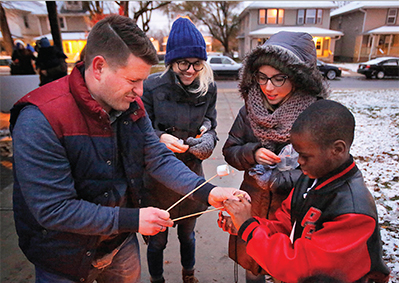
Indianapolis church planter Barry Rager (left) and New Circle Church use events like S’mores and Snow in the Park to reach a neighborhood many describe as dangerous.

Indianapolis church planter Barry Rager (left) and New Circle Church use events like S’mores and Snow in the Park to reach a neighborhood many describe as dangerous. The Ragers are North American Mission Board 2016 Week of Prayer Missionaries. NAMB photo by John Swain

Once the Ragers relocated to Indianapolis, they were told it would likely take them years to connect with their neighbors and build disciple-making relationships.

“When we moved in, we decided that we were going to be as open and positive as we possibly could be,” Amy Rager says. “Most of the people around here keep their blinds shut 24-7. They’re very closed. So we thought, you know what? Our blinds are going to be open. We’re going to act like we trust these people. We’re going to do anything we can to initiate that relationship.”

Before their boxes were even unpacked, the family showed up on their neighbors’ doorsteps with freshly-baked homemade cookies. They also invited their neighbors into their home for dinner.

As they continued to build community, the Ragers eventually started worship services with 40 people attending in September 2014. That was the launch of New Circle Church, Indianapolis. A year later their worship attendance more than doubled and they had seen 22 people baptized.

Barry focuses the church on a simple-yet-comprehensive mission—introducing people to Jesus, developing gospel-centered community and commissioning them to reach people for Christ.

“What I get to do is brag on Jesus and what He has done,” Rager says. “It is such an honor to brag on Jesus.”

“I think if it is never our intention to live on mission, then we won’t live on mission,” Rager says. “We have to be intentional in the way we use our time, and in the meetings we have with people.

– By Tobin Perry on www.AnnieArmstrong.com

Crossover makes a difference in host city and back at home

Uptown_Crossover

COLUMBUS – Mission volunteers from Uptown traveled to Columbus, Ohio in 2015, where they worked for two days training and encouraging local believers in prayer walking and evangelism.

The words of an old praise chorus aptly describe the effect missions can have in a local church:

“It only takes a spark to get a fire going…”

Once church members who have engaged in missions start “passing on” their experiences to their friends, it can ignite a missions fire of sorts, causing a church to look in their own neighborhood and beyond for ways they can reach more people with the gospel.

That’s how IBSA zone consultant Steven Glover describes the impact of Crossover, an annual outreach event held prior to the Southern Baptist Convention. This year’s Crossover initiative in St. Louis is planned largely for Saturday, June 11, although some projects start earlier (see planning checklist below).

Last year, Glover and his family participated in Crossover with a team from Uptown Baptist Church in Chicago. The volunteers worked with a church in urban Columbus, Ohio, to prayer walk their community and share the gospel with people they met. Glover and the team also helped train the Ohioans in prayer walking and evangelism, equipping them for the ministry they did together.

Once they got back to Chicago, they shared with the rest of the congregation what had happened in Columbus. As with any mission trip, the resulting benefits could have stopped there, Glover said.

“But if you have people who have participated in and are excited about it, they’ll continue to talk about it,” he said. That’s why the key is getting as many people involved as possible.

This year, Uptown will take a team to St. Louis to work with a church in a similar ministry setting as their own inner-city church. In Columbus, said Uptown’s missions coordinator Doug Nguyen, the church worked with “an urban congregation that ministered to Muslims and immigrants, as well as families around the neighborhood in downtown Columbus.
“And we’re looking to do the same in St. Louis.”

Uptown_Crossover_2014

BALTIMORE – Members of Uptown Baptist’s Crossover team share the gospel prior to the 2014 Southern Baptist Convention.

 
After Uptown partnered with a Baltimore church for Crossover in 2014, they were able to pray for the congregation specifically when rioting broke out in the city the next spring. “We’re all praying for them right now, for churches to really step up and be the salt and light in that community,” Nguyen told the Illinois Baptist at the time.

When mission volunteers help other Christians reach their community, they’re bearing each other’s burdens, Glover said. They’re energized by helping fulfill the Great Commission, by doing what God has called his people to do.

They’re also more likely to come back home and find ways to do the same in their own city.

“It’s a good investment,” Glover said, “because it’s an ongoing thing.” Iron sharpens iron, he said, referencing Proverbs 27:17. “Getting next to someone who has gone out and done that has such an impact.”

Crossover checklist

Making plans to join Uptown and hundreds of other churches at Crossover prior to this year’s Southern Baptist Convention? Start now by working through this checklist of questions:

Who’s going?
As you recruit volunteers for your Crossover team, think about who they are. What are their ages, ministry skills, and spiritual gifts?

View the list of Illinois Crossover projects at meba.org/crossover-st-louis- 2016, and look for those that fit your team. For example, if you have Spanish speakers in your group, consider joining Iglesia Bautista Maranatha in Granite City for prayer walking and door-to-door evangelism in their community.

Interested in sports outreach? Help Sterling Baptist Church host a 3-on-3 basketball tournament.

What time can they give?
Most Crossover projects happen the Saturday before the Convention begins—this year, that’s June 11. But some initiatives cover a longer span of time:

  • A church plant in Fairmont City needs help with a home makeover
    project June 6-11.
  • Two congregations in Hartford and East Alton are working together on a week-long canvassing project, capped off with a community block party.
  • A new church in Collinsville will utilize volunteers for community surveying and sharing the gospel on  Saturday, and then will host a preview worship service Sunday.
  • Check the full project list at meba.org for more multi-day opportunities.

What’s next?
Start thinking now about how to share your ministry experiences with the congregation back at home.

Which stories best illustrate how God worked through your team to increase your partner church’s influence and favor in their community? Did anyone accept Christ? What spiritual needs can your church pray for over the next year?

Also, how might you extend the relationship with your Crossover partner church? Uptown kept in touch with Baltimore pastor Ryan Palmer, who they worked with in 2014. He visited Uptown when he was in Chicago the next year. As you plan your Crossover project, consider how it might spark a ministry partnership that goes beyond one day.

The Briefing‘LSD in the water,’ says Moore
Here & Now’s Jeremy Hobson interviewed Russell Moore, president of the Ethics and Religious Liberty Commission, Feb. 29 covering the issues evangelical voters are most concerned about and how the tone of the campaign is resonating with them. “I think this campaign gives me reason to think someone has released LSD into the water system in this country, and every single day one looks at the news and cannot even fathom that it’s happening,” Moore cracked.

Baptist group: Keep church, political parties separate
Jon Akin wants members of his congregation in Lebanon, Tenn., to be politically engaged, but the Southern Baptist pastor thinks sermons should focus on the issues, not a particular candidate or political party. He belongs to Baptist21, a group of young Southern Baptist ministers who want a clear division between their denomination and the Republican Party.

Survey spotlights refugees, churches & fear
When it comes to helping refugees, Protestant churches and their pastors are often separated by faith and fear, according to a new survey from LifeWay Research. Most pastors say Christians should lend a hand to refugees and foreigners, and believe caring for refugees is a privilege. But pastors say their churches are twice as likely to fear refugees than they are to help them.

Kasich tells Christian bakers, ‘Make them a cupcake’
Republican presidential candidate John Kasich said that social conservatives need to “move on” from the issue of gay marriage and Christian wedding vendors shouldn’t deny service to same-sex weddings. Although Kasich, an Anglican, believes marriage is a union between one man and one woman, he said conservatives need to move on to more important issues.

Bible removed from POW/MIA display inside VA clinic
A Bible and Bible verse were removed from a POW/MIA display inside an Ohio Veteran’s Administration clinic after the Military Religious Freedom Foundation complained. They were part of a “Missing Man Table” recently erected by volunteers at an outpatient clinic in Akron.

Sources: Baptist Press, Christian Post, Fox News, Here and Now, USA Today

ACP tallies reveal challenge

Lisa Misner —  February 29, 2016

Good attendance tempered by fewer baptisms

For IBSA churches, 2015 was a year of ups and downs: giving and attendance were up, but baptisms were down.

“It seems clear to me that being a Baptist here in Illinois, indeed being a Christian in America, is becoming increasingly counter-cultural,” IBSA executive director Nate Adams said. “We no longer reach people and grow churches simply by opening the doors on Sunday morning.”

A rebounding economy and continued emphasis on missions giving may be behind a 1.53% increase in Cooperative Program giving to $6,230,082 (reported prior to completion of the annual audit) and a 10% hike in the Mission Illinois Offering last year at $403,595, according to the tallies of the Annual Church Profiles submitted by IBSA churches.

Total membership is up by more than 1,000 in IBSA churches (to 193,972), and worship attendance is up by almost 5,000 (7.3%) over the previous year. But baptisms declined by 2.4% to 4,400. That’s down 105 from the previous year, and down from recent averages around 5,000 per year.

On the positive side, the number of churches reporting baptisms was 591, up 29 churches from the previous year; and the number reporting zero baptisms was down by 25 churches to 366.

“The need has never been greater to live out 1 Corinthians 9 and become all things to all people to reach some, while also living out Romans 12 and refusing to be conformed to the culture in which we find ourselves,” Adams said.

Another bright spot in the 2015 ACP report is participation in missions and leadership development: Just under 24,000 volunteers from IBSA churches were mobilized for missions projects in Illinois and worldwide. And IBSA trained 8,932 leaders from 592 churches in a variety of ways, for a total of 20,203 personal training sessions.

And in a new reporting category, IBSA set a goal for 2015 of at least 100 new Bible study groups; churches blew past that goal and started 229 groups.

“One way to summarize those two contrasting pictures of our mission here in Illinois might be to simply say that fewer people are doing more with less,” Adams concluded. “Another way might be to say that some churches are doing well, while others are struggling. My primary concern is that, in total, our churches’ cumulative statewide impact on lostness in Illinois is not growing, at least not numerically.”

And with at least 8 million people in Illinois who do not know Jesus Christ personally, there’s plenty of room for improvement.

IBSA has targeted five areas for kingdom growth in 2016, rolled out at the Annual Meeting in November: evangelistic prayer, witness training, outreach events, expanded VBS, and new groups. A study in the Midwest showed that churches engaging in these activities were more likely to lead people to faith in Christ and to grow disciples. The IBSA Church Resources Team is assisting all churches that want equipping in these areas.

Look for a full report on baptisms and the evangelistic activity of IBSA churches in a future issue of the Illinois Baptist.

– Staff

Platt surprised by number, but financial position called ‘much healthier’

Richmond, Va. | David Platt’s report to the International Mission Board’s Board (IMB) of Trustees was the culmination of six month’s worth of efforts to undo the six year’s worth of overspending.

The IMB president, told trustees 1,132 total IMB personnel had accepted the Voluntary Retirement Incentive (VRI) or Hand Raising Opportunity (HRO).  The numbers broke down to 702 missionaries and 109 staff personnel accepting the VRI, and 281 missionaries and 40 staff accepting the HRO. The positions of 30 personnel in IMB’s Richmond communications office were eliminated in its mobilization restructure.

The total was nearly twice the minimum number the mission board needed to depart to balance its budget. As a result, the number of missionaries on the field are down to around 3,800, a number not seen 1992 when, according to Southern Baptist Convention (SBC) annual reports, the year ended with 3,893 international missionaries were serving.

Platt told reporters participating in a press conference via telephone February 24, “The numbers surprised me, for which I don’t have an explanation. We’ve put it in the hands of missionaries as much as possible… This a larger number than I or anyone else was anticipating. We called on people to pray so we’re going to trust in the Lord and his decision.”

While the press conference was taking place, Platt told reporters a severe storm was passing through and noted the lights were flickering on and off. A few minutes later the lights went out and a Tornado Warning Alert could be heard. The press conference was stopped for a half hour until the storm passed.

After discussing the numbers, Platt told the gathered media, “I want to talk about the number of missionaries who are left. Thousands of missionaries remain on the field, with thousands of years of collective experience. Everyone of them on the field has been placed there by God.”

IMB reported it had “consistently spent more money than it has received — a combined $210 million more since 2010…Because 80 percent of IMB’s budget is devoted to personnel salary, benefits and support expenses, leaders determined a need to reduce the total number of personnel by approximately 600-800 people to get to a healthy financial place in the present for sustained growth and engagement in the future.”

The Illinois Baptist asked what his reaction was to receiving almost double the number of resignations needed? “My heart is heavy but hopeful,” he answered. “Heavy in a sense that my heart is not to see less people on the field. My heart is heavy seeing the effects…It’s a hopeful confidence mingled with that heaviness.”

“What does this say about the confidence the missions force has in the new leadership?” the Illinois Baptist asked in a follow-up. Platt replied, “I’m very encouraged to see God working in the middle of all this. I have a hopeful confidence in what the IMB will be able to do in the future.

“I hope Southern Baptists see a serious desire to love and lead the IMB well…This is in no way a commentary on past leadership. Past leadership made a bold decision to put people on the field.”

Platt also addressed a question he said people have been asking, “How can you send thousands more when you just sent a thousand off the field?” His answer focused on what some would describe as marketplace missions, “limitless opportunities for people to work overseas and retire overseas.” In turn they would be funded by their paychecks and pensions. He also noted mission opportunities for students studying abroad.

One reporter expressed concerns from churches about the departure of so many missionaries leaving a “brain drain” on the field. Platt responded, “We encouraged missionaries returning to take their last days on the field to pour into our national partners and other IMB missionaries that were still there.”

Another reporter asked Platt if he saw this proposed use of self-funded missionaries as the IMB taking a societal approach to missions.

In his answer Platt noted, people who get jobs overseas and are paid by their businesses, universities provide scholarships to students, and countries in southeast Asia are seeking Westerners to retire there “rolling out the red carpet.” With these opportunities, he asked, “How can we not support the core paid missionaries with those around them that can help?”

He continued, “I can’t pray Matthew 7:9 and then tell people who want to serve with the IMB, ‘no.’ God’s created these other avenues…”

Platt also responded to a question regarding what kind of response he has heard from Southern Baptists. “I’ve not been surprised by the feedback from Southern Baptist pastors and church leaders,” he shared. “They’re thankful we’ve chosen to stewardship resources in the way we have…They’ve been very encouraging. Once they hear the big picture they say that makes sense, thank you for making that decision.”

He went on to say, “People aren’t happy about it. I’m not happy about it. It’s a hard reality for Southern Baptists to face that we don’t have the resources to keep more people on the field….I expect people to be upset that people are leaving the field but God’s leading us to greater financial stewardship.”

SBC President Ronnie Floyd told Baptist Press, “This reset is not regress or retreat. Southern Baptist churches must see this as a fresh calling to reaching the world for Christ. Now is the time to go forward with a clear vision and an aggressive strategy to make disciples of all the nations for Christ.”

Twenty-six new missionaries were appointed to the International Mission Board Feb. 23, in a service that was the first to be live-streamed.

The IMB Board of Trustees met February 22-24 in Richmond, Virginia.

IMB will host a livestream focused on “The Future of the IMB” Thursday, March 3, at 11 a.m. EST. For more information, visit IMB.org/live.

Denominational tags have fallen on hard times. History and tradition have become baggage.

I would be surprised if you know of a new church that can be identified with any recognizable branch of Christianity. If you can get creek, river, brook, or tree into your church name, for sure it will grow. The more bland, comforting, serene; the more easily confused with a country club or a rock band your church name is, the more in tune with the times you appear.

And the latest trend has moved beyond nature: Bridge. Liquid. Radiance. Paradox. Propulsion.

In the interest of transparency, I began a move to change our church name 15 or 20 years ago, then I chickened out. Baptist is still our middle name.

Here is my attempt to give a bit of context and explanation for our church name to a deep blue, urban, postmodern population.

What’s in a name?
John the Baptist, eccentric prophet. William Carey, linguist, humanitarian extraordinaire. Fredrick Douglas, abolitionist-orator. Charles Spurgeon, urban crusader. Nannie Helen Borroughs, women’s leader. Walter Rauschenbusch, social justice warrior. Lottie Moon, China champion. Martin Luther King, renowned activist. Billy Graham, global evangelist. Mahalia Jackson, vocalist without equal. Rick Warren, mega-church pastor, best-selling author. Baptist is a name associated with colorful, controversial, influential figures here and around the world.

There are approximately 32 million Baptists in the U.S., half of them are “Southern Baptists,” over 100 million in the world. As for “The Baptist Church,” there isn’t one. Each Baptist congregation is independent, autonomous, self-governing. Many churches participate in larger entities, but those affiliations do not infringe upon congregational self-determination. Yes, this lends itself to some craziness and confusion; it is what it is.

Baptists are not self-named. Our persecutors began using this label in derision beginning in the 1400s. Theologically and historically, Baptists are those who hold the Word of God, the Scriptures, the Bible, as sole authority in all matters of faith, church order, and practice rather than looking to tradition, human hierarchies, committees, or governments.

Many historians seemingly fail to notice that many who came to America for religious freedom, instituted the same state church systems, persecuting those who did not adhere, repeating the sins of the governments they fled.

In U.S. history, Rhode Island, the first colony with complete religious freedom, was founded by Baptist Roger Williams. Williams’s life was a crusade for freedom of conscience and religious liberty. He founded Rhode Island in 1636 after purchasing the land from the Narragansett Indians.

A refuge from religious persecution, Rhode Island became home to the first Jewish synagogue in America and a sanctuary for Quakers who were being persecuted and killed by anti-Quaker laws in Massachusetts and other colonial territories. Rhode Island was an open door to all people, a safe harbor in a sea of tyranny and oppression.

In the flurry of activity around the colonies becoming states, the constitution presented for ratification did not provide for religious liberty. Baptists supported the proposed constitution on the condition an amendment on religious freedom would be added.
Finally, Massachusetts and Virginia became the pivotal states in the process. James Madison was running for the state legislature of Virginia against Baptist pastor John Leland.

Madison was about to lose the election. Leland knew this. He also knew without Madison’s golden voice and political influence there would be no constitution. With victory already in his hand, Leland dropped out of the race, giving Madison an open road on the promise that he would pursue language providing for religious liberty.

So sympathetic was Congress, urged on by President Washington, that they made it their first business to consider the issue Baptists were pressing. As a result, the line of the First Amendment reads, “Congress shall make no law respecting an establishment of religion or prohibiting the free exercise thereof…”

Baptist then is not a “brand name” so much as it is a historical, theological descriptor of people who adhere to biblical authority over human authority and are advocates of religious liberty for all.

Charles Lyons pastors Armitage Baptist Church in Chicago.

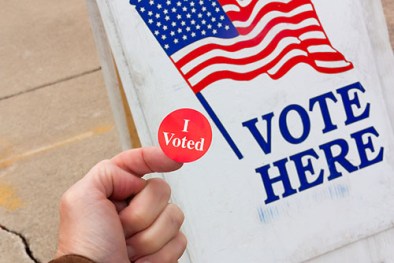
I Voted!With the nation’s first few presidential primaries and caucuses out of the way, pundits are scratching their heads and wondering why evangelical voters aren’t behaving as predicted. Among the three candidates most popular with evangelical voters, Donald Trump, a Presbyterian with a less than pious past, continues to best his two closest rivals – Ted Cruz, a Southern Baptist, and Marco Rubio, a Catholic who attends a Baptist church.

Now, many are starting to ask: “Who are these evangelical voters?” “Who are they really supporting, and why?” Some analysts say not all the people pollsters are calling “evangelicals” really qualify for that label. That may be the reason it appears the evangelical voting bloc is split. It may also be the reason Trump is claiming the support of evangelicals despite the outcry among some devout leaders that his lifestyle and apparent values clash with their own evangelical beliefs.

A survey by LifeWay Research and the National Association of Evangelicals (NAE) determined last fall that evangelicals (as most Southern Baptists would describe them) hold four common beliefs: the Bible is their highest authority, it is very important to share Christ with non-Christians, Christ’s death on the cross is the only sacrifice that can remove sin, and only those who accept Christ as their savior will receive eternal salvation

The survey surprisingly found just 41% of self-identified evangelicals hold all four beliefs, and 21% of those who rejected the evangelical label actually agree with all four. Other polls and studies have found many define evangelical in much broader terms, or as LifeWay’s Trevin Wax stated on The Gospel Coalition’s website, “’Evangelical’ sometimes means ‘cultural Christianity.’”

Later in that same article, Wax also blamed a lack of discipleship as a factor in evangelical voting writing, “A 30-minute sermon once a week or a brief morning prayer are not nearly as formative as the hours and hours a congregant may spend watching cable news, or listening to talk radio, or frequenting conspiratorial websites, or sharing articles that fan the flames of fear and anger.”

The National Review also weighed in after Trump’s win in South Carolina, the fifth most religious state according to Pew Survey. Writer JD Vance cited lack of church attendance by self-identified evangelicals as a factor in the second and third place finishes of Marco Rubio and Ted Cruz. “While approximately 80 percent of the country identifies as Christian, only about one in five regularly attend church services,” Vance wrote.

Based on this, he believes Cruz, who has most actively sought the evangelical vote, may be depending “on a group of religious voters who increasingly spurn church services and, consequently, traditional social conservatives like him.”

There is still much to be said. Next week is Super Tuesday, when Bible Belt states will have their say. While Illinois voters won’t go to the polls until March 15.

Perhaps Rubio, may have had the best insight when speaking after learning of this second place finish in South Carolina. “If it is God’s will that we should win this election, then history will say that on this night in South Carolina we took the first step forward in the beginning of a New American Century.” Truly, the outcome of the 2016 presidential election does hinge on God’s will.

Trump wins evangelicals in S.C.
Billionaire Donald Trump easily won the Republican presidential primary Feb. 20 in the evangelical Christian stronghold of South Carolina. The success among self-identified evangelicals in South Carolina of Trump nearly mirrored his total among all Republican voters in the state.

Planned Parenthood videos mostly ignored
Over the past six months, a series of undercover videos focused on Planned Parenthood made national headlines, provoked outrage in Congress, and prompted investigations in about a dozen states. However, LifeWay Research found 7 out of 10 people are either not aware of the videos (43%) or have not spoken out after seeing them (27%).

More sue home-school guru for sexual harassment
The sexual harassment lawsuit against Bill Gothard, whose ministry preached the subordination of women to men, has grown again. Now 18 people — 16 women and two men — are suing the 81-year-old founder of the Institute in Basic Life Principles, and the Oak Brook, Ill.-based institute. Thousands of conservative Christian families have relied on the IBLP’s home schooling curriculum.

‘Risen’ takes first in new releases
“Risen,” a film that tells of Jesus’ resurrection from the eyes of an unsaved soldier who participated in His crucifixion, opened in first place at the box office among new wide releases the weekend of Feb. 19–21.

Nike drops boxer over anti-gay comments
World champion boxer-turned-politician Manny Pacquiao apologized on social media for saying that people who engage in homosexual acts are “worse than animals,” but not before the remark cost him Nike’s sponsorship.

Sources: Baptist Press, Facts & Trends, RNS, World Magazine