Day 1 EvangelismWith at least 8-million lost people among Illinois’ 13-million residents, IBSA encourages churches to focus on evangelism. Pat Pajak trains hundreds of churches each year. He teaches NAMB’s “Who’s your one?” prayer focus and “Three Circles” witnessing tool. Watch the video, “Sharing Christ.”

Pray for the IBSA evangelism team and for evangelistic zeal in all churches.

Learn more about the Mission Illinois Offering.

MIO Facebook Banner

With all of these Mission Illinois Offering resources and materials at your fingertips, you may be thinking, How do I get my church excited to give and contribute to kingdom work here in our own state? The first answer is to pray for state missions.

As a church leader, pray for your congregation’s hearts to be open to giving to the Mission Illinois Offering. Then, distribute the prayer guide and join as one body, committing to praying together for all the requests listed.

  • Ask your worship leadership team to allot time for prayer for Illinois during the month of September.
  • Consider holding a special prayer gathering at your church where you take turns individually lifting up each ministry and missionary.
  • Pray for the millions in our state who don’t know Christ, for church leaders and church planters in Illinois, and for local churches to have opportunities to share the love of God with their community.

Organize a state missions study. Each year the MIO kit includes missions-related studies geared specifically towards children, youth, and adults. Each age-appropriate lesson shows ways to get people involved with Illinois missions.

And rest assured, it is easy to do a missions study! The material is all ready. You simply need to pick a time for people to meet—it could even be during the Sunday school hour—and find someone to facilitate the study and discussion. We all could use a fresh understanding of the spiritual need in Illinois.

Look for the MIO kit in your church office, and explore resources on the MIO website.

Commit to give. And keep giving until your church’s goal is met! Lead by example and communicate to others the importance of this offering for furthering the kingdom in Illinois.

Provided in your church’s MIO kit are video reports showing the need for Christ across Illinois and some of the missions and ministries IBSA churches together support to meet those needs. During the Sundays leading up to MIO Week, please show them to your congregation.

Just as there are those who speak up for other annual offerings or ministry events, you can become a champion in your church for the cause of state missions. Whether you are a pastor, a deacon or elder, a missions leader, part of a committee, or a preschool teacher—you can be a voice for Mission Illinois. Our call to missions begins here where we live.

When you champion missions in Illinois, know that lives will be transformed because of your church’s commitment to prayer, generous giving, and missions involvement.

Tug-of-war intensifies over freedom of conviction
Both the Democratic Party and superstar Taylor Swift spoke out last week against “religious liberty,” or at least how it’s generally defined by Christians and conservative voters. First, the Democratic National Committee passed a resolution Aug. 24 acknowledging that religiously unaffiliated people “overwhelmingly share the Democratic Party’s values.” The resolution also takes aim at “misplaced claims of ‘religious liberty’” used to “justify public policy that has threatened the civil rights and liberties of many Americans.”

Swift echoed the resolution’s message during her acceptance speech at the MTV Video Music Awards, where her LGBTQ rights-themed song “You Need to Calm Down” won video of the year. (The video includes performers connected to LGBTQ causes, as well as a small group of protestors holding misspelled signs opposing LGBTQ rights.)

“You voting for this video means that you want a world where we’re all treated equally under the law, regardless of who we love, regardless of how we identify,” Swift told viewers, also urging them to sign her online petition in support of the Equality Act, which would add “sexual orientation” and “gender identity” to the list of classes protected under federal civil rights law. The U.S. House of Representatives passed the Equality Act in May, but the measure hasn’t been approved by the Republican-majority Senate.

In October, the U.S. Supreme Court will hear oral arguments in the cases of three employees who claim they were discriminated against because of sexual orientation or gender identity. The Southern Baptist Ethics and Religious Liberty Commission has signed on to a friend-of-the-court brief stating non-discrimination protections in federal workplace law do not cover orientation or identity.

Disaster Relief volunteers brace for Dorian response
On Monday, news reports detailed Hurricane Dorian’s devastation in the Bahamas, while Southern Baptist Disaster Relief leaders in Florida stood ready to respond to needs in the storm’s aftermath.

Baptist church mourns father killed in Texas mass shooting
Joseph Griffith, 40, was one of seven people killed in Texas’ Permian Basin Aug. 31 when a gunman began shooting at random following a traffic stop. Griffith, a father of two, attended First Baptist Church in Odessa with his family. “We all feel a sense of being violated,” Pastor Byron McWilliams said during the church’s worship service the next day. “Every single one of us does because all of a sudden what we hear about from far, far away has come close to home.”

Village Church answers sexual abuse lawsuit
A Southern Baptist church in Texas said it is not liable for damages suffered by a woman who alleges she was sexually abused in 2012 at a camp sponsored by the church. A $1 million lawsuit claims The Village Church acted with “conscious indifference or reckless disregard” for a woman referred to as Jane Doe. In a response filed Aug. 23, the church “generally denies each and every allegation in Plaintiff’s Original Petition and demands strict proof by a preponderance of the credible evidence.”

Students face doubts, questions at evangelical colleges
A new study finds students at evangelical colleges and universities are more likely to feel spiritually unsettled, unsure, or disillusioned than their counterparts at secular schools and mainline institutions. Many school administrators are aware of the dynamics, Christianity Today reports, and working to help students through the struggle.

Sources: Christian Post, Baptist Press, Odessa American, Christianity Today

By Nate Adams

MIO Slider

I recently learned of the passing of Mary Lou Cameron at age 99. Mary Lou was the widow of Harold Cameron, who was state missions director and a church planting leader at IBSA for many years.

I didn’t know Mary Lou personally, but her passing reminded me of the only time I remember meeting her husband, Harold, probably in the late 1970’s. He came to speak in the St. Charles church where I was a youth minister, and shared passionately about the need for new churches in Illinois. In doing so, he told story after story of the challenges and opposition he and others faced in getting new Baptist churches established in northern Illinois, including ours.

At that time, our church had well over 200 weekly attenders, several vibrant ministries, and was baptizing new believers regularly. So it was hard for me as a 20-year-old youth minister to imagine a day just 25 years earlier, when our church didn’t exist.

During his one opportunity to do so, Harold convinced me that Illinois is a mission field, that church planting is the missionary task most needed here, that it is not easy, but that it is extremely worthwhile. His transparent heart cared not only for the lost, but for the lost of tomorrow. He knew that he couldn’t personally share Christ with all those lost people, but he could start churches that would. In that moment, I remember being personally grateful to him for starting our church.

Your giving supports vital church planting efforts across our state.

Now let me fast forward to today, when I am almost the age Harold was then, and when I ask you to join me in giving generously to the annual Mission Illinois Offering, preferably through your church, or at IBSA.org. Church planting is one of the primary ministries supported by that offering, and church planting is still desperately needed in Illinois. In fact, IBSA church planting staff have identified at least 200 places or people groups in Illinois where a new, Bible-believing church is needed, today.

With current leaders and resources, IBSA is seeing about 20 new churches started each year. But your generous offering can help accelerate the pace at which a New Testament church is established, in or near every community in Illinois.

Someone planted your church, and mine, whether it was 25 years ago or 200 years ago. The question for us today is how generously we will continue to pay our gratitude forward, and establish new churches for both new communities and new generations.

Reading Mary Lou’s obituary reminded me that Harold retired in 1981, just a couple of years after I met him as a young man. Men like my father and other church planting and associational leaders, and women like Mary Lou and my mom, then continued to champion that church planting legacy for their generation. In fact, they helped me plant a church in that same northern Illinois region in 1994, before I moved on to help church planting nationwide at the North American Mission Board. Now I stand on their shoulders, and without reservation ask us to continue planting new churches here in Illinois.

It probably won’t surprise you that Mary Lou Cameron designated any memorial contributions to either the scholarship fund of the Baptist Foundation, or to Illinois Baptist State Missions, or in other words, the Mission Illinois Offering. Mary Lou and Harold clearly had hearts for tomorrow, hearts for church planting, and hearts for tomorrow’s lost in Illinois. Our gifts through the Mission Illinois Offering this year can both honor their lives and echo their hearts.

Nate Adams is executive director of the Illinois Baptist State Association. Respond at IllinoisBaptist@IBSA.org.

Show and tell

Lisa Misner —  August 29, 2019

By Adron Robinson

Read: Galatians 5:22–23 (ESV)

“But the fruit of the Spirit is love, joy, peace, patience, kindness, goodness, faithfulness, gentleness, self-control; against such things there is no law.”

Tree made of citrus fruits, oranges, lemons, lime and green leavIn elementary school I always loved show-and-tell. It was exciting to see the hobbies, toys, pets, and even parents of my classmates. Well, for the child of God, every day is show and tell. We should show others the fruit of the Spirit and tell others about Jesus.

There is no such thing as hidden fruit. Fruit is always visible. The people around you will either see the fruit of the flesh or the fruit of the Spirit. We can talk about how much we love the Lord, but the proof is not in our talk, it’s in our walk. Fruit is always visible.

Not only is fruit visible, but fruit always reflects the character of its source. Apple trees always produce apples. Orange trees always produce oranges. And Christians produce love, joy, peace, patience, kindness, goodness, faithfulness, gentleness, and self-control. And notice the word fruit is singular, that means that the Holy Spirit produces all of these in every Christian. Some may not use patience much, for we still wrestle with sin, but it’s in you and the more you submit to Christ in every area of your life, the more the Spirit will produce his attributes in us.

Finally, fruit is for the benefit of others. I have never seen an apple tree eating an apple. Trees bear fruit for the benefit of others. Likewise, the Holy Spirit produces Christlike character in the Christian for our benefit, but also for the benefit of others around us. When they see us showing our fruit, they will want to know where this fruit came from. Then we can tell them about Jesus.

Prayer Prompt: Gracious Father, who gives every good and perfect gift, thank you for the fruit of the Spirit. Please help us to submit to your Spirit so that your attributes can be manifest in us, that you may be glorified in our daily walk. Amen.

Adron Robinson pastors Hillcrest Baptist Church in Country Club Hills and is president of IBSA.

Fired deputy sues employer over ‘Billy Graham Rule’
Former North Carolina sherriff’s deputy Manuel Torres claims the Lee County Sherriff’s Office terminated his employment in 2017, after he declined to significant periods of time alone with a female coworker. Torres is suing his former employer in one of several cases that pits religious freedom against “non-discrimination norms,” law professor Howard Friedman told Christianity Today.

“This is a public official who is invoking religious free exercise to avoid carrying out a part of his employment duties,” Friedman said. He compared the case to that of Kim Davis, the former Kentucky court clerk who refused to issue marriage licenses to same-sex couples. Last week, the Sixth Circuit Court of Appeals ruled Davis can still be sued for her actions in 2015, even though she lost her reelection bid last year.

Legal victory for videographers, while printer’s case pending in Kentucky
Carl and Angel Larsen are seeking an injunction against a Minnesota statute that officials say would require them to film same-sex wedding ceremonies, despite their religious convictions. The U.S. Court of Appeals for the Eighth Circuit ruled in favor of the Larsens and their company Aug. 23, overturning a lower court ruling against them and sending their request for an injunction against the Minnesota Human Rights Act back to the district court level, The Christian Post reports.

Meanwhile, Kentucky’s Supreme Court heard oral arguments in the case of Blaine Adamson, a print shop owner who refused to print T-shirts for Lexington’s 2012 Pride Festival.

Chronicle continues coverage of sexual abuse in the SBC
While former Southwestern Seminary President Paige Patterson faces a lawsuit alleging he mishandled accusations of sexual assault at the seminary, the Houston Chronicle has released a new report outlining Patterson’s mentorship of Darrell Gilyard, who pastored and preached in SBC churches in the late 1980s and early 90s and was viewed as a rising star in the denomination. Gilyard was convicted of sex crimes in 2008.

Related: Abuse survivor Susan Codone shared her story in an Aug. 26 letter to the The Washington Post. Codone will be part of October’s Caring Well conference sponsored by the Ethics and Religious Liberty Commission.

Sutherland Springs pastor to run for state office
Pastor Frank Pomeroy will seek election to the Texas legislature in 2020. The pastor of First Baptist Church in Sutherland Springs lost his daughter Nov. 5, 2017, in the state’s deadliest mass shooting. “I felt like something needed to be brought to the conversation, like civility and real intelligent discourse,” Pomeroy said, according to Associated Press. The outlet also reported: “Pomeroy said that owning guns is not the problem that has led to mass shootings and the focus should be on issues such as mental illness.”

Sources: Christianity Today, The Christian Post, Baptist Press, Houston Chronicle, Washington Post, Associated Press

By Eric Reed

Wide Shot of CrowdShawn and Paige Ruffino live in Sesser, a small town of about 2,000 people in far south Franklin County. Sesser is Paige’s hometown, and Shawn says he has come to love it as his own. That’s why he’s concerned for the spiritual future of the people who live there.

Likewise, the leaders of the church where the Ruffinos are members, Immanuel Baptist Church in nearby Benton, are continually growing in their concern for lost people in Benton and Sesser, and throughout their county. “We’ve been praying at Immanuel for many years for the 26,000 who are lost in our county,” Pastor Sammy Simmons said. “I desperately want everyone the hear the gospel.”

Simmons has led Immanuel Church to join a new IBSA initiative called Everyone Hears. In our state of nearly 13-million people, at least 8-million don’t know Jesus as their personal savior. In many places lostness seems especially great. And there are pockets of hope, where churches are focused on sharing the gospel with everyone who will listen. Everyone Hears aims to organize those efforts, with an evangelism cycle that begins with prayer, and moves through specific activities to demonstrate caring, sharing the gospel, baptizing new believers, and where there is an emerging core group, starting new churches.

Day 3 Church Planting“The purpose of Everyone Hears is that every man, woman, boy, and girl in a certain region can hear the gospel multiple times in ways they can understand,” said Eddie Pullen, IBSA’s church planting strategist who is leading the initiative. So far, 25 IBSA churches across the state are participating in Everyone Hears, targeting their own communities, or areas nearby.

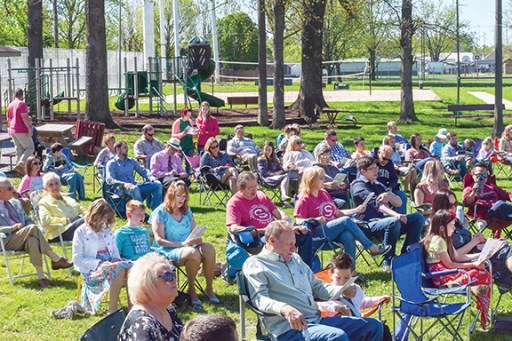
Immanuel Baptist is seeking to reach their county, and Benton and Sesser in particular. At Easter, the church cancelled events at their campus and took worship services outdoors in both communities. About 200 people attended in Sesser, and at least 60 of them had no church affiliation.

The church has engaged in other activities, including praying for lost individuals by name on many occasions, giving away groceries, working to improve the park, hosting opening ceremonies for local ball teams. Bible distribution and a social media campaign are next steps on their outreach list.

“The idea of gospel saturation really hit my heart,” Simmons said. “It’s not just the idea that we want somebody to hear the gospel once and think that’s good enough. Surveys say sometimes it takes seven times where somebody hears the gospel before they make a decision for Christ. And so we want to saturate our area with the gospel such that you can’t miss it.”

Immanuel Church is engaged in international missions, spreading the gospel in Uganda through 12 trips in eight years. But, the pastor said, “we can’t ignore the reality that there are people who have never heard in our own backyard.”

Shawn Rufina

Shawn Rufina

Shawn Ruffino agrees. “We believe it can happen right here; gospel saturation can start right here.” That’s why Ruffino is leading outreach in Sesser. He chokes up as he says, “Jesus changes us, and he can save us, and he can use us no matter what we’ve been through.”

Or where we live.

Learn more about the Mission Illinois Offering and Week of Prayer.

By Jack Lucas

Pupils and teacher smiling at camera in library at the elementary school

Back-to-school season is upon us, offering your church a great opportunity to serve families, teachers, and administrators in your community. Much of our back-to-school outreach often centers around meeting physical needs. School supplies, free haircuts, new tennis shoes—all of those giveaways and donations are wonderful ways to help families in this busy, often expensive season.

But churches can also look beyond August and September for effective ministry to families and education leaders in their communities. In addition to your back-to-school outreach this year, consider adding one or more of these longer-term strategies:

Try to meet unique needs. One school in our community required each student to stock the office by bringing a ream of copy paper at the beginning of the school year. We asked the school what they needed most. Paper, the staff said, so our church provided enough paper for the year, so that families didn’t have to. Throughout the year, check in periodically with schools in your area to ask what unique needs your church can help meet.

Share your space. Another of our local schools had space issues in their gym. We opened our church gym so their teams could practice there, and also hosted school sports banquets in our fellowship hall. Families visited our church who first heard about us after their child met us through school sports.

Work with administrators. You may be surprised at how willing your local principal is to partner with your church. Even with the caution required to keep church and state separate, school administrators often understand churches want to help, with no other agenda in mind. Our church was blessed to build relationships with principals who sent people our way when they had a specific need. Seek out these relationships with school administrators in your community, asking how your church can help.

Don’t forget older kids. Teens in our community responded well to a back-to-school bash at the church. They came to the high-energy outreach to reconnect with their friends, and left with a calendar of events we’d planned for the year ahead. Your church can also do this around holidays, or at the end of the school year as you look ahead to summer activities. Let them know they’re welcome at your church, and that there are specific opportunities for them.

Expect a cumulative effect. The best way to sum up back-to-school outreach is that it often moves the needle little by little as your church builds relationships with teachers, administrators, and families. The impact you make will likely share a close correlation with how consistent and sacrificial your ministry is, and how prepared you are to interact with the families that do show up at church.

As you brainstorm ministry opportunities this fall and beyond, ask your leaders and volunteers these questions:

  • What can we offer teachers and school administrators in the way of resources and encouragement?
  • How can we position our church as a go-to resource for families in need of support?

Our church had the opportunity to minister to couples and families that we never would have had if we hadn’t provided school supplies for their children, or hosted basketball practice for their student’s team. This year, gear up for long-term ministry that really helps families.

Jack Lucas is IBSA’s director of next generation ministries.

Rsource Fall 2019This article is adapted from the Fall issue of Resource magazine, which is available at Resource.IBSA.org.

By J.D. Greear

Editor’s note: Churches in Illinois baptized more than 700 people during One GRAND Month last April. September 8 is Baptism Sunday across the Southern Baptist Convention.

JD GreearFor several years now, I have been greatly burdened by the declining number of baptisms across the Southern Baptist Convention. I believe the baptism numbers serve as one of the best indicators of evangelism in our churches. Jesus came to seek and to save the lost, and that means that proclaiming the gospel is the core of who we are—not only as Southern Baptists, but most importantly, as disciples of Jesus Christ.

That’s why I’m challenging every Southern Baptist church to call for baptisms in services on Sept. 8, the date our SBC Executive Committee has designated as “Baptism Day” on the SBC Calendar.

Baptism Sunday will be an opportunity for thousands of people in our churches to take their step of obedience and faith. Many of them already know they should be baptized, and you can schedule baptism celebrations in advance. Other people in your churches may decide on Sept. 8 that God is calling them to those same baptismal waters.

I know conversations about immediate-response baptism services tend to draw some objections, many of which are grounded in healthy concern about encouraging insincere professions of faith. Trust me, I understand the concerns: I have seen dangerous and irresponsible calls for spontaneous baptisms. God forbid that we ever declare someone “saved” when they aren’t. Not only does this give them false assurance, but it also makes them that much more immune to future calls to repent and believe.

On Baptism Sunday, call people to respond to Jesus.

Our fear of extending these invitations wrongly, though, should never make us shy away from making the invitations at all. After all, every single baptism recorded in the New Testament, without exception, is spontaneous and immediate. For New Testament believers, the pattern was alarmingly simple: believe, confess, get baptized. There was never a gap between when a person trusted Christ and when that person was baptized. Not one.

This follows the example of Jesus’ Great Commission: “Make disciples of all the nations, baptizing them in the name of the Father, Son and Holy Spirit” (Matthew 28:19). Baptism is a believer’s first act of discipleship, a step of obedience that stands as a witness that we belong to Christ.

Baptism is like the wedding ring of salvation. I put on my wedding ring at the moment I decided to publicly declare my commitment to my wife. Putting on the ring did not make me married. But the demonstration of my commitment to my wife that the ring represents was a crucial first step in marriage. Had I refused to do it, my wife would have had reason to question my intentions.

In the same way, baptism is an outward symbol of an inward covenant we’ve made in response to Jesus’ offer of salvation.

Every one of our churches ought to do everything in its power to ensure that everyone who comes forward to be baptized understands the gospel and the significance of what they are doing. During baptism services at our church, for instance, we individually counsel every person who comes forward. Those conversations take time—often extending into the next service—and we always end up turning some people away. But that moment is important, because it starts a conversation about what it means to follow Jesus.

Baptism is of tremendous importance, but we need to keep the biblical order in mind: Baptism is the catalyst to spiritual maturity, not the sign of having attained it.

When we invite people to be baptized, we are calling them to make a decision. That’s exactly what so many of our people need. They come to our churches as consumers, going along with Jesus but never deciding for him.

Several years ago, our church chose to hold our first baptism service after we noticed the biblical pattern of spontaneous baptisms while preaching through a series in the book of Acts. Starting with that service, we saw three times more people choose to be baptized that year than we’d ever seen! I believe that’s because our church had been faithful in sharing the gospel, and we chose to be faithful in calling for a response to that good news.

I believe God is preparing a harvest of souls. Let’s faithfully call them to respond by publicly declaring faith through baptism!

J.D. Greear is president of the Southern Baptist Convention and pastor of The Summit Church in Raleigh-Durham, N.C. For Baptism Sunday resources, go to namb.net/baptism-sunday-resources.

Christian rocker calls leaders to value truth over feeling
In a post that has since been shared nearly 40,000 times, John Cooper, frontman for Christian rock band Skillet, responded to Christian leaders who have announced they’re walking away from the faith. Author Joshua Harris and Hillsong writer Marty Sampson both made public statements recently, with Harris saying outright “I am no longer a Christian.”

Cooper, who founded the band in 1996, also called Christians—those who lead worship and those who are led in it—to a higher standard than what is relevant or trendy in the moment. Rather than lift up current influencers as ultimate truth-tellers, he posted, rely on the Word of God.  “…we are in a dangerous place when the church is looking to 20-year-old worship singers as our source of truth,” Cooper said. “We now have a church culture that learns who God is from singing modern praise songs rather than from the teachings of the Word.”

>Related: Russell Moore on what to do when someone you admire abandons the faith

>Related: The roles endurance and environment play in a Christian’s ability to press on

Illinois parents weigh options ahead of 2020 curriculum change
Gov. J.B. Pritzker’s signature on a bill that will require LGBT history in public schools has sent some Christian parents looking for education alternatives, while others are resolved to keep their kids in the school system.

“We are very aware that times are changing and more liberal views are entering the classroom,” said one Springfield mother of three. “We feel that the changes that are happening in the classroom and throughout the world right now are opportunities to share Christ and his message.”

Methodists mull denominational split
Religion News Service reports a group of conservative United Methodists met this summer to discuss how the denomination can go forward amid growing divisions over its policies toward the LGBTQ community and same-sex marriage. One plan under consideration would keep the UMC denomination as a centrist/liberal organization, while creating a new entity for traditionalists.

In February, delegates to the denomination’s General Conference voted narrowly not to lift bans on LGBTQ clergy and same-sex marriage.

MacDonald indicates return to ministry
James MacDonald, former pastor of Chicagoland’s Harvest Bible Chapel, posted online last week that he’ll “be back soon with fresh messages from God’s Word.” MacDonald was fired in February amid charges of financial mismanagement and poor leadership.

Trade war won’t affect Bibles
Bibles and other religious literature were initially on a list of items that would be subject to a 10% tax hike on goods imported from China, Baptist Press reported. But Christian leaders were relieved last week when the U.S. Trade Ambassador indicated a “Bible tax” will be avoided.

Sources: Facebook, Christian Post, RussellMoore.com, Christianity Today, Illinois Baptist, Religion News Service, USA Today, Baptist Press