By Baptist Press

The Southern Baptist Convention expanded by more than 270 churches in 2017. More people showed up for weekly worship services, and congregations gave more generously in a strengthening economy. However, reported baptisms and membership declined as fewer churches participated in the SBC’s Annual Church Profile (ACP).

Longstanding patterns continued to dominate the ACP, which is compiled by LifeWay Christian Resources in cooperation with Baptist state conventions.

-The number of churches cooperating with the Southern Baptist Convention grew for the 19th consecutive year, reaching 47,544. That’s a 16.3% increase in churches since 1997.

-Membership fell for the 11th consecutive year, to 15 million. Since 2006, Southern Baptist congregations have lost about 1.3 million members.

-Baptisms also declined, as they have for eight of the past 10 years. Congregations reported baptizing 254,122 people—26.5% fewer than in 2007. The latest ratio was one baptism for every 59 church members.

“It’s heartbreaking to be baptizing fewer people for Christ, even though Southern Baptists have nearly 2,900 more churches than we had a decade ago,” said LifeWay President Thom S. Rainer.

“Yet a quarter million baptisms is not an insignificant number. We praise God for every individual who has come to Christ and followed him in baptism. It is my prayer that God would embolden Southern Baptists to share the gospel with their friends and neighbors.”

Fewer churches reporting

The ACP numbers don’t tell the full story of baptisms or other measurables among Southern Baptist churches. Despite the best efforts of associations and state conventions across the country, 26% of churches did not participate, said Scott McConnell, executive director of LifeWay Research. The percentage of SBC churches that participated by reporting at least one item was 74%, down from 80% in 2013 and 77% in each of the last three years. (In Illinois, 95% of IBSA churches submitted an ACP for 2017.)

For that reason, reported totals do not include all of the activity within Southern Baptist life, though the summary does include adjustments in some categories for non-reporting congregations. This summer, LifeWay Research plans to release statistical analysis of the current state of the SBC that includes estimates of the congregations that did not report.

Despite the lower participation rate, the ACP report shows increases in some areas:

-Average attendance at weekly worship services climbed 2.3% to 5.3 million, an increase of nearly 120,000.

-States outside the South reported some of the strongest signs of growth. California now has 47 more congregations and Michigan has 24 more congregations than the previous year. Those figures include churches along with church-type missions—congregations that are not fully independent or self-sustaining.

-Non-Southern states are now home to 21.3% of Southern Baptist churches and 32.2% of church-type missions.

-Reported baptisms nearly doubled in Colorado and rose 31% in Iowa, 17.6% in Alaska, and 13.4% in New Mexico. In North and South Dakota, weekly worship attendance grew by 20.8% while baptisms climbed 34.8%.

Overall, Southern Baptist churches reported 4,376 church-type missions last year, down 2.6% from 2016. The count of churches and missions combined is 51,920 congregations.

Giving & mission expenditures

Southern Baptists saw an increase in overall giving of almost $267 million. Total and undesignated church receipts reported through the ACP increased 3.3% and 2.3% respectively.

Reported mission expenditures fell by about $4 million in 2017. However, the numbers are not directly comparable since there were changes in how many and which state conventions collected this statistic.

Congregations reported total mission expenditures of just under $1.19 billion.

Individual congregations voluntarily report their ACP data to their local Baptist associations and/or their state conventions. National statistics are compiled and released when all cooperating state conventions have reported.

– From Baptist Press

By Chaplain (Major General) Douglas Carver, U.S. Army, Retired

small American flags in the background

The Bible commands us in Romans 13:7 to “give honor to whom honor is due.” Ultimately, all honor and glory and power belongs to our great God and Savior Jesus Christ. But it’s also appropriate, as we celebrate our nation’s independence, to remember and honor a special group of people — our veterans — who for 243 years have protected and preserved our freedom.

Whenever the nation has called — in times of distress or danger, chaos and confusion, peace and prosperity — our veterans have always been there, faithfully answering the call to duty. Our soldiers, sailors, airmen, marines, coast guardsmen and veterans — men and women, active, guard and reserve — have done one of the noblest things a person can do with their life, which is to support and defend our great country with their lives and make a better world for our children and for generations.

Since leaving their bloody footprints at Valley Forge, making disease-infested trenches their homes during World War I, charging the beaches of Normandy, suffering crippling frostbite from three cold Korean winters, wading through booby-trapped rice paddies of Vietnam and traversing dangerous roads and terrain in southwest Asia, our troops have always been counted on to defend the American Dream of life, liberty and the pursuit of happiness and to worship Almighty God freely in peace.

Looking back through our nation’s history:

We honor our post-9/11 veterans for their patriotic response after the terrorist attacks on our nation 17 years ago. Since then, 2.77 million men and women have served in the armed services on 5.4 million combat deployments. Their average age is less than 30. Half of them are married with children. Over 225,000 of our troops have three combat deployments or more.

We honor our Vietnam veterans who served during one of the longest wars in our nation’s history. Fifty years ago, in 1968, they experienced the bloodiest year of the war with nearly 17,000 killed in action beginning with the Tet Offensive in January 1968. Our Vietnam veterans never gave up, gave in, never quit, in spite of our country giving up on them.

We honor our Korean War veterans who fought and died in extremely difficult conditions, where the country’s mountainous terrain and the unrelenting cold of winter were bitter enemies in themselves. As one veteran put it, “on the other side of every mountain was another mountain.” At times the winter cold froze the oil in GIs weapons so they couldn’t fire, and thousands suffered from crippling frostbite. After the war, our troops spearheaded the effort in rescuing over 100,000 Korean orphans whose parents were killed in the war. Let’s remember our Korean War veterans today as we’re on the verge of declaring an end to the Korean War after 65 long years.

We honor the undaunted courage of our World War II veterans who stormed the beaches of Guadalcanal and Normandy, fought valiantly against unrelenting kamikaze attacks and torpedo strikes in the Coral Sea, and liberated the world from the grip of tyranny in Europe and the Pacific Rim. The Greatest Generation of Americans paid a staggering price for war, suffering more than 400,000 killed in action while advancing the cause of freedom throughout the world.

Finally, we honor the courage of our World War I veterans who were drafted to fight “the war to end all wars”. They fought from cold, muddy trenches while for the first time facing machine gun fire, deadly bombs and poisonous gas, enduring all this “to make the world safe for democracy.” This year the nation is commemorating the 100th anniversary of Armistice Day, marking the end of World War I on Nov. 11, 1918.

One hundred years ago, 6,105 Southern Baptist messengers gathered for the 63rd session of the Southern Baptist Convention, May 15-20 in Hot Springs, Ark. Senior leaders felt that the denomination was at a critical point in its 70-year history. Evangelism efforts were at an all-time low, baptisms were down, seminaries were struggling with student population levels due to the war, and fewer men were answering the call to pastoral ministry.

At the same time, the War Department was almost begging churches and denominations for military chaplains. One man who answered the call was George W. Truett, pastor of First Baptist Church in Dallas, who, at the personal request of President Woodrow Wilson, left his pulpit for six months to serve as a chaplain with our troops in England and France.

Rev. Truett said he “would have gladly crossed the ocean and braved all the dangers and hardships for the privilege of preaching to vast multitudes of soldiers who came to the side of our great Saviour and King.”

At that same convention 100 years ago, Southern Baptists made a vow, “pledging their lives, their resources, and their sacred honor to the nation for the war effort, [to] press the saving Gospel of Jesus Christ into the hearts of young men in the flower of their youth.” Southern Baptists agreed that, regardless of how bad things looked in the denomination and the world, their primary focus in supporting our troops and the war effort was to ensure we kept the freedom to share the Gospel of Jesus Christ.

E.Y. Mullins, president of Southern Baptist Theological Seminary, said that the best way we could support our troops was to strengthen their moral and spiritual life, making every effort to preach the Gospel, especially to those from Baptist homes and Baptist churches who were laying their lives on the altar of their country.

A.T. Robertson, professor of New Testament at Southern Seminary in his book, “The New Citizenship: The Christian Facing a New World Order,” said, “If we truly want to honor our troops and the Nation, we must clean up our house and keep it clean if we are to lead the nations of the earth in the path of peace to God and righteousness. We must make Christ king in our homes, schools, stores, factories, railroads, ships, military, city halls, state capitols, and national capitol. We must have men and women who live under the authority of Jesus as Lord and follow His teachings. The world has yet to see a Nation where Christ reigns with honor in the hearts of his people.”

As we honor our veterans and the nation, let us begin by honoring the Lord with our lives and giving thanks to Almighty God for the blessings of liberty, especially the freedom that we have in Christ Jesus. Let us give thanks to and pray for our veterans and their families who have given so much for the earthly freedoms we enjoy. And may we be faithful stewards of the freedom we’ve been granted by the men and women who have, through their selfless and sacrificial service, kept America the land of the free and the brave.

Chaplain (MG) Doug Carver, USA-Retired, is executive director of chaplaincy for the North American Mission Board. This article is adapted from his address honoring veterans on the opening day of the June 12-13 Southern Baptist Convention in Dallas.

The Briefing

Florist: My state turned my life upside down because of my religious beliefs
Barronelle Stutzman, the Washington State florist sued for declining to provide flowers for a same-sex marriage ceremony, writes about what taking a stand for her religion did to her life, and what the U.S. Supreme Court’s Masterpiece Cakeshop ruling and that Court’s decision to vacate the Washington State high court’s ruling might mean for her.

Supreme Court rules pro-life centers don’t have to advertise abortion options
In a much-anticipated decision, NIFLA v. Becerra, the U.S. Supreme Court ruled 5-4 against a California law that forced pro-life centers to advertise abortion services. The court remanded the case, sending it back to the lower court “for further proceedings consistent with this opinion.” Other cases are still pending over similar laws in Hawaii and Illinois, but this message from the highest court in the land places those laws on shaky ground.

ERLC: Church’s internal discourse needs protection
An effort by Texas abortion providers to obtain a church’s internal communications would violate the First Amendment and a federal law protecting religious freedom if successful, according to the Ethics & Religious Liberty Commission. The ERLC filed a friend-of-the-court brief urging the U.S. Fifth Circuit Court of Appeals in New Orleans to overturn a federal judge’s order requiring the Roman Catholic bishops and archbishops of Texas to turn over their private deliberations on what they describe as doctrinal and moral issues.

New church parking tax triggers fresh debate
At least one religious watchdog group says the newly instituted Tax Cuts and Jobs Act that applies the federal income tax to parking benefits provided by churches is a step in the right direction towards transparency in church finances. Others decry the new provision that many historically tax‐exempt employers, including churches, hospitals, charities, and schools will be required to file federal Form 990‐T, which accounts for unrelated business activity.

UN-related religious liberty committee led by ADF rep
Days after the U.S. withdrew from the United Nations Human Rights Council of 47 nations, a U.S. attorney has been named head of a multi-faith nongovernmental group advising the U.N. on religious freedoms globally. Alliance Defending Freedom International’s Kelsey Zorzi began serving June 28 as president of the NGO Committee on Freedom of Religion or Belief.

Sources: Gospel Coalition, WORLD Magazine, Baptist Press, Christian Post, Baptist Press

By Daryl C. Cornett for Baptist Press

Old Holy Bible and the American Flag

Independence Day is my favorite holiday — an occasion to celebrate our country’s existence and have some mandatory fun!

There is nothing particularly religious about it, and that’s just fine. I like the family gatherings, cookouts, parades and fireworks. I like all the red, white and blue. It is an uncorrupted holiday that is exactly what it is supposed to be.

However, I believe that this secular occasion affords us the opportunity for important spiritual perspective and reflection.

First, Independence Day is an occasion to express thankfulness for God’s gift of our American government and its perseverance. This year we celebrate the passing of 242 years since a small group of men, representing 13 British colonies, asserted that the time had come to declare their independence. They made a long list of grievances against England and declared that independence was necessary and right. After winning a war that few thought possible, the confederation of the new states decided to unite under a federal government with its own constitution.

Christians throughout history have lived within a variety of governmental arrangements — monarchies, dictatorships, communist states and democratic republics of various forms. It is fitting to celebrate that in God’s gracious providence He has blessed us with government that guards against abusive power. The design of three separate branches has proven to be a practical check against the consolidation of too much power in one place. Christians can give thanks that God has graciously allowed our context to be a democratic republic in which we get to participate in the election of our own leaders and enjoy the privileges and protections of a constitution with a primary view toward preventing oppressive government.

Additionally, we can give thanks that by God’s grace we are still here. Every nation takes for granted its own existence. Human pride causes us to believe that the United States will always be just as it is today — powerful, prosperous and blessed. No empire thinks in its days of dominance that a time could come when it wouldn’t exist. Romans 13:1 reminds us, “… For there is no authority except from God, and those that exist have been instituted by God.” We should be thankful for our Founders — Adams, Franklin, Jefferson, Washington, Madison, Hamilton, and many others. However, we should acknowledge that our country’s existence originates from the hand of divine providence. The signers of the Declaration of Independence acknowledged this in its closing words: “And for the support of this Declaration, with a firm Reliance on the Protection of divine Providence, we mutually pledge to each other our Lives, our Fortunes, and our Sacred Honor.” As we celebrate with our material comforts and security, let’s be careful to give thanks to the One who has given these good gifts and who has preserved our nation.

Second, we should remember to pray for our leaders. The apostle Paul instructed Timothy, “First of all, then, I urge that supplications, prayers and intercessions, and thanksgivings be made for all people, for kings and all who are in high positions….” It doesn’t matter if you voted for him or even if you like him, your Christian political stewardship is to pray earnestly for him. She may be the antithesis of all your political views, but God has seen fit to put her in that position of leadership. Pray for her.

Third, Independence Day is an occasion for the church to renew its commitment to the proclamation of the Gospel. Because God has continued to bless us with a free society, the door for the sharing of the Gospel remains wide open. Our culture has always had sin problems. Where sinful people exist in a fallen world, the enemy is always at work challenging God’s design. Spiritual darkness pushes back against God’s good news.

In America we have incredible freedom to proclaim our faith. We should be thankful that the first of the amendments to the Constitution provides every individual with freedom for personal religion. The first phrase promises this freedom. “Congress shall make no law respecting an establishment of religion, or prohibiting the free exercise thereof.” Since this was adopted in 1791, we have periodically fussed about what constitutes an establishment of religion but never questioned that each of us has the right to our own personal faith and the right to share it with others. We may receive some rejection, but no one is arresting us for telling others about Jesus.

We would do well to be mindful that our American freedom must not be squandered on selfish individualism. We have all the freedom we could ever ask for to live out our faith with boldness and share it with others without fear of persecution.

On this Independence Day, let our hearts be full of gratitude for what God has established, pray for those God has seen fit to put into leadership, and remember that God continues to give us the freedom to be salt and light to our neighbors and impact our communities with the hope of the Gospel.

Daryl C. Cornett is pastor of First Baptist Church in Hazard, Ky., a chaplain in the U.S. Air Force Reserve and former associate professor of church history at Mid-America Baptist Theological Seminary in Cordova, Tenn.


By Meredith Flynn

Evangelism

DOOR TO DOOR – Kyle Walker (left), vice president for student services at Southwestern Seminary, and his wife Lauren (kneeling), share the gospel in Fort Worth during the Crossover evangelistic outreach prior to the SBC annual meeting.

Taking the gospel to the world is a critical task—one that will require Baptists to work together, reported a task force appointed by outgoing SBC President Steve Gaines. The group, named by Gaines at last year’s annual meeting, presented their report in Dallas, where it was adopted by messengers.

Before the vote, the task force concurrently submitted to messengers a list of 12 evangelism affirmations and denials, based on and supported by Scripture. The report also includes several recommendations for individuals, churches, pastors, SBC entities, and the denomination as a whole—all meant to renew evangelism.

“We wanted to take the opportunity to provide a clear set of principles in terms of things we believe Southern Baptists can heartily affirm as it comes to speaking about evangelism,” said task force chairman Adam Greenway, “and with clarity saying things we do not believe evangelism entails.

“One of the most important things we can give to our convention of churches, and to a watching world, is a clear statement about…where Southern Baptists stand on the issues related to evangelism.”

The task force, which met throughout the year to develop the report, was created to study how Baptists can be more effective in evangelism, amid continually declining baptism numbers across the SBC. Doug Munton, pastor of First Baptist Church in O’Fallon and a member of the task force, said the group noted the element of personal responsibility inherent in evangelism. “We need to be intentional and purposeful,”

Munton told the Illinois Baptist. “I was glad to hear our convention talking about evangelism. The evangelism task force work will be, I pray, a helpful step.”

The report, available in full at BPNews.net, alludes to differences in theology in the SBC, but also calls Baptists to unify around the Great Commission given to all Christians.

“We affirm that the Scriptures teach that gospel conversations should seek to include both clear presentations of the ‘good news’ of salvation and genuine invitations for all people to receive Jesus Christ as Savior and Lord,” the group wrote in one of the affirmations. Following it, the group denied “that gospel conversations are merely general talk about spiritual things and that an evangelistic invitation may only be extended by a singular methodological approach.”

The task force recommended the SBC Executive Committee put a “Baptism Day” on the denominational calendar. Illinois is among the states who have celebrated a statewide baptism emphasis—more than 400 people were baptized this spring on One GRAND Sunday.

Pat Pajak, IBSA’s associate executive director of evangelism, said the report was a great reminder of Baptists’ mission to share the gospel and disciple people who come to faith in Christ.

“Anything we do that reignites a passion for evangelism is a good thing,” he said. “It’s so easy to get distracted by doing good things, busy work, administrative duties, and daily church work that we neglect the Great Commission. And, in eternity, the most important thing will not be if the newsletter was attractive, the calendar was up-to-date, the deacon meetings were on time, the piano was in tune, or the building was clean.

“What will count for all eternity is did we, as believers, share the good news of Christ’s death, burial, and resurrection with others?”

– With additional reporting by Baptist Press

For some Christians, immigration concerns at odds with battle for religious liberty
The Washington Post reports that while some denominations, including the Southern Baptist Convention, have publicly spoken against the separation of families at the border, the current crisis is a complex issue for many conservatives weighing it against cultural issues like abortion and marriage.

Baptist church receives donation from First Daughter
Ivanka Trump pledged $50,000 to a Southern Baptist church in Texas whose pastor tweeted about their desire to help children and families at the border. Prestonwood Baptist Church pastor Jack Graham, a former president of the Southern Baptist Convention, said members of his church will travel to McAllen and Brownsville to assess needs for the immigrant children, and how churches should respond.

Related:

Religious restrictions on the rise—again
More than a quarter of 198 countries studied by Pew Research Center have “high” or “very high” levels of religious restriction, according to data released June 21. This is the second consecutive year that overall restrictions have increased in the countries studied, Pew reported.

Russian churches work around evangelism ban for World Cup outreach
Evangelistic outreach around this summer’s World Cup will have to get creative as a result of the host country’s anti-evangelism regulations, Christianity Today reports. Across Russia, churches will open their doors for viewing parties and other events to share the love of God, and soccer.

More Americans belong to multiethnic churches
Diverse congregations are on the rise, according to new research from Baylor University that found nearly one in five American worshipers now belong to a multiethnic church.

Sources: Washington Post, The Christian Post, ERLC, CNN, Pew Research, Christianity Today (2)

B21 panel

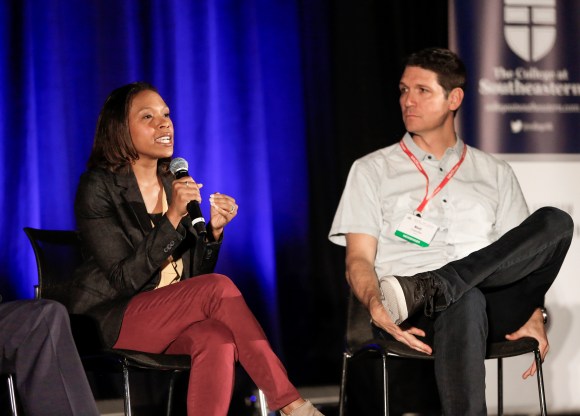
Trillia Newbell, left, director of community outreach for the Ethics & Religious Liberty Commission of the Southern Baptist Convention, and Matt Chandler, pastor of Village Church near Dallas, were part of the B21 panel discussion,. BP photo

The church’s handling of abuse and the #MeToo moment were major topics prior to the SBC’s Annual Meeting and at two panel discussions adjacent to the convention itself. Within the official meeting, actions were limited to passage of two resolutions on the role of women in ministry and an apology to abuse victims, some explanation in reports from seminary presidents, and a motion from the floor asking if a woman could be elected president of the Southern Baptist Convention.

All this comes on the 100th anniversary of women first being elected as voting messengers to the annual convention, and more important, following weeks of controvery surrounding the handling of abuse cases on two SBC seminary campuses, and remarks about women by former Southwestern Baptist Theological Seminary President Paige Patterson. Also former President of Southeastern Seminary where some of the allegations arose, Patterson was first removed from the SWBTS presidency by the full board of trustees, which promoted him to president emeritus with salary and benefits. A week later, as more allegtions emerged, the seminary trustees executive committee fired Patterson from that role and withdrew the offer of housing on the Southwestern campus.

Against this backdrop, messengers arrived in Dallas to find the topics of women and abuse allegtions handled mostly in ancillary panel discussions.

“You need to be trained in this like you’ve never been trained in this,” Matt Chandler, pastor of The Village Church in Flower Mound, Texas cautioned ministry leaders at a luncheon sponsored by B21. “Most of these men who’ve done this are narcissists and are going to come off as great guys,” he warned. He warned that pastors should make what is meant by submission clear in their sermons. “Every time you talk about submission you need to add the caveat about spiritual, physical, sexual, emotional abuse, because these guys are using this.”

In the B21 panel discussion and another by the Ethics & Religious Liberty Commission, the debate assumed a theological position of complementarianism, meaning men and women serve complementary roles in marriage and leadership.

Southern Seminary President Al Mohler said, “If you want to be a patriarchal abuser, complementarianism is an idiology you can grasp onto… Let’s just own this.” Mohler condemned “the distortion of complementarianism to justify predatory and abusive behavior (as) heresy and sin.” He also stressed that complementarianism doesn’t mean every woman is supposed to be submissive to every man.

metoo-panel

A panel discussed preventing and dealing with sexual abuse in the church June 11 at the Cooperative Program stage in Dallas. BP photo

At the same session, James Merritt, pastor of Cross Pointe Church in metro Atlanta said, “I don’t know of anything that Scripture prohibits within our denomination that a woman can’t do,” he said. “A woman can be president of the Southern Baptist Convention…. I don’t know of any position a woman cannot hold biblically. Outside the position of elder, I don’t know of any position of authority a woman cannot hold in the church.”

Merritt noted, “I think sometimes we complementarians go into a Pharisee mode of going beyond what the Scriptures teach, and I think it’s a good wake-up moment for us today.”

Southeastern Seminary President Danny Akin told B21 attendees his school did something historic by electing a woman to chair the trustees. “Becky Gardner is one of the most godly, competent women that I’ve ever met. There’s no sense in which you can make a biblical argument about it. She’s not serving as an elder, a pastor, or an overseer. She’s serving as an administrator.” Gardner is the wife of Joe Gardner, an IBSA zone consultant and director of missions at Metro Peoria Association.

But there’s much the local church can do.

Russell Moore, president of the ERLC, said to be careful when using spiritual language such as grace and mercy. “In almost every abuser in a church context I’ve ever seen…[he] wants to identify himself as King David and says we need to forgive this, and move on, ‘I need to continue on the same place where I was before.’”

Moore said the church needs to be bold and say, “That is not what grace is as defined by the gospel of Jesus Christ. You cannot use the grace of God in order to harm and to destroy Jesus’ flock.”

Several of the panelists noted that some churches fear public reports of abuse can ruin their witness in the community. “This is not a public relations issue to be managed,” stated Moore.

“Jesus does not need you to rescue his reputation by covering up sin.”

Kimberlee Norris, sexual abuse attorney with Ministry Safe, said background checks are not enough. She recommended adding to the background checks “training, screening, and appropriate policies that address grooming behaviors.”

Some of the most poignant advice come from ERLC Outreach Director Trilla Newbell, herself a survivor of sexual abuse. She appeared as a panelist at both events. Newbell advised pastors and churches to think ahead about how to handle such incidents. “It is incredibly important that we have (reporting) procedures already developed so that women in your midst, and men, know that they are already safe,” said Newbell, “so that they know you have already been thinking of this. So that they know that they will be loved.”

Wasted moments in Dallas

Lisa Misner —  June 21, 2018

2018-am-pre-reg-open

By Eric Reed

We could have talked about how SBC entities and churches handle allegations of sexual abuse. We could have talked about the value of women in the culture and their role in our churches and denomination.

We could have talked about the direction of international missions, the SBC Executive Committee’s guidance of missions giving, and the future of Southwestern Seminary after the departure of Paige Patterson.

And certainly we could have talked about the report from Steve Gaines’s evangelism task force, their recommendations, and the crying need to share Christ worldwide and to turn the decline in baptisms and membership in the SBC. 

But instead, we gave two hours of valuable floor time at the 2018 Southern Baptist Convention to non-Southern Baptist interests, parachurch leaders, and panel discussions. 

These were wasted moments.

Don’t get me wrong: We’re glad the ERLC hosted a panel outside the convention itself on the #metoo movement, and the seminary presidents said their schools are concerned about sexual harassment and proper reporting. But in the convention itself, there was no dedicated time for consideration of this critical matter.

A focus on stewardship is important and we appreciate the work of financial advisor Dave Ramsey. The Illinois Baptist runs his column in every issue. But did Ramsey and this topic really deserve so much attention when other issues have arisen in recent months?

The same is true for Ravi Zacharias. Apologetics are important in our era, and every believer should be prepared to share his beliefs with clarity and conviction. But is the platform of our denomination the right venue to tackle so great a subject? And at the loss of time from our meager two days together to address the matters decried online for weeks and in the hallways for days at the convention center?

And the issue of welcoming Vice President Mike Pence to speak can be argued from several angles. Given the comments by incoming SBC President J.D. Greear and others of his generation (and younger), it seems less likely that the platform of the SBC will be the place for a speech that too quickly turned from evangelical political interests to mid-term campaigning. That’s valuable time we won’t get back.

We missed the opportunity to really, deeply, and meaningfully address the renewal of evangelism, the seachange coming at SBC entities currently without presidents, and women—more than half our constituency—their role and our respect for them. The whole event ran late, and the time for helpful discussion was eaten up by outside interests. Almost all of the resolutions were passed without comment because there simply wasn’t time.

Surely the planners of the 2018 convention had no idea their well-intentioned focus on stewardship and issues not exclusive to Southern Baptists would be swamped by headline-making events within the denomination. But when that happened, some shift in the focus of the meeting would have been appropriate.

With all that’s happening within the SBC these days, our short time assembled together needs a laser focus. The rest can wait.

Eric Reed is editor of the Illinois Baptist newspaper.

Who cares?

Lisa Misner —  June 19, 2018

By Nate Adams 

Nate Adams IBSA exterior

Nate Adams

Though I grew up the son of a pastor and denominational worker, I was in my mid-30’s before I first attended a national Southern Baptist Convention. When the convention came to Indianapolis one year, a friend invited my dad and me to drive over and experience it with him. Though I was a Sunday School teacher and deacon in my church, I have to admit that my first thoughts at his invitation were, “Who cares? Who would want to take the time and spend the money attending what sounds like a large church business meeting?”

In fact, even after attending that first meeting, I came home thinking, “Well, that was kind of interesting, especially the big LifeWay bookstore and the exhibit area. But I don’t think it’s relevant enough to me or my church to go again.”

And so I didn’t, until the North American Mission Board invited me to join the staff there. That was 1997, in Dallas, and when I returned there this year it was for my 22nd consecutive SBC.

I think it’s probably healthy for me to remember that, as an Illinois Baptist layman, I didn’t find the annual SBC meeting particularly relevant, or at least worth the time and expense, until I joined the staff of the NAMB and now IBSA. But that’s when the phrase “who cares” stopped being a question for me, and started being the answer to a different question.

That different question became, simply, “Who decides?” Who decides who our missionaries are, and how our cooperative missions money is spent? Who decides how our national entities are led, and how we will speak to our culture? Who gets to decide Southern Baptist doctrinal positions, and how tomorrow’s pastors are trained?

What I’ve learned over the years is that the person who gets to weigh in on all those important questions and decisions is the person who cares. It’s the person who cares enough to attend the meetings, and to understand and participate in the process. The person who shrugs and asks, “Who cares?” doesn’t. The person who cares does.

Of course, not every person who cares gets his or her way in the process. There were several times during this year’s meeting in Dallas when I couldn’t believe what was being said by a messenger from the floor, or when I even disagreed with what was being said from the platform. At least one of the votes disappointed me.

But now that all is said and done, I look back on the annual meeting of messengers to the 2018 Southern Baptist Convention, and realize that, once again, spirited discussion among Spirit-led believers has resulted in both specific decisions and general direction that are trustworthy, and good stewardship of our shared beliefs and resources, and accountable to the churches.

Somehow the miracle of voluntary, grassroots cooperation by diverse, autonomous churches working together through respectful, democratic processes – led us once again to a place of blessing. And that blessing is the opportunity to do far more together than any individual church can do alone.

To be candid, I occasionally go back to the question form of “Who cares?” and wonder how relevant some of what happens at the national SBC level really is to the life of the average Illinois Baptist church. I’m sure some people ask that same question of their state convention or even local associational meetings. But things are decided at all those meetings that impact the mission of God through all our churches and missionaries.

While I can, I want to be in on those decisions, as one of the people who cares.

Nate Adams is executive director of the Illinois Baptist State Association. Respond at IllinoisBaptist@IBSA.org.

The Briefing

SBC WRAP-UP: Greear, Pence, #MeToo draw SBC’s focus
At an annual meeting that saw what chief parliamentarian Barry McCarty called an “extra heavy volume of business” on its opening day, the Southern Baptist Convention elected J.D. Greear as convention president and heard an address by Vice President Mike Pence.

Local county condemns abortion, declares ‘unborn sanctuary’
The Effingham (Illinois) County Board passed a resolution declaring the county a “sanctuary for the life of unborn human beings.” It’s an issue causing an uproar among residents. The board passed the resolution Monday. It means the county is taking the stance condemning abortion, except if both mother and child are at risk.

4 in 10 LGBT Americans identify as Christian
Approximately four out of ten LGBT Americans identify as religiously unaffiliated, roughly equaling the percentage that identify as Christian, according to a new survey. A poll conducted May 24 to June 1 by BuzzFeed News and Whitman Insight Strategies of 880 LGBT Americans found that 39 percent of respondents did not have a religious affiliation.

Under pressure from VP, aid is sent to Christian, Yazidi communities in Iraq
The premier U.S. aid agency is poised to send millions of dollars directly to Christian and Yazidi communities in Iraq under a rarely used, streamlined funding arrangement after coming under pressure from Vice President Mike Pence.

Meet the World Cup stars who love Jesus
World Cup fever will be consuming the planet for the next month. As you learn the stories of the hundreds of athletes from nearly three dozen countries, hear them talk about their faith in their own words.

Sources: Baptist Press, WCIA news, Christian Post, Washington Post, Christianity Today