Growing trends among second-generation and multi-site congregations

By Eric Reed
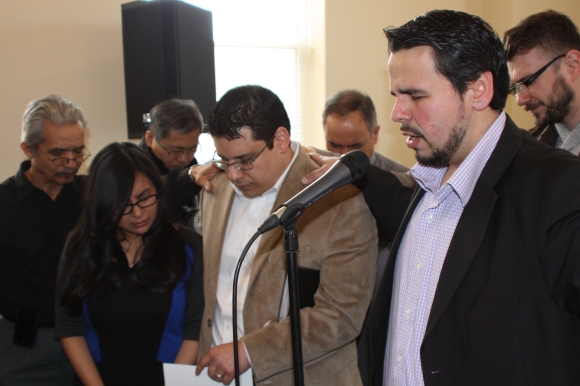
Starting Point in Chicago: Pastor Marvin del Rios of Iglesia Bautista Erie (right) prays for the new congregation his church is sponsoring, led by Pastor Jonathan de la O and his wife, Emely, surrounded by leaders from Chinese, Korean, and Romanian church plants who attended the April 6 launch service.

Starting Point in Chicago: Pastor Marvin del Rios of Iglesia Bautista Erie (right) prays for the new congregation his church is sponsoring, led by Pastor Jonathan de la O and his wife, Emely, surrounded by leaders from Chinese, Korean, and Romanian church plants who attended the April 6 launch service.


Across Illinois |
Five new churches held their “grand opening” events during the two weekends before Easter.

The congregations couldn’t be any more different: They are Hispanic, Korean, Anglo, and multicultural. They meet in the inner city, in new suburbs and older neighborhoods, and way out in the countryside.

Yet their worship services are remarkably alike: all in English, all contemporary, all enthusiastic, and mostly loud.

Collectively they show how some important ministry trends are reaching both main roads and back roads in Illinois:

➢ After decades of planting ethnic language churches, English-language ministries may be the next wave as the grown children of immigrants aren’t feeling comfortable in their parents’ churches.

➢ Starting new churches is getting more complicated and expensive and harder for planters to do solo. That is resulting in more multi-site churches and in new networks among church leaders.

➢ And in some situations, starting from scratch may prove a better strategy than re-engineering a faltering ministry.

Jonathan de la O was born in the United States, but his parents are from El Salvador. He is the product of two countries. “I wasn’t 100% Latino or 100% American, at least in the eyes of those around me,” he said. “It made it difficult to identify with a people group.”

When called to pastor a church, he asked what kind? “I didn’t know where I fit in,” he said in a video.

That tension produced a new kind of church in the Humboldt Park neighborhood: Hispanic worship in English. It’s designed to reach people like him, second-generation young adults, the children of immigrants who are often more like the kids they went to school with than their own parents.

De la O cites a statistic showing 60% of second-gen adults have markedly different culture, language, education, and income than first-gen immigrants. If they don’t find a different kind of church than mom and dad’s, he said, they are likely to drop out.

At home, and not at home

If the very different needs of younger people sound familiar, there’s good reason, said IBSA’s multicultural church planting specialist, Jay Noh. “The gap between first-gen immigrants and their U.S.-born second-gen children includes every challenge that the mainstream U.S. churches have faced, compounded by differences in languages and culture.” In his words, “The paternalistic assumptions of the first-gen won’t be accepted” by their children.

“As soon as they are able to escape the world of their parents and other people of authority, they find a place that is somewhere between their ethnic heritage and the dominant American culture,” said Van Kicklighter, who heads church planting for IBSA.

De la O hopes that place will be his new church. Starting Point Church is meeting in the newly refurbished building owned by Chicago Metro Baptist Association. Noh is assisting another second-gen church start that also shares the space, The Way Bible Church, reaching young Romanians. The Romanian congregation, and second-gen Koreans, Chinese, and international students from Moody Bible Institute, packed out the launch service to show support for De la O and the new church.
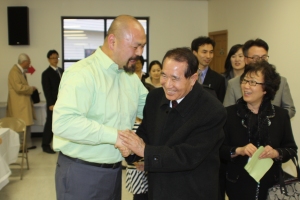
Bethel Church in Mt. Prospect: A multi-ethnic crowd feasted on an international menu following the church's first public service. Pastor John Yi (in the green shirt) shakes hands and bows to almost every guest. Yi has led a ministry to poor families in another Chicago suburb since 2008.

Bethel Church in Mt. Prospect: A multi-ethnic crowd feasted on an international menu following the church’s first public service. Pastor John Yi (in the green shirt) shakes hands
and bows to almost every guest.

Later that same day, northwest of Chicago in Mt. Prospect, a worship band rehearsed prior to the first public service of Bethel Church. On the platform was the expected array of guitar players and drummers, plus one violinist. Mostly Korean, they sang in English and the music was loud.

“Is this typical of Korean worship services?” a guest asked two teenage girls who were thumbing their phones while sitting on the back row of the borrowed sanctuary.

“No,” one girl said. “Not the Korean-language services. They are very traditional.”

“Very,” the other added, “but EM – that’s English Ministry – those services are contemporary. Not as, um, Korean,” she said, smiling.

“Not as, um, Korean” might be a good slogan for Bethel Church. Pastor John Yi has led a multicultural community ministry to poor families in Maywood, about 15 miles away. Now he is starting a new church, also multicultural, which is expected to draw several ethnic groups, but especially second-generation Asians. Like the young women on the back row.

“Our principal attention has been on unchurched English-speaking people in our surrounding neighborhoods in Mt. Prospect even though Bethel Church is made up of a largely Asian-American base,” Yi said. “Interestingly, our ethnic affinity is difficult to dismiss and thus, we have attracted a lot more Korean-speaking people than we had planned.”

The disconnect between generations becomes evident as older people filled the pews, then attempted to sing English worship songs. It’s not only the linguistic gap, there’s a musical gap that many churches have had to bridge.
Their discomfort is evident, but clearly the older people support Yi and his effort to reach their children’s generation. It’s all smiles and bows as about 300 people filled the fellowship hall after the service and shared an inaugural meal of stir-fried rice, Buffalo wings, and Italian spaghetti.

“The first generation has a growing understanding of the necessity of having a gospel ministry that’s culturally indigenous for their U.S.-born second gen,” Noh said. “This may have come about belated as a result of a decade or more of the young generation’s silent exodus from their ethnic churches.”

New networks, new sites

Grace Point in Frankfort: Pastor Emanuel Istrate greets worship attenders at his church's first service. Grace Point is a church plant of Crossroads Community Church in Carol Stream.

Grace Point in Frankfort: Pastor Emanuel Istrate (right) greets worship attenders at his church’s first service. Grace Point is a church plant of Crossroads Community Church in Carol Stream.

In the far south Chicago suburbs, another church launched this day. Meeting in a middle school amid large new houses, this church plant is a restart. “First Baptist Church of New Lennox approached us asking for help,” said Scott Nichols, pastor of Crossroads Community Church in Carol Stream, another suburb 40 miles away. “They sold their building and had been meeting in a school….Unfortunately, they were…near to closing the doors.”

Nichols and his team did what they have done twice before: they brought in leaders and vision. First they offered Saturday night services utilizing the Carol Stream staff. Then, after calling a campus pastor to lead the new work, they restarted Sunday morning worship.

On opening day, Grace Point Community Church in Frankfort welcomed about 60 people from the area. Their target is not based on ethnicity but proximity. “Our target is anyone who will hear us,” Nichols said. “We have gone door to door and mailed about 20,000 postcards to the area.”

Nichols recounts how he’s often said, “You could blindfold an ape and give him a dart. Any place on the Chicagoland map he hits is a good place to plant a church!”

The Crossroads/Grace Point plant demonstrates two trends: the trend toward shutting down a foundering church, then allowing a stronger church to restart a ministry with new vision and new DNA; and the emergence of networks among churches that produce multi-site ministries.

“I believe this is happening both out of necessity and a new valuing of multiplication and reproduction,” Kicklighter said. “Necessity, because churches and pastors are hungry for connection with others,” but also from “a passionate commitment to impact lostness and to do whatever it takes to reach people and give them a local church in which to grow as disciples.”

North by northwest

Grace Fellowship in Davis Junction: Pastor Brad Pittman's church meets in a renovated electrician’s shop at an Ogle County crossroad. Pittman (left) is leading Grace Fellowship's third campus.

Grace Fellowship in Davis Junction: Pastor Brad Pittman’s church meets in a renovated electrician’s shop at an Ogle County crossroad. Pittman (left) is leading Grace Fellowship’s third campus; the other sites are in Ashton and Amboy.

As at Crossroads, the leaders of Grace Fellowship have a broad vision. On Palm Sunday weekend, in a small metal building in north central Illinois south of Rockford, that vision is becoming reality – for the third time.

“I got my first job when I was 13,” Brad Pittman said, “tasseling corn. Anybody know what tasseling corn is?” Hands shot up across the room, along with a few chuckles. “Best job in the world,” he said, before describing his journey from corn tasseler to full-time church planter. A member at Grace Fellowship for 13 years, Pittman eventually joined the staff with pastors Jeremy Horton and Brian McWethy. From the main campus in Ashton, the trio launched Grace Fellowship in Amboy in 2012, and next in rural Davis Junction.

“This is a part of the state where Southern Baptists have had little presence,” said Kicklighter. “When Baptists moved from the south, they settled primarily in the metropolitan areas of the north to work in industry. They did not come to Illinois to buy farms…so we have few churches in these kinds of settings.”

The mainline denominations were better established here, but their churches are in steep decline. So, there is potential here.

“There are over 4 million people living in the non-urban context in Illinois,” said IBSA’s John Mattingly, who leads church planting in the northwest quadrant. “I believe God has prepared many more churches like Grace Fellowship to step out in faith and do something remarkable.”

The three pastors targeted Davis Junction (called “DJ” by the locals) because there was only one faltering mainline church there to serve more than 4,000 people. “We hung over 800 door hangers” in the week before the launch, Pittman said. “We don’t know what the Lord is going to do; we’ll have to wait and see,” he said, before describing how deeply he feels the spiritual need in the area.

“This is not the typical multi-site church plant,” Kicklighter said, “but a commitment to reproduction and, even more importantly, sending people who will impact another place with the Gospel. This is a value system commitment that says extending the reach of the Gospel and the church is at least as important as how many we gather in our own building on Sunday morning.”

More than 60 turned out for the first Saturday evening service, some from the church’s other locations, but many new visitors from DJ. After the service in the brightly rehabbed building, there are lots of hugs, as at each of the launches, and cake.

It is a birthday, after all.

After closure, new hope
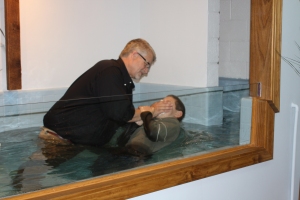
New Hope in Rock Falls: Pastor Jon Sedgwick prays with IBSA church planting leaders Van Kicklighter (left), John Mattingly (right) and Jordan Van Dyke, a future church planter in Galesburg, prior to the launch service. Later Sedgwick baptized a brother and sister.

New Hope in Rock Falls: Pastor Jon Sedgwick baptized a brother and sister at his church’s launch service.

The next morning Jon Sedgwick is all smiles as he baptizes two new believers. Sedgwick didn’t intend to plant a church in northern Illinois. “I didn’t like Illinois,” the former Missouri pastor said emphatically. Illinois was just a place to get through when traveling home to Indiana for visits with family. “But God gave us a love for Illinois!”

“We love Rock Falls!” his wife, Rhadonda, added, equally enthusiastically.

Mattingly had visited the Sedgwicks’ Missouri church describing the need for planters in the Northwest quadrant of Illinois. After Mattingly’s second appeal – “Is God calling someone here to come and help?” – the couple realized, “It was us. God was calling us. God said, ‘Why not you?’”

In 2012, they arrived and began building a new ministry at the building that once housed First Southern Baptist Church of Rock Falls. To the usual round of Bible studies and home meetings, Sedgwick added “Celebrate Recovery,” a faith-based twelve-step program originated by Rick Warren and Saddleback Community Church in California. Reaching out to people with addictions, Sedgwick found doors opening that once were closed to Baptist ministry.

At the worship service, greeters David and John freely told guests how they came to be part of New Hope Church through the recovery ministry.

Also in attendance was Jordan Van Dyke, a planter who is gathering a core group for a new church in Galesburg.
It is commonly observed that ministry in northwest Illinois is especially challenging. “It’s because of the soil,” Van Dyke said. “It’s hard. Sometimes I wish I’d been sent to southern Illinois where, when it’s Sunday, people go to church. In the northwest, it’s Sunday and church is an option. ‘Will I go to church?’ Maybe. Maybe not.”

On this day they do, because there’s new hope in Rock Falls.

Eric Reed is editor of the Illinois Baptist newspaper. In the May 26 issue of IB, we’ll continue our series on The Midwest Challenge with a focus on church revitalization. Go to http://ibonline.IBSA.org to read past issues.

Sonja Conrad was baptized during a spring crusade at First Baptist Church, O'Fallon, Ill.

Sonja Conrad was baptized during a spring crusade at First Baptist Church, O’Fallon, Ill.

THE BRIEFING | Meredith Flynn

A task force appointed to study declining baptisms in the Southern Baptist Convention released its report May 12, detailing five problems they believe have contributed to the recent downward trend. The task force, appointed last year by the North American Mission Board and comprised mostly of pastors, also suggested five solutions focused on prayer, evangelism and discipleship.

When it was published in June 2013, the Annual Church Profile (ACP) report showing the previous year’s facts and figures sounded several alarm bells: 25% of Southern Baptist churches reported zero baptisms. And 60% of churches baptized no one in the 12-17 age bracket.

“We have a spiritual problem,” the task force acknowledged in its report. “Many of our SBC pastors and churches are not effectively engaged in sharing the gospel and yet continue business as usual. We need a sense of brokenness and repentance over the spiritual climate of our churches and our nation.”

Churches also need to get back to celebrating baptisms, the group said. “Many of our churches have chosen to celebrate other things as a measure of their success rather than new believers following Christ in baptism. We have drifted into a loss of expectation.”

To address the decline, the task force suggested five focus areas for pastors that correlate to five problem areas (spiritual, leadership, discipleship, next generation, and celebration):

1. Pray for spiritual awakening.

2. Model personal evangelism and provide pathways. (NAMB has introduced a new evangelism tool called “3 Circles: Life Conversation Guide.)

3. Create a disciple-making culture.

4. Serve the next generation.

5. Celebrate evangelism and baptism.

“…We encourage our fellow SBC pastors to join us in owning this problem,” the task force said. “Together, we can seize this opportunity to lead our churches and be part of the solution.”

For more on the task force’s report, evangelism tools, and a new video challenge, go to www.namb.net/baptismtaskforce.

Boko Haram offer to release kidnapped girls may be ploy, Nigerian Southern Baptist says
Terrorist group Boko Haram released a video Monday offering to release about 100 of the Christian girls they’ve kidnapped, in exchange for the release of Boko Haram prisoners in Nigeria. But the offer could be a tactic to buy time to strategize, Adeniyi Ojutiku told Baptist Press. Ojutiku is a Southern Baptist and co-founder of Lift Up Now, a Christian-based grassroots organization addressing political, economic and social challenges in his homeland Nigeria.

“They have wiped out families. They have killed generations of people, even infants,” Ojutiku said of Boko Haram. “They have maimed people for life. They have killed hundreds and thousands of people. And then to conceive that you would negotiate with such very, very despicable … people who commit such heinous crimes, it is unthinkable to me.

“These people must be prosecuted,” he said. “There cannot be sustainable peace without justice.” Read the full story at BPNews.net.

Arkansas becomes first southern state to issue marriage licenses to same-sex couples
County clerks in Arkansas were thrown into a state of confusion by Judge Chris Piazza’s decision to overturn the state’s ban on same-sex marriage on Friday, May 8. By Monday, clerks in some counties were issuing marriage licenses to same-sex couples, while others had decided not to. Attorney General Dustin McDaniel filed paperwork to temporarily extend the ban Monday, the Associated Press reported, but clerks can continue to issue marriage licenses to same-sex couples until the state’s Supreme Court processes documents from both sides on Tuesday.

Translators work to get Bible into dangerous territory
Ten million landmines may still be buried in Angola, left over from a 27-year civil war that ended in 2002. But Wycliffe Associates, known for their efforts to translate the Bible into every language, is working to take God’s Word to the southern African nation, The Christian Post reports. “These people have been ravaged by brutality and poverty,” said Bruce Smith, president and CEO of Wycliffe Associates. “They live in daily danger of stumbling onto hidden land mines. But worst of all, many have never even heard a word of scripture in their own language.” Read more about Wycliffe’s Angola project at ChristianPost.com.

HGTV stops production on show starring Christian brothers
A reality show in the works about two house-flipping brothers was shelved after the group Right Wing Watch posted about David and Jason Benham’s beliefs about marriage, homosexuality and abortion. “Flip it Forward” would have followed the Benham brothers as they helped six families renovate homes, reports ChristianityToday.com. “We promised we would give Jesus glory whether in victory or defeat,” David Benham said after the show’s cancelation. “Sure seems like we’ve been defeated lately. But you know what? God is bigger than all of this.”


Redunda_Noble_blog_calloutHEARTLAND | Redunda Noble

Our church recently completed a study based on Thom Rainer’s eye-opening book “I Am a Church Member.” In the book, Rainer shared practical insight for developing the right attitude about the part we play as members of the Body of Christ. I breezed through the first few chapters with an air of superiority. As the wife of a pastor for more than 15 years, I was completely proud of myself for being a “model” church member. After all, I was already obeying most of the principles articulated in the book. I kept thinking, “It sure would be great if ‘brother and sister so-and-so’ read this book.” (Be honest. You know you have thought this too!)

I gleefully stood on my pedestal — until I got to chapter four.

The title, “I Will Pray for My Church Leaders,” hit me on the head like a ton of bricks, knocking me off my pedestal and down to my knees.

The moment I read the title, it struck me that I was the one who needed this book. I was not spending quality time daily in prayer for my pastor (who is my husband) and the other leaders of our church. (Bear with me while I confess.) I prayed daily like most Christians. I prayed for my family, my health, my needs, my wants, my desires, my struggles … my, my, my. My. All about Me! Oh My! How selfish I was in my prayers! Nowhere in my prayers did I petition the Lord specifically for the needs of my pastor and leaders.

We mistakenly think our pastor doesn’t need our prayers because when we see him, he is in the pulpit, often wearing a tailored suit and always a smile. We never want to think that our pastors and leaders might be struggling and desperately need our prayers.

Rainer challenges us to pray five minutes a day for our pastor. Only FIVE minutes. Who doesn’t have five minutes, right?

Jesus is the Son of God; yet he understood the importance of prayer in ministry. In Luke 6:12, the Bible records Jesus going to a mountain to pray. He stayed there and prayed ALL NIGHT. As Christians, we should follow Jesus’ example by spending ample time in prayer. While most of us understand we should pray, we have difficulty finding the time to pray. After looking at my own prayer life, I found that I struggled in three areas:

Prioritize prayer
How often do we get up in the morning, get dressed, eat breakfast and rush out the door, certain that we will have time to pray later? But later never comes. By 10:30 p.m., I was exhausted from the busyness of the day, managing to whisper only a few words to the Lord before drifting off to sleep. To prioritize prayer, I had to prioritize my morning and designate a specific time to pray.

Learn what your pastor’s needs are. Pray for his needs the way you pray for your own. It does not matter when you pray as long as you do pray. Put a daily reminder in your smartphone and take the time to pray for your pastor.

Persevere in prayer
You will find that when you decide to pray regularly for your pastor and the leaders in your church, many things will challenge your commitment. You may choose to start with prayer early in the morning, but on the day you begin, the baby wakes up crying at the same time. You may decide to pray on your lunch break at work, but find that other employees constantly interrupt. You may plan to pray in the evening, but your child’s teacher sends extra homework that requires your help. Whatever the challenge, recognize that prayer honors God. Don’t give up. Although you may struggle in the beginning to pray, what joy you will find when you persist.

Prayer is a privilege
What is your attitude toward prayer? Do you see prayer as just another chore added to your to-do list? Attitudes are important to God. View prayer as a privilege. See it as your opportunity to spend time with the One who loves you most. Ask God to give you a desire to pray.

I have struggled to be consistent. But I find that as I continue to pray, my love for the Lord, His church, and my spiritual leaders grows deeper. I hope you find this to be your experience as well.

Redunda Noble leads a women’s Bible study, sings at church and serves alongside husband James Noble, pastor of Grace Fellowship Baptist Church in Memphis, Tenn. This Baptist Press column is part of the call to prayer issued by Frank S. Page, president of the Southern Baptist Convention Executive Committee, to pray for revival and spiritual awakening for churches, the nation and the world.

Russell Moore, president of the Ethics and Religious Liberty Commission, has used the phrase “convictional kindness” to describe how Christians ought to engage a vastly different culture than the one their parents and grandparents knew.

Russell Moore, president of the Ethics and Religious Liberty Commission, has used
the phrase “convictional kindness” to describe how Christians ought to engage a vastly different culture
than the one their parents and grandparents knew.


NEWS | Meredith Flynn

Southern Baptists’ generals in the culture war demonstrated their new strategy at an April meeting for church leaders. But the tactic, softer in decibels but not doctrine, was met by criticism from opponents using modern weaponry – social media.

“The way that we are going to be able to speak to the people in our culture…is not by more culture war posturing, but by a Christ-shaped counter-revolution,” said Russell Moore, president of the Southern Baptist Ethics and Religious Liberty Commission.

The conference on sexuality and the Gospel was the ERLC’s first major event since Moore assumed leadership from Richard Land, who served as the denomination’s main voice on issues such as abortion and first amendment rights.

The event came with a sort of confession: the culture war as we knew it is over.

“We’re all in agreement that the cultural war is over when it comes to homosexuality, certainly when it comes to gay marriage,” Florida pastor Jimmy Scroggins said at the ERLC’s summit. In his urban context of West Palm Beach, Scroggins said, “The question is what are we going to do in the church.”

Some might call this “post-culture war America.” Others might conclude that we’ve entered a new phase, culture cold war, with new weapons such as Twitter and a new battlefield, ironically, inside the church.

Embrace the strangeness
This new culture has been on the horizon for a while: Marriage rates across all demographic groups have fallen continuously since 1970, Andrew Walker of the ERLC noted during his summit breakout session. Cohabitation rates are up too: USA Today reported last year that for almost half of all women between ages 15 and 44, their “first union” was cohabitation instead of marriage.

Also on the rise: Approval for redefining marriage. A recent ABC News/Washington Post poll reported 59% of Americans approve of same-sex marriage.

Addressing sweeping social and cultural changes was one emphasis of the April 21-23 meeting in Nashville, but speakers also talked about how church leaders ought to interact with increasingly specific questions arising at their churches. Like what to do when a transgender person expresses repentance and belief in Christ. Or how to counsel college students when premarital sex is not only accepted, it’s expected on the first date.

A few days before the ERLC summit, Moore appeared on ABC’s “This Week” to discuss religion and politics with a panel of evangelical and conservative leaders. He talked about the falling away of nominal, in-name-only faith, and the increasing “strangeness” of Christianity. Moore told moderator Martha Raddatz, “It’s a different time, and that means…we speak in a different way.”

“We speak to people who don’t necessarily agree with us. There was a time in which we could assume that most Americans agreed with us on life, and on abortion, and on religious liberty and other issues. And we simply had to say, ‘We’re for the same things you’re for, join us.’

“It’s a different day. We have to speak to the rest of the culture and say, ‘Here’s why this is in your interest to value life, to value family, to value religious liberty.’”

During the Nashville meeting, social media provided plenty of evidence of the divide. The meeting was one of Twitter’s top trending topics on its first day. Feedback from attenders was positive, but others watching the summit online spoke out, often harshly, against what speakers said.

That Christian views are seen as strange isn’t surprising, Moore said on the ABC broadcast.

“Many people now when they hear about what evangelical Christians believe, their response is to say, ‘That sounds freakish to me, that sounds odd and that sounds strange. Well, of course it does. We believe that a previously dead man is now the ruler of the universe and offers forgiveness of sins to anyone who will repent and believe.”

Reclaim the strangeness of Christianity, he urged at the Nashville meeting, basing it on the death and resurrection of Jesus.

So, what should we say?
Throughout the summit, speakers stressed the supremacy of the Gospel and clarity of what the Bible teaches about sexuality. Christians shouldn’t apologize for it, said Andrew Walker. Preaching an almost-Gospel is no match for the sexual revolution, Moore said.

Or, as Southern Seminary’s Denny Burk put it, “We have to be grave about these things.”

Scripture calls Christians to speak the truth, but to speak it in love. “We have to reject ‘redneck theology’ in all of its forms,” Jimmy Scroggins said during a panel discussion on the Gospel and homosexuality. “Let’s stop telling ‘Adam and Steve’ jokes.” (God created Adam and Eve, not Adam and Steve…)

As the audience chuckled, Scroggins continued, “Let’s be compassionate because these are people that are in our community, these are people who are in our churches, these are people who have grown up in our youth groups, and these are people that we’re trying to win to Christ, and we want to care for them as a people created in God’s image.”

Speaking with “convictional kindness” has been a major part of Moore’s message in his first year as ERLC president. “I hope to speak with civility and with kindness and in dialogue with people with whom I disagree,” he told Christianity Today last year.

It’s a timely endeavor, especially when social norms run ever more contrary to the Gospel. J.D. Greear pastors The Summit Church in Raleigh-Durham, N.C. At a church that reaches a large number of college students, sexual ethics are a topic of constant conversation.

“Sex gets at the core of who we are. Its dysfunction and its damage is deep, but the Gospel goes deeper still,” Greear said. “Because where sin abounds, grace much more abounds, and the great brokenness of sex presents an even greater opportunity for the Gospel.”

The May 26 issue of the Illinois Baptist will examine in more detail how speakers at the summit addressed contemporary threats to biblical sexuality and marriage. The ERLC also will look more closely at “The Gospel, Homosexuality, and the Future of Marriage” at a conference scheduled for Oct. 27-29 in Nashville.

Jared Moore

Jared Moore

Update (May 20): Bennie Smith, a deacon from New Salem Baptist Church in Hustonville, Ky., will nominate Jared Moore for president at the SBC Annual Meeting in Baltimore.

NEWS | Kentucky pastor Jared Moore announced this week he will allow himself to be nominated for president of the Southern Baptist Convention at the denomination’s June meeting in Baltimore. Moore, pastor of New Salem Baptist Church in Hustonville, Ky., currently is the SBC’s second vice president.

In a post on his blog and SBC Voices, Moore listed four reasons he’s willing to serve: He wants to serve Southern Baptists, represent rural Southern Baptists, promote unity in the SBC, and promote the Cooperative Program.

“I was saved in a rural Southern Baptist church, and I’ve primarily served rural Southern Baptists ever since,” Moore wrote. “Where I live now, the nearest gas station is 7 miles away. My church is a small church made up of about 60 people. They’re a loving, caring, godly group of people…I want to represent Southern Baptists like the ones I serve on a daily basis who may not have the opportunity to attend the convention or serve at the convention level.”

I want to represent Southern Baptists like the ones I serve on a daily basis who may not have the opportunity to attend the convention or serve at the convention level. – See more at: http://sbcvoices.com/why-i-am-allowing-myself-to-be-nominated-for-sbc-president/#sthash.M2hwtrUG.dpuf

Moore joins Ronnie Floyd, pastor of Cross Church in northwest Arkansas, in the election to succeed current SBC President Fred Luter. Fellow Kentucky pastor Paul Sanchez will nominate Moore, and Albert Mohler, president of The Southern Baptist Theological Seminary, will nominate Floyd.

I was saved in a rural Southern Baptist Church, and I’ve primarily served rural Southern Baptists ever since. Where I live now, the nearest gas station is 7 miles away. My church is a small church made up of about 60 people. They’re a loving, caring, godly group of people. – See more at: http://sbcvoices.com/why-i-am-allowing-myself-to-be-nominated-for-sbc-president/#sthash.M2hwtrUG.dpuf

I was saved in a rural Southern Baptist Church, and I’ve primarily served rural Southern Baptists ever since. Where I live now, the nearest gas station is 7 miles away. My church is a small church made up of about 60 people. They’re a loving, caring, godly group of people. – See more at: http://sbcvoices.com/why-i-am-allowing-myself-to-be-nominated-for-sbc-president/#sthash.M2hwtrUG.dpuf

The_BriefingTHE BRIEFING | Half of all Illinois residents said they’d move out of state if they could, putting the Land of Lincoln at the top of a Gallup survey of all 50 states. But it’s a dubious honor: On average, only 33% of residents in all states would like to move, compared to 50% in Illinois.

19% of Illinois residents said they are extremely, very or somewhat likely to move in the next year, compared to about 14% across all 50 states.

Gallup linked their most recent poll to similar studies that measure how negative residents are about their state’s taxes, and how much they distrust their government. Illinois topped the latter list too – only 28% of residents said they had a great deal or fair amount of trust in their state government. As for taxes, 71% of Illinoisans said they were too high, placing the state fourth on a list topped by New York, New Jersey and Connecticut.

One piece of good news amid the bad: A study from the University of Colorado-Boulder named Chicago the country’s funniest city, largely because of its improv scene. Judging from the Gallup numbers, it may be a good time to learn to laugh at ourselves, too. Read more at Gallup.com.

Supreme Court rules in favor of town meeting prayers
The U.S. Supreme Court on Monday ruled that prayers before town meetings in Greece, N.Y., can continue. The Second Circuit Court of Appeals in New York City had ruled the prayers “had the effect of affiliating the town with Christianity,” but the Supreme Court’s 5-4 decision overturned that ruling. “This is a victory for all of those who believe in the freedom of speech, including religious speech, as a prized part of our God-given religious liberty,” said Russell Moore, president of the Southern Baptist Ethics and Religious Liberty Commission. Read the full story at BPNews.net.

Oklahoma school district bars pre-game prayers
The Freedom From Religion Foundation successfully lobbied an Oklahoma school district to stop pre-game prayers led by baseball coach Larry Turner and his staff. In a letter written by his attorney, Owasso School District Superintendent Clark Ogilvie said his district “will not allow any District employees to participate with any District students in any prayer or other religious activities in connection with any school-sponsored events.” Read more at ChristianPost.com.

Page appoints SBC Mental Health Advisory Council
Frank Page, president of the Southern Baptist Executive Committee, has named a 23-member advisory council to assist churches as they respond to mental health needs in their congregations. The group, chaired by Kentucky pastor Tony Rose, will address concerns brought by messengers at the 2013 SBC Annual Meeting in Houston. There, Baptists approved a motion by Arkansas pastor Ronnie Floyd to ask Southern Baptist entities “to assist our churches in the challenge of ministry to those suffering from mental health issues…” Messengers also approved a resolution on “Mental Health Concerns and the Heart of God.” Read more at BPNews.net.

Disaster Relief volunteers respond to southern storms
Southern Baptist Disaster Relief teams moved quickly into the Southeast U.S. following a spate of tornadoes and severe storms two weeks, and are still at work in several states.

“These storms were so strong that the slabs were swept clean by the wind,” said Disaster Relief director Joe Garner in Arkansas, where teams were serving the Mayflower and Vilonia areas. “There is very little chainsaw work to do. It is mainly clearing debris.”

Since April 26, destructive storms have affected 13 states, Baptist Press reports. For more Disaster Relief updates, go to BPNews.net.

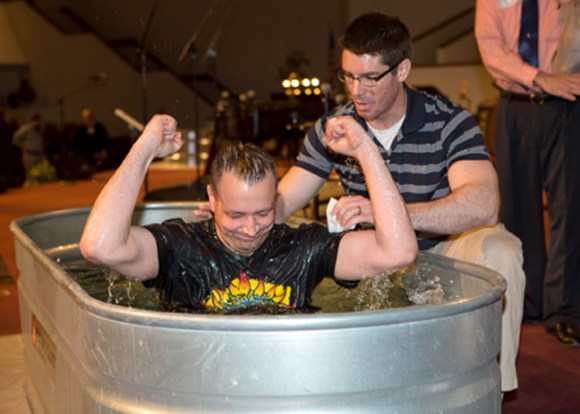
After being baptized in a horse trough, David Vittetoe celebrates as John Howard, minister to students, assists. The troughs gave the church three locations to baptize the 103 people who came forward.

After being baptized in a horse trough, David Vittetoe celebrates as John Howard, FBC O’Fallon minister to students, assists. The troughs gave the church three locations to baptize the 103 people who came forward.


HEARTLAND | Lisa Sergent

Over a single weekend, more people were baptized at First Baptist, O’Fallon, than in all of 2013. The church’s crusade March 29-30 resulted in 103 baptisms, 17 salvation decisions, and 15 rededications.

Tom Dawson, FBC’s minister of adult education who helped organize the crusade, described it as “a wonderful event.” He called Texas evangelist Ronnie Hill “electric. He brought God’s Word straight to peoples’ hearts.”

Dawson said the church did “quite a bit of preparation” in the month before the crusade. Prayer, training, and logistics were key. Groups spent time praying for Hill and for those who would come and make decisions. Church members were trained to be “encouragers,” or counselors, to talk with people as they came forward.

Carol Cluff, adult ministries specialist, said the encouragers were trained a few days in advance of the crusade. “We wanted to make sure every person who stepped forward had someone to come with them, to talk with them about what prompted them to come forward, and to make sure they fully understood the commitment they were making.”

She noted many of those who were baptized had come to understand they had been “baptized out of order. Several people realized they had been baptized as a baby or even as a child without knowing Christ and wanted to be baptized now as believers in Jesus. Others had accepted Christ at youth events some time ago, but not taken that step.”

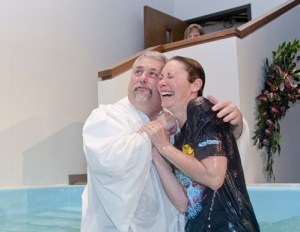
Sarah Schultz rejoices with Skip Leininger, associate pastor of FBC O’Fallon, after being baptized at the church’s March 29-30 crusade.

Sarah Schultz rejoices with Skip Leininger, associate pastor of FBC O’Fallon, after being baptized at the church’s March 29-30 crusade.

Hill urged the church to be ready to baptize people in each session and not make them wait until a later date. In anticipation of a large number of baptisms, the church made sure to have plenty of T-shirts, shorts and towels on hand. Plus, they placed two horse troughs filled with water on either side of the platform giving them three locations, including the baptistery, to baptize people in a single service.

“We were ready to baptize people on the spot,” Dawson said.

First Baptist has made follow-up a priority, stressing the importance of continued discipleship. In a series of follow-up actions, encouragers are keeping in touch with those they counseled and are connecting them with small groups within the church. As part of the effort, Senior Pastor Doug Munton is leading a special sermon series covering the Good News and the importance of baptism along with why Christians should share their faith and be fishers of men.

Munton is pleased with the crusade’s outcome. “We had a great crusade,” he shared. “The Gospel was preached clearly and the response was great. Many people trusted Christ as Savior and that never gets old to me. And, it was such a privilege to see more than 100 people follow the Lord in believer’s baptism.”

Leininger prepares to baptize Sonja Conrad.

Leininger prepares to baptize Sonja Conrad.

Dawson said church members are excited. The momentum continued into Easter as the church had its largest Easter Sunday worship attendance – 2,569 people.

“The crusade was wonderful,” said Cluff. “It lit us on fire.”

Mark_Coppenger_blog_calloutCOMMENTARY | Mark Coppenger

You know the scene: A troubled family member arrives at home only to find various loved ones seated in the living room. They ask him or her to sit down and hear what they have to say. One by one, they read prepared statements of love and admonition. The subject, eyes brimming with tears or flashing with indignation, endures as much as possible before caving in, pushing back or storming out.

The poor soul has bottles hidden around the house and in the flowerbed, and she can find another pint as soon as her prime stashes are blown.

Or there’s the trash addict who can’t throw anything away, even dead animals. (I was called in on a cleanup with some church members in my seminary days; we found a dead, dried out cat under matted stained clothes under stacks of newspapers in one of the closets.)

An intervention is very uncomfortable but worth it, whether the addiction is drugs or drink, clutter or cussedness. They’re ruining themselves, as those around them are grieving if not outright harmed. And they don’t much appreciate your suggestion that something is out of whack.

I know that people can come to Christ in a lot of tender ways. An immigrant wife is touched by her Christian neighbor’s shopping and language tips. A lost welder is disarmed by the warmth of a church softball team he’s been asked to join. A “singing Christmas tree” rendition of Joy to the World brings tears to the eyes of a cranky, unchurched parent who shows up to watch his high school senior perform.

But the Lord has also used Jonathan Edwards’ Sinners in the Hands of an Angry God and the chaste slap of a godly college girl knocking some sense into a unbelieving suitor, whose advances were unseemly, a jolt which caused him to reassess his secular worldview. Or how about Mordecai Ham’s scathing anti-alcohol parades, which salvifically grieved some drunks standing outside bars on the roadside?

God may well use a sequence of happy and scary events and items to lead an individual to Himself. (I think I once heard the late evangelism professor Roy Fish say the average was seven Gospel touches before conversion.)

So Bob may have been providentially prepped for salvation by, in order, a Vacation Bible School lesson he heard at age 8; a highway sign reading, “Prepare to Meet God”; a Jack Chick tract named Holy Joe; the stellar performance of a homeschooled spelling bee champ who thanked Jesus for helping her; five minutes of a Joel Osteen sermon; and a friend who repeated something he heard in an Alistair Begg broadcast.

Truth is, we risk looking silly when we declare, well beyond our competency and theological warrant, that all evangelistic approaches other than our own are tacky, pompous, dated, specious, trendy, dopey, sleepy, grumpy, sneezy and bashful.

That being said, there is an irreducible kernel of awkwardness and agony in conversion — repentance. I compare it to throwing up. I hate it. I fight it. (On a bucking airplane I close my eyes, turn the air full blast on my face, breathe deeply and sit very still.) I suppress it with every fiber of my being. But when it comes, oh, the relief — the blessed cooling of a sweaty brow, the relaxation of suppressed muscles.

Yes, it’s that gross, as is repentance, as we hurl up and out the poison and rot of self and sin and damnable, willful stupidity — the sort of thing you find in James 4:8-10: “Cleanse your hands, sinners, and purify your hearts, double-minded people! Be miserable and mourn and weep. Your laughter must change to mourning and your joy to sorrow. Humble yourselves before the Lord, and He will exalt you.”

Sometimes we hear and say that a witnessing Christian is “just one beggar telling another one where to find bread.” I’d suggest it’s more like a formerly-suicidal fellow who was talked off the ledge trying to talk a currently-suicidal fellow off the ledge. Or it is like a repentant Taliban terrorist in Gitmo going on TV to dissuade current Taliban terrorists to cut it out.

Of course, most don’t think that a law-abiding, philanthropic citizen — working the NYT crossword in Starbucks on Sunday morning, sitting across from his wife Khloe enjoying a half double decaffeinated half-caf with a twist of lemon, beside their jogger stroller bearing little Nash — is a suicidal terrorist. But he is just as we were. He’s bound for a well-deserved sinner’s hell, indifferent to the godly stewardship of his life, harming innocents along the way by his passive, aggressive and passive-aggressive defiance of the Kingdom and its gospel of grace, Khloe and Nash being his prime victims as his “spiritual leadership in the home” couples them to his downgrading train.

And so we intervene. If, that is, we love the person, are convinced of his plight and are willing to risk the alienation of affection. It doesn’t take licenses or programs or eloquence, though those can help. It simply demands compassion, courage, a firm grasp of the hard truth and, yes, a life which reflects a better way.

Mark Coppenger is director of the Nashville extension center and professor of Christian apologetics at Southern Baptist Theological Seminary in Louisville, Ky. This column first appeared at BPNews.net.

Mothers Day Offering 2014COMMENTARY | Nate Adams

I remember my dad writing once about an Easter Sunday that came long after we kids were grown and gone. None of us were going to be home for the holiday weekend that year, so my mom suggested that she and my dad volunteer to work in the nursery that Sunday.

In case my dad had doubts, my mom was ready with her reasons. “There are likely to be several young families visiting our church that day. Those who work in the nursery all the time deserve a break. We’re available, and able. Oh, and by the way, others took care of our kids on Easter for years. Even this Easter, others will be taking care of our grandchildren.”

And so those two grandparents who hadn’t needed a nursery nor worked in one for quite a while sat and rocked babies that Easter Sunday. As they did so, they prayed for the families of those babies, and for their own family. I remember my dad saying it was one of the most memorable Easter Sundays he ever experienced.

There is something especially sacred it seems, about giving to others out of gratitude for the way that you have received yourself. In fact, as Mother’s Day now approaches, I think of the countless ways I have benefited from a godly, sacrificing mother. And I think of how blessed our own children have been by my wife’s investment in their lives.

One way to “pay it forward” to others in gratitude for the mothers who have blessed our lives is to give generously to the Mother’s Day Offering for the Baptist Children’s Home and Family Services (BCHFS). Last year, BCHFS provided Christ-centered services to 1,417 individuals – 23% more than the previous year. Through residential care at the Baptist Children’s Home in Carmi, maternity services at Angels’ Cove, multiple Pathways Counseling offices, the Safe Families for Children program, and ministry to orphans in Uganda, BCHFS lives out this year’s Offering theme, “Families are Worth Fighting For!”

Sharing Christ is the central motivation for the services BCHFS provides. Of course they provide ministry and healing that help families through troubled times. But in doing so, the BCHFS staff also unashamedly shares the Gospel of Jesus with those they serve, and seeks to model His love daily to them. Last year alone, 16 children from the Residential Care program and from Safe Families made professions of faith in Christ.

The BCHFS does not receive state or federal contract for care funding, and does not receive funding through the Cooperative Program. Their ministry is completely reliant on the generosity of Illinois Baptist churches and individuals who invest in the lives of those they serve. That’s why the Mother’s Day Offering is so important.

From the BCHFS web site (www.bchfs.com) your church can download information and materials to help you promote this year’s Mother’s Day Offering. And if your church doesn’t receive an offering that particular Sunday, you can still use the web site to donate directly to BCHFS’s important ministries.

If you appreciate your own family, and especially your mom this Mother’s Day, I can’t think of a better way to demonstrate your gratitude to God and “pay it forward” than to support this important ministry to hundreds of hurting families. And remember, if your own family is facing challenges right now, the Baptist Children’s Home and Family Services is there for you too.

Our family will be supporting the ministries of BCHFS this year, and I pray yours will too. Whether it’s thanking our children’s workers with a turn in the nursery, or thanking our mothers by giving to help hurting families, it’s a good, good thing to “pay it forward.” As Jesus said in Matthew 10:8 “Freely you have received; freely give.”

Nate Adams is executive director of the Illinois Baptist State Association.

THE BRIEFING | Meredith Flynn

Barna reports the same percentage of Americans are Bible-engaged as are Bible-skeptical. The annual State of Bible study, produced with the American Bible Society, found 19% of people say they read the Bible at least four times a week and believe it is the actual or inspired Word of God. And 19% say the Bible is “just another book of teaching written by men that contains stories and advice.” The number of skeptics has almost doubled over the past three years, according to a summary at Barna.com.

Baptists may meet with gay author
Southern Baptist leaders who authored a response to Matthew Vines’ book “God and the Gay Christian,” said they’re willing to meet with the author in person. Vines’ book was released April 22, the same day Southern Seminary President Albert Mohler and a group of professors released an e-book to respond to Vines’ belief that Scripture allows monogamous same-sex relationships.

“I will be very glad to meet you in person and not merely in print. I am thankful for a respectful exchange of beliefs,” Mohler tweeted in response to a message from Vines thanking him for engaging in a Religion News Service Q&A about the book. Read more at BPNews.net.

‘Family Talk’ wins in court
A ministry run by Focus on the Family founder James Dobson was issued a temporary injunction against the federal government, meaning the organization does not have to provide abortion-inducing drugs in its employee health care plans. Dobson’s “Family Talk” radio program, newsletter and website has 28 full-time employees, according to an Associated Press report. The U.S. Supreme Court currently is considering a similar case involving Hobby Lobby. Get the full story at ChristianPost.com.

Midwest leaders meet to pray
Around 100 Baptist leaders and church planters from the Midwest gathered in Wisconsin for an April prayer summit hosted by the North American Mission Board. “It was a wonderful time of focused prayer for our personal life, in a small group, and corporately in a large group setting,” said IBSA President Odis Weaver. “We prayed for personal holiness, for the Midwest Send cities, and for revival and spiritual awakening.”

Coach denies proselytizing charges
Clemson University football coach Dabo Swinney, an outspoken Christian, defended his program’s policies after the Freedom From Religion Foundation sent a letter of complaint detailing “several serious constitutional concerns.” FFRF’s concerns include Swinney’s appointment of a chaplain for the team, scheduled devotionals, and the team’s attendance at a 2011 Fellowship of Christian Athletes breakfast.

“Players of any faith or no faith at all are welcome in our program. All we require in the recruitment of any player is that he must be a great player at his position, meet the academic requirements, and have good character,” Swinney responded in a statement. CBS News reported the coach said in a teleconference he would continue to run the program like he always has. Read more at