THE BRIEFING | Meredith Flynn

As World Cup fever raged across the globe – and even here! – new research from Barna showed most Americans recognize their country’s fascination with sports, and almost two-in-three think the culture cares too much about athletics.

The nationwide survey conducted in February found 89% of adults strongly or somewhat agree that sports are an important part of American culture, with men slightly more likely to strongly agree than women. Interestingly, practicing Christians (55%) were the most likely group to strongly agree.

soccer ballBarna also found 27% of Americans believe the culture cares too much about sports, and 39% agree somewhat. A majority of Americans also agree strongly or somewhat that professional athletes make too much money (86%), and that American professional sports are very corrupt and distract from important global issues (both 62%).

As for America’s favorite sport: Football reigns supreme with regular viewers (53%), followed by basketball and baseball (both 33%). Soccer’s numbers were higher than you might think, especially considering the survey was completed before the World Cup. 11% of Americans regularly watch the beautiful game (that’s what they call soccer), 20% have played it, and 16% say their kids play.

Zamperini remembered as Olympian, war hero, Christian
Former Olympic runner and prisoner of war Louis Zamperini died July 2 at the age of 97. Zamperini, the subject of Laura Hillenbrand’s 2010 book “Unbroken,” also was a Christian. His conversion happened at a Billy Graham Crusade after he returned from a Japanese POW camp, at the height of his bitterness and rage over two years of captivity. Read Denny Burk’s tribute to Zamperini.

Some Nigerian girls escape, more than 200 remain captive
While many Americans were celebrating independence, dozens of women and girls in Nigeria were finding freedom from a much more immediate threat. The Christian Post reports more than 60 women and girls kidnapped by Boko Haram on June 22 escaped around July 4. More than 200 girls reportedly are still held by the terrorist group founded to fight the influence of Western education. In a video message released earlier this year, Boko Haram leader Abubakar Shekau threatened to sell the kidnapped girls.

Book release: Piper’s ‘Pastor’s Kid’
Barnabas Piper’s new book “The Pastor’s Kid: Finding Your Own Faith and Identity,” was written for PKs, pastors and churches, the son of famed pastor John Piper wrote in the introduction. Coinciding with the book’s July 1 release, the author answered questions from culture writer Jonathan Merritt in this Q&A for Religion News Service, including the biggest negative effect of his upbringing (“not connecting with God in a personal way”). Piper also shared a few surprising facts about his dad, like his love for the comedy “What About Bob.”

Four Southern Baptists named to ’33 under 33’ list
Christianity Today’s list of influential young leaders includes four Baptists, Baptist Press reported July 1. They are:

  • Trevin Wax, a blogger and managing editor of LifeWay’s The Gospel Project
  • Hip-hop artist turned pastoral intern Trip Lee
  • Former rapper D.A. Horton, who is now the North American Mission Board’s national coordinator for urban student missions
  • Saira Blair, a 17-year-old candidate for West Virginia’s state legislature

See the rest of the list at ChristianityToday.com.


Nate_Adams_July7HEARTLAND | Nate Adams

We have a fairly small front porch. We don’t spend much time there, partly because we live on a cul-de-sac, and our front porch doesn’t offer much privacy. It looks directly into the yards, and lives, of several other families.

We spend much more time on our backyard deck. That’s where we can see most of our flowers and our garden. It’s where we grill during the summer time, and where we enjoy the privacy provided by a number of mature trees.

Last weekend, though, our son Caleb brought over his lawn trimmer to see if I could help him make it work, since it used to be my lawn trimmer. When he arrived, I met him on the front porch, and for some reason we sat down there to work on it. Soon my wife, Beth, joined us, and noted that the only other person who seemed to be outside that beautiful Saturday was our neighbor who has cancer. Let me call her Cindy.

Cindy was out tending to her beautiful front yard flowerbeds. Suddenly Beth exclaimed, “Oh my, Cindy just fell.” Caleb and I then looked up from our work, and saw Cindy lying on her sidewalk.

“Maybe she’s OK. Let’s see if she gets up,” we said. “We don’t want to embarrass her by running over there if she just lost her balance for a minute.”

But as we watched, Cindy just laid there for a few seconds. Then, with great effort, she raised one hand and began waving it slowly in the air.

We all then sprinted to her side. Cindy was relieved to see us, and asked if we would help her try to get up. She had fallen on her hip.

Our first, careful efforts to help her brought her so much pain that we all agreed we needed to leave her where she was and get some medical help. We found her husband inside, who called an ambulance and then scurried around to prepare to go with her to the hospital.

We stayed with Cindy for several minutes, comforting her until the ambulance arrived, and then assured both of them of our prayers. As she was rolled into the back of the ambulance, Cindy raised her hand once again, and softly said, “Thank you for seeing me and for coming to help. If you hadn’t, I think I would still be there.”

It has occurred to me many times since that day how unusual and providential it was that we were even in a position to help Cindy. Like so many, we seem to be backyard deck people more than front porch people.

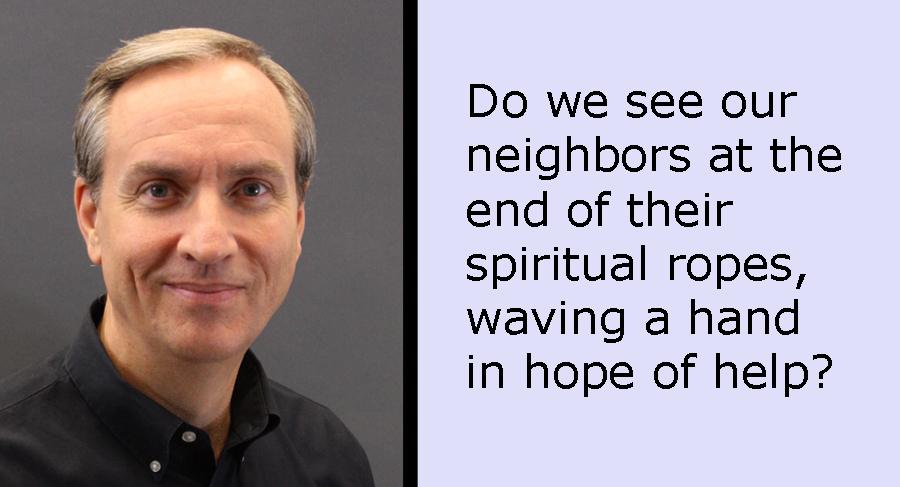
And I have also been convicted how true that is spiritually, in our relationships with our neighbors. How many of the people we know are down and helpless, at the end of their ropes spiritually, and quietly waving one last hand in hope of help? Are we even in a position to see them? Or are we comfortable in our own backyards?

Many of the people we know who have deep spiritual needs don’t even know what or Who they need. Cindy didn’t. She just suddenly knew she was helpless. But because we were in that rare position to see her fall, we were able to play a small role in getting her the help needed.

This summer, let’s all spend more time on the front porch. Let’s look for the frail waves of the people around us. And let’s help them call on the One who can meet them right where they are. We may see their soft wave of gratitude in eternity.

Nate Adams is executive director of the Illinois Baptist State Association.

NEWS | The U.S. Supreme Court has issued additional protection to Wheaton College as it fights a mandate in the Affordable Care Act that requires employers to cover drugs like the morning-after pill in their employee health plans.

Wheaton, a Christian college in a western Chicago suburb, already qualified for an exemption from the Affordable Care Act offered to faith-based non-profit organizations. But many have said the government’s plan – to let non-profits sign a form allowing insurers to pay for the drugs, rather than the organization itself – isn’t enough. As the Associated Press reported July 3, “Wheaton and dozens of other non-profits have sued over the form, which they say violates their religious beliefs because it forces them to participate in a system to subsidize and distribute the contraception.”
The Supreme Court’s unsigned opinion July 3 says that during its court case, Wheaton doesn’t have to sign the form but can write a letter to the U.S. Department of Health and Human Services explaining its objection to the requirements.

The Court’s three female justices – Ruth Bader Ginsburg, Elena Kagan and Sonia Sotomayor – disagreed with the temporary injunction. Sotomayor wrote that the Court’s action “undermines confidence in this institution.”

On June 30, the justices ruled 5-4 that “closely held,” for-profit businesses Hobby Lobby and Conestoga Wood Specialties don’t have to cover abortion-inducing drugs in their employee plans. ChristianityToday.com has a helpful infographic from The Becket Fund forecasting next steps in court cases against the mandate.

Lisa Sergent holds a musket used by a private who served under General George Washington. It is owned by history buff and pastor Dan Fisher (left).

Lisa Sergent holds a musket used by a private who served under General George Washington. It is owned by history buff and pastor Dan Fisher (left).

COMMENTARY | Lisa Sergent

There’s an old song that says, “Don’t know much about history.” What Dan Fisher knows has been largely ignored – or forgotten – in our time. Clergymen were heroes in the American Revolution, said Fisher, himself a Southern Baptist pastor and Oklahoma state representative.

Fisher, the pastor of Trinity Baptist Church in Yukon, Okla., travels the country presenting “Bringing Back the Black Robed Regiment.” A term coined by British sympathizers, the “regiment” were the pastors – Presbyterian, Methodist, Lutheran, Baptist and Episcopalian – who helped lead the fight for liberty from the British. He shared his message to a gathering hosted by the Illinois Family Institute this spring.

Portraying Lutheran pastor Peter Muhlenberg, later a general in the Continental Army who rallied his congregation to fight, Fisher said, “If the church doesn’t speak out, then who will? We were the men of the book, we were the men of truth, we were the men of true liberty because we knew that ultimately true liberty can only come though an internal relationship with Christ. When you have true liberty, then you can defend external liberty.”

Fisher shared how many of these 18th century pastors gave their lives and livelihoods in the fight to defend liberty. He encouraged today’s pastors to stand boldly for religious liberty. “What price are you willing to pay?” he asked.

He applies this aspect of United States history, forgotten by many, to today’s cultural issues. “There comes a time when our liberty must be protected,” said Fisher. “Friends, if we lose our external liberty we lose our internal liberty to believe and preach.”

Urging Christians to take a stand, Fisher stated, “Some 50% of today’s evangelicals don’t even bother to vote. And out of those who do vote, 25% vote the opposite of what Christians believe. Not on political issues, but on moral issues…How do we justify that?”

Fisher repeated second U.S. President John Adams’ warning to America in 1798: “We have no government armed with power capable of contending with human passions unbridled by morality and religion…Our constitution was made only for a moral and religious people. It is wholly inadequate to the government of any other.”

Lisa Sergent is director of communications for the Illinois Baptist State Association and contributing editor of the Illinois Baptist.

Pre-ruling panel discussion explores impact of Hobby Lobby case and threats to religious freedom

NEWS | Meredith Flynn

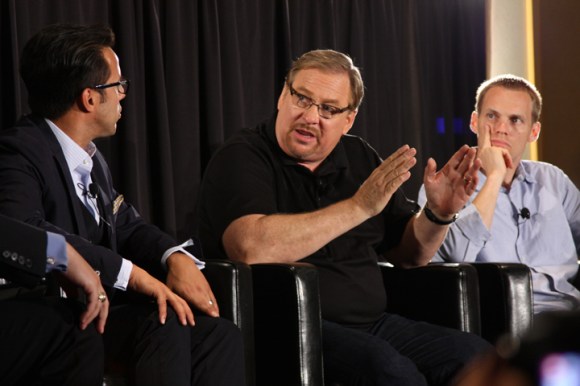
Pastors Rick Warren and David Platt (center and right) joined a panel discussion in June on Hobby Lobby and religious liberty. The panel was sponsored by the Ethics and Religious Liberty Commission during the Southern Baptist Convention in Baltimore.

Pastors Rick Warren and David Platt (center and right) joined a panel discussion in June on Hobby Lobby and religious liberty. The panel was sponsored by the Ethics and Religious Liberty Commission during the Southern Baptist Convention in Baltimore.

After the Supreme Court’s June 30 ruling in favor of Hobby Lobby, many Christians celebrated the decision that opens the door for “closely held” companies to refuse to cover abortion-inducing drugs in their employee health care plans.

“A great day for Religious Liberty!” tweeted Southern Baptist Convention President Ronnie Floyd, with the hashtag #hobbylobby.

“This is as close as a Southern Baptist gets to dancing in the streets with joy,” wrote Russell Moore, president of the SBC’s Ethics and Religious Liberty Commission. Moore presented an award to the Green family, who owns Hobby Lobby stores, during the SBC Annual Meeting in June. The Greens filed suit against the Department of Health and Human Services two years ago over what has become known as the abortion-contraceptive mandate in the Affordable Care Act.

“… We simply cannot abandon our religious beliefs to comply with this mandate,” CEO David Green said then.

The Hobby Lobby case has brought new visibility to religious liberty issues. But Texas pastor Robert Jeffress told Fox News “the victory will be short lived.”

“…People of faith are going to increasingly come into conflict with governmental mandates that violate their personal faith,” said Jeffress, the pastor of First Baptist Church, Dallas, according to a report by The Christian Post.

Imperiled religious liberty was the focus of a panel discussion in Baltimore during the Southern Baptist Convention last month. Religious freedom is a critical issue for churches, panelists said, but it’s still flying under the radar for most of them.

Moore and the ERLC hosted the conversation that include pastors Rick Warren and David Platt, and Samuel Rodriguez, president of the National Hispanic Christian Leaders Conference. The panel focused on the Hobby Lobby Supreme Court case but also veered into other questions concerning religious freedom.

The panelists’ main point was clear: All church members must be aware of issues that threaten religious liberty, standing firmly in a Gospel that compels Christians to stand up for their religious freedoms, and for that of others.

Before the Court ruled in favor of Hobby Lobby, Moore said the verdict would be one of the most significant decisions affecting religious liberty in years. The case and several others, like the Washington florist who was sued when she declined to provide flowers for a same-sex wedding, have raised awareness about religious freedom and threats to it.

But religious liberty isn’t just tied to current events or cases. It has ancient roots.

“Before religious liberty is a political issue or a social issue, religious liberty is a Gospel issue,” Moore said during the panel discussion. People come to Christ when the Word of God addresses their conscience, he explained. An uncoerced conscience.

“We don’t believe that the Gospel goes forward by majority vote,” he said. “We believe that the Gospel goes forward by the new birth, and so we need freedom in order to do that.”

Refusing to fight for religious liberty now, Moore added, will be highly detrimental to future generations. “If we shrug this off, what we’re doing is consigning future generations, and we’re consigning people’s consciences, to a tyranny that we are going to be held accountable for.”

There are also ramifications for Christians living and working in contemporary society. Platt, pastor of The Church at Brook Hills in Birmingham, Ala., said during the panel discussion he felt convicted about how many of his church members are aware of how their freedoms could be threatened.

People in churches “need to know it’s coming,” Platt said. “It’s going to affect every person in every profession in the church. This is not just for certain groups.”

Costly faith

One lesson from the Hobby Lobby case, Moore said, is that threats can simmer under the surface for a long time before they bubble up. “Many people assume that religious liberty violations come with shock and awe, with tanks coming in. And religious liberty violations typically happen this way, with a bureaucrat’s pen…By the time the issue gets to you, you have not even seen how it has already advanced.”

Perhaps because so many flagrant violations of religious liberty happen in other countries, the issue can seem like what Moore termed “other people’s problems.” That’s why it’s key to champion freedom not just for Americans, or Christians, the panelists said. “If it’s them today, it’s us tomorrow,” Warren said of other religious groups facing threats to their freedom.

Concerning religious liberty in America, the panelists talked about voting as one area that can breed complacency. If you preach sanctity of life and biblical marriage and religious liberty on Sunday, Rodriguez said, but then vote in a way that runs counter to those things on Tuesday, isn’t that hypocrisy? “Our vote must be a reflection of my Christian worldview belief.”

One other cause for a lack of concern, Platt said, is a lack of urgency. Many church members aren’t taking risks for the Gospel, he said. Faith doesn’t cost anything for many of us. But, he said, “When you believe in a resurrected king, you speak about him all the time, and whatever he says you do, no matter what it costs you in the culture.”

Baptists almost ‘dance for joy’ over religious freedom ruling

THE BRIEFING | Meredith Flynn

The U.S. Supreme Court ruled June 30 in favor of Hobby Lobby and Conestoga Wood Specialties, deciding that the companies do not have to cover abortion-inducing drugs in their employee health plans.

The 5-4 decision sets an important precedent for “closely held” companies (those owned by individuals or families) that object to what has become known as the abortion-contraceptive mandate in the Affordable Care Act.

In the opinion, Justice Samuel Alito wrote that under the standard set by Religious Freedom Restoration Act of 1993, “the HHS contraceptive mandate is unlawful.”

The_BriefingSouthern Baptist leaders responded quickly to the ruling. “It is an absolute victory for the proponents of religious liberty,” said SBC Executive Committee President Frank Page. “I am thankful that both common sense and conscience have seen a victory in a day where such victories are rare.”

Russell Moore, president of the SBC’s Ethics and Religious Liberty Commission, called the ruling an “exhilarating victory for religious freedom.” During the SBC Annual Meeting in Baltimore earlier this month, Moore presented an award to the Green family, who owns Hobby Lobby.

“As a Baptist, I am encouraged that our ancestors’ struggle for the First Amendment has been vindicated,” Moore said after the Court’s decision.

“This is as close as a Southern Baptist gets to dancing in the streets with joy.”

Read more at BPNews.net.

Court also rules on abortion clinic buffer zones
The Supreme Court struck down a 2007 Massachusetts law restricting pro-life advocates from congregating within 35-foot zones around abortion center entrances and driveways, Tom Strode of Baptist Press reports. Justices issued a 9-0 opinion on the matter, and Chief Justice John Roberts wrote that the law “imposed serious burdens” on free speech.

Marriage in limbo in several Upper Midwest states
Indiana has joined a list of states in which the definition of marriage is pending an appeal of a federal judge’s ruling. After Judge Richard Young struck down the state’s same-sex marriage ban June 25, a federal appeals court issued a stay two days later. Michigan and Wisconsin are in a similar situation, as seen in this map from USA Today (which doesn’t reflect the Indiana appeal). Same-sex marriage officially became legal in Illinois June 1, although some counties began issuing marriage licenses in the spring.

LifeWay survey: Domestic violence rarely preached about in church
Nearly three-fourths of Protestant pastors say domestic or sexual violence is a problem in their community, but 42% rarely or never preach on the topic. The survey, conducted by LifeWay Research and sponsored by Sojourners and IMA World Health, also found 74% of pastors know someone who has experienced domestic violence. Read more at LifeWayResearch.com.

Thief-turned-pastor shares testimony
George Aguilar, once an enemy of churches in Oklahoma, is now a pastor in his home country of El Salvador. After robbing from and vandalizing 11 churches in the Tulsa area, Aguilar came to Christ after one of the churches he stole from took him in. Read his story from The Baptist Messenger.


Hannah_Batista

Hannah Batista shares her testimony in a video produced by FBC Bethalto.

HEARTLAND | The last year of Hannah Batista’s life has been different from the first 16. Last summer, she accepted Christ during Super Summer, a week that’s less about camp activities and more about discipling students.

Through a series of tough circumstances, Hannah had ended up living in the home of a member of First Baptist Church in Bethalto. She was an unwilling church attender, and an unwilling Super Summer participant when she wound up at Greenville College last June. “I was guilted into going, honestly,” she says now.

But during the week, something changed. Lots of things, actually. In the quiet of her dorm room on the last night of the week, Hannah accepted Christ.

“Everything I thought I knew was being torn down, and in its place, something new was being built up,” she said from her seat in the dining hall at this year’s Super Summer. Hannah is now a leader in her youth group, and was baptized this year by her youth pastor, Tim Drury.

Watch a video of Hannah’s testimony and baptism at FBC Bethalto (courtesy of the church’s Facebook page).

Fred_Luter_revivalCOMMENTARY | Eric Reed

I’ve never been prouder – of Fred Luter or of the Southern Baptist Convention – than when, on the second day of the annual meeting in Baltimore, they suspended the agenda and spent most of an hour in prayer.

Will this be Bro. Fred’s lasting contribution to the SBC, I thought to myself, that he was willing to lay aside the fixed orders of business, to call us all to our knees, and to take our deep needs to the Lord?

Two years earlier, I sat on a bench in the cavernous lobby of the New Orleans Convention Center talking with a pastor-friend of mine. He’s African American. I seemed more excited by Luter’s election that day than he did. I posed a question about the new president’s lasting impact.

“We’ll have to wait and see,” was his response. “Will this be a one-time thing, or has the Convention really changed? Is there room for me in leadership?”

That has been the response of several people I’ve asked since then, even Luter himself. Many people, especially African American pastors, said they wanted to see what happened after Luter’s term. Would he really be able to increase the ethnic diversity on SBC boards and in leadership? Would there be a lasting place at the table for black, Hispanic, and Asian leaders?

Under Luter’s direction, the committees responsible for manning those boards have attempted to broaden representation. In fact, messengers at the Phoenix convention in 2011 had ordered the start of such a concentrated effort even before Luter’s election as the SBC’s first African American president.

It was good to see several African American pastors on the platform in 2014: Southern Seminary Professor Kevin Smith spoke for the Resolutions Committee. Chicago’s very own Marvin Parker of Broadview Missionary Baptist Church served with the Committee on Order of Business and Michael Allen of Uptown Baptist Church was elected “back-up preacher” for the 2015 annual meeting.

But it took a messenger from the floor to confirm what those watching the live video stream had noticed. There was not a lot cultural diversity on the worship platform. The messenger moved that the music teams next year be more diverse, because, he noted, while the choirs and bands were almost all white, the Convention isn’t anymore – and heaven won’t be either.

I saw a similar message in the official photograph of the incoming SBC officers: five middle-aged white guys in dark suits. Except for one goatee, that photograph could have been snapped in 1974.

Or 1954.

We missed an opportunity to extend Bro. Fred’s impact. Korean-American pastor Daniel Kim ran for president, and his showing as a late-entry against winner Ronnie Floyd was respectable. But both first and second vice-presidents ran unopposed. Why? Because no one else stepped up.

Fred Luter’s lasting impact may not be that he radically altered the composition of committees or platform personnel. Instead, he demonstrated the door is open and there’s room at the table. And he was willing to take the risk.

As a pastor in New Orleans, Luter suffered jeers for his embrace of the historically white denomination. And before he agreed to run for SBC president in 2012, one advisor warned, “Look at the racial make-up of the Convention, Fred. You might lose.”

But he won. In a big way. Unopposed. Twice. To cheers and tears and shouts of joy from a whole lot of people glad that a new day had arrived for Southern Baptists.

Successor Floyd called him “the most beloved president” in recent SBC history. Luter traveled widely and preached in churches of all sizes and ethnicities. He embodied the new spirit of the SBC, and he did it with characteristic joy and grace. For all that, he is deservedly and deeply appreciated.

But, for me, Fred Luter’s lasting impact is that he was willing to step up.

Eric Reed is editor of the Illinois Baptist.

Hobby_LobbyNEWS | The U.S. Supreme Court is expected to hand down its decision in Sebelius v. Hobby Lobby and Conestoga Wood Specialties sometime this week. The case has been closely watched by religious liberty advocates who believe the Court’s ruling will have significant impact on the freedom Americans have to practice their religious convictions.

At issue is the businesses’ refusal to cover abortion-inducing drugs for its employees, a measure required of for-profit companies by the Obama administration’s healthcare plan.

“The United States Supreme Court is deciding whether or not in this country there is the freedom to dissent, and the freedom to accommodate these conscientious objections in the governing of people’s lives and in the running of their businesses,” Russell Moore told Southern Baptist pastors and leaders meeting in Baltimore. The president of the Ethics and Religious Liberty Commission took part in a panel discussion about the case during the SBC’s annual meeting in June.

“It’s going to be a tremendously significant and important case for every single one of your churches and your ministries,” Moore said. “This will have everything to do with everything that your church does for the next 100 years.” In March, the ERLC issued a call to prayer for Hobby Lobby and the Supreme Court’s ruling.

Several institutions have won their fight against the health care mandate, including Colorado Christian University just this week. But Hobby Lobby and Conestoga Wood Specialties’ status as Christian-owned, for-profit businesses is what makes their case different.

The Hobby Lobby case sparked an online discussion about what makes a business “Christian.” See today’s Briefing for more.

The_BriefingTHE BRIEFING | Meredith Flynn

Leading up to the Supreme Court’s expected ruling on a case involving Hobby Lobby, culture writer Jonathan Merritt took issue with calling the craft retailer a “Christian business” because of its dealings with China, one of the world’s worst offenders of human rights.

Hobby Lobby currently is fighting for an exemption to the government’s requirement that for-profit companies cover some abortion-inducing drugs in their employee health care plans. The Supreme Court’s ruling is expected this week.

The things Hobby Lobby claims to stand for, Merritt wrote for The Week magazine, including sanctity of life and religious liberty, are grossly undervalued in China.

“Hobby Lobby reminds us why for-profit businesses should resist calling themselves ‘Christian,’” he wrote. “The free market is messy and complicated and riddled with hypocrisy. Conducting business in today’s complex global economy almost ensures one will engage in behavior that is at least morally suspect from a Biblical standpoint.”

Merritt invited Russell Moore, president of the Ethics and Religious Liberty Commission, to respond to his article. Moore recently presented the Green family with the John Leland Award for Religious Liberty.

Forsaking business in China, Moore wrote, likely won’t help improve human rights there. Historically, he said, “open trade, in most cases, tends to help the development of political rights rather than hinder them.” If the Greens believed boycotting Chinese business would turn the nation’s government toward improved human rights, Moore said, they would.

But, “The Greens cannot control the decisions made by the Chinese government. They can, however, direct their own actions. And, as Americans, they can participate in a democratic republic in which the people are ultimately accountable for the decisions of their government.

“Buying products from companies that operate in a country that aborts children is not the same as being forced by the United States government to purchase directly insurance that does the same.”

Meriam Ibrahim released from prison, then rearrested
A 27-year-old mother of two imprisoned for her Christian faith was released June 23, but rearrested just hours later, The Christian Post reported this morning. Meriam Yahia Ibrahim, a Sudanese doctor, had been imprisoned with her young son and newborn daughter after she was found guilty of apostasy and adultery. (Because Ibrahim’s husband, Daniel Wani, is a Christian, their government does not recognize their marriage.) Her death sentence was to be carried out in two years. After Ibrahim was freed and her sentence commuted Monday, she was rearrested with her husband and children as they prepared to leave Sudan. Ibrahim’s case has drawn attention internationally and in the U.S., 38 members of Congress signed a letter asking the government to intervene on her behalf. Read more at ChristianPost.com.

Benched basketball star says ‘I know God has a plan!’
Isaiah Austin, a center for the Baylor University basketball team, was expected to be a first-round pick in the June 26 NBA draft. Instead, a diagnosis of Marfan syndrome will end his career, reported The Christian Post. He sat down for an emotional interview with ESPN, but was hopeful on Twitter and Instagram, using social media to talk about his faith in God.

“I know God has a plan!” Austin posted as part of a message on Instagram, with the hashtag #NewBeginnings. “I would love to thank EVERYONE who has reached out to me,” he tweeted under the handle God’s Child. “Toughest days of my life. But not the last! Life goes on. GOD IS STILL GREAT!”

Mohler: PCUSA marriage vote helps establish ‘clear divide’
When the General Assembly of The Presbyterian Church (U.S.A.) voted to allow pastors to conduct same-sex marriages, their decision set a dividing line in culture and in Christianity, said Southern Seminary President Albert Mohler.

“That very clear divide puts on one side those who stand with 2,000 years of Christian witness and on the very clear statements of Scripture, and, on the other side, those who stand with the moral revolution of the era…,” Mohler said on his daily podcast.

The Presbyterian denomination not only voted on the policy change for pastors, but also to amend their constitution to define marriage as between “two people” instead of “a man and a woman.” A majority of the PCUSA’s presbyteries must approve the amendment for it take effect, Baptist Press reported, but the departure of many conservative congregations makes the change a likely prospect.