The_BriefingTHE BRIEFING | Russell Moore, president of the Southern Baptist Ethics and Religious Commission, urged Christians to “pray fervently” for believers facing persecution for their faith.

“As Christians, we should pray for the president and our military leaders to wisely administer the sword of justice (Romans 13:1-3),” Moore said in a written statement. “As part of the global body of Christ, we must also pray fervently for our persecuted brothers and sisters in Iraq and across the Middle East (Hebrews 13:3).”

His comments came after President Barack Obama authorized U.S. airstrikes and humanitarian aid to help Iraqi religious minorities under attack from militant groups in the country.

Obama “is right to take action to protect religious minorities, including Christians, in Iraq from ISIS,” Moore said. “He has my prayers.”

Read the full story at BPNews.net, or click here for an overview of the recent onslaught of persecution around the world.

Other news:

Amid controversy surrounding Driscoll, LifeWay stops selling Seattle pastor’s books
A day after the Acts 29 church planting network removed Pastor Mark Driscoll and his churches from their membership, LifeWay Christian Resources stopped selling Driscoll’s books online and in stores. “LifeWay Stores and Lifeway.com are not selling Mark Driscoll’s books while we assess the situation regarding his ministry,” communications director Marty King told Christianity Today.

The Acts 29 and LifeWay decisions came after a string of controversies and charges surrounding Driscoll, founding pastor of Mars Hill Church in Seattle.

Gungor stands by beliefs about Adam & Eve, biblical flood
Christian musician Michael Gungor’s admission that he no longer believes in a literal Adam and Eve or flood sparked controversy when the comments were published in a WORLD magazine online report this month. Ken Ham, founder of Answers in Genesis and the Creation Museum, called for Gungor to apologize for the statements, while the musician responded to the controversy on his blog.

Marriage rates in decline among Millennials
Millennials are less likely to marry by 40 than any other previous generation, according to data from the American Community Survey analyzed by the Urban Institute. For example, in 1990, 91% of women age 40 had married; currently, only 69.3% of women age 40 have married. The rate for men is approximately 4% lower, Baptist Press reported.

Coming to a theater near you: “Christian Mingle The Movie”
Girl creates fake faith profile on Christian dating site, meets potential Mr. Right. Girl admits phony faith and loses Mr. Right, but gains a relationship with God. “Christian Mingle The Movie” is due in theaters in October. Read more at ChristianPost.com.

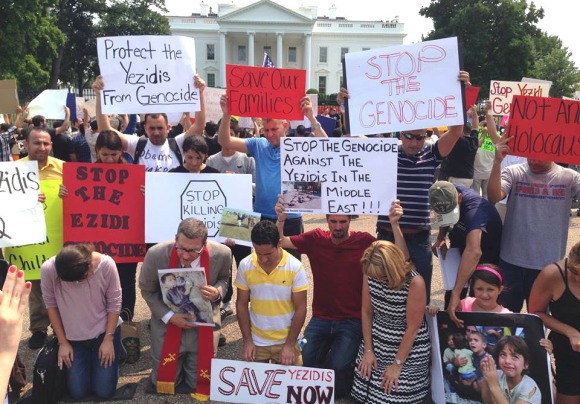
Rob Schenck (front, red scarf), president of Faith in Action and the National Clergy Council, prays Aug. 7 for the Yazidis and Christians suffering in Iraq. IMB photo

Rob Schenck (front, red scarf), president of Faith in Action and the National Clergy Council, prays Aug. 7 for the Yazidis and Christians suffering in Iraq. IMB photo

Christians around the world face heightened persecution

NEWS | From Baptist Press and IMB reports

An unfamiliar symbol began showing up on social media pages late last month. The curved line under a single dot is the Arabic letter “Nun,” reportedly used by militants in Iraq to mark the homes of Christians in the country.

“Nun” stands for Nazarene, or Jesus.

Extremists with the Islamic State of Iraq and Syria (ISIS) have forced Christians from their homes under threat of death. The Iraqi believers and other religious minorities joined millions of Syrian refugees already displaced by civil war. In a region rich with Christian history, many have noted, very little evidence of Christianity is left.

The onslaught of persecution this summer has awakened many in the Western church to the needs of Christians around the world. Many pastors and Christian organizations in July changed their Twitter avatars and Facebook profile photos to include the letter “Nun.” They also used the hashtag #WeAreN as a show of solidarity with the persecuted believers.

“The Islamic militants mean it for evil when they mark homes with ‘N’ for ‘Nazarene,’” wrote Russell Moore, president of the Ethics and Religious Liberty Commission. “They assume it’s an insult, an emblem of shame. Others once thought that of the cross.

“But in that intended slight, we are reminded of who we are, and why we belong to one another, across the barriers of space and time and language and nationality. We are Christians. We are citizens of the New Jerusalem. We are Nazarenes all.”

Iraqi refugee crisis

“There are no Christians left in Mosul.”

That’s how religious freedom advocate Nina Shea described conditions in Iraq’s second largest city in July.

Shea, director of the Hudson Institute’s Center for Religious Freedom, told CBN News that Islamic militants have eradicated virtually every trace of Christianity from Mosul, the center of Iraq’s Christian community for 2,000 years. Mosul is located on the site of the ancient city of Nineveh.

In June, militants with the Islamic State in Iraq and Syria (ISIS) extended an offer to let Christians in Mosul practice their Christian faith behind closed doors, after they paid a hefty tax and agreed not to proselytize. However, multiple sources in the region said that offer was later withdrawn and all Christians were told to leave or face execution.

Members of Assyrian Christian and Chaldean Catholic groups left empty handed, Shea said. Militants confiscated all of their possessions, including homes, cars, clothes “and even their wedding rings, sometimes with the finger attached if it would not come off.”

Christians aren’t the only religious minority targeted by ISIS. On August 3, militants seized the city of Sinjar, forcing the Yazidi Kurdish population to flee. Many escaped to the nearby Sinjar Mountains, a barren heap of rock where daytime temperatures can top 120 degrees.

More than 150 Yazidi immigrants rallied in front of the north lawn of the White House August 7 to plead for American involvement in the growing crisis. (President Obama announced that evening he had authorized military airstrikes on Iraq.) The protestors came from across the U.S. to rally on behalf of the Yazidis, who do not practice Islam but instead follow an ancient religion ISIS equates to “devil worship.”

Christians and religious minorities in other nations also have faced recent persecution due to war and religious hostilities:

Syria | The recently released International Religious Freedom Report included a daunting sentence about the country that shares Iraq’s northwestern border: “In Syria, as in much of the Middle East, the Christian presence is becoming a shadow of its former self.”

A three-year-old civil war has resulted in millions of refugees and increasingly persecuted religious minorities, including Christians caught between the regime currently in power and militants fighting against it. The report, released annually by the U.S. State Department as a picture of the state of international religious freedom the previous year, found that in the city of Homs, only 1,000 Christians remain. There were approximately 160,000 Christians there before the war.

Nigeria | Approximately 1,505 Nigerian Christians have been killed for their faith this year, as the Boko Haram terrorist group and other extremists continue their campaign of religion-based violence in the West African nation. Boko Haram and other groups have killed nearly as many Nigerian Christians in the first seven months of this year as were killed in all of 2013, the advocacy group Jubilee Campaign reported July 29.

Christians killed to date include seven fathers of the 223 Chibok school girls still missing after Boko Haram kidnapped more than 300 students in mid-April. (The group is dedicated to fighting the influence of Western education.) The fathers were killed July 20 when Boko Haram attacked the city of Damboa and hoisted a Boko Haram flag there, the Associated Press reported.

Response from the West

David Curry is president and CEO of Open Doors USA, which offers assistance to persecuted Christians around the world and lobbies repressive governments to cease religious persecution. In July, he called the plight of Christians in Mosul and the remainder of northern Iraq “unprecedented in modern times.”

“This latest forced exodus of Christians further shows why Western governments and the people in the West need to cry out in support for religious freedom in the Middle East and elsewhere,” Curry said in a statement. “If this does not move us concerning the near extinction of Christianity in the Middle East, it’s likely nothing else can.”

Since the United States invaded Iraq in 2003 to overthrow Saddam Hussein, nearly one million Christians have fled the country for safer surroundings.

In an editorial this month for The Christian Post, Curry expressed doubt that the persecution of Christians would ever be treated as “a major humanitarian crisis” by governments and secular media. “However, we should be able to count on our own family,” he wrote.

“The persecution of Jesus followers should be preached from every pulpit and prayed for at every kitchen table. One day soon it may be your faith that is under attack and you will be hoping that others will be praying for you…or even notice that it is happening.”

The International Mission Board and its ministry partner Baptist Global Response are coordinating relief efforts among Iraqi refugees. For more information about how to help, go to www.IMB.org.

Daniel_WoodmanHEARTLAND | Daniel Woodman

Editor’s note: This column first appeared on Baptist Press (BPNews.net) as part of the Southern Baptist Convention’s call to prayer.

If you attended the Southern Baptist Convention in Baltimore or watched online, you know prayer played a big role in this year’s annual meeting. Messengers spent time praying together in the convention hall, and also adopted a resolution on praying for other churches that are struggling, “so that together…we can more effectively reach our neighbors and our nation with the Gospel.”

The resolution was a response to a growing number of churches taking action and praying for local sister churches. Emmanuel Baptist Church in Carlinville, Ill., is one such church.

Noticing the need for unity among local churches, Emmanuel began praying for sister churches in its local Baptist association on a weekly basis. The church prays for three churches and their pastors each week, rotating the list to pray for all 27 churches in the association multiple times each year.

Church members and leaders alike began to observe a noticeable, positive impact from this prayer focus. Taking note of the cause/effect relationship of the power of praying for local churches, Emmanuel recently expanded its regular prayer list to include two church plants outside of the association.

The church prays a specific, scripted prayer for each church and pastor each week: for “the physical and spiritual protection of the pastor so that he would deliver the message that God has given them, and to lead the people with passion to reach the lost in their community.”

This scripted prayer addresses an eternal need for each church, according to Cliff Woodman, pastor of Emmanuel Baptist Church: “I wanted it to be a specific prayer that could apply to any church. The mission of every church is to reach the lost and make disciples.”

If more Southern Baptist churches take this kind of initiative to pray for each other and unify under the banner of Christ, then communities will come together spiritually and the Kingdom of God will expand as a result, Woodman said, citing Jesus’ words from His high priestly prayer: “I in them and you in me. May they be brought to complete unity to let the world know that you sent me and have loved them even as you have loved me” (John 17:23).

Daniel Woodman is an entering freshman journalism major at the University of Missouri and a member of Emmanuel Baptist Church in Carlinville.

Syrian refugees cross the border from Syria to Jordan. IMB photo by Jedediah Smith

Syrian refugees cross the border from Syria to Jordan. IMB photo by Jedediah Smith


NEWS | Ava Thomas & Eden Nelson
(Baptist Press)

Aman* used to be a banker in Syria, but that’s a life he can hardly remember anymore.

Now three years on the other side of a harrowing escape from his war-torn homeland, he’s stuck in a bleak job market, washing dishes for 10 hours a day to feed his starving family.

And worst of all, he’s starting to wonder if it’s ever going to end.

It’s an exhausting life for Aman and the 3 million other Syrian refugees who have flooded surrounding countries, Don Alan*, a Christian leader in the region, said.

Think back to a day when you missed a meal, or a night when you weren’t sure you were ever going to get home, Alan said. “Multiply that by 100 or 1,000, and that is a portion of what the Syrian refugee feels.”

Alan hopes Christians in the West will take up the cause of their Syrian brothers and sisters and persist in holding them up.

“Pray that we would not become weary of this crisis,” Alan said. “Some of them have been refugees for more than three years. We must persevere in supporting them.”

Aid funds from government organizations are drying up, he said, and Syria’s neighbors are bending under the burden of refugees spilling over their borders.

Lebanon’s tallies indicate that by year’s end, one third of the tiny country’s population will be refugees from Syria. Ross Mountain, the U.N. resident and humanitarian coordinator, called it an “existential crisis” for Lebanon. More than one million refugees have amplified the country’s water shortage into a serious problem.

Refugees are also straining the country’s economy, accepting jobs for less pay than Lebanese, Mountain said.

To the north of Syria, many Turks are also growing weary of absorbing more and more waves of their neighbors.

Though the Turkish government has extended health care and other continuing aid to Syrian refugees, in a January poll 55% of Turks indicated they would like to see the borders closed to fleeing Syrians. Going further, 30% of those wanted to send back the Syrians already living in Turkey.

“Surrounding countries continue to seek ways to find stability in the midst of such a crush of refugees,” Alan said.

Those countries also face fresh challenges, thanks to the emergence of the Islamic state spanning parts of Syria and Iraq, he said.

The militant group ISIS, which recently declared the Islamic state, is exacerbating the region’s refugee problem at an extraordinary rate through broad violence and religious persecution, Alan said. Iraqis are now joining their Syrian neighbors in pouring over the borders – especially Christians.

In mid-July, ISIS gave thousands of Christians in northern Iraq an ultimatum to leave the region or face execution. As a result, Christians are being forced to leave homes and villages where they have lived for centuries, Alan said.

Thousands have fled, and many people are asking if this signals the end of Christianity in Iraq (see sidebar).

The ramifications of the Middle East’s refugee crisis will be “felt for decades to come,” Alan said. It’s a bleak situation, he said, but he hopes Christians around the globe will pray that in the midst of the darkness God will do “something new in our day.”

“Pray that we would be courageous and bold. The Gospel is one of peace, even in the midst of pain and turmoil,” he said. “Pray that we would respond with open hearts and open hands. There are ways we can help today by giving, praying and speaking of the hurt of those fleeing this conflict.”

When the Bible is so clear about helping the marginalized, Alan said, how can Christians not respond to “one of the greatest crises of our time?”

“The question to you and me is will we catch His vision for what He is doing?” Alan said. “As Jesus reminded us, if we do it to the least, the one most forgotten, then we do it to Him.”

*Name changed

Baptist Global Response is providing food and hygiene kits to refugee families. For more info, go to www.gobgr.org

Ava Thomas and Eden Nelson are writers for the Southern Baptist International Mission Board. Story excerpted from Baptist Press.

THE BRIEFING | Dozens of people came to faith in Christ at the August 2 funeral for 15-year-old Braxton Caner, according to reports on social media.

“Dozens saved today @ Brax’s funeral. We wanted the Gospel given,” tweeted Braxton’s father, Ergun Caner, president of Brewton-Parker College in Georgia. Caner also re-tweeted a photo of his son’s football teammates kneeling and praying after the service for Braxton, whose death was reported July 29 as a suicide.

On July 30, Ergun Caner wrote, “No words. No sermon. No funny quotes. No answers. No note. Nothing but excruciating pain & the assurance that I’ll see him in Glory.” The next day, he posted a photo of himself baptizing then-6-year-old Braxton.

Pastor Rick Warren, who lost his 27-year-old son to suicide last year, was one of many Christian leaders who reached out to Caner and his wife over Twitter. “I am weeping with you @erguncaner and Jill.”

Read The Christian Post’s report here.

Other news:

The_Briefing‘Third way’ church could be removed from fellowship with Baptist association

The executive board of the Los Angeles Southern Baptist Association has recommended that messengers from New Heart Community Church not be seated at the association’s annual meeting in October. Danny Cortez, pastor of the La Mirada congregation, announced earlier this year that he no longer believes same-sex relationships are sinful. The church voted to become a “third way” church that neither condemns nor affirms homosexuality. Read more at BPNews.net.

Missionary doctor recovering from Ebola virus in U.S.
The director of the Centers for Disease Control and Prevention said Aug. 3 that Dr. Kent Brantley is “improving” after contracting the Ebola virus. Brantley, an aid worker in Liberia with Samaritan’s Purse, was flown to Atlanta for treatment Aug. 2. Fellow American Nancy Writebol is expected to join him today. Both doctors contracted the Ebola virus while treating patients in a region where hundreds have died from a recent outbreak. Read more at SamaritansPurse.org.

IMB worker reports on ‘invisible war’ with Ebola
The Southern Baptist International Mission Board says it is monitoring the Ebola epidemic in West Africa, and medical coordinators “have been in touch with Southern Baptist missionaries in the region to keep them informed of the changing situation,” Baptist Press reports. The IMB has personnel in Guinea and Liberia, two of the countries affected by the outbreak.

A Christian worker in Liberia shared her account of what it’s like to live in a country where people are fighting an “invisible” enemy like the virus. Read it at BPNews.net.

Praying for peace in Jerusalem
Southern Baptist Convention leader Roger S. Oldham gives several specific ways to pray for the conflict between Israel and Hamas. “On the political front, the ‘peace of Jerusalem’ seems to be an elusive dream,” Oldham wrote. “But on the spiritual front, those who know the Prince of Peace have learned that peace is a gift the Lord gives (John 14:27).”

Volunteers from Illinois are serving this week near Port-au-Prince, Haiti. One team member is Alison Howell, whose daughter, Mackenzie, wrote a children's book to raise money to help re-build the country.

Many mission teams from Illinois have served in Haiti since the January 2010 earthquake. This photo was taken during a one-week trip to the country last summer; read stories and see more photos here.


HEARTLAND | Mackenzie Howell
was just five years old when she saw a TV program about the massive earthquake that destroyed parts of Haiti in January 2010. The young Texan decided immediately she needed to do something to help.

Mackenzie_Howell_blog

Volunteers from Illinois are serving this week near Port-au-Prince, Haiti. One team member is Alison Howell, whose daughter, Mackenzie, wrote a children’s book to raise money to help re-build the country.

Since then, she’s raised thousands of dollars for re-building efforts in the country through several different enterprises, including a book about a courageous Haitian girl named Leila.

Mackenzie’s projects connected her with IBSA’s Bob Elmore, who facilitates mission trips to Haiti. Mackenzie’s mom is on one of those trips this week, writing letters to her daughter every day from Haiti. Alison Howell hopes to learn more about the country this week, in preparation for when Mackenzie is ready to go herself.

In her first letter Aug. 3, Alison talked about how God sometimes calls people to do hard things.

“Remember last week in Sunday School when we talked about how God asked Paul and Barnabas to do some difficult things, but they always obeyed Him because they knew that they could trust Him. You and I can trust Him too.

“I can trust Him to take care of me in Haiti, and even more importantly to take care of you, brother and Daddy while I’m gone. You can trust Him to give you the courage to do what He is asking you to do too.”

Follow Alison Howell’s mission trip at her blog, “Letters to my daughter from Haiti.”

COMMENTARY | Josh Laxton

Last spring, my wife and I bought a used minivan. Honestly, I’m not a big fan of minivans, nor am I a fan of buying a much-older car. (I didn’t learn auto repair in seminary.) However, I am a big fan of making my wife happy.

Not long after purchasing the van, I was driving with our three small children when, suddenly, after a few mildly intense sputtering episodes, the van died. There I was, with a broken down car, stranded in the middle of the road, with no shoulder to move the vehicle to safety. As I tried to decide what to do, my 4-year-old daughter had her own breakdown. Her piercing cries of, “Daddy, Daddy!” were accompanied by heavy sobbing and huge tears. Ellie broke down because of our van’s condition.

Josh_Laxton_July31For many of us, our churches are like my minivan. Depending on the source, 80-90% of churches are in a state of plateau or decline. They were running fine, but something happened along the way, and now the church is not functioning and operating the way Jesus intended—as a God-glorifying, gospel-centered, mission-oriented, disciple-making, church-planting vehicle. Sure, the flashers, radio, horn, and air still work (worship and programs are still going, committees are still meeting). But there is a breakdown in the primary reason for the church’s existence—it’s literally not moving, not going anywhere.

The question is not whether our churches need a breakout to the next level of growth or ministry. Rather, it’s how we as leaders can get them there. To do so, like Ellie, we need to have a breakdown over the condition of the church.

Nehemiah is an excellent example of a leader who identified the need for breakout, and in doing so, had a breakdown. Although he had never been to Jerusalem, he had great affection and concern for his homeland; therefore, when his brothers came to visit, he asked how his countrymen were faring. The news he received was bad; the people and the city were broken. The Bible says that upon hearing this, Nehemiah “wept and mourned” for days. In addition, he “continued fasting and praying before the God of heaven.”

What led to Nehemiah’s breakdown? Two key truths stand out:

First, he knew the truth about God and what God had called His people to be and do (Genesis 12:3; Exodus 19:4-6). When Nehemiah learned that the wall was in ruins and the people lived in great trouble and shame, he recognized that they were not where they were supposed to be. That has implications for our ministry today: Do we know with certainty the honest, transparent conditions of our church in relation to God’s intended reality, rather than our own presuppositions, preferences, or traditions?

Second, not only did Nehemiah know the truth about God’s intended reality for his people, he also knew the heart of God. In other words, he not only knew about God and His plan, but he also knew God. Thus, when he heard about the condition of the city and the people, he went immediately to the Father, weeping, morning, fasting, and praying.

He was broken over their condition because God was broken over their condition. As a result, the Bible tells us, Nehemiah “continued” going to the Father.

Nehemiah led in a way that reflected the heart of God and how He viewed the condition of the people. As leaders, are we leading in a way that reflects the heart of God towards the people in our churches?

Breakout in Jerusalem didn’t happen until Nehemiah broke down. The good news is that God still works in our brokenness to lead his people to breakout.

Josh Laxton is lead pastor of Western Oaks Baptist Church in Springfield. His second column on Nehemiah will appear in the August 18 issue of the Illinois Baptist, online at http://ibonline.IBSA.org.

The_BriefingTHE BRIEFING | The U.S. State Department released its International Religious Freedom Report on Monday, citing 2013 as a year when “the world witnessed the largest displacement of members of religious communities in recent memory.”

The report also listed nations where religious freedom is severely threatened and violated. Those “countries of particular concern” are Burma, China, Eritrea, Iran, North Korea, Sudan, Saudi Arabia, Turkmenistan and Uzbekistan.

Before U.S. Secretary of State John Kerry presented the report, President Barack Obama announced his nominee for the country’s ambassador-at-large for international religious freedom. Rabbi David Saperstein would be the first non-Christian to hold the post, reports Christianity Today. He is director of the Religious Action Center of Reform Judaism, an attorney, and an adjunct professor at Georgetown University Law Center. Saperstein’s nomination requires confirmation by the U.S. Senate.

“Rabbi Saperstein is a respected thinker and leader who brings gravity to this important task,” said Russell Moore, president of the SBC’s Ethics and Religious Liberty Commission. “He has my prayers and my pledge of full cooperation. The downgrade of religious freedom and the persecution of religious minorities around the world must end.”

Other news:

Texas church ministers with blankets, BIbles, coloring books at the border
De Dorman first felt a burden for families stranded at the U.S./Mexico border when she herself was stuck in an airport for three days in June. Dorman, a member of First Baptist Church in McAllen, Texas, went back home and organized a group of volunteers from her church to help out at an immigrant processing center in their town. Part of their ministry is giving out blankets to children who aren’t used to constant air conditioning, along with bilingual Bibles and Gospel-themed coloring books. “We tell them wherever you journey, the Lord wants to go with you,” Dorman told the Southern Baptist Texan. “We do our best, as God opens the doors, to speak to them and to set resources into their hands for that long bus ride.”

Pastor preaches forgiveness after hate crime
A church in Clarksville, Tenn., has forgiven whoever burned a cross outside their building, said Pastor Vernon Hooks of New Hope Missionary Baptist Church. “Whoever did it, we forgive them,” Hooks said after the cross was discovered on the grounds of his mostly African American church early on July 22. “That’s the message, that we are a forgiving church and we’ll let the police do their job.” Police have classified the incident as a hate crime and are still investigating. Read the full story from the Clarksville Leaf-Chronicle.

The Bible, re-designed?
A project aimed at making the Bible more readable for more people has earned more than $1.4 million in support on the fundraising site Kickstarter.com. “Bibliotheca,” an idea from book designer Adam Lewis Greene, organizes the Bible into four volumes designed like modern books. The text is in one column, and there are no verse or chapter notations. A video on Greene’s Kickstarter page explains  the inspiration behind the project.

Barna survey measures Americans’ dietary worries
Healthier eating habits may be on trend these days, but nearly half of all Americans are worried they eat too much. And 63% say they’re concerned about not eating enough fresh produce. The new research from Barna also found 55% of Americans experience some kind of “food guilt.” Read more at Barna.org.


HEARTLAND | Nate Adams

It feels like I have had more than a few challenging days of ministry recently. But today is an especially good Sunday, and I’d like to tell you about it.

I leave home very early, to drive almost 200 miles to an IBSA church where I know the pastor, but have never attended on a Sunday morning. It’s their 70th anniversary, and I have a nice plaque from IBSA to present to them. In all those regards, it’s not really an unusual Sunday.

Nate_Adams_July28What’s a little more unusual is that my wife, Beth, is traveling with me. Our youngest son Ethan is leading the worship team at our home church in Springfield, and Beth would like to be there too. But by evening we will be at the church where our middle son Noah is youth pastor, and so she has decided to come along. So it’s already an especially good Sunday.
We drive past one, two, three IBSA churches, and eventually past the one where I recall speaking three years ago when my oldest son Caleb also shared his testimony. He had just returned to the Lord after years as a prodigal. And as I realize that today my wife is with me, and that all three of our sons are worshiping and serving in an IBSA church, I realize that this is an especially good Sunday.

At the church celebrating its 70th anniversary we are greeted warmly, with appreciation for both IBSA and for our long drive that morning. I watch as an effective pastor loves his people, and they love him back. I meet a 93-year-old former church planter and pastor, who tells me he helped plant one of the first SBC churches in northern Indiana. He’s surprised I don’t recognize his former supervisor’s name, until I remind him I wasn’t born yet.

Later when I’m presenting the plaque, I tell both the 93-year-old church planter and the 70-year-old church that my wife and I are on our way, after church, to IBSA’s first “ChicaGO” student camp at Judson University. It’s a pilot church planting camp that we hope will continue to produce church planters, church plants, and eventually 70-year-old churches. And as I describe this picture of church planting across the generations – I realize that this is an especially good Sunday.

We arrive at Judson University late in the afternoon, and help greet students and chaperones from 11 different IBSA churches. Then a bus-load of IBSA All State Youth Choir students unload, and I remember they are there for a couple of days too, to join the ChicaGO mission week, and share a couple of concerts in the area.

That night the choir sings at Calvary Baptist Church in Elgin. In addition to being my mom’s and son’s church, this is also the church where Wilma and Jack Booth are members. During the concert, IBSA Worship Director Steve Hamrick reminds us that Wilma was one of the leaders that started the IBSA All State Choir 36 years ago. And as I reflect on the blessing of tomorrow’s worship leaders being equipped for churches across the generations – I realize that this is an especially good Sunday.

I will have to wait until my next column to tell you about the “week in the life of church planters” that follows this special Sunday. But let me punctuate this account by telling you that as the All State Youth Choir led us in singing “Jesus Messiah,” I found my eyes welling up with tears. God was reminding me that, though there will be challenging days, He is steadfastly building churches and growing leaders across the state and across the generations here in Illinois. And whenever I can see that as clearly as I do today, well, it’s an especially good Sunday.

Nate Adams is executive director of the Illinois Baptist State Association.

Editor’s note: This is the final story in a series of three testimonies about Super Summer, an annual discipleship week for students sponsored by the Illinois Baptist State Association. Click here to read how Hannah Batista met Christ at Super Summer, and here for why youth minister Tim Drury takes his students to Greenville for the week every year.

Zaxxson_NationHEARTLAND | Zaxxson Nation spent Super Summer 2014 teaching high school seniors the most practical parts of discipleship— finding a mentor, building intentional friendships, and investing in a local church. As assistant dean for the green school, which is focused on discipleship, Nation helped transfer to his students some of the same principles he learned as a Super Summer student.

Assistant dean is just one hat Nation has worn since his first week in Greenville 12 years ago. As a 16-year-old student leader from Rochester First Baptist, he realized at Super Summer that his Christianity was based more on head knowledge than faith that had taken root in his heart.

“God really changed everything in my life” that week, Nation said. “And at that point I was ready to serve, to do whatever it took to just serve Him.”

Part of what makes Super Summer different from some other camps is the laser-like focus on knowing Jesus more, Nation said. At his first Super Summer, “When we had free time, we were talking about Jesus. And when we went to bed at night, we were joking around, but we were also sharing our testimonies.”

Years later, he said, “I think it’s the same now as it was 12 years ago when I was a student. It’s still people coming together for the same reason; it’s still students that are serious about their faith.”

Nation acknowledged that Super Summer creates an environment that’s impossible to recreate once students get home and the distractions of life flood back in. Being cut off from regular life for a week is both a blessing and a curse, he said. “God uses it, though; He used it for my life,” he said.

“The other big thing about Super Summer is it’s pretty much where I got my standard for being a godly man,” Nation remembered. He met pastors and leaders who had memorized large chunks of the Bible and shared their faith regularly.

“Super Summer puts you under those guys’ teaching for an entire week, and you leave inspired. And I left personally saying, ‘Wow, I want to be like that.’

“Because as a student I saw that and was challenged by those high standards, I want to go back and work under those guys, and be peers to those guys and continue to learn from them. That’s a huge motivator for me, to think that one day a student could look at me and my life and say that I’m inspiring them in the same way that those guys inspired me.”