


It is not a surprise to God where we find ourselves culturally. He says to us what He has always said to His people: Live for me in the place where I have placed you.

It is not a surprise to God where we find ourselves culturally. He says to us what He has always said to His people: Live for me in the place where I have placed you.


Fred Luer, president of the Southern Baptist Convention, spoke to IBSA staff during their weekly chapel service on Wednesday, April 17.
By Lisa Sergent
SBC President Fred Luter spoke to Illinois Baptist State Association staff in their Wednesday, April 17 IBSA chapel service urging them to, “Listen to the challenge of Jesus. Pray for the Lord of the harvest to send more laborers.”
A day after meeting leaders from around the state at the Meet the President Event, Luter spoke from Matthew 9:35-38, telling staff to ask themselves, “What would Jesus do? What’s it going to take to reach our nation? What’s it going to take to reach our community? What’s it going to take to reach our state?
“If we really want to talk about changing lives, we need to talk to somebody who has experience changing lives. Jesus always had a word for every question, every circumstance. Jesus always had an answer no matter who the person was, no matter what the question was.”
There were three things Jesus would always do, said Luter: Be concerned, be compassionate and give a challenge.
Contrasting today’s society with the past, Luter said this generation doesn’t have a respect for the Lord or the church like previous generations. “What would Jesus do to reach this generation, to reach this society? I have no doubt in my mind, He would meet them. He would be concerned about people. That’s why if you really want to impact Illinois you must be concerned about the lost and the unchurched. We must be concerned about their hurts, their struggles, their addictions, and their pain. We must be concerned about their eternal destiny.”
Luter said Christians need to remember what their lives were like before they were saved to better identify with the lostness around them. “We weren’t always born again. God brought us from somewhere.
Yesterday, the SBC president shared how he had been raised in a fatherless home, hung-out with a tough crowd, and had suffered life-threatening injuries in a motorcycle accident in his youth. While still in the hospital, a deacon from his local church told him he needed to accept Jesus as his savior. The former street preacher, now pastor of the thriving Franklin Avenue Baptist Church in New Orleans, and first African-American president of the Southern Baptist Convention, is never far from his roots, always remembering how far Jesus has brought him.
“Those of us who are still amazed by God’s amazing grace, those of us who never got over being saved who never got over the grace of God, those of us who never got over the fact that we could be in hell today but thank God for the grace of God. We must show compassion for this generation.”
He implored, “Brothers and sisters listen to the challenge of Jesus. Illinois, listen to the challenge of Jesus. The harvest is plentiful, but the workers are few. Listen to the challenge of the master.”
Then, Luter emphasized Jesus did not give that challenge to the government or to politicians. “The challenge was given to the church.”
He cautioned all Christians against complacency. “We need people who want to take up the challenge of Jesus Christ and share the Gospel with everybody. We’ve got enough church folks; we need laborers who will take up the challenge. Will you take up that challenge today?”
Finishing his message, Luter offered one last thought for Baptists in Illinois, “What would Jesus do for this iPod, iPad, iPhone, tattooed, baggy pants, underwear showing generation? He would be concerned. He would show compassion. He would set out the challenge, because the harvest is plentiful, but the laborers are few.”
Lisa Sergent is communications director for the Illinois Baptist State Association.
Step by Step: Following Jesus from the Palms Parade to the Resurrection
 Day 3: Tuesday, March 26
The confrontations (Matthew 21:23-32, 22:34-46; 26:6-16)
The Tuesday accounts read like a boxing match: The elders question his authority; Jesus tells them harlots will enter the kingdom before unbelieving religious leaders.
The priests and lawyers try to trip him up with trick questions; Jesus confounds them with amazing answers.
Ultimately, he silences the tricksters. The match goes to Jesus. But the confrontations leave Jesus weeping over the sorry spiritual state of the city where Israel should meet and worship God (Matt. 23:27).
Later Jesus pulls his disciples aside for deep teaching on the end times. And from the Mount of Olives they retreat at evening to Bethany, where a woman causes a squabble when she anoints Jesus for his burial. “Love the Lord your God with all…” he taught earlier that day, and she did.
Having seen her offering, Judas made a different – and fatal – choice.
Lord, at various times we behave like all the people you encountered. Prevent us from argumentative debate and traitorous bargaining. We want to give you our very best.
Devotion by Eric Reed, artwork by Kerry Jackson
Step by Step: Following Jesus from the Palms Parade to the Resurrection
Day 2: Monday, March 24
Spring cleaning (Matthew 21:12-22)
Jesus created such a commotion that every pilgrim in Jerusalem must have been talking about it. Who would disrupt the holy transactions? Weren’t the bank tellers swapping Caesar’s money for acceptable temple coins to give their offerings? Weren’t the sellers offering animals for sacrifice? “We couldn’t come all this way with lambs under our arms?” some travelers might mutter.
“Who does he think he is!” the tongues likely wagged.
After the ruckus, Jesus and the disciples overnighted a few miles away in Bethany, possibly at home of the resurrected Lazarus.
Returning to Jerusalem the next day, Jesus cursed the fig tree. At first it seems unfair to the tree, but this action says it all: even good things become bad when they are unfruitful. Rituals are offensive when they replace the faith they are intended to aid. Anything that robs God of worship must be driven out.
Lord, we all could use some spring cleaning now. Examine me, Lord, and wipe away anything that prevents me from worshiping you.
Devotion by Eric Reed, artwork by Kerry Jackson
Editor’s note: The following article is adapted from a bulletin insert available at biblicalspirituality.org. The author is former Illinois Baptist pastor Don Whitney.
The beginning of a new year is an ideal time to stop, look up, and get our bearings. To that end, here are some questions to ask prayerfully in the presence of God.
1. What’s one thing you could do this year to increase your enjoyment of God?
2. What’s the most humanly impossible thing you will ask God to do this year?
3. What’s the single most important thing you could do to improve the quality of your family life this year?
4. In which spiritual discipline do you most want to make progress this year, and what will you do about it?
5. What is the single biggest time-waster in your life, and what will you do about it this year?
6. What is the most helpful new way you could strengthen your church?
7. For whose salvation will you pray most fervently this year?
8. What’s the most important way you will, by God’s grace, try to make this year different from last year?
9. What one thing could you do to improve your prayer life this year?
10. What single thing that you plan to do this year will matter most in ten years? In eternity?
For more questions to ask at the beginning of 2013, go to www.biblicalspirituality.org.
The Youth Encounter student event begins tomorrow, December 28, in Springfield. Tim Sadler, IBSA’s evangelism director and organizer of the two-day conference, asks you to pray for these three things:
1. That even now, God would be working in the hearts of students who will attend Youth Encounter, and that those who don’t know yet Him will have open ears and hearts to the Gospel.
2. That the Gospel would be clearly preached.
3. That students would hear and respond, and that many would come to a saving knowledge of Jesus Christ.
And ransom captive Israel
That mourns in lonely exile here
Until the Son of God appear.
Rejoice! Rejoice! Emmanuel
Shall come to thee, O Israel.
O come, thou day-spring, come and cheer
Our spirits by thine advent here.
Disperse the gloomy clouds of night,
And death’s dark shadows put to flight.
Rejoice! Rejoice! Emmanuel
Shall come to thee, O Israel.
O come, O come, thou Lord of might,Who to thy tribes on Sinai’s height,
In ancient times did’st give the Law,
In cloud, and majesty and awe.
Rejoice! Rejoice! Emmanuel
Shall come to thee, O Israel.
(“O Come, O Come Emmanuel,” original author unknown)
DECATUR, Ill. | The photos below depict just a few highlights of the IBSA Pastors’ Conference and Annual Meeting at Tabernacle Baptist Church. Read the November 26 issue of the Illinois Baptist for more in-depth coverage, and go to Vimeo.com/IBSA to watch videos of Pastors’ Conference and Annual Meeting messages.
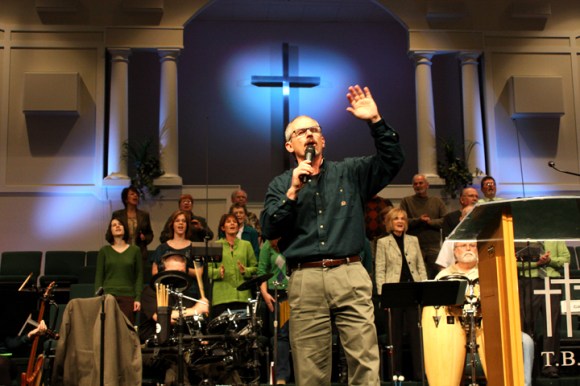
Chris Vieth and the choir from Tabernacle Baptist Church lead in worship during the IBSA Pastors’ Conference.

Kenny Qualls, Ronnie Floyd, Wes Feltner and Phil Hunter preached impassioned messages on the theme “Renew” during the Pastors’ Conference.

At IBSA’s Young Leaders Forum, attenders snacked on hot wings while Charles Campbell (right) led a panel discussion featuring experienced leaders (from left) Tim Lewis, Don Sharp and Kenny Qualls.

Women at the Ministers’ Wives’ Conference listen to Penny Weaver, director of New Life Pregnancy Center in Decatur, Ill., as she describes how the center meets the very real needs of new moms.

IBSA’s Rex Alexander talks with Carol Stewart at the Illinois Disaster Relief exhibit.

Shoppers peruse the resources available at the LifeWay bookstore, run by representatives from the LifeWay store in Carterville, Ill.
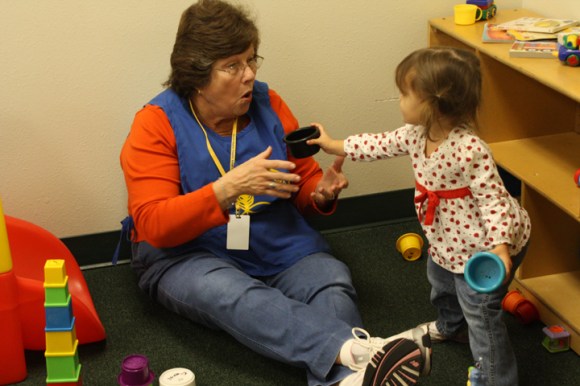
Childcare volunteer Nancy Russell shares a pretend snack with one-year-old Lucy Kreuter. Illinois Disaster Relief workers provided free childcare during the Pastors’ Conference and Annual Meeting sessions.
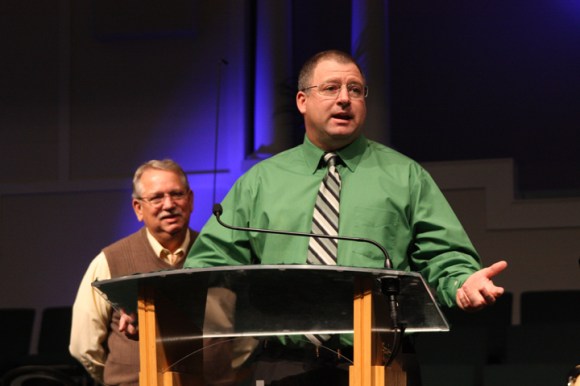
Chris Cutsinger, pastor of Center Baptist Church near Marion, Ill., is this year’s IBSA Bivocational Pastor of the Year. He was presented with the award IBSA Executive Director Nate Adams and Bob Carruthers (left), director of missions for Sandy Creek Baptist Association.

Jonathan Peters, president of the Illinois Baptist State Association, preaches his president’s message on “taking the Gospel to the streets.” Peters urged listeners to consider Illinois’ largest metropolitan areas as their mission fields.

Southern Baptist Convention Executive Committee President Frank Page told Illinois Baptists they had embraced more than any other state, percentage-wise, the Cooperative Program 1% Challenge.

Nate Adams invites Illinois Baptists to choose to partner, choose two cities (Chicago and St. Louis), and choose two people to pray for during Wednesday evening’s Mission Illinois celebration and commitment service.
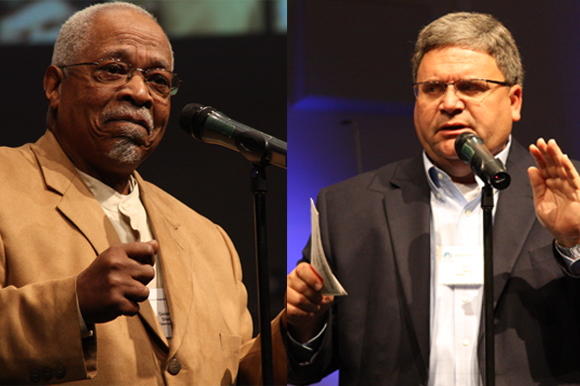
Don Sharp (left) of Faith Tabernacle Church in Chicago and Tim Lewis of Bethel Baptist, Troy, entreated meeting attenders to engage in ministry in their cities, Chicago and metro St. Louis.

Meeting attenders hold their hands out in the directions of Chicago and St. Louis, praying over each region that God would continue to send leaders and draw people to Himself.
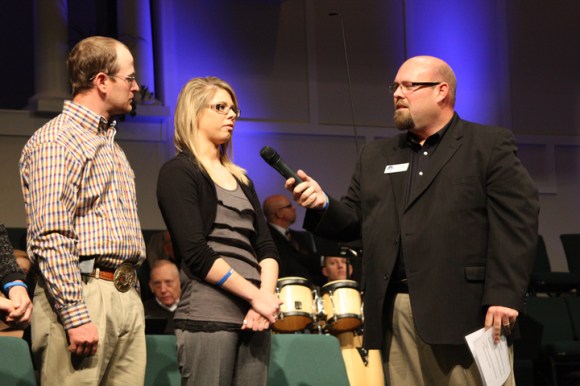
Tim Sadler (right) interviews Mindy Burwell and her husband Mark during the Mission Illinois celebration. Mindy received Christ after her pastor’s wife, Vickie Hayes, began praying for her through the Choose2 evangelism emphasis.

Illinois Baptists commit to ‘Choose2’ and pray for two lost friends or family members.
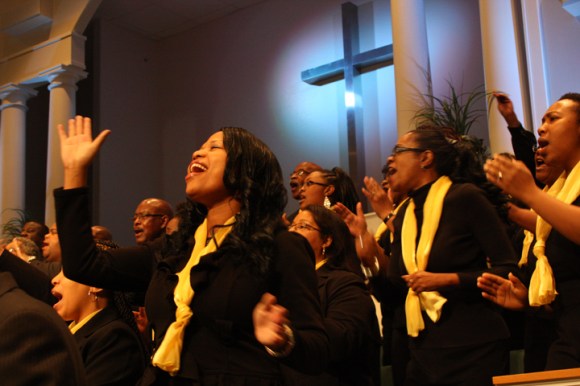
The choir from Broadview Missionary Baptist Church leads in worship before their pastor, Marvin Parker, preaches the annual sermon.

Marvin Parker closes the 2012 IBSA Annual Meeting with a plea for Illinois Baptists to reach out to their families, friends, and neighbors with the Gospel.
COMMENTARY | Immediately after the Pew Forum released new findings about t he current state of American Protestantism, writers and thinkers took to their blogs to warn us not to put too much stock in the so-called shift, at least not for the reasons we might think.
“…Many will likely trumpet this as a huge shift. It’s not. This is simply the natural progression of what is taking place in our context,” said LifeWay’s Ed Stetzer of the research, which states that for the first time in history, Protestants are not a majority in the United States. Rather, the 48% that claim to be Protestants are a plurality at the top of a list of choices that also includes Catholic (22%), Mormon (2%), Orthodox (2%) and “Other Faith” (6%). That means nearly 20% of Americans aren’t affiliated with any faith, the highest percentage ever in Pew Center polling.
“A big part of what is happening is that the ‘Nominals’…are shifting and becoming the ‘Nones,'” Stetzer wrote. “This makes sense, as the cultural currency (in other words, the value a society places on identifying as a Christian) is decreasing. And thus, we see a movement away from Christian identity as a cultural value.”
Stetzer identifies these three main points from the research:
1. “On a growing basis, identifying oneself as a Christian is not a means to societal advancement but can actually be a means to societal rejection.”
2. What he calls the “squishy middle,” or nominalism, is going away. Southern Seminary’s Russell Moore also blogged about this following the Pew Center’s research. “Most of the old-line Protestant denominations are captive to every theological fad that has blown through their divinity schools in the past thirty years-from crypto-Marxist liberation ideologies to sexual identity politics to a neo-pagan vision of God—complete with gender neutralized liturgies.
“What we should pay attention to instead may be the fresh wind of orthodox Christianity whistling through the leaves-especially throughout the third world, and in some unlikely places in North America, as well. Sometimes animists, Buddhists, and body-pierced Starbucks employees are more fertile ground for the gospel than the confirmed Episcopalian at the helm of the Rotary Club.”
3. “It is still a vast overstatement to see this as a collapse of the Christian faith in North America,” Stetzer wrote. “The reality is that evangelicals have been relatively steady as a percent of the population over the last few years, however there is still great cause for concern here – and for action.”
That action must take shape as a willingness to seize opportunities explain exactly what a Christian is, Stetzer said. “…As society moves away from Christian identification, let’s meet them on the road and say, ‘We did not believe in that expression of Christianity anyway. Let me tell you about Jesus and how he changes everything.'”
OLYMPICS | Serena Butler

Still smiling after a two-hour train ride,
and ready to work with Southfields Baptist Church.
Our first full day of ministry in London started with a train ride. (Well, it actually started with a bowl of traditional English porridge for breakfast, then a train ride). Our group traveled together for an hour until we arrived at Liverpool Street station, where eight of us jumped off to catch the Tube (London’s subway) to Kings Cross Baptist Church. The rest traveled another hour to the Southfields stop, near Wimbledon, where we’ll work alongside Southfields Baptist Church.
Our first day of training was a lot like training for a new job. We learned how to make sandwiches, run the coffee machines, and keep the store room stocked with supplies. We also hung banners and set up tables and chairs, all in preparation for the people who will stop by the coffee houses this week to grab a bite to eat and watch the Games on the big screen.
We continue to have opportunities to talk to people who are here as volunteers or representing their countries or just as spectators. On Thursday, we met some members of the Chinese press, and also two young ladies from Russia who were trying to get tickets to some of the Olympic events. We told them about the coffee house and gave them flyers so that they could remember times and the place. We also delivered flyers to the homes around the coffee house. (Unlike in the U.S., you can put a flyer in the mail slot of the homes here. You just open the slot in the door and drop it onto the floor.)

We’ve had opportunity after opportunity to answer the question: Why are you here?
We’re having lots of conversations about why we’re here, and one of the beautiful things about this team is watching the younger members learn from the older members. The younger ones are seeing evangelism being modeled, and then are trying their hand at it a little while later.
Friday evening’s Opening Ceremonies will be our first big ministry event. At Southfields, they’ll be showing “Chariots of Fire” and the ceremonies on the big screen. Our group will be running the coffee house and passing out flyers at the Tube stop. Pray for both Kings Cross and Southfields churches as they minister, and that hearts will be open to the Gospel.


 iB2 News