Archives For November 30, 1999

News of interest to Illinois Baptists

Pre-ruling panel discussion explores impact of Hobby Lobby case and threats to religious freedom

NEWS | Meredith Flynn

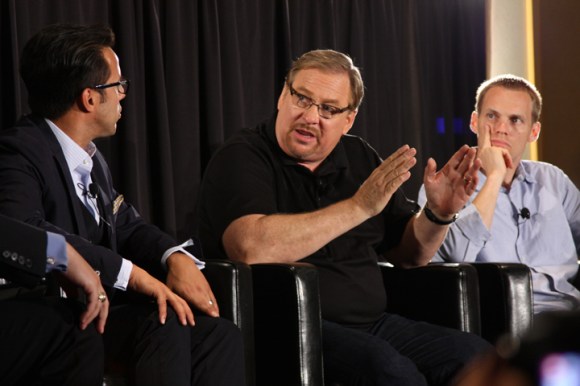
Pastors Rick Warren and David Platt (center and right) joined a panel discussion in June on Hobby Lobby and religious liberty. The panel was sponsored by the Ethics and Religious Liberty Commission during the Southern Baptist Convention in Baltimore.

Pastors Rick Warren and David Platt (center and right) joined a panel discussion in June on Hobby Lobby and religious liberty. The panel was sponsored by the Ethics and Religious Liberty Commission during the Southern Baptist Convention in Baltimore.

After the Supreme Court’s June 30 ruling in favor of Hobby Lobby, many Christians celebrated the decision that opens the door for “closely held” companies to refuse to cover abortion-inducing drugs in their employee health care plans.

“A great day for Religious Liberty!” tweeted Southern Baptist Convention President Ronnie Floyd, with the hashtag #hobbylobby.

“This is as close as a Southern Baptist gets to dancing in the streets with joy,” wrote Russell Moore, president of the SBC’s Ethics and Religious Liberty Commission. Moore presented an award to the Green family, who owns Hobby Lobby stores, during the SBC Annual Meeting in June. The Greens filed suit against the Department of Health and Human Services two years ago over what has become known as the abortion-contraceptive mandate in the Affordable Care Act.

“… We simply cannot abandon our religious beliefs to comply with this mandate,” CEO David Green said then.

The Hobby Lobby case has brought new visibility to religious liberty issues. But Texas pastor Robert Jeffress told Fox News “the victory will be short lived.”

“…People of faith are going to increasingly come into conflict with governmental mandates that violate their personal faith,” said Jeffress, the pastor of First Baptist Church, Dallas, according to a report by The Christian Post.

Imperiled religious liberty was the focus of a panel discussion in Baltimore during the Southern Baptist Convention last month. Religious freedom is a critical issue for churches, panelists said, but it’s still flying under the radar for most of them.

Moore and the ERLC hosted the conversation that include pastors Rick Warren and David Platt, and Samuel Rodriguez, president of the National Hispanic Christian Leaders Conference. The panel focused on the Hobby Lobby Supreme Court case but also veered into other questions concerning religious freedom.

The panelists’ main point was clear: All church members must be aware of issues that threaten religious liberty, standing firmly in a Gospel that compels Christians to stand up for their religious freedoms, and for that of others.

Before the Court ruled in favor of Hobby Lobby, Moore said the verdict would be one of the most significant decisions affecting religious liberty in years. The case and several others, like the Washington florist who was sued when she declined to provide flowers for a same-sex wedding, have raised awareness about religious freedom and threats to it.

But religious liberty isn’t just tied to current events or cases. It has ancient roots.

“Before religious liberty is a political issue or a social issue, religious liberty is a Gospel issue,” Moore said during the panel discussion. People come to Christ when the Word of God addresses their conscience, he explained. An uncoerced conscience.

“We don’t believe that the Gospel goes forward by majority vote,” he said. “We believe that the Gospel goes forward by the new birth, and so we need freedom in order to do that.”

Refusing to fight for religious liberty now, Moore added, will be highly detrimental to future generations. “If we shrug this off, what we’re doing is consigning future generations, and we’re consigning people’s consciences, to a tyranny that we are going to be held accountable for.”

There are also ramifications for Christians living and working in contemporary society. Platt, pastor of The Church at Brook Hills in Birmingham, Ala., said during the panel discussion he felt convicted about how many of his church members are aware of how their freedoms could be threatened.

People in churches “need to know it’s coming,” Platt said. “It’s going to affect every person in every profession in the church. This is not just for certain groups.”

Costly faith

One lesson from the Hobby Lobby case, Moore said, is that threats can simmer under the surface for a long time before they bubble up. “Many people assume that religious liberty violations come with shock and awe, with tanks coming in. And religious liberty violations typically happen this way, with a bureaucrat’s pen…By the time the issue gets to you, you have not even seen how it has already advanced.”

Perhaps because so many flagrant violations of religious liberty happen in other countries, the issue can seem like what Moore termed “other people’s problems.” That’s why it’s key to champion freedom not just for Americans, or Christians, the panelists said. “If it’s them today, it’s us tomorrow,” Warren said of other religious groups facing threats to their freedom.

Concerning religious liberty in America, the panelists talked about voting as one area that can breed complacency. If you preach sanctity of life and biblical marriage and religious liberty on Sunday, Rodriguez said, but then vote in a way that runs counter to those things on Tuesday, isn’t that hypocrisy? “Our vote must be a reflection of my Christian worldview belief.”

One other cause for a lack of concern, Platt said, is a lack of urgency. Many church members aren’t taking risks for the Gospel, he said. Faith doesn’t cost anything for many of us. But, he said, “When you believe in a resurrected king, you speak about him all the time, and whatever he says you do, no matter what it costs you in the culture.”

Hobby_LobbyNEWS | The U.S. Supreme Court is expected to hand down its decision in Sebelius v. Hobby Lobby and Conestoga Wood Specialties sometime this week. The case has been closely watched by religious liberty advocates who believe the Court’s ruling will have significant impact on the freedom Americans have to practice their religious convictions.

At issue is the businesses’ refusal to cover abortion-inducing drugs for its employees, a measure required of for-profit companies by the Obama administration’s healthcare plan.

“The United States Supreme Court is deciding whether or not in this country there is the freedom to dissent, and the freedom to accommodate these conscientious objections in the governing of people’s lives and in the running of their businesses,” Russell Moore told Southern Baptist pastors and leaders meeting in Baltimore. The president of the Ethics and Religious Liberty Commission took part in a panel discussion about the case during the SBC’s annual meeting in June.

“It’s going to be a tremendously significant and important case for every single one of your churches and your ministries,” Moore said. “This will have everything to do with everything that your church does for the next 100 years.” In March, the ERLC issued a call to prayer for Hobby Lobby and the Supreme Court’s ruling.

Several institutions have won their fight against the health care mandate, including Colorado Christian University just this week. But Hobby Lobby and Conestoga Wood Specialties’ status as Christian-owned, for-profit businesses is what makes their case different.

The Hobby Lobby case sparked an online discussion about what makes a business “Christian.” See today’s Briefing for more.

NEWS | Meredith Flynn

Ask church leaders what is the single biggest threat to marriage right now, and most would probably give the same answer: the stunning wave of approval for same-sex marriage.

But a changing definition of marriage isn’t the only thing endangering the institution, said Baptist leaders at an April summit on sexuality and the Gospel. In fact, it may not even be at the top of the list.

Pornography has dulled the consciences of many Christians. Cultural trends have tended to devalue marriage at the expense of other arguably good things, like education, career and financial stability. And pastors may not feel the freedom or confidence to speak plainly about the issues affecting their congregations: sexual purity, marital fidelity, and what the Bible really says about all of it.

Faced with these threats to marriage, Andrew Walker of the Southern Baptist Ethics and Religious Liberty Commission said the church has a choice: “We can confront these changes, we can acknowledge them, we can work to combat them, or, sadly, we can conform to them.”

One thing the church can’t afford to do: nothing.

For today’s 20-somethings, marriage and family look very different than when their parents were making decisions about who to wed and how many kids to have. In 1960, 72% of American adults were married. In 1980, it was 62%. In 2012, it was just over 50%.

According to a 2013 study by the University of Virginia, the average age of first marriage now is historically
high – 27 for women and 29 for men. Waiting to marry has resulted in a lower divorce rate and better economic prospects for women; however, researchers also point to higher birth rates among unmarried women.

Almost half (48%) of first births are to unmarried women.

“What exists outside the church usually makes its way inside the church,” said Walker, the ERLC’s director of policy studies. In a breakout session at the Nashville summit hosted by the ERLC, he explored 11 threats to contemporary marriage, including:

The “soul mate” concept of marriage that emphasizes emotional and sexual fulfillment and partnership over biblical covenant and commitment.

Marriage as an aspiration. People marry later when they wait until they’re financially established, Walker said. “We need to mitigate against the [idea] that someone needs a Master’s degree and $75,000 in the bank” before they get married, he added.

– The rise of “professional marriages” where spouses have individual bank accounts and separate social lives.

Also on Walker’s list of external threats to marriage: divorce. Many would say it’s a threat inside the church too, although the statistics that place divorce rates the same or higher among Christians have been misreported, some researchers say. The more subtle danger may be Christians’ acceptance of the divorce culture.

In an interview last year with Christianity Today, ERLC President Russell Moore said divorce is one way Christians have surrendered to “the patterns of this age.”

“Evangelical Christians are as counter-cultural as we want to be, and it is clear that we are slow-train sexual revolutionaries, embracing the assumptions of the outside culture a few years behind everybody else,” Moore said. “This has had disastrous consequences.”

How these factors have marginalized marriage inside the church is supported largely by anecdotal evidence. The single adults in your congregation likely weren’t raised to focus on whom they would eventually marry. Marriage has been confined to “meeting the right person” for an entire generation (maybe more); it’s not something they can control. So young Christians focus instead on friendships, education and career. On top of all that, they’re haunted by the specter of divorce. Looking toward marriage seems strange to most of them, even limiting – and potentially disappointing.

David Prince is a Kentucky pastor who also spoke at the ERLC summit. He said that when he visits new parents in the hospital, he prays over their babies, and specifically for their future spouses. One grandfather in a hospital room expressed his disbelief that Prince was praying that way already, the pastor said.

The majority of Americans, and even more religious Americans, still have faith in the institution of marriage, according to research presented at the summit by sociologist Mark Regnerus. The question is whether they have enough faith to pursue it for themselves. In the absence of a “marriage culture,” wrote blogger Trevin Wax last year, Christians who marry early and stay married 40, 50 or 60 years will stand out. Which is good news for the church. “We’ll be ordinary oddballs,” Wax said. “So let’s not waste the opportunity.”

A healthier view
If negative influences on marriage and sexuality that exist outside the church have made their way inside, Scripture offers a better way forward. And it speaks to modern-day problems like pornography, said Southern Seminary professor Heath Lambert.

Likening porn to the “forbidden woman” in Proverbs 7, he told summit attenders there is a silent killer running rampant in churches. And it’s not growing acceptance of same-sex marriage.

“A greater threat to the church today is the Christian pastor, the Christian schoolteacher, the Christian Bible college and seminary student, who exalts sound theology, points to the Bible, and then retreats to the basement computer to indulge in an hour or three of internet pornography.”

Regnerus shared daunting numbers: When asked whether they had looked at porn on a given day, 11% of men said yes. Between 35 and 40% said they had within the last week, including 20-25% of Christian men between the ages of 18 and 39. And it’s not just men. In a reflection on biblical womanhood during the summit, Trillia Newbill said research from 2007 showed 13 million women clicked on pornographic web sites every month. Women represent one in three visitors to adult entertainment sites, she said.

“There is a stereotype and a really, really, really bad rumor that women don’t struggle with sexual sin,” said the ERLC’s consultant for women’s initiatives. “The sin that came into the world and corrupted all that was beautiful in the world, also corrupted us women.”

How can churches offer hope and the truth of the Gospel? By presenting marriage and sexuality in the same tone as Scripture, said Kevin Smith, who closed the conference with a message on biblical sexuality within marriage.

“…Certainly, let us avoid vulgarity and certainly let us avoid [language] that will remove the mystery of sexual intimacy between a husband and a wife,” the pastor and professor from Louisville, Ky., said.

“I’m kinda tired of preachers bragging about their hot wife.”

But Smith also warned church leaders not to let a sex-saturated society muzzle proclamations of biblical marriage and sexuality. Avoid the “flattening out” of sex that happens in our culture, which removes emotional, commitment and intellectual aspects of the one-flesh union of the Bible, Smith said.

“The one who is proclaiming the Word of God and speaking of sexuality in a biblical context, we’re trying to heighten the conversation. We’re not trying to make sex less dramatic, we’re trying to make sex more dramatic.”

And more biblical.

Meredith Flynn is managing editor of the Illinois Baptist newspaper. Read the IB online at http://ibonline.IBSA.org.

O’Fallon, Ill. | An Illinois pastor has prescribed three goals – and one new project – for the next president of the Southern Baptist International Mission Board.

In a May 24 blog post, FBC O’Fallon Pastor Doug Munton said choosing who will replace current President Tom Elliff is “perhaps the most important decision that will be made in the Southern Baptist Convention for years to come.” Elliff, 70, asked IMB trustees in February to begin looking for his successor.

Munton said the next president should focus on making the IMB effective and efficient, and on providing the organization with energy. “Missionaries are great, but they can become discouraged,” he wrote. “Keep them focused on the life-giving energy of time spent with the Lord in daily devotions.  Remind them often of the joy of the Lord.”

Lastly, Munton asked the IMB’s next leader to begin an IMB Endowment of $20 billion. Harvard University has an endowment of more than $30 billion, he said, so why shouldn’t the Southern Baptist agency have a similar goal? “With all due respect to Harvard, our job is bigger and greater.”

The revenue stream would allow the IMB to send more missionaries and would serve as a buffer against a tumultuous market, he said. “Encourage every Southern Baptist to leave the IMB in their will,” Munton advised. “Thousands would respond to that plea. Thousands and thousands.”

The annual meeting of the Southern Baptist Convention is June 10-11 in Baltimore. Look for our coverage at ib2news.org and in the June 16 issue of the Illinois Baptist newspaper, online at http://ibonline.IBSA.org.

Candidates lead in varied contexts: Small church, city church, megachurch

Baltimore | With the Southern Baptist Convention’s annual meeting one week away, the election to succeed current President Fred Luter appears to be a three-candidate race:

Ronnie_FloydRonnie Floyd
Church:
Cross Church has four campuses in northwest Arkansas, and launched a site in Neosho, Mo. this Easter. According to the church’s website, more than 17,000 people have been baptized during Floyd’s 27-year tenure.

SBC service: He has chaired the SBC Executive Committee and led the Great Commission Resurgence Task Force. Most recently, Floyd organized national prayer meetings for Southern Baptist ministers.

Quotable: “It is obvious to me that we need a mighty, fresh manifestation of God’s presence in our lives personally, which I would call personal spiritual revival,” Floyd said in an interview with Midwestern Seminary President Jason Allen about the SBC presidency. “Our churches need that mighty manifestation of God’s presence through the life of the church – revival, revitalization, whatever you want to call it, refreshing winds of the Spirit. There is no question that the greatest need in American life is a spiritual awakening.”

Read the Baptist Press Q&A with Floyd here.

Dennis_KimDennis Manpoong Kim
Church: 
Global Mission Church of Greater Washington, a predominantly Korean congregation, is the largest church in the Baptist Convention of Maryland/Delaware.

SBC service: Kim is a past president of the Council of Korean Southern Baptist Churches in America, and recently served on a task force appointed by the North American Mission Board to
study the SBC’s declining baptisms.

Quotable: In his interview with Baptist Press, Moon outlined how he would call the SBC forward in fulfilling the Great Commission if he is elected president: “In a time when about 1,000 churches close their doors every year, I believe that the need of the hour is an evangelistic tool that is simple enough to train all church members, effective enough to ignite believers’ passion for evangelism and engaging enough to captivate the hearts of the present generation.”

Read the entire Baptist Press Q&A with Kim here.

Jared_MooreJared Moore
Church:
New Salem Baptist in Hustonville, Ky., is a church of about 60 members that Moore describes as a “loving, caring, godly group of people.” He served as a youth minister and pastor in Tennessee before moving to Kentucky.

SBC service: Moore currently is second vice president of the Southern Baptist Convention.

Quotable: “I want to represent Southern Baptists like the ones I serve on a daily basis who may not have the opportunity to attend the convention or serve at the convention level,” Moore wrote on his blog. Among his other reasons for running: promoting unity and the Cooperative Program.

“Apart from cooperating with other SBC churches through the Cooperative Program, our small church could not support as many ministries on our own,” Moore wrote. “I hope to encourage churches to begin, continue, or increase their support of the Cooperative Program.”

Read Moore’s Baptist Press Q&A here.

BREAKING_NEWSNEWS | Two Southern Baptist leaders have submitted a resolution on transgender identity that could be considered June 10-11 by messengers at the SBC’s annual meeting in Baltimore.

“You know you’re a cultural tipping-point when both Newsweek and Time magazine run cover stories on your cause within the span of a single year,” wrote Denny Burk, who co-authored the resolution. “Such is the case with transgender, which both Newsweek and Time have declared to be the next phase of the gay rights revolution.”

Burk, a professor at Boyce College in Louisville, Ky., co-wrote the resolution with Andrew Walker, director of policy studies at the Southern Baptist Ethics and Religious Liberty Commission. The SBC Resolutions Committee will consider the measure prior to the annual meeting and decide whether to bring it (or an amended version) to the Convention for a vote.

On his blog, Burk outlined several reasons for the resolution: The American Psychiatric Association removed transgender from its list of disorders last year. Some school systems now allow students to use opposite-gender restrooms and locker rooms. And, Burk wrote, parents, medical professionals, and counselors are increasingly open to treatment – including sex reassignment surgery – that helps children and others identify with the gender they feel, rather than the one with which they were born.

“…Christians are going to have to have to meet the transgender challenge as a matter of great pastoral and missional urgency,” Burk wrote. “We must be clear about what the Bible teaches and be faithful to live that message out in a culture that is increasingly out of step with biblical norms.”

The full text of the proposed resolution is available at DennyBurk.com (scroll to the bottom of the post). It asks SBC voters to affirm several statements, including:

  • That “perceived conflict between their biological sex and their gender identity” is one way some people experience the brokenness sin brought into the world.
  • God’s design is that “gender identity should be determined by biological sex and not by one’s self-perception.”
  • Transgender persons should be invited to “trust in Christ and to experience renewal in the gospel.”
  • “That we regard our transgender neighbors as image-bearers of almighty God and therefore that we condemn acts of abuse or bullying committed against them.”
  • Opposition to efforts to bring biological sex in line with a different gender identity.
  • “Our love for the gospel and urgency for the Great Commission must include declaring the whole counsel of God, including what God’s word teaches about God’s design for us as male and female persons created in His image and for His glory.”

Dennis_KimNEWS | The SBC Voices blog posted late Tuesday afternoon that Dennis Kim, pastor of Global Mission Church of Greater Washington, will be nominated for president of the Southern Baptist Convention when it convenes in Baltimore in June.

Texas pastor Dwight McKissic will nominate Kim, whose predominantly Korean church is the largest in the Baptist Convention of Maryland/Delaware, according to a report by the convention’s communications director.

Kim is a past president of the Council of Korean Southern Baptist Churches in America, and recently served on a task force appointed by the North American Mission Board to study the SBC’s declining baptisms.

Dr. Kim’s heartbeat is evangelism and discipleship,” McKissic wrote in a letter announcing he would nominate Kim. “He has been faithfully serving as the senior pastor of this church for 23 years with a great passion for evangelism, discipleship and world missions. Fulfilling the Great Commission is the all-consuming passion of his ministry.

“…He is fully bilingual in Korean and English with a keen understanding of multicultural world views. If elected, he will be an ambassador for the Kingdom and Southern Baptists that’s well qualified.”

Kim joins Ronnie Floyd, pastor of Cross Church in northwest Arkansas, and Jared Moore, pastor of New Salem Baptist Church in Hustonville, Ky., in the election to succeed current SBC President Fred Luter.

Read more about Kim in this article from BaptistLIFE, the newsjournal of the Baptist Convention of Maryland/Delaware.

Growing trends among second-generation and multi-site congregations

By Eric Reed
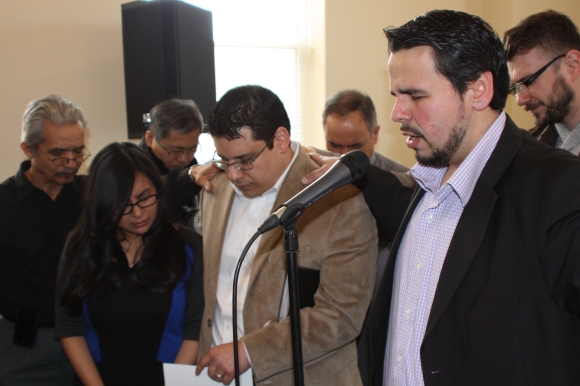
Starting Point in Chicago: Pastor Marvin del Rios of Iglesia Bautista Erie (right) prays for the new congregation his church is sponsoring, led by Pastor Jonathan de la O and his wife, Emely, surrounded by leaders from Chinese, Korean, and Romanian church plants who attended the April 6 launch service.

Starting Point in Chicago: Pastor Marvin del Rios of Iglesia Bautista Erie (right) prays for the new congregation his church is sponsoring, led by Pastor Jonathan de la O and his wife, Emely, surrounded by leaders from Chinese, Korean, and Romanian church plants who attended the April 6 launch service.


Across Illinois |
Five new churches held their “grand opening” events during the two weekends before Easter.

The congregations couldn’t be any more different: They are Hispanic, Korean, Anglo, and multicultural. They meet in the inner city, in new suburbs and older neighborhoods, and way out in the countryside.

Yet their worship services are remarkably alike: all in English, all contemporary, all enthusiastic, and mostly loud.

Collectively they show how some important ministry trends are reaching both main roads and back roads in Illinois:

➢ After decades of planting ethnic language churches, English-language ministries may be the next wave as the grown children of immigrants aren’t feeling comfortable in their parents’ churches.

➢ Starting new churches is getting more complicated and expensive and harder for planters to do solo. That is resulting in more multi-site churches and in new networks among church leaders.

➢ And in some situations, starting from scratch may prove a better strategy than re-engineering a faltering ministry.

Jonathan de la O was born in the United States, but his parents are from El Salvador. He is the product of two countries. “I wasn’t 100% Latino or 100% American, at least in the eyes of those around me,” he said. “It made it difficult to identify with a people group.”

When called to pastor a church, he asked what kind? “I didn’t know where I fit in,” he said in a video.

That tension produced a new kind of church in the Humboldt Park neighborhood: Hispanic worship in English. It’s designed to reach people like him, second-generation young adults, the children of immigrants who are often more like the kids they went to school with than their own parents.

De la O cites a statistic showing 60% of second-gen adults have markedly different culture, language, education, and income than first-gen immigrants. If they don’t find a different kind of church than mom and dad’s, he said, they are likely to drop out.

At home, and not at home

If the very different needs of younger people sound familiar, there’s good reason, said IBSA’s multicultural church planting specialist, Jay Noh. “The gap between first-gen immigrants and their U.S.-born second-gen children includes every challenge that the mainstream U.S. churches have faced, compounded by differences in languages and culture.” In his words, “The paternalistic assumptions of the first-gen won’t be accepted” by their children.

“As soon as they are able to escape the world of their parents and other people of authority, they find a place that is somewhere between their ethnic heritage and the dominant American culture,” said Van Kicklighter, who heads church planting for IBSA.

De la O hopes that place will be his new church. Starting Point Church is meeting in the newly refurbished building owned by Chicago Metro Baptist Association. Noh is assisting another second-gen church start that also shares the space, The Way Bible Church, reaching young Romanians. The Romanian congregation, and second-gen Koreans, Chinese, and international students from Moody Bible Institute, packed out the launch service to show support for De la O and the new church.
Bethel Church in Mt. Prospect: A multi-ethnic crowd feasted on an international menu following the church's first public service. Pastor John Yi (in the green shirt) shakes hands and bows to almost every guest. Yi has led a ministry to poor families in another Chicago suburb since 2008.

Bethel Church in Mt. Prospect: A multi-ethnic crowd feasted on an international menu following the church’s first public service. Pastor John Yi (in the green shirt) shakes hands
and bows to almost every guest.

Later that same day, northwest of Chicago in Mt. Prospect, a worship band rehearsed prior to the first public service of Bethel Church. On the platform was the expected array of guitar players and drummers, plus one violinist. Mostly Korean, they sang in English and the music was loud.

“Is this typical of Korean worship services?” a guest asked two teenage girls who were thumbing their phones while sitting on the back row of the borrowed sanctuary.

“No,” one girl said. “Not the Korean-language services. They are very traditional.”

“Very,” the other added, “but EM – that’s English Ministry – those services are contemporary. Not as, um, Korean,” she said, smiling.

“Not as, um, Korean” might be a good slogan for Bethel Church. Pastor John Yi has led a multicultural community ministry to poor families in Maywood, about 15 miles away. Now he is starting a new church, also multicultural, which is expected to draw several ethnic groups, but especially second-generation Asians. Like the young women on the back row.

“Our principal attention has been on unchurched English-speaking people in our surrounding neighborhoods in Mt. Prospect even though Bethel Church is made up of a largely Asian-American base,” Yi said. “Interestingly, our ethnic affinity is difficult to dismiss and thus, we have attracted a lot more Korean-speaking people than we had planned.”

The disconnect between generations becomes evident as older people filled the pews, then attempted to sing English worship songs. It’s not only the linguistic gap, there’s a musical gap that many churches have had to bridge.
Their discomfort is evident, but clearly the older people support Yi and his effort to reach their children’s generation. It’s all smiles and bows as about 300 people filled the fellowship hall after the service and shared an inaugural meal of stir-fried rice, Buffalo wings, and Italian spaghetti.

“The first generation has a growing understanding of the necessity of having a gospel ministry that’s culturally indigenous for their U.S.-born second gen,” Noh said. “This may have come about belated as a result of a decade or more of the young generation’s silent exodus from their ethnic churches.”

New networks, new sites

Grace Point in Frankfort: Pastor Emanuel Istrate greets worship attenders at his church's first service. Grace Point is a church plant of Crossroads Community Church in Carol Stream.

Grace Point in Frankfort: Pastor Emanuel Istrate (right) greets worship attenders at his church’s first service. Grace Point is a church plant of Crossroads Community Church in Carol Stream.

In the far south Chicago suburbs, another church launched this day. Meeting in a middle school amid large new houses, this church plant is a restart. “First Baptist Church of New Lennox approached us asking for help,” said Scott Nichols, pastor of Crossroads Community Church in Carol Stream, another suburb 40 miles away. “They sold their building and had been meeting in a school….Unfortunately, they were…near to closing the doors.”

Nichols and his team did what they have done twice before: they brought in leaders and vision. First they offered Saturday night services utilizing the Carol Stream staff. Then, after calling a campus pastor to lead the new work, they restarted Sunday morning worship.

On opening day, Grace Point Community Church in Frankfort welcomed about 60 people from the area. Their target is not based on ethnicity but proximity. “Our target is anyone who will hear us,” Nichols said. “We have gone door to door and mailed about 20,000 postcards to the area.”

Nichols recounts how he’s often said, “You could blindfold an ape and give him a dart. Any place on the Chicagoland map he hits is a good place to plant a church!”

The Crossroads/Grace Point plant demonstrates two trends: the trend toward shutting down a foundering church, then allowing a stronger church to restart a ministry with new vision and new DNA; and the emergence of networks among churches that produce multi-site ministries.

“I believe this is happening both out of necessity and a new valuing of multiplication and reproduction,” Kicklighter said. “Necessity, because churches and pastors are hungry for connection with others,” but also from “a passionate commitment to impact lostness and to do whatever it takes to reach people and give them a local church in which to grow as disciples.”

North by northwest

Grace Fellowship in Davis Junction: Pastor Brad Pittman's church meets in a renovated electrician’s shop at an Ogle County crossroad. Pittman (left) is leading Grace Fellowship's third campus.

Grace Fellowship in Davis Junction: Pastor Brad Pittman’s church meets in a renovated electrician’s shop at an Ogle County crossroad. Pittman (left) is leading Grace Fellowship’s third campus; the other sites are in Ashton and Amboy.

As at Crossroads, the leaders of Grace Fellowship have a broad vision. On Palm Sunday weekend, in a small metal building in north central Illinois south of Rockford, that vision is becoming reality – for the third time.

“I got my first job when I was 13,” Brad Pittman said, “tasseling corn. Anybody know what tasseling corn is?” Hands shot up across the room, along with a few chuckles. “Best job in the world,” he said, before describing his journey from corn tasseler to full-time church planter. A member at Grace Fellowship for 13 years, Pittman eventually joined the staff with pastors Jeremy Horton and Brian McWethy. From the main campus in Ashton, the trio launched Grace Fellowship in Amboy in 2012, and next in rural Davis Junction.

“This is a part of the state where Southern Baptists have had little presence,” said Kicklighter. “When Baptists moved from the south, they settled primarily in the metropolitan areas of the north to work in industry. They did not come to Illinois to buy farms…so we have few churches in these kinds of settings.”

The mainline denominations were better established here, but their churches are in steep decline. So, there is potential here.

“There are over 4 million people living in the non-urban context in Illinois,” said IBSA’s John Mattingly, who leads church planting in the northwest quadrant. “I believe God has prepared many more churches like Grace Fellowship to step out in faith and do something remarkable.”

The three pastors targeted Davis Junction (called “DJ” by the locals) because there was only one faltering mainline church there to serve more than 4,000 people. “We hung over 800 door hangers” in the week before the launch, Pittman said. “We don’t know what the Lord is going to do; we’ll have to wait and see,” he said, before describing how deeply he feels the spiritual need in the area.

“This is not the typical multi-site church plant,” Kicklighter said, “but a commitment to reproduction and, even more importantly, sending people who will impact another place with the Gospel. This is a value system commitment that says extending the reach of the Gospel and the church is at least as important as how many we gather in our own building on Sunday morning.”

More than 60 turned out for the first Saturday evening service, some from the church’s other locations, but many new visitors from DJ. After the service in the brightly rehabbed building, there are lots of hugs, as at each of the launches, and cake.

It is a birthday, after all.

After closure, new hope
New Hope in Rock Falls: Pastor Jon Sedgwick prays with IBSA church planting leaders Van Kicklighter (left), John Mattingly (right) and Jordan Van Dyke, a future church planter in Galesburg, prior to the launch service. Later Sedgwick baptized a brother and sister.

New Hope in Rock Falls: Pastor Jon Sedgwick baptized a brother and sister at his church’s launch service.

The next morning Jon Sedgwick is all smiles as he baptizes two new believers. Sedgwick didn’t intend to plant a church in northern Illinois. “I didn’t like Illinois,” the former Missouri pastor said emphatically. Illinois was just a place to get through when traveling home to Indiana for visits with family. “But God gave us a love for Illinois!”

“We love Rock Falls!” his wife, Rhadonda, added, equally enthusiastically.

Mattingly had visited the Sedgwicks’ Missouri church describing the need for planters in the Northwest quadrant of Illinois. After Mattingly’s second appeal – “Is God calling someone here to come and help?” – the couple realized, “It was us. God was calling us. God said, ‘Why not you?’”

In 2012, they arrived and began building a new ministry at the building that once housed First Southern Baptist Church of Rock Falls. To the usual round of Bible studies and home meetings, Sedgwick added “Celebrate Recovery,” a faith-based twelve-step program originated by Rick Warren and Saddleback Community Church in California. Reaching out to people with addictions, Sedgwick found doors opening that once were closed to Baptist ministry.

At the worship service, greeters David and John freely told guests how they came to be part of New Hope Church through the recovery ministry.

Also in attendance was Jordan Van Dyke, a planter who is gathering a core group for a new church in Galesburg.
It is commonly observed that ministry in northwest Illinois is especially challenging. “It’s because of the soil,” Van Dyke said. “It’s hard. Sometimes I wish I’d been sent to southern Illinois where, when it’s Sunday, people go to church. In the northwest, it’s Sunday and church is an option. ‘Will I go to church?’ Maybe. Maybe not.”

On this day they do, because there’s new hope in Rock Falls.

Eric Reed is editor of the Illinois Baptist newspaper. In the May 26 issue of IB, we’ll continue our series on The Midwest Challenge with a focus on church revitalization. Go to http://ibonline.IBSA.org to read past issues.

Russell Moore, president of the Ethics and Religious Liberty Commission, has used the phrase “convictional kindness” to describe how Christians ought to engage a vastly different culture than the one their parents and grandparents knew.

Russell Moore, president of the Ethics and Religious Liberty Commission, has used
the phrase “convictional kindness” to describe how Christians ought to engage a vastly different culture
than the one their parents and grandparents knew.


NEWS | Meredith Flynn

Southern Baptists’ generals in the culture war demonstrated their new strategy at an April meeting for church leaders. But the tactic, softer in decibels but not doctrine, was met by criticism from opponents using modern weaponry – social media.

“The way that we are going to be able to speak to the people in our culture…is not by more culture war posturing, but by a Christ-shaped counter-revolution,” said Russell Moore, president of the Southern Baptist Ethics and Religious Liberty Commission.

The conference on sexuality and the Gospel was the ERLC’s first major event since Moore assumed leadership from Richard Land, who served as the denomination’s main voice on issues such as abortion and first amendment rights.

The event came with a sort of confession: the culture war as we knew it is over.

“We’re all in agreement that the cultural war is over when it comes to homosexuality, certainly when it comes to gay marriage,” Florida pastor Jimmy Scroggins said at the ERLC’s summit. In his urban context of West Palm Beach, Scroggins said, “The question is what are we going to do in the church.”

Some might call this “post-culture war America.” Others might conclude that we’ve entered a new phase, culture cold war, with new weapons such as Twitter and a new battlefield, ironically, inside the church.

Embrace the strangeness
This new culture has been on the horizon for a while: Marriage rates across all demographic groups have fallen continuously since 1970, Andrew Walker of the ERLC noted during his summit breakout session. Cohabitation rates are up too: USA Today reported last year that for almost half of all women between ages 15 and 44, their “first union” was cohabitation instead of marriage.

Also on the rise: Approval for redefining marriage. A recent ABC News/Washington Post poll reported 59% of Americans approve of same-sex marriage.

Addressing sweeping social and cultural changes was one emphasis of the April 21-23 meeting in Nashville, but speakers also talked about how church leaders ought to interact with increasingly specific questions arising at their churches. Like what to do when a transgender person expresses repentance and belief in Christ. Or how to counsel college students when premarital sex is not only accepted, it’s expected on the first date.

A few days before the ERLC summit, Moore appeared on ABC’s “This Week” to discuss religion and politics with a panel of evangelical and conservative leaders. He talked about the falling away of nominal, in-name-only faith, and the increasing “strangeness” of Christianity. Moore told moderator Martha Raddatz, “It’s a different time, and that means…we speak in a different way.”

“We speak to people who don’t necessarily agree with us. There was a time in which we could assume that most Americans agreed with us on life, and on abortion, and on religious liberty and other issues. And we simply had to say, ‘We’re for the same things you’re for, join us.’

“It’s a different day. We have to speak to the rest of the culture and say, ‘Here’s why this is in your interest to value life, to value family, to value religious liberty.’”

During the Nashville meeting, social media provided plenty of evidence of the divide. The meeting was one of Twitter’s top trending topics on its first day. Feedback from attenders was positive, but others watching the summit online spoke out, often harshly, against what speakers said.

That Christian views are seen as strange isn’t surprising, Moore said on the ABC broadcast.

“Many people now when they hear about what evangelical Christians believe, their response is to say, ‘That sounds freakish to me, that sounds odd and that sounds strange. Well, of course it does. We believe that a previously dead man is now the ruler of the universe and offers forgiveness of sins to anyone who will repent and believe.”

Reclaim the strangeness of Christianity, he urged at the Nashville meeting, basing it on the death and resurrection of Jesus.

So, what should we say?
Throughout the summit, speakers stressed the supremacy of the Gospel and clarity of what the Bible teaches about sexuality. Christians shouldn’t apologize for it, said Andrew Walker. Preaching an almost-Gospel is no match for the sexual revolution, Moore said.

Or, as Southern Seminary’s Denny Burk put it, “We have to be grave about these things.”

Scripture calls Christians to speak the truth, but to speak it in love. “We have to reject ‘redneck theology’ in all of its forms,” Jimmy Scroggins said during a panel discussion on the Gospel and homosexuality. “Let’s stop telling ‘Adam and Steve’ jokes.” (God created Adam and Eve, not Adam and Steve…)

As the audience chuckled, Scroggins continued, “Let’s be compassionate because these are people that are in our community, these are people who are in our churches, these are people who have grown up in our youth groups, and these are people that we’re trying to win to Christ, and we want to care for them as a people created in God’s image.”

Speaking with “convictional kindness” has been a major part of Moore’s message in his first year as ERLC president. “I hope to speak with civility and with kindness and in dialogue with people with whom I disagree,” he told Christianity Today last year.

It’s a timely endeavor, especially when social norms run ever more contrary to the Gospel. J.D. Greear pastors The Summit Church in Raleigh-Durham, N.C. At a church that reaches a large number of college students, sexual ethics are a topic of constant conversation.

“Sex gets at the core of who we are. Its dysfunction and its damage is deep, but the Gospel goes deeper still,” Greear said. “Because where sin abounds, grace much more abounds, and the great brokenness of sex presents an even greater opportunity for the Gospel.”

The May 26 issue of the Illinois Baptist will examine in more detail how speakers at the summit addressed contemporary threats to biblical sexuality and marriage. The ERLC also will look more closely at “The Gospel, Homosexuality, and the Future of Marriage” at a conference scheduled for Oct. 27-29 in Nashville.

Jared Moore

Jared Moore

Update (May 20): Bennie Smith, a deacon from New Salem Baptist Church in Hustonville, Ky., will nominate Jared Moore for president at the SBC Annual Meeting in Baltimore.

NEWS | Kentucky pastor Jared Moore announced this week he will allow himself to be nominated for president of the Southern Baptist Convention at the denomination’s June meeting in Baltimore. Moore, pastor of New Salem Baptist Church in Hustonville, Ky., currently is the SBC’s second vice president.

In a post on his blog and SBC Voices, Moore listed four reasons he’s willing to serve: He wants to serve Southern Baptists, represent rural Southern Baptists, promote unity in the SBC, and promote the Cooperative Program.

“I was saved in a rural Southern Baptist church, and I’ve primarily served rural Southern Baptists ever since,” Moore wrote. “Where I live now, the nearest gas station is 7 miles away. My church is a small church made up of about 60 people. They’re a loving, caring, godly group of people…I want to represent Southern Baptists like the ones I serve on a daily basis who may not have the opportunity to attend the convention or serve at the convention level.”

I want to represent Southern Baptists like the ones I serve on a daily basis who may not have the opportunity to attend the convention or serve at the convention level. – See more at: http://sbcvoices.com/why-i-am-allowing-myself-to-be-nominated-for-sbc-president/#sthash.M2hwtrUG.dpuf

Moore joins Ronnie Floyd, pastor of Cross Church in northwest Arkansas, in the election to succeed current SBC President Fred Luter. Fellow Kentucky pastor Paul Sanchez will nominate Moore, and Albert Mohler, president of The Southern Baptist Theological Seminary, will nominate Floyd.

I was saved in a rural Southern Baptist Church, and I’ve primarily served rural Southern Baptists ever since. Where I live now, the nearest gas station is 7 miles away. My church is a small church made up of about 60 people. They’re a loving, caring, godly group of people. – See more at: http://sbcvoices.com/why-i-am-allowing-myself-to-be-nominated-for-sbc-president/#sthash.M2hwtrUG.dpuf

I was saved in a rural Southern Baptist Church, and I’ve primarily served rural Southern Baptists ever since. Where I live now, the nearest gas station is 7 miles away. My church is a small church made up of about 60 people. They’re a loving, caring, godly group of people. – See more at: http://sbcvoices.com/why-i-am-allowing-myself-to-be-nominated-for-sbc-president/#sthash.M2hwtrUG.dpuf