Archives For November 30, 1999

News of interest to Illinois Baptists

Editor’s note: After an often tearful year, the Christian’s counterattack is hope.  The enemy may use the events of last year to strike chords of fear, but in reporting them, we offer notes of hope for 2016. God is in control of this world, and whatever happens, this history being made before our eyes will turn people toward him. He is our hope.
This is our certainty as we anticipate the new year, our hope.

Torch-squareBy Lisa Sergent | When did we become the enemy?

In just a handful of years, we have come to understand what it means to be in the minority and to have our rights challenged. The Supreme Court ruling legalizing same-sex marriage in all 50 states may serve as the line in the sand. Crossing that line happened quickly—not that Christians have moved, but the culture moved sharply to the left, putting followers of Christ on the defensive. Over half of all Americans approved of same-sex marriage, and the divide is even greater among younger people.

And so it was that in 2015 religious liberty really became an issue. Same-sex marriage may have been the flashpoint, but now the First Amendment rights of believers, pastors, and churches are on everyone’s minds. As never before, churches are asking legal, constitutional questions: Are we still protected? If so, how long will it last?

The growing divide between Christians and majority public opinion has led to increased concerns about religious freedom. In 2012, Barna Research found 33% of Americans believed “religious freedom in the U.S. has grown worse in the past 10 years.” In just three years that number grew to 41%. Among evangelicals that number is 77%, up from 60% in 2012.

Complicated response: A 17th-century Baptist stance that the government should stay out of all religious issues is a more tenable position in the 21st century than the “God and country” approach of the Moral Majority years, when evangelicals’ morals were in the majority. Today, Baptist leaders are having to advocate from a different posture.

When Kentucky court clerk Kim Davis was arrested in September for refusing to issue marriage licenses to same-sex couples, not all Christians agreed with her refusal based on her faith.

Fellow Kentuckian Al Mohler, president of Southern Seminary, framed the larger issue: “What this story reveals beyond the headlines is that the moral revolution on marriage and human sexuality will leave nothing as it was before… A legion of Christians struggle to be faithful in their own situations, responsibilities, and callings, and our churches will struggle to find a new relationship with an increasingly hostile government and society.”

Editor’s note: After an often tearful year, the Christian’s counterattack is hope.  The enemy may use the events of last year to strike chords of fear, but in reporting them, we offer notes of hope for 2016. God is in control of this world, and whatever happens, this history being made before our eyes will turn people toward him. He is our hope.
This is our certainty as we anticipate the new year, our hope.

Gender-squareBy Lisa Sergent | The U.S. Supreme Court ruling in June declaring same-sex marriage to be a constitutional right in all 50 states seemed to open a floodgate.

Olympic hero Bruce Jenner was named Woman of the Year by Glamour magazine after he reimagined himself as “Caitlyn.” Then, almost immediately, transgender issues multiplied, even reaching Illinois.

Consider what happened when Township High School District 211 tried to fight the federal government. A transgender boy wanted to use the girls’ locker room at Palatine High School. He was denied access by school officials. The student, who is still anatomically male, took the demand to the Department of Education. After several meetings, the suburban Chicago school board acquiesced to the demands and submitted to monitoring by the OCR through 2017.

Andrew Walker of the SBC’s Ethics and Religious Liberty Commission wrote, “By taking the action it has, the federal government is endorsing a worldview of expressive individualism—a worldview that shuns limits, endorses controversial gender ideology, and opens up society to ever-evolving standards of sexual morality.”

So far, only Texans are successfully standing against the transgender advance. After a citywide “rights ordinance” was defeated 62% to 38% in November, Second Baptist Houston’s pastor Ed Young said, “I think there are enough people in the city who still have and will vote godly principles. A lot of people did some soul searching and said ‘This is enough.’”

What can pastors do? Ahead of these developments, Russell Moore told Baptist editors in February that transgenderism is likely to come first to the church youth department as adolescents copy the blurring of male and female identities in the larger culture. Be ready.

For pastors, the call in 2016 is to preach Genesis 1-2 descriptive of the sexes and the whole of Scripture as prescriptive of marriage, family life, and sexual identity and behavior. Have we ever before needed sermons saying “boys will be boys” is no excuse for sin, but instead a plea for gender sanctity?

Meanwhile, the blurring continues—literally. Pantone Color Institute chose two hues as 2016 Color of the Year. They’re blending pink and blue to demonstrate “gender fluidity.” Pantone calls it “a color snapshot of what we see taking place in our culture that serves as an expression of a mood and an attitude.”

Editor’s note: After an often tearful year, the Christian’s counterattack is hope.  The enemy may use the events of last year to strike chords of fear, but in reporting them, we offer notes of hope for 2016. God is in control of this world, and whatever happens, this history being made before our eyes will turn people toward him. He is our hope.
This is our certainty as we anticipate the new year, our hope.

Jesus-squareBy Eric Reed | The killing of 14 people at a social services facility in San Bernardino, California came only two weeks after the fatal shootings of 192 people in Paris in November. At first, the California attack seemed different from the Paris massacre: far fewer fatalities in a daytime shooting following angry words in the workplace.

But then, similarities emerged. Weapons of war altered to discharge more rounds and kill more people, a stockpile of explosives, young people with Middle East backgrounds, and finally the verdict: self-radicalized Muslims.

The fear of ISIS-connected terrorist attacks on U.S. soil that has marked 2015 appeared plausible and justified. But for some Christians, combatting terrorism on a national security level became complicated by biblical mandates to care for widows and orphans and strangers as we witnessed the flight of 1.5 million Syrians from their own homeland, trying to escape ISIS rebels themselves.

There was no uniform response from Southern Baptists. Several leading pastors agreed that Syrian refugees should not be admitted to the U.S. And polls showed many people agreeing with Republican presidential candidate Donald Trump who recommended halting Muslim immigration in response to terror attacks.

But others found themselves defending Muslims as Russell Moore, president of the SBC’s Ethics and Religious Liberty Commission, cautioned, “A government that can close the borders to all Muslims simply on the basis of their religious belief can do the same thing for evangelical Christians.”

What are believers to do? First, we pray. That is not a simplistic answer. To know the mind of Christ, we study his Word and we pray. The Teacher who instructed us to “love our neighbor as ourselves” is the same One who said “be shrewd as serpents and innocent as doves.”

Second, we can educate ourselves. The pastor who said that members of his church are “all over the place” on handling Syrian refugees can lead meaningful discussion rather than allow his flock to wander into emotional or unbiblical arguments.

Third, remember the spiritual need of all persons involved. “Our Muslim neighbors are not people we want to scream and rail at—we don’t want to demonize our mission field,” Moore told Buzzfeed. “I think that the evangelistic missionary impulse of Christianity that sometimes seculars present as nefarious actually is what grounds evangelicals to see individuals not as issues but as persons.

“Every person may well be our future brother or sister in Christ.”

Editor’s note: After an often tearful year, the Christian’s counterattack is hope.  The enemy may use the events of last year to strike chords of fear, but in reporting them, we offer notes of hope for 2016. God is in control of this world, and whatever happens, this history being made before our eyes will turn people toward him. He is our hope.
This is our certainty as we anticipate the new year, our hope.

Unrest and reconciliationBy Lisa Sergent | Chicago joined the list that started with Baltimore and Ferguson, Missouri as protestors against police shootings of young African American men took the streets, often chanting “black lives matter.” In contrast to other troubled settings, recent marches in Chicago were mostly peaceful, despite the volatile subject matter.

Race-related protests spread to college campuses such as the University of Missouri in Columbia, which led to the resignations of both the president and chancellor. Even the sense of safety a church provides was shattered one June evening, when a white shooter shot and killed nine people of color while they met for prayer at Emanuel African Methodist Episcopal Church in Charleston, S.C.

In response, religious leaders continue to the call for racial reconciliation. But the church’s role is unclear. Some are counting on the church to bring peace, others say the church is fanning the conflict.

According to Barna Research, 84% of Americans agree with the statement: “There is a lot of anger and hostility between different ethnic and racial groups in America today.”

Surprisingly, Barna’s polling revealed a significant minority believe “churches add fuel to the fire of racial animus; more than one-third say ‘Christian churches are part of the problem when it comes to racism’ (38%).” The percent is even higher among the Millennial generation (ages 18 to 31) where 46% believe Christian churches add to the problem of racism.

Despite those numbers, the same research found 73% of Americans believe, “Christian churches play an important role in racial reconciliation.” That view is as common among whites (75%) as it is among blacks (77%), although Hispanics are a bit more skeptical with 67% believing churches can play a role.

A role for the church: SBC leaders have held and participated in summits and ministries aimed at reducing racial tensions throughout 2015. SBC President Ronnie Floyd declared “racism and prejudice is a sin against God” at June convention in Columbus, Ohio. At the same meeting, Floyd led messengers in a prayer for racial reconciliation within the convention’s churches and across the nation.

Even more hopeful is LifeWay President Thom Rainer who forecasts fewer segregated churches in 2016. On his blog, Rainer stated, “For most of American history, 11 a.m. on Sunday was the most segregated hour of the week. That is changing. A church that is not racially and ethnically diverse will soon become the exception instead of the norm.”

refugees
Each day thousands of refugees and migrants who arrive on the Greek island of Lesbos after fleeing war and persecution in their home countries line up to take ferries to Athens. Photo by Jedediah Smith/IMB

By Staff

Evangelicals are “all over the place” in their reaction to the Syrian refugee crisis, in one assessment, a situation complicated many times over by the terrorist attacks that left 129 dead in Paris in November and now the killings of 14 by an Islamic couple in San Bernardino, California. First characterized as a workplace shooting, that attack that was soon revealed as motivated by religious extremism.

The call to aid refugees came as early as September as 1.5 million Syrians fled Islamic terrorist forces in their homeland, spilling into Turkey, sailing to Greece, and beginning an unprecedented migration across Europe. But the response from Americans, tepid from the beginning, chilled further as the shooting began.

“There’s a lot of confusion among Christians on the right response to Syrian refugees,” Robert Jeffress, pastor of First Baptist Church of Dallas told Baptist Press, “because many people do not understand that while we as Christians have one responsibility individually, the government has another responsibility.”

Individuals must “show compassion for these refugees,” Jeffress said, but “the government has another responsibility… to secure our borders.”

“Well, before we’re Americans we’re Christians,” Russell Moore contended in an interview with NPR. The head of the SBC’s Ethics and Religious Liberty Commission advocate assisting Syrian refugees, citing Jesus’ teaching about the Good Samaritan.

“We have to be informed by a certain moral sense, which means we need to speak up for moral principle and for gospel principle regardless of who that offends,” Moore said. “We have to be the people who stand up and say ‘Look, vigilance is good, and prudence is good. But a kind of irrational fear that leads itself to demagogic rhetoric is something that we have to say no (to)—no, we’re not going to go there.”

Relatively few Syrian refugees have been admitted into the U.S. so far: 1,500 by one count, 2,100 by another. At present, governors of 32 states have refused resettlement of Syrians within their borders, despite what Time magazine calls an intensive vetting process which has been increased for Syrian refugees. (Illinois’ Bruce Rauner was the eighth governor to refuse to settle refugees.)

“The screening of refugees is a crucial aspect of national security, and we should insist on it,” Moore told BP. “At the same time, evangelicals should be the ones calling the rest of the world to remember human dignity and the image of God, especially for those fleeing murderous Islamic radical jihadis.”

Indeed, Christianity Today, which positions itself as a magazine of evangelical thought, has urged Christians to embrace the “unparalleled opportunity to love neighbors here and abroad, and to showcase the beauty of the gospel that proclaims good news to the poor, liberty for those stuck in refugee camps, and a new life for those fleeing from oppression.”

It should be noted that the editorial was published prior to the mass shooting in Paris, and since then, polls show evangelicals split on aiding refugees. “We want to protect ourselves from those who might hurt us,” the president of World Vision Richard Stearns wrote. “Jesus asks us to love our neighbors—regardless if there might be enemies among them.”

Not everyone agrees. “Christian charity means loving the safety of the neighbor next door at least as much as loving the safe passage of the neighbor far away,” wrote Michigan pastor Kevin DeYoung in a widely read blog post. DeYoung, whose church (University Reformed in Lansing) has extensive outreach to immigrants, says he doesn’t know what to do about our “broken immigration system.” But “the issues are of such a complexity that they cannot be solved by good intentions and broad appeals to Christian charity.”

WMU offers aid

Meanwhile, the Woman’s Missionary Union Foundation is working with an Arab ministry to help Syrian refugees living in Jordan. Currently, there are 1.5 million Syrian refugees in Jordan, but only a small percentage resides in official refugee camps. Those who live outside of the camps are not eligible to receive food or other assistance from the Jordanian government.

“Because of the increase in the number of refugees from Syria, we are seeing many families who are not being taken care of and have nowhere to turn,” says Ruba Abbassi of Arab Woman Today (AWT). “They need food, blankets and basic necessities.” The WMU Foundation has a long history of working with AWT.

The WMU Foundation is asking people to provide a blanket for $25, a heater for $50, or a month’s worth of food for a family for $100. Gifts can be directed to the WMU Foundation’s AWT Fund, 100 Missionary Ridge, Birmingham, AL 35242. Or visit wmufoundation.com.

– IB staff report, with reporting from Baptist Press, transcripts from NPR.org, ChristianityToday.com, and thegospelcoalition.org

Churches take up five gospel challenges for the coming year

At the IBSA Annual Meeting, churches take up five gospel challenges for the coming year.What are the building blocks of an effective ministry, one that reaches people who are far from God? And how can churches play their role in building God’s kingdom here on earth, and in Illinois?

Surrounded by large Lego-style building blocks, IBSA Executive Director Nate Adams said the answers to those questions are largely familiar.

“The problem is not that we don’t know what to do, the problem is that we’re not doing it,” Adams said during the Wednesday evening session of the IBSA Annual Meeting. The worship service was all about five keys to effective, redemptive ministry: Expanded VBS, Witness Training, Outreach Events, New Groups, and Evangelistic Prayer.

At the close of the service, meeting attenders were invited to commit to one or more of the ministry challenges, and pinpoint on a map of Illinois where they want to see God build his kingdom.

Adams introduced each building block, and an Illinois pastor told how his church had seen God work through that specific ministry. Here are their stories:


Build a better VBS
Scott Foshie, Steeleville Baptist

“VBS is one of the most effective evangelistic tools in our church life,” Foshie said, introducing the first building block. “It reaches kids, parents and grandparents.”

In their 2015 Vacation Bible School, Steeleville church members shared the gospel in many different settings, including small and large groups, and saw 32 professions of faith. “As we followed up with families, we’ve had 10 baptisms,” said Foshie.

Research shows 30% of Christians accept Christ before age 13, and 70% do so by age 18. These statistics demonstrate the need for child evangelism. The most proven way to do this is through Vacation Bible School. Yet, last year 45% of IBSA churches did not host a VBS.

Adams implored churches to help one another with VBS. “If you’re doing one yourself can you help someone else do one? Can we come alongside and help you?” he asked.

Foshie said it’s important to start planning early and to come together in evangelistic prayer. When you do this, “people come to know Jesus,” he said.

“VBS is the low hanging fruit,” said Adams. “If your church is going to do one thing this year—do VBS.”


Go tell the Good News
Sammy Simmons, Immanuel, Benton

Immanuel Baptist holds an attractional evangelistic event every year—alternating a living nativity with a summer block party.

“There are 26,000 lost people in our county,” Simmons said. “Evangelistic events allow us to do all hands on deck. They allow our people opportunities to serve…all weekend or sometimes a week-long event. Our people love to serve.”

Six weeks before this summer’s block party, Simmons began a sermon series on sharing the gospel. He asked every Sunday school class to get involved as well.

One of the ways church members learned to share the gospel was using the “Three Circles” method, a strategy for starting spiritual conversations. Using that method at the block party, Simmons said, “One of our deacons led a cop to Christ.”

Church members followed up with attendees who had completed cards stating they do not attend church. “Over the next four weeks we saw eight individuals come to know Christ,” Simmons said.

After the pastor finished sharing his church’s story, Adams noted, “The church ought to be a place where we teach one another and learn from one another how to share our faith….The hardest thing is starting a spiritual conversation, the second hardest thing is sharing a spiritual conversation.”


Start a new group
Carlton Binkley, FBC, Woodlawn

On a typical Sunday morning, 85-90 people show up for worship at FBC Woodlawn, but the church regularly saw only eight people coming to its weekly prayer meeting. There was no step in place to assimilate new people into the body of Christ, Binkley said.

The pastor became convicted that they needed to be imitating the church in Acts 2, “[meeting] from house to house…breaking bread together, fellowshipping with one another, being in community.”

So they traded in their Wednesday night prayer service in order to start in-home Bible studies across the county.

It began with three groups the first semester, then grew to seven; now they’re about to launch their ninth group and average almost 90 people each week.

With 100% of the congregation involved in a small group, the outcomes are evident: They’ve had eight baptisms in the last year, people are learning ministry skills through discipleship, and the hope is for these groups to lead to church planting efforts.

“We just want to see Jefferson County come to Christ,” Binkley said, “and we think [God] is going to do it through small group ministry.”


Pray intentionally
Roger Teal, Grace Fellowship, Benton

The theme “Build Your Kingdom Here” is an evangelistic prayer in and of itself, Adams said. Pastor Roger Teal’s church has watched God work through their commitment to pray for people who don’t yet know Christ.

Teal explained how his church recently moved locations. Claiming the passages in Ezra 3 where the Israelites built an altar for their church before the actual building, he decided, “We’re going to do that.”

So the congregation cut down a tree, went to the exact spot where the altar would be in their new church, and “started writing names down of people they knew they wanted to see come to know Jesus as Lord and Savior,” Teal said.

Although the building is still not complete, the altar is finished. And the names written on it are seen every Sunday as people walk past. A young man named Garret Mahan, whose name is on the altar, came to know Christ and was baptized by his grandfather, Rick Webb (pictured below). Garrett has since answered a call to ministry.

The altar has served to keep the names of lost people in front of the congregation where they cannot be forgotten or ignored.

When someone at Grace comes to know the Lord, his or her name gets circled. With three so far, Teal said they have a lot more to go. “But, we’ve got three names that are circled.”


Dots on a map

At the end of the worship service, Adams asked everyone in the sanctuary to consider which of the five ministry challenges they’ll take up in the coming year. He invited them to walk down the aisle and place a commitment card near a large map of Illinois, and then to use a post-it note to indicate where in the state they are praying God will build his kingdom.

As the service concluded and people slowly made their way out of the sanctuary, the map remained as a reminder of that prayer.

Build Your Kingdom.

Here.

– Team report by Illinois Baptist staff

New church plants double in 2015

Edgar and Sonia Rodriguez, potential Chicago church planters

IBSA’s northwest church planting director, John Mattingly, talks with Edgar and Sonia Rodriguez, potential Chicago church planters.

Illinois Baptist church planters started 20 new congregations in 2015, an increase of 10 from last year’s number.

“We are very grateful to the Lord for the increased harvest of new churches this year,” said Van Kicklighter, associate executive director for IBSA’s Church Planting team. “At the same time, we feel the burden of knowing that 20 new church plants doesn’t begin to impact the huge number of people in Illinois who need to hear the gospel message.”

In October, Kicklighter and his team welcomed a group of potential church planters for an assessment event that will help determine their next steps in the planting process. Edgar Rodriguez, a candidate from Illinois, said the state’s diversity draws would-be planters.

“Not just in Chicago, but in [all of] Illinois…Individuals are coming in from all over the world, so I think it’s good ground for the gospel and leaders from various places in the world to be trained up and eventually be sent out.”

Thomas Clark wants to plant a new church in Chicago. “This is a place where souls are needing to be saved,” he said, noting that Christ’s blood can have an impact there. “There’s a lot of blood being shed in Chicago, but with the right blood, we can make a difference.”

Tim Swigart

Tim Swigart, who wants to plant churches in NW IL, preaches to a number of IBSA representatives.

New churches are needed outside Chicagoland too. Tim Swigart and his wife are Midwest natives and self-described “farm kids.” They’re exploring planting possibilities in Northwest Illinois, the state’s most unchurched region.

“The motif of ‘planting’ is an apt one in understanding why some years produce a large harvest of new churches and other years a smaller harvest,” Kicklighter said. “As in the parable of the sower, some seed falls on good soil while other seed falls on hard and rocky soil.

“We are seeking to increase the number of people and churches who are sowing in the mission fields of Illinois and the amount of gospel seed that is sown.”

Bryan Coble and his wife, Marci, are two potential “sowers” from Missouri. At the assessment event, Bryan said planters are drawn to Illinois not just to plant churches, but to “make disciples that will plant churches themselves.”

Local churches are key to more church plants, Kicklighter said. IBSA’s Church Planting team has implemented a pray-partner-plant strategy to engage more congregations in the planting process.

“This year the Lord has blessed our sowing and gave us an increased harvest,” Kicklighter said. “Some of this is a reflection of the work of our staff and some is the result of more praying, partnering, and planting churches.”

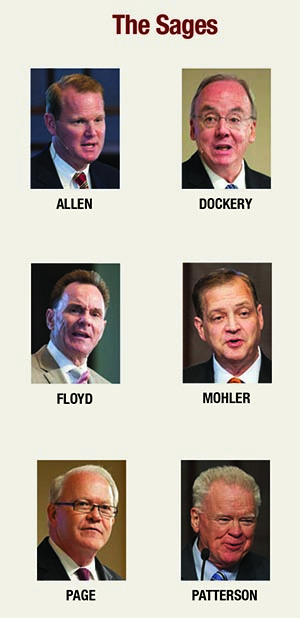
Forward thinkingNEWS | Jason Allen is the youngest by far of the group he has called together. And in this gathering of seminary presidents and convention leaders, there is a sense that a passing of the baton is happening before our eyes. In fact, that is one topic Allen has asked his illustrious guests to address in this symposium on “The SBC in the 21st Century.”

Their reports will be gathered and published in a book for wider distribution, but for now—at this late September gathering on the campus of Midwestern Baptist Theological Seminary—the task is to listen and learn what their listy observations hold in common.

Midwestern Seminary’s “miraculous transformation” is not the subject of this meeting, although most every speaker references it in his opening remarks. They speak of Allen’s impact, engendering confidence in a once-struggling institution. They take note of the new chapel that rises above a green slope at the entrance to the Kansas City campus. The building in a clean prairie style was completed just as Allen assumed the presidency of the school two years ago. A couple of speakers reference the rise in enrollment. And there’s some discussion of the just-announced $7-million gift to build a much-needed student center and dining complex.

Among the notables here is an unnamed presence, Charles Spurgeon, the famous 19th century British preacher and evangelist. Midwestern recently acquired much of Spurgeon’s personal library collection and has converted the former chapel space to house it. There’s a lot of informal conversation about Spurgeon. Most attenders take the tour.

But amid obvious historical footings and with the insight of SBC heads, the subject is the future. At 38, fresh in his seminary presidency, Allen draws experienced leaders and thinkers to look forward—and tell us what they see.

Who are we now?

Many questions about Baptist identity seem to have been answered in the past 30 years. Starting with the Conservative Resurgence in 1979, Southern Baptists have affirmed biblical inerrancy and ended a lean toward mainline Protestant liberalism. That shift also ended whatever tendency Southern Baptists would have had toward cultural accommodation. We aren’t mainline or mainstream, and as the culture moves farther left, we don’t want to be.

We know who we aren’t, but who are we?

The more recent issue for Southern Baptists is that of Reformed theology: Just how Calvinistic are we. Trinity University President David Dockery calls Southern Baptists “modified Calvinists” because we are not consistent in all five points.

Three of our seminaries are more strongly Reformed, products and by-products of Al Mohler’s 22-year presidency at The Southern Baptist Theological Seminary. At this conference, only Paige Patterson, President of Southwestern Baptist Theological Seminary, was clearly not Calvinist. He raised the issue of evangelistic zeal, and questioned whether the growth of Calvinist adherents will cool the baptismal waters further.

“Evangelism will have to be reestablished as the majority of the Great Commission,” Patterson said. He criticized church planting that does not produce new believers. Talking about the gospel is as far removed from effective witnessing as talking about race cars is from driving in NASCAR, Patterson said in a pithy list of analogies.

The more current “ecclesial crisis” is that of regenerate church membership. In the quest to reach seekers and postmoderns and millennials, church membership has been devalued, and more specifically, the certainty that people who join our churches are in fact believers in Christ as evidenced by baptism.

The SagesConfessional conviction

Will Southern Baptists embrace an identity that is more theological than tribal?” Mohler asked in his list of “10 unavoidable questions.”

The sages are almost uniform in their desire for Southern Baptists to have stronger theology and firmer confessional expressions of those beliefs. Too many people are members of SBC churches because it’s the family church, their friends go there, or they like the music—not because they hold strongly to the church’s theology.

Not to devalue our “tribal identity,” Mohler said, but “the tribe is not enough.” Tribalism—this informal gathering based on traditions and relationships—will give way to cultural accommodation, he warned, whereas confessional conviction will give believers (and thereby the denomination) theological moorings to withstand societal pressures to surrender to sexual redefinitions and moral decline.

Mohler asked whether today’s generation will “summon the courage” to face these issues which will require of them vigilance.

The current era is one of warm evangelicalism whose backbone is softening, to summarize several speakers. That makes this “the Baptist moment” according to Mohler. Among evangelicals, Baptists are best positioned to give the issues of “late modernity” a solid biblical, theological response.

Generational handoff

The discussion among panelists on “passing the baton” was playful at points with elder Patterson describing youthful Allen as “a man not yet dry behind the ears.” At another time Patterson, turning, 73 this month, commented, “I came on the scene right after Polycarp was martyred.” (That’s 155 A.D.) In these moments, it’s clear the baton is passing.

Mohler framed the handoff this way: “We have to ensure that there is healthy, courageous generational transition” in such a way that there is a Southern Baptist Convention in the future.

For Dockery, the handoff is more than from one generation to the next. It must be intergenerational. “Most Southern Baptists (and most Americans) do not find our identity in generations; our identity is in Christ.” Dockery says the handoff is also international and global, given the growth of evangelicalism in Africa and Asia.

Collaborative ministry

In a time when there is much discussion about “cooperation” as a denominational distinctive, SBC Executive Committee CEO Frank Page injected a new term, one that may have more weight with Millennials. “Collaborative ministry is biblical,” Page said. And for a generation accustomed to frequent electronic communication on every aspect of daily life, “collaborative” may be an easier sell than “cooperative.”

Cooperation indicates compliance with a mindset and participation in a program, whereas collaboration implies partnership and full participation by all parties involved.

As a denomination comprised mostly of smaller congregations, collaborative ministry “gives everyone a seat at the table,” Page said, including the SBC’s over 10,000 ethnic churches. But there’s education to be done. And it’s not only younger leaders who need the crash course. “We find there is a lack of understanding among ethnic churches of collaborative missions,” Page said.

But it was Dockery who pointed out that while the SBC has made strides in righting the sin of prejudice (the “one stain” on our record, he said), greater effort is required to bring minorities into leadership.

What about associations?

“This is no time to fly solo in the culture,” SBC President Ronnie Floyd said, “and no time for a church to fly alone.” Floyd’s presentation had the same listy character of the other speeches, but as a pastor, his list was most practical.

Floyd in particular called for a reduction in duplication (“and triplication”) of ministries and services by local, state, and national entities.

Larger state conventions, especially in the South, often offer their own versions of education, missions, and church planting; but since the implementation of the Great Commission Resurgence five years ago, those conventions have shifted funds to the national SBC in an effort to more effectively share the gospel in “new work” or frontier areas. And state convention staffs have been reduced by one-third, from 1,750 nationally to 1,350.

Making the denomination leaner is part of the thrust toward more effective collaboration. Floyd raised the issue of mergers, naming the International Mission Board and North American Mission Board as one possibility.

Local associations are another example where “regionalization” may make the SBC more effective. It’s a question that should be answered “honestly and boldly,” Floyd said, rather than trying to “preserve our old wineskins.”

“How can we leverage where we are and what we have and who we are to reach forward in a unprecedented manner” to advance the gospel?

Eric Reed is editor of the Illinois Baptist. Read the latest issue online.

The BriefingNo safe haven will be granted in the United States for the Assyrian Christians

The United States is the largest home to Assyrians, many of them driven out starting a century ago during the Armenian genocide. Yet the Obama administration has made clear it won’t shelter the Assyrian refugees forced from Syria or Iraq by ISIS.

“This administration will not issue visas for Syrians based on Christian faith.”

That was the word given to Anglican bishop Julian Dobbs by the State Department’s Bureau of Population, Refugees, and Migration. As a board member of Barnabas Fund, one of the largest relief organizations working in Syria and Iraq, Bishop Dobbs appealed to the State Department earlier this summer on behalf of the Assyrian Christians. The State Department said no.

Officials told Dobbs the Assyrians should use “people traffickers” to get across their borders to Turkey then appeal to the UN for refugee status.


9 things you need to know about refugees in America

Because of wars, conflicts, and persecution, there are more people around the world than at any other time since records began that have been forced to flee their homes and seek refuge and safety elsewhere, reports the UN refugee agency. Currently, across the globe there about 19.5 million people are refugees, and about half are children.

The number of refugees admitted into the U.S. each year is decided by the President. Before the beginning of each fiscal year, the President, in consultation with Congress, establishes an overall refugee admissions ceiling as well as regional allocations. The total number of refugees authorized for admission in 2013 was 70,000. The largest regional allocation was to the Near East/South Asia region, which accounted for 46 percent of the authorized admissions number to continue accommodating refugee arrivals from Iraq, Iran, and Bhutan. Learn more about the laws, policies, and numbers regarding refugees in America.


Chaplain survives dismissal attempt

Navy Chaplain Wesley Modder has survived an attempt to force him out of the Navy after his commanding officer’s claims that Modder failed to show tolerance and discriminated against sailors of different faiths were not proven.

David Steindl, commander of the Naval Personnel Command in Millington, Tenn., said the evidence presented against Modder did not meet the standard of “gross negligence” or “disregard of duty.”

Capt. Jon Fahs had requested Modder be detached from duty last February for counseling sailors that premarital sex and homosexuality were wrong. Fahs said Modder had shown he was unable to function in a pluralistic environment.

“I am called by my faith to express love for all, regardless of the diversity of backgrounds from which they come,” said Modder, who is endorsed by the Assemblies of God. “I will continue to follow my faith in all things. I am grateful to be able to continue the ministry God called me to do.”


Bernie Sanders Seeks ‘Common Ground’ With Evangelicals at Liberty University

Speaking as an honored guest at Liberty University’s Sept. 14 morning convocation, Democrat presidential candidate Bernie Sanders stated, “I came here today because I believe from the bottom of my heart that it is vitally important for those of us who hold different views to be able to engage in a civil discourse.”

Sanders noted he believed “we can find common ground” on issues like economic equality, family welfare, free higher education, and race relations.

“I am motivated by a vision which exists in all of the great religions, in Christianity, in Judaism, in Islam, in Buddhism, and other religions,” continued Sanders. “That vision is so beautifully and clearly stated in Matthew 7:12 and it states, ‘so in everything, do to others what you would have them do to you, for this sums up the Law and the Prophets.'”


Assisted suicide bill passed in Calif.

Approved by the California State Senate Sept. 11 and the state Assembly Sept. 9, the End of Life Option Act would allow physicians to prescribe life-ending drugs to terminally ill patients, according to the Los Angeles Times. The measure heads for approval or veto to Democratic Gov. Jerry Brown, who has “expressed concern” about it but not articulated his position, the Times reported.

The California bill is modelled after Oregon’s so-called “death with dignity” law, but with several changes. California’s law would expire after 10 years if not reapproved by the legislature and would require doctors to consult in private with patients desiring to die in an effort to prevent coercion by friends and family members, The New York Times reported.

Sources: Baptist Press, Christian Post, ERLC.com, The Gospel Coalition, World Magazine

Help needed in Sublette

Lisa Misner —  August 28, 2015
DR vounteers at work in Sublette.

Disaster Relief Supervisor, Jamie Kincaid, works with 2 Texas volunteers to pull a loose branch out of damaged tree in Sublette.

NEWS | Morgan Jackson

When an “act of God” takes place and overwhelms a community with destruction, a genuine act of God is the response through Southern Baptist Disaster Relief Teams. When a DR call out is given, volunteers respond to offer physical labor, but more importantly, spiritual healing through sharing the gospel.

Two months ago, an F2 tornado struck the southern end of Woodhaven Lakes, the world’s largest privately owned camping resort located in Sublette, IL. Disaster Relief teams have been offering aid in the area ever since, the most recent group during the week of August 16-22.

120 individuals from Illinois, Missouri, and Texas traveled to Sublette to do mostly chainsaw work – cutting trees, taking care of hanging limbs, etc. Volunteers also cleaned up multiple properties and carried debris to designated spots where it could be properly disposed of.

Damage from an F2 tornado

The F2 tornado that struck Woodhaven Lakes 2 months ago left some camping facilities unscathed and others in ruins.

Woodhaven Lakes is for many either a weekend house or vacation spot. This made it difficult to get in touch with owners who weren’t there in the middle of the week. DR Supervisor from Springfield, Jamie Kincaid, said that a work order needs to be signed before anything is done to the property. “Without that, we can’t touch it.”

Despite this hurdle, by the end of the week the 120 volunteers completed a total of 146 job orders. Less people on the property, though, also meant fewer individuals to share Christ with. But God opened spiritual doors nonetheless.

Wendell Romans from Texas, a Disaster Relief volunteer of 23 years, said the DR chaplain had a chance to share the Gospel with a couple on Tuesday. He also explained that if a family is home, once the team is through working on their property, they sign a Bible, present it to the owners, and pray with them.

Unlike the majority of Disaster Relief trips, though, the group doing most of the witnessing this time was the laundry team. Woodhaven Lakes had a laundromat on the facility that they allowed volunteers to use for free. While pouring detergent and folding clothes, Ruth Ann Lusk had multiple opportunities to pray with people.

She said, “We’re actually the ones doing the talking this time. People come in, and we just start talking to them. Or they see our shirts and start talking to us first.” The number of spiritual conversations during the week were numerous, and so far there are two known salvation decisions.

To read another story from this Disaster Relief trip, check out the August 31 issue of the Illinois Baptist.