Archives For November 30, 1999

News of interest to Illinois Baptists

Fulkerson and Porter group photo web

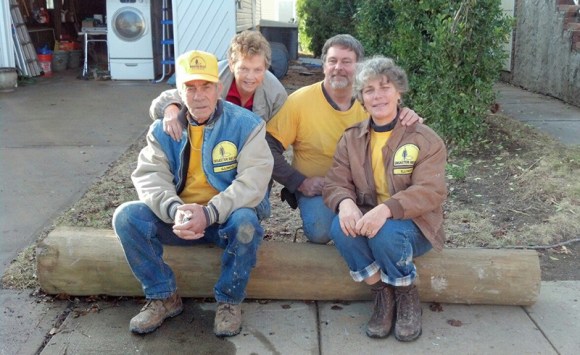
Disaster Relief volunteers Bob Fulkerson and his wife Margie (left) and Butch and Debbie Porter (right) rest for a moment during a call out a few years ago in New York. Fulkerson passed away Tuesday, March 29 while serving on a call out in Leesville, La. Both couples are members of First Baptist Church of Galatia, Ill. Photo courtesy Butch and Debbie Porter.

Funeral arrangements have been made for Southern Baptist Disaster Relief (DR) volunteer Don Fulkerson, who died of a heart attack Tuesday, March 29, while serving flood victims in Leesville, Louisiana. Fulkerson, 77, was with a group of trained DR workers from First Baptist Church of Galatia, IL, and volunteers from other Illinois Baptist churches.

Visitation will take place Friday, April 1 from 6-9 p.m.  and Saturday, April 2 from 9-11 a.m. at First Baptist Church of Galatia, 108 E. Church St., Galatia, IL 62935. His funeral will be Saturday, April 2 at 11 a.m. also at First Baptist Church of Galatia. Fulkerson was a member of the church.

Rex Alexander, Disaster Relief coordinator for the Illinois Baptist State Association (IBSA), suggested DR volunteers attending the funeral, “wear your yellow shirts in honor of Don’s faithful service to the Lord through Disaster Relief Ministry.” Southern Baptist DR volunteers are easily identified at disaster recovery scenes by the bright yellow shirts they wear.

“The callout to Louisiana was Don’s 15th response over a period of only four years and his wife, Margie, was almost always by his side serving whenever the opportunity arose,” shared Alexander. “Their faithful service to Christ brought great joy to both of them as they served side by side in the ministry of Disaster Relief.”

Cards of condolence may be mailed to his widow Margie Fulkerson, P.O. Box 5, Galatia, IL 62935.

The DR team from First Baptist Church of Galatia were first responders in what is expected to be a series of callouts to aid victims of spring floods in Louisiana. IIBSA teams will serve alongside teams from around the country.

IBSA has 1,600 trained volunteers who serve as part of the Southern Baptist Convention’s Disaster Relief ministry (SBDR), the third largest relief agency in the United States. Disaster Relief often responds to natural disasters by providing feeding stations, mobile kitchens, child care, and chaplains. In the case of flooding, volunteers in their signature yellow shirts help homeowners with “mudout,” clearing flooded properties of debris and contaminated building materials, so they can begin rebuilding and recovery.

Don Fulkerson

Don Fulkerson

Leesville, Louisiana | A volunteer with a Southern Baptist Disaster Relief (DR) team from Illinois died of a heart attack Tuesday, March 29, while serving flood victims in Leesville, Louisiana. Don Fulkerson, 77, was a member of First Baptist Church of Galatia, Illinois. He was serving with a group of trained relief workers from the church and others from churches around Illinois.

“The callout to Louisiana was Don’s 15th response over a period of only four years and his wife, Margie, was almost always by his side serving whenever the opportunity arose,” said Rex Alexander, Disaster Relief coordinator for the Illinois Baptist State Association (IBSA). “Their faithful service to Christ brought great joy to both of them as they served side by side in the ministry of Disaster Relief,” Alexander said.

The DR team from First Baptist Church of Galatia were first responders in what is expected to be a series of callouts to aid victims of spring floods in Louisiana. Illinois teams will serve alongside teams from around the country.

“Our Illinois Baptist family certainly grieves with and is in prayer for the Fulkerson family, and the entire church family at First Baptist in Galatia,” said IBSA Executive Director Nate Adams. “We appreciate so much Don’s and Margie’s service, along with so many other devoted disaster relief volunteers, and we are confident that Don’s life and sacrifice will bring eternal rewards, both to him and to the lives he touched.”

The North American Mission Board (NAMB) coordinates Southern Baptist Disaster Relief on the national level. NAMB president and former Illinois Baptist pastor Kevin Ezell extended his condolences to the family of Fulkerson as they mourn his passing. “Don is a great example of someone who chose to stay active into his later years and to contribute in a way that truly made a difference in the lives of others,” said Ezell. “I pray that his wife Margie and his entire family will feel God’s love and comfort during these days and that they will also be aware of the gratitude and appreciation for them from their entire Southern Baptist family.”

IBSA has 1,600 trained volunteers who serve as part of the Southern Baptist Convention’s Disaster Relief ministry (SBDR), the third largest relief agency in the United States. Disaster Relief often responds to natural disasters by providing feeding stations, mobile kitchens, child care, and chaplains. In the case of flooding, volunteers in their signature yellow shirts  help homeowners with “mudout,” clearing flooded properties of debris and contaminated building materials, so they can begin rebuilding and recovery.

Contact:
Illinois Baptist State Association
Lisa Sergent, Director of Communications
3085 Stevenson Drive
Springfield, Illinois 62703
LisaSergent@IBSA.org
(217) 391-3119


David Crosby

David Crosby

New Orleans pastor David Crosby is the third candidate to be named as a nominee for Southern Baptist Convention president. On March 24, former SBC President Fred Luter announced he will nominate Crosby, pastor of First Baptist Church, to the post during the SBC Annual Meeting in St. Louis.

“I have watched David the last 10 years here in New Orleans as he has taken the leadership of all the churches and pastors of our city in helping to rebuild New Orleans, which everybody knows was totally destroyed [in 2005] in Hurricane Katrina,” Luter, pastor of Franklin Avenue Baptist Church in New Orleans, told Baptist Press.

Crosby joins previously announced candidates — J.D. Greear, pastor of The Summit Church in Raleigh-Durham, N.C., and Steve Gaines, pastor of Bellevue Baptist Church in Cordova, Tenn.

In contrast to Greear and Gaines, Crosby has lead his church to a higher percentage in Cooperative Program giving. According to Luter, during the 20 years Crosby has pastored First Baptist, the congregation has given between 7-15% of its undesignated receipts through the Cooperative Program. Annual Church Profile reports show First Baptist’s total missions giving to be at least 22% of its undesignated receipts annually over the past five years.

Greear’s church gives 2.4% of undesignated receipts to CP, while Gaines’ gives approximately 4.6% of undesignated receipts to CP.

First Baptist has averaged 658 people in Sunday morning worship services and 24 baptisms between 2011 and 2015. The Summit’s baptisms increased from 19 in 2002, when Greear arrived, to 928 in 2014. Bellevue has averaged 481 baptisms annually during Gaines’ tenure.

Crosby is married and has three children and eight grandchildren. He earned a master of divinity from New Orleans Baptist Theological Seminary and a doctor of philosophy from Baylor University.

March 2 Jimmy Scroggins, pastor of Family Church in West Palm Beach, Fla., announced he will nominate Greear, and March 9 Johnny Hunt, former SBC president and pastor of First Baptist Church in Woodstock, Ga., said he will nominate Gaines.

The 2016 Southern Baptist Convention will take place June 14-15 in St. Louis, MO. Current SBC President Ronnie Floyd is finishing his second term in the post. Floyd is pastor of Cross Church, Northwest Arkansas.

Platt surprised by number, but financial position called ‘much healthier’

Richmond, Va. | David Platt’s report to the International Mission Board’s Board (IMB) of Trustees was the culmination of six month’s worth of efforts to undo the six year’s worth of overspending.

The IMB president, told trustees 1,132 total IMB personnel had accepted the Voluntary Retirement Incentive (VRI) or Hand Raising Opportunity (HRO).  The numbers broke down to 702 missionaries and 109 staff personnel accepting the VRI, and 281 missionaries and 40 staff accepting the HRO. The positions of 30 personnel in IMB’s Richmond communications office were eliminated in its mobilization restructure.

The total was nearly twice the minimum number the mission board needed to depart to balance its budget. As a result, the number of missionaries on the field are down to around 3,800, a number not seen 1992 when, according to Southern Baptist Convention (SBC) annual reports, the year ended with 3,893 international missionaries were serving.

Platt told reporters participating in a press conference via telephone February 24, “The numbers surprised me, for which I don’t have an explanation. We’ve put it in the hands of missionaries as much as possible… This a larger number than I or anyone else was anticipating. We called on people to pray so we’re going to trust in the Lord and his decision.”

While the press conference was taking place, Platt told reporters a severe storm was passing through and noted the lights were flickering on and off. A few minutes later the lights went out and a Tornado Warning Alert could be heard. The press conference was stopped for a half hour until the storm passed.

After discussing the numbers, Platt told the gathered media, “I want to talk about the number of missionaries who are left. Thousands of missionaries remain on the field, with thousands of years of collective experience. Everyone of them on the field has been placed there by God.”

IMB reported it had “consistently spent more money than it has received — a combined $210 million more since 2010…Because 80 percent of IMB’s budget is devoted to personnel salary, benefits and support expenses, leaders determined a need to reduce the total number of personnel by approximately 600-800 people to get to a healthy financial place in the present for sustained growth and engagement in the future.”

The Illinois Baptist asked what his reaction was to receiving almost double the number of resignations needed? “My heart is heavy but hopeful,” he answered. “Heavy in a sense that my heart is not to see less people on the field. My heart is heavy seeing the effects…It’s a hopeful confidence mingled with that heaviness.”

“What does this say about the confidence the missions force has in the new leadership?” the Illinois Baptist asked in a follow-up. Platt replied, “I’m very encouraged to see God working in the middle of all this. I have a hopeful confidence in what the IMB will be able to do in the future.

“I hope Southern Baptists see a serious desire to love and lead the IMB well…This is in no way a commentary on past leadership. Past leadership made a bold decision to put people on the field.”

Platt also addressed a question he said people have been asking, “How can you send thousands more when you just sent a thousand off the field?” His answer focused on what some would describe as marketplace missions, “limitless opportunities for people to work overseas and retire overseas.” In turn they would be funded by their paychecks and pensions. He also noted mission opportunities for students studying abroad.

One reporter expressed concerns from churches about the departure of so many missionaries leaving a “brain drain” on the field. Platt responded, “We encouraged missionaries returning to take their last days on the field to pour into our national partners and other IMB missionaries that were still there.”

Another reporter asked Platt if he saw this proposed use of self-funded missionaries as the IMB taking a societal approach to missions.

In his answer Platt noted, people who get jobs overseas and are paid by their businesses, universities provide scholarships to students, and countries in southeast Asia are seeking Westerners to retire there “rolling out the red carpet.” With these opportunities, he asked, “How can we not support the core paid missionaries with those around them that can help?”

He continued, “I can’t pray Matthew 7:9 and then tell people who want to serve with the IMB, ‘no.’ God’s created these other avenues…”

Platt also responded to a question regarding what kind of response he has heard from Southern Baptists. “I’ve not been surprised by the feedback from Southern Baptist pastors and church leaders,” he shared. “They’re thankful we’ve chosen to stewardship resources in the way we have…They’ve been very encouraging. Once they hear the big picture they say that makes sense, thank you for making that decision.”

He went on to say, “People aren’t happy about it. I’m not happy about it. It’s a hard reality for Southern Baptists to face that we don’t have the resources to keep more people on the field….I expect people to be upset that people are leaving the field but God’s leading us to greater financial stewardship.”

SBC President Ronnie Floyd told Baptist Press, “This reset is not regress or retreat. Southern Baptist churches must see this as a fresh calling to reaching the world for Christ. Now is the time to go forward with a clear vision and an aggressive strategy to make disciples of all the nations for Christ.”

Twenty-six new missionaries were appointed to the International Mission Board Feb. 23, in a service that was the first to be live-streamed.

The IMB Board of Trustees met February 22-24 in Richmond, Virginia.

IMB will host a livestream focused on “The Future of the IMB” Thursday, March 3, at 11 a.m. EST. For more information, visit IMB.org/live.

Increased missions support is encouraging, but it’s just a beginning.

The new year brought encouraging news to the IBSA office: In 2015, churches gave more than $6.2 million through the Cooperative Program, which funds missions and ministry in Illinois, across the country, and around the globe.

That’s $93,914 more than in 2014, an increase of 1.53%.

“We certainly are grateful to each IBSA church that continues to prioritize missions and ministries beyond their church by giving through the Cooperative Program,” said IBSA Executive Director Nate Adams, in response to the increase.

Founded in 1925, the Cooperative Program works when churches send a percentage of their tithes and offerings to their state convention, which then forwards a percentage—Illinois sends 43.25%—to support and train more than 4,000 international missionaries, plus 5,600 missionaries and chaplains in North America.

The remainder—56.25%—stays in Illinois to help get the gospel to eight million people who don’t know Christ, to strengthen nearly 1,000 existing churches, and to help start new congregations in neighborhoods with little to no evangelical presence.

Over the past several years, cooperative giving has been hampered by economic downturn. Adams noted that 2015 giving still fell behind 2012 and 2013 (and IBSA’s peak year of 2009).

“Throughout most of 2015, Cooperative Program giving in Illinois was running one to two percent behind 2014, so when giving surged in December and ended up higher than 2014, we were very encouraged,” he said. “I know a number of churches that have been struggling in various ways, and I hope this upturn in giving is an indication of greater church health and strength in 2016.”

The Southern Baptist Executive Committee shared its own good news in October, when they reported a 1.39% increase in nationwide CP giving over the previous fiscal year. The increase can be credited at least in part to the “1% CP Challenge” issued to churches by Executive Committee President Frank Page.

Last year, Baptist Press reported more than 4,400 churches have met or exceeded the challenge to increase their giving through CP by 1%. Page has said that if every SBC church accepted the challenge, CP giving would increase by $100 million.

Looking into 2016, Adams echoed the challenge. “I would join our national SBC partners in urging churches to embrace percentage giving from their annual budgets, and to consider a 1% increase in CP giving this next year.”

For Cooperative Program promotional resources, contact IBSA’s Church Communications Team at (217) 391-3127 or Communications@IBSA.org.


ILS16 Bumgarner_Tuesday

Bob Bumgarner

The two-day Illinois Leadership Summit kicked off January 26 with nearly 250 leaders from around the state filling the IBSA Building in Springfield.

Keynote speaker Bob Bumgarner led participants through the first two phases of IBSA’s four-phase leadership development process: leading self, leading followers, leading leaders, and leading the organization. Bumgarner, a leadership expert, is executive pastor of Chets Creek Baptist Church in Jacksonville, Florida.

He shared that character is the focus of leadership development. “Leading myself is a growing self-awareness of who I am, what my strengths are and where I am headed coupled with the character, commitment, and competence required to get there.”

More simply, he said, “We have to understand that before we can lead others well, we have to learn to lead ourselves.”

Bumgarner shared, “When we develop our heart we are accepting our assignment. The goal for personal responsibility is accepting responsibility for our actions when we lead… We don’t do that because it’s our job, we do that because it’s our calling.”

Stressing the importance of good leadership, Bumgarner noted, “Our impact on the people we lead either makes them better or worse.”

The job of the leader is to help the people your leading see and shape the future. “These are people who said I will trust and follow you,” he said. “What do you really want to accomplish? Until you tell them what you want to accomplish, they don’t know how to contribute.”

The Illinois Leadership Summit is part of IBSA’s ongoing leadership development plan. The conference features 27 speakers in 32 breakout sessions, including some Illinois pastors sharing experiences from their churches.

The Summit continues January 27. For coverage of the event, like us on Facebook and follow us on Twitter. #ILS16

Update: Saeed Abedini has returned to Boise, Idahio, and has seen his children. In developing news, Saeed’s wife Naghmeh has filed a domestic relations case against him today (Jan. 27).

Saeed Abedini was released last week after more than three years in an Iranian prison. Upon his release he was taken to a U.S. Air Force Base in Germany for debriefing and medical assessment, then to the Billy Graham Training Center (the Cove) in Asheville, NC,  for a period of rest and time with his parents. The pastor from Idaho next planned a reunion with his wife, Naghmeh, and their children.

His freedom, part of a prisoner exchange with Iran following that nation’s nuclear disarmament agreement with the U.S. was announced January 16.

In his first media interview since his release from an Iranian prison was announced Jan. 16, Abedini told FOX News’ Greta Van Susteren of the brutal physical and psychological torture he suffered in Iran for three and half years. Abedini prayed hours at times to survive years of abuse and unjust imprisonment in Iran for his Christian faith, and described his prayers as a “wonderful time with the Lord” which he enjoyed.

“I was beaten within to death kind of,” he told Van Susteren in broken English. “God saved me over there.” During a botched trial, the judge closed him in a room where guards beat him so badly with their fists that he suffered internal bleeding in his stomach. And at another time, he said, he was beaten on the face and body with a heavy metal chair.

Abedini’s wife Naghmeh has twice been delayed in seeing him since his prison release. She cancelled plans to visit him in Germany, where he was treated at a U.S. military hospital before his Jan. 21 arrival in the U.S., to give him more time to recover before reuniting with their children Rebekkah and Jacob. She told Baptist Press of plans to meet him Jan. 25 at the Cove, but according to news reports, that visit had also been delayed, Reuters News reported.

“We are ready to welcome him home,” Naghmeh said in a January 17 interview with FOX News, noting that the couple’s young children were making welcome home signs.

Leaders who have long called for the pastor’s release, including Southern Baptist ethicist Russell Moore, were quick to respond to the news. “Praise God,” he posted.

“The prayers of the Body of Christ all over the world have been answered,” Moore, president of the Ethics and Religious Liberty Commission, said later in a statement released by the ERLC. “This day of celebration should remind us to pray and work all the more for the multitudes still persecuted for their faith all over the world, including in Iran. We hope and long for the day when Iran, and nations like it, are free from those who wish to enslave the conscience at the point of a sword.”

Abedini was serving an eight-year sentence after being arrested in 2012. The pastor, who was raised in Iran and later became an American citizen, had organized Christian house churches in the Muslim country.

The ERLC gave Abedini a religious liberty award in 2014, which his wife accepted on his behalf at the Southern Baptist Convention’s annual meeting in Baltimore. Naghmeh returned to the SBC in 2015, where pastors prayed for her family and her husband’s release during the annual Pastors’ Conference.

During much of his imprisonment, Naghmeh advocated publicly for Saeed, organizing prayer vigils for him and sharing updates on social media. Late last year, though, she stepped back from the public campaign after e-mails she sent to supporters were leaked. The messages noted “physical, emotional, psychological and sexual abuse (through Saeed’s addiction to pornography)” that had marked the couple’s marriage. After her husband’s release, Naghmeh confirmed to the Washington Post that the abuse had started early in their marriage and grew worse during Saeed’s imprisonment.

“When he gets home, we can address the serious issues that have happened and continued,” she said. Naghmeh also told Washington Post religion reporter Sarah Pulliam Bailey that it’s unclear whether her husband will continue to be a pastor.

“I think he would have to deal with a lot of issues,” she said. “There will need to be a time of healing for him and his family.” Evangelist Franklin Graham is “coming alongside our family through the next steps of the difficult journey ahead,” Naghmeh posted on Facebook January 20.

The American Center for Law and Justice, who had lobbied extensively for Abedini’s release, credited God’s intervention for his freedom. “We want to rejoice that the Lord has set these individuals free,” said Chief Counsel Jordan Sekulow.

“At the end of the day, this was a move of God, because so many circumstances had to line up correctly for this to happen, and it did. And that’s not humans doing that; that is the Lord and we were just instruments to do our part.

Eric Reed with additional reporting from Baptist Press.

Disaster_Relief_logo_ILBy Meredith Flynn

Illinois Baptist Disaster Relief volunteers began working today to assist homeowners in the wake of flooding across the state and the Midwest.

Capital City Baptist Association, headquartered in Springfield, mobilized a team of volunteers to serve in Kincaid, where 35 homes were directly affected by flooding and others needed assistance following heavy rainfall, reported Director of Missions David Howard.

The team will work is expected to work in Kincaid through the week and possibly next, said IBSA Disaster Relief Coordinator Rex Alexander.

“We have assessors today working in Alexander County near Olive Branch, Illinois,” Alexander continued. “Williamson Association is preparing to go to that location on Wednesday of this week. But if we find out today that the water has not receded enough, then they will have to wait.”

In addition, a team from First Baptist Church, Galatia, is scheduled to leave Thursday to help in Alexander County or the St. Louis area. Volunteers from First Baptist Church, Harrisburg, and Metro East Association are scheduled to serve next week, likely in Alexander County, he said.

“We will learn this week more about the work needed in Alexander County and possibly other places in the state.”

Illinois Baptists have 1,600 trained disaster relief volunteers belonging to 37 teams based around the state. The teams include kitchen, childcare, chaplaincy, chainsaw, flood recovery, laundry and shower units along with a disaster relief command and communications trailer, and a search and rescue unit. To learn more about IBSA Disaster Relief, visit www.IBSA.org/dr.

Editor’s note: After an often tearful year, the Christian’s counterattack is hope.  The enemy may use the events of last year to strike chords of fear, but in reporting them, we offer notes of hope for 2016. God is in control of this world, and whatever happens, this history being made before our eyes will turn people toward him. He is our hope.
This is our certainty as we anticipate the new year, our hope.

Steeples-squareBy Meredith Flynn| In late 2015, Southern Baptist Convention President Ronnie Floyd wrote a blog post titled “Why we are where we are.”

It could well have been the slogan so far for Floyd’s year-and-a-half as SBC president. The Arkansas pastor has used his platform and his online presence to paint a picture for Southern Baptists of the state of things, and how to move forward together.

Throughout his presidency, Floyd has identified pressing issues for Baptists. He has written about how to think and pray on global issues like immigration and terrorism. Within the Convention, he has highlighted the need to pray for spiritual awakening, culminating in a corporate prayer meeting last summer in Columbus, facilitated by Floyd.

He also has championed the Cooperative Program, calling for it to be “the financial priority of each of our churches” after the International Mission Board announced a plan to cut personnel in light of budgetary shortfalls.

“If you are concerned about some of our missionaries having to come home and the decrease of our missionary forces,” Floyd wrote, “the greatest thing your church can do to help turn it around is increase your giving through the Cooperative Program. It helps build our base of support financially, which in turn will increase our ability to reach the world.”

Looking ahead: Giving through the Cooperative Program was up 1.39% for the 2014-15 fiscal year, an encouraging increase following several years of calls from SBC leaders for churches to increase their giving. In 2016, look for more information about “Great Commission Advance,” an initiative introduced at the Convention in Columbus. It’s set to run through 2025, the 100th anniversary of the Cooperative Program.

When Southern Baptists elect a new president in St. Louis this summer, the “Floyd factor” likely will be in play, as the denomination looks for another leader able to bring Baptists together around key issues inside and outside the Convention.

Editor’s note: After an often tearful year, the Christian’s counterattack is hope.  The enemy may use the events of last year to strike chords of fear, but in reporting them, we offer notes of hope for 2016. God is in control of this world, and whatever happens, this history being made before our eyes will turn people toward him. He is our hope.
This is our certainty as we anticipate the new year, our hope.

Missionaries-squareBy Meredith Flynn | The tone was set at the 2015 Southern Baptist Convention: If we’re going to continue sending missionaries to people groups who haven’t heard the gospel, the missions paradigm has to change.

“Churches almost unknowingly begin to farm out missions to missions organizations,” International Mission Board President David Platt said during the missionary commissioning service that coincided with the Convention.

“But this is not how God designed it.”

Instead, said the leader of the world’s largest evangelical missions organization, local churches must play a greater role in sending missionaries to the ends of the earth, like the first-century church at Antioch did.

Two months later, Platt announced 600-800 missionaries and staff would end their service with the IMB through a voluntary retirement incentive and subsequent hand-raising opportunity. And the local church was still central to the conversation.

IMB released a list of ways churches can support returning missions personnel. Many, including Illinois pastor Doug Munton, publicly encouraged local congregations to consider hiring returning missionaries to fill vacant staff positions.

At their September meeting, the SBC Executive Committee adopting a resolution encouraging churches to give to the Cooperative Program—Southern Baptists’ main method of funding missions—“more than ever before” in light of the IMB cuts.

Since Platt was named president in 2014, he has prioritized the responsibility of local churches and everyday Christians to leverage what they have so that more people around the world might hear and respond to the gospel. And not just through monetary gifts.

“Even if our income from churches were to double over the next year…we would still have a cap on our ability to send a certain number of full-time, fully supported church planters,” Platt said when he announced the personnel plan in August. The solution: “Consider all of the different avenues that God created in His sovereign grace for multitudes more people to go.”

What it means for churches: Those avenues may find business people, college students and retirees in your church leaving their lives in the U.S. to take the gospel to people who have never heard it. Local congregations have an opportunity to expand the ways they think about missions, and encourage “regular” people in the pews to do the same.