Archives For November 30, 1999

Family gatherings

ib2newseditor —  October 16, 2017

Postcard art

Not long ago, the pastor of an already growing church contacted me about “becoming Southern Baptist.” His church was starting to think about planting another church or campus, and had heard about the partnership and resources available through our North American Mission Board.

As I began explaining Southern Baptist polity and structure to him, I realized that those of us who “became” Southern Baptist when our parents enrolled us in the church nursery may sometimes take for granted the way our largest Protestant denomination in America operates and cooperates. In fact, many laypeople in our churches today might have trouble answering this pastor’s question.

Later I wished I had explained Southern Baptist life to him the way I truly think about it—like a family. A local church is like the immediate family you live with every day. You do life with them and know them intimately, in good times and bad, for better and worse.

A local Baptist association is like your family that lives nearby. You might see them every week, or maybe once a month, perhaps for dinner or to help with a project. They would help you move, or loan you their truck, or pick up your kids or grandkids in an emergency. They are your first line of support, and your first line of defense. You trust them, and you count on them, because they’re family, even if they don’t live at your house all the time.

Illinois Baptists will celebrate their annual ‘family reunion’ Nov. 7-9.

A state Baptist Association or Convention is like a more extended family. The distance between family members keeps you from seeing everyone in person very often. But you talk by phone, and you’re Facebook friends, and you’re aware of what each other is doing. When you’re in their town, you visit them. When their kids graduate or get married, or have a big life event, you’re there. And they’re there for you too.

When you are together with extended family, it’s still clear you’re related. The subtle family resemblances are there. Behaviors and preferences may be diverse, but values are largely the same. You know the same folklore. You celebrate the same heritage. You would still do anything for each other, even if Uncle Bill irritates you a little. You would never want to leave or lose this family, even if you’re grateful to get back in the car and go home.

Then there’s the national Southern Baptist Convention, which I might compare to a nationwide family reunion. I attended one of those once, for the Cunningham line of my family, which has gathered every Father’s Day weekend for decades in western Kentucky. We loved going, and met people we had never met before, and it didn’t take long to discover common threads, and certainly common values. I hope to go again someday. And if you ask me, “Are you a Cunningham?” I will proudly say yes, and eagerly help anyone from that family.

I know lots and lots of pastors and church members who have never been to a national Southern Baptist Convention, but who faithfully give to Southern Baptist missions, and who faithfully believe The Baptist Faith and Message. It’s a wonderful, diverse, large family.

And so, with a newfound warmth and enthusiasm for family, I invite you to come to Tabernacle Baptist Church in Decatur this November 7-9 for the IBSA Pastors’ Conference and IBSA Annual Meeting. In fact, bring someone with you who hasn’t been to this extended family gathering in a while. You won’t know everyone, but everyone you meet will be family. They believe what you believe, and they work together at doing the things you know are most important. And at least most of us would do anything for you.

Nate Adams is executive director of the Illinois Baptist State Association. Respond at IllinoisBaptist@IBSA.org.

Marci Coble

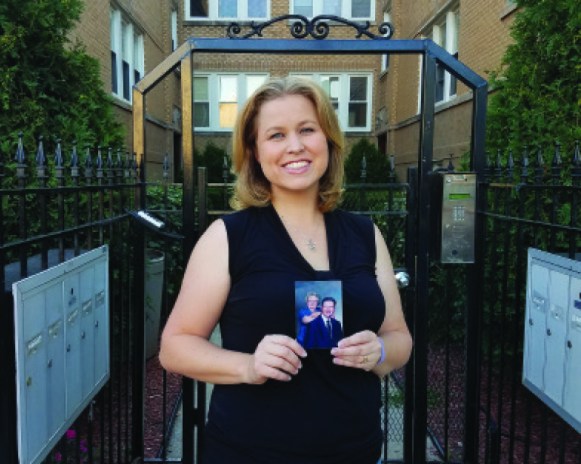
Standing outside their Chicago condo, Marci is holding a photo of her grandparents. Her grandfather, Maurice Swinford, led church development for IBSA and ultimately served as executive director.

The strategy is simple. Lost people know lost people. They hang out with lost people. If you lead one lost person to faith in Christ, suddenly you have broken into a whole new circle of people who need Jesus. And the most effective witness to the gospel is someone whose life has been changed by salvation in Jesus Christ—especially if it’s happened recently.

That’s why the Illinois Baptist State Association continues to invest in church planting as an important and effective strategy for evangelism. There are lots of places in a state of 13 million people where there is little or no evangelical witness.

IBSA is identifying 200 places and peoples that need Jesus. With at least 8 million lost people living just next door, it won’t be hard to put those pins on the map. For Bryan and Marci Coble, that pin landed in the Irving Park area of Chicago, far away and far different from her small hometown in Chatham.

Marci Coble was raised near Springfield under a strong Baptist influence. Her grandfather, Maurice Swinford, was on IBSA’s staff 15 years and served as executive director from 1988 to 1993. “He was always making sure I knew who Jesus is,” Marci says with a tear in her eye. She was a GA and Acteen, and worked one summer at Lake Sallateeska Baptist Camp.

“I was allotted a lot of opportunities and a lot of blessings that I probably wouldn’t have had without his influence and without being his granddaughter—even my call to missions.”

She is almost as emotional describing Chatham Baptist Church. “I grew up there, I was baptized there,” Marci says. “Bryan and I were married there. They shaped me and molded me and I’m blessed to call that my home.”

So when Marci’s husband, Bryan, suggested when he finished his seminary studies that they move to Portland, Ore., to plant a new church, Marci’s brows furrowed. She was willing to go wherever God led them—in fact, they visited the Pacific Northwest on a vision tour—but might God lead them to Chicago?

“Bryan had set up an appointment in Portland. And we received a note from my grandmother with an article from IBSA letting us know they need church planters in Illinois too.” Marci laughed. “And we were like, ‘Oh, that’s so sweet. I love Grandma.’” But the message stuck.

“I didn’t want to come to Chicago,” Bryan readily confesses. “I was raised 60 miles south of St. Louis and grew up a St. Louis Cardinals fan. When we started to pray about Chicago, God actually told me—this may sound crazy,” he says as an aside, “to get a Chicago Cubs hat and wear it for 30 days.”

Bryan shifts the Cubs hat on his head, as if he’s adjusting to the fit.

“My heart started to change,” the Missouri transplant says as a smile breaks out. “My love for this city and my burden for this city started to grow. We love this city so much. We love the people of this city so much,” he says.

A similar feeling started growing back in Chatham, Marci’s home church in suburban Springfield. The town of 11,000 is one-seventh the size of the Cobles’ new neighborhood. And for the church members there, Chicago has seemed like someone else’s responsibility.

“To be honest with you, Chicago has always seemed very distant to us,” says Pastor Milton Bost. But having a hometown girl serving as a missionary in the big city has changed things.

“I think Bryan and Marci are kind of pioneers for us,” Bost says.

Chatham has become heavily involved in the Cobles’ planting work 200 miles away. “Folks from Chatham came up to help us do this,” Bryan says on a rainy Saturday morning in April. A children’s playground in the center of their neighborhood is also the epicenter of their planting work. “(We) hand out flyers, hand out cookies, talk to people, build relationships.” The park is covered in people wearing green T-shirts declaring their love for the area.

“We want the community to know that we love them, we’re here to invest in them first and foremost,” Marci says.

The couple moved their two boys there last year—in time for the Cubs’ World Series win. They began surveying the city and seeking God’s direction. In the spring the Cobles bought a small condo in a pre-war three-floor building, and started meeting the neighbors—Hispanics, Anglos, and some Asian people. Their goal is to launch a Bible study, then a church, in the recreation building at the park.

“Chicago is a world city. It has high influence not just within the state of Illinois, but in the world,” Bryan says. “We need to be able to reach these people with the gospel. We do it in love, so that they will hopefully come to know Christ and be changed by the gospel. And the world with them.”

Learn more about the Mission Illinois Offer and Week of Prayer September 10-17 at www.MissionIllinois.org.

Watch the video, “A Heart for the City.”


Dwight McKissic by Van Payne

Texas pastor Dwight McKissic moved to bring his proposal on the “alt-right” to messengers at the Southern Baptist Convention Tuesday June 13. BP photo by Van Payne

After a series of floor votes and behind-the-scenes discussions in the late evening, convention leadership announced Tuesday night that messengers will be given opportunity to consider a resolution originally proposed by a Texas pastor condemning the “alt-right” movement. Debate over the resolution, which is a statement of messengers’ opinion but non-binding on Southern Baptist churches, threatens to draw attention away from SBC President Steve Gaines announcement that he wishes to name a committee to focus on soul-winning, and possibly shift the spotlight away from Ethics & Religious Liberty Commission President Russell Moore.

The Resolutions Committee, a group of one-time appointees led this year by former ERLC vice president Barrett Duke, brought nine resolutions to the floor. They included statements on prayer and repentance, the morality of political and church leaders, the nature of atonement, and “the sin of gambling.” But the committee did not bring for a vote a statement proposed by Arlington, Texas pastor Dwight McKissic condemning actions of the alt-right political movement.

“Our decision not to report that resolution out is not an endorsement of the alt-right,” Duke said at a news conference following the afternoon session. “There are aspects of people who identify as alt-right, certainly, a lot of views and their intentions, we would adamantly, aggressively oppose.” He said the committee chose not to bring McKissic’s motion for a vote after hours of discussions over broad language that they characterized as problematic and possibly inflammatory.

As he did in a previous convention to debate use of the confederate battle flag, McKissic took to the floor. He asked the messengers to amend the rules and bring his proposed resolution for a vote. That vote failed to get a two-thirds majority.

Later, in the evening session, another messenger from Washington D.C. cited unnamed media reports about conventions failure bring the “alt-right” statement back for a vote, and made an impassioned plea for another opportunity for messengers to see McKissic’s statement. The messenger said he “feared” the SBC was being called racist because they did not vote on the alt-right statement. A second balloting to bring the resolution to the floor received only 58% of the vote, again short of the two-thirds majority. But messengers’ considerable interest in the issue convinced the Resolutions Committee to revisit the matter.

The Committee will bring a resolution addressing the alt-right movement at 2:45 p.m. (PT) today. The statement is expected to address the sin of racism. It comes as the SBC continues efforts to bring non-whites into leadership. Coming three years after New Orleans pastor Fred Luter served as the SBC’s  first African American President, messengers elected African American pastor and professor Walter Strickland as first vice president on Tuesday and Hispanic pastor Jose Abella as second vice president. The SBC Pastors Conference on Monday elected African American pastor H.B. Charles of Jacksonville, Florida as its president.

SBC President Gaines had asked for time on Tuesday to announce plans for a year-long study on evangelism in the SBC, and presentation of a plan for more effective soul-winning by SBC churches and pastors. Gaines’ effort comes after another year of declines in baptisms and worship attendance, and a decade of shrinking SBC church membership.

The ERLC’s annual report is the final item on the agenda today. Yesterday, Moore characterized the annual meeting as a “family reunion” of people who together advance the gospel. Although there was a motion for messengers to be allowed to address concerns about the ERLC, the motion seems likely to be referred or dismissed entirely. Moore did not speak to recent national reports that his relationship with the both SBC leaders and the Trump administration remains strained. And as attention turns to the “alt-right,” it appears less likely messengers will have time, or a parliamentary vehicle, to discuss the ERLC.

See what others are saying:

Southern Baptists, Racism, and the Alt-Right: It’s Time to Make This Right, Plain, and Clear

Southern Baptists are about to vote on a proposal to condemn white supremacy

Southern Baptists Grapple Over Calls to Condemn Alt-Right

Southern Baptist Convention in uproar over ‘alt-right’

A Resolution Condemning White Supremacy Causes Chaos at the Southern Baptist Convention

Southern Baptists grapple with morality, white nationalism in the Trump age

Southern Baptist Convention Resolution Denouncing ‘Alt Right,’ White Nationalism Hits a Snag

Messengers OK 9 resolutions, to vote on ‘alt-right’ proposal

— Eric Reed in Phoenix

Broadview | Whatever happens in the general election, preach the Word—and stick to the Word—speakers at the 2016 IBSA Pastors’ Conference exhorted their audience. The first day of the meeting at Broadview Missionary Baptist Church in metro Chicago coincided with the concluding games of the World Series, so several of the speakers got in on the Cubs banter, but ultimately the stuck to the Word.

david-sutton

David Sutton

“We think about what’s going on in our world today,” said pastor David Sutton of Bread of Life Missionary Baptist Church in Chicago, who also served as president and organizer of the event. “So much grief,” he said, referring to a record number of shootings in the city the previous weekend. “When I think about this being an election year, it seems to further exacerbate things—there are so many things we can allow to divide us—even where we live, if we live in a rural town or a large community.”

The theme for the conference is “Crossroads, our pathway to reconciliation,” building on the “Cross Culture” theme of the IBSA Annual Meeting which will follow the pastors’ gathering.

“I believe God has called us together for such a time as this, even as we stand together in such a divided time,” Sutton said, pointing out the dichotomies of Illinois’ geography and population. “We come from so many different groups and backgrounds, [but] even in our differences we can come together…. I heard one preacher say we may not agree on everything, but that doesn’t mean we can’t walk together hand-in-hand.”

The featured preachers built on that theme, repeatedly igniting the crowd of pastors from Northern and Southern Illinois, black and white and Hispanic and Asian, in cheers and applause.

fred-luter-2

Fred Luter

“If God can change you and me, the same God can change their lives,” said Fred Luter, pastor of Franklin Avenue Baptist Church in New Orleans, speaking of lost people, particularly those engaged in drugs, gang activity, and a litany of sinful lifestyles he enumerated.

“In your B.C. days, in other words, in your ‘before Christ’ days, what did it take to change you? Before you stopped drinking, before you stopped shacking up, before you stopped using the N-word, before you stopped going to casinos and playing the lottery (I hoped you stopped!)… you heard the gospel! You heard the gospel of Jesus Christ! You were transformed by the power of the gospel…. The same gospel can change our city and can change those knuckleheads in our streets!”

Luter, who served as the first African American president of the Southern Baptist Convention, urged the crowd: “Come on preachers, let’s preach the gospel of Jesus Christ! Come on teachers, let’s teach the gospel of Jesus Christ! Hallelujah, Jesus saves!”

scott-nichols

Scott Nichols

Illinois pastor Scott Nichols of Crossroads Community Church in Carol Stream, said “reconciliation is painful, hard work” but it’s our calling for “those in the grip of sin…because God’s done reconciliation in my life. Our purpose is not growing our church. The purpose is making us like Christ. The purpose is winning the world to Christ,” Nichols said.

Politics was overshadowed by Gospel in the preaching and in the breakout sessions. “Leave the political stuff alone, that is only going to divide,” said Ron Gray, pastor of The Connection Church in Chicago, in a breakout session.

“With all this is going on around us, someone should be asking ‘Is God trying to tell us something?” said H. B. Charles, Jr., a skilled expositor and pulpiteer from Jacksonville, Florida.

hb-charles3

HB Charles, Jr

“God speaks by his actions, but God also speaks by in his inactions.” There is the wrath that is due man’s rebellion, “and there is the wrath of abandonment” for those who persist in the sins listed in Romans 1, as God turns them over to the outcomes of their sins.

As several speakers said, whatever the outcome of the election on November 8, the next day God will still be on the throne and in charge. “I was tempted to label this sermon the unelected and unimpeachable king!” Charles said. “His almighty Son has already been appointed King, and he is not up for re-election.”

“Thank you, Lord!” came the reply from the pews.

By Marvin Del Rios

Editor’s note: This post is the last in a series on cross-cultural ministry, taken from a round table discussion between four Illinois pastors and leaders. Click here to read more from their conversation, published in the September 29 issue of the Illinois Baptist newspaper. 

marvindelriosMarvin Del Rios is pastor of iglesia Bautista Erie in Chicago. He will lead worship during the Thursday morning session of the Illinois Baptist State Association’s Annual Meeting at Broadview Missionary Baptist Church in Chicagoland, Nov. 2-3. The theme of the meeting is “Cross-Culture.”

Defining ‘cross-cultural ministry’
When I hear “cross-cultural ministry,” I go to the book of Acts, chapter 6, which talks about the differences between the Hellenistic Jews and the Jews that come from their own land. That is something that we are living within Hispanic or Latino churches right now, which is the way our generations relate to one another.

The first generation can become accustomed to a certain way of preaching, a certain way of leading worship, a certain way of “doing church” right. The second and third generations are more familiar with American culture, education, lifestyle, and language. What is happening is that there is unfortunately an exodus of the second and third generations that are leaving the church. Either they’re leaving completely and not coming back, or they’re going to a more English-based or multicultural church.

On a pastor’s responsibility
Even though I am called to go and preach to the nations, I have a burning desire to go and reach my second- and third-generation Latino culture. Unfortunately, there is a huge disconnect with the first, second, and third generations, even though we may speak the same language and may have some of the same traditions.

 We have tried to make our church a hub for the community.

Even though I am a second-generation Hispanic leading a predominately first-generation church, a few people that are second-generation have seen me model trying to minister and take care of that first generation. And now, the first generation is taking the extra step to learn a little bit more English. All of that happened with modeling. I could have said, “Fine, I’m concentrating on the second and third generations, and that’s it.” But we still have that need for the gospel for all generations and cultures. It is our responsibility to see it through and make it happen.

On inter-generational outreach
My approach has been to let get something going well with our second-generation people, so they can take it back to the first generation. Usually we hear about the first generation ministering to the second generation, but now it is starting to turn around.  Now it is the second generation ministering to the first generation. Because of that dynamic, we also are ministering to the young professionals in our community and trying to see where we can come out of our comfort zone.

We have tried to make our church a hub for the community. Now we are housing an AA meeting for families and a lot of contemporary culture kinds of programs. In a nutshell, the people in our community know we are there to serve. Is it happening really fast? No, I wish it would be faster. But it is getting to the point that we are seeing more of the gospel leading out, instead of the gospel just being planted in our church and staying there.

Missions opportunities to highlight gathering in Metro Chicago

Final preparations are under way for the 110th IBSA Annual Meeting November 2-3. The event at Broadview Missionary Baptist Church in metro Chicago will focus on cross-culture ministry opportunities in Illinois. The keynote speaker will be Dr. Jeff Iorg, president of Gateway Seminary of the SBC, called Golden Gate Seminary prior to its relocation from the San Francisco Bay Area to metro Los Angeles this year.

“Dr. Iorg is among the most compelling, thoughtful, and missional voices in Southern Baptist life today, especially when it comes to understanding post-Christian culture in America,” said IBSA Executive Director Nate Adams. “I’m so grateful that he is leading our West Coast seminary into the future, where pastors and leaders will engage values and cultures that are already very different from those of the past century.”

I hope this year’s Annual Meeting will bring to all of us a new vision and higher level of commitment to ‘cross culture’ with the gospel.

Iorg is a former church planter and state convention executive director in the Pacific Northwest. As a leader of Southern Baptist work on the West Coast, Iorg has addressed many of the cultural challenges now facing evangelicals in the Midwest. He has written frequently on theological and biblical perspectives on marriage, sexuality, and gender. His book “Building Antioch” shows from the New Testament how an ordinary believing congregation can become a transformational community.

“Illinois Baptists will come away from Dr. Iorg’s messages challenged and transformed, I’m sure,” Adams said.

The Wednesday evening session, including Iorg, will focus on a four-phase process for engaging ministry across cultural barriers. Adams will outline the plan and share testimonies and videos of Illinois churches carrying the gospel to people unlike themselves.

“My own recent trips to Chicago have reminded me again how diverse our churches are, and even more so how varied and challenging are the cultures that our churches need to reach,” Adams said. “I hope this year’s Annual Meeting will bring to all of us a new vision and higher level of commitment to ‘cross culture’ with the gospel.”

IBSA President Kevin Carrothers, pastor of Rochester First Baptist Church and Vice President Adron Robinson, pastor of Hillcrest Baptist Church in Country Club Hills, will also bring messages.

In addition to the session on the variety of ministry opportunities in Illinois, the meeting will include two business sessions on Wednesday afternoon and Thursday morning. Vision tours of Chicago-area ministry opportunities are available. Seating is limited, so online registration is encouraged.

Visit www.IBSAAnnualMeeting.org to learn more.

By Kevin Carrothers

Editor’s note: This post is one in a series on cross-cultural ministry, taken from a round table discussion between four Illinois pastors and leaders. Click here to read more from their conversation, published in the September 29 issue of the Illinois Baptist newspaper. 

kevin-carrothersKevin Carrothers is pastor of Rochester First Baptist Church and president of IBSA. He will deliver the president’s message Wednesday, Nov. 2, during the Illinois Baptist State Association’s Annual Meeting at Broadview Missionary Baptist Church in Chicagoland. The theme of the meeting is “Cross-Culture.”

On being an influential church
I was a couple of years into my ministry in Rochester when I sat down with a leader in town. I asked him, “What do you think about when you hear Rochester First Baptist Church? What comes to mind?” His words weren’t really a rebuke, but I didn’t like what he said. He said “You’re a nice little church.”

Well, we are a small church, unapologetically a small church, but that was his perception, a “nice little church.” Now, hopefully that has changed since then. Now, we’re “the church that does the party” (our annual fall festival). Or we’re the church that does VBS in the summer in a way that spreads the gospel to our community.

We don’t have to be the biggest church but we can still be the most influential church.

I don’t want to just be the nice little church, but we are still little. The word that I want is influence. We don’t have to be the biggest church but we can still be the most influential church.

On ‘incarnational’ ministry
God was incarnational with us—he sent Jesus to live among people. Likewise, we need to be incarnational. Sometimes I think that’s where we kind of miss the boat in the church. We think we have to come up with a new program or a new ministry. Instead, let’s find out who is doing something and go be involved in that.

For me personally, being incarnational is volunteering at my kid’s school. On my day off, I spend a couple hours at the schools and have a presence there. That makes an impact. It’s coaching Little League or youth basketball. You’re there with people. Then, you have to be intentional about making sure the gospel becomes known, about making sure that they know this is who you are.

It gets back to all the things we have been talking about. Cross-culturally we have to love our community; we have to show them that we care. We have to go where they are.

By John Yi

Editor’s note: This post is one in a series on cross-cultural ministry, taken from a round table discussion between four Illinois pastors and leaders. Click here to read more from their conversation, published in the September 29 issue of the Illinois Baptist newspaper. 

john-yiJohn Yi is IBSA’s second-generation church planting catalyst in Chicago, founder of a community ministry in Maywood, and a leader at Bethel SBC, a church plant in Mt. Prospect. Visit John at the virtual vision tour sponsored by the IBSA Church Planting Team during the IBSA Annual Meeting Nov. 2-3 at Broadview Missionary Baptist Church in Chicagoland.

On living where you serve
I think my wife and I always knew that once we got to the place where we would set down our roots ministry, we would have to live in the community where we were going to do our work.

We were not going to be commuting. That was something we had both experienced in our young adult years—traveling to go to church. In fact, until we lived in Maywood and started our ministry there, I don’t think I had ever lived and gone to church in the same town.

…the sacrifice might mean having to pull up your roots and go to a place that feels very uncomfortable and unnatural to you.

We lost some other comforts in the move too. A lot of our friends are away from us too.  We were distant from the people with whom we felt comfortable.

On becoming a community church
We still live in Maywood. And in the years since our move there, we’ve learned the sacrifices were worth it. I think in order to be cross-cultural, there has to be a weighing of what is not necessary for the sake of ministry. We have done that at our church, Bethel SBC, too. Part of us wanting to become a community church means we really have to become less Korean.

In Korean churches it is almost a universal practice to have a lunch fellowship after the worship service and it is almost always Korean food. When I first proposed not doing Korean food anymore, there was an uproar. I’m like, “Why can’t we just do sandwiches or order pizza once in a while, or do spaghetti and meatballs?”  That’s how it was at the beginning, but now I can’t even remember the last time we had a Korean meal at church.  Our members have really taken to this idea that we really have to make it more accessible. We want to get rid of all the barriers, and I think that is one of the sacrifices we have to sometimes make.

And sometimes, the sacrifice might mean having to pull up your roots and go to a place that feels very uncomfortable and unnatural to you.  We know missionaries do that all the time when they go to a foreign country, but when you weigh the value of the gospel and the Kingdom of God, I think sometimes those things that seemed so important to us start to lose their luster.

Which church are you?

ib2newseditor —  October 26, 2016


By Adron Robinson

Editor’s note: This post is one in a series on cross-cultural ministry, taken from a round table discussion between four Illinois pastors and leaders. Click here to read more from their conversation, published in the September 29 issue of the Illinois Baptist newspaper. 

adron-robinsonAdron Robinson is pastor of Hillcrest Baptist Church in Country Club Hills and vice president of IBSA. He will deliver the annual sermon on Thursday, Nov. 3, during the Illinois Baptist State Association’s Annual Meeting at Broadview Missionary Baptist Church in Chicagoland. The theme of the meeting is “Cross-Culture.”

On finding an identity
Every church is going to be “that” church. People are going to say that’s the church that does this, or that church does that. As leaders, we need to get out front in defining what our church is going to be known for. John 13:35 just comes to mind: “By this all people will know that you are my disciples, if you have love for one another.” Your church needs to be known for showing your community God’s love in some way.

Your church needs to be known for showing your community God’s love in some way.

I grew up next door to a church. The church’s driveway was right in between it and the house where I was raised. Growing up, I thought the driveway was ours because we never saw church people until Sunday. On Sunday, they would come in and park on the street and fill up the driveway. They would be in the building all day and you would hear the music, but the rest of the week, the building was empty.

The church was just “that” church next door. When they came around on Sunday, they were “those” church people.  The complaint among the neighbors was that they took up all our parking. Other than that, they had no interaction whatsoever with the block, not to mention the rest of the community.

On engaging your community
Churches can do a great service to their community just by being good neighbors, and engaging people around them. Go be a coach, or just be a parent watching your kids play on a local sports team. Let people see the love of Christ in you. You don’t have to always be carrying a big Bible around, but just get to know people and start the relationships and let your love for the Lord be seen amid those interactions. You do much more for the gospel that way.

I think we try to reinvent the wheel too much. The community is already gathering together; go to those areas and take the gospel with you.

With the IBSA Annual Meeting just weeks away, pastors and church members who plan to serve as messengers at the Nov. 2-3 meeting are encouraged to make preparations now. See the checklist below for a step-by-step plan of how to get ready for Chicago.

The meeting at Broadview Missionary Baptist Church is preceded by the annual IBSA Pastors’ Conference, which begins Tuesday, Nov. 1 at 1 p.m. and will feature preachers H.B. Charles, Fred Luter, Scott Nichols, and Jonathan Peters. The Pastors’ Conference also will include breakout sessions on cross-culture ministry and evangelism.

“Cross-Culture” is the theme of the Annual Meeting, which begins at 1:15 p.m. on Wednesday, Nov. 2. Jeff Iorg, president of Gateway Seminary of the Southern Baptist Convention, will help interpret the meeting’s theme throughout the sessions, and will join IBSA Executive Director Nate Adams and other guests for Mission Illinois: “Cross-
Culture” on Wednesday evening.

The meeting also will feature preaching by Kevin Carrothers, IBSA president and pastor of Rochester First Baptist Church, and Adron Robinson, IBSA vice president and pastor of Hillcrest Baptist Church in Country Club Hills.

Meeting attenders will have an opportunity to see Chicago missions and ministry sites on vision tours planned for Nov. 1 and Nov. 3. Space is limited; go to IBSA
annualmeeting.org to sign up and choose your route (Northside, Southside, Westside, Suburban, or a Chicago sampling).

IBSA also will offer dine-in meal opportunities during the Pastors’ Conference and Annual Meeting. See details below and order meal tickets at IBSAannualmeeting.org/meal-tickets.

Check the website, IBSAannualmeeting.org, for all other meeting details, including information about travel, parking, and hotel accommodations. And take note of the other meetings also scheduled Nov. 1-3:

Young Leaders Network
When: Tuesday, Nov. 1, 9:30 p.m.
Where: Broadview Baptist Church
Menu: Wings ‘n things

Pastors’ Wives Luncheon
When: Wednesday, Nov. 2, 9 a.m. to noon
(Coffee fellowship begins at 8:30 a.m.)
Where: Broadview Fellowship Hall
Cost: $15; send check made out to IBSA Pastors Wives to Stevi Smith, 1302 W. Robinson St., Harrisburg, IL 62946
RSVP: Pre-registration is not required, but strongly recommended by Monday, Oct. 24. E-mail Lindsay McDonald at lmcdonald_31@hotmail.com.

Church Planters Breakfast
When: Thursday, Nov. 3, 7 a.m.
Where: Broadview Fellowship Hall
Cost: This is a free breakfast for planters and spouses, but pre-registration is appreciated.
RSVP: RachelCarter@IBSA.org, (217) 391-3101

Directors of Missions/Moderators Breakfast
When: Thursday, Nov. 3, 7 a.m.
Where: Broadview Fellowship Hall
RSVP: If you have received an invitation, please RSVP to LindaDarden@IBSA.org or (217) 391-3137.

annual-mtg-checklist