Archives For November 30, 1999

HEARTLAND | Nate Adams

It feels like I have had more than a few challenging days of ministry recently. But today is an especially good Sunday, and I’d like to tell you about it.

I leave home very early, to drive almost 200 miles to an IBSA church where I know the pastor, but have never attended on a Sunday morning. It’s their 70th anniversary, and I have a nice plaque from IBSA to present to them. In all those regards, it’s not really an unusual Sunday.

Nate_Adams_July28What’s a little more unusual is that my wife, Beth, is traveling with me. Our youngest son Ethan is leading the worship team at our home church in Springfield, and Beth would like to be there too. But by evening we will be at the church where our middle son Noah is youth pastor, and so she has decided to come along. So it’s already an especially good Sunday.

We drive past one, two, three IBSA churches, and eventually past the one where I recall speaking three years ago when my oldest son Caleb also shared his testimony. He had just returned to the Lord after years as a prodigal. And as I realize that today my wife is with me, and that all three of our sons are worshiping and serving in an IBSA church, I realize that this is an especially good Sunday.

At the church celebrating its 70th anniversary we are greeted warmly, with appreciation for both IBSA and for our long drive that morning. I watch as an effective pastor loves his people, and they love him back. I meet a 93-year-old former church planter and pastor, who tells me he helped plant one of the first SBC churches in northern Indiana. He’s surprised I don’t recognize his former supervisor’s name, until I remind him I wasn’t born yet.

Later when I’m presenting the plaque, I tell both the 93-year-old church planter and the 70-year-old church that my wife and I are on our way, after church, to IBSA’s first “ChicaGO” student camp at Judson University. It’s a pilot church planting camp that we hope will continue to produce church planters, church plants, and eventually 70-year-old churches. And as I describe this picture of church planting across the generations – I realize that this is an especially good Sunday.

We arrive at Judson University late in the afternoon, and help greet students and chaperones from 11 different IBSA churches. Then a bus-load of IBSA All State Youth Choir students unload, and I remember they are there for a couple of days too, to join the ChicaGO mission week, and share a couple of concerts in the area.

That night the choir sings at Calvary Baptist Church in Elgin. In addition to being my mom’s and son’s church, this is also the church where Wilma and Jack Booth are members. During the concert, IBSA Worship Director Steve Hamrick reminds us that Wilma was one of the leaders that started the IBSA All State Choir 36 years ago. And as I reflect on the blessing of tomorrow’s worship leaders being equipped for churches across the generations – I realize that this is an especially good Sunday.

I will have to wait until my next column to tell you about the “week in the life of church planters” that follows this special Sunday. But let me punctuate this account by telling you that as the All State Youth Choir led us in singing “Jesus Messiah,” I found my eyes welling up with tears. God was reminding me that, though there will be challenging days, He is steadfastly building churches and growing leaders across the state and across the generations here in Illinois. And whenever I can see that as clearly as I do today, well, it’s an especially good Sunday.

Nate Adams is executive director of the Illinois Baptist State Association.

Editor’s note: This is the final story in a series of three testimonies about Super Summer, an annual discipleship week for students sponsored by the Illinois Baptist State Association. Click here to read how Hannah Batista met Christ at Super Summer, and here for why youth minister Tim Drury takes his students to Greenville for the week every year.
Zaxxson_NationHEARTLAND | Zaxxson Nation spent Super Summer 2014 teaching high school seniors the most practical parts of discipleship— finding a mentor, building intentional friendships, and investing in a local church. As assistant dean for the green school, which is focused on discipleship, Nation helped transfer to his students some of the same principles he learned as a Super Summer student.

Assistant dean is just one hat Nation has worn since his first week in Greenville 12 years ago. As a 16-year-old student leader from Rochester First Baptist, he realized at Super Summer that his Christianity was based more on head knowledge than faith that had taken root in his heart.

“God really changed everything in my life” that week, Nation said. “And at that point I was ready to serve, to do whatever it took to just serve Him.”

Part of what makes Super Summer different from some other camps is the laser-like focus on knowing Jesus more, Nation said. At his first Super Summer, “When we had free time, we were talking about Jesus. And when we went to bed at night, we were joking around, but we were also sharing our testimonies.”

Years later, he said, “I think it’s the same now as it was 12 years ago when I was a student. It’s still people coming together for the same reason; it’s still students that are serious about their faith.”

Nation acknowledged that Super Summer creates an environment that’s impossible to recreate once students get home and the distractions of life flood back in. Being cut off from regular life for a week is both a blessing and a curse, he said. “God uses it, though; He used it for my life,” he said.

“The other big thing about Super Summer is it’s pretty much where I got my standard for being a godly man,” Nation remembered. He met pastors and leaders who had memorized large chunks of the Bible and shared their faith regularly.

“Super Summer puts you under those guys’ teaching for an entire week, and you leave inspired. And I left personally saying, ‘Wow, I want to be like that.’

“Because as a student I saw that and was challenged by those high standards, I want to go back and work under those guys, and be peers to those guys and continue to learn from them. That’s a huge motivator for me, to think that one day a student could look at me and my life and say that I’m inspiring them in the same way that those guys inspired me.”

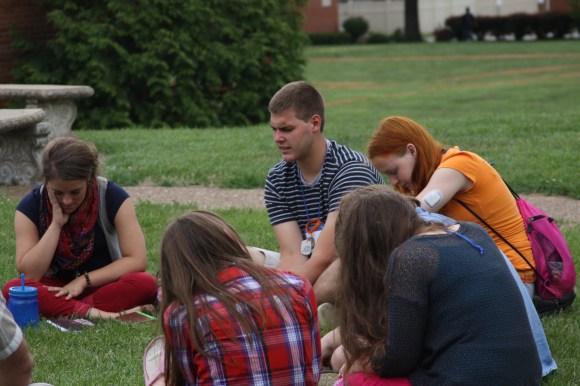
Students meet in their "family group" at Super Summer, IBSA's discipleship week for students in Greenville, Ill.

Students meet in a “family group” at Super Summer, IBSA’s discipleship week for students in Greenville, Ill.

HEARTLAND | When you ask him if students in his youth group are different after they experience Super Summer, Tim Drury pops open his laptop and pulls up a video of Hannah Batista sharing her testimony. Hannah came to Christ last summer during the annual discipleship week at Greenville College.

Most students are already Christians when they get to Super Summer, which is sponsored by the Illinois Baptist State Association. But the week is still life-changing. They grow, and they want to grow more, said Drury, youth minister at FBC Bethalto.
“My job as a student pastor is to take what they’ve learned, and for the other 51 weeks of the year, help them put it into practice.”

It’s something he’s been learning how to do since the early 2000s, when he first came to Super Summer as a youth pastor. He now serves as an assistant dean in the gray school, a group for students preparing to go to college in the fall. The dean of the gray school, Lakeland Baptist Pastor Phil Nelson, has been at every Super Summer since the beginning, more than 20 years ago.

The students aren’t the only ones being mentored, Drury said. He’s being discipled too, by pastors like Nelson who take a week away from their churches to come to Greenville.

Caleb Ellis was a student in Drury’s gray school this year. The 18-year-old, who’s also from Bethalto, likened his first Super Summer to drinking from a fire hose. But he learned “tools for practical, modern faith,” and was already talking in Greenville about how he could go home and start Gospel conversations with a friend from another culture.

When he came to Bethalto, Drury said, “I needed something that did heavy discipleship and challenged our kids to look more like Jesus.” Super Summer helps fill in the gaps caused by the time limitations he faces as a youth minister. He may only see most students once a week, for example, and it’s difficult to do intensive classes for specific ages or genders. But in Greenville, his students are “under the pressure of the Gospel” – it’s a refining process for them, an opportunity to evaluate their relationship with Christ.

And for him. The students are learning things here that he’s still learning, Drury said.

For more on Super Summer, read the July 28 issue of the Illinois Baptist, online later this week at http://ibonline.IBSA.org.

prayer_1

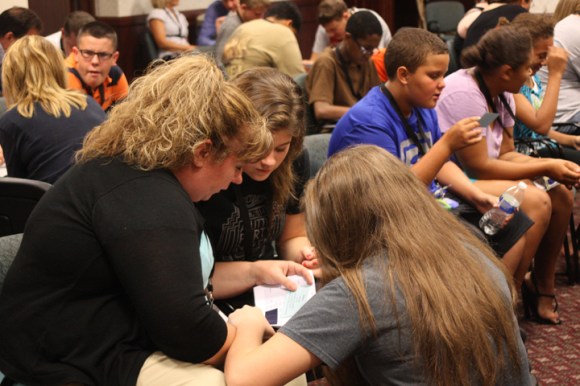
Students and their leaders at ChicaGO Week pray for specific neighborhoods that are in need of a new church.


HEARTLAND |
How do you introduce junior high and high school students to the intricacies of church planting in one of the country’s largest cities?

Take them there, and let them try it out.

More than 50 teens will spend this week working alongside five church planters in Chicagoland as part of the first-ever ChicaGO Week, a project sponsored by the Illinois Baptist State Association. The week kicked off July 13 at Judson University in Elgin, where youth groups from Harrisburg, Chicago, and several places in between will gather for worship after days at their project sites.
prayer_2During the opening worship service, the students heard from someone with lots of experience juggling the responsibilities of church planting.

And lots of experience with actual juggling too.

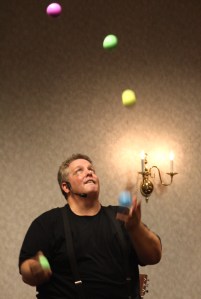
Ken Schultz is a professional entertainer with the stage name “The Flying Fool.” He’s also co-pastor of Crosswinds Church in Plainfield, a church he started several years ago with nuclear engineer John Stillman.

“God uses my juggling and John as a nuclear engineer to help grow a church,” Schultz told the students. Crosswinds has an average weekly attendance of 120 people, and 60% of those came to Christ through the church’s ministry.

“John makes killer spreadsheets,” Schultz said of his co-pastor. “I do this,” he said, before wowing the crowd by juggling three long knives.

juggling

Pastor Ken Schultz used his juggling and unicycle-riding skills in a message on boldness.

“What are you good at?” Schultz asked the students. “Can God use that to build his church?

“He can. You just need to give it to him.”

This week, they’ll do just that at Backyard Bible Clubs, through prayer walking and community clean-up projects, and by offering their time to church planters working hard to get to know their neighbors. It’s a lot to juggle, but God empowers His people to do His work.

“Let this generation be bold, let them be bold as lions for your glory and your good,” Schultz prayed at the end of his message. “If You can use a silly guy who juggles, You can use anybody.”


Nate_Adams_July7HEARTLAND | Nate Adams

We have a fairly small front porch. We don’t spend much time there, partly because we live on a cul-de-sac, and our front porch doesn’t offer much privacy. It looks directly into the yards, and lives, of several other families.

We spend much more time on our backyard deck. That’s where we can see most of our flowers and our garden. It’s where we grill during the summer time, and where we enjoy the privacy provided by a number of mature trees.

Last weekend, though, our son Caleb brought over his lawn trimmer to see if I could help him make it work, since it used to be my lawn trimmer. When he arrived, I met him on the front porch, and for some reason we sat down there to work on it. Soon my wife, Beth, joined us, and noted that the only other person who seemed to be outside that beautiful Saturday was our neighbor who has cancer. Let me call her Cindy.

Cindy was out tending to her beautiful front yard flowerbeds. Suddenly Beth exclaimed, “Oh my, Cindy just fell.” Caleb and I then looked up from our work, and saw Cindy lying on her sidewalk.

“Maybe she’s OK. Let’s see if she gets up,” we said. “We don’t want to embarrass her by running over there if she just lost her balance for a minute.”

But as we watched, Cindy just laid there for a few seconds. Then, with great effort, she raised one hand and began waving it slowly in the air.

We all then sprinted to her side. Cindy was relieved to see us, and asked if we would help her try to get up. She had fallen on her hip.

Our first, careful efforts to help her brought her so much pain that we all agreed we needed to leave her where she was and get some medical help. We found her husband inside, who called an ambulance and then scurried around to prepare to go with her to the hospital.

We stayed with Cindy for several minutes, comforting her until the ambulance arrived, and then assured both of them of our prayers. As she was rolled into the back of the ambulance, Cindy raised her hand once again, and softly said, “Thank you for seeing me and for coming to help. If you hadn’t, I think I would still be there.”

It has occurred to me many times since that day how unusual and providential it was that we were even in a position to help Cindy. Like so many, we seem to be backyard deck people more than front porch people.

And I have also been convicted how true that is spiritually, in our relationships with our neighbors. How many of the people we know are down and helpless, at the end of their ropes spiritually, and quietly waving one last hand in hope of help? Are we even in a position to see them? Or are we comfortable in our own backyards?

Many of the people we know who have deep spiritual needs don’t even know what or Who they need. Cindy didn’t. She just suddenly knew she was helpless. But because we were in that rare position to see her fall, we were able to play a small role in getting her the help needed.

This summer, let’s all spend more time on the front porch. Let’s look for the frail waves of the people around us. And let’s help them call on the One who can meet them right where they are. We may see their soft wave of gratitude in eternity.

Nate Adams is executive director of the Illinois Baptist State Association.

Hannah_Batista

Hannah Batista shares her testimony in a video produced by FBC Bethalto.

HEARTLAND | The last year of Hannah Batista’s life has been different from the first 16. Last summer, she accepted Christ during Super Summer, a week that’s less about camp activities and more about discipling students.

Through a series of tough circumstances, Hannah had ended up living in the home of a member of First Baptist Church in Bethalto. She was an unwilling church attender, and an unwilling Super Summer participant when she wound up at Greenville College last June. “I was guilted into going, honestly,” she says now.

But during the week, something changed. Lots of things, actually. In the quiet of her dorm room on the last night of the week, Hannah accepted Christ.

“Everything I thought I knew was being torn down, and in its place, something new was being built up,” she said from her seat in the dining hall at this year’s Super Summer. Hannah is now a leader in her youth group, and was baptized this year by her youth pastor, Tim Drury.

Watch a video of Hannah’s testimony and baptism at FBC Bethalto (courtesy of the church’s Facebook page).

Nate_Adams_blog_callout_JuneHEARTLAND | Nate Adams

One big event that pulls many of us together each June is the annual Southern Baptist Convention. This year’s gathering in Baltimore was filled with inspirational music, messages and reports. But at its core, the annual SBC is a business meeting where messengers from autonomous churches gather to affirm or determine how they will cooperate.

Those messengers elect board and committee members. They agree on how to invest shared resources in missions and ministry. And they declare to one another and to many onlookers the biblical truths on which they will continue to stand.

It’s a big event with big consequences. But the reality is that there are relatively few messengers at the annual meeting compared to the number of churches and church members that cooperate as the Southern Baptist Convention. Most of us trust a few of us to determine which leaders, strategies, and priorities should direct the resources that we all have shared.

That’s why I would argue that the real big event for Southern Baptists does not take place in a convention center, or in a single city, or even on the same day. The real big event that determines at least the financial strength of our Great Commission cooperation happens in multiple locations at multiple times. It’s called the local church business meeting. That is where each church determines the percentage of its budget that will go through the Cooperative Program to support Southern Baptist missions and ministries. And that is the “big event” that really determines the degree to which we will cooperate in fulfilling our shared, Great Commission purpose.

For more than 20 years now, the percentage given by all SBC churches through the Cooperative Program as a percentage of undesignated giving has ever so slowly declined. It’s only been a fraction of a percent each year. But over time, national CP giving as a percentage of churches’ undesignated giving has declined to 5.4%, when it used to be almost 11%.

Here in Illinois, our churches are doing a little better than the national average. IBSA churches’ CP giving is about 7% of their undesignated gifts. But that is still well below the level being given 20 years ago.

There are some indications, however, that the trend in CP giving may be on the verge of a reversal. Annual Church Profile data for 2013 was recently released, revealing a second consecutive year of uptick rather than decline in national CP giving. The “One Percent Challenge” that Dr. Frank Page has been championing for 2-3 years now appears to be gaining traction, and numerous churches are accepting that challenge to intentionally increase the percentage of their CP giving.

Other churches are starting to give a percentage of their offerings, rather than a flat amount. It’s only two years, but it’s enough to encourage optimism that churches may be recapturing their vision for the power and effectiveness of cooperative missions giving.

So whether you were able to attend the big event of the Southern Baptist Convention this year or not, I hope you will consider attending the big event of your church’s business meetings, especially the one where the annual budget is discussed. Challenge your church to be one that’s helping reverse the trend by increasing your commitment to SBC missions and ministries through the Cooperative Program.

The Big Event of all history, of course, will be that day when Jesus returns and our Great Commission task as His church draws to a close. All our churches’ big events should anticipate and point to that one. And our churches’ business meetings are a good place to start, because that’s where we can choose priorities that demonstrate we believe He’s coming back soon.

Nate Adams is executive director of the Illinois Baptist State Association.
HEARTLAND | This morning, read Psalm 68. Then think on these 25 attributes of God seen in the psalm, outlined by David Platt in a sermon at the Southern Baptist Pastors’ Conference in Baltimore.

God is awesome.
God is active.

He subdues all who rebel against Him.
He satisfies all who trust in Him.

He is the One True God.
He is the covenant-keeping Lord.

God is father of the fatherless.
He is protector of the widow.
God loves the lonely.
He rescues the captive.
He provides for the needy.

God is sovereign over all nature.
He is sovereign over nations.

God is powerful above us.
God is present with us.

He commands a heavenly army.
He conquers an earthly victory.

God daily bears our burdens.
He ultimately saves our souls.
He is my God and King.
He is our God and King.

He draws peoples to Himself.
He deserves praise throughout the earth.
He is the divine warrior.

God speaks a dependable word.

For us, there are two implications, Platt said. Give glory to this God. And give your life to His mission.

HEARTLAND | Eric Reed

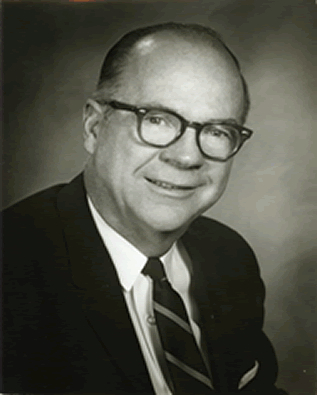
Owen Cooper was a prophet. “We live in an age when it is popular to be tolerant and it is a stigma to be called intolerant,” the chemical engineer from Mississippi preached to messengers at the Southern Baptist Convention. “Tolerance of a half truth soon leads to tolerance of an untruth and then to tolerance of an error,” he warned. “Social and political pressures in the name of tolerance are quenching the flame of missionary zeal.”

Owen_Cooper_0616

Photo from Mississippi Historical Society website

Cooper was describing his own time, but his convention sermon delivered in Atlantic City in 1964 has proven an apt description of our time.

Among Cooper’s insights: Christianity is losing ground in the U.S., world population is growing faster than the Christian faith, and Islam is on the rise; baptisms in SBC churches are declining, more ministry is focused on places where Southern Baptists are strong than to regions and nations where evangelical witness is weak, and the word “witness” itself is almost lost from our vocabulary – and our activity.

“Southern Baptists are losing their mission zeal because of a growing feeling among many theologians and the laity that, after all, man is not lost.” He cited contemporary articles declaring the beginning of “the post-Christian era.”

In 1964? Really?

“Perhaps it is well to ask ourselves the question, ‘What is wrong?’” Cooper said. “‘What is the trouble? Why the diminution of spiritual momentum in the world, and in our country, and in our denomination?’”

In the two decades after World War 2, the Southern Baptist Convention grew rapidly. An emphasis on Sunday school and evangelism that reached the burgeoning families of returning GIs swelled the ranks. The SBC eclipsed the mainline denominations that peaked in 1964 and started their downward spiral. Even as the SBC rallied for growth in membership, Cooper sounded an alarm. Ten million Southern Baptists were on the church rolls, but three million of them couldn’t be accounted for. Baptisms flatlined.

The numbers are no better today. With 15.7 million members officially, our churches report only 5.8 million in worship on any given Sunday. And baptisms are down for seven out of the last nine years, after 40-plus years mostly plateaued. We peaked in 1972.

“We may find ourselves somewhat in the position occupied by Gideon when his followers included…those who follow the crowd as well as the earnest and dedicated,” Cooper said. Apparently some thinning of the herd at the watering hole wouldn’t hurt. “It’s too easy to join a Baptist church,” he stated.

But more than the incipient decline, Cooper decried the loss of commitment to evangelism. “The Southern Baptist Convention was organized for the purpose of ‘directing the energies of the whole denomination for the propagation of the Gospel.’ Witnessing was acknowledged as our principle objective; it must continue to be such.”

Cooper, a layman, was very public about his faith. (Even in 1964, he said personal witnessing would be considered “intolerant, bigoted, and improper” in many circles.) One of only two laymen elected president of the SBC, he served two terms starting in 1973.

In the 1964 sermon, Cooper called on messengers to increase Cooperative Program giving. In 1962, he said, citing the most recent statistics available, 10% of receipts by Southern Baptist churches went to the CP missions and 8% to state missions; today CP giving is down to 5.4% per church, on average. And he called for more money, missionaries, and church planters in distant and unreached parts of the U.S.

But mostly Cooper called for a return to witnessing: “The challenges and problems faced by Southern Baptists, yea even in Christianity for that matter, seem overwhelming when viewed in their totality. Yet broken into their component parts, it becomes much simpler. As Southern Baptists, as Christians, our task is to ‘win them one by one.’

“Ask men to witness,” he urged. “At the time a person joins the church, he should understand that part of his responsibility is to witness, and opportunities should be provided for Christian witness…Without the primacy of missions and witnessing, the church is without true purpose,” Cooper said, “the pulpit is without power and the pew is without potency.”

Eric Reed found Owen Cooper’s 1964 convention sermon while researching the SBC for the Illinois Baptist series B-101. Cooper, from Yazoo City, Mississippi, was a member of the SBC Executive Committee at the time he delivered it.

Blessed bikers

Meredith Flynn —  May 19, 2014
Rainy weather

The annual Blessing of the Bikes April 27 in Decatur went on despite stormy weather.

HEARTLAND | Meredith Flynn

It wasn’t a great weather day for the annual Blessing of the Bikes in Decatur, Ill. Gray clouds piled up in the sky on Sunday afternoon, April 27, and then came a downpour, just as hundreds of motorcyclists made their way to and from the Harley-Davidson store to be prayed over by volunteers in orange vests.

Every spring, riders gather in Decatur and at the Bald Knob Cross in southern Illinois to be blessed. Over the sounds of revving engines, pray-ers put their hands on the shoulders of each rider and ask God for a safe motorcycle season.

It’s a tradition IBSA’s Pat Pajak has kept for several years, including the most recent blessing. He hustled home from a preaching engagement that Sunday afternoon to change into his Harley shirt, blue jeans and leather vest. On the way to the blessing, he stopped to help a couple whose bike had hit a pothole and slid down an embankment.

“After patching up a cut on the wife’s chin and helping her husband wrestle the bike out of the mud and wet grass, I shared how the Lord had watched over them,” Pajak said. “Our discussion led to the Blessing of the Bikes, which they were headed to, and ultimately the Gospel.

“Standing on the side of Highway 51 in the rain, I had the privilege of leading both of them to Jesus Christ.”

Pajak was 30 minutes late by the time he got to the Harley-Davidson parking lot, but he – and his new brother and sister in Christ – had already been extraordinarily blessed.

F.A.I.T.H Riders is a ministry for motorcyclists who want to use their passion for biking to share the Gospel. For information about how to start a chapter in your church, contact Pajak at (217) 391-3129.