Archives For November 30, 1999

God’s Word gives rest

Meredith Flynn —  November 17, 2014

HEARTLAND | Meredith Flynn

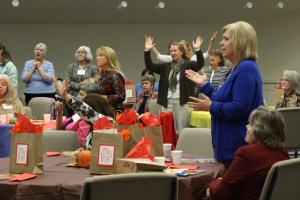
Women worship at the Ministers’ Wives’ Conference, held each year during the IBSA Pastors’ Conference.

Women worship at the Ministers’ Wives’ Conference, held each year during the IBSA Pastors’ Conference.

Ministers’ wives face a lot of expectations—from themselves and from other people. Often, those expectations are too high, said Sue Jones during IBSA’s annual Ministers’ Wives’ Conference and luncheon.

“As we confront expectation, as we confront worry, what we need to do is to remember the truth that God has for us,” said Jones, who has been married to her husband, Clif, for 34 years—30 of those in ministry. “That He will never leave us or forsake us, that He who has called us will complete the work in us.

“Am I there yet? Oh my goodness, no.”

God’s sovereignty was the theme of this year’s conference, held during the IBSA Pastors’ Conference Nov. 5. Jones, a native Southerner, entertained her audience with stories about her family and frank life advice, which she said may some day make it into a book about common sense living. She talked about her worries, and asked women to call out their own: money, children, church, husbands, not saying the right thing.

Jones urged minister’s wives to believe rightly by “taking every thought captive,” as Paul writes in 2 Corinthians 10:5. How do we live transformed lives, she asked. God led her to try to memorize John 1. She didn’t want to, Jones admitted; in fact, once she got to verse 11, she felt like that was probably enough. But the words have helped her ward against worry.

Sue Jones from Tabernacle Baptist Church in Decatur shared about living a life transformed by a reliance on God’s Word.

Sue Jones from Tabernacle Baptist Church in Decatur shared about living a life transformed by a reliance on God’s Word.

“When I lay down at night and those thoughts come to my mind, I say, ‘In the beginning was the word, and the word was with God…” said Jones, quoting the passage.

“And as I begin to pray John 1:1-11, I find peace. He is God. All things were made by him. He is light and life. I am dearly loved. I am the apple of his eye. There is nothing in my life, there is no hurt, there is no person, and there is no worry that is beyond the scope of the God of the universe. And I begin to discover rest.”

Libby Morecraft from First Baptist Church, Harrisburg, led in worship during the conference, and current officers Judy Taylor and Lindsay McDonald shared encouraging words about missions and marriage. IBSA’s Carmen Halsey spoke about upcoming women’s ministry opportunities, and encouraged the audience about the position they have.

“Yes, it’s different,” Halsey said. “Yes, there are some hardships that come with it. But it’s really a glory moment, too, that God trusted you to do something unique and put you out in front.” She encouraged women to “be the vessel” through which God works.

Ministers’ Wives’ Conference officers for 2015 are: president, Judy Taylor, Dorrisville Baptist Church, Harrisburg; vice president, Lindsay McDonald, First Baptist Church, Casey; and secretary-treasurer, Sue Jones, Tabernacle Baptist Church, Decatur.

The 2015 Ministers’ Wives’ Conference and Luncheon will be held Nov. 11 in Marion.

Nate_Adams_1110HEARTLAND | Nate Adams

Recently the city council in Seattle, Washington, voted unanimously to change their designation of the second Monday in October from Columbus Day to Indigenous Peoples Day. “Nobody discovered Seattle, Washington,” said one Indian nation president during the council meeting. And so, at least on one day in October, the city of Seattle will go its own way.

And yet, Seattle is not alone. The Minneapolis, Minnesota, city council passed a similar measure earlier this year. In Hawaii, they now celebrate “Discoverers’ Day” instead of Columbus Day, while in South Dakota it’s now “Native Americans Day.”

As much as I appreciate our nation’s Native American heritage, actions like these seem to me to denote a troublesome attitude or mindset, and yet one that I’m noticing more and more, even in Baptist life. It’s a mindset that says, “We’re mainly interested in what’s relevant and valuable to us here at home, and less interested in the bigger picture of what others are doing.”

In a way, it’s a mindset that’s compatible with the deeply held Baptist belief in autonomy. “No one outside our church is going to tell us what to do!” Yet at the same time it’s a mindset that tugs against the very spirit of unity and cooperation that have always been the hallmarks and strength of Baptist churches.

The way I see it expressed more these days is through practices such as designated rather than cooperative giving, or ecumenical rather than denominational partnerships. For example, one large Baptist church in the south that used to give more than $1 million through the Cooperative Program recently shifted more than 90% of that directly to their preference, international missions. And I see Baptist churches of all sizes occasionally doing missions or benevolence projects with partners whose doctrinal positions I daresay they have not examined.

Some of this is people just naturally doing what they want, or supporting what they find most compelling. But in those individual choices or preferences, there are often also great losses. When we each do what we prefer locally, we diminish what we can all accomplish collectively.

As we come to the close of another year here in Illinois, and perhaps finalize our church budgets, I would encourage us to do more pulling together and less pulling apart. There is already great individuality and diversity among our churches. And yet it is our unity around Baptist doctrine and cooperative missions that pulls us together, and allows us to accomplish together things that no individual church could do on its own.

Recently I’ve been invited to a number of churches to share, usually in a combined adult Sunday school class, how and why “cooperative missions” works, and then to preach in the morning worship service. Each time I do, there are older adults who come and say something like, “That’s why I’ve been Southern Baptist all my life.” And there are younger adults, many of whom didn’t grow up in a Baptist church or receive any childhood missions education, who say, “You know, I don’t think I really understood how we work together with other churches, but that really makes sense.”

In other words, our churches are already full of indigenous peoples, who naturally go their own ways. Our responsibility as autonomous but cooperating Baptist churches is to pull people together around the Word of God and the Mission of God.

Columbus wasn’t the first or only discoverer of America, and he wasn’t perfect. But when we celebrate in his name, we pull together as a nation, and we affirm the spirit of adventure and discovery. Likewise we should enthusiastically pull together as Baptists, around the name of Jesus Christ, and in support of the wonderful adventure we share, establishing His Kingdom in a new world.

Nate Adams is executive director of the Illinois Baptist State Association.

HEARTLAND | Meredith Flynn

In two out of three Southern Baptist congregations, fewer than 100 people gather for worship on Sunday morning. Megachurches may get more attention, but small churches are the backbone of the SBC, Frank Page has said.
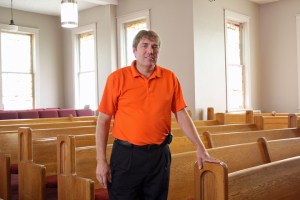
Illinois pastor Cliff Woodman is part of a new advisory council on small and bivocational churches.

Illinois pastor Cliff Woodman is part of a new advisory council on small and bivocational churches.

Still, small church pastors often feel overlooked and marginalized, left out and under-resourced. A new advisory council assembled by Page, president of the SBC Executive Committee, exists to communicate the unique needs of these categories of churches with denominational leaders.

“I will not allow the Southern Baptist Convention to forget who we are,” said Page during the first meeting of the Bivocational and Small Church Advisory Council. “Part of my goal in this is to elevate the role of the small church pastor and the bivocational pastor, period. And that’s going to happen.”

Illinois pastor Cliff Woodman is part of the 21-member council, which will work over the next three years to develop a report on the statistics that define Southern Baptist churches. The group, one of several Page has brought together in his first four years as Executive Committee president, represents a large majority of Southern Baptist churches.

“Some would say 35,000 of our 46,000 churches, maybe more than that, are in the two categories of small church or bivocational,” Page said at the Sept. 11-12 meeting in Atlanta. For the council’s purposes, he defined a small church as one with 125 people or fewer in Sunday school attendance. The group also looked at research on the percentages of SBC churches by worship attendance. According to 2013 data, 68% of Southern Baptist churches have 100 or fewer people in worship, compared to 78% of IBSA churches and missions.

Woodman, now pastor of Emmanuel Baptist Church in Carlinville, spent more than 25 years as a bivocational pastor at Harmony Baptist Church in
Medora. He told the Illinois Baptist small church and bivocational pastors (most who also work a second job) often feel out-of-the-loop. Sunday school curriculum may feel tailored to larger churches with more people and more classroom space, for example, and large church pastors often are the ones invited to speak at meetings or conferences.

But non-megachurches can be effective churches. Woodman, whose Carlinville church reported an average worship attendance of 145 in their 2013 Annual Church Profile, is leading Emmanuel to look closely at what makes a congregation healthy. He referenced LifeWay President Thom Rainer’s 2013 book “I Am A Church Member,” which outlines members’ responsibilities to their congregation.

“If a church member’s not supposed to look at ‘what’s in it for me,’ then maybe churches ought to stop looking at ‘what’s in it for me,’” Woodman said. The better question is, “What can I do for the bigger body?”

Major shift toward bivocational
Page has used a “fault lines” analogy to describes areas of SBC life where there are rifts between different groups. One of those fault lines, he said in the Atlanta meeting, is related to church methodology, or how churches do church. The discussion centered on bivocational ministry, a strategy Page called “the wave of the future.” It’s also the wave of the past.

Southern Baptist churches have long relied on bivocational pastors to lead churches. Decades ago, many pastors were farmers; today, they also drive school buses, deliver the mail, and run small businesses.

“I’m convinced that in the 21st Century, the best stewardship model is bivocational,” Page said. “We’ve got a lot of students coming out of seminary now who have no intention of being full support.” In other words, they’re prepared to work more than one job to make ends meet.

That news was encouraging to Woodman. There was a day, he said, when “the underlying current was that the bivocational guy wasn’t good enough to have a full-time church.” Page shared with the group that some Christian universities are now training students to be pastors along with learning another vocation.

While there will always be churches that want their pastor to be full-time, Woodman said, bivocational ministry is imperative if Southern Baptists want to extend the reach of churches into more communities. “And we’re going to have to do a better job at it,” he said, and at preparing future leaders for it. Because bivocational pastoring is “a different game.”

Quit the comparison game
Small church pastor Job Dalomba posed a pointed question in an April blog post: “We have to ask ourselves an honest question: Do we want to see the glory of God shining from larger churches or do we just want their numbers, resources and notoriety to be our numbers, resources and notoriety?”

The SBC Voices post by Dalomba, pastor of a new, small church in Southaven, Mississippi, called for small church pastors to stop comparing themselves to men who lead larger congregations, and to pray for those big churches too.

It’s a strategy the congregation at Emmanuel has utilized this year. A church’s prayer requests are a good measure of its health, Pastor Woodman said. “Throw them up on the wall, and see what your prayer requests do. And when you get done, you begin to think about what does that tell you your view of God is.

“And in essence, you’ll find in most churches that he’s healer, a physician; he’s an employment agency; he’s Triple A. But what’s lacking is that he’s a savior.”

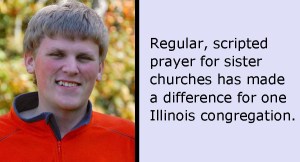
Woodman’s congregation was already praying by name for people who don’t know Christ when he arrived as pastor last year. To that focus, they’ve added regular prayer for sister churches in Macoupin Baptist Association. The prayers are scripted, with a focus on reaching people who don’t know Christ. Woodman is hopeful the strategy will help build a spirit of teamwork between his church and others in the community, he told SBC Life earlier this year.

“When we started praying for our sister churches, that helped us be healthier. If we as pastors and churches would take the same attitude, then we’d stop looking at what others were doing for us, and we’d start doing for others.”

With reporting by Baptist Press and SBC Life. Meredith Flynn is managing editor of the Illinois Baptist newspaper, online at http://ibonline.IBSA.org.

And why it matters to Baptists now

HEARTLAND | Eric Reed

After his election as president of the Southern Baptist Convention, Arkansas pastor Ronnie Floyd has called Southern Baptists to prayer, but not just any prayer—extraordinary prayer. The phrase is not original to Floyd, as he stated from the start. It’s almost 300 years old.

Credit Jonathan Edwards, the Puritan preacher with poor eyesight who often read from a manuscript his most famous sermon, “Sinners in the Hands of an Angry God.”

Floyd adopted the term “extraordinary prayer” from a book by Edwards called “An Humble Attempt to Promote Explicit Agreement and Visible Union of God’s People, in Extraordinary

Prayer, for the Revival of Religion and the Advancement of Christ’s Kingdom on Earth, Pursuant to Scripture Promises and Prophecies Concerning the Last Time.” (Titling was not their strong suit in the 18th century.)

But what did he mean by extraordinary prayer?

The 2014 IBSA Annual Meeting theme is Mission Illinois: A Concert of Prayer. For more information, go to IBSA.org/ibsa2014.

Mission Illinois: A Concert of Prayer is the theme of the 2014 Annual Meeting of the Illinois Baptist State Association. For more information, go to IBSA.org/ibsa2014.

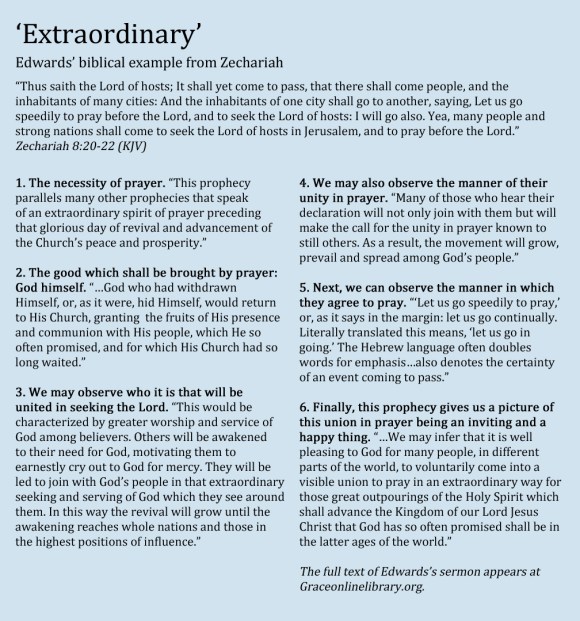
From Zechariah, Edwards drew a picture of prayer that would result first in revival of the church, then awakening and regeneration of lost people. “God’s people will be given a spirit of prayer,” Edwards wrote, “inspiring them to come together and pray in an extraordinary manner, that He would help his Church, show mercy to mankind in general, pour out his Spirit, revive His work, and advance His kingdom in the world as He promised.

“Moreover, such prayer would gradually spread and increase more and more, ushering in a revival of religion.”

Edwards offered an example he had witnessed personally. In 1744, a group of ministers in Scotland called on believers to engage in prayer. “They desired a true revival in all parts of Christendom, and to see nations delivered from their great and many calamities, and to bless them with the unspeakable benefits of the Kingdom of our glorious Redeemer, and to fill the whole earth with His glory.”

The group pledged to pray every Saturday evening, Sunday morning, and all day on the first Tuesday of each quarter—for two years.

During that time, many churches were renewed. In one town alone, 30 groups of young people formed and committed themselves to prayer for revival. Buoyed by the results, the ministers sent 500 letters to pastors in New England urging their own two-year commitment.

Edwards noted: “Those ministers in Boston said of this proposal: ‘The motion seems to come from above, and to be wonderfully spreading in Scotland, England, Wales, Ireland and North America.’”

And they extended the two-year pledge to seven years of prayer.

Edwards, who with George Whitefield and others, was at the heart of the First Great Awakening, cited prayer as vital to the movement of God’s spirit in the colonies.

Extraordinary prayer sidebar


Our Midwest state

Meredith Flynn —  September 8, 2014

HEARTLAND | Nate Adams

Recently, IBSA hosted a Midwest regional meeting that included the state executive directors, missions directors, evangelism directors, and church health directors from ten Baptist state conventions. Our main purpose was to finalize plans for the 2015 Midwest Leadership Summit that will be hosted here in Springfield next January. 

But it was also an interesting time to compare notes on Baptist work throughout our Midwest region. Here are four observations about what “all” Midwest state conventions seem to be experiencing, and then also about where we in Illinois find ourselves these days.

Nate_Adams_Sept8First, there was a shared desire to keep fewer ministry resources within our churches and region, and to share more with the vast mission fields outside our states, especially internationally.  

Here in Illinois, our Cooperative Program giving that goes beyond the state is the fifth highest percentage among all 42 state conventions. The past two years, we have sent extra year-end gifts that made those CP percentages the highest in IBSA’s history.  

A second observation is that most Midwest state conventions are feeling a tight “squeeze” between the North American Mission Board’s lower and more designated funding (for church planting exclusively), and generally flat to lower giving from churches through the Cooperative Program.  

Here in Illinois, NAMB funding shifts have necessitated that we absorb full responsibility for our state WMU and Women’s Ministry Director, for other missions positions and initiatives that are not specifically church planting, and for funding that assists local associations. We have also received notice that areas such as collegiate ministry, urban ministry centers, and disaster relief coordination will not be funded by NAMB in future budget years.  

A third observation is that among our group of Midwest Baptist leaders we are experiencing a noticeable amount of transition and turnover. My personal sense is that the combination of financial pressures and feelings of not being appreciated are taking their toll on a lot of good people that help a lot of small to medium-sized churches, especially.  

Here in Illinois, we have been seeking to manage a gradual downsizing and restructuring of our IBSA staff without necessitating traumatic changes for either personnel or ministries. However, I sense among some of our staff the same uneasiness about the future security of existing ministries.  

Finally, even in the midst of these challenges, I observed state convention leaders that continue to believe strongly in their ministries of strengthening and starting local churches in their Midwest contexts. They—we—are trusting the Lord into the future, but also appealing more and more intentionally and urgently to the faithful churches in our respective states to validate, value, and directly support state missions.  

MIO_blogHere in Illinois, the most direct and supportive way your church can do that is through the Mission Illinois Offering. Most churches receive that offering in September, but you can contribute through the MIO any time in the year, and 100% of that offering goes to support our state missionaries and state missions efforts among churches right here in Illinois.  

Across the Midwest, Baptist state conventions, most of which are smaller than Illinois, are facing pressures and decisions that may soon be ours, at a time when our culture needs the Gospel more than ever, and our churches need assistance more than ever. If we want our Midwest state of Illinois and its churches to remain strong and advance the Gospel here, we must all take responsibility for our Illinois mission field, and give our most generous offerings to the Mission Illinois Offering this year.

Nate Adams is executive director of the Illinois Baptist State Association.

HEARTLAND | Nathan Knight

It doesn’t take long when reading the Bible to see that God is impassioned for the plight of His people, such as this passage in Exodus:

“Then the Lord said, ‘I have surely seen the affliction of my people who are in Egypt and have heard their cry because of their taskmasters. I know their sufferings, and I have come down to deliver them….'” (Exodus 3:7-8).

Nathan_Knight_Sept1In the face of an ever-increasing worldwide persecution of Christians, we would be wise to cultivate practices in our churches that might more readily reflect this notion of God’s nature. I would like to note three ways you can implement this in the life of your church that will, eventually, lead to three rewards.

Three practices:
1. Apply biblical truth locally by using what is happening globally. Every pastor labors to try and faithfully apply the truths of the Bible in a way that will assault his people and spur them on toward faithfulness. They do that by considering their own context and using aspects of it to illustrate or apply that particular truth.

However, considering a different context will help your congregation identify with the plight of God’s people around the world. For example, when preaching or teaching through 1 Peter, don’t limit the illustrations and applications of persecution only to homosexuality or other American problems. Take them to the checkpoint just outside of Mosul where they are walking with their family and will have to answer for their faith in Christ. Bring them into the homes of those who just received word of the mock crucifixions of converted Christians in Syria.

Occasionally sprinkling in ideas like these will serve to strengthen faithfulness in our more immediate contexts.

2. Pray frequently, specifically and experientially. If we pray for the plight of God’s people in our public services, it is often done in short order or in a sort of peripheral way that does not resonate with the actual circumstances of the world. Don’t just pray for the persecuted church when it is on the calendar; pray for them often so as to engrain it into the minds and hearts of the people.

Praying continually will help your church understand that persecution is going on continually and will model the realities of our brothers and sisters in other countries. And when you do pray, pray for specific people in specific places. This will serve to put a face on otherwise formless peoples.

Also, genuinely pray in the mood of the situation. If I asked you to breathe life into the lungs of a victim the same way I asked you to pick up some milk at the store, we would rightly think something has gone awry in my soul. Likewise, consider the situation and pray in a manner that reflects it.

3. Be meaningfully involved in the nations. Appropriating 10 percent of your monies toward international missions is a good thing but it is not sufficient to build a fervency among your congregation for the people of God around the world. As a church, we have adopted a couple of communities around the world, and we have people who travel and work in others.

By sending people and resources to Christians in various communities, we make the people at our church more familiar with situations that might have just been another story on the evening news.

As you apply these practices to the particular church you pastor, you’ll probably begin to notice the culture of your congregation changing. Here’s what I believe you’ll joyfully reap.

Three Rewards:
1. Outsiders will be more warmed to your church. You don’t make an international church by simply putting “international” in your name. Making the nations a regular diet of your service will engender internationals to feel more at home. Also, the lost will see that you are not trying to hide yourself from the world and paint it with rose-colored glasses, but instead, you are broken by its brokenness. This will often pleasantly surprise the lost and possibly have them listen to your answers.

2. You will prepare your people for suffering. Paul told Timothy that “all those who desire to live a godly life will be persecuted” (2 Timothy 3.12). We pampered American evangelicals have been living a dream for a while. But the normal experience of Christians in history is to suffer for what they believe. We are not entering into a strange time of history, but a more normal one (see 1 Peter 4.12).

Bringing the realities of the world to the fore of God’s people will only serve to help believers in their own navigation of an increasingly hostile world.

3. Your church will grow into another facet of Christ-likeness. Let’s not forget that Christ understood Saul to be persecuting Himself when Saul was assaulting the church (Acts 9.4). The more we knead into the dough of church life — the realities of God’s people all over the world, both the good and the bad — the more we will come to understand all that it is to be in Christ.

Nathan Knight is pastor of Restoration Church in Washington, D.C. This column from Baptist Press first appeared at the website of the Southern Baptist Convention’s Ethics & Religious Liberty Commission, http://www.erlc.com.

HEARTLAND | Meredith Flynn

A recent visit with exchange students was like a crash course in geopolitics.

“This group doesn’t get along with these people,” they explained before a dinner of sloppy joes. Our new friends, both from former Soviet republics, told us about the precarious dynamics in their homelands.

“That’s a closed border.”

“They’re extremists.”

Their voices were matter-of-fact, unflinching about the hostilities that are, for them, the way things have always been.
It’s hard to imagine being so used to war in your own country. On the other side of the world, however, it’s too easy to adopt that kind of nonchalance.

Take the recent rash of violent conflict sweeping across the Middle East. War, unrest, and religious persecution are such big parts of what we know about the region. Many of us are desensitized, disengaged, and even disinterested in who’s fighting who now.

Nun_blogUntil a tweet or Facebook post puts a face on the issue. Or until you remember someone you know—like my friends at the dinner table—who understands and has possibly experienced this kind of personal war that sends families running for the mountains to escape almost certain death.
We all know someone who has been persecuted.

As militant groups in Iraq continued their assault on religious minorities, including Christians, leaders in the U.S. urged the western church to remember that. These fellow Christians are our family, Open Doors USA President David Curry wrote this month. We ought to “pray fervently” for them, Southern Baptist ethicist Russell Moore said.

We all know someone, because we’re family.

But when the problems seem distant, how do Christians pray fervently? The International Mission Board is leading the way by including prayer requests at the end of their news articles about the unrest in the Middle East.

“Beg the Lord to awaken the world to the humanitarian crisis unfolding in Iraq and provide pathways for Christians and others to respond,” they posted after a story on the Yazidi Kurds forced to flee their homes.

“Ask God to miraculously protect the Yazidis and other Kurds who fled into the mountains; ask Him to provide a means of rescue and temporary homes for the refugees.”

And for militants with the Islamic State of Iraq and Syria (ISIS): “Pray that ISIS leaders and soldiers would experience the love of Jesus Christ and that their lives would be transformed.”

We all know someone, so let’s pray.

Meredith Flynn is managing editor of the Illinois Baptist newspaper.

HEARTLAND | Nate Adams

Last month IBSA hosted a pilot mission project at Judson University in Elgin, one that linked student groups from all over Illinois with church planters in Chicago. We called the experience “ChicaGO,” and welcomed to it over 60 students from 11 IBSA churches. For a couple of the days, the IBSA All-State Youth Choir joined us, bringing our total to over 100 that helped a half dozen church planters.

After leading a brief devotion with the larger group each morning, I was able to follow individual groups to their work sites. Here’s a brief journal of what I saw:

It’s Monday, and I pull in to Transformation Church in South Chicago Heights. Alex Bell is the planter of this restart in a church building that has been there for years. The property had been somewhat neglected under the previous, older congregation, and Alex has the students hard at work sprucing up the grounds for their first outreach Vacation Bible School.

Nate_Adams_Aug18Alex is cutting down small trees, and I join in with a group hauling the branches to the curb. The bus full of IBSA All-State Youth Choir members pulls in, and I walk over to it with Alex and listen as he hops aboard and quickly gives the new arrivals their instructions. I’m impressed with his concise, passionate orientation to their mission field, and the people’s most pressing needs there.

He tells the students that, for today, they are missionaries from his church out into its community, and asks them to represent them well. He sends them out with invitations to Vacation Bible School, and asks them to pray as they deliver them, and to return with any prayer requests they discover.

It’s Tuesday, and I follow a group out to the Avondale neighborhood, where Dave Andreson is the planter. There is no church building, except the rented flat where Dave and his wife and their toddler and baby live.

After orienting the group to his mission field, he leads us down the street three blocks to the school where he is seeking to build relationships. Politics and budget shortages have kept the school grounds from receiving any major maintenance for three years. We cut tree branches so the school’s sign can be seen. We pull weeds from the cracked asphalt playground. We trim bushes and drag away debris.

It’s Wednesday, and I follow a group out to Garfield Park, a neighborhood second only to Englewood in its annual murder rate. Heroic planter Jamie Thompson has been seeking to establish a church there, though it is really an urban ministry center as well. They meet in a rented building that used to be a Chicago fire station.

Our group is helping Jamie host a week-long Bible club for the neighborhood’s kids. While they clean up from the previous day’s club and get ready for the kids to arrive, Jamie tells me how hard it is to build a church in the midst of violence and poverty, and how hard it is to disciple new Christians when they need jobs and freedom from addiction.

It’s Thursday and I don’t get to visit a work site. Instead I help interview a prospective new staff member, to fill a position that’s been vacant for over two years. He will help us start new African-American churches in Chicago. I leave the interview excited that we’ve finally found the right guy.

Friday the groups head back home. Later we will learn that the Friday night we departed, 11-year-old Shamiya Adams, who attended the Garfield Park Bible Club that week, was shot and killed by a stray bullet that entered her apartment and passed through two rooms to strike her. Pastor Jamie tells us she knew Jesus as her Savior.

Nate Adams is executive director of the Illinois Baptist State Association.

Daniel_WoodmanHEARTLAND | Daniel Woodman

Editor’s note: This column first appeared on Baptist Press (BPNews.net) as part of the Southern Baptist Convention’s call to prayer.

If you attended the Southern Baptist Convention in Baltimore or watched online, you know prayer played a big role in this year’s annual meeting. Messengers spent time praying together in the convention hall, and also adopted a resolution on praying for other churches that are struggling, “so that together…we can more effectively reach our neighbors and our nation with the Gospel.”

The resolution was a response to a growing number of churches taking action and praying for local sister churches. Emmanuel Baptist Church in Carlinville, Ill., is one such church.

Noticing the need for unity among local churches, Emmanuel began praying for sister churches in its local Baptist association on a weekly basis. The church prays for three churches and their pastors each week, rotating the list to pray for all 27 churches in the association multiple times each year.

Church members and leaders alike began to observe a noticeable, positive impact from this prayer focus. Taking note of the cause/effect relationship of the power of praying for local churches, Emmanuel recently expanded its regular prayer list to include two church plants outside of the association.

The church prays a specific, scripted prayer for each church and pastor each week: for “the physical and spiritual protection of the pastor so that he would deliver the message that God has given them, and to lead the people with passion to reach the lost in their community.”

This scripted prayer addresses an eternal need for each church, according to Cliff Woodman, pastor of Emmanuel Baptist Church: “I wanted it to be a specific prayer that could apply to any church. The mission of every church is to reach the lost and make disciples.”

If more Southern Baptist churches take this kind of initiative to pray for each other and unify under the banner of Christ, then communities will come together spiritually and the Kingdom of God will expand as a result, Woodman said, citing Jesus’ words from His high priestly prayer: “I in them and you in me. May they be brought to complete unity to let the world know that you sent me and have loved them even as you have loved me” (John 17:23).

Daniel Woodman is an entering freshman journalism major at the University of Missouri and a member of Emmanuel Baptist Church in Carlinville.

Volunteers from Illinois are serving this week near Port-au-Prince, Haiti. One team member is Alison Howell, whose daughter, Mackenzie, wrote a children's book to raise money to help re-build the country.

Many mission teams from Illinois have served in Haiti since the January 2010 earthquake. This photo was taken during a one-week trip to the country last summer; read stories and see more photos here.


HEARTLAND | Mackenzie Howell
was just five years old when she saw a TV program about the massive earthquake that destroyed parts of Haiti in January 2010. The young Texan decided immediately she needed to do something to help.

Mackenzie_Howell_blog

Volunteers from Illinois are serving this week near Port-au-Prince, Haiti. One team member is Alison Howell, whose daughter, Mackenzie, wrote a children’s book to raise money to help re-build the country.

Since then, she’s raised thousands of dollars for re-building efforts in the country through several different enterprises, including a book about a courageous Haitian girl named Leila.

Mackenzie’s projects connected her with IBSA’s Bob Elmore, who facilitates mission trips to Haiti. Mackenzie’s mom is on one of those trips this week, writing letters to her daughter every day from Haiti. Alison Howell hopes to learn more about the country this week, in preparation for when Mackenzie is ready to go herself.

In her first letter Aug. 3, Alison talked about how God sometimes calls people to do hard things.

“Remember last week in Sunday School when we talked about how God asked Paul and Barnabas to do some difficult things, but they always obeyed Him because they knew that they could trust Him. You and I can trust Him too.

“I can trust Him to take care of me in Haiti, and even more importantly to take care of you, brother and Daddy while I’m gone. You can trust Him to give you the courage to do what He is asking you to do too.”

Follow Alison Howell’s mission trip at her blog, “Letters to my daughter from Haiti.”