Archives For November 30, 1999

HEARTLAND | Nate Adams
Nate_Adams_March23Recently a bivocational pastor shared with me a difficult decision he needed to make, whether or not to stay as pastor of the church he was serving. He had already accepted the reality that the small church could not afford both his insurance and a full-time wage, and that he needed employment outside the church to support his family. What seemed to have him questioning whether he could stay were recent remarks by a couple of his church members.

“We had to cancel Sunday services one week because of a snowstorm,” he explained, “and a couple of the members raised the question of whether or not they should still pay me that week, since I hadn’t actually preached.”

I could hear the hurt in his voice, and read the disappointment in his face. He was still a few years away from retirement, and had recently lost his job outside the church. At a time when being valued by the church was very important to him, a couple of unthinking church members had made him feel less valued than ever.

But the pastor went on to explain that, in his view, the problem probably ran deeper than a careless statement or two. “I really think some of them think that way. They aren’t giving generously to the Lord, or even to support me as their pastor. They feel they are merely purchasing a service from me, and that if that service is not delivered, the church shouldn’t have to pay.”

After a few minutes of talking it through, it seemed clear to me that the pastor was going to stick it out. He loved his congregation, and I suspect that even the ones who made the hurtful statements loved him. But he and I agreed that if he was going to feel appreciated, and perhaps even more importantly, if his people were to have their hearts matured and transformed into generous, godly givers, that he needed to provide some candid teaching, and loving but direct conversation, on tithing and giving.

I think one of the reasons I was able to understand this pastor’s hurt and encourage him to press on is that this same dynamic of consumerism can also affect our cooperative missions work as churches. Not often, but occasionally, I will hear someone ask, “Why should we give to that? What do they do for us?”

They could be referring to a mission offering, or the Cooperative Program, or the local association, or any ministry where the investment is largely in people that are doing ministry among and on behalf of the churches. If there’s not some direct, tangible benefit back to the church, the value is questioned. “If they aren’t here, helping us, maybe they don’t deserve our support.” If the sermon isn’t preached, the ongoing, continual ministry of the pastor isn’t valued.

The next Sunday after that conversation, a snowstorm hit here in Springfield. Several area churches cancelled services, but our church did not.

With that pastor’s pain still in the back of my mind, I got up early to clear the snow from our driveway, and make sure we could get to church. As we headed out the door, I asked my wife to make sure we had our offering envelope with us. I remembered in a fresh way that our tithe was the Lord’s, and that our church’s staff and ministries count on our support, whether we’re there benefitting from them or not.

I also remembered that the portion of my weekly offering that goes through the Cooperative Program supports thousands of missionaries and other ministries that operate literally around the clock and around the world. The Lord and they are at the heart of my giving, not the benefits I receive. And I’m grateful for each one of you that feels and gives from that heart too.

Nate Adams is executive director of the Illinois Baptist State Association.

Fanny_CrosbyHEARTLAND | Steve Hamrick

February marked the 100th anniversary of the death of one of America’s greatest hymn writers and poets, Fanny J. Crosby. Frances Jane van Alstyne (née Crosby), lived nearly 95 years, from March 24, 1820, to February 12, 1915.

At six weeks old, young Francis developed an inflammation in her eyes that was treated with a mustard poultice, a common treatment of the 19th century. Whether because of the mustard or a congenital condition, blindness resulted. But it rarely affected her attitude. She was known in early years as the “happy little blind girl.”

Her first attempt at verse at age eight shows her outlook.

Oh, what a happy child I am,
Although I cannot see
I am resolved that in this world
Contented I will be

The attitude of God’s gratefulness continued as a theme throughout her life. “When I get to heaven,” she once said, “the first face that shall ever gladden my sight will be that of my Savior.”

It is estimated that Crosby wrote more than 8,000 hymns, with over 100,000,000 (that’s one hundred million) copies in print. Many of her hymns include references to sight and light. Notice the insight of one of her most well known songs, “Blessed Assurance”:

Perfect submission, perfect delight,
Visions of rapture now burst on my sight;
Angels descending bring from above
Echoes of mercy, whispers of love.

In addition to her hymns, Crosby published more than 1,000 secular poems, four books of poetry and two best-selling autobiographies. Most don’t know that she also wrote a number of popular and patriotic songs of her day.

During her long life she had the honor of reading her works in front of the U.S. Senate, Congress, and before many U.S. presidents, including John Q. Adams and James Polk; she also was dear friends with Grover Cleveland.

Despite being one of the most popular personalities of the 19th century, Crosby’s most rewarding work during her lifetime was her service to rescue missions. She dedicated her life in serving the poor, immigrants and less fortunate. During her years as a mission worker she wrote, “Pass Me not O Gentle Savior,” “More Like Jesus,” and “Rescue the Perishing.”

Her songs are still sung by churches around the world. Thousands of arrangements have been set for choirs, orchestras and praise teams. The band Caedmon’s Call recently recorded “Draw Me Nearer” (I am Thine O Lord) using one of Mrs. Crosby’s best texts. The words tell her story well:

I am thine, O Lord, I have heard thy voice,
And it told thy love to me;
But I long to rise in the arms of faith
And be closer drawn to thee.

Steve Hamrick is IBSA’s director of worship and technology.

Chicago leaders convened a one-day prayer meeting and equipping conference in January at Lighthouse Fellowship Baptist Church in Frankfort.

Chicago leaders convened a one-day prayer meeting and equipping conference in January at Lighthouse Fellowship Baptist Church in Frankfort.

HEARTLAND | Eric Reed

First Baptist Church of Paxton has a newfound calling as prayer intercessors. “Christ’s church in America is in desperate need of spiritual revival and renewal,” said Pastor Bob Stilwell. “We need to be awakened from our comfort and complacency in our salvation. We need to be shaken from our evangelistic lethargy.”

In January, Stilwell led his congregation in a concert of prayer similar to the prayer for spiritual awakening at the IBSA Annual Meeting in November. The Paxton church is one of many in Illinois joining a national call to prayer, including more than 30 in metro Chicago.

“As I prayed in preparation of God’s message to our congregation for the week focusing on interceding, the Lord revealed His vision for us as an intercessory church,” Stilwell said. “God has begun the process of renewing hearts, changing attitudes and giving new life to our church.”

The call to prayer comes ahead of the 2015 Southern Baptist Convention meeting in Columbus, June 10-11. SBC President Ronnie Floyd picked up past president Fred Luter’s call for revival. “Our greatest need is a mighty awakening in the nation. This has to be preceded with a strong sense of personal revival and church revival,” Floyd said.

At a meeting of SBC leaders and editors in Orange Beach, Alabama, last week, Floyd said registration for the Ohio convention is up 5% compared to this time last year. That is significant, especially for a meeting held outside the Deep South, and Floyd is encouraged. But, he said commitments to attend, made in the next 30 days, “are critical.”

“Are (Southern Baptists) really in agreement that the number one need in America is spiritual awakening?” Paraphrasing the theme of the annual meeting, he said, “We need visible union, we need to lock our arms together, and we need to extraordinarily pray for spiritual awakening.”

In metro Chicago, more than 75 people gathered at Lighthouse Fellowship Baptist Church in Frankfort for an all-day prayer and equipping conference in late January. The prayer coordinator for Chicago Metro Baptist Association, Cheryl Dorsey, urged attenders to seek God’s direction.

“I used to tell God what I wanted and needed until I had a time when I didn’t know what to pray. I learned to pray, ‘God, how am I going to pray about this?’” Dorsey said. “It was as if God said, ‘When are you going to find out what I want you to pray?’”

IBSA’s Dennis Conner, church planting director for the Northeast region, told one breakout session, “We say with our mouth that we trust God, but in our hearts, we trust ourselves. Our churches need a sense of desperation.”

That feeling of great need is common to people responding to the call to prayer. “We need to be filled with a sense of urgency in sharing the Good News of Jesus Christ—the unfailing hope that only he offers to a hopeless world,” Stilwell said. “At FBC Paxton, we’re praying for the Holy Spirit to
bring about such a renewal in our own hearts and the hearts of all of believers throughout Illinois, across the nation and throughout the world.”

And from Floyd: “Why don’t we call on God to do…what we wring our hands about because it hasn’t happened?”

Hidden entrances

nateadamsibsa —  February 23, 2015

HEARTLAND | Nate Adams

Several years ago Beth and I had the opportunity to travel overseas to Amsterdam. As Sunday approached, we began scouting out nearby churches with English-speaking worship services. Finding only one within walking distance, we made plans to attend and committed to starting out early. But it was not early enough.

This was before the days of GPS and smart phones, and all we had were verbal directions from the place we were staying. We recognized the various street names and landmarks they told us we would find along the way. We knew we were in the right neighborhood. But we could not find the church.

Nate_Adams_Feb23Did we ask others for directions along the way? Well of course, though as a self-respecting husband who rarely feels lost, I waited as long as possible. But most of the folks in the neighborhood spoke only Dutch, and at least one of our well-intentioned helpers actually directed us to a German-speaking Lutheran service, which only cost us more time.

Finally, as the scheduled worship hour was upon us, we met a nice little man who was willing to walk with us a short way and point down a narrow alleyway. We had probably walked past it several times, but never realized that it led to where we needed to go.

Somewhat by faith, we walked down that narrow passage until it opened up into a beautiful courtyard. And right in the center was a beautiful old stone church, the place of worship for which we had been searching.

What a rich and deep worship experience we had that morning. On the way out, we inquired about a stained glass window that had caught our attention, one that seemed to depict pilgrims gathered for prayer on an ocean shore. It turns out the church in which we were worshiping that morning was the church from which the Mayflower pilgrims had departed for the New World almost 400 years ago.

When we returned to the hotel and told them of our difficulty finding the church, the staff apologetically acknowledged that the neighborhood had grown up quite a bit around the historic church. New buildings and thoroughfares now surrounded and somewhat masked the entrance to the courtyard. They were glad that someone familiar with the entrance had showed us how to find it.

In recent days, I have sometimes wondered what it is that keeps me from feeling a more consistent closeness to God. Like that narrow alleyway in Amsterdam, it seems the path to greater intimacy with God can be hard to find, even when I’m diligently looking for it.

Psalm 100 gives us a wonderful word picture of entering God’s gates with thanksgiving, and entering His courts with praise. Recalling that psalm during some recent soul-searching, I asked myself if I had been feeling or expressing genuine thanksgiving to God.

I began realizing how much my prayer life had been consumed with either asking for things to be different or expressing frustrations,  neither of which came from a heart of gratitude toward God. Like the buildings and thoroughfares that had grown up around that historic church, I had somehow allowed various disappointments and distractions to obscure my vision of God. They were keeping me from recognizing that I enter the courtyard of praise through a gateway of thanksgiving, and that God’s goodness and salvation and sovereignty merit my continual gratitude, even when things aren’t going my way.

Have your circumstances allowed obstacles such as discontentment or frustration or something else to creep in to your spiritual life and block your intimacy with God? Like that kind little man in Amsterdam, let me point you once again to the gateway of thanksgiving. You will be so delighted with where it leads.

Nate Adams is executive director of the Illinois Baptist State Association.

When God calls, you go

Meredith Flynn —  February 16, 2015

HEARTLAND | “I think for most people when God really calls you out in faith to something deep, you know in your soul it’s going to cost you everything,” says church planter Nathan Brown.

“But when God calls you on his mission, you go because you love him.”

Brown came to Illinois from California to plant Real Church Chicago. Hear more about the challenging call to start a new work in the city in this video clip:

HEARTLAND | Eric Reed

When I said to my co-workers, “Well, let’s go meet a thousand of our closest friends,” I didn’t know how true that statement would be. We left our offices and drove the four blocks to Springfield’s Crowne Plaza Hotel, site of the 2015 Midwest Leadership Summit. And like so many of our Baptist gatherings, this one felt like Homecoming Week at Sandy Creek Church. We saw dear friends from across Illinois, and some we knew from the other dozen states in attendance.

Eric_Reed_Feb9But I never expected to see Woodie.

After all, it’s been 35 years. And the last time I saw Woodie, he was a Mormon. In Alabama. Go figure. Woodie and his siblings were fourth-generation Reformed Latter Day Saints (RLDS) living in a fishing town on the Gulf Coast. We all went to high school together. Although our school was a ministry of a conservative fundamentalist church, no one made an issue of Woodie’s religion. All his family
were clean-cut, well-mannered, and better behaved than many in our class who claimed to be Christians. I remember Woodie as a great guy, a good football player, and very well liked. But lost.

Woodie came to that truth while in college. Through a campus ministry he came to a life-saving faith in Jesus Christ and left his family’s religion. Later, he attended Mid-America Seminary and was called to ministry. Eventually Woodie moved to Lamoni, Iowa, the place where Latter Day Saints founder Joseph Smith once lived and present-day home to the RLDS college. Woodie had attended that college for a couple of years until he began question the RLDS religion.

Returning in 1991, Woodie started a Baptist student ministry, reaching out to RLDS students and others.

Eventually he pastored First Baptist Church of Lamoni, the sponsor of his college ministry, for nine years, and just recently was called to lead Calvary Baptist Church in Clinton, Iowa. Woodie said God is opening doors to Brazilian soccer players (in Iowa!) because his son plays soccer and his wife is originally from Brazil. Go figure.

That’s why he was at the Midwest Leadership Summit and standing in the hallway outside the ballroom at the Springfield Crowne Plaza. Woodie is a Southern Baptist pastor in the Midwest, looking for fresh ideas, inspiration, and encouragement.

I stand amazed by all God has done in Woodie’s Christian life and Baptist ministry. And I’m so glad God brought our paths to cross again.

I should be more amazed that 35 years after high school—even though Woodie hasn’t changed much—I recognized him standing there. But that’s the Lord’s doing too.

Go figure.

Eric Reed is IBSA’s associate executive director for the Church Communications team, and editor of the Illinois Baptist newspaper.

Rob (left) and Mona Payne (center) lead worship during "Pop Up Church" for Downtown Phoenix Church, also known as DTPHX Church. Photo by Shawn Hendricks/BP

Rob (left) and Mona Payne (center) lead worship during “Pop Up Church” in Phoenix. Photo by Shawn Hendricks/BP

THE BRIEFING | Meredith Flynn

Young adults in downtown Phoenix “don’t think about going to church on Sunday morning any more than you and I think about going to bingo on Friday nights,” says Pastor Jim Helman. To reach Millennials, his Downtown Phoenix Church “pops up” every other week at a coffee shop or in a park, and uses the other weeks to serve the community. Read more at BPNews.net.


His Seattle Seahawks may have lost the Super Bowl in stunning fashion (that second down call!), but quarterback Russell Wilson seems to already be bouncing back via Twitter. After the game, the outspoken Christian posted motivational messages and Psalm 18:1–“I will love You, O LORD, my strength.”


Imprisoned pastor Saeed Abedini thanked President Obama for meeting with his wife and children last week, and for assuring the couple’s young son that he will try to secure his father’s release by March (when Jacob Abedini will celebrate his 7th birthday). “I know that as a father you can truly understand the pain and anguish of my children living without their father and the burden that is on my wife as a single mother,” Abedini wrote to Obama from Rajaee Shahr prison in Iran.

In the letter, provided online by the American Center for Law and Justice, Abedini also thanked Obama “for standing up for my family and I and for thousands of Christians across the world who are persecuted for their faith in Jesus Christ.”


The American Bible Society will relocate to Philadelphia after selling its Manhattan building for $300 million, reports The Christian Post. The 12-story facility on Broadway, which has housed ABS since 1966, is about 10 blocks from another ministry: the offices of the Metro New York Baptist Association.


Religion writer Cathy Lyn Grossman reports on the “post-seculars,” a group defined in a new study as falling between “traditional” and “modern” views of science and religion. Said study co-author Timothy O’Brien, “We were surprised to find this pretty big group (21 percent) who are pretty knowledgeable and appreciative about science and technology but who are also very religious and who reject certain scientific theories.”


Democrats feel more warmly toward Muslims than do Republicans, Pew reports in a study on how ideology and age affect American “temperatures” about Muslims and Islam.


As Boko Haram continues to wage a war of terror in Nigeria, “…God has raised up believers who have remained steadfast and bold in the midst of applied pressures to silence them,” said one Christian worker, according to this Baptist Press story.


When leaders gather

nateadamsibsa —  February 2, 2015

Nate_Adams_February2HEARTLAND | Nate Adams

More than 50 years ago, a small group of leaders from six Baptist state conventions here in the Upper Midwest gathered to discuss how they could help churches reach people with the gospel more effectively. They recognized that, even in that day, our Baptist faith and message were counter-cultural, not only to the spiritually lost, but also to those who had been exposed to the religious traditions that dominated the region. Being Southern Baptist in the north was and is not easy. The Midwest is a challenging mission field.

Those leaders returned home, determined to work with local associations to invite 10 leaders per association to the first North Central States Rally. The objective was to encourage stronger evangelism and church planting, and to deliver highly relevant training along with the clear message that Midwest pastors and church leaders were not alone.

I remember the first of these that I attended, back in January 2006. I was serving with the North American Mission Board, and was asked to come and lead a couple of conferences on the Acts 1:8 paradigm for missions strategy in the local church.

Though I had been assured that it happened every three years, I have to admit that I did not expect to find many leaders gathered in snowy Indianapolis in late January. But I was wrong. Almost 900 pastors, church planters, associational leaders, and lay leaders from all over the Midwest came, and eagerly soaked in the training and inspiration provided by Midwest practitioners and state and national SBC leaders.

In the hallways, in small group gatherings, and around the lunch and dinner tables, two central messages were clear. We are all here to advance the gospel in this region, and we are not alone.

That 2006 Rally, and the 2009 and 2012 Rallies that followed it, were all hosted in Indianapolis, which is fairly central to the six state conventions whose leaders gather. But in January 2015, the gathering expanded to include 10 state conventions. It took on a new name, The Midwest Leadership Summit. It attracted more than 1,000 leaders, the largest ever. And we were blessed to host it right here in Springfield, Illinois.

An all too common mindset these days seems to be that it’s too difficult to attract people to meetings. It’s not just that people are busy and travel is expensive. There seems to be a spirit of independence, sometimes even isolationism that can easily creep in to churches and their leaders. It’s easy to convince ourselves that things will be easier, simpler, cheaper, if we just stay home and focus on our own church.

But it is autonomy pulled together into cooperation, not independence pulled apart into isolation, that has produced missions advance by churches over the years. Sure it’s challenging and costly to get together, especially for busy leaders. But when committed, missions-minded leaders gather and ask how they can work together to more effectively advance the gospel, good things are bound to happen.

In the days ahead, we at IBSA will be working more intentionally with associational and church leaders to facilitate key leadership gatherings that are focused on evangelistic, gospel advance. You will see some of those plans elsewhere in this issue.

Some will be fairly local, in the form of leadership cohorts. Some will be “virtual,” facilitated by webinars or other online tools. And yes, some will continue to be statewide, even though that can involve costly time and travel.

We believe the gathering of leaders is worth it. It’s when leaders gather that we can remind one another that the mission of reaching people with the gospel is urgently important, and bigger than any of our individual lives, or churches. We cannot, we must not, allow ourselves to grow isolated or believe that we are meant to do it alone.

Nate Adams is executive director of the Illinois Baptist State Association.
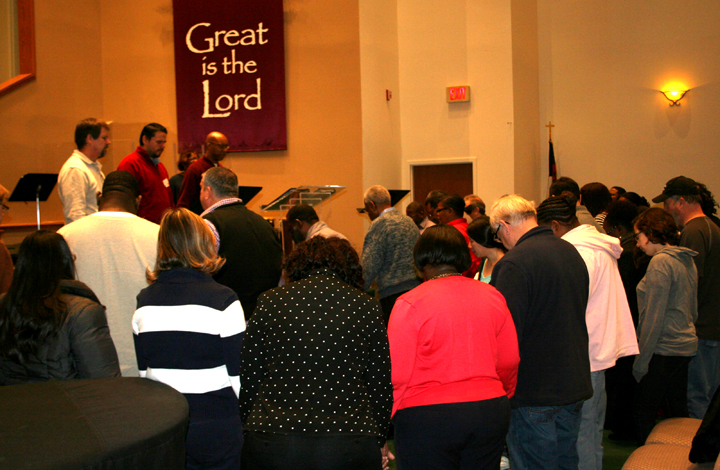
HEARTLAND | Hundreds of leaders from 13 states across the Midwest were in Springfield, Ill., last week for the Midwest Leadership Summit, a triennial training event facilitated by state Baptist conventions in the region and national Southern Baptist entities. These “man on the street” interviews were conducted on Wednesday, a day full a breakout sessions on evangelism and discipleship, missions, women’s ministry, and dozens of other topics.

Read more about the Midwest Leadership Summit at www.Facebook.com/IllinoisBaptist, and in the next issue of the Illinois Baptist newspaper, online at http://ibonline.IBSA.org.


Students at AWSOM listen to Bible study leader Courtney Veasey.

Students at AWSOM listen to Bible study leader Courtney Veasey.

HEARTLAND | The girls from Anna Heights Baptist Church were pretty quiet after AWSOM, said their leader, Judy Halter.

“Whenever you’re raising the bar like that, I think the girls are going to get quiet.” Halter and two fellow leaders brought 14 girls to the annual conference for young women. (AWSOM stands for “Amazing Women Serving Our Maker.”)

“I think it’s all about discipleship,” she said. “It really is, and that was a great missions and discipleship conference.”

With a deep theme for 2014. The most recent AWSOM focused on “the battle for your mind” and found its biblical basis in 2 Corinthians 10:5, a verse that calls Christians to “take every thought captive to obey Christ.”

“The more I study about biblical womanhood and research current world issues impacting women, the root cause always begins in a person’s thoughts,” said Carmen Halsey, IBSA’s director of women’s ministry and missions. “This year’s theme was intended to be a proactive stance in educating our young women and their leaders about the power of our thoughts, and the need to discover the Word and plant it deep inside, so that the Holy Spirit is armed and ready to do war.”

Planting the Word was main speaker Courtney Veasey’s role at AWSOM. The director of women’s academic programs at New Orleans Baptist Theological Seminary taught on the conference theme passage and others from the Bible, urging the girls toward victory in the battle, and a deeper dependence on God’s Word. AWSOM attendees also sat in on a variety of breakout sessions:

  • Dr. Olivia Johnson, a former police officer with a doctorate in criminal justice, talked the girls through a series of potentially dangerous situations they could face in the real world, training them on how to think through each situation and make smart choices.
  • Mother/daughter pair Amy and Amanda Neibel educated the students on human trafficking prevention. The Neibels are part of a leadership team established to raise awareness among Illinois women and churches about human trafficking.
  • Brenda Sommer, a licensed clinical professional counselor, taught on the role of Christian counseling and how girls can speak truth into the lives of friends who are struggling.
  • Halter cited Renee Smith’s session on CrossFit as one moment when things weren’t so quiet. Smith, a pastor’s wife from Mt. Zion, demonstrated easy exercises and gave tips for developing a healthy selfimage.

This year’s AWSOM conference is scheduled for November 6-7 in Springfield. For more information about upcoming opportunities for women and girls, go to http://www.IBSA.org/womensmissions.