Archives For November 30, 1999

Nate AdamsHEARTLAND | As I visit churches from one end of the state to the other, I’ve learned that there is one question that can divide a congregation into camps faster than any question of theology or worship style or even politics. “Are you all Cardinals fans or Cubs fans?”

Now I owe a nod of respect to White Sox fans too. But while the Cubs and the Sox are constant cross-town rivals, the competitive focus this year has definitely been the division race between the Cardinals, the Cubs, and yes, the Pirates, as these NL Central teams ended the regular season with the three best records in baseball. And once the Cubs dispensed with the Pirates in their one-game, wildcard playoff, the stage was set for something that, unbelievably, had never happened before, a Cardinals/Cubs playoff series.

Who was I cheering for? Well, I’m one of those unusual guys that likes both teams. During my baseball-card-collecting boyhood years in Southern Illinois, Cardinal stars like Bob Gibson, Lou Brock, and Orlando Cepeda were my heroes. When we later moved to the northwest suburbs of Chicago, WGN drew me in to the wonderful Wrigley world of Ernie Banks, Ron Santo, and Harry Caray. We have two great National League teams to cheer for here in Illinois!

But when it came to the historic 2015 Division Series, I had to pull for the Cubs. You see, the Cardinals win a lot. Over the past twenty years, the Cards have only missed the postseason seven times. The Cubs have only made it to the postseason four times. The Cubs haven’t been in a World Series since 1945, and haven’t won it since 1908. That’s the longest championship drought of any North American professional sports team. IBSA was a year old when the Cubs last won the World Series.

Call them “lovable losers” if you must, but I simply call the Cubs perennial underdogs, that I believe one day will win. While I enjoy the Cardinals’ success, there’s this part of me that identifies strongly with the underdog Cubbies.

You see, as a Christian in today’s culture, and even as a Baptist in Illinois, I often feel like an underdog. I often feel that my message, the Gospel, and my life’s values, anchored in the Bible, are not “winning” in the culture these days, no matter how hard I try or how deeply I believe. I often feel like I’m playing on a team for whom winning is always postponed into the future.

Now let me hasten to say that feeling that way doesn’t discourage me, really. And it doesn’t ever truly threaten my commitment to God, to His Kingdom, to the fulfillment of the Great Commission, and yes, to the Baptist family.

It doesn’t matter if the world or the culture considers me a winner. But every now and then, when a worship service is especially powerful, or a mission trip is especially helpful, or I see someone respond to the Gospel and enter eternity—I realize that we are winning. And I remember that being true to the team, the Kingdom, that ultimately wins is so much more important than any measure of temporal success.

I guess that’s why I enjoyed seeing the Cubs win a postseason series, even over the Cardinals, and even though they were dismissed by the Mets in four straight games shortly thereafter. It gave me just a taste of the victory that has always been promised for “next year.” And it encouraged me to keep playing hard and staying faithful to teams that sometimes get labeled lovable losers, but that one day will be truly and eternally victorious.

Nate Adams is executive director of the Illinois Baptist State Association. Respond to his column at IllinoisBaptist@IBSA.org.

Attenders to share breakouts, ‘tailgate’ dinner

2015 IBSA Pastors' ConferenceHEARTLAND | Inspiring preaching, personal instruction, and a Tuesday night tailgate party are on the schedule at the 2015 IBSA Pastors’ Conference. The event starts on Tuesday, Nov. 10, at 1:30 p.m., preceding the IBSA Annual Meeting. (Get the schedule here.)

In his invitation to pastors, conference treasurer Brian Smith of Second Baptist Church in Granite City asked churches to pray for the gathering and for pastors who need spiritual rejuvenation and fellowship.

The theme “Built Up” comes from Ephesians 4:11-13, with sections titled:

• Built to Lead

• Built to Labor

• Built to Last

Guest speakers are pastors Timothy Cowin of The Rock Church in St. Louis, Phil Hunter of West County Community Church in Wildwood, Missouri, and Jimmy Scroggins of First Baptist Church of West Palm Beach, Florida.

The Missouri pastors are well known in the region for effective church leadership. Scroggins is the featured teacher on NAMB’s 3 Circles: Life Conversation Guide, a video demonstrating how to share faith by drawing a simple diagram.

Joining the pastors is Shane Garrison, a Campbellsville University professor who will share on reaching “spiritual orphans.” Garrison is a frequent speaker for LifeWay Christian Resources. He teaches on connecting with unchurched families through Vacation Bible School.

The speakers will also lead smaller breakout sessions, offering personal interaction and instruction. Breakouts will be offered in three time slots on a variety of topics, including:

• Establishing an evangelistic prayer ministry

• Teaching church members to effectively share
the gospel

• Growing your church through launching new
groups

• Connecting your church to unchurched
families through VBS

• Attracting families through evangelistic
outreach events

• Getting ready for company

Tuesday night tailgate

A “tailgate dinner” of subs and sliders, chips and finger foods, and hot bowls will be available on Tuesday night. The Disaster Relief mobile kitchen unit will be on hand, and a DR team will prepare chicken and noodles and homemade chili.

The dinner will be offered at the church. Cost is $5 at the door. IBSA is subsidizing the meal as an expression of thanks to pastors.

What are we going to do?

Lisa Misner —  October 12, 2015

HEARTLAND | Nate Adams

Nate AdamsI remember vividly my Dad talking about the final hours he spent with his mother, my grandma, in the hospital before she died. Grandma was a devoted Christian and churchwoman, a member for more than 60 years of First Baptist Church in Murray, Kentucky, where the Cooperative Program was born in 1925.

As she came to the end of her life, and was only semi-conscious, Dad said she would occasionally rise up out of her hospital bed and say over and over, “What are we going to do? What are we going to do? What are we going to do?” Then he said she would relax back into her pillow with these words: “I guess we’ll just trust the Lord.”

For devoted Southern Baptists, recent news from the International Mission Board that as many as 600 to 800 missionaries soon need to return from the mission field leads us to that same, urgent question. What are we going to do?

I don’t have space here to go into all the details, which you can read at the imb.org or sbc.net web sites. But in summary, the IMB has been drawing down on financial reserves and selling properties for years in order to keep as many missionaries on the field as possible. It has been an unsustainable situation, that IMB leadership reports must now be corrected.

What are we going to do? I submit that trusting the Lord is still the best and right answer. Let me suggest five specific ways we here Illinois can do that.

First, we should pray. We should intercede for those in leadership at IMB as they make decisions, and for those missionaries and others who are affected by those decisions. We should pray for solutions, and for generosity from givers and churches, and for the Lord to send laborers into the harvest fields, even as it seems the opposite may be happening.

Second, we should trust the IMB trustees and executive staff to do their jobs. More than once over the years I have thought to myself that I would do things differently if I were in charge of some organization. Sometimes time proves me right, and sometimes time proves me wrong. But in our autonomous, cooperative family of churches we elect trustees to give oversight to the gifted and called leaders of our entities. They are closer to the facts, finances, and circumstances than any of us. And the Bible says that one of the ways we trust the Lord is to trust the leaders He providentially allows to have positions of authority.

Third, we should renew and increase our churches’ commitment to missions through the Cooperative Program. Even the surges and higher levels of giving to the Lottie Moon Christmas Offering over the past decade have apparently not been enough to prevent this downsizing of the missionary force. But ten percent giving through the Cooperative Program would have. Nationally, CP giving from SBC churches has dropped from an average of 10% in 1989 to 5.5% in 2014 (6.8% here in Illinois). If churches’ CP giving had continued to average at least 10% over those years, the number of international missionaries would have grown dramatically, along with the rest of our cooperative missions and ministries.

Fourth, we should of course consider giving our most generous gifts ever through the Lottie Moon Christmas Offering. IMB says that will not change the need for many of the missionaries to return home. But it may speed the rate at which they can be replaced.

And finally, as churches, associations, state conventions, and individual Christians, we should look for ways to directly assist the missionaries who will be returning stateside. Temporary housing, transportation, job placement, and personal encouragement will all be needed by returning missionary families. IBSA will be establishing a Missionary Relief Fund, and the offering received at this year’s IBSA Annual Meeting will be designated for that fund. I will also be contacting IMB with a list of IBSA’s currently open positions.

Many of us were surprised at the need for these missionaries to return home. But God is not. And so let us answer that urgent question with one or all of these very tangible actions that demonstrate we are trusting the Lord.

Nate Adams is executive director of the Illinois Baptist State Association. Respond at IllinoisBaptist@IBSA.org. Read this and other articles in the 10/12 issue of the Illinois Baptist online.

Lifetree CafeHEARTLAND | Morgan Jackson

Every Tuesday and Thursday night, First Baptist Church in Waterloo hosts what Pastor Steve Neill calls “a scheduled hour of stories and conversations to feed the soul.” The weekly meeting around coffee and discussion, called Lifetree Café, resulted from the church’s dedication to use a new building to reach their community.

“Whether you go to a church or not, you’re always welcome at Lifetree,” said Cyndi Antry, a member of the team responsible for setting up the café each week.

The ministry probably wasn’t on anyone’s radar nearly three years ago, when an official press release announced the church’s plans to begin construction on “The Beacon.” The congregation had been envisioning the new building for quite some time, with an original goal to build an extra 8,000-square-feet onto their pre-existing building to accommodate more space for classrooms and activities.

The congregation had spent a year on the planning, development, and funding of the proposed building, when they realized a former nursing home connected to the church’s property was just sitting there…vacant.

The church purchased the 24,000- square-foot space at an unbelievably low price, said Lisa Dean, co-leader of The Beacon’s logistics planning team. And after 15 months, more than 80,000 hours of work, and help from over 700 volunteers from 40 churches across 18 states, The Beacon was finally completed.

The new building contains a fellowship hall, kitchen and dining room, entertainment stage, café, children’s education center, youth wing, recreation area, basketball court, and a capacity of 400 people. And its presence on Market Street offers great access to and for the community.

The Beacon is now home to a number of outreach programs for children and adults, and Lifetree Café has especially captured the community’s attention. The “conversation café” is a nationwide ministry with multiple sites in the United States and Canada. It is designed to be a safe place for people to explore their spiritual questions and to share their stories.

Discussion revolves around a specific topic each week—usually something spiritually and culturally relevant like prayer, loneliness, health, ADHD, guilt, life after death, justice, race, immigration, relationships, other world religions, stem cell research, and countless others.

A host team and friendship team run each session; the friendship team is in charge of setting up coffee and snacks, and one of six hosts leads the conversation.

Each Lifetree meeting lasts an hour and typically includes a short film, as well as small and large group discussion. People are also given helpful tips and applications they can take home and practice in their everyday lives—often printed handouts containing information on the week’s topic, as well as online links to learn even more.

No two meetings are the same, Antry said. “Some are very emotional. Some are very lighthearted.” It just depends on the week, the topic, and who God brings through the door.

FBC Waterloo’s Facebook page advertises “food for thought” as the main entrée at LTC. Pastor Neill says Lifetree is “sort of like a live, local talk show—with an inspirational twist.”

The ministry’s ultimate purpose is to help those who attend grow closer to God, but no one there is trying to “sell” people on a certain church or religion. Rather, the goal is to offer a place where individuals can come and ask questions, talk freely, and explore life. If God wants to work during a discussion and convict someone’s heart, he will, Antry said.

Lifetree just helps create a space where people can experience the Lord’s power.

“Here at Lifetree we have certain things we value,” said David Batts, chairman of the building committee for The Beacon. “Your thoughts are welcome, and your doubts are welcome. We’re all in this together.”

In the Middle

Lisa Misner —  September 21, 2015

HEARTLAND| Nate Adams

I am reminded lately of the song “Stuck in the Middle with You.” The song was written by Gerry Rafferty and Joe Eagan, and recorded by their band, Stealers Wheel, in 1972. The song was inspired when Rafferty and Egan were seated at a restaurant table with record company representatives on one side of them and producers on the other. The executives were talking across them, conducting business, and the singers were “stuck in the middle.”

Neither the IBSA staff and missionaries nor I feel “stuck” in any sense of the word, but I do feel we’re in the middle of something. As a middle-sized state convention here in the middle of the country, and now in the middle of a funding challenge, we are also in the middle of some crucial questions about how we do ministry, how we advance the gospel, and how we sustain our shared work financially.

Nate Adams

In the previous issue of the Illinois Baptist, I outlined reasons that inspire me personally to give through my church to the Mission Illinois Offering each year. (See IBSA.org/MIO.)

I unapologetically ask IBSA churches to receive an annual offering for state missions. But there are some additional dynamics that make the Mission Illinois Offering even more important this year.

For one thing, Cooperative Program giving in Illinois, the primary funding source of our missions and ministries, has not yet rebounded from what’s now called “The Great Recession” of 2007-2009. Yet expenses, especially “people costs” such as healthcare and travel, continue to rise. For example, IBSA’s healthcare premiums will increase 20% next year, or almost $65,000. Yet CP income planned in the 2016 IBSA budget is actually $340,000 less than we received in 2009.

Compounding the CP shortfall is a strategic shift by our partners at the North American Mission Board to focus almost exclusively on church planting in larger cities. Of course church planting is a top priority for us in Illinois too. But now funding for staff and ministries such as WMU and women’s ministries, collegiate ministry, IBSA’s church consultants and partnership with local Associations, and soon our funding of the Christian Activity Center in East St. Louis, must come 100% from the IBSA budget, rather than being shared by both NAMB and IBSA.

We appreciate the partnership NAMB provides for church planting, especially in Chicago and metro St. Louis. But we must ask how other Illinois ministries can continue to be funded. The Mission Illinois Offering is the single most important factor in answering that question.

Over the past five years, larger state conventions have downsized by a third or more. Smaller state conventions who are much more dependent on NAMB funding have needed to focus their attention more exclusively on church planting, often at the expense of assisting existing churches.

While we in Illinois have also downsized and economized, we’ve done so gradually, without layoffs or major loss of services or ministries. In a sense, we benefit from being “medium-sized,” with enough resources to be somewhat self-sufficient, and yet not so many institutional obligations that limit our options for trimming budgets.

You and your church can help through generous participation in the Mission Illinois Offering. If your church does not collect the Mission Illinois Offering, you can contribute directly. Visit www.IBSA.org and click on the “donate” tab. Or mail your gift labeled “MIO” directly to IBSA at 3085 Stevenson Dr., Springfield, IL 62703.

And for the record, there’s still no place in the world I’d rather be than here in the middle with you.

Nate Adams is executive director of the Illinois Baptist State Association. Respond to his column at IllinoisBaptist@IBSA.org.

Let’s go back to church

Lisa Misner —  September 2, 2015

Back to Church SundayHEARTLAND | The kids have gone back to school, so now let’s go back to church. That’s the idea behind National Back to Church Sunday, September 20. After Labor Day is one of those times when the number of church visitors increases. How can we prepare?

Smiles, everyone. Practice your greetings. Put it plainly: let’s make people feel welcome, not just at the assigned hand-shaking time, but before and after the service, too.

Two-minute warning. As with the last moments of an NFL game, assign the greeting to the last two minutes of the service. Encourage people to stick around and talk, or invite the guests to lunch at a local restaurant.

Check the signage. Invite a stranger to assess the effectiveness of the signs in your buildings, especially for the restrooms and children’s area.

Paint the entryway. The rest of the place may need it too, but at least spruce up the lobby.

Best face forward. Assign the friendliest greeters for the month of September in a variety of ages. Review the basics of making people feel welcome and giving directions.

Learn more about Back to Church Sunday

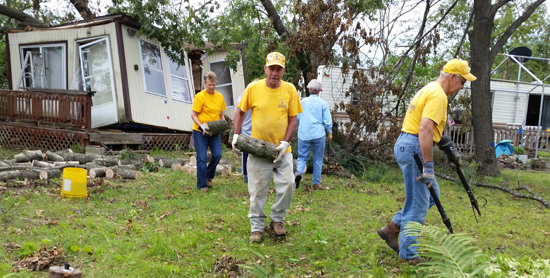
Disaster Relief volunteers clean up tornado damage at Woodhaven Lakes Camping Resort in Sublette.

Disaster Relief volunteers clean up tornado damage at Woodhaven Lakes Camping Resort in Sublette.

HEARTLAND | IBSA Disaster Relief volunteers are busy serving and ministering at home in Illinois and on the east coast in July.

Disaster Relief chainsaw teams will continue their work next week at Woodhaven Lakes Camping Resort. On June 22 an EF-2 tornado tore through the private camping resort in Sublette, a community two hours west of Chicago.

Hundreds of downed trees and limbs still need to be cleared and removed from several properties.

Many residents don’t have insurance and those who do, have found the damage is not covered by their policy. “People were really overwhelmed,” shared Debbie Porter, a member of the FBC Galatia Chainsaw Team that served there from July 6-11. “They’ve greeted us with open arms and embraced us. They can’t believe we came to help for free.”

The FBC Galatia team was joined by chainsaw teams from Greater Wabash, Salem South, Sinnissippi, Three Rivers and Williamson Associations. The 50 volunteers completed 65 jobs while in Sublette.

Teams from Salem South and Three Rivers Associations will join with teams from FBC Harrisburg and Sullivan Southern July 20-25 to finish the work the previous teams started.

“Once you start a response it is always an extra blessing if you can finish it,” shared Rex Alexander, Illinois State Disaster Relief Coordinator. “We anticipate about 120 volunteers working together to bring help, healing, and hope to this community.” Alexander estimates at least 150 jobs remain to be completed.

Teams from Michigan, Missouri, Ohio and Tennessee will bring bucket trucks, shower trailers and chainsaws next week to assist the Illinois teams. Lodging for volunteers will be provided by Northside Baptist in Dixon, Victory Baptist in Mendota, and FBC La Moille.

Alexander said the Illinois teams still need additional trained volunteers to help. “We could use some additional individuals to fill out some of our chainsaw teams, serve as chaplains, and serve as assessors,” he noted. “We could also use one or two more tractors and operators. Most jobs at Woodhaven involve cutting huge trees (sometimes on top of structures or tangled together). Moving these trees to the curb after they are cut up involves a significant amount of human labor. Teams with tractors, bobcats, or skid steers can accomplish the work much faster than teams without this heavy equipment.”

Meanwhile, IBSA Disaster Relief feeding teams are serving this week and next in Long Island, NY in support of the Hurricane Sandy Rebuild Ministry. Fifteen volunteers are feeding mission teams there to rebuild homes damaged by the hurricane, which devastated parts of New Jersey and New York in October 2012. The volunteers from churches around the state will serve through July 26.

If you are a trained IBSA Disaster Relief volunteer and would like to help at Woodhaven Lake Camping Resort in Sublette, e-mail Alexander at RexAlexander@IBSA.org or call (217) 391-134.

Disaster relief call-outs are expensive with many teams coming from the southern part of the state and Alexander said any monetary donations would be appreciated. To donate online go to www.IBSA.org and click on the “Donate” link. Checks may be mailed to IBSA Disaster Relief, P.O. Box 19247, Springfield, IL 62794-6247.

If you would like to become an IBSA Disaster Relief volunteer, the next training opportunity is October 9-10 at Lake Sallateeska Baptist Camp. Visit www.IBSA.org/dr or call (217) 391-142 for more information.

Diana_Davis_blog_calloutEditor’s note: Diana Davis is an author, columnist and minister’s wife. This column appeared in the April 6 Illinois Baptist. Visit Diana’s website at http://www.dianadavis.org.
HEARTLAND | Diana Davis

When a first-time guest completes a guest registration card at your church, what happens next? The most common answer to that question: absolutely nothing. No, it’s not an intentional oversight, but without an ongoing, immediate follow-up plan, your church may miss the opportunity to reach guests for Christ and include them in your church family.

Need fresh ideas? Tweak some of these to fit your unique church:

First-time guest online survey. People love to give an opinion! Create a brief survey on your church’s website. (See a sample survey at dianadavis.org) Carefully study survey responses.

Same-day contact. A specially trained volunteer makes a brief phone call to each guest on Sunday afternoon after they visit your church.

E-mail and/or snail mail. Assign volunteers to send a swift, personal email or card to each first-time guest.

Small group personal invitation. Provide contact info to an appropriate small group or Sunday School class for each family member. A member of that small group may offer to meet the guest at a specific door to escort them to class the next time they visit.

Coffee, anyone? An Indiana church delivers three coupons for a free drink in their coffee area, encouraging the guest to return for three consecutive Sundays. In a different church, volunteers deliver a church coffee mug to the guest’s door before they get home from church.

Pastor’s letter. Many pastors prepare a warm letter or e-mail to welcome first-time guests; some even jot a handwritten note. Pastor Ted Traylor at Olive Baptist, Pensacola, often texts or phones first-time guests on Saturdays, inviting them to come back on Sunday.

Notice that church members—not just ministry staff—accomplish the majority of follow-up. Newcomers want to hear what you love about your church. They desire relationships, and relationships provide evangelistic opportunities.

When God brings a first-time guest to your church this Sunday and they complete a guest registration card, what will happen next?

“The harvest is abundant…pray to the Lord of the harvest to send out workers into His harvest” (Luke 10:2).

HEARTLAND | Nate Adams

As Easter approaches each year, I frequently find myself returning to the music of “Jesus Christ Superstar.” Perhaps it’s because I was a teenager in the 1970’s, when Andrew Lloyd Webber’s groundbreaking rock opera was immensely popular. They say the music of our teen years can shape us for the rest of our lives, and certainly hearing these songs again brings back many memories and emotions.

Nate_Adams_April6But really more than the music, it has been Tim Rice’s lyrics that have stuck with me. To this day I can recite most of the words Rice penned over 40 years ago, including the powerful dialogue where Pilate angrily demands of Jesus, “Why do you not speak when I have your life in my hands? Why do you stay quiet? I don’t believe you understand!”

Jesus’ reply in the rock opera, though imaginary, is consistent with the Bible’s message. “You have nothing in your hands,” Jesus meekly replies. “Any power you have comes to you from far beyond. Everything is fixed, and you can’t change it.”

Those simple words powerfully convey the confidence and courage of Jesus as he went to the cross for us, and also the providence and sovereignty of God in securing our salvation. Each time I hear them, they make me want to cheer for God and His great victory on our behalf.

To their credit, Webber and Rice took moments like that from the passion week of Christ and, with some admitted license and imagination, placed them in the contemporary music and language of their day. The result was memorable, and therefore enduring.

And yet, as critics and Christians alike noted even during the height of its popularity, Jesus Christ Superstar has one obvious and major shortcoming. It concludes with the crucifixion.

Apologists for the rock opera observed that the ending was deliberately left to the faith or skepticism of the observer. Even Christians noted with appreciation that it at least served to place the name of Jesus on peoples’ lips, and the story of his life in their minds and hearts, in many cases for the first time.

But there was no resurrection. No Easter. No delivering the good news that death was not the end for Jesus and that it need not be the end for those who believe in him.

Yes, ultimately Jesus Christ Superstar sadly reminds us that it’s possible to stop the story too soon. It’s possible to focus so much on the various overtures to Easter that we don’t truly celebrate the finale.

It happens all around us. Immediately after Valentine’s Day, the candy and toy aisles at every store in town switch their ruby red treats and treasures over to the pastel, Easter versions. Clothing catalogs tell us that we need something new to wear. And florists and garden centers remind us that a properly decorated Easter requires lilies. All these traditions paint the days before Easter with an elaborate pageantry. Then the big day comes, and we are left to wonder whether all the preparation overshadowed Easter itself.

We can even do it in our churches. For weeks we can invest in preparing musicals, programs, decorations, and children’s activities designed to help us celebrate Easter. All these things are good. But they are not the finale. They are not the really big part of the story that must be celebrated and that must be told.

The title song from Jesus Christ Superstar is sung by, of all people, Judas, near the end of the rock opera. In it he asks Jesus, “Who are you? What have you sacrificed?” In our churches and in our conversations with others, we need to make sure to get to the part of the story that answers those questions with truth and faith and confidence. As important as what happened before Easter is, it’s what happens after Easter that makes all the difference.

Nate Adams is executive director of the Illinois Baptist State Association.

PriorityHEARTLAND | Living a life with intention is the theme of this year’s IBSA Women’s Resource Conference April 24-25 at Tabernacle Baptist Church in Decatur.

The two-day Priority Women’s Resource Conference is designed to equip leaders serving in the local church. The conference will include worship and large group sessions led by nationally known speakers, 40 breakout offerings on a variety of topics, a luncheon for ministers’ wives, exhibit area with ministry resources, and a 5K walk/run.

A screening of “War Room,” a new film from the creators of “Fireproof” and “Courageous,” will follow the Friday evening session.

Priority begins Friday at 1 p.m. with a missions celebration featuring North American and International Mission Board missionaries and Tajuan McCarty, founder of The WellHouse ministry that seeks to rescue victims of human trafficking. Clella Lee, a leadership consultant for National Woman’s Missionary Union (WMU), will also speak during the opening session.

Lee directs WMU’s Christian Women’s Leadership Center, which engages women in discovering and implementing leadership gifts in their churches and workplaces. Women desiring to express those gifts are sometimes hampered by demands on their time, or by other factors.

“I think women are hesitant sometimes; they don’t want to come across as too aggressive,” Lee said. “And so I think sometimes they aren’t always as apt to take a hold of those leadership skills they have…they have a sense of call or a sense of need, and recognize some of those gifts, but sometimes they’re hesitant.”

Lee will speak about the Christian Women’s Leadership Center, and also will lead three breakout sessions during the conference on the dynamics of a ministry family, the private spiritual life of a leader, and creative approached to missions in a church plant.

Rachel Lovingood will continue the leadership theme in the Friday evening session. The author, pastor’s wife, and speaker at LifeWay events will delve into how women can develop into the leaders God has created them to be. She also will unpack specific topics in several breakout sessions.

The Friday evening session also will feature author and missions advocate Kimberly Sowell, and worship led by Pastor Chad Ozee of Journey Church in Bourbonnais.

Saturday begins early with a 5K fun run or walk, and concludes with an afternoon session featuring Lori McDaniel, an International Mission Board global mission catalyst and church planter wife from Arkansas. Ministers’ wives also are invited to a luncheon with Kathy Litton, the North American Mission Board’s consultant for ministers’ wives ministry.

Cost is $25 for attenders who are part of an IBSA church, and $30 for all others. Conference information and registration is online now at www.IBSA.org/womensmissions. A block of rooms has been reserved at the Decatur Conference Center and Hotel (across the street from Tabernacle Baptist Church). Contact the hotel at (217) 422-8800.