Archives For November 30, 1999

Denominational tags have fallen on hard times. History and tradition have become baggage.

I would be surprised if you know of a new church that can be identified with any recognizable branch of Christianity. If you can get creek, river, brook, or tree into your church name, for sure it will grow. The more bland, comforting, serene; the more easily confused with a country club or a rock band your church name is, the more in tune with the times you appear.

And the latest trend has moved beyond nature: Bridge. Liquid. Radiance. Paradox. Propulsion.

In the interest of transparency, I began a move to change our church name 15 or 20 years ago, then I chickened out. Baptist is still our middle name.

Here is my attempt to give a bit of context and explanation for our church name to a deep blue, urban, postmodern population.

What’s in a name?
John the Baptist, eccentric prophet. William Carey, linguist, humanitarian extraordinaire. Fredrick Douglas, abolitionist-orator. Charles Spurgeon, urban crusader. Nannie Helen Borroughs, women’s leader. Walter Rauschenbusch, social justice warrior. Lottie Moon, China champion. Martin Luther King, renowned activist. Billy Graham, global evangelist. Mahalia Jackson, vocalist without equal. Rick Warren, mega-church pastor, best-selling author. Baptist is a name associated with colorful, controversial, influential figures here and around the world.

There are approximately 32 million Baptists in the U.S., half of them are “Southern Baptists,” over 100 million in the world. As for “The Baptist Church,” there isn’t one. Each Baptist congregation is independent, autonomous, self-governing. Many churches participate in larger entities, but those affiliations do not infringe upon congregational self-determination. Yes, this lends itself to some craziness and confusion; it is what it is.

Baptists are not self-named. Our persecutors began using this label in derision beginning in the 1400s. Theologically and historically, Baptists are those who hold the Word of God, the Scriptures, the Bible, as sole authority in all matters of faith, church order, and practice rather than looking to tradition, human hierarchies, committees, or governments.

Many historians seemingly fail to notice that many who came to America for religious freedom, instituted the same state church systems, persecuting those who did not adhere, repeating the sins of the governments they fled.

In U.S. history, Rhode Island, the first colony with complete religious freedom, was founded by Baptist Roger Williams. Williams’s life was a crusade for freedom of conscience and religious liberty. He founded Rhode Island in 1636 after purchasing the land from the Narragansett Indians.

A refuge from religious persecution, Rhode Island became home to the first Jewish synagogue in America and a sanctuary for Quakers who were being persecuted and killed by anti-Quaker laws in Massachusetts and other colonial territories. Rhode Island was an open door to all people, a safe harbor in a sea of tyranny and oppression.

In the flurry of activity around the colonies becoming states, the constitution presented for ratification did not provide for religious liberty. Baptists supported the proposed constitution on the condition an amendment on religious freedom would be added.
Finally, Massachusetts and Virginia became the pivotal states in the process. James Madison was running for the state legislature of Virginia against Baptist pastor John Leland.

Madison was about to lose the election. Leland knew this. He also knew without Madison’s golden voice and political influence there would be no constitution. With victory already in his hand, Leland dropped out of the race, giving Madison an open road on the promise that he would pursue language providing for religious liberty.

So sympathetic was Congress, urged on by President Washington, that they made it their first business to consider the issue Baptists were pressing. As a result, the line of the First Amendment reads, “Congress shall make no law respecting an establishment of religion or prohibiting the free exercise thereof…”

Baptist then is not a “brand name” so much as it is a historical, theological descriptor of people who adhere to biblical authority over human authority and are advocates of religious liberty for all.

Charles Lyons pastors Armitage Baptist Church in Chicago.

Teaching Sunday School

Lisa Misner —  February 22, 2016

I have the privilege and challenge of attending a different church almost every week, but this past month I was able to attend my home church two weeks in a row. The first week, at the end of our Sunday school class, our teacher announced that he and his wife would be gone the following Sunday, and asked if any of us were available to substitute.

Our eyes met, and he smiled and said, “I don’t guess you will be here next Sunday.” I replied that actually I would, and a few minutes later I was walking out the door with his teacher’s book under my arm.

Teaching Sunday schoolI love teaching Sunday school. I’ve done my best to learn to preach over the years, but I’m really more at home in a classroom setting. I love the process of studying and organizing a lesson, of thinking through its most relevant, real life applications, and then planning creative illustrations or exercises that will help everyone take home some practical help.

But it’s more than just the teaching process that always made me love leading a Sunday school class. It’s living life with a small group of people week in and week out. It’s coming together outside class for fellowship and ministry. It’s doing missions projects together. And it’s making our class so fun and inviting and loving that we have lots of opportunities to welcome others in, and even send some of them out to do the same thing elsewhere.
That one week I got to teach Sunday school, I really only got to do the teaching part. Most of the rest of those benefits only come with consistent, loving investment in a group of people over time.

But the Lord did give us a special moment during that lesson. Our text in 2 Corinthians spoke of the burdens and hardships that Paul was carrying for the sake of the gospel. It wasn’t in the curriculum, but in my notes I had simply written the question, “Are we carrying any burdens or enduring any hardships for the sake of the gospel?”

When I framed that question for the group, I made it clear that I wasn’t just looking for a list of minor inconveniences, or for the self-absorbed whining in which we can readily engage. I asked them what burdens or hardships they were currently facing because they longed for someone to know Christ.

Frankly, I didn’t expect a lot of response. Sometimes teachers ask questions simply to create reflection or allow for conviction. But in the hallowed moments that followed, several in the class shared with quiet emotion the difficulties they were currently facing while trying to lead someone they loved to Christ, or back to Christ.

After a few minutes of sharing, we encouraged one another, and urged one another “not to give up,” as Paul had written. Paul labeled his own afflictions “momentary” and “light” compared to the glory that is waiting for us. And as our class shared our own burdens with one another in the context of God’s Word, we felt them get lighter as well. We walked out of that class with renewed determination and optimism. Now that’s Sunday school.

My one week back in teaching Sunday school reminded me again how powerful and transformational small group Bible study can be. And it gave me a renewed appreciation for my own Sunday school teacher, Matt, and for the thousands of faithful men and women that lead Bible studies in our churches every week.

Nate Adams is executive director of the Illinois Baptist State Association. Respond at IllinoisBaptist@IBSA.org.

Illinois flood callout complete, Missouri recovery ongoing

Kincaid_flood_recovery

Illinois Disaster Relief teams, including one from Capital City Baptist Association, dismantled destroyed houses in Kincaid.

Illinois Disaster Relief volunteers were busy with flood recovery efforts in two states throughout the month of January. They came to the aid of flood victims after holiday storms dumped 10 or more inches of rain across Illinois and Missouri.

Flooding in the states killed at least two dozen people, affected roughly 5,000 homes and temporarily closed portions of Interstate 44 and Interstate 70. The flooding was particularly bad in Missouri where in some areas along the Mississippi, floodwaters rose to 48.9 feet, surpassing the 1993 record by nearly half a foot. “It’s bigger than people realize,” said Joe Banderman, leader of the Missouri Baptist Convention’s collegiate relief team. “Unless you’re here, it’s hard to get an idea of the scope of the flooding.”

Arnold flood recovery

It’s dirty work mudding out flooded homes in the Mississippi River region. Members of Genesis Church suited up to dig out in Missouri.

Illinois DR teams were kept busy in the rural Illinois town of Kincaid, extreme Southern Illinois in Alexander County, and in the suburban St. Louis town of Arnold, Missouri.
Flood recovery work includes helping homeowners dispose of flood-soaked belongings, ripping out floors and walls, spraying mold repellent on the remaining wall studs and floor joists. The process is very emotional for the victims.

Missouri was hit particularly hard by the flooding, said Dwain Carter, the Missouri Baptist Convention’s disaster relief director. He hopes Southern Baptists can continue to help families by deploying volunteer teams to assist in flood recovery, following the departure of teams in late January who prepared meals and engaged in various facets of outreach to flood victims.

“Our Disaster Relief teams had a great impact in Kincaid and also in several small communities in Southern Illinois,” said Rex Alexander, IBSA’s DR coordinator. “These smaller towns are often ignored during times of disaster and the residents were especially grateful for our ministry.”

He expressed his gratitude for all the volunteers who served during the coldest month of the year. “Their commitment and service to the Lord is an example for all of us to follow!”
Carter said the sacrificial service of disaster relief volunteers from 21 state conventions painted a “perfect picture” of Southern Baptist cooperation. “We talk about cooperative giving a lot, but this was a cooperative effort to overcome a disaster,” he said.

“Southern Baptist Disaster Relief,” he added, “is a cooperation of thousands of Southern Baptists to bring hope, help and healing while transforming lives and communities through the Gospel.”

In all, 48 volunteers from Capitol City and Metro East Associations served in Kincaid, while 41 volunteers from Harrisburg First Baptist and Williamson Association served in Olive Branch. A team of 14 volunteers from First Baptist Galatia worked in Arnold.

If you would like to become a disaster relief volunteer, training events are scheduled for April 8-9 at Western Oaks Baptist in Springfield, April 22-23 at Streator Baptist Camp in Streator, and October 14-15 at Lake Sallateeska Baptist Camp in Pinckneyville. For more information visit www.IBSA.org/DR or call Rex Alexander at (217) 391-3134.

– With additional reporting by Baptist Press

Grappling with leadership

Lisa Misner —  February 15, 2016

A better grip

It may be hardest part of ministry, but the local church’s future depends on leaders who understand who—and how—they lead.

Michael Kanai came to the Illinois Leadership Summit excited about recent happenings at his church. “We had a retreat and we made many plans and casted our vision,” the pastor of Orchard Valley Baptist Church in Aurora said. “Now,” he continued, “we need to implement and execute the plans.”

For many pastors and church leaders, that’s the hard part: turning plans into action and leading the congregation to achieve the goals. A stumble or two at this stage can stall the work and cause the people to wonder about the abilities of the leader.

But, don’t be mistaken, this article is not about goals and action plans. It’s about what happens in the heart of the leader who realizes he can’t do the ministry alone. He needs a team, and more important, he needs a team of leaders.

“We are at a point where we are needing to lead leaders,” Kanai said. “It’s really helpful learning the difference between leading followers and leading leaders. The ‘collective’ we just attended just told us there is a steep step between those two types of leadership—it’s a pivotal shift in the way you lead.”

Halfway through the Summit, Kanai was clearly “getting it.”

Setting the (grappling) hook

For two days in January, pastors, staff, and church leaders convened at the Springfield facilities of the Illinois Baptist State Association. Last year at the same time, almost 1,300 leaders from 10 Baptist state conventions across 13 states gathered for the Midwest Leadership Summit at the nearby Crowne Plaza.

Previously called the North Central States Rally, the triennial event schooled ministry leaders in programming and skills to help grow their churches and fulfill their callings in their Upper Midwest mission fields. But this meeting was different: First, it was an Illinois-only event. With the two-year break between conferences, IBSA sought to build on the momentum from the 2015 event by bringing Illinoisans together to address the leadership issues we face here. And second, this event was not so much about skills, but about the heart and character of the leader.

“When most pastors think about leadership in ministry, they view it as administrative duties, supervisory oversight, or managing some new project,” said associate executive director Pat Pajak. “Until a pastor discovers the necessity of leading himself, especially in the areas of spiritual disciplines and character development, he will never be able to lead followers, lead leaders, or lead an organization in the way God intended.”

That’s why this Summit was different.

“IBSA frequently offers ministry skill training, but we made it clear from the outset that the Summit would focus on one’s personal growth as a leader,” said executive director Nate Adams. “That shift appears to have both met a felt need, and also created an itch among leaders that IBSA hopes to help scratch in the days ahead.”

ILS16 Bumgarner_Tuesday

Bob Bumgarner

The centerpiece for the event was the new leadership development process that the IBSA team has been crafting for more than a year. The main speaker for the event was Bob Bumgarner, a leadership expert who has contributed to the creative process. He was joined by four Illinois pastors in the main sessions (called “collectives”), and by 28 other pastors and ministry leaders in breakout sessions (called “intensives”).

“I think we would all agree that leadership development is forefront and needed in Southern Baptist life,” Bumgarner said. “And I also think we all would agree that it’s not as easy as it sounds.” Bumgarner (pictured above) headed leadership development for the Florida Baptist Convention and currently serves as executive pastor of Chets Creek Baptist Church in Jacksonville, Florida, a large, multi-campus congregation.

Bumgarner sought to dispel the myth that all leadership is alike no matter the group or setting; and that leadership is innate and there’s nothing that can be done to improve it.

Not true.

IBSA’s four-part plan

Leading self is about growing your capacity to be on Jesus’ mission as a person of influence.

“The hardest person I ever lead is me,” Bumgarner said, as he began to unpack the four phases in IBSA’s leadership process. “We have to understand that before we can lead others well, we have to learn to lead ourselves.”

Bumgarner pointed to the iceberg as a good illustration of the issues in self-leadership. Most of it is under the surface. That’s why character is so important. “You can get so successful that your character can’t support (your ministry)….If you want to be a better self-leader, figure out how you can hunger for God’s wisdom.”

He recommended spending five hours per week developing character and 50-60 hours developing ministry.

“Ministry is a place where you can be completely busy or completely lazy, and people won’t know,” said Heath Tibbetts, pastor of First Baptist Church of Machesney Park. He brought some personal applications for pastors. “I’ve realized strong self-leading means that even if no one else is looking, the Holy Spirit is keeping me accountable.”

Table_fellowship

Eric Trout, Ashby Tillery, and Mark Mohler, all from Marion, were among Summit attenders who watched the large-group collective session in the room adjacent to IBSA’s auditorium.


Leading followers
is about leading individual contributors, people who are not leading others, often serving as a ministry head or teacher in small groups or classes.

There are official followers, such as deacons or committee members, but there are also unofficial followers, the people who like or respect the leader, who have bought into the vision and want to be part of making it happen.

Bumgarner said at this stage, the objective is to identify your followers, inspire them by giving them a leader worth following, initiate followers by casting vision, and invest in their personal development. Make a goal, he advised: “By the end of next year, I want to have invested this amount of time into this number of people.”

“Our church grew when I stopped trying to lead big and started trying to lead through small groups,” said Mark Mohler, pastor of Second Baptist Church of Marion. He described bringing his congregation into a new vision for the church that found its most vital point of connection at the level of Sunday school classes.

Leading leaders is directed toward those who lead others. It requires a different skill set to keep those people who have leadership abilities of their own on your team.

Here is the pivotal point in the four phases of leadership. Adams described an image of stairs. In this case, not all the stairs are of equal height. Some have a short rise, others have a tall rise. The step between leading followers and leading leaders is the biggest jump for most people. And as Kanai described his own discovery at the Summit, it’s the most critical.

A leader who can only lead followers is limited by his own capacity; but a leader who can lead those who lead multiplies his capacity. But leading leaders is challenging and it’s risky. Other leaders have their own ideas, and they may set their own agendas.

“It can be one of the scariest moments of our life,” Bumgarner said, “nurturing your baby and then handing the baby to another person to raise….Regardless of the pain sharing a ministry can cause, something bigger and better can happen as a result.”

At this stage, empowerment of additional leaders must be balanced with clear, ongoing vision-casting: “85% of your success in leading leaders is wrapped up in common purpose and clear communication,” Bumgarner advised. “Do enough (communication) so that downstream from that work, we can see the fruit we’re looking for.”

Leading organizations is about leading leaders who lead other leaders. It’s about having a vision for the whole ministry and communicating that effectively to the whole organization.

In church life, this leader is usually the senior pastor, but not every pastor is actually leading at this level. He may be leading followers, or even leaders, but not effectively guiding the work of the whole ministry.

“Leading organizations requires working on the ministry versus in the ministry,” Bumgarner said. Many listeners in the room seemed to connect with this comment. He described a season when his ministry was consumed by the work of ministry rather than giving adequate attention to the purpose of the ministry, its vision and goals.

Leadership at this level requires strategic planning about how to do the ministry. “Your church needs you to facilitate the things that need to be done in order to share the gospel. If you find time to get the top 20% done, the other 80% will be done right.”

Bumgarner concluded, “The point of organizational functionality is to keep the main thing the main thing.”

– Coverage of the Illinois Leadership Summit by Meredith Flynn, Kris Kell, Kayla Rinker, Lisa Sergent, and Eric Reed

Sign-ups are now open for two popular missions initiatives for Illinois students.

CMD 2016CMD registration open now

Children’s Ministry Day for kids in grades 1-6 is Saturday, March 12. Leaders can register their groups for a project at http://www.IBSA.org/kids. This year, volunteers can choose from 14 sites: Bourbonnais, Bridgeport, Carbondale, Carlinville, Carrier Mills, Chicago, Crystal Lake, Decatur, Hamel (on March 19), Mt. Vernon, Peoria, Quincy, Rockford and Springfield.

Several hands-on projects are planned at each location. Projects will close once the maximum number of registrants is reached. The cost per participant is $15, which includes a T-shirt, lunch, and some ministry supplies.

Children’s Ministry Day begins at 9:30 a.m. with orientation, and concludes at 3:30 p.m. following a celebration service at each site. Register at IBSA.org.

GO Team deadline March 1

GO TeamsFor older students, IBSA’s GO Teams are accepting applicants for four international summer mission trips. In 2016, GO Teams will travel to Italy, Haiti, Jamaica and Guatemala.

“We believe that one of the best ways to help students develop a missionary heart is to give them an opportunity to leave their comfort zone and put their feet on the international mission field,” said IBSA’s Rex Alexander. “GO Teams give students that opportunity.

“We see God begin to create a passion for the lost and a heart for the nations that will stay with them throughout their lives.”

In Guatemala, students will work with deaf children, teens and adults, doing Vacation Bible School-type activities in schools for those with special needs. VBS is also the focus of the Haiti and Jamaica trips, where students will work alongside local churches.

The project in Trieste, Italy, is a new GO Team opportunity for 2016. The team will partner with a local congregation for a school painting project and kids camp, and also will prayer walk the community and work to build relationships on behalf of the church.

The GO Team application and information about each project are available at www.IBSA.org/students. The application deadline is March 1. For details about all upcoming missions opportunities, contact IBSA’s Church Resources Team at (217) 391-3138 or go to www.IBSA.org/missions.


The Forgotten Side

Lisa Misner —  February 1, 2016

Metro East prepares for the Southern Baptist Convention | June 14-15, 2016

Brook's Catsup

The World’s Largest Catsup Bottle may not be as tall as the Gateway Arch (it’s only 170 feet tall from base to cap), but the big monument in Collinsville, Illinois, is older, by 16 years. It was erected over the Brooks plant in 1949. The Brooks bottle has its own website and fan club. Catsupbottle.com

People from elsewhere are confused when I say I am from Illinois, near St. Louis. For many, Illinois means Chicago. But our state is much bigger than that.

When James Eads built the first bridge across the Mississippi in 1874, downtown St. Louis was connected to Illinois as never before. We love our giant city to the north, but much of our state is closer to St. Louis.

If you live near enough to the S-T-L, you know that our region is called Metro East. Let me tell you some of the Metro East story.

The Metro East is five counties on the Illinois side of the river. With 700,000 residents, it’s about one-fourth of the population of metropolitan St. Louis, which comes in at 2.8 million. It includes places like East St. Louis, Alton, Belleville, Edwardsville, Columbia, Collinsville, Fairview Heights and, yes, my town of O’Fallon.

We are diverse, but sometimes segregated. For example, East St. Louis is 98% African American, while O’Fallon is 82% white.

We are old towns, but there is a lot of new growth. Many of us work downtown, but new jobs are being created on our side of the river as well. And Scott Air Force Base has a large influence here. We have poverty and wealth. We have struggling churches and churches that are growing rapidly. We have challenges and opportunities.

Our relationship with St. Louis is complex. We love the city, the sports teams (at least those who don’t move away!) and the many things to see and do there. But we feel forgotten by the Missouri side. We go to the west side of the river often. They rarely come to the east side. We love and need St. Louis, but we identify closely with our own towns and schools.

Our area has many Catholics, but Baptists have a strong influence as well. St. Louis was founded by French explorers and Catholic missionaries. About half of the people in St. Louis consider themselves religious because they have a Catholic background, but the other half don’t claim to be anything.

New Design Baptist Church

The first Baptist church in Illinois was founded at New Design near present day Waterloo in 1796. This log meeting house dates back to 1832.

The first Baptist church in the state of Illinois was in a community called New Design. It was formed in 1786 near the Metro East city of Waterloo. Colonists traveled from Virginia and Kentucky to that spot near the Mississippi River. Among their number were two preachers, James Smith and David Badgley, who preached at New Design. The colony had more than 200 residents by 1800 and was the largest settlement in Illinois at the time.

Since that day, Baptists have impacted the region with the message of the gospel. Many of the strongest churches in IBSA are in Metro East and there are numerous new church plants here.

When the Southern Baptist Convention comes to St. Louis this summer there will be many Metro East Baptists in attendance. We will work and host many of the events that precede the convention. Our churches are planning to host and participate in Crossover events during the weekend before the convention. And my wife is president of the Ministers’ Wives luncheon that will be held on Tuesday of the convention week. She will be very busy!

Okay, we get it. Metro East isn’t Chicago. It isn’t even St. Louis, exactly. But it is a great place to live and we have a great view of the Arch. And God is at work here. And that makes it pretty great!

Doug Munton is pastor of First Baptist Church of O’Fallon. (Illinois, that is, not the one on the Missouri side of the river.) This is part of a series of articles on the Illinois side of the 2016 Southern Baptist Convention meeting in St. Louis.


Come to Metro East for Crossover

What do you get when 5,000 or more Southern Baptists descend on your town for a week? Outreach partners!

Crossover is the SBC’s concentrated evangelistic effort in the days just before each Southern Baptist Convention. Often, it’s a focused outreach day on the preceding Saturday. Churches from all across America bring workers and witnesses to meet needs and share Christ.

And local churches and new church plants find a ready supply of helpers, if they will simply put them to work.

Matt Burton, associate pastor of First Baptist Church of Mascoutah says they have a “two-fold Crossover plan.”

  • Tuesday through Friday of that week we will be doing a “Mascoutah Changers” where our students will use the skills they’ve learned in four years of World Changers to make an impact on the community. Included in our light construction or clean-up projects will be evangelism training and prayer walking.
  • Then on Saturday, the actual Crossover day, the church is planning a block party. We will host a health fair offering such things as school health exams, pregnancy screenings, blood pressure checks, eye exams, etc. And during the day, we will separate out adults from children and give each a clear gospel presentation with an intentional follow-up plan, Burton said.

What to do now:

For Metro East churches, start planning your strategy. Either host a Crossover event or make plans to support another church with theirs. Partnerships formed now can last for years, and advance the gospel in many communities.

For churches outside Metro East, now is the time to make contact with a church in the St. Louis region and form a partnership. Churches will offer different types of ministry events, depending on the demographics and needs of their communities.

Illinois Crossover projects are listed on the Metro East Baptist Association website—meba.org/crossover-st-louis-2016. Most of the projects are scheduled for Saturday, June 11, but some, like the week-long construction initiative in Mascoutah, start earlier.

Go to meba.org and click on “Crossover St. Louis 2016” in the right column for more information, or contact the association at (618) 624-4444.


The Rescuers

Lisa Misner —  January 28, 2016

Massive cleanup is underway after December floods. Illinois teams put their backs—and hearts—into the work.

Disaster Relief mud-out work in Arnold, Missouri.

During their mud-out work in Missouri, a team from First Baptist Church of Galatia, IL, reporting leading five flood victims to faith in Christ.


When the Illinois Baptist Disaster Relief (DR) team arrived at the home of an elderly Missouri couple, they were initially received with some hesitancy.

“The couple was tormented with questions about why God did this to them,” said Debbie Porter, a member of First Baptist Church, Galatia, and a IBSA Disaster Relief volunteer for the last 11 years. “Also, other groups had already visited them and left much of the work unfinished. They thought we would be there for an hour and do the same, but we stayed until the job was done—nearly 24 work hours.”

The couple’s home was one of thousands impacted by Christmas floodwaters in communities like Arnold, located just south of St. Louis, as well as in Illinois and throughout the Midwest. Porter and her husband, Butch, were part of a team of 13 DR volunteers from Galatia, Carlyle, Eldorado, Carterville and Hamilton County who answered God’s call to help Missouri homeowners with flood damage.

DR garage

Volunteers from FBC Galatia were on the scene in Arnold, Mo., following winter rains that affected thousands of homeowners.


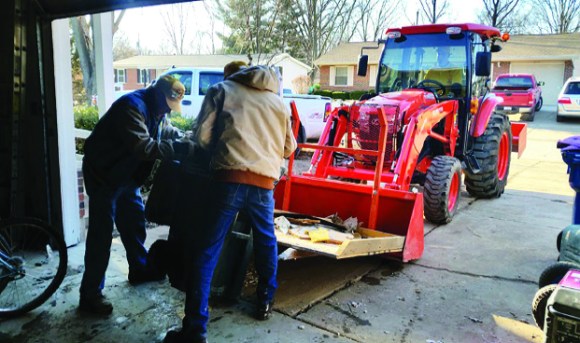
The team spent a week doing “mud-outs,” a process of debris removal, drywall removal, power washing and sanitizing homes. Equipped with a tractor and a homemade platform, Porter said the team was able to pull out even the heaviest and most water-soaked items.

“We went to the home of a retired Baptist minister who has diabetes,” she said. “The guys removed all of his Bibles and his entire ministerial library, as well as six or seven desks and big filing cabinets, all ruined.”

Along with Illinois, DR volunteers from Kansas, Kentucky, Tennessee, Texas, Michigan, New Mexico and Nebraska have joined the cleanup effort. Dwain Carter, director of Disaster Relief for the Missouri Baptist Convention, said though the floodwater has receded, the need is still great.

“Since Jan. 1 we’ve had 362 accepted work orders and we’ve completed 202,” Carter said. “We’ve had teams come from multiple states into two different areas of St. Louis, some doing mud-outs and some cooking for the Red Cross.”

But though the work has been messy and difficult, Porter said the Lord is working through the muck.

“We meet and pray with the homeowners, but we also come across people and we’re able to tell them about what we’re doing,” she said. “We are staying at First Baptist Church, Arnold, so we get to tell how the church is providing for us and how it’s a great church to get plugged into.”

Porter said working with DR is both an honor and a blessing and she prays that other Illinois Baptists would consider going through the training and join this important and powerful ministry.

“When we come back to our home church from a mission like this, we are enthusiastic and recharged and eager to recruit others to join with us the next time,” she said. “I want to encourage people to not let age or health restrictions stop them.

“Get the training and go where there is a need. It may be one of the greatest joys in your life. We work around medical issues, taking breaks when we need breaks and we don’t push beyond what we know we can do. There is power in numbers.”

As the work continues and more DR teams come to Missouri to help, Carter said all Southern Baptists are able join in the cleanup effort through prayer.

“We need prayers for safety,” he said. “People have been working here for weeks and are getting tired and they need energy and strength. Also, one of the greatest things is that we’ve had at least five people that I know of accept Christ during this time. Please pray for more opportunities to share God’s love.”

For more information about IBSA Disaster Relief, visit www.IBSA.org/dr or call Rex Alexander, IBSA Disaster Relief Coordinator, at (217) 391-3134.

Kayla Rinker is a reporter living in Missouri.

The State of the Mission

Lisa Misner —  January 25, 2016

Nate Adams State of the MissionI’m writing this the day after watching President Obama’s final State of the Union Address. After almost an hour of evidence and persuasion, the President neared the end of his address by declaring, “And that’s why I stand here, as confident as I have ever been, that the state of our Union is strong.”

A few minutes later, South Carolina Governor Nikki Haley delivered the Republican response, acknowledging that President Obama “spoke eloquently about grand things,” and that “he is at his best when he does that.” Then she quickly added, “Unfortunately, the President’s record has often fallen short of his soaring words.” She went on to describe what she called a weak economy, a crushing national debt, an ineffective healthcare plan, chaotic unrest in many cities, and “the most dangerous terrorist threat our nation has seen since September 11th.”

And so viewers were left to wonder which facts to believe, which leader to trust, and which picture of America is most accurate.

I understand the dilemma, though. Here at IBSA, we are at the time of year when we cumulate and analyze data from almost a thousand churches’ Annual Church Profiles (ACPs).

Looking at some measurements, the state of our mission here in Illinois appears strong, at least compared to the previous year. The number of new church plants rebounded from 7 in 2014 to 22 in 2015. Cooperative Program missions giving was up 1.5% in 2015, and Mission Illinois Offering giving was up more than 10%. Mission trip participation remained strong at just under 24,000 volunteers.

But other measurements might produce a different picture. Baptisms reported by IBSA churches in 2015 are down from 2013 for the second straight year, and overall worship attendance and Bible study participation were flat to down as well.

My primary concern is that, in total, our churches’ statewide, cumulative impact on lostness in Illinois is not growing, at least not numerically.

President Obama quipped near the beginning of his address that he would try to be brief, because he knew there were several in Congress who were anxious to get back to Iowa (to campaign for the 2016 Presidential election). His joke underscored the reality that, whatever you may think about the current state of things, the more important issue is where we go from here.

To advance our mission here in Illinois, I would challenge us toward two primary imperatives—evangelism and leadership development.

I wrote recently about five actions in churches that, statistically speaking, most often result in people coming to faith in Christ. They are an evangelistic prayer strategy, Vacation Bible School, witness training, outreach events, and starting intentional new groups. If your church could use some help in these areas, our IBSA staff would love to assist.

I would also challenge us all to develop leaders more intentionally in our churches. At this month’s Illinois Leadership Summit, more than 200 church leaders are gathering at the IBSA Building in Springfield to explore what it means to “lead self, lead followers, lead leaders, and lead organizations” more effectively. Even if you miss the Summit, our IBSA staff will welcome the opportunity to help you and your church leaders with an intentional leadership development process.

In many ways, the state of our churches’ mission here in Illinois is still strong. But to keep it that way, and to advance the gospel into the lostness of Illinois, we must recommit to the important work of evangelism and leadership development.

Nate Adams is executive director of the Illinois Baptist State Association. Respond at IllinoisBaptist@IBSA.org.


Praying for revival

Lisa Misner —  January 18, 2016

College students focus of Jan. 22 meeting

A pastor in Southern Illinois is calling Christians across the state to meet together this month to pray and fast for spiritual awakening among the more than 850,000 college students in Illinois.

Phil Nelson, pastor of Lakeland Baptist Church in Carbondale, sent a letter to Illinois Baptist churches late last year, urging churches toward increased prayer for and involvement on college campuses.

“In 1985 when I came as a campus pastor to Southern Illinois University, we had over 1,000 students that claimed to be associated with a Baptist church in Illinois, but just four years ago our list from the university of students who claimed an association with a Baptist church was less than 50,” Nelson wrote.

“In a state where over 850,000 are enrolled in college work we have very few viable ministries to our American students. This cannot be our position any longer for the sake of the Gospel in the lives of our children and young adults.”

Nelson said the idea for the prayer meetings began to take shape at the 2015 IBSA Annual Meeting, where he connected with potential host pastors. Four churches so far have committed to host a prayer meeting on January 22, and there is still time for more to sign on, Nelson said. The four sites currently are:

• Evanston Baptist Church, Evanston

• College Avenue Baptist Church, Normal

• First Baptist Church, Bethalto

• Stonefort Missionary Baptist Church, Stonefort

Each meeting will begin at 9 p.m. and end at 6 the next morning. Each hour of prayer is divided into several segments and will include times of group prayer, worship and fellowship. Pray-ers are invited to come and go, Nelson said.

The format is based on a prayer gathering he attended in 1976, shortly after he became a Christian as a college student at Southern Illinois University. That meeting “changed the campus make-up at Carbondale,” Nelson told the Illinois Baptist. He shared more about the experience in his letter to churches:

“I participated in an all-night prayer meeting where many evangelical campus ministries came together to pray and fast throughout the night and ask God to bring an awakening on our campus,” Nelson wrote.

“That spring we saw many students in every ministry come to trust Christ and many of those who trusted Christ are now still spread across this globe in active evangelical ministries to this day.”

For more information about the January 22 prayer meetings, contact Nelson at pastorphill@lakelandchurch.org or (618) 529-4906.


The weekend weatherman surprised us, not with his forecast but with an off-hand remark. Following a news story about the mounting Powerball jackpot that promised to make someone a billionaire, the anchor cheerleading for Lotto asked him, “What would you do if you won? Where would you be the next day?”

“I’d be right here,” he responded, “because I don’t play the lottery.”

Good for you, weather guy. You’d expect Russell Moore and Al Mohler to sound off on the folly of the lottery. And Baptist pastors were certain to preach and blog on the sinfulness of gambling. But the TV meteorologist? And what about the law professor at a secular university who declared this massive state-run lottery “our national disgrace.”

Ultimately three winners split almost $1.6-Billion in what a radio reporter called “a shot at the American dream.”

Really? The American dream once was owning your own home and being able to send your kids to college. But as that dream moves farther out of reach for many people, a new concept of the “dream” has been blown out of proportion by greed. Perhaps it’s greed that’s our national disgrace.

Many would nominate abortion as chief of our national sins, and it certainly qualifies. Or moral decline or child abuse or drug use or racism or gun violence or failing education or our inability to shut down terrorists. But what prompted Colorado attorney and Salon writer Paul Campos to cite Powerball as such a disgrace is the impact it has on those who can least afford to play the “game.”

Americans spent $70-Billion on state lotteries in 2014. That’s an average of $285 per U.S. adult. But only half of the adult population buys tickets, so the average amount spent by actual players is about $570. And, as Campos points out, 20% of the players buy 70% of the tickets. One in eight U.S. adults spends $1,800 per year on the lottery, including in equal proportions households making less that $15,000 per year.

Campos contends “what drives much of the spending on lottery tickets, and especially the spending by poor people, is not some lighthearted search for a cheap thrill, but genuine despair….The eagerness with which almost every state government exploits the desperation of its most hopeless citizens is a national disgrace.”


Quotable: The lottery’s real losers

“…The reality is that, regardless of who wins the Powerball, it is the poorest in our communities that are guaranteed to lose.

Casinos and lotteries are marketed directly to those people who most feel compelled to get more money quickly, and therefore, have less hesitancy to spending part—or all—of their income trying to do so.

It’s not hard to see that gambling is a form of economic predation. Gambling grinds the faces of the poor into the ground.”

– Russell Moore (from russellmoore.com)

“Many economists have noted… that most lottery sales, and most lottery sales outlets, are actually in the most economically disadvantaged neighborhoods in American cities.

Governments are targeting the most economically disadvantaged, knowing that they are most likely to buy lottery tickets because they feel they have very little to lose and because they are easily persuaded that there is at least a possibility, albeit a very small possibility, that they will all of the sudden strike it rich.

We need to understand that the state is putting itself in the position of economically exploiting its own citizens. As one major economist famously remarked, a lottery is basically a tax on the stupid.”

– Al Mohler  (from The Briefing, 1/11/2016)